

 English
 русский
 Español
 عربى

Content
- 1 What Is a Standard Free-Type Gas Spring?
- 2 Operating Principle and Internal Structure
- 3 Main Advantages of the Standard Free-Type Design
- 4 Available Specification Range
- 5 How the Product Compares with Alternative Support Solutions
- 6 Materials and Cylinder Options
- 7 Manufacturing Strengths and Quality-Oriented Production
- 8 Design and Selection Guidance
- 9 Installation Best Practices
- 10 Application Examples
- 11 Safety, Service Life, and Maintenance
- 12 Why Manufacturing Integration Matters to Buyers
- 13 Ordering and Customization Considerations
- 14 Frequently Asked Questions
- 14.1 What does “free-type” mean?
- 14.2 Can a standard free-type gas spring hold a lid open?
- 14.3 How is the correct force determined?
- 14.4 What is the difference between stroke and center distance?
- 14.5 Are these gas springs maintenance-free?
- 14.6 Can the gas spring be used outdoors?
- 14.7 Can one gas spring replace two gas springs?
- 14.8 Can a gas spring be installed upside down?
- 14.9 Why does a gas spring feel different in hot and cold weather?
- 14.10 Can a standard gas spring be used with an electric linear actuator?
- 14.11 What information should be sent for technical selection?
- 15 Conclusion
- 16 References
- 17 Product: Standard free-type gas spring
Standard Free-Type Gas Springs: Reliable Lift Assistance for Doors, Lids, and Equipment Enclosures
2026-09-03
Standard free-type gas springs are compact pneumatic support components designed to make lifting, opening, holding, and closing operations easier and safer. Also called free gas springs, standard support struts, or simple gas struts, they use pressurized nitrogen inside a sealed cylinder to generate controlled extension force. When correctly selected and installed, a gas spring can offset part of the weight of a lid, door, panel, hatch, or cover, allowing users to operate it with much less effort.
Although the construction of a free-type gas spring is straightforward, the engineering behind dependable performance is highly important. The cylinder diameter, rod diameter, stroke length, extended length, gas pressure, end fittings, mounting position, and operating environment all influence the final result. A suitable product should provide consistent support throughout its working range, smooth movement, reliable sealing, and sufficient durability for repeated cycles.
The standard free-type gas spring described in this article is designed for applications that require assisted movement without locking at intermediate positions. It provides end positions at full extension and full compression, while integrated hydraulic damping helps control the final portion of travel. This makes it a practical and economical solution for upward-opening doors, flip-top lids, furniture compartments, vehicle hoods, tailgates, machinery covers, and advertising kiosks.
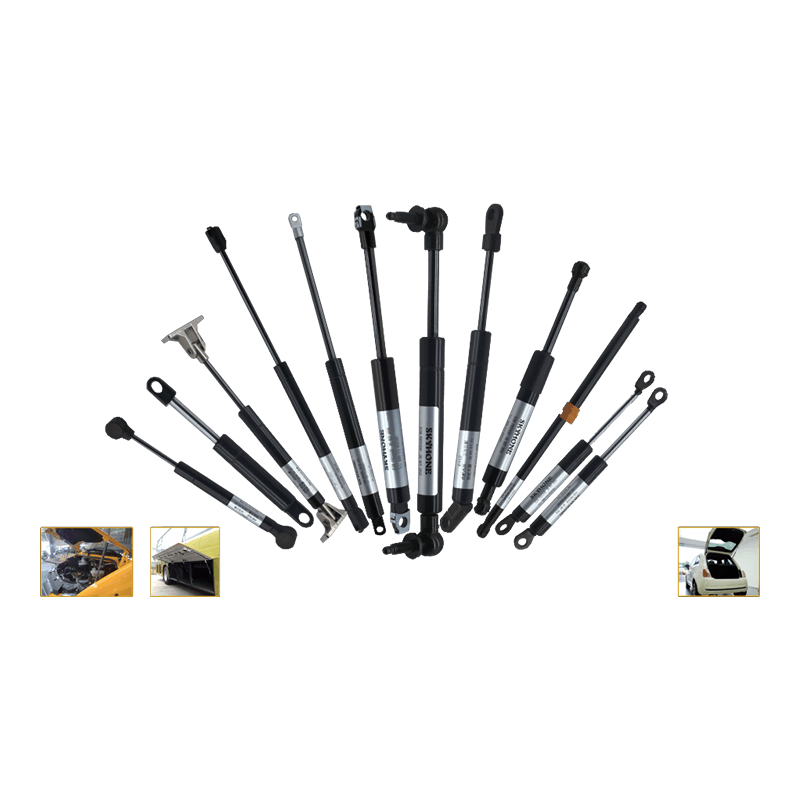
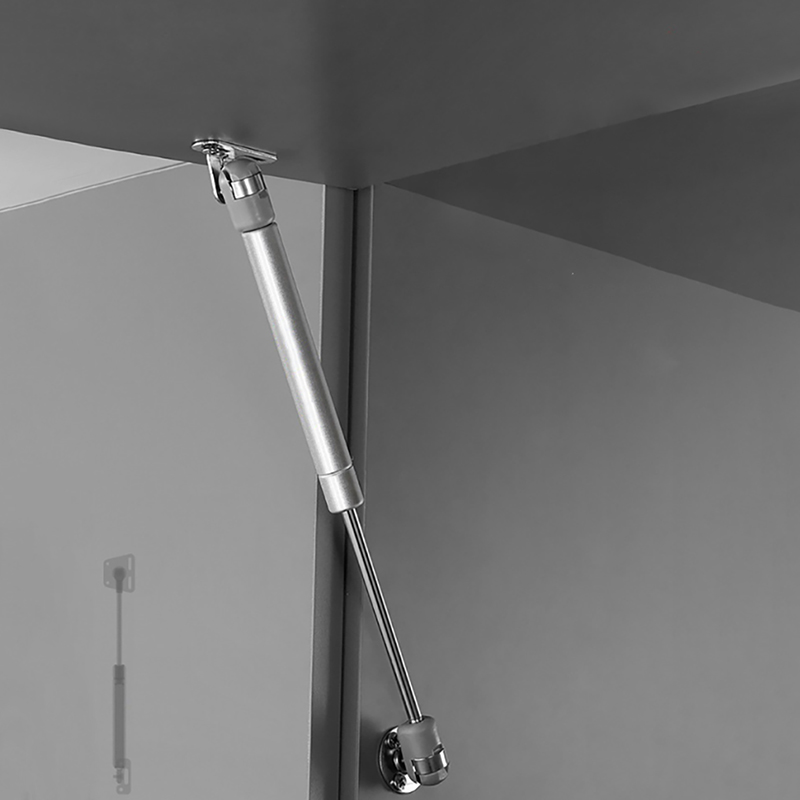
Standard free-type gas spring
What Is a Standard Free-Type Gas Spring?
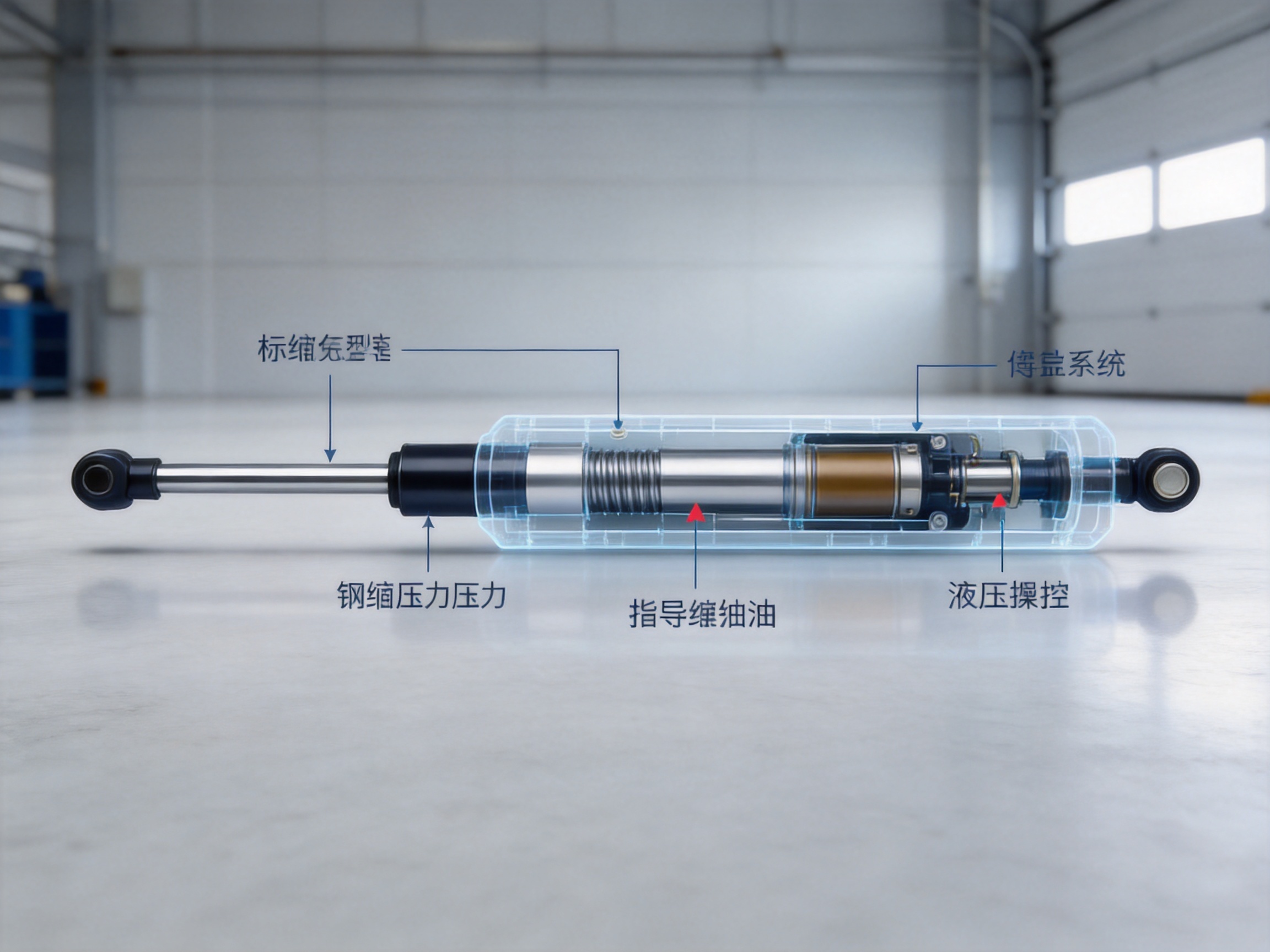
A standard free-type gas spring is a sealed mechanical support device consisting primarily of a pressure cylinder, piston, piston rod, sealing system, guide assembly, and connection fittings. The cylinder is filled with high-pressure nitrogen and a controlled quantity of hydraulic oil. Nitrogen produces the supporting force, while the oil contributes to damping and smoother movement.
Unlike a mechanical coil spring, which stores energy through elastic deformation, a gas spring produces force through compressed gas acting on the piston. The pressure inside the cylinder pushes against the piston area and causes the rod to extend. When an external load pushes the rod inward, the gas is compressed further and resists the movement. This opposing force creates the assisted opening and closing action required in many products.
The term “free-type” indicates that the gas spring is not equipped with a locking mechanism for intermediate positions. It is intended to move freely between its compressed and extended positions under the influence of the applied load and gas force. Depending on the application, the component may help lift a cover, hold a hatch open, reduce the closing speed, or prevent a panel from dropping suddenly.
It is important to distinguish a free-type gas spring from a lockable gas spring. A lockable model may hold a load at a selected position along the stroke, while a standard free-type model generally provides support only and does not maintain a user-selected intermediate position. This simpler construction can provide advantages in cost, installation, reliability, and maintenance requirements when intermediate locking is not necessary.
Operating Principle and Internal Structure
Pressurized Nitrogen for Lifting Assistance
The primary energy source of the gas spring is high-pressure nitrogen. Nitrogen is widely used because it is stable, nonflammable under normal operating conditions, and suitable for a sealed pneumatic system. As the piston rod moves into the cylinder, the available gas volume changes and the internal pressure rises. The resulting force resists compression and assists extension.
The gas force is not exactly identical at every point of the stroke. Pressure changes as the rod moves, and the effective force is influenced by the rod area, temperature, friction, and the geometry of the mounting arrangement. For this reason, selection should be based on the actual application rather than on the weight of the supported component alone.
Hydraulic Oil for Controlled Movement
A measured quantity of hydraulic oil inside the cylinder helps create damping as the piston moves. This damping is particularly useful near the end of travel, where an unsupported lid or door could otherwise accelerate or strike its stop with excessive force. The oil helps transform abrupt movement into a softer, more controlled action.
The damping effect improves user comfort and helps protect both the gas spring and the surrounding product. It can reduce noise, vibration, impact loading, and wear on hinges or mounting brackets. In an enclosure, cabinet, furniture panel, or vehicle hatch, this controlled movement also improves the perceived quality of the finished product.
Sealed Cylinder and Rod Guidance
The cylinder is sealed to retain the nitrogen and hydraulic oil while limiting the entry of dust, moisture, and other contaminants. A guide assembly supports the piston rod as it moves in and out of the cylinder. The sealing and guiding components must work together to maintain low friction, prevent leakage, and keep the rod aligned during repeated operation.
A well-designed sealing system is one of the most important differences between a dependable gas spring and a short-lived alternative. Poor sealing can cause pressure loss, oil leakage, inconsistent force, or premature failure. Precision manufacturing of the cylinder, rod, guide, and sealing interfaces is therefore essential to stable long-term performance.
Main Advantages of the Standard Free-Type Design
Simple and Cost-Effective Construction
The free-type configuration contains fewer functional elements than lockable, multi-position, or electronically controlled support systems. It does not require a manual release lever, locking valve, control cable, or additional position-control mechanism. This simplified construction helps reduce product cost and makes the gas spring an attractive option for high-volume applications.
For a cover that only needs to open and close, intermediate locking may provide no practical benefit. In such cases, paying for a more complicated mechanism can add unnecessary cost and increase the number of possible wear points. A standard free-type gas spring supplies the core function—assisted movement—without adding features that the application does not require.
Effortless Opening and Lifting
When the gas force is matched to the load and installation geometry, the user can open a panel or lift a lid with significantly less manual effort. This is especially valuable for large covers, deep storage compartments, upward-opening doors, and equipment housings positioned above the user’s normal working height.
Gas assistance can also improve accessibility for users with different strength levels. In office furniture, industrial equipment, transport products, and public facilities, a well-balanced cover is easier to operate and less likely to be mishandled. The support strut can reduce the risk of a heavy panel dropping unexpectedly during opening.
Soft and Quiet Closing
Built-in hydraulic damping helps slow the movement near the end of the stroke. Instead of allowing a cover to slam into its closed position, the gas spring provides a more gradual finish. This reduces impact noise and can help protect hinges, latches, panels, and the internal contents of the enclosure.
Quiet operation is particularly valuable in offices, homes, hotels, public transportation facilities, medical environments, and retail installations. A product that opens easily and closes smoothly generally feels more refined and is more pleasant to use over its service life.
Maintenance-Free Sealed Operation
The sealed design does not require regular refilling, lubrication, or adjustment during normal use. Once correctly specified and installed, the gas spring is intended to operate as a self-contained support component. This reduces routine maintenance labor and helps simplify product ownership.
Maintenance-free operation is valuable when gas springs are installed in locations that are difficult to access, such as vehicle tailgates, elevated equipment panels, advertising kiosks, or built-in furniture compartments. Reducing service access requirements can lower the total cost of ownership for both manufacturers and end users.
Broad Application Compatibility
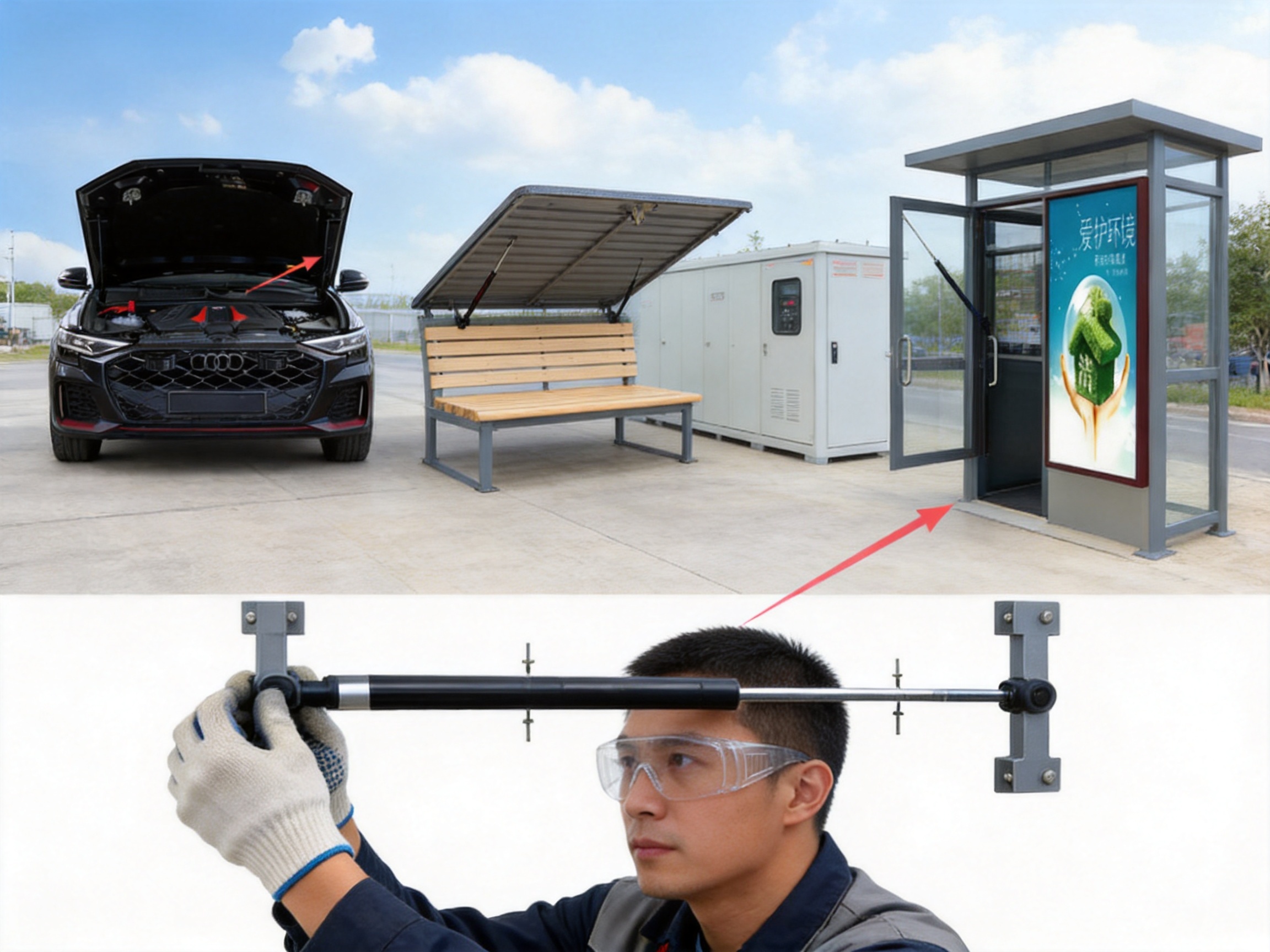
The standard free-type design can be used in a wide range of products. Typical applications include automotive hoods and tailgates, bus shelter advertising kiosks, machine guards, electrical cabinets, toolboxes, storage benches, furniture lids, display cases, access panels, and upward-opening doors.
The same basic operating principle can be adapted to different dimensions, force levels, and installation conditions. Available configurations include multiple cylinder and rod diameter combinations, a broad range of center distances, several stroke ranges, and gas pressures suitable for light to heavy support requirements.
Available Specification Range
The supplied product range includes several standard diameter combinations. The pipe diameter and rod diameter are expressed in millimeters, while center distance, stroke, and pressure define the principal selection parameters. The ranges below provide a starting point for design and quotation. Exact performance depends on the complete configuration and application conditions.
| Pipe Diameter–Rod Diameter (mm) | Center Distance (mm) | Stroke (mm) | Pressure (N) |
|---|---|---|---|
| 15–6 | 150–300 | 40–110 | 20–300 |
| 18–8 | 150–600 | 40–250 | 30–500 |
| 22–10 | 200–400 | 60–160 | 50–1000 |
| 22–10 | 400–500 | 160–200 | 50–1000 |
| 22–10 | 500–600 | 200–250 | 50–1000 |
| 22–10 | 600–700 | 250–300 | 50–1000 |
| 22–10 | 700–800 | 300–340 | 50–1000 |
| 22–10 | 900 | 400 | 50–1000 |
| 22–12 | 500–1000 | 200–450 | 500–1500 |
| 28–14 | 500–1000 | 200–450 | 500–2000 |
The 15–6 and 18–8 configurations are suitable starting points for compact covers, furniture panels, smaller access doors, and light-duty enclosures. The 22–10, 22–12, and 28–14 combinations provide larger options for longer strokes and higher support forces. The correct size should be determined using the cover mass, center of gravity, hinge position, desired opening angle, mounting points, and number of gas springs.
Center distance refers to the distance between the connection points when the gas spring is in its extended condition or according to the supplier’s specified measurement method. Because different manufacturers may define dimensions differently, buyers should confirm the measurement reference before finalizing a drawing or purchase order.
Stroke is the distance through which the piston rod travels. A longer stroke can support a larger opening movement, but it also affects the required installation space and mounting angle. The compressed length must be checked carefully to ensure that the gas spring does not bottom out before the cover reaches its intended closed position.
Pressure or force rating is normally expressed in newtons. It should not be selected solely by dividing the cover weight by the number of gas springs. The lever effect of the cover and the distance from the hinge have a major influence on the actual force required. A design with two gas springs may need a different nominal force from a design with one spring, even when the cover weight is identical.
How the Product Compares with Alternative Support Solutions
Compared with Mechanical Hinges Alone
A standard hinge allows rotation but does not normally compensate for the weight of the attached panel. Without assistance, the user must carry the full load during opening and closing, and the panel may fall if released. A free-type gas spring adds controlled lifting and resistance while retaining a relatively simple installation.
Gas springs also help maintain a more stable open position when the extension force and geometry are correctly matched. They can reduce the load on the user and lower the impact transmitted to the hinge system. For many covers, this provides a better operating experience than a hinge-only design.
Compared with Coil Springs
Coil springs can provide stored energy, but they often require additional brackets, guides, or protective covers. Their force characteristics may be less convenient for certain lifting applications, and exposed coils can present pinch points or collect debris. A sealed gas spring integrates the energy source, guidance, and damping functions into a compact cylinder assembly.
The gas spring’s damping behavior is another practical advantage. A coil spring alone may assist opening but does not automatically provide the same controlled hydraulic closing action. Additional dampers or friction devices may be required, increasing component count and installation complexity.
Compared with Friction Hinges
Friction hinges rely on resistance at the hinge joint to hold or slow a panel. They can be useful for small components, but the friction force may change with wear, temperature, contamination, or adjustment. A friction hinge may also create a higher operating effort throughout the entire movement.
A free-type gas spring separates the lifting function from the hinge and can be selected for a defined force range. This allows the hinge to focus on rotation while the gas spring supports the load and provides damping. For larger panels and covers, this arrangement can produce a more balanced user experience.
Compared with Lockable Gas Springs
A lockable gas spring is appropriate when a cover must remain at an adjustable intermediate position. However, the locking mechanism adds cost and may require a release control. If the application only needs fully open and fully closed operation, the standard free-type version is often more economical and easier to integrate.
The free-type model also offers a straightforward operating experience. Users do not need to locate or activate a release button before moving the panel. The product can therefore be especially suitable for simple furniture, equipment covers, storage lids, and access doors where the open position is predetermined.
Compared with Electric Actuators
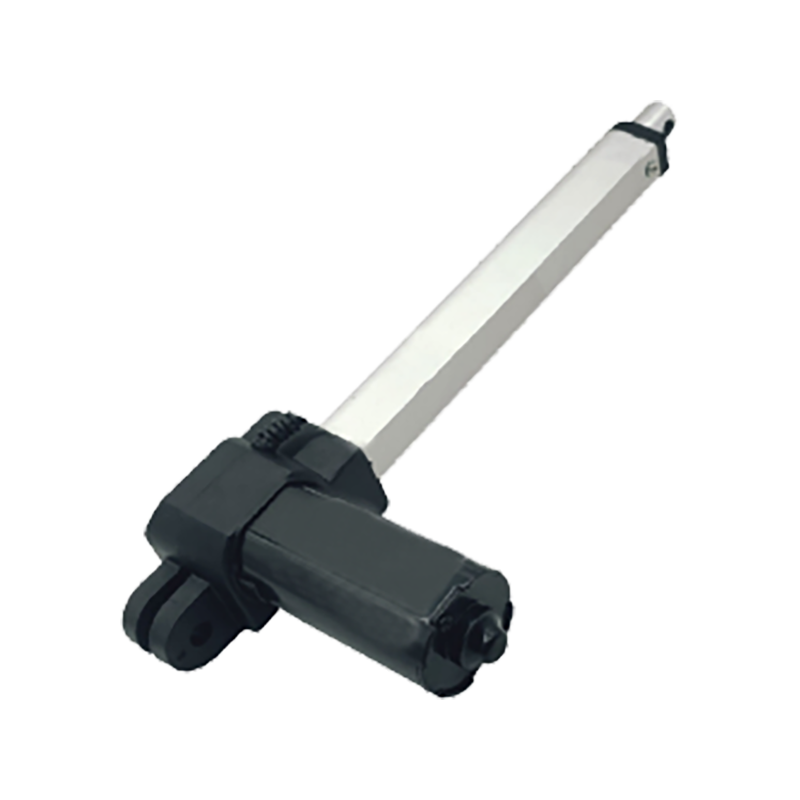
Electric linear actuators can provide powered movement, position control, sensors, and remote operation. They are appropriate for automated height adjustment systems, medical equipment, industrial machinery, and other applications requiring active control. However, an electric actuator needs a motor, power supply, control system, and appropriate protection.
A gas spring is not intended to replace an electrically controlled actuator when automation is required. Its advantage is different: it offers passive, self-contained assistance at a much lower level of system complexity. For manually operated panels and lids, a gas spring can deliver the necessary support without electrical wiring, programming, or standby power.
Materials and Cylinder Options
The product information identifies seamless precision steel tubing and stainless steel as available cylinder material options. Seamless precision steel tubing provides a strong and dimensionally consistent foundation for many general-purpose applications. It can be suitable for furniture, industrial enclosures, equipment covers, and other indoor or protected environments.
Stainless steel is an important option when corrosion resistance and appearance are priorities. It may be considered for vehicle applications, outdoor equipment, public facilities, humid environments, and products exposed to cleaning agents or changing weather conditions. Material selection should be based on the actual environment, including humidity, salt exposure, chemical contact, temperature, and expected service life.
The piston rod surface is also important. The rod repeatedly passes through the seal and is exposed to the surrounding environment. A smooth, durable surface helps reduce seal wear and supports stable movement. The rod should be protected from scratches, bending loads, welding spatter, abrasive dust, and improper handling during assembly.
When a gas spring is used in a corrosive environment, the cylinder material alone may not determine the complete resistance of the assembly. End fittings, brackets, rod surfaces, fasteners, and installation hardware should also be reviewed. A complete corrosion-resistance strategy is more effective than selecting one corrosion-resistant component while leaving other exposed parts unprotected.

Manufacturing Strengths and Quality-Oriented Production
SuZhou Skyhone Intelligent Technology Co., Ltd. is a professional manufacturing enterprise engaged in the research and development, production, sales, and service of standing desks and related intelligent office solutions. Its location in Suzhou places the company within the Yangtze River Delta furniture manufacturing region, where established supply chains, engineering resources, and industrial support provide a strong foundation for product development.
Although the standard free-type gas spring is a relatively compact component, reliable production requires more than simply filling a tube with gas. The manufacturing process should coordinate material selection, tube preparation, rod processing, piston assembly, sealing, gas filling, oil dosing, end fitting installation, inspection, and packaging. Intelligent manufacturing resources can help organize these steps with improved process consistency and traceability.
Engineering and Application Support
A major manufacturing strength is the ability to connect product development with real application requirements. Gas spring performance depends heavily on the design in which it is installed. An experienced supplier should therefore review more than the requested force value. Important design information includes the lid or door mass, dimensions, hinge location, opening angle, mounting points, installation orientation, cycle frequency, ambient temperature, and required closing behavior.
Application-oriented engineering helps prevent common selection errors. For example, a gas spring that appears strong enough based on static weight may be insufficient if mounted close to the hinge. Conversely, excessive force can make closing difficult, overload the hinge, or create unsafe opening behavior. Reviewing the complete mechanism allows the supplier to recommend a more practical combination of stroke, length, force, and quantity.
Precision Tube and Rod Processing
Dimensional consistency is essential for a sealed pneumatic product. The cylinder must provide a suitable internal surface for piston movement, while the rod must maintain accurate alignment through the guide and seal. Precision processing helps reduce friction variation and supports consistent movement across production batches.
Manufacturing controls may include inspection of tube dimensions, rod straightness, surface condition, thread accuracy, and end-fitting geometry. These checks are particularly important when gas springs are installed in paired configurations. Two springs used on the same cover should have sufficiently consistent force and dimensions to avoid twisting, uneven loading, or asymmetric movement.
Controlled Assembly and Filling
The internal assembly process must protect the cylinder, piston, seals, and rod from contamination. Small particles can damage sealing surfaces or increase friction. Controlled work procedures, suitable assembly tools, and clean handling practices help maintain the integrity of the finished component.
Nitrogen filling and hydraulic oil dosing must also be managed carefully. The final force depends on the gas pressure, effective piston area, temperature, and internal volume. Consistent filling procedures support repeatable force performance. The sealing operation must retain both gas and oil throughout the expected service life.
Inspection and Functional Verification
Quality-oriented production should include dimensional inspection, visual inspection, leak evaluation, movement checks, and force verification appropriate to the product specification. The exact inspection plan may vary according to the application and customer requirements, but the objective is consistent: confirm that every finished gas spring conforms to the agreed design.
Functional verification is especially important because a gas spring can appear visually correct while still having unsuitable force, friction, damping, or leakage performance. Testing the actual movement and force characteristics helps identify problems that cannot be found through appearance inspection alone.
Intelligent Manufacturing and Supply Capability
The company’s position within an intelligent manufacturing environment supports the development of coordinated production processes. Digital production records, organized process control, standardized work instructions, and systematic quality feedback can help improve repeatability as order volume increases.
For customers purchasing components for adjustable office tables, furniture systems, equipment covers, or other products, manufacturing capability affects more than the individual sample. Stable production supports repeat orders, consistent replacement parts, predictable assembly, and reduced disruption to downstream manufacturing schedules.
A supplier that combines research and development, manufacturing, sales, and service can also respond more efficiently when application requirements change. Customers may need a different force, length, material, end fitting, or installation orientation during product development. Direct communication between technical and production teams can shorten the path from initial design review to validated production.
Design and Selection Guidance
Define the Application First
Before selecting a gas spring, identify what the component must do. The application may require lifting assistance, open-position support, controlled closing, reduced manual effort, or protection against sudden dropping. These objectives should be translated into measurable requirements such as opening force, closing effort, opening angle, travel speed, cycle life, and available installation space.
Also identify whether the product will operate indoors or outdoors, whether it will encounter water or salt spray, and whether it will be exposed to dust, oil, cleaning chemicals, or extreme temperatures. Environmental factors can affect material selection, sealing, damping, and expected life.
Calculate the Required Force
Gas spring force should be estimated from the torque created by the supported panel. The panel weight acts through its center of gravity, while the gas spring creates an opposing or assisting torque based on its mounting points and angle. A simplified conceptual relationship is:
Required gas spring force depends on panel weight, gravitational acceleration, distance from the hinge to the center of gravity, distance from the hinge to the gas spring connection, the gas spring angle, and the number of gas springs.
Because the geometry changes as the panel opens, the required force is not constant throughout the movement. A design that feels balanced at one angle may feel too heavy or too forceful at another. For this reason, application drawings or dimensional sketches are valuable during selection.
Select the Stroke and Extended Length
The stroke must be long enough to allow the required movement without reaching the mechanical limit too early. At the same time, the extended length must fit between the mounting points when the panel is open. The compressed length must fit when the panel is closed.
Clearance should be checked throughout the complete movement. The gas spring should not collide with the panel, frame, hinge, wiring, or other components. The rod should not be forced sideways or used as a structural guide for loads outside its intended axial direction.
Choose the Number of Gas Springs
One gas spring may be adequate for a narrow or lightweight cover, while two gas springs are often preferred for wider panels or heavier assemblies. Two units can distribute the support force and reduce twisting, but they should be installed symmetrically whenever possible.
When two gas springs are used, the mounting structure must be sufficiently rigid. If the panel or brackets flex, the springs may not share the load evenly. Unequal loading can increase friction and cause one side to move before the other.
Consider Temperature Effects
Gas spring force varies with temperature because gas pressure changes as temperature changes. Applications exposed to outdoor weather, vehicle heat, cold storage, or industrial temperature cycles should account for this behavior. A force that is appropriate at room temperature may feel stronger in a hot environment and weaker in a cold environment.
Temperature also affects hydraulic damping and seal behavior. Customers should provide expected operating temperatures during the design stage so that the supplier can assess the most appropriate configuration and materials.
Installation Best Practices
Gas springs should normally be installed so that the rod orientation and damping behavior match the supplier’s recommendations. In many common arrangements, the rod is positioned downward when the product is closed so that the internal oil can support the desired damping function. The exact orientation should be confirmed for the selected model and application.
Mounting brackets must be aligned with the direction of gas spring movement. Side loads, bending forces, or misaligned connection points can increase friction and damage the rod, guide, or seal. The gas spring should be allowed to pivot at its end fittings if the design requires angular movement.
Do not use the gas spring as a hinge, structural brace, or lateral stabilizer unless the product has been specifically designed for that purpose. The surrounding brackets and panels must carry the main structural loads. The gas spring should provide axial support and controlled movement within its rated conditions.
During installation, avoid scratching or bending the piston rod. Do not clamp the polished rod in a vise or strike the cylinder with tools. Damaging the rod surface can compromise the seal and lead to premature leakage. Fasteners should be tightened according to the assembly design without restricting the intended pivoting motion.
Mechanical stops should be considered where appropriate. Although the gas spring reaches compressed and extended positions, the surrounding product should not rely on the gas spring alone to absorb severe impact loads. Separate stops can protect the gas spring and provide more predictable control of the panel’s final position.
After installation, operate the cover slowly through its complete range. Check for interference, abnormal noise, excessive force, uneven movement, and secure attachment. If the cover falls, rises too quickly, cannot close, or places excessive force on the hinges, the configuration should be reviewed before normal use.
Application Examples
Automotive Hoods and Tailgates
Gas springs are widely used to assist vehicle hoods and rear tailgates. They help raise the panel, reduce the effort required by the user, and support the open position. The automotive environment may involve vibration, temperature variation, moisture, road contaminants, and frequent operation, so material and sealing performance are important considerations.
For vehicle applications, the gas spring must be selected with careful attention to available space, opening angle, hinge geometry, and the weight distribution of the panel. The use of stainless steel or other corrosion-resistant options may be considered where environmental exposure requires additional protection.
Furniture and Storage Lids
Furniture lids, storage benches, cabinets, and upward-opening compartments can benefit from compact gas spring assistance. A gas spring reduces the effort needed to open the lid and helps prevent sudden closure. Its quiet damping is especially useful in homes, offices, hotels, and shared environments.
The free-type configuration is often sufficient for furniture that has a defined open position. If the lid needs to remain at any user-selected angle, a lockable or friction-based solution may be more appropriate. The selection should reflect the intended user experience rather than adding unnecessary functionality.
Equipment Enclosures and Machine Covers
Industrial equipment covers can be heavy and difficult to handle without assistance. A gas spring makes routine inspection and service access easier while helping control the descent of the cover. This can reduce the likelihood of accidental dropping and improve the ergonomics of maintenance work.
Equipment designers should review the operating environment carefully. Dust, oil mist, vibration, heat, and cleaning chemicals may influence the choice of cylinder material, rod protection, seals, and mounting hardware. The gas spring should be protected from direct impact and excessive side loading.
Bus Shelter Advertising Kiosks
Advertising kiosks and public display cabinets often use upward-opening or hinged access panels. A support strut can make service access easier for maintenance personnel and help keep the panel controlled during opening and closing. In outdoor installations, corrosion resistance, temperature variation, water exposure, and vandal-resistance of the complete assembly should be considered.
Because these kiosks may be installed in public areas, the closing behavior should be predictable and smooth. A correctly selected gas spring can contribute to safer handling and reduce the noise associated with repeated panel operation.
Safety, Service Life, and Maintenance
Standard free-type gas springs are sealed components and should not be opened, drilled, heated, or modified. The cylinder contains pressurized gas, and unauthorized disassembly can create a serious safety hazard. Repairs, refilling, or changes to the internal pressure should only be performed by qualified professionals using suitable equipment and procedures.
Routine maintenance generally consists of visual inspection and checking the mounting hardware. Users should look for oil leakage, corrosion, damaged end fittings, bent rods, loose brackets, unusual friction, or a noticeable reduction in lifting assistance. A damaged gas spring should be replaced rather than forced back into service.
The expected service life depends on cycle frequency, load, temperature, installation alignment, contamination, and material selection. A gas spring used occasionally in a clean indoor cabinet may experience very different conditions from one used many times per day on an outdoor vehicle or industrial enclosure.
Cleaning should be performed without damaging the rod surface or seal area. Abrasive tools and aggressive chemicals should be avoided unless their compatibility with the material and finish has been confirmed. The piston rod should remain free of dirt and impact damage because contamination can be drawn toward the seal during operation.
When replacing a gas spring, the replacement should match the original extended length, stroke, force, diameter, end fittings, and installation orientation. Installing a component with a higher force rating is not automatically an improvement. Excessive force may cause difficult closing, abrupt opening, hinge damage, or unsafe panel behavior.
Why Manufacturing Integration Matters to Buyers
For component buyers, the value of a gas spring is determined not only by its purchase price but also by its consistency in production and service. A small dimensional variation can cause installation difficulty when the part is used in a tight assembly. A force variation can lead to uneven opening between units. A sealing problem can result in field returns and customer complaints.
Manufacturing integration helps address these risks. A supplier involved in research and development, production, sales, and service can gather application feedback and use it to refine product specifications. This integrated approach is valuable when customers need customized center distances, stroke lengths, forces, materials, or connection arrangements.
Located in Suzhou, the company benefits from access to the region’s furniture industry and manufacturing ecosystem. This is relevant to customers developing standing desks, ergonomic office tables, storage furniture, and intelligent office products because gas springs may be used alongside electric linear actuators and other adjustment components in complete workspace solutions.
The combination of product development and intelligent manufacturing supports a practical supply relationship. Customers can discuss the technical requirement, confirm the appropriate configuration, evaluate samples, and move toward repeat production with a single professional source. This can simplify communication compared with coordinating separate design, component, and service suppliers.
Ordering and Customization Considerations
When requesting a quotation, buyers should provide the required quantity, application description, preferred material, pipe and rod diameter, extended length, stroke, estimated force, connection type, and operating environment. A drawing or photograph of the installation can help the engineering team understand the available space and movement path.
It is also useful to specify whether the gas spring will be used singly or in pairs, the required opening angle, and the desired opening and closing feel. If the component will be installed on a vehicle, outdoor cabinet, or frequently operated machine cover, the expected temperature range and cycle frequency should be included.
Customization may involve more than changing the gas pressure. Center distance, stroke, end fittings, cylinder material, rod finish, brackets, and packaging can all influence the suitability of the finished product. A technically coordinated specification reduces the risk of receiving a component that fits dimensionally but does not perform correctly in the application.
For international purchasing, customers should also confirm packaging requirements, labeling, inspection documentation, delivery schedule, and replacement-part expectations. Consistent packaging can help prevent rod or fitting damage during transportation. Clear product identification supports efficient assembly and future service.
Frequently Asked Questions
What does “free-type” mean?
“Free-type” means that the gas spring supports movement but does not lock at selected intermediate positions. It normally operates between its fully extended and fully compressed positions. If an application needs adjustable locking at any point in the stroke, a lockable gas spring should be considered instead.
Can a standard free-type gas spring hold a lid open?
Yes, it can help support a lid in the open position when the force, mounting geometry, and opening angle are properly designed. The final open position should be controlled by the product geometry or a suitable mechanical stop rather than by relying on the gas spring to absorb repeated impact.
How is the correct force determined?
The correct force depends on the cover weight, center of gravity, hinge position, gas spring mounting points, opening angle, and number of gas springs. It should be calculated from the complete mechanism and then verified through testing. Weight alone is not sufficient for accurate selection.
What is the difference between stroke and center distance?
Stroke is the travel distance of the piston rod between the compressed and extended conditions. Center distance is the length measured between the connection centers according to the supplier’s dimensional definition. Both values are necessary to confirm that the gas spring will fit and provide the required movement.
Are these gas springs maintenance-free?
The sealed design is intended for maintenance-free operation under normal conditions. Users should still perform occasional visual checks for leakage, corrosion, loose fittings, damaged rods, and abnormal movement. A gas spring that shows damage or reduced performance should be replaced.
Can the gas spring be used outdoors?
Outdoor use is possible when the complete specification is suitable for the environment. Material, rod finish, sealing, end fittings, mounting hardware, temperature range, and exposure to rain or salt should be considered. Stainless steel may be appropriate for applications requiring enhanced corrosion resistance.
Can one gas spring replace two gas springs?
Not automatically. The answer depends on the panel weight, width, stiffness, hinge arrangement, and required force. Two gas springs can distribute the load and reduce twisting, while one may be adequate for a compact cover. The design should be evaluated before changing the quantity.
Can a gas spring be installed upside down?
Installation orientation affects damping and should follow the supplier’s recommendation for the selected model. In many applications, positioning the rod downward when the product is closed helps achieve the intended damping behavior. The correct orientation should be confirmed during design review.
Why does a gas spring feel different in hot and cold weather?
Gas pressure changes with temperature. As a result, the extension force may feel higher in warm conditions and lower in cold conditions. Hydraulic damping and seal characteristics can also vary with temperature. Applications with substantial temperature changes should be evaluated using the expected operating range.
Can a standard gas spring be used with an electric linear actuator?
Yes, a gas spring and an electric linear actuator can be used in the same system when their functions are coordinated. The gas spring may counterbalance part of the load while the actuator supplies powered movement. The combined forces must be reviewed to prevent overloading, uncontrolled motion, or interference.
What information should be sent for technical selection?
Useful information includes the panel weight and dimensions, center of gravity, hinge position, desired opening angle, mounting-point locations, number of gas springs, available space, operating temperature, expected cycle frequency, material preference, and end-fitting requirements. A sketch or three-dimensional model can improve selection accuracy.
Conclusion
The standard free-type gas spring is a practical solution for applications requiring reliable lifting assistance, smoother closing, and reduced manual effort without intermediate locking. Its sealed nitrogen-and-oil construction combines pneumatic support with hydraulic damping in a compact, maintenance-free assembly.
Compared with hinges alone, coil springs, friction hinges, lockable gas springs, and powered actuators, the free-type design offers a useful balance of simplicity, cost, compactness, and dependable operation. It is especially effective for covers and panels that move between defined closed and open positions.
The available range of pipe and rod diameters, center distances, strokes, and force levels supports applications from light furniture panels to heavier equipment covers and vehicle components. Seamless precision steel tubing and stainless steel options provide flexibility for different performance and environmental requirements.
Reliable results depend on correct engineering rather than force selection alone. Mounting geometry, center of gravity, opening angle, temperature, cycle frequency, alignment, and end fittings should all be considered. With appropriate application support and controlled production, the gas spring can contribute to better ergonomics, quieter operation, improved safety, and longer service life.
SuZhou Skyhone Intelligent Technology Co., Ltd. combines research and development, production, sales, and service capabilities within Suzhou’s strong furniture and intelligent manufacturing environment. This integrated foundation supports customers seeking dependable gas springs for ergonomic office furniture, equipment enclosures, vehicle components, public kiosks, and other lifting-assistance applications.
References
1. ISO 10100, Hydraulic Fluid Power—Cylinders—Acceptance Tests.
2. ISO 9001, Quality Management Systems—Requirements.
3. Parker Hannifin, Industrial Gas Spring and Motion Control Engineering Principles.
4. Bosch Rexroth, Fluid Power Fundamentals and Pneumatic Support Applications.
5. Engineering mechanics references covering torque, center of gravity, hinge geometry, and counterbalance force calculations.
6. General design guidance for pneumatic springs, sealed cylinders, hydraulic damping, corrosion-resistant materials, and mechanical safety stops.
Product: Standard free-type gas spring


- Contact Info
-
-
 Phone+86-15950656125
-
 Email
-
 AddressRoom 1007-1, South Building, Suyue Plaza, Suzhou Industrial Park, Suzhou City, Jiangsu Province, China
-
- Products
- Follow Us
- Need help? Please contact us
Copyright ©
SuZhou Skyhone Intelligent Technology Co., Ltd.
All Rights Reserved.
Privacy
Custom Ergonomic Adjustable Office Tables Manufacturers

