

 English
 русский
 Español
 عربى

Content
- 1 Why Adjustable Tablet Workstations Matter
- 2 Core Product Specifications
- 3 Gas Spring Height Adjustment
- 4 Ergonomic Benefits for Seated and Standing Work
- 5 Purpose-Built Tabletop for iPad and Mobile Devices
- 6 Mobile Base and Stability
- 7 Material Selection and Surface Protection
- 8 Advantages Compared with Typical Alternatives
- 9 Applications in Retail and Customer Service
- 10 Applications in Education and Libraries
- 11 Applications in Creative Studios
- 12 Applications in Homes and Flexible Workspaces
- 13 Manufacturing Strengths of SuZhou Skyhone Intelligent Technology Co., Ltd.
- 14 Product Development and Engineering Approach
- 15 Quality Control Considerations
- 16 Customization and Project Flexibility
- 17 Efficient Manufacturing and Supply Support
- 18 Installation, Operation, and Care
- 19 How to Select the Right Configuration
- 20 Environmental and Operational Efficiency
- 21 Frequently Asked Questions
- 21.1 What is the main purpose of the SK01-1 desk?
- 21.2 How high and low can the tabletop be adjusted?
- 21.3 Does the desk require electricity?
- 21.4 Is the desk easy to move?
- 21.5 What are the tabletop dimensions?
- 21.6 What is the tabletop made from?
- 21.7 Which frame colors are available?
- 21.8 Which tabletop colors are available?
- 21.9 What makes the base different from a basic mobile cart?
- 21.10 Can the desk be used in a retail store?
- 21.11 Can it be used in a classroom or library?
- 21.12 Is the desk suitable for a home office?
- 21.13 How should the desk be kept stable?
- 21.14 How does the desk compare with an electric standing desk?
- 21.15 What should buyers discuss with the manufacturer?
- 22 Conclusion
- 23 References
- 24 Product: SK01-1 iPad High-Legged Pneumatic Height-Adjustable Desk
A Practical Guide to the SK01-1 iPad High-Legged Pneumatic Height-Adjustable Desk
2026-09-13
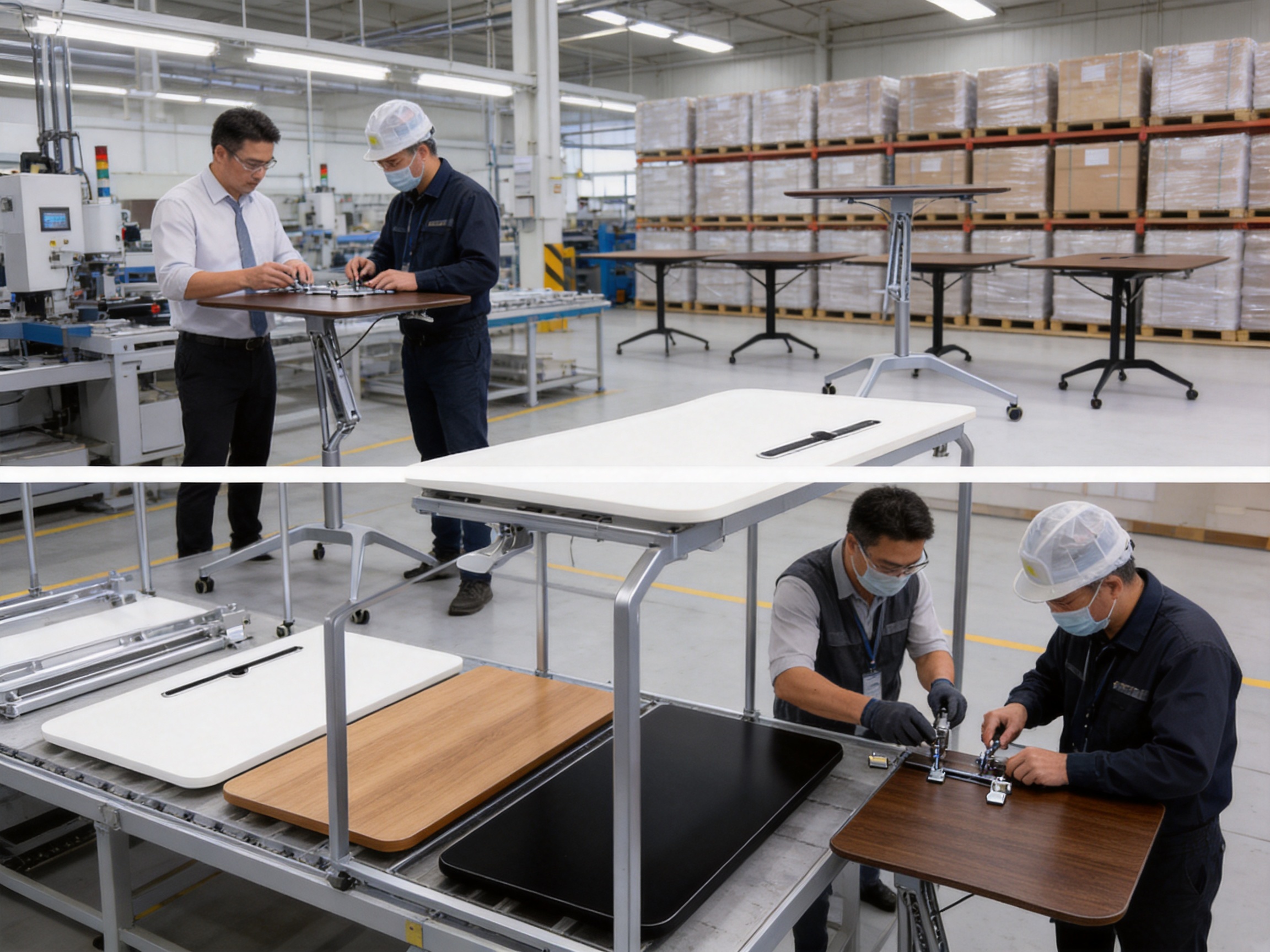
Modern work, learning, retail, and service environments increasingly require furniture that can adapt to people, devices, and changing spatial needs. A fixed-height table may be adequate for one task, one user, and one posture, but it becomes less effective when a workstation must support sitting, standing, moving, reading, presenting, checking out customers, or repositioning equipment. The SK01-1 iPad High-Legged Pneumatic Height-Adjustable Desk addresses these requirements through a compact mobile platform, a gas spring lifting system, a carefully shaped support base, and a tabletop designed around tablet-based work.
With a lifting range of 750 mm to 1060 mm, the desk supports a broad range of seated and standing activities. Its 715 mm by 475 mm tabletop provides sufficient space for an iPad, accessories, documents, and small work materials without occupying the footprint of a conventional office desk. Four casters, including two lockable wheels, add mobility while preserving stability during use. The aluminum-and-iron structure, powder-coated finish, and choice of tabletop colors make the unit suitable for professional and domestic interiors.
More importantly, the SK01-1 is not simply a small table with adjustable legs. It is a purpose-oriented workstation developed for tablet interaction, flexible placement, and ergonomic posture changes. Its pneumatic adjustment system enables fast manual height changes without dependence on a motor, control panel, or power outlet. This makes the product particularly valuable in locations where mobility, simplicity, quiet operation, and low maintenance are important.
Why Adjustable Tablet Workstations Matter
Tablets have changed the way people read, communicate, process orders, display information, and complete administrative tasks. An iPad can function as a point-of-sale terminal, digital catalog, learning device, presentation tool, inspection interface, drawing surface, or portable office. However, the flexibility of the device can be limited if it is placed on an unsuitable surface.
A low table may force users to bend forward for long periods. A counter-height surface may be uncomfortable for seated use. A heavy fixed workstation can make it difficult to move the device between rooms or activity zones. A conventional electric desk may provide height adjustment but introduce cables, motors, control components, and additional maintenance requirements. The SK01-1 responds to these limitations by combining a compact work surface with a pneumatic mechanism and mobile base.
The desk can be used when a person is seated, standing, or moving between different positions. This flexibility is especially relevant in environments where users do not remain at one station for an entire shift. Retail staff may need to bring a tablet to a customer. Teachers may reposition a digital reading or presentation station. Designers may move an auxiliary work surface beside a larger desk. Home users may alternate between study, browsing, video calls, and creative tasks.
Ergonomic adaptability does not mean that every user will require the same height. The correct working height depends on body dimensions, chair height, task type, device angle, and personal preference. A broad adjustment range is therefore more useful than a single preset height. The 750 mm to 1060 mm range of the SK01-1 allows users to create a more comfortable relationship between the tabletop, forearms, shoulders, eyes, and screen.
Core Product Specifications
The following specifications define the main configuration of the SK01-1 iPad High-Legged Pneumatic Height-Adjustable Desk.
| Specification | Product Detail |
|---|---|
| Product type | Pneumatic height-adjustable table |
| Primary application | iPad, tablet, mobile work, reading, display, and auxiliary workstation use |
| Lifting range | 750 mm to 1060 mm |
| Tabletop dimensions | 715 mm × 475 mm × 25 mm |
| Tabletop construction | 25 mm MDF with PVC vacuum-formed surface |
| Main structural materials | Aluminum and iron |
| Surface treatment | Powder coating |
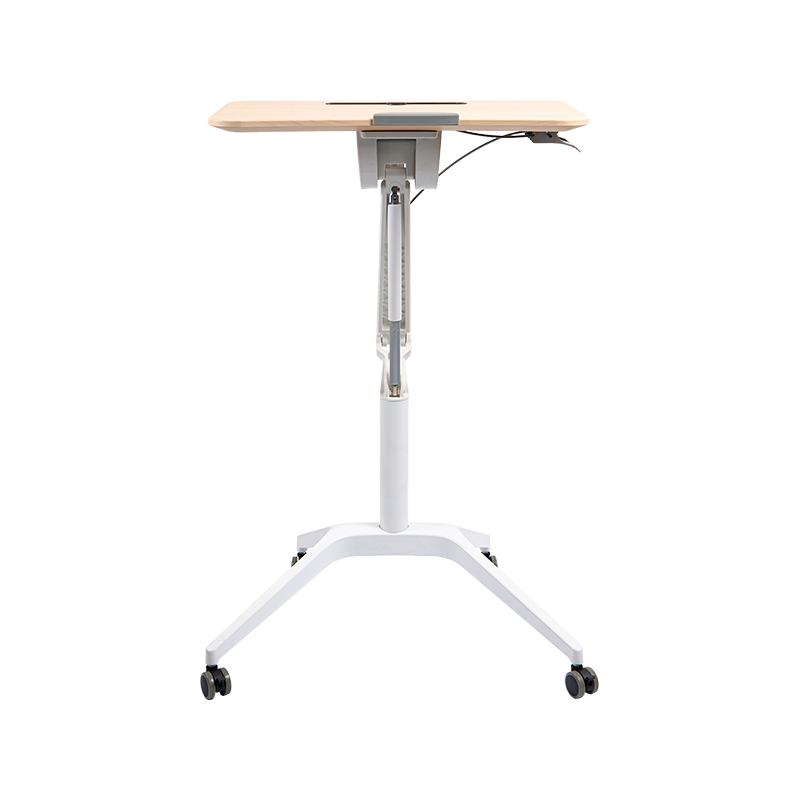
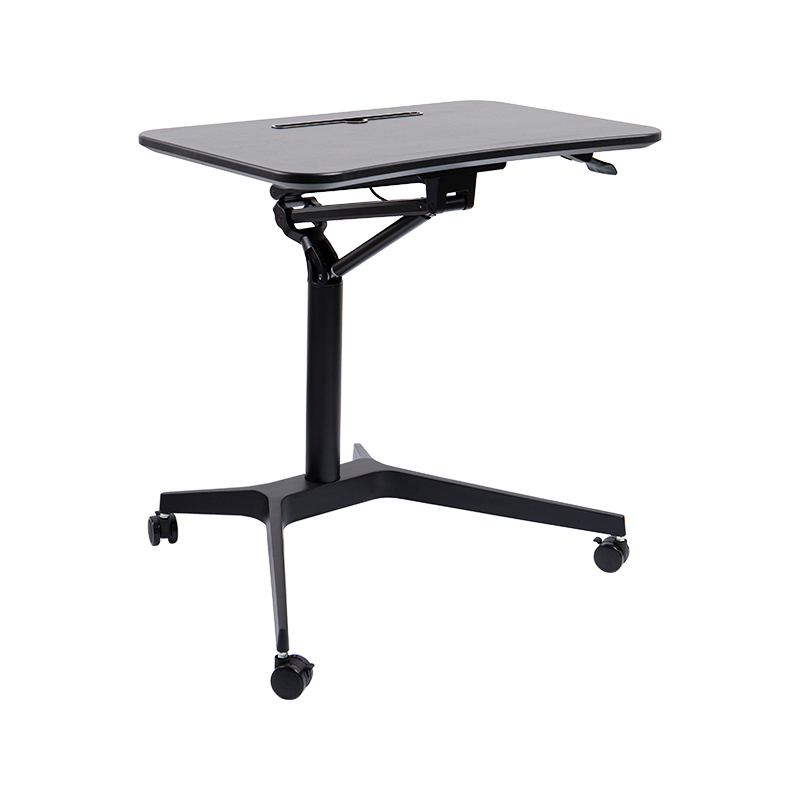
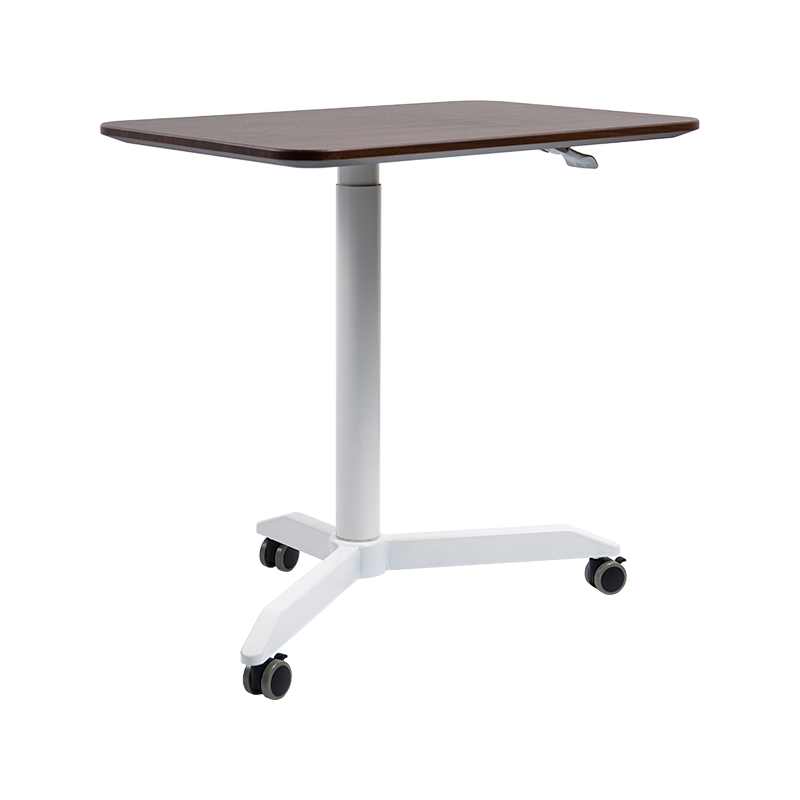
| Frame color options | White, silver, and black |
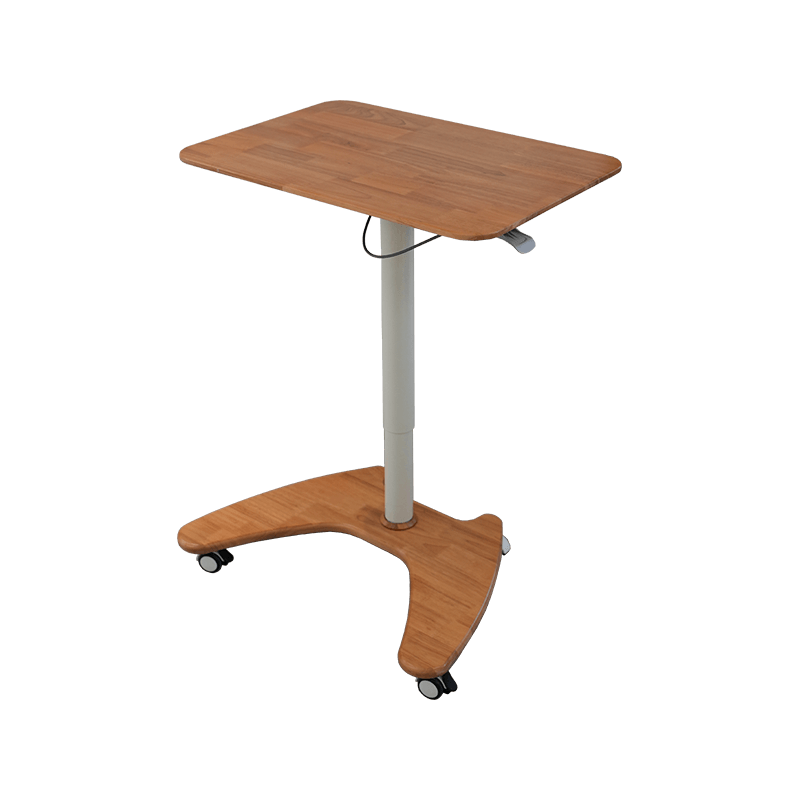
| Panel color options | White, maple, walnut, and black |
| Casters | Four casters: two with locks and two without locks |
| Support structure | Three-way outward-expanding base with rounded and arc-shaped transitions |
| Lifting principle | Gas spring lifting |
These specifications show how the product balances compactness and functionality. The tabletop is large enough for its intended device-centered applications, while its moderate dimensions make the desk easier to place in narrow rooms, beside seating, near counters, or within busy work areas. The 25 mm thickness provides a substantial visual and structural presence without making the tabletop unnecessarily bulky.
Gas Spring Height Adjustment
The defining feature of the SK01-1 is its gas spring lifting mechanism. Gas springs use pressurized gas contained within a cylinder to assist movement. When the adjustment control is activated, the stored energy in the spring helps raise or lower the work surface. The user can then position the tabletop at a desired level within the available range.
This operating principle offers several practical benefits. First, it does not require an electrical connection. The desk can be used in a classroom, retail space, library, studio, reception area, or home without routing power cables across the floor. Second, the mechanism is quiet compared with many motorized alternatives. Third, the control arrangement is mechanically straightforward, which can simplify daily operation and reduce the number of electronic components exposed to regular handling.
A pneumatic desk is also useful where rapid repositioning is part of the workflow. A user can adjust the height when switching from seated tablet work to standing interaction. In a retail environment, staff can set a comfortable operating position during routine processing and raise the surface when showing a product or completing a customer-facing transaction. In education, a teacher or student can change the height to suit reading, writing, demonstration, or collaborative use.
Compared with a fixed-height table, the gas spring system provides much greater adaptability. Compared with an electric lifting desk, it can provide a simpler installation and a lower dependence on electrical infrastructure. Compared with manually disassembled or telescoping furniture, it enables on-demand adjustment without tools.
The adjustment range also makes the product suitable for shared use. Different users can select different working positions without moving to separate stations. This can reduce the need for multiple pieces of furniture and help organizations make more efficient use of limited floor space.
Ergonomic Benefits for Seated and Standing Work
Extended static posture is a common challenge in desk-based activity. Remaining seated for too long can result in discomfort, while standing continuously can create fatigue when the work surface is not properly positioned. A height-adjustable workstation encourages users to change posture and redistribute physical loading during the day.
The SK01-1 supports this type of movement by allowing the tabletop to travel between 750 mm and 1060 mm. At the lower end of the range, the desk can support seated tablet use, reading, writing, and browsing. At higher settings, it can function as a standing station or customer-facing tablet counter. Intermediate positions allow users to fine-tune the relationship between their body and the device.
For tablet work, ergonomic positioning involves more than simply raising the surface. Users should keep the device at a comfortable viewing distance, avoid excessive neck flexion, and position the forearms in a relaxed manner where possible. The tabletop offers a stable platform on which a tablet stand, keyboard, protective case, or other accessory can be arranged. Because the desk can be adjusted, the entire work surface can be aligned with the user rather than forcing the user to adapt to a fixed counter.
The product does not replace the need for sound ergonomic habits. Users should still take regular breaks, vary activities, and avoid maintaining one posture for prolonged periods. Nevertheless, adjustable furniture can make these healthy practices easier to implement. A desk that can be raised or lowered quickly reduces the friction associated with changing position.
For organizations, this adaptability may also support more inclusive shared workspaces. Users with different heights, mobility requirements, or working preferences can customize the desk without requiring permanent alterations to the environment.
Purpose-Built Tabletop for iPad and Mobile Devices
The tabletop measures 715 mm in width and 475 mm in depth, providing a practical platform for iPads and similar tablets. Its proportions are broad enough to accommodate the device and common accessories while remaining compact enough for mobile use. A user can place a tablet at the center, add a stand or keyboard, and retain space for a notebook, documents, receipt printer, barcode scanner, or small presentation materials, depending on the application.
The top is constructed from a 25 mm MDF core with PVC vacuum-formed surfacing. Medium-density fiberboard provides a uniform engineered panel, while the PVC surface creates a consistent finish that is suitable for regular interior use. Vacuum forming allows the surface material to follow the shape of the panel and wrap the edges, helping create a visually continuous appearance.
Fully wrapped edges are valuable in a mobile workstation. They reduce the exposed area of the core material and create a smoother perimeter for users who frequently approach the table from different directions. The edge treatment also supports easier cleaning, which is particularly important in retail, classroom, healthcare-adjacent, and public-facing environments where the tabletop may be touched frequently.
The available panel colors include white, maple, walnut, and black. White provides a clean and bright appearance, maple adds a light wood character, walnut offers a warmer and more traditional visual effect, and black creates a stronger contemporary contrast. These options allow purchasers to coordinate the desk with existing furniture, wall finishes, flooring, and corporate interiors.
Because the tabletop is designed for practical device use rather than oversized desktop storage, it encourages efficient organization. A compact, dedicated work surface can help prevent unnecessary accumulation of materials and makes it easier to move the station when the room layout changes.
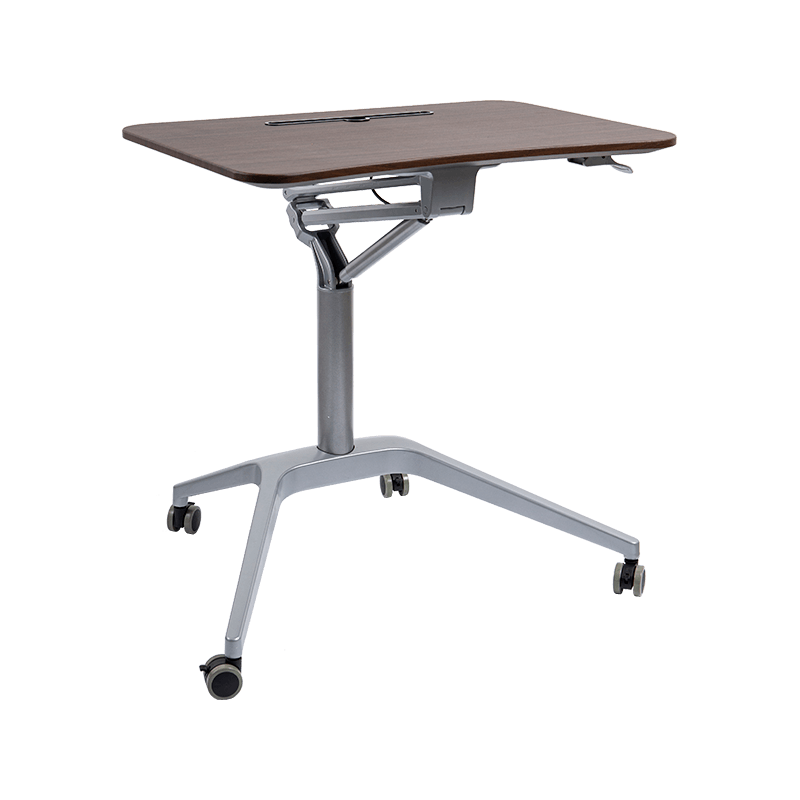
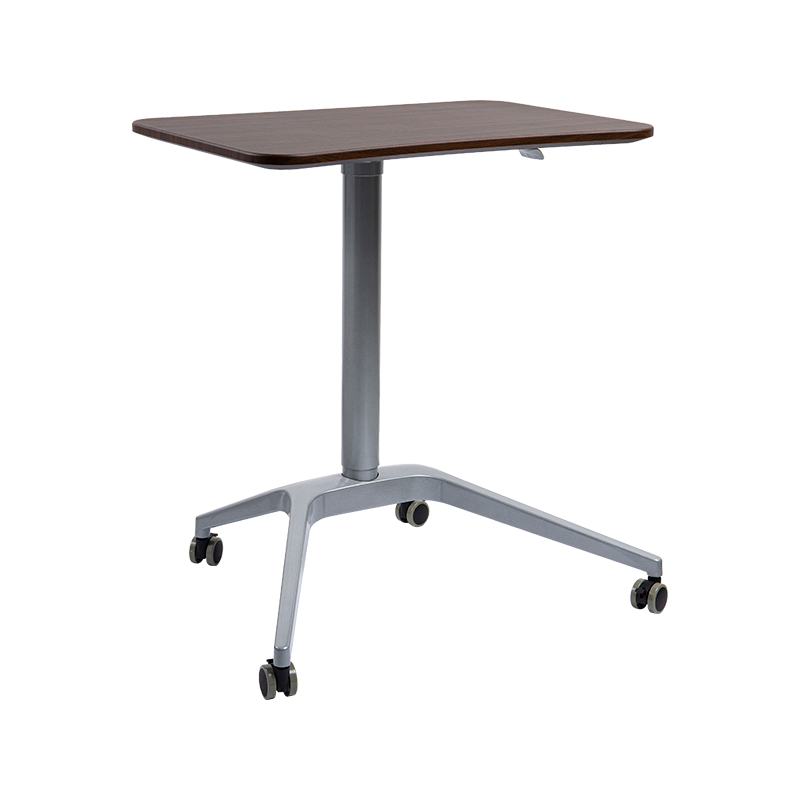
SK01-1 iPad High-Legged Pneumatic Height-Adjustable Desk
Mobile Base and Stability
Mobility is one of the product’s strongest functional advantages. The SK01-1 is fitted with four casters, two of which include locking mechanisms. This arrangement allows the desk to move when repositioning is required and remain secured when the user is working.
Lockable casters are particularly important for tablet interaction. Touchscreen work involves repeated contact, tapping, swiping, and sometimes writing with a stylus. If the desk moves too easily, the user may experience reduced control and the device may become more difficult to operate. Once the desired position has been selected, the two locking casters can help reduce unwanted movement.
The two non-locking casters support smoother directional movement. Together with the locking wheels, they provide a balance between maneuverability and stationary use. Staff can move the desk between rooms, place it next to a service counter, or bring it closer to a seated user without lifting the entire unit.
The support base uses a three-way outward-expanding structure. By extending the support points outward, the design distributes the footprint across a broader area than a narrow central column would provide. This contributes to stability and gives the desk a visually grounded appearance.
The base also incorporates rounded transitions and an arc-shaped transition at the central connection. These details produce smoother overall lines and help avoid the harsh visual appearance associated with purely angular structural frames. Rounded transitions can also make the product more comfortable to approach in busy spaces where people may pass close to the desk.
Stability depends on correct use, floor conditions, load distribution, and the condition of the casters. Users should position the desk on a reasonably level surface, engage the wheel locks when stationary, and avoid placing excessive or uneven loads at the outer edges of the tabletop. When used according to its intended purpose, the combination of the outward-expanding support structure and caster system provides a practical foundation for mobile tablet work.
Material Selection and Surface Protection
The primary frame materials are aluminum and iron. These materials allow the design to combine different structural characteristics. Aluminum is valued for its relatively low weight and corrosion resistance, while iron provides a strong foundation for structural components and support elements. Their combination can help achieve a balance between portability, rigidity, and long-term use.
The frame is finished with powder coating in white, silver, or black. Powder coating applies a dry coating material to the prepared metal surface, followed by curing. The resulting finish is generally valued for its uniform appearance, consistent coverage, and resistance to routine wear. It also allows the frame to be matched with different interior design styles.
White and silver frames can contribute to a lighter, more open appearance in classrooms, offices, studios, and healthcare-related spaces. A black frame creates a stronger visual definition and may suit technology-focused interiors, retail environments, or modern homes. The multiple color choices give distributors and project buyers additional flexibility when planning coordinated installations.
Material selection also affects maintenance. Smooth coated metal surfaces are easier to wipe than porous or heavily textured finishes. The PVC-wrapped tabletop can likewise be cleaned with appropriate non-abrasive products. Regular care should include removing dust and spills, checking caster operation, and inspecting moving components for signs of damage or unusual resistance.
The product’s material combination is especially appropriate for a workstation that may be moved repeatedly. A lightweight but stable structure is easier for staff to reposition than a heavy solid-wood unit. At the same time, the desk must maintain sufficient rigidity for comfortable touchscreen use. The aluminum-and-iron construction is intended to address both requirements.
Advantages Compared with Typical Alternatives
The adjustable furniture market includes fixed tables, electric standing desks, manual telescoping desks, lecterns, mobile carts, and specialized tablet stands. The SK01-1 occupies a distinct position among these categories.
Compared with Fixed-Height Tables
A fixed table offers simplicity but does not adapt to different users or tasks. If its height is appropriate for seated work, it may be too low for standing use. If it is designed as a counter, it may be unsuitable for sitting. The SK01-1 provides a more flexible solution by allowing the same station to support both positions.
Its mobility is another advantage. A fixed table often requires lifting or disassembly before it can be moved. The caster-equipped SK01-1 can be repositioned as part of normal workflow. This is valuable where rooms are reconfigured frequently or where one device station serves multiple activity areas.
Compared with Electric Height-Adjustable Desks
Electric desks provide powered adjustment and may be suitable for larger work surfaces or heavier office equipment. However, they require a power source and typically include motors, control switches, cables, and electronic components. These features can increase installation complexity and may be unnecessary for a compact iPad-centered workstation.
The SK01-1 uses gas spring lifting instead. It can be adjusted without plugging into a wall outlet, which supports greater placement freedom. It may also be advantageous in temporary installations, public areas, classrooms, pop-up retail spaces, and locations where cable management would be inconvenient.
Compared with Basic Mobile Carts
A basic cart may provide mobility but often lacks ergonomic height adjustment. It may also use a narrow, utilitarian base that is less visually appropriate for customer-facing environments. The SK01-1 combines casters with a height-adjustable work surface and a more refined three-way support structure.
The rounded transitions and choice of finishes make it easier to integrate into professional interiors. The product is therefore not limited to back-of-house use. It can function as a visible service station, digital display table, or learning aid.
Compared with Portable Tablet Stands
A tablet stand is useful for holding a device but generally does not provide a complete work surface. Users may still need a separate table for documents, accessories, or input devices. The SK01-1 provides a dedicated tabletop while retaining the mobility and device-oriented character of a stand.
Its larger surface and adjustable range also support more varied tasks. Users can read, write, interact with customers, use a keyboard, or organize small equipment without relying on a second piece of furniture.
Applications in Retail and Customer Service
Retail stores increasingly use tablets for product information, customer registration, mobile checkout, inventory lookup, appointment management, and digital payment. A mobile height-adjustable table can support these activities while allowing staff to adapt the station to different users and customer interactions.
At a service counter, the SK01-1 can be positioned at a standing height for fast routine operations. When a customer needs to review a catalog, complete a form, or examine product information, the table can be moved closer or adjusted to a more comfortable level. The mobile base can also support seasonal layouts, promotional displays, and temporary service points.
Because the tabletop is compact, the unit can fit into areas where a full-size counter would be impractical. Retailers may place it near an entrance, beside a product display, within a showroom, or in a queue-management zone. The available panel and frame colors allow the desk to coordinate with brand-neutral interior concepts, wood finishes, or monochrome technology displays.
Lockable wheels help maintain a stable position during customer transactions. A cleanable tabletop and powder-coated frame are appropriate for environments where surfaces are handled regularly. The absence of a required power connection can also make temporary placement easier, although any tablet, printer, or payment device used with the desk may still require its own power or battery planning.
Applications in Education and Libraries
Schools, training centers, and libraries need furniture that accommodates different ages, body sizes, and learning activities. The SK01-1 can be used as a digital reading station, a mobile research point, a presentation surface, or an auxiliary desk for tablet-based lessons.
In a library, the table can support catalog searches, electronic reading, digital archives, or assisted information services. It can be moved between reading areas and service locations as demand changes. The adjustment range helps users operate the device from seated or standing positions, while the compact footprint preserves circulation space.
In classrooms, teachers can reposition the unit during group activities or use it as a demonstration station. Students can access a tablet without being limited to one fixed desk arrangement. The rounded base transitions may be particularly suitable for environments in which users frequently walk around furniture.
Educational furniture must usually balance durability, usability, cleaning, and flexible room layouts. The SK01-1 addresses these priorities through its coated metal frame, wrapped tabletop, mobile base, and non-electric height adjustment. It can serve as a supplementary unit without requiring the entire classroom to be redesigned.
Applications in Creative Studios
Creative professionals often move between digital and physical work. A designer may need a tablet for sketching, reference images, project management, or client presentations while using a larger table for materials. The SK01-1 can function as an auxiliary station that is positioned beside a primary desk or moved into a presentation area.
The adjustable height can support different creative activities. A lower position may be useful for seated drawing or note-taking, while a higher position may be better for reviewing work with a standing team. The tabletop provides space for a tablet and a limited set of tools without competing with a full-size drafting or production table.
Studios often have changing layouts and shared equipment. A mobile desk reduces the need to dedicate a permanent location to a single device. Its color options can also suit minimalist, industrial, warm wood, or contemporary interiors.
Applications in Homes and Flexible Workspaces
Home users may not have room for separate desks for work, study, hobbies, and digital entertainment. A compact adjustable table can serve several roles throughout the day. It can operate as a study desk in the morning, a standing video-call station in the afternoon, and a reading or browsing surface in the evening.
The caster system allows the desk to move between rooms or be stored against a wall when not required. Its tabletop dimensions are suitable for an iPad and basic accessories without taking up the floor area of a conventional office desk. Users should still ensure that the desk is placed where the caster locks can be engaged and where movement will not create a hazard.
In shared homes, the adjustable height makes it easier for family members with different preferences to use the same furniture. It can also be useful for users who want to alternate between sitting and standing without investing in a large motorized workstation.
Manufacturing Strengths of SuZhou Skyhone Intelligent Technology Co., Ltd.
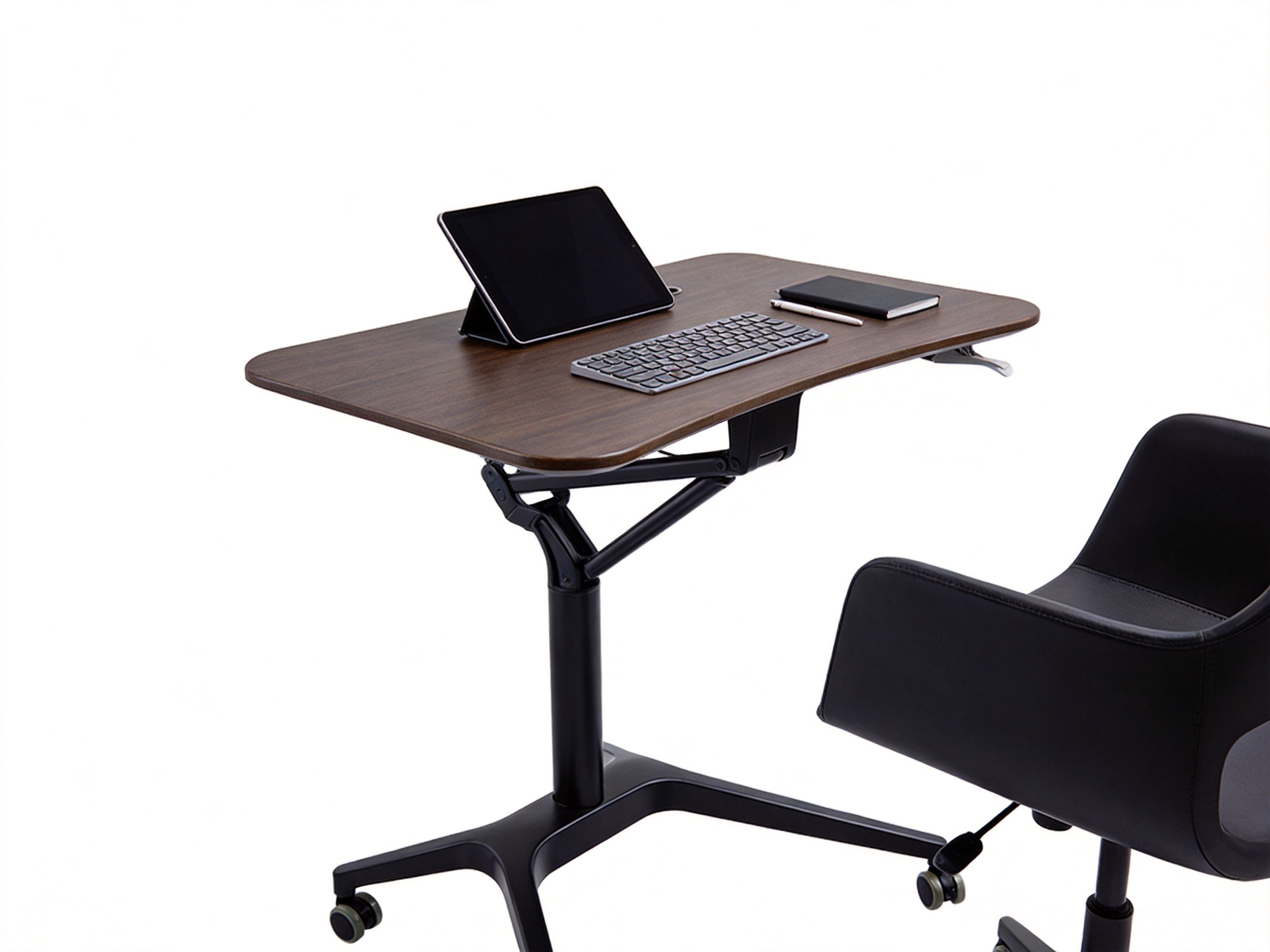
SuZhou Skyhone Intelligent Technology Co., Ltd. is a professional manufacturing enterprise focused on the research and development, production, sales, and service of standing desks and related ergonomic furniture. Based in Suzhou, Jiangsu Province, the company operates within the Yangtze River Delta, a region known for its developed manufacturing networks, engineering resources, supplier ecosystems, and logistics infrastructure.
This regional position is strategically important for adjustable furniture production. A complete industrial chain can support access to metal processing, surface treatment, panel manufacturing, hardware, casters, gas spring components, packaging, and assembly services. When these capabilities are coordinated effectively, a manufacturer can respond more efficiently to design revisions, quality requirements, color requests, and project-specific orders.
The company’s focus on intelligent office space solutions reflects a broader shift in furniture manufacturing. Modern buyers are not only purchasing a desk frame and tabletop; they are seeking products that support health, productivity, mobility, device integration, and adaptable room planning. Research and development therefore plays an important role in translating user requirements into practical structures.
For a product such as the SK01-1, manufacturing strength involves multiple stages. The frame must be designed for stable support and smooth adjustment. Metal components must be formed and finished consistently. The gas spring system must be matched to the desk structure and intended movement. The tabletop must be shaped, wrapped, and assembled accurately. Casters must be installed correctly, and final units must be inspected before packaging.
A professional manufacturer can add value by coordinating these stages rather than treating them as isolated operations. Consistent component matching helps reduce variation between units. Standardized assembly procedures support repeatability. Inspection checkpoints can identify problems with surface appearance, wheel installation, structural alignment, or adjustment behavior before products reach customers.
Product Development and Engineering Approach
The SK01-1 demonstrates an engineering approach centered on a specific use case: a mobile, tablet-oriented, pneumatic workstation. This is different from adapting a large office desk to a smaller format. The dimensions, support structure, adjustment range, material combination, and wheel configuration are considered together.
Product development begins with understanding the environment in which the desk will be used. A retail station requires mobility and a presentable appearance. A classroom station requires easy cleaning and flexible positioning. A home desk requires a compact footprint and quiet operation. A studio workstation requires adaptability and compatibility with other furniture. The same core design can address these environments because its functions are not limited to one application.
Engineering also involves balancing stability and portability. A desk that is too light may feel unstable, while one that is too heavy may be difficult to move. The aluminum-and-iron construction, outward-expanding base, and four-caster configuration work together to create a practical compromise. The frame colors and tabletop finishes then extend the product’s suitability across different interiors.
The gas spring must likewise be selected and integrated according to the tabletop weight, frame geometry, and expected user interaction. Smooth adjustment requires more than installing a spring; it depends on the relationship between the lifting mechanism, guide components, control method, and structural alignment. A focused manufacturer is better positioned to refine these relationships through product testing and engineering feedback.
Quality Control Considerations
Quality control for an adjustable desk should address both visible and functional characteristics. Surface inspections can verify powder-coating consistency, color uniformity, edge wrapping, and the absence of obvious damage. Dimensional checks can confirm tabletop size, frame alignment, and assembly accuracy.
Functional checks should include caster movement, caster locking, height adjustment, structural steadiness, and the fit of major components. The tabletop should remain properly supported through its adjustment range. The frame should not exhibit unnecessary looseness under normal intended use. The gas spring control should operate in a predictable manner when the user adjusts the desk.
Packaging inspection is also important for mobile furniture. Corners, coated frame sections, tabletop edges, and caster assemblies should be protected against damage during handling and transport. Clear assembly instructions and appropriate protective materials can reduce the likelihood of installation errors or cosmetic defects after delivery.
For commercial buyers, quality consistency matters because multiple units may be installed in one location. Differences in color, height behavior, or structural alignment can affect the appearance and usability of an entire project. A manufacturing company with coordinated production and inspection procedures can better support repeat orders and larger deployments.
Customization and Project Flexibility
The SK01-1 already offers several aesthetic choices. Frame colors are available in white, silver, and black, while panel colors include white, maple, walnut, and black. This allows standard configurations to address a range of visual requirements without changing the product’s primary function.
Customization can be especially valuable for hospitality, education, retail, and office projects. A buyer may prefer a light tabletop for a bright learning environment, a walnut panel for a hospitality setting, or a black frame for a technology showroom. Color coordination can help a mobile workstation appear integrated rather than temporary.
Project buyers should communicate requirements clearly during the quotation and production stages. Important considerations may include quantity, destination, packaging, assembly expectations, preferred colors, accessory compatibility, and intended use. The manufacturer’s experience in standing desks and ergonomic furniture can help identify practical solutions while maintaining the core product’s stability and adjustability.
Customization should not compromise the product’s structural performance. Changes to tabletop thickness, material, accessory loading, or hardware arrangement may affect the gas spring balance and overall stability. A professional supplier should therefore evaluate requested modifications from both an aesthetic and engineering perspective.
Efficient Manufacturing and Supply Support
Manufacturing efficiency affects more than production cost. It can influence delivery planning, replacement parts, quality consistency, and the supplier’s ability to respond to changing market requirements. Suzhou’s industrial ecosystem provides a strong foundation for coordinated sourcing and production, while the company’s focus on intelligent office solutions supports product specialization.
Efficient production may involve standardized frame components, repeatable powder-coating procedures, controlled tabletop processing, organized assembly stations, and systematic inspection. These methods help reduce unnecessary variation and support dependable output. They also make it easier to manage different color configurations without losing control of the core manufacturing process.
For international customers, communication and service are equally important. A supplier should be able to provide product specifications, configuration information, application guidance, and after-sales support. The company’s sales and service role complements its manufacturing activities by helping customers select suitable products and coordinate procurement.
The SK01-1 benefits from being positioned within a broader product category that includes adjustable-height desks, electric linear actuators, and gas springs. Experience with these related technologies can support a deeper understanding of lifting systems, structural frames, control methods, and ergonomic workstation requirements.
Installation, Operation, and Care
Before use, the desk should be assembled according to the supplied instructions and placed on a level floor. All structural fasteners should be tightened appropriately, and the casters should be checked to ensure that they rotate and lock correctly. The tabletop should be inspected for damage before accessories or devices are placed on it.
To adjust the height, the user should follow the product’s intended control procedure and guide the tabletop smoothly rather than applying sudden lateral force. Users should keep fingers, cables, and loose objects away from moving joints during adjustment. The desk should not be moved while a device or accessory is positioned in a way that could fall or become entangled.
When the desk is in its working position, the lockable casters should be engaged. This is particularly important when tapping on a touchscreen, writing with a stylus, or interacting with a customer. Before moving the desk, users should release the locks, clear the movement path, and confirm that devices are secure.
Routine maintenance is simple but worthwhile. Dust and spills should be removed with suitable cleaning materials. Abrasive cleaners should be avoided because they may damage the PVC surface or powder-coated finish. Wheels and adjustment components should be inspected periodically, especially in high-use commercial environments. Any unusual noise, looseness, or resistance should be investigated before continued heavy use.
Users should also respect the intended load and application. The SK01-1 is designed as a tablet-oriented workstation and auxiliary table. It should not be treated as a climbing surface, seat, heavy-duty storage rack, or support for loads beyond its intended design.
How to Select the Right Configuration
When purchasing the SK01-1, buyers should begin by identifying the primary workflow. If the desk will support mobile checkout, the tabletop should be arranged to leave sufficient room for the payment device and customer interaction. If it will be used for digital reading, the buyer may prioritize a surface color that reduces visual distraction and works well with the surrounding seating.
For shared offices or classrooms, the full height range is a central advantage because different users will operate the desk. For compact home environments, the tabletop size and caster movement should be considered alongside available storage space. For public-facing use, frame and panel colors can be selected to complement the interior and create a cohesive appearance.
Buyers should also consider the floor surface. Hard flooring, low-pile carpet, and uneven surfaces can affect caster movement and stability. The desk should be placed where there is adequate clearance for adjustment and movement. If accessories such as keyboards, printers, scanners, or stands are planned, their dimensions and cable requirements should be reviewed in advance.
Commercial purchasers may benefit from ordering a sample unit before a larger project. A sample can be used to evaluate adjustment behavior, tabletop capacity, mobility, color matching, and user acceptance. It can also reveal whether additional accessories or workflow changes are needed.
Environmental and Operational Efficiency
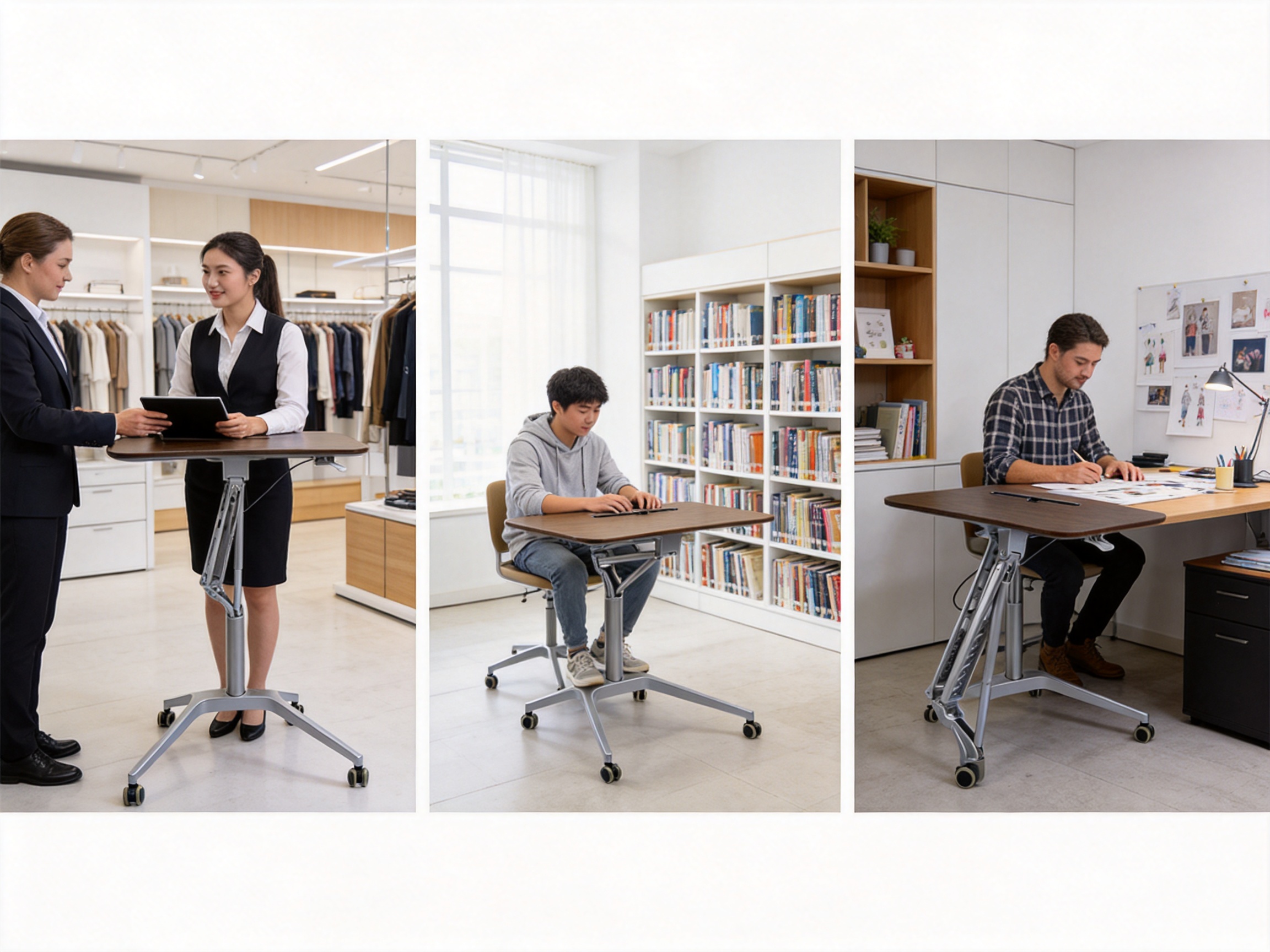
The SK01-1 can contribute to more efficient use of interior space because one adjustable mobile station can serve several functions. Instead of assigning separate fixed tables for reading, checkout, presentation, and auxiliary work, an organization may use one adaptable unit across different activity zones.
The pneumatic operating principle also avoids the need for a dedicated electrical connection at the desk itself. This may reduce cable clutter and simplify layout changes. It does not eliminate the energy needs of the tablet or other equipment, but it can make the furniture infrastructure more flexible.
A durable frame, replaceable functional components, and maintainable surfaces can extend the useful life of the product. Longer service life reduces the need for frequent furniture replacement and supports more responsible purchasing. Proper care, correct loading, and periodic inspection are essential to achieving these benefits.
Manufacturing efficiency can further support responsible resource use by reducing production waste, improving material utilization, and maintaining consistent component quality. While individual environmental performance depends on many factors, a product designed for long-term adaptability can offer practical value beyond its initial installation.
Frequently Asked Questions
What is the main purpose of the SK01-1 desk?
The SK01-1 is a compact pneumatic height-adjustable workstation designed primarily for iPads and similar mobile devices. It can be used for reading, digital work, customer service, retail checkout, presentations, study, and auxiliary office or studio tasks.
How high and low can the tabletop be adjusted?
The listed lifting range is 750 mm to 1060 mm. This range supports seated, standing, and intermediate working positions, although the most suitable setting depends on the user’s height, chair, task, and device arrangement.
Does the desk require electricity?
The height adjustment is powered by a gas spring rather than an electric motor. The desk itself therefore does not require a wall outlet for lifting. Any iPad, printer, payment terminal, or other accessory used with the desk may have separate power requirements.
Is the desk easy to move?
Yes. It has four casters, including two lockable casters and two non-locking casters. The desk can be repositioned by releasing the locks and moving it across a suitable floor. The locks should be engaged when the workstation is in use.
What are the tabletop dimensions?
The tabletop measures 715 mm by 475 mm and has a thickness of 25 mm. These dimensions provide a compact but useful platform for an iPad, accessories, documents, and other small work materials.
What is the tabletop made from?
The tabletop uses a 25 mm MDF core with a PVC vacuum-formed surface. The surface is designed to provide a consistent appearance and fully wrapped edges for a smoother, easier-to-clean perimeter.
Which frame colors are available?
The powder-coated frame is available in white, silver, and black. These choices support different interior styles, from bright and minimal spaces to more contemporary or technology-oriented environments.
Which tabletop colors are available?
The panel options are white, maple, walnut, and black. Buyers can choose a finish that coordinates with existing furniture, flooring, wall colors, or project design requirements.
What makes the base different from a basic mobile cart?
The base uses a three-way outward-expanding support structure with rounded transitions and an arc-shaped transition at the center connection. This provides a more deliberately engineered and visually refined support system than a simple narrow cart frame, while the height adjustment adds ergonomic flexibility.
Can the desk be used in a retail store?
Yes. It can serve as a mobile checkout point, product information station, digital catalog table, customer registration desk, or temporary display station. Its compact size and caster system make it suitable for changing retail layouts.
Can it be used in a classroom or library?
Yes. Common uses include electronic reading, tablet-based research, digital demonstrations, mobile presentations, and auxiliary learning stations. The adjustable range can help accommodate different users and seated or standing activities.
Is the desk suitable for a home office?
It can be used as a compact home workstation, reading table, tablet station, or flexible standing surface. Its intended device-centered design makes it especially suitable for users who do not need the large desktop area of a full-size office desk.
How should the desk be kept stable?
Place it on a reasonably level surface and engage the two lockable casters when working. Avoid unevenly distributing heavy objects near the outer edges and do not use the desk for loads beyond its intended application.
How does the desk compare with an electric standing desk?
The SK01-1 uses a gas spring instead of a powered motor. This means it can be adjusted without a desk-level power connection and may offer simpler placement and operation for compact tablet-focused applications. Electric desks may be preferable for larger desktops or heavier equipment requiring powered adjustment.
What should buyers discuss with the manufacturer?
Buyers should confirm the required quantity, tabletop and frame colors, intended application, packaging, delivery requirements, accessory compatibility, and any requested customization. For larger projects, requesting a sample unit can help verify suitability before full deployment.
Conclusion
The SK01-1 iPad High-Legged Pneumatic Height-Adjustable Desk combines ergonomic adjustment, mobility, compact dimensions, and device-specific functionality in one adaptable workstation. Its 750 mm to 1060 mm lifting range supports changes between seated and standing use. Its gas spring mechanism avoids dependence on an electric connection. Its 715 mm by 475 mm tabletop provides a practical platform for an iPad and related work materials.
The 25 mm MDF tabletop with PVC vacuum-formed surfacing offers a durable, smooth, and easy-to-maintain work surface, while the aluminum-and-iron structure provides a balance of strength and manageable weight. Powder-coated frame colors and multiple panel finishes make the desk suitable for professional, educational, retail, studio, and residential environments.
The three-way outward-expanding support structure, rounded transitions, arc-shaped center connection, and four-caster configuration distinguish the product from basic fixed tables and simple mobile carts. Two lockable wheels help the desk remain stable during interaction, while the remaining casters support convenient repositioning.
Behind the product is SuZhou Skyhone Intelligent Technology Co., Ltd., a manufacturer focused on standing desks, ergonomic furniture, gas spring solutions, and intelligent office space applications. Its location in Suzhou and the Yangtze River Delta provides access to a mature manufacturing ecosystem, while its emphasis on research, development, production, sales, and service supports a coordinated approach to product delivery.
For businesses and individuals seeking a flexible tablet workstation without the complexity of a motorized desk, the SK01-1 offers a focused and practical solution. It is particularly well suited to environments where furniture must move, adapt, remain visually presentable, and support different users throughout the day.
References
1. Product specification materials for the SK01-1 iPad High-Legged Pneumatic Height-Adjustable Desk, including dimensions, materials, finishes, caster configuration, and gas spring operating principle.
2. SuZhou Skyhone Intelligent Technology Co., Ltd. company information regarding research and development, manufacturing, sales, service, and standing desk solutions.
3. General principles of ergonomic workstation design, including posture variation, seated and standing work, viewing distance, and neutral upper-limb positioning.
4. General manufacturing principles for powder-coated metal furniture, engineered wood panels, PVC surface forming, caster systems, and gas spring mechanisms.
5. General guidance for the planning and operation of mobile workstations in retail, educational, office, studio, library, and residential environments.
Product: SK01-1 iPad High-Legged Pneumatic Height-Adjustable Desk

- Contact Info
-
-
 Phone+86-15950656125
-
 Email
-
 AddressRoom 1007-1, South Building, Suyue Plaza, Suzhou Industrial Park, Suzhou City, Jiangsu Province, China
-
- Products
- Follow Us
- Need help? Please contact us
Copyright ©
SuZhou Skyhone Intelligent Technology Co., Ltd.
All Rights Reserved.
Privacy
Custom Ergonomic Adjustable Office Tables Manufacturers

