

 English
  русский
  Español
  عربى
عربى 
Content
- 1 Product Overview
- 2 Key Specifications
- 3 Ergonomic Value of Pneumatic Height Adjustment
- 4 Mobility as a Core Advantage
- 5 Flat-Legged Triangular Support Design
- 6 Tabletop Material and Surface Performance
- 7 Frame Materials and Powder-Coated Finish
- 8 Gas Spring Lifting System
- 9 Advantages Over Competing Products
- 10 Manufacturing Strengths Behind the Product
- 11 Quality Control and Reliability
- 12 Applications in Modern Work Environments
- 13 User Experience and Daily Operation
- 14 Design Flexibility and Custom Appearance
- 15 Why the TH01-3 Matches Current Workplace Trends
- 16 Company Manufacturing Capability and Industry Focus
- 17 Comparing Pneumatic, Electric, and Fixed Workstations
- 18 Procurement Considerations for Buyers
- 19 Sustainability and Long-Term Practical Value
- 20 Installation and Use Recommendations
- 21 Q&A Section
- 21.1 What is the main purpose of the TH01-3 pneumatic height-adjustable desk?
- 21.2 What is the height adjustment range?
- 21.3 How does the desk adjust height?
- 21.4 Why choose a pneumatic desk instead of an electric desk?
- 21.5 What are the tabletop dimensions?
- 21.6 What materials are used for the tabletop?
- 21.7 What materials are used for the frame?
- 21.8 Does the desk have wheels?
- 21.9 What color options are available?
- 21.10 What makes the flat-legged design useful?
- 21.11 Who manufactures the product?
- 21.12 What are the main competitive advantages?
- 22 Conclusion
- 23 References
- 24 Product: TH01-3 iPad (Flat-Legged) Pneumatic Height-Adjustable Desk
Pneumatic Height-Adjustable Mobile Desk for Flexible Ergonomic Workstations
2026-06-15
Modern workspaces increasingly require furniture that can move, adapt, and support healthier working habits without adding unnecessary complexity. The TH01-3 iPad Flat-Legged Pneumatic Height-Adjustable Desk is designed for exactly this kind of environment. It combines a gas spring lifting system, a compact tabletop, a mobile caster base, and a stable triangular support structure to create a practical workstation for offices, educational spaces, product demonstrations, electronic device testing, light assembly, and flexible collaborative areas.
Unlike a fixed-height table, this pneumatic height-adjustable desk provides a lifting range from 750 mm to 1060 mm, allowing users to switch between seated and standing postures. Unlike many electric height-adjustable desks, it does not require a motor, controller, power cable, or electrical connection for height movement. This gives it a simple, clean, and highly mobile character. The user can reposition the desk, lock it in place, and adjust the height manually through the gas spring lifting mechanism.
The product is especially suitable for settings where the desk must follow the user or the task rather than remain fixed in one location. In many modern facilities, work is no longer performed only at a permanent workstation. Teams may need temporary testing tables, demonstration platforms, teaching stands, digital device stations, or movable support surfaces. The TH01-3 answers these needs with a compact 715 mm by 475 mm tabletop, a durable 25 mm MDF core, a PVC vacuum-formed surface, and a frame made from aluminum and iron with powder-coated finishing options.
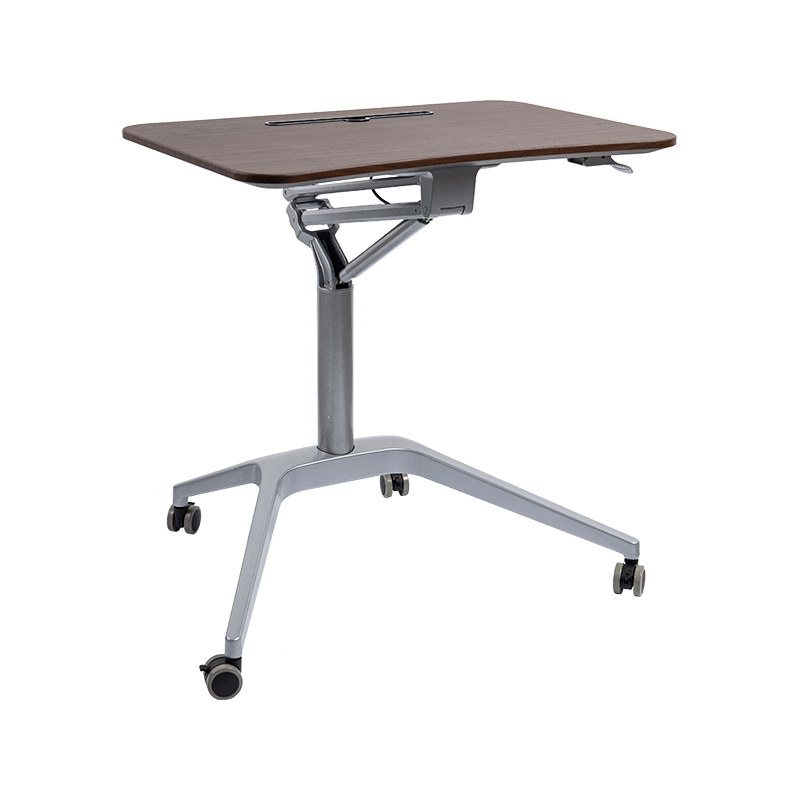
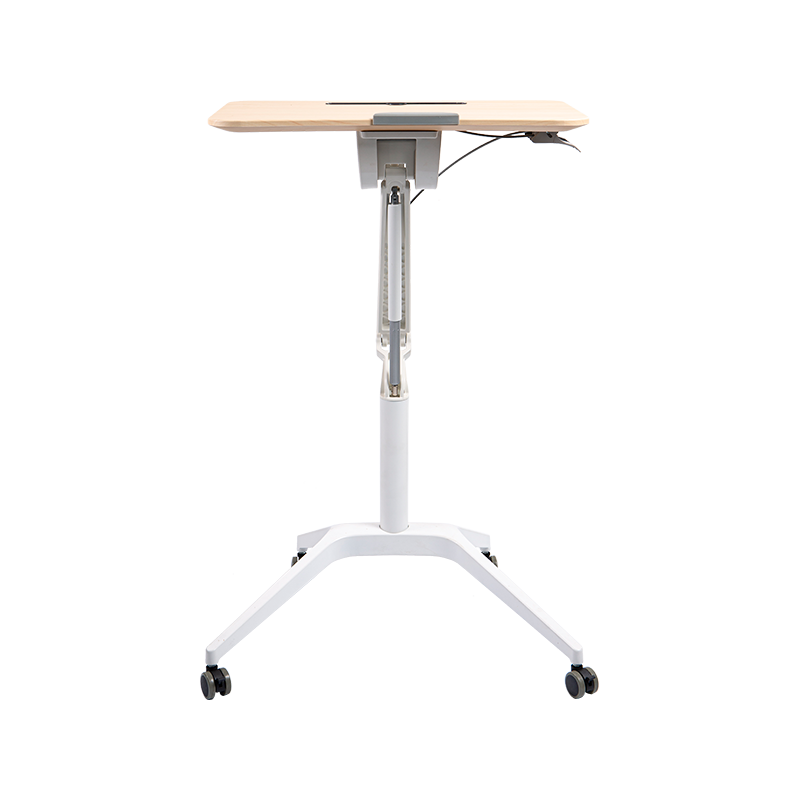
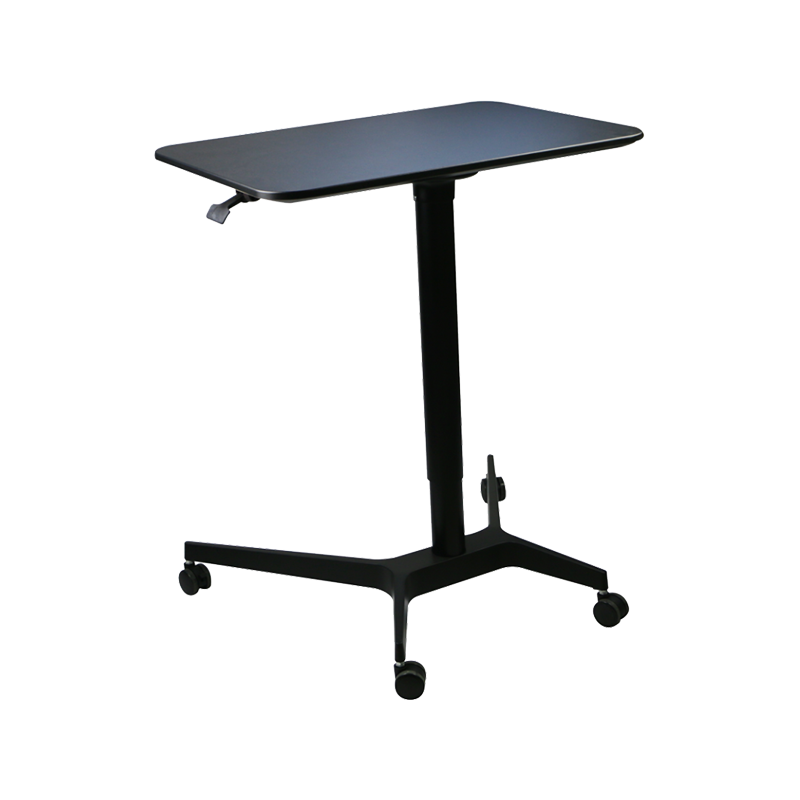
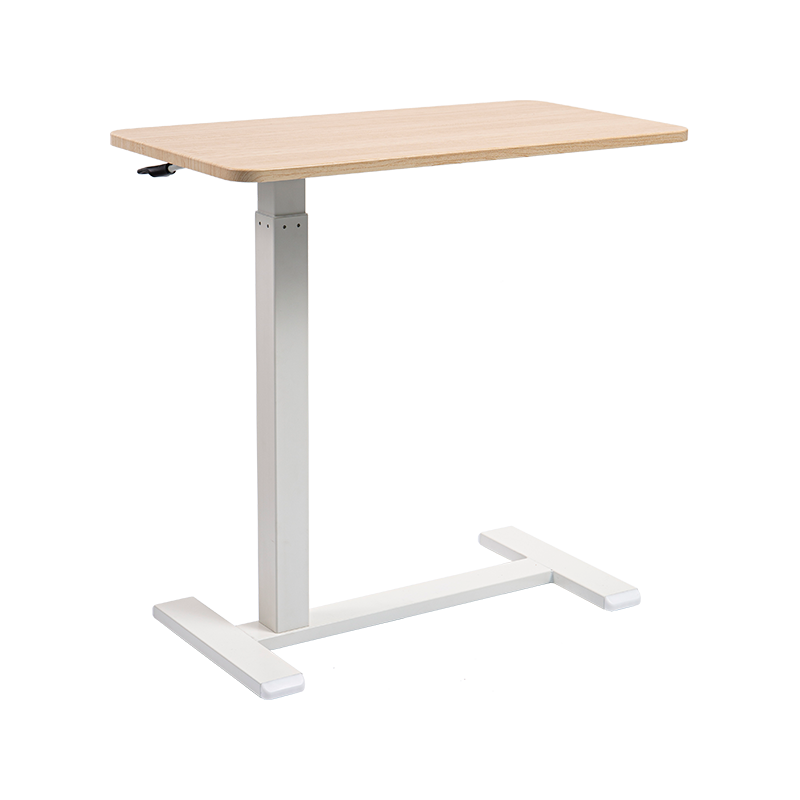
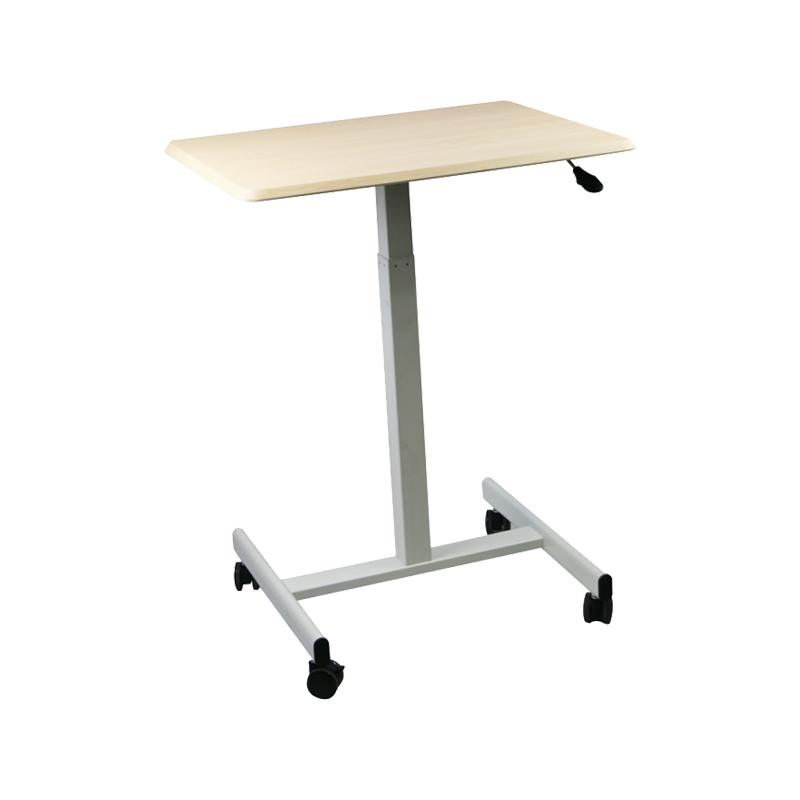
TH01-3 iPad (Flat-Legged) Pneumatic Height-Adjustable Desk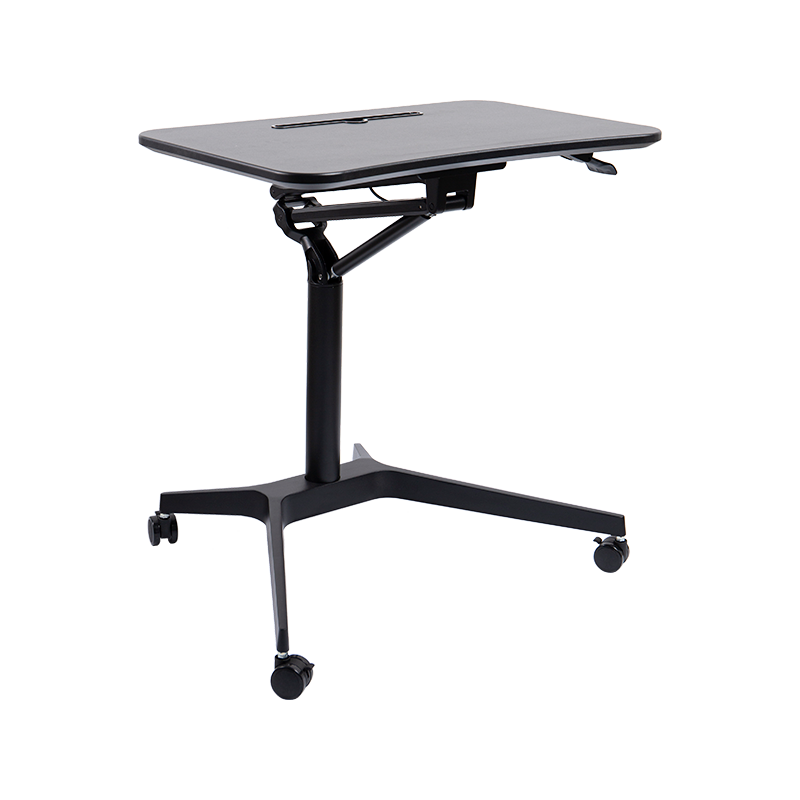
The core value of this desk lies in its balance of ergonomic adjustment, mobility, compactness, and durability. It is large enough to support everyday tasks and digital devices, yet compact enough to pass through busy work areas and fit into smaller rooms. Its four casters, including two lockable wheels and two non-locking wheels, make it easy to move and secure. Its triangular flat-legged support design helps provide stability while maintaining a clear and modern visual profile.
SuZhou Skyhone Intelligent Technology Co., Ltd. develops and manufactures standing desk solutions with an emphasis on intelligent office space, ergonomic comfort, and reliable industrial production. Located in Suzhou, in the Yangtze River Delta region, the company benefits from a mature furniture and manufacturing supply chain. This industrial environment supports material sourcing, metal processing, surface treatment, component assembly, quality control, and product customization. As a result, the TH01-3 is not merely a simple mobile table; it is a product shaped by manufacturing discipline, component integration, and practical user-centered design.
Product Overview
The TH01-3 iPad Flat-Legged Pneumatic Height-Adjustable Desk belongs to the pneumatic height-adjustable table category. It uses gas spring lifting rather than an electric motor or a traditional mechanical screw mechanism. The lifting range is 750 mm to 1060 mm, giving users a total adjustment span of 310 mm. This range supports different user heights and different working postures, from seated writing and device operation to standing demonstrations and quick collaborative tasks.
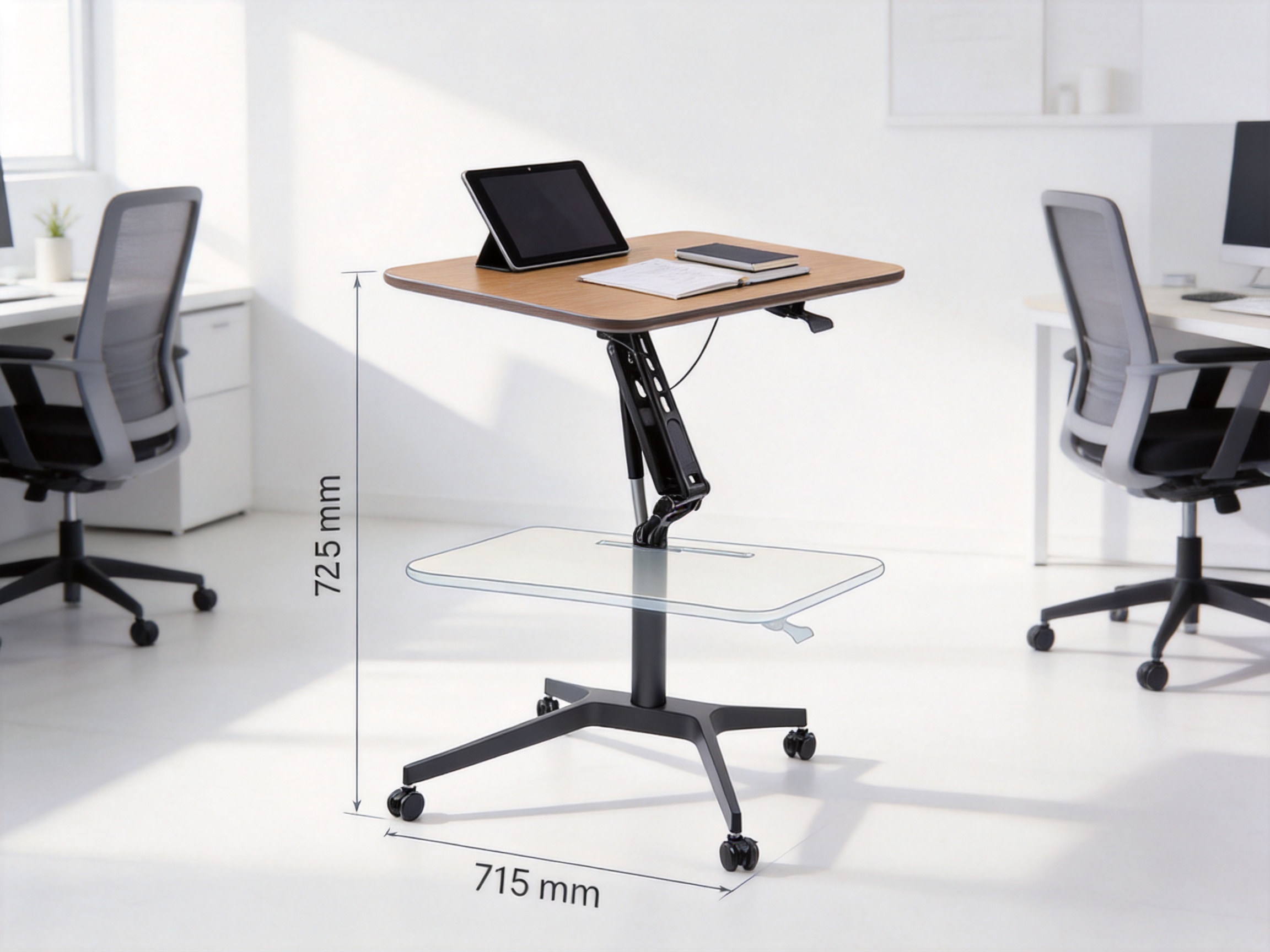
The tabletop measures 715 mm by 475 mm by 25 mm. This size is suitable for a tablet, notebook computer, testing equipment, documents, tools, educational materials, or product samples. The tabletop is made from 25 mm MDF with a PVC vacuum-formed surface. MDF provides a uniform core with good dimensional stability, while PVC vacuum forming helps create a smooth, continuous surface with better resistance to daily wear, light impact, and easy cleaning requirements.
The frame combines aluminum and iron, providing a balance between strength, weight control, and manufacturing efficiency. Aluminum contributes corrosion resistance and a refined appearance, while iron provides structural rigidity and load-bearing capability. The frame surface is treated with powder coating, available in white, silver, and black. Powder coating is widely used in durable furniture and equipment frames because it creates a consistent finish that resists chipping, scratching, and corrosion better than many conventional liquid paint processes.
The panel colors include white, maple, walnut, and black, giving buyers options for different environments. White supports clean medical, educational, and technology-oriented interiors. Maple and walnut create warmer furniture tones for office and training spaces. Black offers a professional and modern appearance suitable for technical workstations, display rooms, and demonstration areas.
The foot design is one of the distinguishing features of the TH01-3. The triangular support structure is more linear, the outward angle of the legs is slightly larger, the lines at the center connection are more distinct, and the structural transition is more direct. This gives the base a stronger visual identity while contributing to practical stability. The flat-legged form makes the product look lighter and more modern than bulky pedestal-style mobile tables.
Key Specifications
Item |
Specification |
User Benefit |
Lifting range |
750 mm to 1060 mm |
Supports seated and standing working positions |
Tabletop dimensions |
715 mm by 475 mm by 25 mm |
Compact enough for mobility while offering practical work surface area |
Tabletop material |
25 mm MDF plus PVC vacuum forming |
Provides a stable core, smooth surface, and improved daily wear resistance |
Frame material |
Aluminum plus iron |
Balances strength, durability, and structural support |
Surface treatment |
Powder coating in white, silver, or black |
Enhances appearance, corrosion resistance, and long-term durability |
Caster configuration |
Two lockable casters and two non-locking casters |
Enables easy movement and secure positioning during use |
Panel color options |
White, maple, walnut, and black |
Fits different workspace styles and project requirements |
Working principle |
Gas spring lifting |
Allows smooth manual height adjustment without electrical power |
Ergonomic Value of Pneumatic Height Adjustment
Ergonomics is not only about comfort; it is also about adaptability. A workstation that can be adjusted to suit the user and the task helps reduce awkward postures and supports more natural movement during the day. The 750 mm to 1060 mm adjustment range of the TH01-3 allows it to serve different users and different activities. A seated user can lower the desk for writing, typing, checking a tablet, or handling small components. A standing user can raise it for demonstration, discussion, scanning, device control, or light inspection tasks.
The gas spring lifting system is particularly useful in environments where fast height changes are needed. Electric desks offer precise motorized adjustment, but they require power access and may be less convenient when the workstation is frequently moved. A gas spring system removes dependence on electrical infrastructure. Users can adjust the desk manually without searching for an outlet or managing cables. This is a major advantage in classrooms, laboratories, temporary workstations, event spaces, showrooms, and production support areas.
Compared with fixed-height desks, the pneumatic design reduces compromise. A fixed table often suits only one posture or one average user height. When multiple users share a desk, some may need to bend forward, lift their shoulders, or position their arms awkwardly. Over time, poor workstation height can contribute to discomfort in the neck, shoulders, wrists, and back. An adjustable table allows the working surface to be better aligned with the user’s body and task.
Compared with crank-operated height-adjustable tables, the TH01-3 offers faster and more intuitive operation. Crank mechanisms can be useful for heavier desks, but they require repeated turning and may discourage users from changing posture frequently. A gas spring desk is easier to operate for quick transitions. The more convenient the adjustment system, the more likely users are to actually use the ergonomic feature.
Compared with some low-cost mobile tables, the TH01-3 offers a more complete ergonomic and structural package. It is not simply a rolling side table. It has a defined height range, a purposeful lifting mechanism, a stable triangular support base, lockable casters, and material choices designed for frequent use. These details matter in professional environments where furniture must perform consistently throughout the workday.
Mobility as a Core Advantage
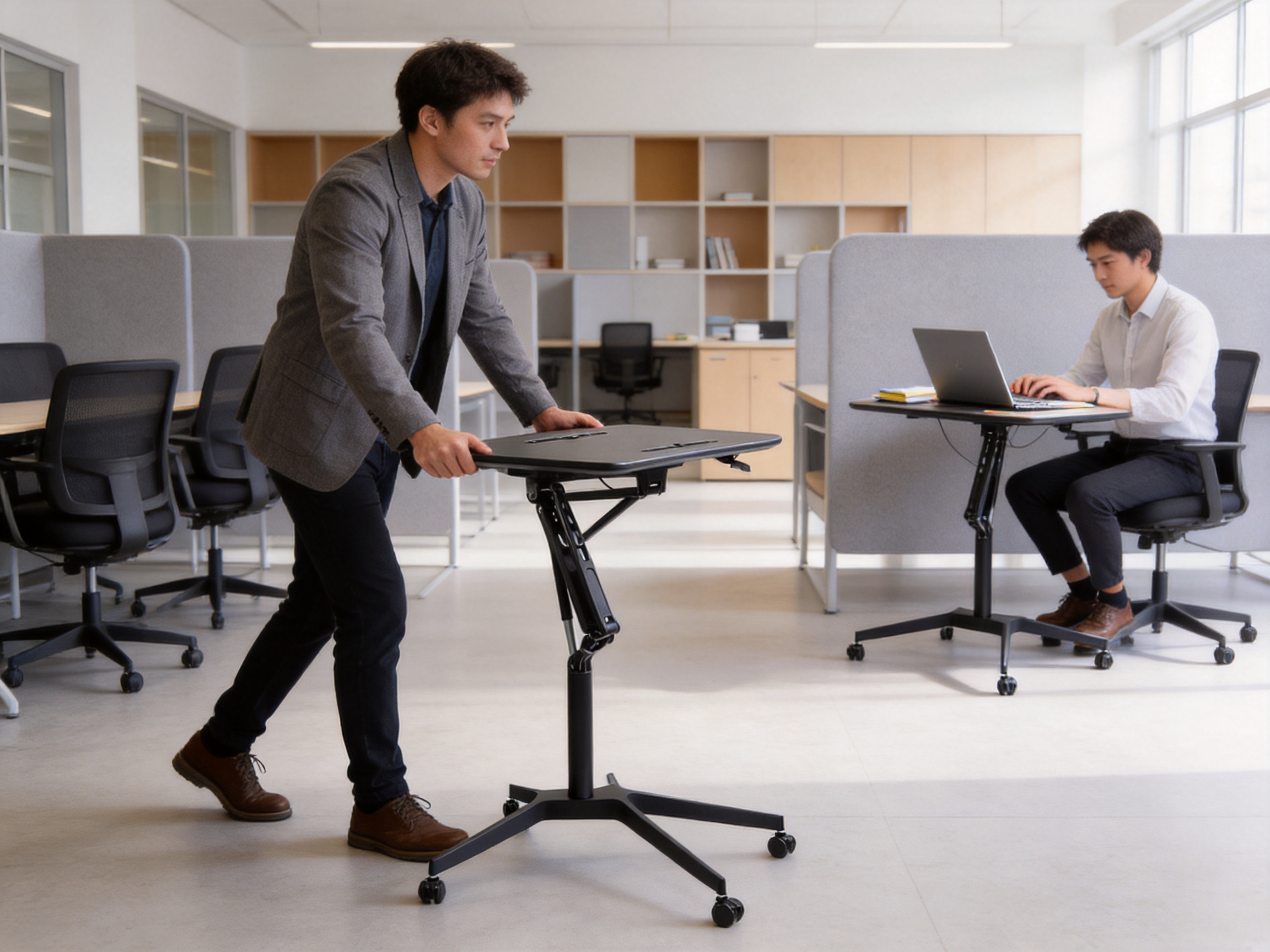
Mobility is one of the strongest advantages of the TH01-3. Many height-adjustable desks are designed to stay in one place. They provide ergonomic flexibility but limited spatial flexibility. The TH01-3 provides both. The caster base allows the table to be moved easily between rooms, between workstations, or around a single workspace. When it reaches the required location, the two lockable casters help keep it stable during use.
This combination of movement and locking stability is valuable in multi-purpose environments. For example, in an educational training room, an instructor may use the desk as a mobile teaching platform. In a product showroom, staff may move the desk to demonstrate a device or support a presentation. In a testing area, technicians may move the table between equipment stations. In an office, it can function as a temporary standing station or collaborative desk during quick discussions.
The compact tabletop size also supports mobility. A larger table may offer more surface area but can be difficult to maneuver in narrow spaces. The 715 mm by 475 mm tabletop provides a practical balance: it is wide enough for useful work, yet compact enough to remain agile. This makes the desk especially relevant for modern spaces where floor area must be used efficiently.
Mobility also contributes to cost efficiency. Instead of installing multiple fixed workstations for occasional tasks, organizations can use mobile adjustable desks that can be shared across departments, classrooms, or project teams. A single mobile table can support different workflows throughout the day. This flexibility can reduce furniture redundancy and improve workspace utilization.
Flat-Legged Triangular Support Design
The TH01-3 uses a flat-legged structure with a triangular support concept. This is not only an aesthetic choice; it is a functional design decision. The outward angle of the legs creates a broader stance, helping distribute forces more effectively. The triangular geometry supports stability by creating a clear load path from the tabletop through the central lifting column and into the base.
Many mobile desks suffer from one of two problems: they are either too bulky or not stable enough. A bulky base may improve stability but reduce visual elegance and make the product harder to move around furniture. A lightweight base may look clean but feel unstable during use. The TH01-3 seeks a balanced approach. Its triangular support structure maintains a direct, linear appearance while offering a more confident stance.
The defined center connection and direct structural transition also contribute to the product’s professional appearance. In practical terms, clean transitions reduce unnecessary complexity, making the frame easier to inspect, maintain, and manufacture consistently. In visual terms, the desk looks purposeful rather than improvised. This matters in customer-facing spaces, training centers, and modern offices where furniture must support both function and brand image.
The flat-legged design can also help reduce interference with users’ feet and surrounding objects. A well-designed base should not make the user feel crowded or restricted. While every mobile workstation must balance caster placement, leg spread, and stability, the TH01-3’s design provides a direct and open form suitable for flexible use.
Tabletop Material and Surface Performance
The tabletop is made from 25 mm MDF with PVC vacuum forming. MDF is widely used in furniture manufacturing because it provides a smooth and consistent substrate. Unlike natural wood, MDF does not have grain direction, knots, or irregular density patterns. This makes it suitable for precision machining, edge forming, and surface finishing. A 25 mm thickness gives the tabletop a solid feel and helps resist deformation under normal use.
PVC vacuum forming adds practical value. In this process, a PVC film is heated and formed over the MDF surface under vacuum pressure. The result is a continuous, smooth finish that can cover the top and edges more uniformly than some separate laminate applications. This helps improve the tabletop’s resistance to wear, light impact, staining, and everyday cleaning. In workspaces where devices, tools, papers, or sample products are frequently placed on the desk, surface durability is important.
The tabletop color options allow the desk to fit different environments. White can make a space feel brighter and cleaner. Maple and walnut provide warmer natural tones that work well in offices and educational rooms. Black creates a more technical or premium impression and may suit product demonstration areas or electronics-related tasks.
Compared with thin or low-density tabletops, the 25 mm MDF structure gives the TH01-3 a more robust surface. Compared with untreated wood surfaces, PVC vacuum forming offers easier maintenance and more consistent finish quality. Compared with some metal tabletops, the MDF and PVC surface can feel warmer and more comfortable for general office, demonstration, and training applications.
Frame Materials and Powder-Coated Finish
The frame uses aluminum and iron. This combination allows the product to benefit from the strengths of both materials. Iron provides rigidity and structural support, which are important for the lifting column, base, and load-bearing parts. Aluminum can help reduce weight and improve corrosion resistance in selected components. Together, they create a frame suitable for a mobile height-adjustable desk that must remain strong but not overly heavy.
Surface treatment is powder coating, available in white, silver, and black. Powder coating is a dry finishing process in which charged powder particles adhere to the metal surface and are then cured under heat. The cured coating forms a durable layer that can resist scratches, corrosion, and general wear. For mobile furniture, this is especially important because frames may be touched, moved, bumped, or cleaned frequently.
Powder coating also provides environmental and manufacturing advantages compared with many solvent-based liquid coatings. It can reduce volatile organic compound emissions and improve coating utilization. The finish is typically uniform and durable, supporting consistent quality across production batches. For customers purchasing multiple units for offices, classrooms, or project facilities, consistent finish quality helps create a professional and unified appearance.
The availability of white, silver, and black frame finishes also supports customization. A white frame can match clean interiors and modern office furniture. Silver can create a technical or neutral appearance. Black provides strong contrast and a professional tone. Combined with the tabletop colors, these frame options allow buyers to configure the desk for different design schemes.
Gas Spring Lifting System
The working principle of the TH01-3 is gas spring lifting. A gas spring stores energy through compressed gas and provides controlled lifting assistance. When the user activates the mechanism, the gas spring helps raise or lower the tabletop smoothly within the designed height range. This creates a simple, efficient, and power-free adjustment experience.
One of the key advantages of gas spring lifting is independence from electricity. In many workspaces, power outlets are limited or already used by computers, chargers, monitors, testing devices, and other equipment. A pneumatic desk does not add another power demand. It also avoids cable clutter, which is particularly beneficial for mobile use. A desk that must be unplugged before movement is less convenient; a pneumatic desk can simply be moved and adjusted.
Gas spring systems are also quieter than many powered mechanisms. In classrooms, offices, libraries, and meeting spaces, noise matters. A quiet height adjustment supports a better user experience and avoids disturbing surrounding work. The absence of motors also reduces the number of electronic components that may require troubleshooting.
Compared with electric linear actuator desks, the TH01-3 does not aim to replace large dual-motor office desks used for heavy computer setups. Instead, it serves a different need: fast, mobile, compact, manually adjustable support. In its category, the gas spring mechanism is a strong advantage because it matches the product’s intended use. It provides the right level of adjustment without unnecessary weight, wiring, control panels, or maintenance complexity.
Advantages Over Competing Products
The TH01-3 has several competitive advantages when compared with fixed desks, basic mobile carts, crank-adjustable tables, and certain electric height-adjustable desks. Its strongest advantage is the combination of pneumatic adjustment and mobility. Many competitors offer one feature but not both. A fixed desk may be stable but cannot adapt. A mobile cart may move easily but may not support ergonomic height changes. An electric adjustable desk may adjust well but may be less convenient to move. The TH01-3 integrates these functions in a practical middle-ground format.
Another advantage is simplicity. Products with many electronic components can provide advanced features, but they may also introduce higher cost, more complex installation, and greater dependence on power infrastructure. The TH01-3 uses gas spring lifting, which provides smooth manual adjustment without electronics. For many use cases, this is the more efficient solution. Users do not need to program controls, manage cables, or worry about power availability.
The desk also offers better professional design than many low-cost portable tables. Its triangular support structure, powder-coated frame, and multiple finish options make it suitable for visible professional environments. Some mobile tables look temporary or improvised; the TH01-3 looks like a purpose-built piece of ergonomic furniture.
The tabletop construction is another competitive strength. The 25 mm MDF core gives the surface a substantial feel, while the PVC vacuum-formed finish improves practical durability. Some inexpensive mobile desks use thinner boards, exposed edges, or less refined surfaces that can wear quickly. The TH01-3’s tabletop is designed for repeated use in active environments.
Its caster configuration provides a practical balance between mobility and control. Four mobile wheels make movement easy, while two locking casters secure the desk when needed. This is important because a height-adjustable table must remain stable during writing, device operation, or product demonstration. A desk that moves unintentionally can be frustrating and unsafe. Lockable casters help prevent this issue.
The compact dimensions also provide a competitive advantage. Large desks may be difficult to move and may occupy too much space. Very small stands may not provide enough working area. The TH01-3’s tabletop size is well suited for tasks requiring a tablet, laptop, documents, tools, or a small device setup. It is not oversized, but it is not merely a narrow pedestal either.
Finally, the product benefits from the manufacturing background of SuZhou Skyhone Intelligent Technology Co., Ltd. The company’s focus on standing desks and ergonomic office solutions means the product is developed within a specialized manufacturing context rather than as a generic accessory. This contributes to better understanding of lifting mechanisms, frame stability, surface finishing, and user requirements.
Manufacturing Strengths Behind the Product
High-quality height-adjustable furniture requires more than assembling a tabletop and a base. It requires coordinated manufacturing across materials, mechanisms, surface treatments, and inspection processes. SuZhou Skyhone Intelligent Technology Co., Ltd. operates in Suzhou, an important manufacturing and furniture industry region in the Yangtze River Delta. This location provides access to an integrated industrial chain, including metal fabrication, furniture panel processing, coating services, component suppliers, logistics networks, and skilled production labor.
The company’s manufacturing strengths begin with product development. A pneumatic height-adjustable desk must be designed around user height range, lifting balance, table weight, gas spring force, frame geometry, caster placement, and stability. These factors must work together. If the gas spring force is not properly matched to the tabletop and frame, adjustment may feel too heavy or too abrupt. If the base geometry is not well designed, the desk may feel unstable at higher positions. If the tabletop is too large or too heavy, mobility and lifting performance may suffer. The TH01-3 reflects a balanced design approach in which each specification supports the overall function.
Metal processing is another important strength. Aluminum and iron components must be cut, formed, welded, drilled, assembled, and finished with dimensional consistency. In adjustable furniture, small alignment errors can affect lifting smoothness and stability. Accurate processing supports reliable assembly and better user experience. The frame’s direct structural transitions and defined center connection require manufacturing precision to maintain consistent geometry.
Surface finishing is also a key production capability. Powder coating requires proper surface preparation, coating application, curing temperature control, and inspection. A good powder-coated finish should be even, well-adhered, and visually consistent. Since the TH01-3 is mobile, its frame may experience frequent contact with hands, shoes, chair legs, equipment, and cleaning tools. Durable coating helps preserve appearance and extend service life.
The tabletop process combines MDF processing and PVC vacuum forming. The board must be cut accurately, shaped cleanly, and prepared for surface forming. Vacuum forming requires control of temperature, film tension, pressure, and adhesion to produce a smooth finish. Consistency is important because the tabletop is the part users see and touch most often. A refined tabletop communicates product quality immediately.
Assembly quality is equally important. The gas spring mechanism, lifting column, tabletop connection, base, and casters must be integrated carefully. The table should move smoothly, lock securely, and remain stable through repeated adjustment cycles. Quality inspection can include visual checks, height adjustment tests, caster function tests, locking checks, surface finish inspection, and packaging review.
Quality Control and Reliability
Reliability in a mobile pneumatic desk depends on repeated performance. Users may adjust the height several times a day and move the desk frequently. Therefore, each functional component must withstand routine operation. The gas spring must provide controlled lifting support. The frame must resist loosening and deformation. The casters must roll smoothly and lock effectively. The tabletop must remain stable and presentable after daily use.
A disciplined manufacturing process helps ensure this reliability. Incoming materials should be checked for consistency, including MDF quality, metal tube or profile dimensions, caster performance, and gas spring specifications. During production, metal parts should be processed accurately and coated consistently. During assembly, fasteners should be tightened properly, lifting components aligned correctly, and functional tests performed before packaging.
Packaging is also part of product quality. A desk can be well manufactured but still arrive damaged if packaging is inadequate. Mobile furniture includes metal components, corners, casters, and finished surfaces that must be protected during transport. Strong packaging design helps prevent scratches, dents, and surface damage.
For buyers, especially commercial buyers, reliability means lower maintenance effort and fewer interruptions. In offices, schools, laboratories, and demonstration spaces, furniture should support work rather than create problems. The TH01-3’s simple pneumatic mechanism and durable material choices help reduce operational complexity.
Applications in Modern Work Environments
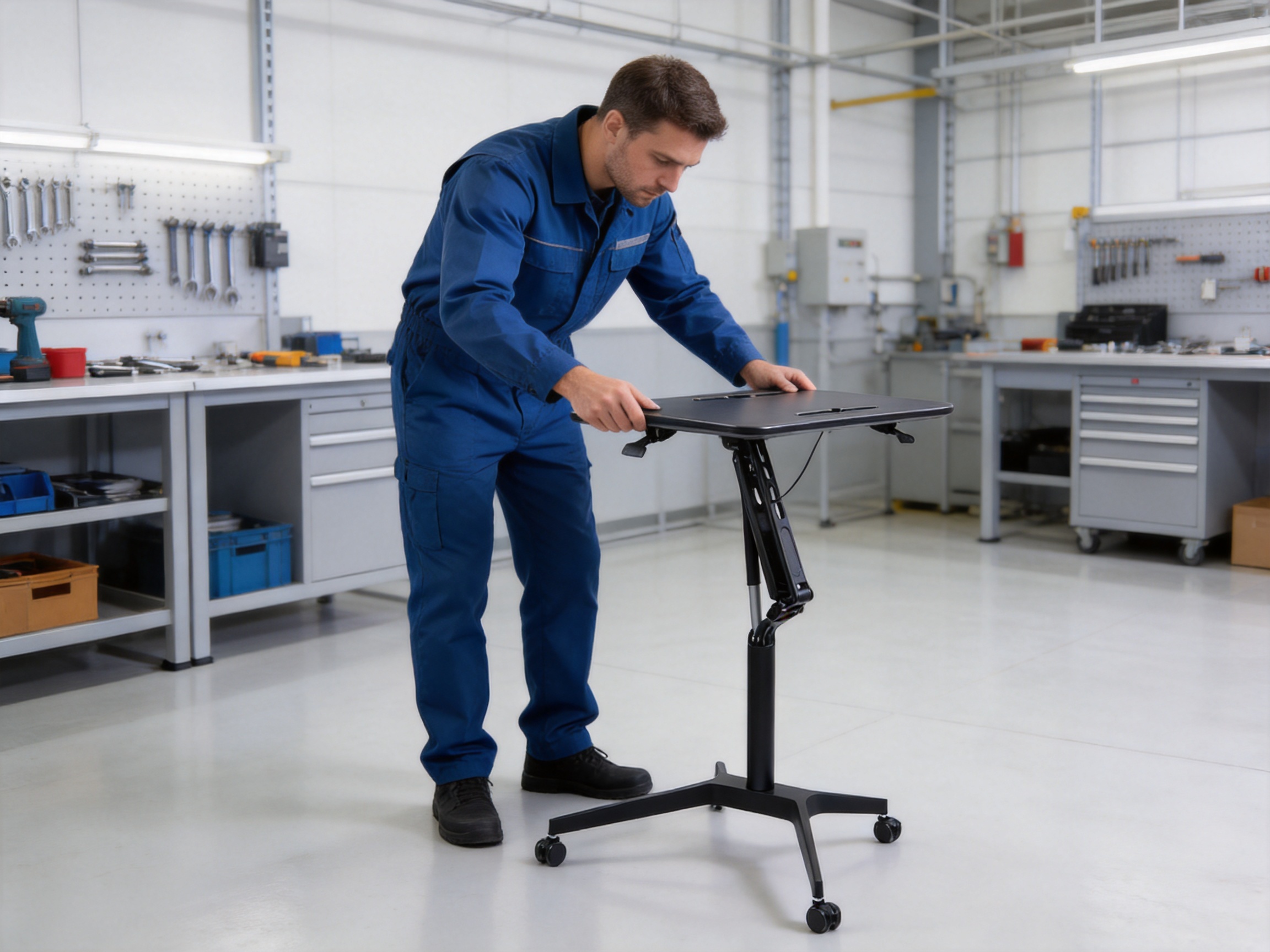
The TH01-3 is suitable for many environments that require frequent height or position adjustment. One important application is electronic device testing. Technicians often need a movable surface for tablets, instruments, cables, samples, or inspection tools. A compact height-adjustable desk can be moved between testing stations and adjusted to a comfortable working height. Since the desk does not require power for height adjustment, electrical outlets remain available for testing equipment.
Product demonstration is another strong application. Sales teams, showroom staff, or trainers can place a device, sample, or digital display on the tabletop and move the desk to the best position for viewers. The adjustable height allows the product to be displayed at seated or standing eye levels. The professional frame and tabletop finish support a clean presentation.
In educational training spaces, the desk can function as a mobile instructor station, tablet stand, teaching support table, or temporary student workstation. The ability to move the desk allows rooms to be reconfigured quickly. A teacher can use it at the front of the room, beside student groups, or in a demonstration area. Lockable casters keep it secure once positioned.
In light assembly stations, users may need a surface that can be adjusted for different tasks or operators. A desk set too low can cause bending; one set too high can strain the shoulders. The TH01-3’s height range gives more flexibility than fixed tables, especially for shared workstations. Its compact format suits smaller assembly tasks, inspection steps, or tool support.
Creative workspaces can also benefit from the desk. Designers, engineers, and project teams often move between computers, prototypes, sketches, and discussions. A mobile adjustable desk can act as a flexible side station for brainstorming, tablet use, sample review, or quick standing meetings. The desk can be moved where needed and stored when not in use.
Healthcare-adjacent and reception environments may also find value in mobile height-adjustable surfaces, provided the intended use matches the product’s load and cleaning requirements. A compact pneumatic desk can support check-in devices, forms, small equipment, or temporary work needs. The PVC surface and powder-coated frame make cleaning and maintenance more convenient than rough or unfinished materials.
User Experience and Daily Operation
A good mobile height-adjustable desk should feel intuitive. Users should not need extensive training to benefit from it. The TH01-3’s operation is straightforward: move the desk to the required location, lock the casters if stability is needed, and adjust the height through the gas spring lifting mechanism. This simplicity is one of the product’s greatest strengths.
The height range allows users to tune the tabletop position based on posture and task. For writing or seated tablet use, the desk can be lowered. For presentations or standing operation, it can be raised. Because the adjustment is manual and does not rely on electricity, users can change height wherever the desk is located.
Daily mobility is also convenient. The caster configuration supports smooth relocation. Two lockable casters help stabilize the table during use. This makes the product suitable for dynamic workplaces where furniture is frequently repositioned. When a meeting ends, a class changes activity, or a testing task moves to another station, the desk can move with the workflow.
Maintenance is simple compared with more complex electric desks. There are no motors, electronic control boxes, or digital panels associated with the height-adjustment function. Users should keep the surface clean, avoid overloading the tabletop beyond its intended use, check caster locks periodically, and ensure fasteners remain secure. The powder-coated frame and PVC-formed tabletop are designed for practical daily care.
Design Flexibility and Custom Appearance
Visual design matters in modern offices and professional environments. Furniture is part of the workspace identity. The TH01-3 offers several color combinations through tabletop and frame options. This allows the product to match different interior styles without changing its core structure.
White tabletop and white frame combinations can create a clean, minimal appearance. This is suitable for modern offices, technology demonstration areas, and training rooms. Maple or walnut tabletops with silver or black frames can create a warmer or more furniture-like appearance. Black-on-black combinations can fit technical, laboratory, or premium display environments.
The compact tabletop and linear support structure help the desk blend into different spaces. It does not dominate the room visually, yet it looks purposeful. This is important for mobile furniture, which may be used in many locations rather than one fixed area. A flexible visual design ensures the desk does not look out of place when moved from a meeting room to a training area or from a showroom to a testing station.
Why the TH01-3 Matches Current Workplace Trends
Workplace design has moved toward flexibility, wellness, and efficient use of space. Employees, instructors, technicians, and presenters often need furniture that supports multiple tasks. The TH01-3 aligns with these trends by providing height adjustability, mobility, and compact design in one product.
Health-conscious workspaces increasingly encourage posture changes. Standing all day is not the goal; sitting all day is not ideal either. The goal is movement and variation. A pneumatic height-adjustable desk makes posture changes easier. Because it is mobile, it can bring ergonomic support into areas where fixed standing desks may not be practical.
Space efficiency is another trend. Offices and institutions want rooms that can change function quickly. A training room may become a meeting room. A demonstration area may become a collaborative workspace. A testing station may need temporary extra surface area. Mobile adjustable desks support these changes without construction or permanent installation.
Simplicity is also valuable. Not every adjustable workstation requires motors, memory presets, or complex controls. For many tasks, a reliable gas spring system is more appropriate. It provides the needed flexibility with fewer dependencies and easier operation.
Company Manufacturing Capability and Industry Focus
SuZhou Skyhone Intelligent Technology Co., Ltd. is a professional manufacturing enterprise engaged in research and development, production, sales, and service of standing desk products. Its focus on healthy, efficient, and intelligent office space solutions provides a strong foundation for products such as the TH01-3. A company that specializes in adjustable furniture understands the importance of lifting performance, frame stability, user ergonomics, surface durability, packaging, and customization.
The company’s location in Suzhou Industrial Park and the broader Yangtze River Delta region supports manufacturing competitiveness. This region has a dense network of suppliers and processing capabilities, allowing efficient sourcing and production coordination. For height-adjustable desks, this can include metal components, lifting systems, tabletops, casters, coatings, packaging materials, and quality services.
Advanced manufacturing strength is not only about machines; it is also about process control. A product like the TH01-3 requires coordination between design, material selection, production tooling, assembly procedures, and inspection standards. The company’s experience in standing desks helps support this coordination. By focusing on ergonomic adjustable office furniture, it can refine product details based on real user needs and market requirements.
Customization is another important capability. Commercial buyers may require specific tabletop colors, frame colors, packaging arrangements, or project-based configurations. The available panel colors and powder-coating options show that the product is already designed with customization in mind. For distributors, office furniture projects, educational procurement, and specialized workstation planning, this flexibility can be a significant advantage.
Comparing Pneumatic, Electric, and Fixed Workstations
To understand the TH01-3’s market position, it is useful to compare pneumatic, electric, and fixed workstation types. Fixed desks are simple and usually cost-effective, but they do not adapt to different postures or users. They are best for stable environments where one height is acceptable. However, modern work often involves shared users and changing tasks, making fixed height less ideal.
Electric height-adjustable desks provide excellent adjustment for office setups, especially when supporting monitors, computers, and heavier accessories. They can include memory presets and precise control. However, they require power and are often larger and less mobile. For a permanent office desk, electric adjustment can be the right choice. For a mobile demonstration or training workstation, electric systems may add unnecessary complexity.
Pneumatic desks occupy a valuable middle position. They adjust quickly, do not need power, and can be designed for mobility. The TH01-3 is an example of a pneumatic solution optimized for compact, flexible, and practical use. It may not replace a large electric executive desk, but it can outperform electric desks in situations where movement, simplicity, and fast repositioning matter more than powered precision.
This distinction is important for buyers. The best product is not always the most complex product. The best product is the one that fits the use case. For mobile workstations, light assembly, teaching, demonstrations, and shared environments, the TH01-3’s pneumatic system offers an efficient and competitive solution.
Procurement Considerations for Buyers
Organizations evaluating the TH01-3 should consider how the desk will be used. If the requirement is a mobile, compact, height-adjustable surface for tablets, documents, demonstrations, light tools, or temporary work, the product is a strong fit. If the requirement is a large permanent workstation carrying multiple monitors and heavy equipment, a larger electric desk may be more suitable. Understanding the task ensures the right product selection.
Buyers should also consider the value of mobility. In many environments, the ability to share a workstation across rooms or departments can be more valuable than a larger fixed desk. The TH01-3 can support agile workflows, reduce furniture redundancy, and make spaces more flexible.
Color selection should match the environment. White and silver may suit bright modern interiors. Black may suit technical or professional spaces. Maple and walnut tabletops can soften the appearance and integrate well with traditional office furniture. Selecting the right combination can improve acceptance and visual harmony.
Maintenance requirements are another procurement factor. Because the desk uses a gas spring mechanism rather than an electric motor, daily operation is simple. The PVC-formed tabletop and powder-coated frame support easy cleaning. Lockable casters provide operational safety when the desk is in use.
Commercial buyers may also value supplier capability. Working with a specialized manufacturer can support more consistent product quality, clearer communication, and better project coordination. SuZhou Skyhone Intelligent Technology Co., Ltd. offers experience in ergonomic adjustable desks and intelligent office furniture solutions, which can be valuable for distributors, project buyers, and organizations seeking custom adjustable office table solutions.
Sustainability and Long-Term Practical Value
Sustainability in furniture is not only about materials; it is also about long-term usefulness. A product that can serve multiple functions and remain in use for a long time reduces unnecessary replacement. The TH01-3 supports this idea through flexible application, durable surfaces, and adaptable height adjustment.
Because the desk is mobile, it can continue to be useful even when room layouts change. A fixed table may become unsuitable when a department reorganizes or a room changes function. A mobile adjustable desk can be reassigned. This improves lifecycle value.
The powder-coated finish contributes to long-term appearance and corrosion resistance. The PVC vacuum-formed tabletop supports daily wear resistance and maintenance. The gas spring mechanism avoids electrical components for height adjustment, reducing dependence on electronic parts and power access.
From a space planning perspective, flexible furniture can reduce the need for multiple specialized tables. A single TH01-3 can support presentation, training, testing, and temporary workstation needs at different times. This efficient use of resources contributes to practical sustainability.
Installation and Use Recommendations
For best performance, the desk should be assembled according to the manufacturer’s instructions and used within its intended application range. The tabletop should be used for appropriate office, training, demonstration, and light-duty tasks. Users should avoid placing excessive or unbalanced weight on the surface, especially when the desk is raised to its highest position.
Before moving the desk, users should unlock the lockable casters. After positioning it, they should lock the appropriate casters to prevent unintended movement. Height adjustment should be performed smoothly and with attention to objects on the tabletop. Cables from devices placed on the desk should have enough slack to prevent pulling during height adjustment or movement.
Routine care should include wiping the tabletop with suitable cleaning materials, checking caster function, and inspecting visible fasteners. The powder-coated frame should be cleaned with non-abrasive methods to preserve the finish. The PVC surface should not be exposed to sharp cutting tools or extreme heat unless protective mats are used.
In shared environments, simple user guidance can improve safety and satisfaction. A brief instruction label or staff training can remind users to lock casters, adjust height carefully, and avoid overload. Because the product is intuitive, extensive training is usually unnecessary, but basic operating habits help preserve performance.
Q&A Section
What is the main purpose of the TH01-3 pneumatic height-adjustable desk?
The main purpose is to provide a compact, mobile, and height-adjustable workstation for flexible tasks. It is suitable for seated and standing use, product demonstrations, electronic device testing, education, training, light assembly, and creative workspaces.
What is the height adjustment range?
The lifting range is 750 mm to 1060 mm. This range allows users to work in seated or standing postures and adapt the surface height to different tasks.
How does the desk adjust height?
The desk uses a gas spring lifting mechanism. This allows smooth manual height adjustment without electric power, motors, or control panels.
Why choose a pneumatic desk instead of an electric desk?
A pneumatic desk is ideal when mobility, simplicity, and power-free operation are important. It avoids cables and electrical dependence, making it convenient for classrooms, showrooms, testing areas, and flexible workspaces.
What are the tabletop dimensions?
The tabletop measures 715 mm by 475 mm by 25 mm. It provides enough working area for tablets, documents, small devices, tools, or demonstration materials while remaining compact and easy to move.
What materials are used for the tabletop?
The tabletop uses a 25 mm MDF core with a PVC vacuum-formed surface. This combination provides a stable structure, smooth finish, and improved resistance to daily wear and light impact.
What materials are used for the frame?
The frame is made from aluminum and iron. This combination supports strength, durability, and practical mobility.
Does the desk have wheels?
Yes. It has four casters, including two lockable casters and two non-locking casters. This allows easy movement and secure positioning.
What color options are available?
The tabletop is available in white, maple, walnut, and black. The powder-coated frame is available in white, silver, and black.
What makes the flat-legged design useful?
The flat-legged triangular support structure improves visual clarity and helps create a stable base. The outward leg angle and direct structural transitions support both function and modern appearance.
Who manufactures the product?
The product is manufactured by SuZhou Skyhone Intelligent Technology Co., Ltd., a professional enterprise focused on standing desks and ergonomic office space solutions.
What are the main competitive advantages?
The main advantages include gas spring height adjustment, power-free operation, compact mobility, lockable casters, a durable PVC-formed tabletop, powder-coated metal frame, stable triangular support structure, and flexible color options.
Conclusion
The TH01-3 iPad Flat-Legged Pneumatic Height-Adjustable Desk is a practical response to the needs of modern flexible workspaces. It is not simply a small table with wheels, and it is not a large stationary electric desk. It occupies a valuable category between these extremes, offering ergonomic height adjustment, easy mobility, stable support, durable materials, and clean visual design.
Its 750 mm to 1060 mm lifting range supports multiple postures and users. Its gas spring lifting system provides smooth manual operation without power. Its 715 mm by 475 mm tabletop is compact yet functional. Its 25 mm MDF and PVC vacuum-formed surface improves everyday durability. Its aluminum and iron frame with powder coating supports long-term use and professional appearance. Its caster design enables movement and secure placement. Its flat-legged triangular support structure creates both stability and modern style.
Compared with fixed desks, the TH01-3 offers far greater ergonomic adaptability. Compared with basic mobile carts, it provides better height adjustment, structure, and finish quality. Compared with crank tables, it offers faster adjustment. Compared with many electric desks, it provides greater mobility and simpler power-free operation. These advantages make it a strong choice for offices, schools, testing facilities, showrooms, creative workspaces, and light assembly environments.
Behind the product is the manufacturing capability of SuZhou Skyhone Intelligent Technology Co., Ltd., supported by its specialization in standing desks and its location in the advanced industrial ecosystem of Suzhou and the Yangtze River Delta. The company’s strengths in product development, metal processing, surface treatment, tabletop production, assembly, quality control, and customization help transform a simple concept into a reliable ergonomic workstation.
For organizations seeking a flexible, durable, and easy-to-use adjustable office table, the TH01-3 provides a compelling solution. It supports healthier posture variation, improves workspace adaptability, and delivers professional quality in a compact mobile form. As work environments continue to change, products like this pneumatic height-adjustable desk will become increasingly important for creating efficient, comfortable, and responsive spaces.
References
Bridger, R. S. Introduction to Human Factors and Ergonomics. CRC Press.
Kroemer, K. H. E., and Grandjean, E. Fitting the Task to the Human: A Textbook of Occupational Ergonomics. Taylor and Francis.
Pheasant, S., and Haslegrave, C. M. Bodyspace: Anthropometry, Ergonomics and the Design of Work. CRC Press.
Karwowski, W., and Marras, W. S. Occupational Ergonomics: Principles of Work Design. CRC Press.
ASHRAE. Indoor Environmental Quality and Workspace Comfort Guidelines. American Society of Heating, Refrigerating and Air-Conditioning Engineers.
BIFMA. General-Purpose Office Furniture Standards and Ergonomic Design Considerations. Business and Institutional Furniture Manufacturers Association.
Product: TH01-3 iPad (Flat-Legged) Pneumatic Height-Adjustable Desk


- Contact Info
-
-
 Phone+86-15950656125
 -
 Email
Email -
 AddressRoom 1007-1, South Building, Suyue Plaza, Suzhou Industrial Park, Suzhou City, Jiangsu Province, China
-
- Products
- Follow Us
- Need help? Please contact us
Copyright ©
SuZhou Skyhone Intelligent Technology Co., Ltd.
All Rights Reserved.
Privacy
Custom Ergonomic Adjustable Office Tables Manufacturers

