

 English
  русский
  Español
  عربى
عربى 
Content
- 1 Product Overview: A Compact Pneumatic Desk for Flexible Work
- 2 Key Specifications
- 3 Design Philosophy: Simple, Mobile, and Ergonomic
- 4 Gas Spring Lifting: The Advantage of Electricity-Free Adjustment
- 5 Ergonomic Value: Supporting Movement During the Workday
- 6 Mobility and Locking Casters: A Desk That Moves With the Task
- 7 Material Strength: Aluminum and Iron for Daily Reliability
- 8 Powder Coating and Surface Quality
- 9 Advanced Manufacturing Strength Behind the Product
- 10 Advantages Over Conventional Fixed Desks
- 11 Advantages Over Electric Standing Desks in Specific Use Cases
- 12 Advantages Over Basic Mobile Tables
- 13 Application Scenario: Home Office
- 14 Application Scenario: Hot-Desking and Shared Offices
- 15 Application Scenario: Classrooms and Training Rooms
- 16 Application Scenario: Laboratories and Technical Work Areas
- 17 Application Scenario: Creative Studios and Light-Duty Workstations
- 18 User Experience: Smooth Adjustment and Practical Control
- 19 Procurement Value for Distributors, Dealers, and Project Buyers
- 20 Manufacturing Process Focus: From Concept to Finished Desk
- 21 Quality Control and Reliability Considerations
- 22 Why the TH-13 Stands Out in the Adjustable Desk Market
- 23 Company Strength: Specialized Adjustable Desk Manufacturing
- 24 Maintenance and Daily Use Recommendations
- 25 Sustainability and Practical Resource Efficiency
- 26 Buyer Guidance: When to Choose the TH-13
- 27 Frequently Asked Questions
- 27.1 What is the height adjustment range of the TH-13?
- 27.2 Does the desk require electricity?
- 27.3 What is the tabletop size?
- 27.4 What materials are used in the desk?
- 27.5 What colors are available?
- 27.6 Can the desk be moved easily?
- 27.7 Where can the TH-13 be used?
- 27.8 How does the TH-13 compare with an electric standing desk?
- 27.9 How does the TH-13 compare with a fixed desk?
- 27.10 Is the desk easy to maintain?
- 27.11 Why is powder coating important?
- 27.12 What manufacturing strengths support this product?
- 28 Conclusion: A Practical Desk for the Future of Flexible Work
- 29 References
- 30 Product: TH-13 (Cat Head Leg Column with Square Panel Column) Pneumatic Height-Adjustable Desk
Pneumatic Height-Adjustable Desk for Flexible Sit-Stand Workspaces
2026-07-03
Modern work environments are changing quickly. Offices, laboratories, classrooms, studios, and home work areas no longer rely on one fixed posture or one fixed workstation layout. Users increasingly expect a desk that can move, adjust, and support multiple ways of working throughout the day. The TH-13 pneumatic height-adjustable desk is designed for this need. With a gas spring lifting system, a compact square tabletop, a metal structure, powder-coated surfaces, and mobile caster wheels, it provides a practical sit-stand platform for users who need ergonomic flexibility without the complexity of an electric system.
This article introduces the TH-13 pneumatic height-adjustable desk in detail, focusing on its structure, working principle, user benefits, manufacturing quality, application value, and competitive advantages. It also explains how SuZhou Skyhone Intelligent Technology Co., Ltd. combines product engineering, materials selection, metal processing, surface finishing, assembly control, and service capabilities to deliver reliable adjustable workspace solutions for global customers.
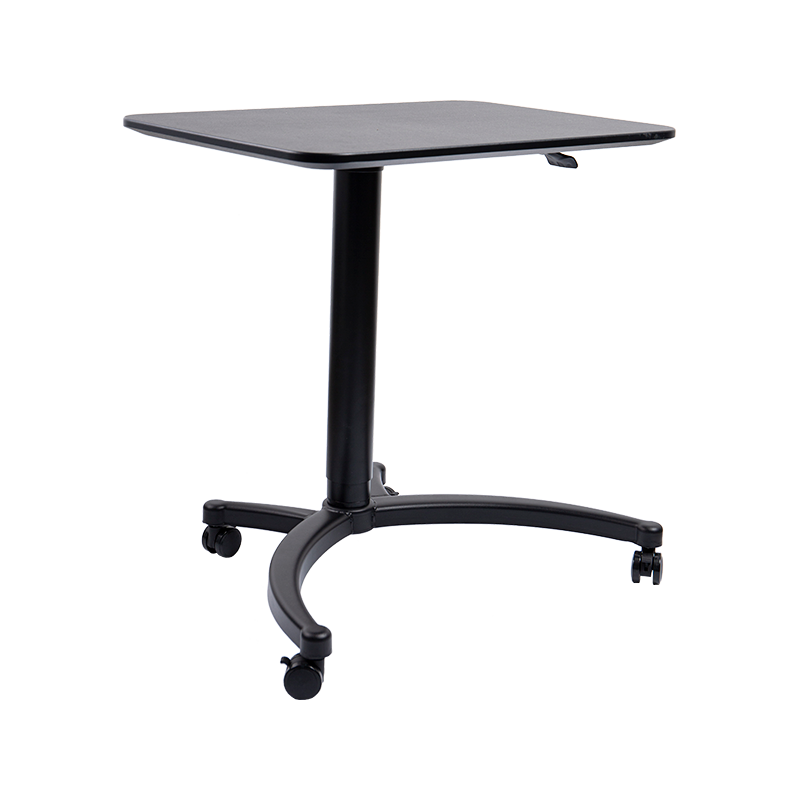
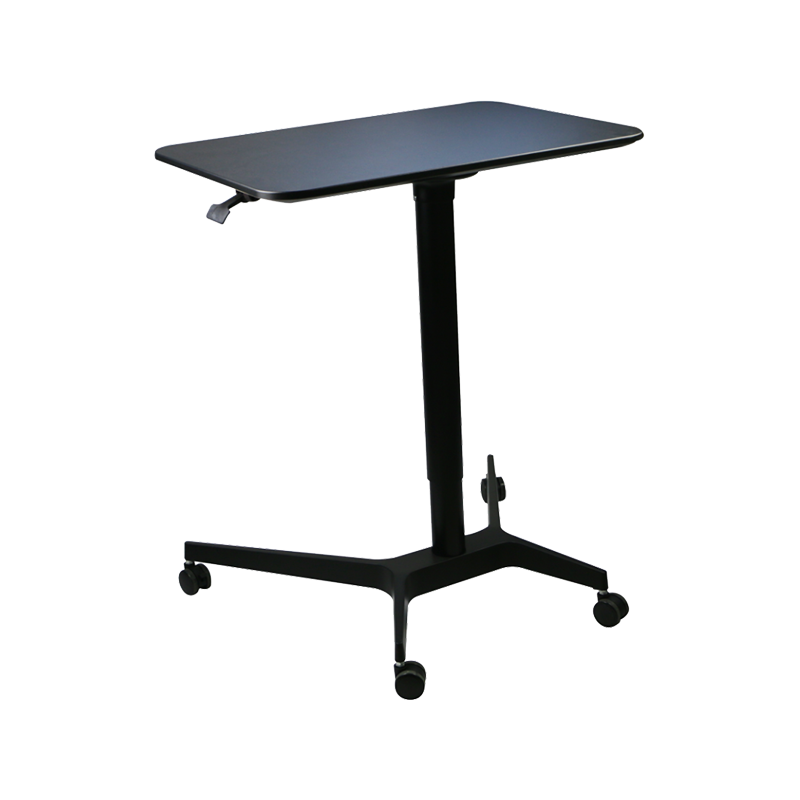
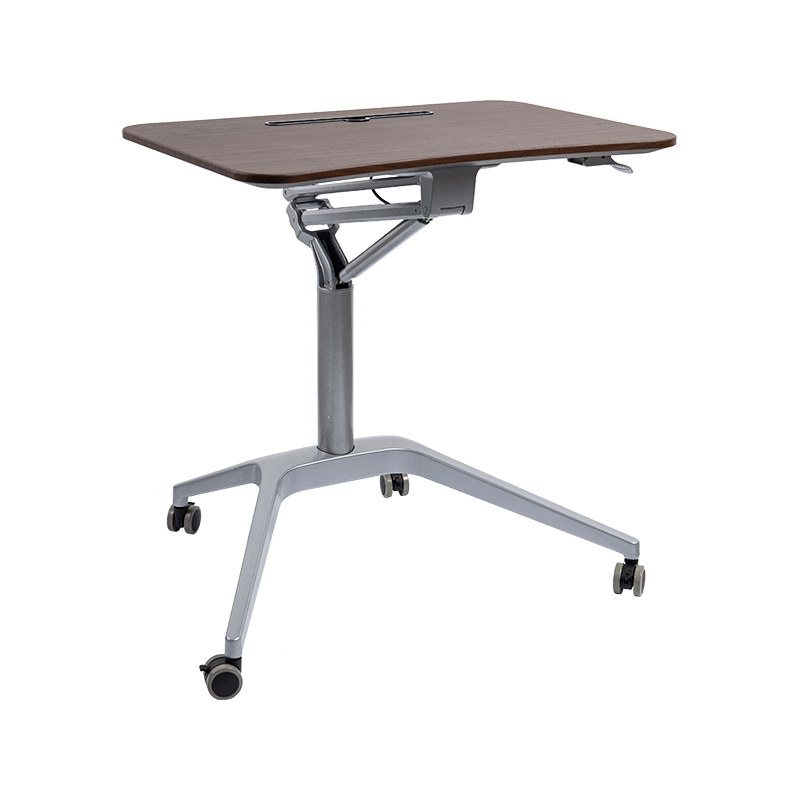
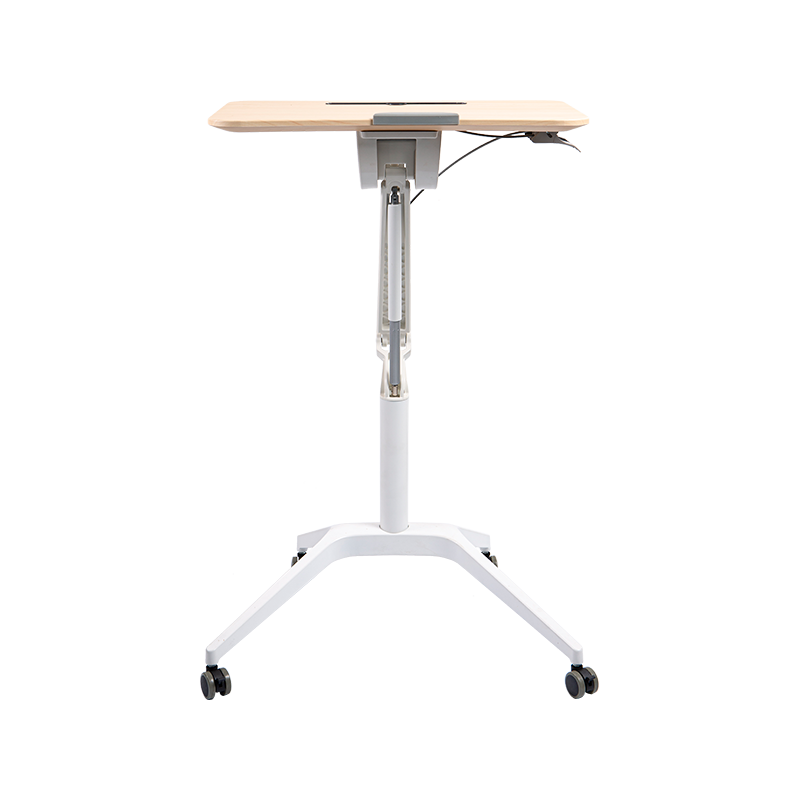
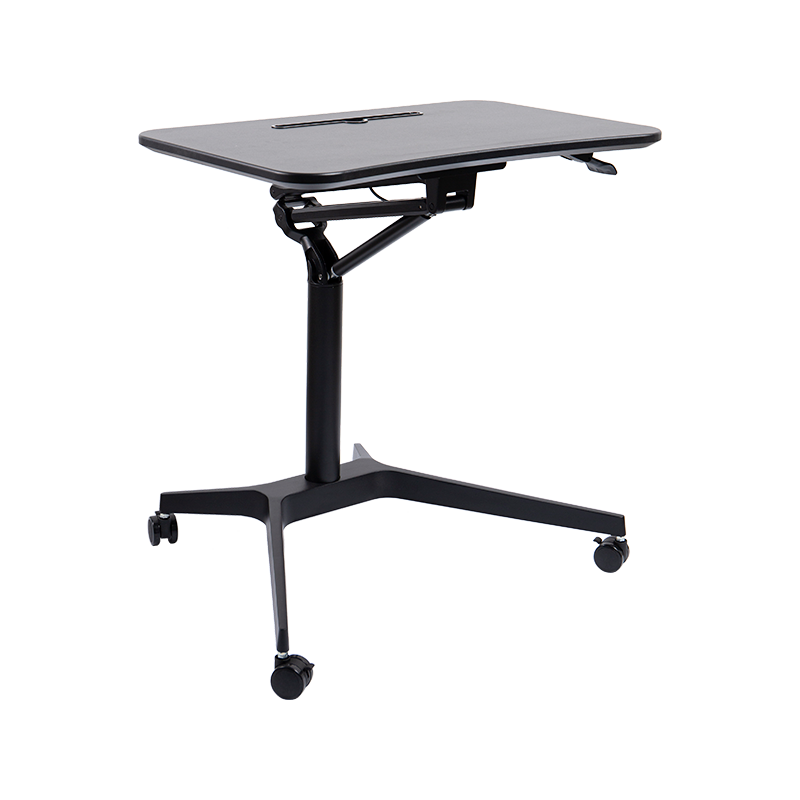
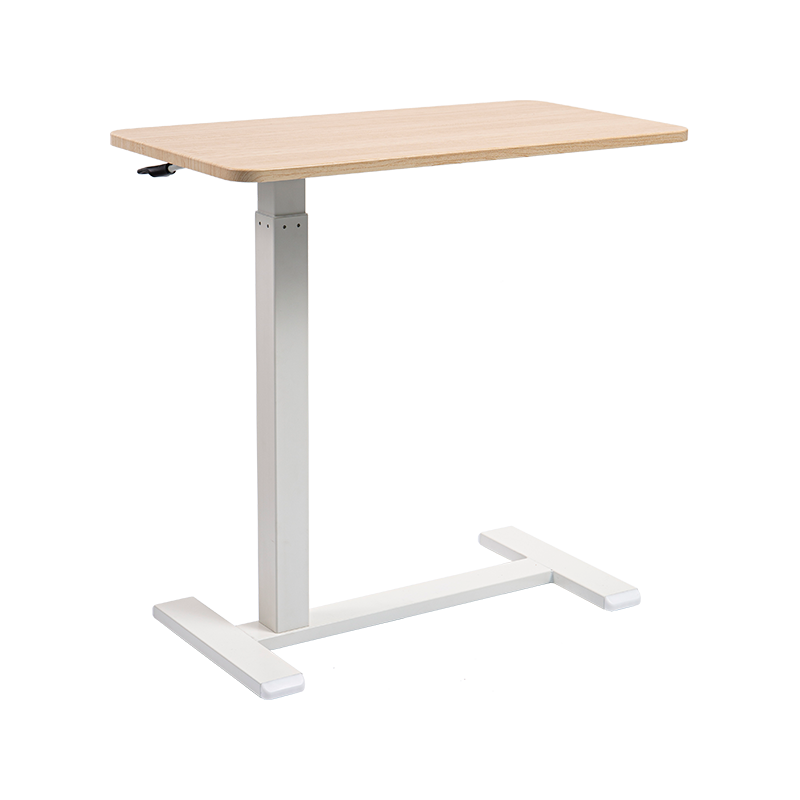
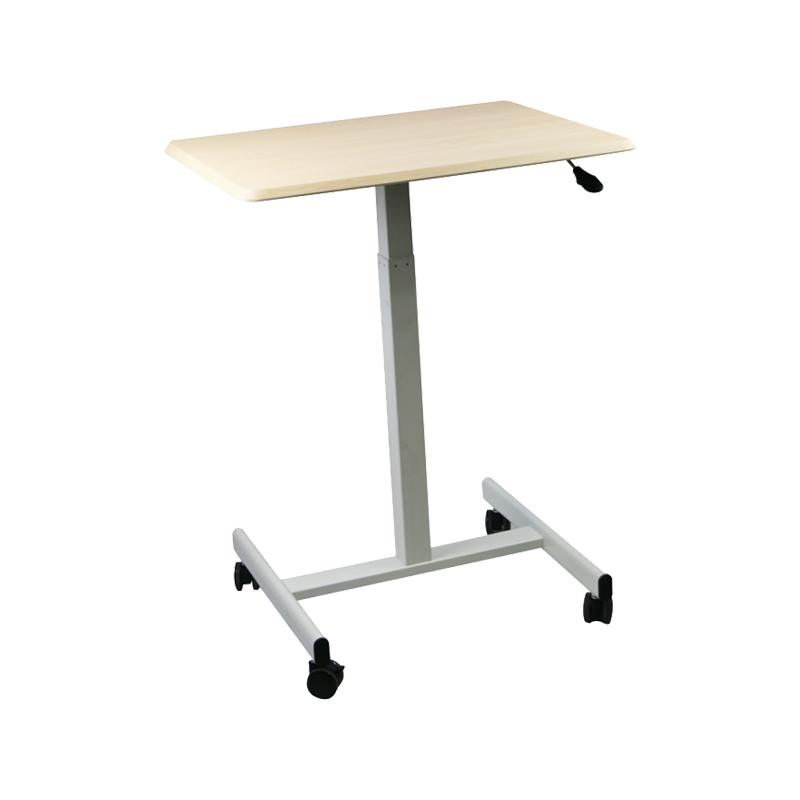
TH-13 (Cat Head Leg Column with Square Panel Column) Pneumatic Height-Adjustable Desk
Product Overview: A Compact Pneumatic Desk for Flexible Work
The TH-13 is a pneumatic height-adjustable table with a lifting range from 720 mm to 1130 mm. This range allows users to work in a seated position, a semi-standing position, or a full standing position according to their body height, task type, and personal comfort. Unlike fixed-height desks, the TH-13 supports posture changes during the day, helping users avoid staying in one position for too long.
The desktop measures 715 mm by 495 mm, making it suitable for compact environments. It can accommodate a laptop, monitor, keyboard, mouse, documents, instruments, or office accessories while still being easy to move through limited spaces. This makes it useful in home offices, shared work areas, small meeting rooms, education facilities, light-duty workshop stations, medical support rooms, and laboratory environments where space efficiency is important.
The desk uses a gas spring lifting mechanism. This means it does not require electric power, motors, control boxes, power cables, or digital control panels. The user can adjust the height manually and position the desktop at a preferred level within the adjustment range. The pneumatic system creates a smooth and simple lifting experience while maintaining a clean structure.
The main materials are aluminum and iron. This combination balances weight, strength, stability, and durability. The metal frame is finished by powder coating, available in black and white, giving the desk a clean appearance and improving resistance to daily wear. The base is equipped with four caster wheels: two with locking functions and two without locks. This design allows the desk to be moved when needed and fixed in position when work begins.
Key Specifications
Item |
Specification |
User Value |
Product model |
TH-13 |
Compact pneumatic sit-stand desk for flexible work environments |
Lifting range |
720 mm to 1130 mm |
Supports seated and standing work positions for different users |
Tabletop size |
715 mm by 495 mm |
Provides an efficient surface for office, study, laboratory, or light-duty tasks |
Main material |
Aluminum and iron |
Combines structural strength with practical mobility |
Surface color |
Black and white |
Fits modern office, home, school, and technical workspaces |
Surface treatment |
Powder coating |
Improves surface durability, appearance, and ease of cleaning |
Caster wheels |
Two locking casters and two non-locking casters |
Allows easy movement and stable positioning |
Working principle |
Gas spring lifting |
Provides electricity-free height adjustment with a simplified structure |
Design Philosophy: Simple, Mobile, and Ergonomic
The TH-13 is built around three practical ideas: height adjustability, mobility, and everyday stability. Many workstations can provide one of these functions, but not all combine them in a compact format. A fixed desk may be stable, but it does not support posture changes. A large electric standing desk may offer height adjustment, but it may be too large, too heavy, or too dependent on power cables for some environments. A mobile cart may move easily, but it may not provide a comfortable range for sit-stand work. The TH-13 addresses these common limitations by combining a pneumatic column, a compact tabletop, a metal structure, and lockable caster wheels.
The product is especially valuable in spaces where users need flexibility rather than permanent installation. In a shared office, a desk may need to be repositioned for different teams. In a classroom, it may be used by teachers, students, or presenters. In a laboratory, it may serve as a temporary instrument platform or documentation station. In a home office, it may allow a user to switch between sitting and standing without buying a full-size electric standing desk. The compact footprint makes the desk easy to place near a wall, beside a sofa, next to a bed, or within a narrow workstation area.
The square tabletop provides a balanced work surface. Its shape is simple, predictable, and easy to use with standard equipment. The 715 mm by 495 mm size is large enough for daily work tools but small enough to avoid occupying excessive floor area. The column structure and caster base help keep the desk mobile while maintaining a stable platform for normal office and light-duty applications.
Gas Spring Lifting: The Advantage of Electricity-Free Adjustment
One of the most important features of the TH-13 is its gas spring lifting system. Gas springs are widely used in adjustable furniture, monitor arms, lifting columns, medical equipment, industrial panels, and vehicle components because they can provide controlled movement without electric power. In the TH-13, the gas spring allows the desktop height to be adjusted within the 720 mm to 1130 mm range.
Compared with electric height-adjustable desks, a pneumatic desk has several clear advantages in suitable applications. First, it does not need access to a power outlet. This is useful in classrooms, mobile workstations, laboratories, exhibition spaces, and temporary office layouts where power connection may be inconvenient. Second, it avoids cable management problems. There is no need to route power cords from the floor, wall, or desk frame, which helps maintain a cleaner environment and reduces trip hazards.
Third, the structure is generally simpler. An electric desk usually includes motors, control boxes, wiring, switches, and power components. These parts may be highly useful for heavy-duty or programmable height adjustment, but they also increase complexity. The TH-13 uses a pneumatic lifting method, making the overall system easier to understand, operate, transport, and maintain. For users who need reliable manual height adjustment rather than electronic memory functions, this can be a more practical choice.
Fourth, pneumatic adjustment is quiet and immediate. There is no motor noise and no waiting for an electric actuator to move slowly through a height range. The user can make quick height changes according to the task. This is valuable in environments where multiple users share one workstation, or where the work surface must shift between writing, typing, inspection, display, and demonstration tasks.
The absence of electrical components also improves adaptability in some settings. For example, in certain laboratory or classroom areas, reducing electrical devices may simplify safety planning. In mobile office areas, a desk that can move without being unplugged is easier to manage. In home environments, users who want a clean and minimal setup may prefer a power-free height-adjustable desk.
Ergonomic Value: Supporting Movement During the Workday
Ergonomics is not only about the shape of a chair or the height of a desk. It is about matching the working environment to the human body and allowing variation over time. A desk that encourages posture change can help users create a healthier work rhythm. The TH-13 supports this by allowing the desktop to move between seated and standing heights.
When a user sits for a long time, pressure on the lower back, shoulders, and neck may increase, especially if the desk is not at the correct height. When a user stands for too long, fatigue in the legs and feet may occur. A height-adjustable desk makes it possible to alternate between positions, reducing the need to maintain a single posture for many hours. The TH-13 is designed for this practical movement-based approach.
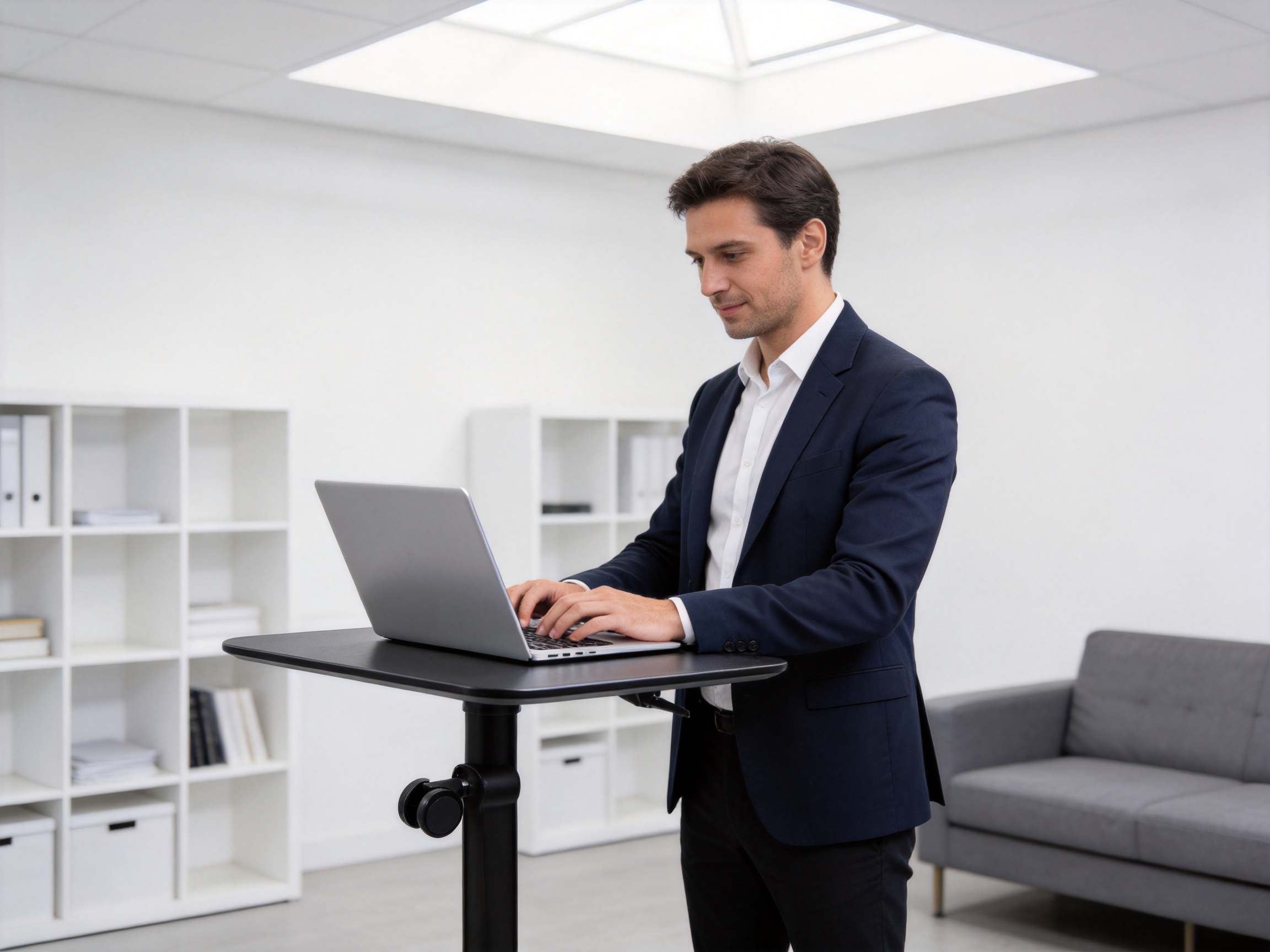
The lifting range of 720 mm to 1130 mm is useful for many common tasks. At lower positions, the desk can serve as a seated workstation for typing, writing, reading, or laptop use. At higher positions, it can support standing tasks such as presentations, quick meetings, inspection work, teaching, creative sketching, or equipment operation. This range gives users more control over their workspace and allows the same desk to serve different body heights and working styles.
The compact tabletop can help users organize essential items close at hand. A smaller surface discourages excessive clutter, which can improve focus and make repositioning easier. In many modern work environments, users do not need a large fixed desk for every task. Instead, they need a practical surface that can hold the most important tools while remaining flexible and mobile.
Mobility and Locking Casters: A Desk That Moves With the Task
The caster base is another key advantage of the TH-13. Many height-adjustable desks are fixed in one place because they are large, heavy, or connected to power. The TH-13 uses four caster wheels, including two with locking functions. This arrangement gives the desk two operating modes: mobile when movement is needed and stable when the casters are locked.
Mobility can dramatically improve the efficiency of shared spaces. In a training room, desks can be moved into rows, groups, or presentation layouts. In a studio, the workstation can be shifted closer to a display, camera, tool area, or sample table. In a laboratory, the desk can move between benches or serve as a temporary data recording platform. In a home office, it can be used beside a chair during one part of the day and moved away afterward to save space.
The locking casters help prevent unwanted movement during use. Once the desk is positioned, the user can lock two wheels to improve steadiness. This is especially useful when typing, writing, or placing equipment on the tabletop. The combination of mobility and locking support creates a balance between convenience and control.
Compared with traditional stationary desks, a mobile pneumatic desk reduces the time and effort needed to reconfigure a workspace. Instead of lifting furniture or planning around fixed positions, users can roll the desk to the best location for the current activity. This is important in modern workplaces where flexibility and fast adaptation are increasingly valued.
Material Strength: Aluminum and Iron for Daily Reliability
The TH-13 uses aluminum and iron as its main structural materials. This material selection reflects the need for strength, durability, and practical handling. Iron provides solid load-bearing capability and a stable structural foundation. Aluminum contributes useful weight management and corrosion resistance characteristics, depending on the component design and finish. Together, these materials create a desk frame suitable for daily office, education, laboratory, and light-duty operational use.
Metal construction offers important advantages over low-grade plastic or weak composite structures. It improves resistance to deformation, provides better long-term support, and gives the desk a professional appearance. A height-adjustable desk must remain stable through repeated lifting and lowering cycles, so the quality of its column, base, joints, and connecting parts is essential.
The powder-coated surface adds another layer of value. Powder coating is commonly used for furniture frames and metal equipment because it creates a consistent finish that can resist scratches, wear, and general environmental exposure better than many simple paint applications. It also produces a smooth and clean surface that is easy to wipe. For shared workspaces, classrooms, and laboratories, ease of cleaning is especially important.
The available black and white colors allow the desk to match different interior styles. Black provides a professional and technical appearance suitable for offices, studios, and workshops. White offers a clean and bright appearance suitable for education, healthcare-adjacent environments, modern home offices, and minimalist interiors. Color choice may seem simple, but it matters when desks must visually integrate into a broader workspace design.
Powder Coating and Surface Quality
Surface finishing is an important part of product performance. A desk is touched, moved, cleaned, and used every day. If the surface finish is weak, it may chip, fade, or become difficult to maintain. The TH-13 uses powder coating to improve the durability and visual consistency of its metal components.
Powder coating involves applying dry powder to prepared metal surfaces and curing it under heat to form a solid coating. A well-controlled powder coating process can produce a uniform layer, smooth appearance, and strong adhesion. Before coating, metal components typically require preparation such as cleaning, degreasing, and surface treatment. These steps help ensure that the coating bonds properly to the metal.
For adjustable desks, powder coating supports both performance and aesthetics. The finish helps protect the frame from daily contact, cleaning, and movement. It also gives the product a consistent professional look. In shared environments, furniture may be handled by many users, so coating durability contributes directly to long-term value.
SuZhou Skyhone Intelligent Technology Co., Ltd. pays attention to manufacturing details such as surface preparation, coating consistency, part matching, and final inspection. These process controls help ensure that the finished desk not only functions properly but also maintains a clean and refined appearance over time.
Advanced Manufacturing Strength Behind the Product
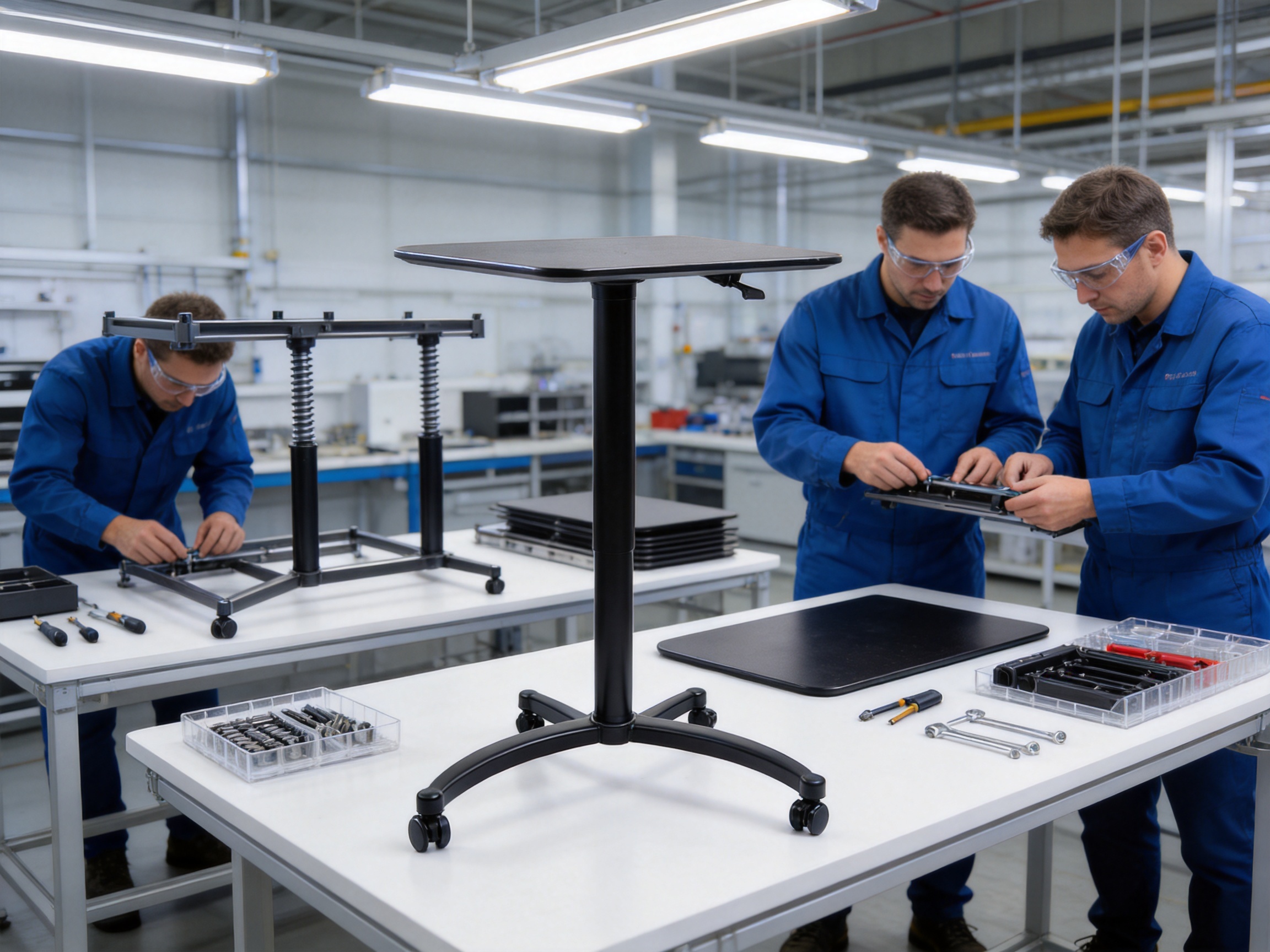
A reliable height-adjustable desk depends on more than design drawings. It requires accurate material processing, stable component sourcing, controlled assembly, inspection standards, and manufacturing experience. SuZhou Skyhone Intelligent Technology Co., Ltd. is a professional manufacturing enterprise engaged in the research and development, production, sales, and service of standing desks and adjustable office solutions. Located in Suzhou, within the Yangtze River Delta furniture and manufacturing region, the company benefits from a mature industrial chain and strong intelligent manufacturing resources.
The company’s manufacturing strength begins with product development. Height-adjustable furniture must consider ergonomics, structural stability, lifting performance, user safety, cost efficiency, and visual design. For a pneumatic desk such as the TH-13, engineers must coordinate the gas spring system, column geometry, tabletop dimensions, caster layout, frame materials, and assembly tolerances. Each of these elements affects the user experience.
Metal processing is another important capability. The frame components must be cut, formed, welded or connected, finished, and assembled accurately. Dimensional consistency is essential for smooth column movement and stable tabletop support. Poorly controlled tolerances can lead to shaking, uneven lifting, misalignment, or premature wear. A manufacturer with experience in adjustable desk structures can better manage these details.
Surface finishing also reflects manufacturing quality. Powder coating requires process control over pretreatment, powder application, curing temperature, coating thickness, color consistency, and inspection. A visually attractive desk is not enough; the coating must also adhere well and support daily use. Careful finishing improves both customer satisfaction and product life.
Assembly quality is equally critical. The gas spring must be installed correctly, moving parts must be aligned, casters must rotate properly, locking mechanisms must function, and the tabletop must be securely supported. Each unit must deliver a smooth adjustment experience and dependable stability. Final checks help identify issues before shipment, reducing installation problems and after-sales concerns.
The company’s location in Suzhou offers further advantages. The Yangtze River Delta region has a dense network of component suppliers, metal processing partners, logistics providers, coating facilities, and skilled labor resources. This environment supports efficient production planning, rapid response to customer needs, and better control of quality and delivery. For global buyers, this industrial base can be an important factor when choosing a supplier of adjustable office furniture.
Advantages Over Conventional Fixed Desks
The most obvious competitor to the TH-13 is the conventional fixed-height desk. Fixed desks are common because they are simple and familiar, but they do not adapt to changing users or changing tasks. A fixed desk may be too high for one user and too low for another. It may be acceptable for seated work but unsuitable for standing work. It may also be difficult to reposition if it is large or heavy.
The TH-13 provides a more flexible alternative. Its 720 mm to 1130 mm height range allows users to adjust the working surface rather than adapt their body to the furniture. This can improve comfort during typing, writing, reading, and standing tasks. In shared work environments, adjustability is especially valuable because different users may use the same desk at different times.
Another advantage is mobility. A fixed desk often requires a designated location. The TH-13 can be moved according to the user’s needs, then locked in place. This helps organizations make better use of space. Instead of purchasing separate desks for every possible location, a mobile height-adjustable desk can serve multiple areas.
The compact tabletop also gives the TH-13 an advantage in space-conscious environments. Large fixed desks may encourage clutter and reduce room flexibility. The TH-13 provides enough space for essential work without dominating the area. For home offices, dormitories, training centers, clinics, small studios, and temporary workstations, this is a practical benefit.
Advantages Over Electric Standing Desks in Specific Use Cases
Electric standing desks are valuable for many applications, especially where heavy loads, programmable height memory, and large tabletops are needed. However, they are not always the best solution. The TH-13 provides advantages in applications where simplicity, mobility, compact size, and power-free operation are more important than motorized automation.
First, the TH-13 does not need electricity. This eliminates power cord routing, outlet dependence, and the need to unplug the desk before moving it. In flexible spaces, this can save time and reduce visual clutter. In rooms where outlets are limited, the desk can still operate normally.
Second, the TH-13 has fewer electronic components. There is no motor, control box, keypad, or power adapter. Fewer electronic components may mean fewer electronic failure points and simpler daily maintenance. Users do not need to learn digital controls or troubleshoot power issues. The desk works through a mechanical pneumatic principle that is easy to understand.
Third, the desk is well suited to compact and mobile work. Many electric standing desks are built as permanent workstations. They are often heavier and less convenient to move. The TH-13, with caster wheels and a smaller work surface, is designed for movement and repositioning.
Fourth, pneumatic adjustment can be faster for quick changes. A user can manually reposition the desktop without waiting for a motorized system. This is useful in teaching, demonstration, inspection, and shared workstation scenarios where height changes may occur frequently and rapidly.
For buyers comparing product types, the key question is not whether pneumatic or electric is universally better. The key question is which system fits the application. For compact, mobile, power-free sit-stand use, the TH-13 offers a strong competitive position.
Advantages Over Basic Mobile Tables
Another product category that may appear similar is the basic mobile table or utility cart. These products can move, but many do not provide ergonomic height adjustment. A mobile table at the wrong height may still cause discomfort or limit task efficiency. The TH-13 improves on basic mobile tables by adding pneumatic height control.
Basic mobile tables may also lack a professional lifting structure. If a mobile table is designed only for transport, it may not provide the same level of user comfort for writing, typing, or standing work. The TH-13 is designed specifically as a height-adjustable work desk, which makes it more appropriate for office and task-based use.
The lockable caster arrangement is also important. A mobile table without effective locking may shift during use, causing frustration or safety concerns. The TH-13 includes two locking wheels so the user can secure the desk after repositioning. This combination of movement and control gives the product a practical advantage.
In addition, the TH-13 has a clean appearance suitable for professional spaces. It does not look like a temporary cart or improvised platform. Its powder-coated metal structure and square tabletop allow it to fit into modern office, education, studio, and technical environments.
Application Scenario: Home Office
Home offices often face space limitations. Many users do not have a dedicated room for work. A desk may need to fit beside a bed, sofa, dining table, window, or bookshelf. The TH-13’s compact size and mobility make it highly suitable for this type of environment.
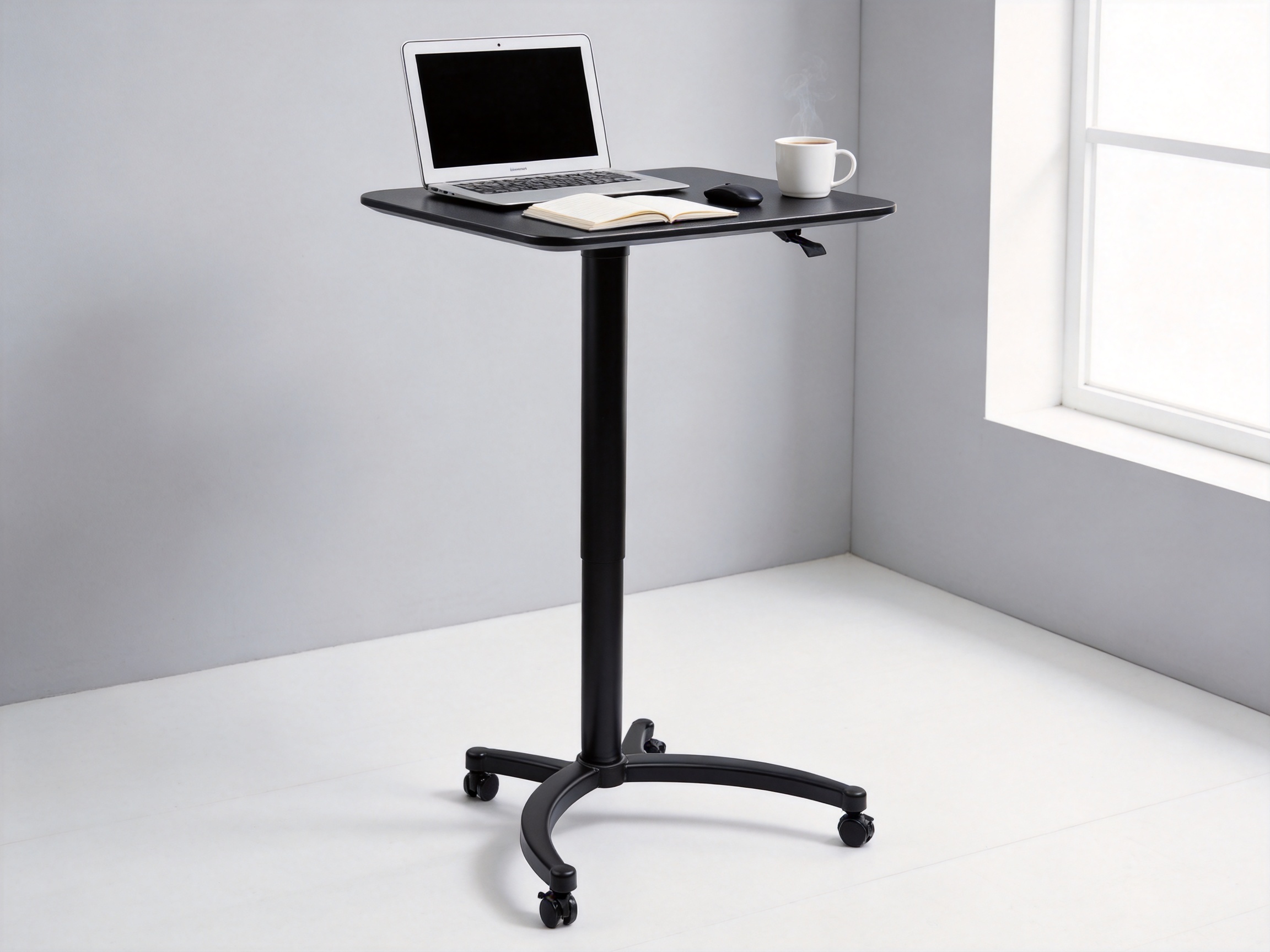
A home user can place a laptop, keyboard, mouse, notebook, or small monitor on the tabletop. During seated work, the desk can be lowered to a comfortable level. When the user wants to stand, the desktop can be raised. After work, the desk can be moved aside to free space. Because it does not require electricity, it can be used in different rooms without worrying about outlet locations.
The powder-coated finish supports easy cleaning, which is useful in multi-purpose home spaces. The black and white color options allow the desk to match different interiors. For users who want a practical ergonomic upgrade without installing a large electric desk, the TH-13 offers a balanced solution.
Shared offices need furniture that can serve different people throughout the day. In hot-desking areas, a workstation may be used by a tall user in the morning and a shorter user in the afternoon. Fixed desks cannot adapt easily to this pattern. The TH-13 solves this by allowing each user to adjust the desktop height.
Mobility also helps office managers reconfigure space. Desks can be moved for teamwork, individual focus, presentations, temporary projects, or cleaning. Since the TH-13 is not tied to electrical outlets, it can be placed wherever the layout requires. Locking casters keep the workstation stable after relocation.
The compact tabletop supports essential digital work while conserving floor space. In an office where real estate efficiency matters, smaller adjustable workstations can improve layout flexibility. The desk can also serve as a temporary standing meeting station, equipment stand, or visitor workstation.
Application Scenario: Classrooms and Training Rooms
Educational environments benefit from furniture that adapts quickly. Teachers may need a standing presentation desk, a seated grading surface, a mobile laptop platform, or a movable demonstration table. The TH-13 can support these needs in one product.
In classrooms, the desk can be moved between the front of the room, student group areas, or storage locations. The height can be adjusted for different teachers or activities. In training rooms, multiple desks can be arranged in different layouts depending on the session. The lack of electrical dependence makes setup easier, particularly in rooms with limited outlets.
The metal frame and powder-coated surface are practical for high-use environments. Furniture in schools and training centers is often moved and handled frequently, so durability and ease of maintenance are important. The TH-13’s construction supports repeated use while maintaining a professional look.
Application Scenario: Laboratories and Technical Work Areas
Laboratories and technical work areas often require flexible support surfaces. A user may need a writing station, a laptop stand, an instrument platform, or a mobile inspection desk. The TH-13’s height adjustment and caster base make it suitable for many light-duty support roles in these settings.
The ability to adjust height is useful when users alternate between seated data entry and standing observation. The desk can be moved closer to a workbench, equipment station, or sample area. After use, it can be relocated to keep walkways clear. The powder-coated metal surface is also easier to clean than many porous materials.
Because the desk does not rely on electrical lifting components, it can reduce cable clutter in technical spaces. This does not eliminate the need for safe use of any devices placed on the desk, but it simplifies the desk’s own operation. For many laboratories, equipment rooms, and inspection areas, a power-free mobile workstation can be a practical addition.
Application Scenario: Creative Studios and Light-Duty Workstations
Creative professionals often work in changing positions. A designer may sketch while standing, review materials while seated, move a desk near natural light, then reposition it beside a display. A photographer may use a small mobile table for laptop control, accessories, or quick review tasks. A maker or technician may need a temporary surface near tools or samples. The TH-13 supports these dynamic workflows.
The square tabletop provides a focused area for essentials. The height range allows the desk to function as a standing review station or seated work surface. The caster wheels allow it to move around a studio or workspace without heavy lifting. When the desk reaches the desired location, the locking casters provide stability.
In creative environments, furniture must often be both functional and visually clean. The TH-13’s black or white powder-coated frame fits well with modern studio equipment and office interiors. Its compact form avoids blocking movement or consuming valuable space.
User Experience: Smooth Adjustment and Practical Control
A good height-adjustable desk should feel intuitive. Users should not need complicated instructions to change posture or move the desk. The TH-13 is designed around simple manual operation. The pneumatic mechanism supports height changes without an electric interface, and the caster base makes relocation straightforward.
The user experience can be described in three steps. First, the user positions the desk where it is needed. Second, the user locks the appropriate caster wheels to prevent movement. Third, the user adjusts the height within the available range according to the task. This simplicity is one of the product’s strongest advantages.
Because the desk has a compact tabletop, users can quickly organize and clear the surface. This is especially useful in shared spaces where one person may use the desk after another. A simple, easy-to-clean surface supports workplace hygiene and efficient turnover.
The desk also supports a more active work style. Instead of waiting until discomfort appears, users can change height proactively. For example, they may sit for focused typing, stand for reviewing documents, lower the desk for writing, then raise it for a quick discussion. This natural flexibility is the core value of the product.
Procurement Value for Distributors, Dealers, and Project Buyers
For distributors and project buyers, a product must be more than attractive. It must be practical to sell, ship, assemble, support, and apply across different customer segments. The TH-13 offers procurement value because it serves multiple markets with one core design: office, education, home, studio, laboratory, and light-duty technical use.
The product’s specifications are easy to communicate. Buyers can understand the lifting range, tabletop size, material, color options, surface treatment, caster arrangement, and gas spring principle quickly. This helps sales teams explain the product clearly to end users. The compact size also makes it easier to present as a practical solution for limited spaces.
The power-free lifting system can reduce concerns related to plug standards, electrical certifications, motor compatibility, voltage differences, and cable replacement. While every market still requires appropriate quality and safety evaluation, a pneumatic product avoids some of the complexity associated with electric furniture exports. This can simplify product positioning in certain channels.
SuZhou Skyhone Intelligent Technology Co., Ltd. also supports customers through its experience in adjustable desk manufacturing. The company’s focus on research, development, production, sales, and service allows it to respond to market needs and customization requests. For buyers seeking ergonomic adjustable office furniture, a manufacturer with specialized standing desk knowledge can provide stronger technical communication and production reliability.
Manufacturing Process Focus: From Concept to Finished Desk
The production of a pneumatic height-adjustable desk involves multiple controlled steps. Although the finished product appears simple to the user, reliable performance depends on detailed manufacturing discipline. The process begins with product design and engineering validation. Designers define the lifting range, tabletop size, frame geometry, column structure, base shape, caster arrangement, and user interface.
Material selection follows. Aluminum and iron components are chosen according to strength, weight, cost, and process requirements. The materials must support repeated adjustment, user handling, and stable desktop support. A well-designed combination of materials helps keep the desk practical for everyday movement while maintaining structural reliability.
Next, metal components are processed. This may involve cutting, forming, machining, punching, bending, welding, or fastening preparation depending on the part. Accuracy is important because the lifting column must move smoothly and the tabletop must remain properly aligned. Component edges and contact surfaces must be managed carefully to support safe assembly and use.
Surface preparation and powder coating are then performed. Cleaning and pretreatment help remove oils, dust, and contaminants from metal surfaces. Powder is applied and cured to create a durable finish. Color consistency is checked to ensure that black and white products meet visual expectations. Surface defects such as uneven coating, bubbles, scratches, or poor adhesion must be controlled.
Assembly brings the components together. The gas spring mechanism is installed, the column and support structure are aligned, the tabletop is mounted, and the caster wheels are attached. Functional checks confirm that the lifting action works properly and that caster locks operate as expected. Final inspection helps ensure that the product meets dimensional, visual, and performance requirements before packaging.
Packaging and logistics are also part of manufacturing quality. Adjustable desks must be protected during transport. Proper packaging reduces the risk of scratches, deformation, or missing components. Clear packing methods help distributors and end users receive products in good condition and assemble them efficiently.
Quality Control and Reliability Considerations
Quality control for a height-adjustable desk should cover structure, movement, surface, safety, and appearance. The TH-13’s performance depends on the relationship between the gas spring, column, tabletop, base, and casters. If one part is poorly made or poorly assembled, the user experience may suffer. Therefore, a systematic quality approach is necessary.
Structural inspection verifies that metal parts are correctly formed and connected. Dimensional checks help ensure that components fit together as intended. Surface inspection confirms that powder coating is even, clean, and properly cured. Functional inspection checks lifting movement, height positioning, caster rolling, and caster locking. Appearance inspection ensures that the product meets customer expectations for finish and presentation.
Reliability is also supported by design simplicity. Because the TH-13 does not use electric motors or control systems, it avoids many electrical issues that can occur in motorized desks. There are no electronic height controllers to reset, no control boxes to replace, and no power cords required for lifting. This simplicity can improve user confidence in environments where desks must be used by many people.
However, simplicity does not mean low engineering requirements. A gas spring desk still needs careful balancing, proper mechanism integration, safe movement, and stable support. Manufacturing experience is important because the product must feel smooth and secure during repeated use. This is where specialized adjustable desk production capability becomes a competitive strength.
Why the TH-13 Stands Out in the Adjustable Desk Market
The adjustable desk market includes many products, from large electric executive desks to small laptop risers. The TH-13 occupies a valuable middle position. It is more ergonomic than a fixed table, more mobile than many electric standing desks, more professional than a basic cart, and simpler than complex motorized systems. This combination gives it a distinctive market advantage.
Its first strength is practical height range. The 720 mm to 1130 mm lifting range supports common seated and standing work postures. Its second strength is compact size. The 715 mm by 495 mm tabletop is large enough for essential tasks but small enough for flexible placement. Its third strength is power-free operation. The gas spring system removes electrical dependence and simplifies use. Its fourth strength is mobility. Four casters, including two locking wheels, allow the desk to move and stay in place as needed. Its fifth strength is durable construction. Aluminum, iron, and powder coating support daily use and easy maintenance.
These strengths make the TH-13 especially suitable for customers who want ergonomic flexibility without overcomplicating the workstation. In many real-world environments, the best furniture is not the largest or most automated. It is the furniture that fits the task, moves when needed, adjusts easily, and remains reliable over time. The TH-13 is designed around that practical standard.
Company Strength: Specialized Adjustable Desk Manufacturing
SuZhou Skyhone Intelligent Technology Co., Ltd. is deeply engaged in standing desk research and production. This specialization matters because adjustable furniture has different engineering requirements from ordinary furniture. It must combine movement, load support, ergonomics, durability, and user safety. A manufacturer focused on this field can better understand market demands and product performance details.
The company provides healthy, efficient, and intelligent office space solutions for global users. Its location in Suzhou gives it access to the mature furniture and intelligent manufacturing supply chain of the Yangtze River Delta. This regional advantage supports material sourcing, component processing, surface finishing, assembly coordination, and logistics efficiency.
For customers seeking custom ergonomic adjustable office tables, the company’s manufacturing background supports product adaptation and supply capability. Customization may involve color, packaging, configuration, branding requirements, project quantities, or product portfolio matching. A supplier with integrated production and service capability can communicate more effectively with distributors, project contractors, and end users.
The TH-13 reflects the company’s practical approach: combine ergonomic value with manufacturing simplicity, durable materials, and flexible use. It is not merely a product for one desk category. It is part of a broader movement toward adjustable, healthier, and more adaptable workspaces.
Maintenance and Daily Use Recommendations
The TH-13 is designed for straightforward daily use, but proper care helps maintain performance and appearance. Users should place the desk on a reasonably flat surface whenever possible. Before working, the locking casters should be engaged to reduce unwanted movement. When moving the desk, users should unlock the casters and guide the desk carefully, avoiding sudden impacts or uneven flooring that may affect stability.
The tabletop and powder-coated metal surfaces can be cleaned with a soft cloth. For typical office use, mild cleaning methods are usually sufficient. Abrasive tools or harsh chemicals should be avoided because they may damage the coating or tabletop surface. Keeping the desk clean is especially important in shared offices, classrooms, and laboratories.
Users should also avoid exceeding the intended light-duty purpose of the desk. The tabletop is suitable for common office supplies, computer equipment, writing materials, and similar items. Heavy machinery, excessive loads, or impact work should be handled by specialized industrial benches rather than a mobile pneumatic desk. Using the product within its intended application helps preserve lifting performance and stability.
Periodic checks can improve long-term reliability. Users or facility managers can inspect caster locks, wheel rotation, fastening points, and lifting movement. If any component feels loose or unusual, it should be addressed before continued use. Simple preventive attention can extend service life and maintain user safety.
Sustainability and Practical Resource Efficiency
Sustainability in office furniture is not only about materials; it is also about product usefulness, durability, adaptability, and maintenance. A desk that serves multiple tasks can reduce the need for several separate pieces of furniture. The TH-13’s combination of height adjustment and mobility allows one product to support many environments and work patterns.
The power-free lifting system also reduces energy use during operation. Unlike electric standing desks, the TH-13 does not consume power to move up and down. For individual use, this difference may seem small, but in large facilities or flexible spaces with many workstations, simplified non-electric products can contribute to cleaner layouts and reduced dependence on electrical infrastructure.
Durable metal construction and powder-coated finishing also support longer use. Furniture that remains functional and visually acceptable over time is more resource-efficient than furniture that must be replaced frequently. Easy cleaning and simple maintenance further improve practical sustainability by extending daily usability.
Buyer Guidance: When to Choose the TH-13
The TH-13 is a strong choice when the user needs a compact sit-stand desk that can be moved easily and adjusted without electricity. It is suitable when floor space is limited, when workstations are shared, when layouts change often, or when a simple ergonomic upgrade is desired.
It is especially appropriate for home offices, hot-desking areas, classrooms, training rooms, laboratories, creative studios, and light-duty technical stations. It is also useful for temporary work setups, presentation support, mobile laptop use, and flexible documentation tasks.
Buyers should choose the TH-13 when they value mobility, power-free height adjustment, easy maintenance, and compact design. If an application requires very large tabletops, heavy load capacity, electronic height memory, or integrated power management, a larger electric standing desk may be more suitable. However, for many practical environments, the TH-13 offers a better balance of simplicity, flexibility, and ergonomic value.
Frequently Asked Questions
What is the height adjustment range of the TH-13?
The TH-13 adjusts from 720 mm to 1130 mm. This range supports seated and standing work positions for many users and tasks.
Does the desk require electricity?
No. The desk uses a gas spring lifting mechanism, so it does not require motors, power cables, control boxes, or electrical outlets for height adjustment.
What is the tabletop size?
The tabletop measures 715 mm by 495 mm. It is compact but suitable for common work items such as a laptop, keyboard, mouse, monitor, notebook, or office accessories.
What materials are used in the desk?
The main structure is made from aluminum and iron. These materials provide practical strength, stability, and durability for daily use.
What colors are available?
The desk is available in black and white. Both options use powder-coated finishing for a clean appearance and improved surface durability.
Can the desk be moved easily?
Yes. The base includes four caster wheels. Two wheels have locking functions, allowing the desk to move when needed and remain more stable when locked.
Where can the TH-13 be used?
It can be used in home offices, shared workspaces, classrooms, training rooms, laboratories, creative studios, and light-duty technical work areas.
How does the TH-13 compare with an electric standing desk?
The TH-13 is more suitable for compact, mobile, and power-free applications. It does not provide electric memory functions, but it avoids cables, motors, and outlet dependence. For users who want simple manual sit-stand adjustment, it is a practical alternative.
How does the TH-13 compare with a fixed desk?
A fixed desk cannot change height and is usually less flexible. The TH-13 supports seated and standing postures, accommodates different users, and can be moved to different locations.
Is the desk easy to maintain?
Yes. The pneumatic system avoids electrical maintenance, and the powder-coated metal surface is easy to clean. Users should keep the desk on suitable flooring, lock the casters during use, and avoid excessive loads.
Why is powder coating important?
Powder coating improves the surface finish of metal components. It helps create a smooth, durable, and easy-to-clean surface suitable for frequent daily use.
What manufacturing strengths support this product?
SuZhou Skyhone Intelligent Technology Co., Ltd. specializes in adjustable desk development and production. Its strengths include product engineering, metal processing coordination, powder coating control, assembly inspection, supply chain support, and service capability in the adjustable office furniture field.
Conclusion: A Practical Desk for the Future of Flexible Work
The TH-13 pneumatic height-adjustable desk responds to a clear need in modern workspaces: flexible, ergonomic, mobile, and simple furniture. Its gas spring lifting system allows users to adjust height from 720 mm to 1130 mm without electricity. Its 715 mm by 495 mm tabletop provides a focused surface for essential work. Its aluminum and iron structure, powder-coated finish, and caster base support daily durability, mobility, and ease of use.
Compared with fixed desks, it offers superior posture flexibility and mobility. Compared with many electric desks, it provides a simpler power-free solution for compact and shared environments. Compared with basic mobile tables, it adds meaningful ergonomic height adjustment and a more professional workstation function. These advantages make it suitable for offices, homes, schools, laboratories, studios, and light-duty work areas.
Behind the product is the manufacturing capability of SuZhou Skyhone Intelligent Technology Co., Ltd., a company focused on standing desks and adjustable office solutions. Through design experience, material selection, metal processing, powder coating, assembly control, and supply chain advantages in Suzhou, the company supports dependable product quality and market adaptability.
As work continues to move toward healthier, more flexible, and more efficient patterns, products like the TH-13 will become increasingly valuable. It is not only a desk; it is a compact platform for movement, productivity, and adaptable space planning.
References
Bridger, R. S. Introduction to Human Factors and Ergonomics. CRC Press.
Kroemer, K. H. E., Kroemer, H. B., and Kroemer-Elbert, K. E. Ergonomics: How to Design for Ease and Efficiency. Academic Press.
Grandjean, E. Fitting the Task to the Man: A Textbook of Occupational Ergonomics. Taylor & Francis.
Pheasant, S., and Haslegrave, C. M. Bodyspace: Anthropometry, Ergonomics and the Design of Work. CRC Press.
International Organization for Standardization. ISO 9241: Ergonomics of Human-System Interaction.
International Organization for Standardization. ISO 6385: Ergonomic Principles in the Design of Work Systems.
Sanders, M. S., and McCormick, E. J. Human Factors in Engineering and Design. McGraw-Hill.
Product: TH-13 (Cat Head Leg Column with Square Panel Column) Pneumatic Height-Adjustable Desk


- Contact Info
-
-
 Phone+86-15950656125
 -
 Email
Email -
 AddressRoom 1007-1, South Building, Suyue Plaza, Suzhou Industrial Park, Suzhou City, Jiangsu Province, China
-
- Products
- Follow Us
- Need help? Please contact us
Copyright ©
SuZhou Skyhone Intelligent Technology Co., Ltd.
All Rights Reserved.
Privacy
Custom Ergonomic Adjustable Office Tables Manufacturers

