

 English
  русский
  Español
  عربى
عربى 
Content
- 1 What Is a Free-Stop Gas Spring?
- 2 How the Operating Principle Works
- 3 Core Advantages Over Conventional Alternatives
- 4 Comparison with Other Gas Spring and Support Solutions
- 5 Applications in Furniture and Cabinetry
- 6 Applications in Office and AV Equipment
- 7 Material and Construction Options
- 8 Manufacturing Strengths and Process Control
- 9 How to Select the Correct Free-Stop Gas Spring
- 10 Installation Recommendations
- 11 Safety and Service Considerations
- 12 Why a Specialized Manufacturer Matters
- 13 Free-Stop Gas Springs and Ergonomic Product Design
- 14 Cost and Design Efficiency
- 15 Frequently Asked Questions
- 15.1 What is the difference between a free-stop gas spring and a normal gas spring?
- 15.2 Does a free-stop gas spring require a release lever?
- 15.3 Can a free-stop gas spring hold a panel at any angle?
- 15.4 Are free-stop gas springs suitable for heavy doors?
- 15.5 Can the product be used with glass doors?
- 15.6 What cylinder materials are available?
- 15.7 How do I calculate the required gas force?
- 15.8 Can two free-stop gas springs be installed on one panel?
- 15.9 Are free-stop gas springs maintenance-free?
- 15.10 When should I choose an electric linear actuator instead?
- 15.11 Can the gas spring be customized?
- 15.12 What makes a high-quality free-stop gas spring different?
- 16 Conclusion
- 17 References
- 18 Product: Free-stop gas spring (friction-type free-stop gas strut)
Free-Stop Gas Springs: Precision Positioning, Silent Support, and Flexible Motion Control
2026-08-18
Modern furniture, office equipment, and compact mechanical systems increasingly require more than simple opening and closing assistance. Users want panels that lift smoothly, remain wherever they are placed, and move quietly without complicated controls. Designers also need support components that are compact, visually clean, reliable, and adaptable to different installation environments. The free-stop gas spring, also called a friction-type free-stop gas strut or arbitrary-stop support strut, addresses these requirements by combining gas-assisted lifting with continuous manual positioning.
Unlike a conventional gas spring that automatically extends or a self-locking gas spring that requires a release mechanism, a free-stop gas spring can hold a supported panel at practically any point within its stroke. The user simply pushes or pulls the panel until the desired angle or height is reached. Internal friction then resists movement and helps maintain the selected position. This operating principle makes the product especially suitable for lightweight flip-up doors, overhead cabinets, monitor platforms, adjustable display panels, laptop risers, and other applications where frequent fine adjustment is important.
For manufacturers and equipment designers, the value of a free-stop gas spring extends beyond its basic function. It can reduce the number of exposed control parts, simplify the appearance of a finished product, improve user comfort, and support more flexible product design. With suitable force selection, stroke configuration, tube material, and mounting hardware, the same general technology can be adapted to many custom furniture and equipment projects.
What Is a Free-Stop Gas Spring?
A free-stop gas spring is a compact motion-support device that uses pressurized nitrogen and a friction-based braking structure to assist movement and resist unwanted motion. The gas pressure creates an extension force, while the internal friction mechanism provides resistance throughout the stroke. When the applied external force is removed, the combined action of gas support and friction helps the gas spring remain at the position selected by the user.
The term “free-stop” describes the product’s ability to stop at intermediate points rather than only at the fully extended or fully compressed ends of travel. “Friction-type” emphasizes the braking method used inside the cylinder. “Arbitrary-stop” indicates that the user can select an operating position according to the immediate requirement. These terms describe closely related products and are commonly used when discussing manually adjustable support struts.
The component normally consists of a pressure cylinder, piston rod, piston assembly, sealing elements, guide components, nitrogen gas, and a friction-generating mechanism. Depending on the construction, the friction mechanism may be integrated with the piston or another internal braking structure. The external design may include threaded ends, ball sockets, clevis fittings, brackets, or other attachment options selected for the application.
The product is not intended to replace every type of locking actuator. Its most effective use is in applications where the supported load is relatively light, adjustment is frequent, and the user values simple manual operation. For heavy doors, safety-critical equipment, or applications requiring a positive mechanical lock, a dedicated locking gas spring, linear actuator, hinge brake, or additional mechanical support may be more appropriate.
How the Operating Principle Works
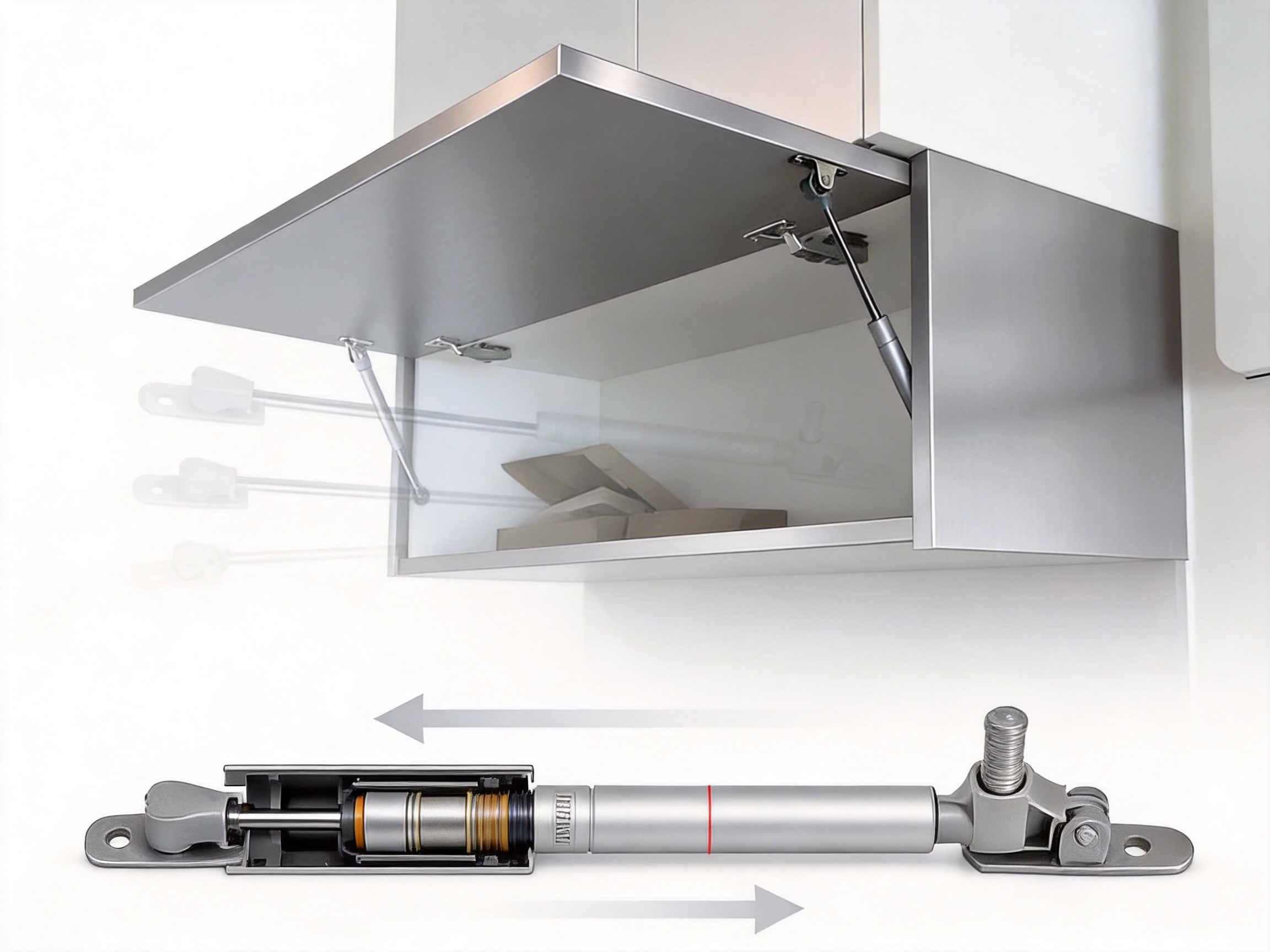
A conventional gas spring typically contains compressed nitrogen separated from the external environment by seals and a piston. When the rod is pushed into the cylinder, the gas is compressed and stores energy. When the external load is reduced, the pressure difference produces an extension force. This force can help lift a door, lid, or platform and reduce the effort needed from the user.
In a free-stop design, gas support is combined with controlled internal friction. The gas pressure continues to provide lifting assistance, but the friction mechanism resists the tendency of the rod to move automatically. If the user applies enough force to overcome the friction and the supported load, the rod moves in the selected direction. When the user stops applying force, friction helps prevent further movement.
This balance is central to the product’s performance. If the friction level is too low, the supported panel may drift or move under its own weight. If the friction level is too high, operation may feel stiff and the user may need excessive force. A well-designed product therefore requires careful coordination between gas force, friction resistance, panel weight, geometry, mounting position, and the direction of movement.
The user experience is also influenced by the installation angle. A gas spring installed near a hinge does not produce the same effective torque as one installed farther from the hinge. The position of the mounting points changes the mechanical advantage throughout the opening range. For this reason, product selection should consider not only the nominal gas force but also the panel dimensions, center of gravity, hinge location, opening angle, and desired operating feel.
Core Advantages Over Conventional Alternatives
Continuous Position Adjustment
The most important advantage of a free-stop gas spring is continuous positioning. A standard free-extension gas spring generally moves toward its extended position whenever the load permits. It provides useful lifting assistance, but it does not normally hold a panel at every intermediate position. Users may need a separate stay, latch, hinge, or support arm to stop the panel at a chosen point.
A self-locking gas spring can provide firm position retention, but it commonly requires a release cable, handle, lever, button, or other unlocking mechanism. That additional control system may increase cost, installation complexity, visual clutter, and maintenance requirements. A free-stop gas spring offers an alternative for applications in which manual force is acceptable and a simple, handle-free appearance is preferred.
With a free-stop design, a user can open a cabinet door partway, raise a display to a comfortable viewing height, or position a laptop platform according to personal preference. This flexibility can improve ergonomics and make a product more adaptable to different users and operating conditions.
Simple and Intuitive Operation
Free-stop gas springs do not require a separate unlocking action. The user moves the supported component directly. This reduces the number of steps required during normal operation and can make the finished product easier to understand, especially for office furniture, household cabinetry, and shared equipment.
The absence of an exposed lever or cable also supports a clean exterior. Designers can create smooth front panels, minimalist cabinet doors, and compact equipment platforms without routing a control cable through the structure. Fewer external parts may also reduce the possibility of interference, accidental activation, or damage during routine use.
Controlled and Quiet Movement
Pressurized gas support reduces the sudden drop that may occur when a heavy or spring-loaded panel is released. The gas spring helps distribute the movement and can provide a more controlled opening and closing experience. The friction mechanism contributes resistance throughout the stroke, helping prevent abrupt movement when the user changes position.
Compared with exposed mechanical stays or some rigid locking arms, an enclosed gas spring can operate with less noise and a more refined feel. The sealed cylinder and guided rod help keep the working components protected from everyday contact. In furniture and office environments, this quiet operation is valuable because it minimizes disturbance and supports a more comfortable user experience.
Clean Appearance and Flexible Integration
The cylindrical form of a gas spring can be integrated into cabinets, lift stands, monitor platforms, and equipment frames without dominating the product’s appearance. It can often be mounted inside a cabinet or beneath a panel, leaving only a small portion visible. This is especially useful for contemporary furniture, where functional hardware is expected to remain discreet.
Because the product does not depend on an exposed control handle, designers have greater freedom when developing compact or visually simplified products. The gas spring can be paired with concealed hinges, aluminum profiles, steel brackets, or custom mounting plates according to the structure of the finished product.
Support for Frequent Fine-Tuned Adjustment
Many products are not opened and closed only in two fixed positions. A monitor stand may need several viewing heights during a working day. A display panel may be adjusted for different audiences. A laptop riser may be positioned to suit seated or standing use. An overhead cabinet may need to remain partly open when the user is selecting items.
In these situations, a free-stop gas spring can be more convenient than a component designed only for full extension or a mechanism with a limited number of locking points. The user can make small adjustments quickly and without searching for a release control.
Comparison with Other Gas Spring and Support Solutions
| Support solution | Positioning behavior | Control method | Typical strengths | Typical limitations |
|---|---|---|---|---|
| Standard free-extension gas spring | Usually moves toward extension and supports a defined open position | Direct manual movement, with no friction-based arbitrary stop | Simple lifting assistance, economical construction, fast opening | Limited intermediate positioning and possible tendency to extend automatically |
| Free-stop gas spring | Can hover at many positions within the stroke | Direct push or pull by the user | Handle-free adjustment, quiet support, clean appearance, flexible positioning | Best suited to light or moderate loads and requires correct force matching |
| Self-locking gas spring | Locks when the mechanism is engaged or the rod reaches a locking condition | Release lever, cable, button, or integrated control | Positive retention and improved control for selected applications | More components, greater installation complexity, and a visible or hidden release system |
| Mechanical stay or hinge brake | May hold at one or several predetermined positions | Manual movement, latch, or indexed mechanism | Can provide a direct mechanical stop and defined locking points | May create noise, require more space, or limit adjustment flexibility |
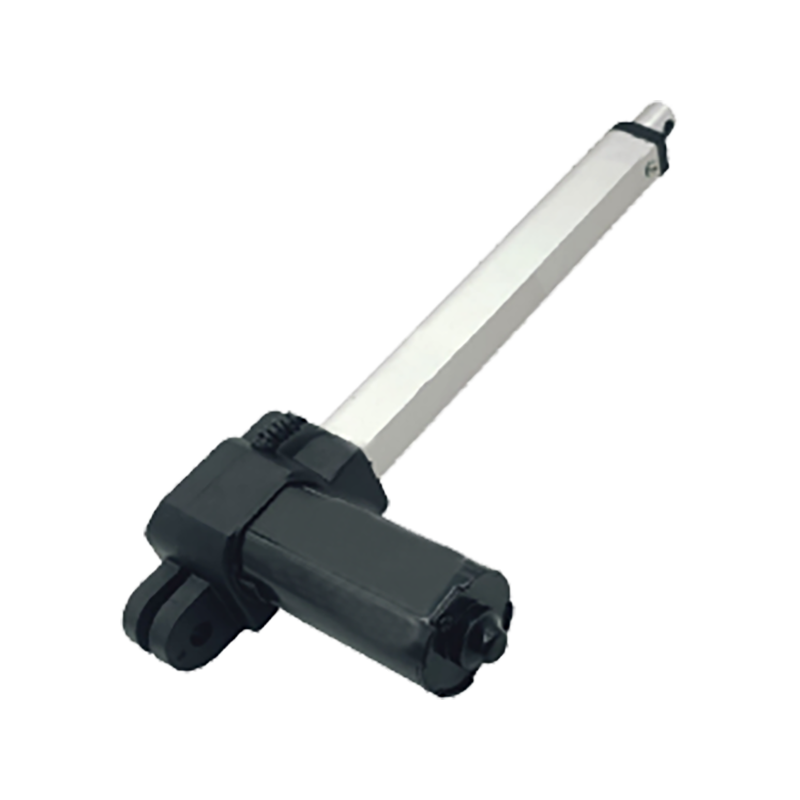
| Electric linear actuator | Motor-driven movement over a controlled range | Switch, handset, control panel, or automation system | Suitable for powered height adjustment, synchronized motion, and heavier systems | Requires power, wiring, controls, and a higher overall system cost |
This comparison shows that free-stop gas springs occupy a useful middle position. They provide more positioning freedom than a standard gas spring while avoiding the controls and wiring associated with powered actuators. They are also simpler than many self-locking systems when the application does not require a positive, user-activated lock.
The correct choice depends on the intended user experience and safety requirements. A manually adjustable lightweight panel may benefit greatly from a free-stop support. A large industrial cover that must remain locked under vibration may need a positive locking system. A height-adjustable desk requiring synchronized movement and programmable positions will generally require electric linear actuators rather than passive gas support.
Applications in Furniture and Cabinetry
Overhead Kitchen Cabinet Doors
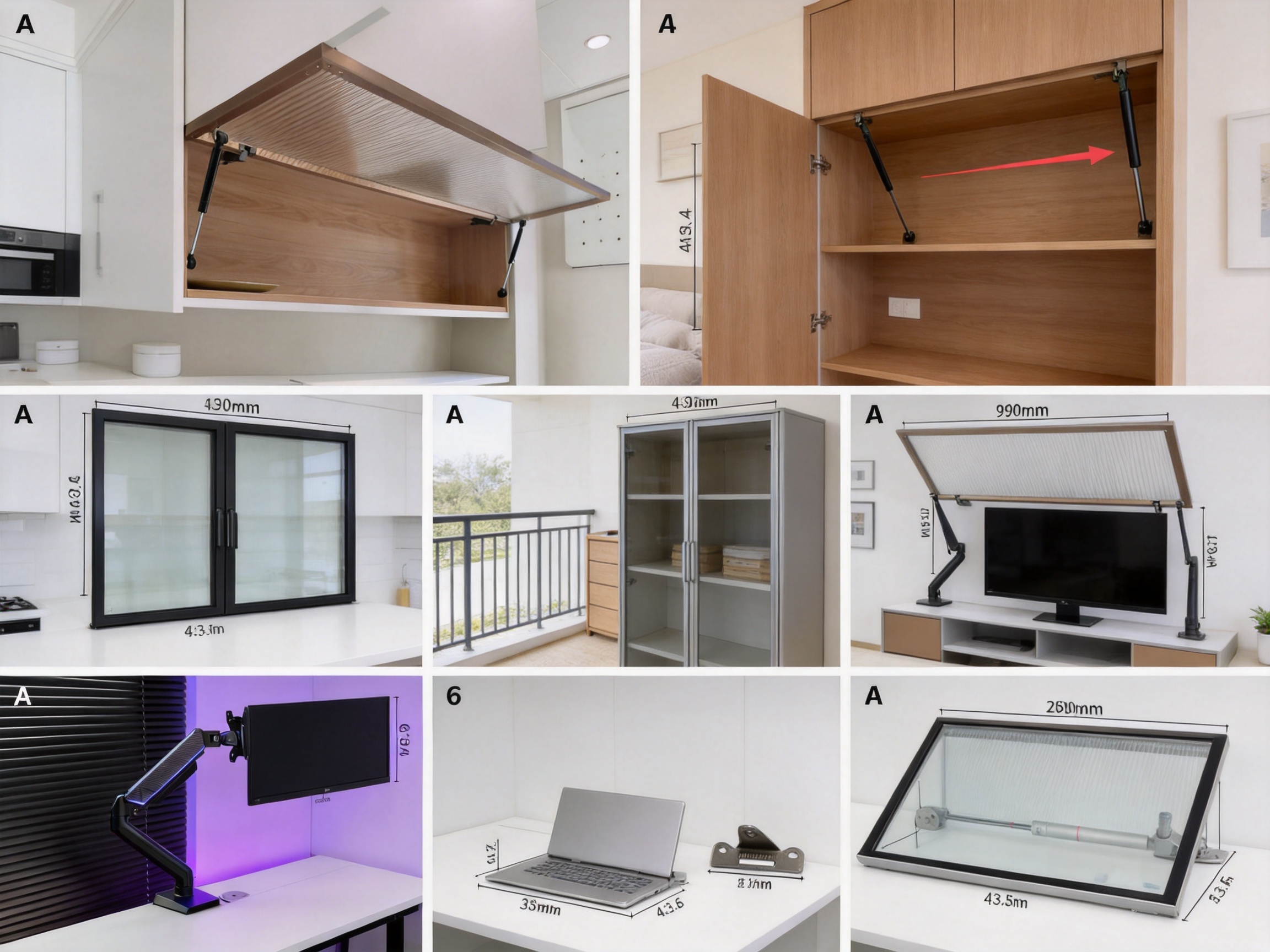
Overhead cabinet doors can be difficult to hold open, especially when the user needs both hands to retrieve or organize items. A free-stop gas spring assists the upward movement and helps keep the door at a convenient angle. The user can open the door fully or stop it partway, depending on the available clearance and the task being performed.
The handle-free adjustment principle is particularly useful in modern kitchens with wide horizontal doors. Instead of reaching for a release lever or manipulating a separate support, the user can guide the door directly. The gas spring can be installed in pairs or in a configuration selected according to the door width, weight, hinge layout, and required opening range.
Aluminum-Framed Glass Doors
Glass doors with aluminum frames are often selected for display cabinets, wall storage, and contemporary interior furniture. Their appearance depends on clean lines and limited visual hardware. A compact free-stop gas spring can support the door while preserving the minimalist character of the cabinet.
Because glass panels may have a different weight distribution from solid wood doors, careful force and mounting calculations are important. The support should be selected to avoid excessive opening force or uncontrolled movement. Properly matched friction and gas force can make the door feel stable while reducing stress on the hinges and frame.
Wardrobe Flip-Up Panels
Flip-up wardrobe panels and storage doors often operate in restricted spaces. The user may want the panel to remain at an intermediate height rather than extend into a ceiling, wall, or adjacent cabinet. A free-stop gas spring allows the panel to be positioned according to the room layout and the user’s reach.
The component can also help reduce the effort required to close the panel. Instead of allowing the door to fall, the gas spring moderates the movement and supports a more controlled closing action. This can help protect hinges, frame joints, and decorative surfaces during frequent operation.
Balcony Storage Units
Balcony storage units may be exposed to changing temperatures, dust, and humidity. A gas spring with a suitable cylinder and surface treatment can provide a compact support solution for access panels and flip-up lids. Stainless steel cylinder options may be considered where additional corrosion resistance is needed.
Environmental conditions should always be evaluated before final selection. The product should be protected from direct water accumulation, corrosive chemicals, and impacts. Mounting hardware should also be selected to match the surrounding material and expected load.
Applications in Office and AV Equipment
Monitor Lift Stands
Monitor lift stands benefit from the ability to position a screen at different heights without motors, cables, or electrical controls. A free-stop gas spring can help raise the monitor platform and maintain the selected viewing position. This supports ergonomic workstation layouts for users who alternate between seated and standing work or who share equipment among people of different heights.
The system designer must consider the monitor weight, support arm geometry, center of gravity, and movement path. If the display is mounted too far from the pivot or if the gas force is mismatched, the platform may feel too light, too heavy, or unstable. A correctly configured free-stop gas spring can provide smooth manual adjustment with a compact footprint.
Flip-Up TV Mounts
Flip-up television or display mounts may be installed in cabinets, hospitality furniture, meeting rooms, and space-saving interior systems. A free-stop support can help users raise or lower the display manually and stop it at a suitable angle. This can be useful when viewing positions change or when the screen must be stored behind a panel.
For larger screens, designers should verify the product’s load capacity and the structural strength of the mounting frame. A free-stop gas spring is most appropriate when the supported assembly remains within the intended force range and when additional safety retention is provided if required by the application.
Laptop Risers
Laptop risers are compact products that benefit from smooth, repeatable, and quiet adjustment. A friction-type gas spring can help the user raise the platform, position it for comfortable typing or viewing, and lower it without a separate locking control. This makes the design suitable for home offices, shared workstations, training rooms, and mobile work environments.
The small size of a laptop platform places particular importance on compact hardware. A suitably designed gas spring can be integrated beneath the platform or along the support arms. It can provide a premium operating feel while keeping the overall product visually simple.
Adjustable Display Panels
Retail displays, presentation boards, information panels, and compact AV equipment may need to be adjusted for viewing angle or user height. A free-stop gas spring can provide manual adjustment without adding motors or a complex control system. The ability to stop at different points can support different room layouts, viewing distances, and presentation conditions.
In public environments, designers should consider misuse, repeated cycling, and the possibility of users applying force outside the intended direction. Protective covers, robust mounting points, and travel limits may be needed to ensure long-term reliability.
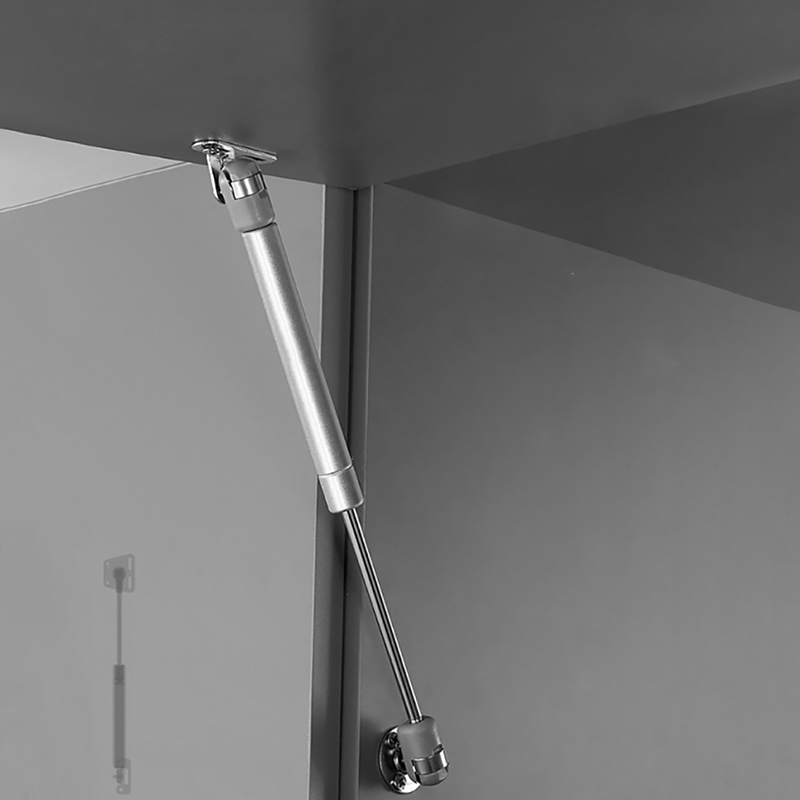
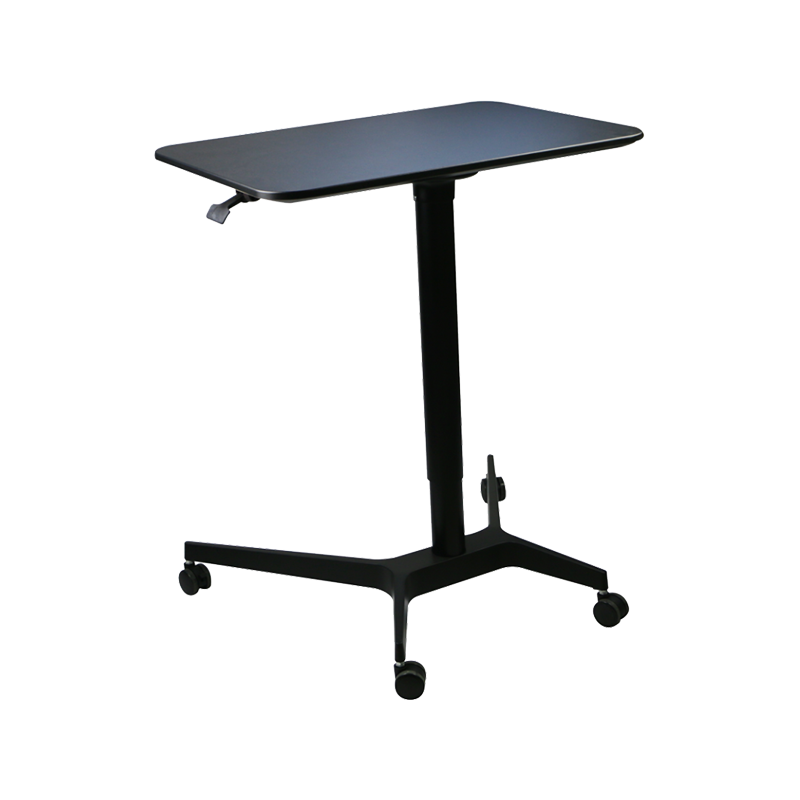
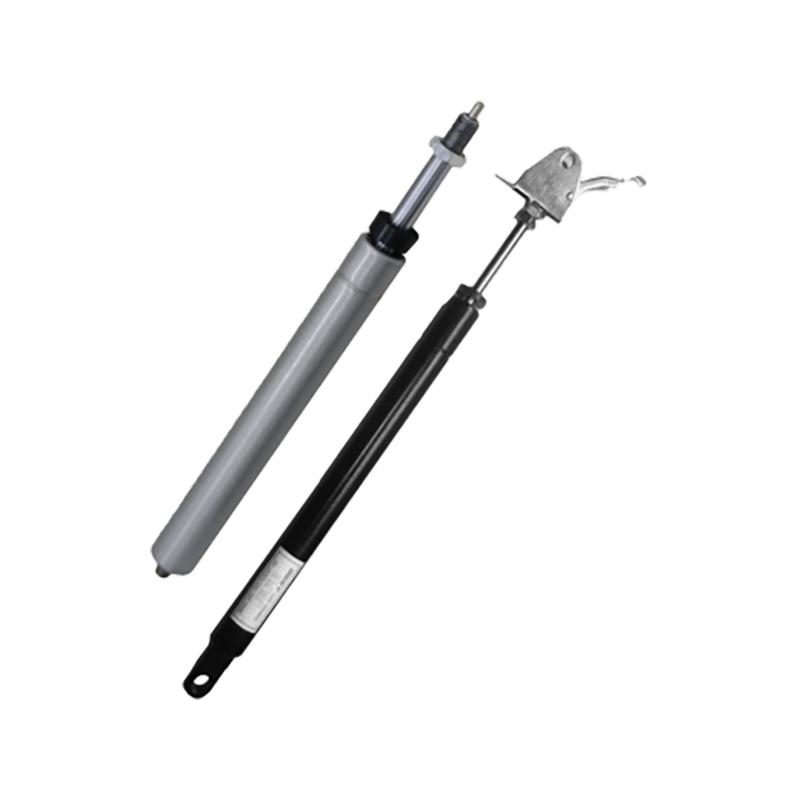
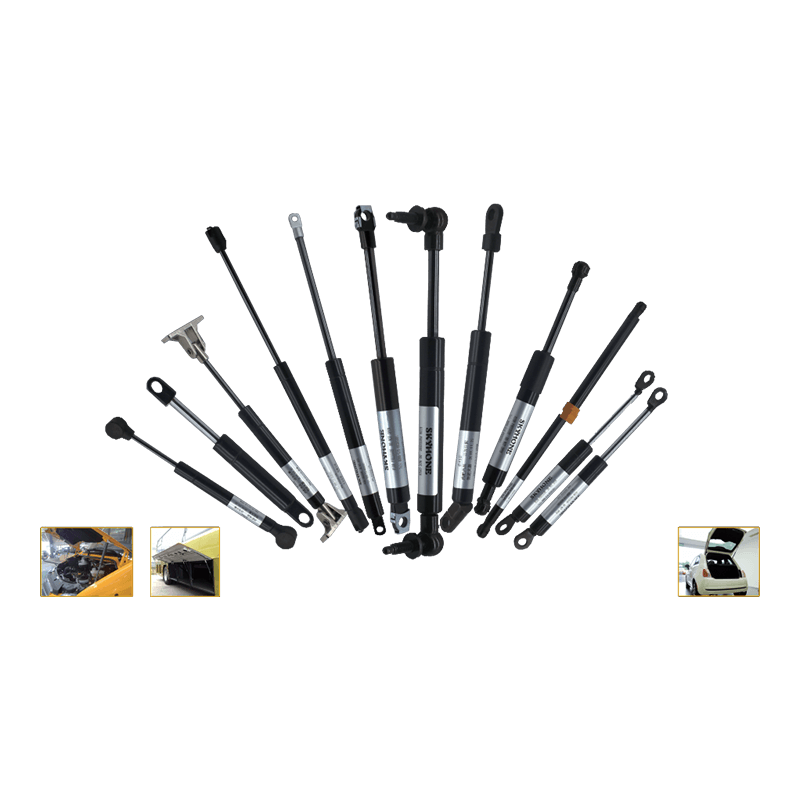
Free-stop gas spring (friction-type free-stop gas strut)
Material and Construction Options
The cylinder is one of the most important structural and functional elements of a gas spring. It contains the pressurized nitrogen and supports the internal components during repeated movement. Free-stop gas springs may use seamless precision steel tubing or stainless steel tubing, depending on the application and required environmental performance.
Seamless Precision Steel Tubing
Seamless precision steel tubing offers a strong and consistent cylinder structure. The absence of a welded seam in the main tube can support dimensional stability and a smooth internal surface when the tubing is processed correctly. Precision dimensions are important because the piston, guide, and sealing elements must operate within controlled clearances.
Steel is suitable for many indoor furniture, office, and equipment applications. It can also be treated or coated to improve surface protection and create a consistent appearance. The final choice should consider humidity, exposure to cleaning agents, installation location, and expected service life.
Stainless Steel Tubing
Stainless steel can provide enhanced resistance to corrosion and may be appropriate for applications exposed to humidity, condensation, or demanding cleaning conditions. It can also contribute to a premium appearance in visible furniture and equipment components.
Material selection should not be based on appearance alone. The complete assembly, including the rod, fittings, seals, brackets, and fasteners, must be evaluated as a system. If only the cylinder is corrosion-resistant while other exposed parts are not suitable for the environment, the overall product may still be vulnerable.
Piston Rod and Surface Protection
The piston rod moves through the guide and sealing system during every operating cycle. Its surface finish, straightness, hardness, and resistance to corrosion influence the smoothness and service life of the gas spring. A suitable rod surface helps reduce wear on seals and supports consistent movement.
During installation and use, the rod should be protected from scratches, bending, paint overspray, and abrasive contamination. The rod should not be used as a handle or subjected to side loads beyond the design conditions. Proper alignment is also essential because misalignment can increase friction and shorten component life.
Manufacturing Strengths and Process Control
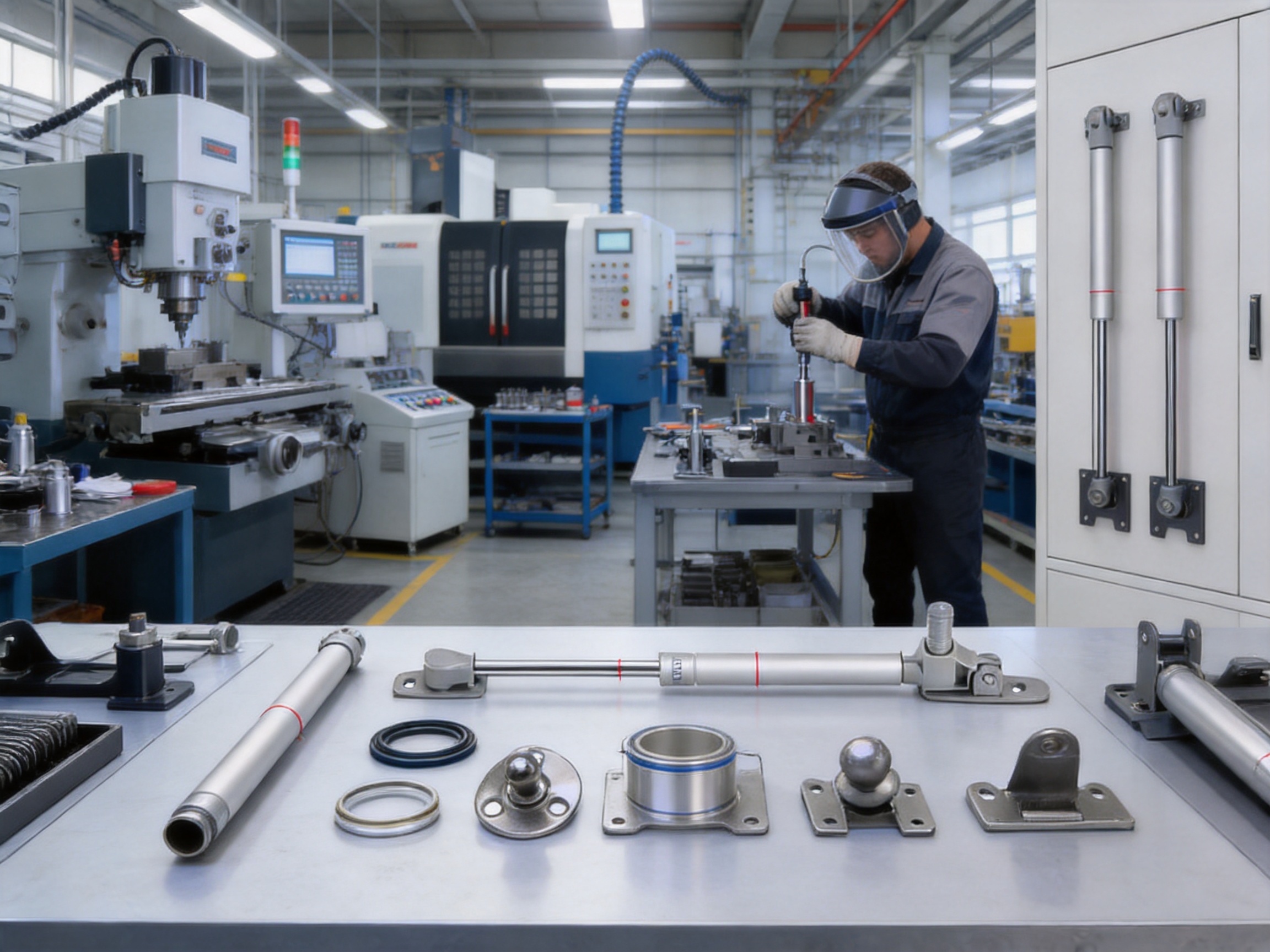
Producing a reliable free-stop gas spring requires more than filling a cylinder with gas. The component must be designed, machined, assembled, charged, tested, and packaged with control over several interacting variables. A manufacturer with capabilities in research and development, production, sales, and service can coordinate these stages more effectively and respond to application-specific requirements.
SuZhou Skyhone Intelligent Technology Co., Ltd. is a professional manufacturing enterprise focused on standing desks and related motion-support solutions. Based in Suzhou, an important furniture manufacturing center in the Yangtze River Delta, the company benefits from a regional supply chain that supports metal processing, furniture hardware, mechanical components, assembly, and intelligent manufacturing. This industrial environment can help shorten communication cycles between product development and production while supporting customized projects.
Product Research and Development
Research and development is essential when a gas spring must be adapted to a specific panel, platform, or furniture structure. The development process may include reviewing the customer’s drawings, calculating the required force, selecting the stroke, confirming mounting points, evaluating opening angles, and checking the desired operating feel.
For free-stop products, development attention must be given to the relationship between gas pressure and friction resistance. A product that performs well in one mounting geometry may not feel the same in another. Engineering review should therefore consider the complete mechanism rather than treating the gas spring as an isolated part.
Application-oriented development also helps identify whether the product should be used alone, in pairs, or with an additional hinge, damper, stay, or safety device. This approach improves the likelihood that the final furniture or equipment product will operate smoothly under real conditions.
Precision Tube Processing
Precision tube processing provides the foundation for stable internal operation. The cylinder must maintain suitable dimensional accuracy, surface quality, and structural integrity. Consistent tube preparation supports the correct installation of guides, pistons, seals, and end fittings.
Seamless precision steel tubing and stainless steel options give designers flexibility across indoor and more demanding environments. The appropriate material can be selected according to strength, corrosion resistance, visual requirements, and cost targets. Controlled processing is especially important for compact gas springs, where small dimensional variations may have a noticeable effect on operating resistance.
Machining and Component Consistency
Internal and external components must be produced with consistent dimensions so that the gas spring behaves predictably from unit to unit. Piston components, rod ends, guides, fittings, and mounting elements should be controlled according to defined specifications. Consistency helps reduce variation in force, friction, noise, and movement feel.
For custom orders, controlled machining also makes it easier to adapt thread types, end fittings, rod lengths, cylinder lengths, and mounting configurations. This is valuable for furniture manufacturers that use different cabinet structures or for equipment companies developing several product sizes from a common platform.
Sealing and Assembly Control
Gas springs depend on effective sealing to retain internal pressure and keep contaminants away from the working components. Assembly conditions, seal installation, guide alignment, and cleanliness all affect long-term performance. A professional production process should include suitable handling procedures and inspection points for these operations.
The assembly sequence must protect the rod and seals from damage. It should also ensure that the friction mechanism is installed correctly and that the internal components move as intended. A controlled assembly process helps create repeatable operation and reduces the risk of premature leakage, binding, or inconsistent resistance.
Nitrogen Charging and Force Verification
Gas pressure determines much of the lifting assistance provided by the product. Charging must therefore be performed according to controlled specifications. The final force can be influenced by temperature, stroke position, friction, mounting angle, and gas pressure, so force verification should be conducted under defined test conditions.
Testing should confirm that the gas spring provides the required support without making manual adjustment excessively difficult. For a free-stop design, the test must evaluate both extension assistance and holding resistance. The goal is not simply to achieve a high force value but to create a balanced operating profile suitable for the intended application.
Inspection and Quality Assurance
Quality assurance may include checks for dimensions, surface condition, fittings, rod movement, sealing performance, gas force, friction behavior, and appearance. Sampling plans and inspection frequency can be established according to product type, order volume, and customer requirements.
Functional testing is particularly important for free-stop gas springs because the defining characteristic is the ability to remain at an intermediate position. A component may meet basic dimensional requirements but still provide an unsatisfactory user experience if its friction is uneven, its force is poorly matched, or its movement is noisy.
A strong manufacturing system also benefits from traceability. Recording production batches, material information, process parameters, and inspection results can support root-cause analysis and continuous improvement. For customers purchasing components for commercial furniture or equipment, this level of process control helps reduce production risk.
Intelligent Manufacturing and Supply Chain Support
Intelligent manufacturing is valuable when it connects production equipment, quality checks, material management, and order information. Digital production records can improve visibility and help manufacturers respond efficiently to repeat orders or customized specifications. Automation and standardized work instructions may also reduce manual variation in repetitive processes.
SuZhou Skyhone Intelligent Technology Co., Ltd. operates within the Suzhou industrial environment, where a developed manufacturing network supports furniture and mechanical product development. This regional advantage can facilitate supplier coordination, prototyping, component sourcing, and production scaling. It also provides a practical foundation for serving international customers that need both standard products and customized solutions.
How to Select the Correct Free-Stop Gas Spring
Determine the Supported Load
The first step is to determine the mass of the panel or platform being supported. Include attached hardware, handles, screens, decorative materials, and any contents that may remain on the panel during operation. Estimating only the bare panel weight can result in an undersized support.
The load should be considered together with the center of gravity and pivot location. A gas spring does not directly carry the entire panel weight in every installation. Its effective contribution depends on the distance between the gas spring mounting points and the hinge or pivot axis. Two panels with the same mass may require different gas spring forces if their dimensions or mounting geometries differ.
Select the Stroke and Extended Length
The stroke determines how far the rod can move between its compressed and extended positions. The extended length affects the maximum opening position, while the compressed length affects the available closing geometry. The gas spring must fit within the available space throughout the complete movement path.
Designers should check for interference between the cylinder, rod, brackets, panel, hinges, and surrounding structure. A simple drawing or three-dimensional model can help verify that the gas spring does not contact adjacent parts at any point. Travel limits should be built into the furniture or equipment structure where necessary.
Balance Assistance and Friction
A free-stop gas spring should assist the user without forcing the panel open or making it difficult to close. The correct operating feel is usually a balance between the gas extension force, the panel’s gravitational torque, and the internal friction resistance.
If the gas force is too high, the panel may rise unexpectedly or require excessive force to close. If the gas force is too low, the user may need to lift most of the load manually. If the friction is too low, the panel may drift. If the friction is too high, intermediate adjustment may feel rough or tiring.
Consider the Installation Direction
Many gas springs are designed to operate most effectively when installed according to a recommended orientation. The mounting direction can influence lubrication, friction behavior, and the protection of internal components. The manufacturer’s installation guidance should be followed, especially for applications involving repeated movement or unusual angles.
Where possible, the gas spring should be installed so that side loading is minimized. The cylinder and rod should remain aligned with the intended direction of force. Brackets should be rigid enough to prevent flexing, and fasteners should be tightened correctly without restricting the movement of ball sockets or clevis joints.
Evaluate Environmental Conditions
Indoor office and cabinet applications may only require standard steel construction and appropriate surface protection. Areas exposed to humidity, cleaning chemicals, salt air, condensation, or frequent handling may call for stainless steel or additional corrosion-resistant treatments.
Temperature can affect gas pressure and therefore the operating force. If the product will be used in unusually hot or cold conditions, the expected temperature range should be included in the design review. The manufacturer can then help determine whether a special specification is required.
Installation Recommendations
Before installation, confirm that the gas spring specification matches the approved design. Check the extended length, stroke, force, end fittings, mounting orientation, and quantity of supports. Inspect the rod and fittings for damage. Do not install a component with a bent rod, damaged seal, or deformed attachment point.
Mounting brackets should be aligned with each other and securely fastened to structurally sound areas. Thin cabinet panels may require reinforcement plates or a larger load-distribution area. If two gas springs are used, they should be installed symmetrically where possible so that the panel does not twist during movement.
The piston rod should not be scratched or contaminated during installation. Avoid clamping the polished rod or using tools directly on its working surface. The gas spring should not be disassembled, drilled, heated, or exposed to open flame because it contains pressurized gas.
After installation, move the panel slowly through the entire stroke. Check for interference, unusual noise, excessive side loading, uneven movement, and unwanted drift. Confirm that the panel remains stable at representative intermediate positions. If the product is used in a public or commercial environment, perform additional cycling tests before release.
Safety and Service Considerations
A free-stop gas spring should be regarded as a support and positioning component, not automatically as a fail-safe structural lock. If a panel could cause injury or equipment damage if it falls, the design should include an independent safety feature such as a mechanical stop, safety cable, locking support, or secondary retention system.
Users should not exceed the specified load, stroke, temperature range, or movement direction. The product should not be used as a step, handrail, structural brace, or lifting point. Children and untrained users should not be allowed to misuse furniture panels or adjustable equipment.
Routine inspection should look for oil leakage, corrosion, loose fittings, damaged brackets, bent rods, abnormal noise, and reduced holding performance. A noticeable change in operating force may indicate wear, pressure loss, seal damage, or a problem with the surrounding mechanism. Defective gas springs should generally be replaced rather than repaired in the field.
Correct cleaning is also important. Dust and abrasive particles should be kept away from the piston rod and sealing area. Strong solvents should not be used unless they are confirmed compatible with the surface finish and seals. The product should be protected from impact during transportation and assembly.
Why a Specialized Manufacturer Matters
Gas spring selection is often treated as a simple catalog decision, but the performance of a free-stop system depends heavily on application details. A specialized manufacturer can review the load, geometry, stroke, operating angle, materials, fitting requirements, and expected cycle frequency before recommending a configuration.
This type of technical support can help prevent common problems such as insufficient lifting assistance, excessive opening force, panel drift, poor alignment, premature wear, and incompatible mounting hardware. It can also help customers decide when a free-stop gas spring is appropriate and when a self-locking product or electric actuator would be a better solution.
SuZhou Skyhone Intelligent Technology Co., Ltd. combines product development, manufacturing, sales, and service capabilities in the field of standing desks and related office-space solutions. Its location in Suzhou provides access to a mature furniture industry ecosystem and a broad manufacturing supply chain. For customers developing ergonomic office tables, adjustable furniture, cabinetry, or equipment supports, this combination can support both standard procurement and customized product development.
The company’s manufacturing strengths include attention to precision metal components, support for seamless steel and stainless steel cylinder options, application-oriented engineering, and coordination between design and production. These capabilities are important when a customer requires a free-stop gas spring with specific dimensions, force characteristics, mounting fittings, or surface requirements.
Free-Stop Gas Springs and Ergonomic Product Design
Ergonomics is not limited to electric height adjustment. A manually adjustable product can also improve posture, reach, viewing angle, and physical comfort when its movement is intuitive and stable. Free-stop gas springs are useful in this context because they let the user choose a position rather than forcing the user to adapt to a small number of fixed settings.
For example, a monitor platform can be raised until the top of the display is at a comfortable eye level. A laptop riser can be adjusted to reduce neck flexion. A flip-up work surface can be positioned according to the user’s reach. A display panel can be tilted to reduce glare. These adjustments may be made quickly during normal use, encouraging users to change position more often.
The absence of powered controls can also make a product more accessible in settings where electrical infrastructure is limited. A free-stop support requires no motor, control box, handset, or standby power. This can simplify installation and reduce the number of components that require maintenance.
Cost and Design Efficiency
A free-stop gas spring can offer a practical balance between functionality and system cost. Compared with an electric actuator, it usually requires fewer components and no electrical wiring. Compared with a self-locking gas spring, it may eliminate a release cable, lever, or control button. Compared with a purely mechanical indexed mechanism, it can provide more continuous positioning within a compact form.
Cost efficiency should be evaluated across the entire product system rather than by component price alone. A slightly more specialized gas spring may reduce the need for brackets, controls, wiring, or complicated user instructions. It may also simplify assembly and improve the perceived quality of the finished product.
Design efficiency is another advantage. A single support concept can sometimes be adapted to different panel sizes by changing the force, stroke, or mounting arrangement. This can help manufacturers create product families while maintaining a consistent user experience and visual language.
Frequently Asked Questions
What is the difference between a free-stop gas spring and a normal gas spring?
A normal free-extension gas spring generally produces a force that moves the rod toward the extended position. It assists lifting but does not normally remain at every intermediate position. A free-stop gas spring adds controlled friction so that the user can manually place the supported panel at different points within the stroke.
Does a free-stop gas spring require a release lever?
No. Its main operating advantage is that the user can move the supported component directly by pushing or pulling. No exposed lever, cable, button, or unlocking switch is normally required.
Can a free-stop gas spring hold a panel at any angle?
It can hold the panel at many positions within its designed movement range, but the result depends on correct force matching, friction level, mounting geometry, alignment, and load distribution. “Any angle” should be understood as any suitable position within the specified operating stroke, not as an unlimited guarantee under every load condition.
Are free-stop gas springs suitable for heavy doors?
They are primarily intended for lightweight or moderate-load panels and platforms. Heavy doors may require multiple supports, a higher-capacity design, a self-locking mechanism, or an independent safety support. The manufacturer should review the complete application before a final selection is made.
Can the product be used with glass doors?
Yes, free-stop gas springs can be used with aluminum-framed glass doors when the load, mounting structure, and force are correctly evaluated. The frame and brackets must be strong enough to distribute the load, and the installation should avoid damaging the glass.
What cylinder materials are available?
Common options include seamless precision steel tubing and stainless steel tubing. Steel is suitable for many indoor applications, while stainless steel may be preferred where additional corrosion resistance or a premium visible finish is required.
How do I calculate the required gas force?
Force selection depends on panel mass, center of gravity, hinge position, gas spring mounting points, opening angle, number of gas springs, and desired operating feel. A basic weight estimate is not enough for accurate selection. Technical drawings or application data should be provided to the manufacturer for engineering confirmation.
Can two free-stop gas springs be installed on one panel?
Yes. Two supports are often used for wider or heavier panels, provided they are matched and installed symmetrically. The supporting structure must be rigid enough to prevent twisting, and both gas springs should operate through compatible movement paths.
Are free-stop gas springs maintenance-free?
They are designed for low-maintenance use, but the surrounding assembly should still be inspected periodically. Check for corrosion, leakage, loose fasteners, damaged rods, abnormal noise, or changes in holding performance. Do not lubricate the rod or disassemble the cylinder unless the manufacturer specifically provides instructions.
When should I choose an electric linear actuator instead?
An electric linear actuator is generally more suitable when powered adjustment, remote control, synchronized movement, programmable positions, or a higher load capacity is required. A free-stop gas spring is better suited to direct manual adjustment without wiring or electronic controls.
Can the gas spring be customized?
Depending on the manufacturer’s capabilities, customization may include stroke, extended length, force, cylinder material, rod length, end fittings, mounting brackets, and surface treatment. The final specification should be confirmed through engineering review and testing.
What makes a high-quality free-stop gas spring different?
Important differences include consistent gas force, stable friction behavior, durable seals, accurate tube dimensions, suitable rod surface quality, reliable fittings, controlled assembly, and effective inspection. Manufacturing process control is essential because the product’s performance depends on the interaction of many small components.
Conclusion
Free-stop gas springs provide a practical solution for products that need lifting assistance, silent movement, and flexible manual positioning. Their friction-based operating principle allows users to stop a supported panel or platform at a convenient point without a separate unlocking control. This gives them a valuable position between conventional free-extension gas springs and controllable self-locking support systems.
The technology is especially useful for overhead kitchen cabinets, aluminum-framed glass doors, wardrobe flip-up panels, balcony storage units, monitor lift stands, flip-up TV mounts, laptop risers, and adjustable display panels. In each case, the main benefits are intuitive operation, clean appearance, reduced mechanical complexity, and support for frequent fine adjustment.
Performance depends on correct engineering. Load, center of gravity, stroke, mounting geometry, friction, gas force, material selection, environmental conditions, and safety requirements must all be considered. A reliable manufacturing process is equally important. Precision tubing, controlled component production, careful sealing and assembly, accurate nitrogen charging, functional testing, and traceable quality assurance all contribute to consistent results.
With its Suzhou manufacturing base, product development capabilities, furniture-industry supply chain access, and focus on standing desks and intelligent office-space solutions, SuZhou Skyhone Intelligent Technology Co., Ltd. can support customers seeking standard or customized motion-support components. By combining application engineering with controlled production, the manufacturer can help designers create furniture and equipment that are easier to use, more adaptable, and more refined in daily operation.
For companies developing adjustable furniture, ergonomic office products, cabinets, AV equipment, or compact mechanical systems, the free-stop gas spring is worth considering when manual control and continuous positioning are more important than powered movement or positive locking. Properly specified and installed, it can add meaningful functional value while maintaining a simple and elegant product design.
References
1. General principles of pressurized nitrogen gas springs, piston-rod guidance, sealing systems, and force assistance in furniture and mechanical support applications.
2. General engineering practices for calculating gas spring force according to panel mass, pivot geometry, center of gravity, opening angle, and mounting position.
3. General design guidance for friction-based positioning mechanisms and manually adjustable support struts.
4. General manufacturing principles for seamless precision steel tubing, stainless steel cylinders, surface treatment, and dimensional process control.
5. General recommendations for installation alignment, side-load reduction, safety retention, inspection, and service of gas spring assemblies.
6. General ergonomic design principles for adjustable monitor stands, laptop platforms, display panels, and office furniture.
Product: Free-stop gas spring (friction-type free-stop gas strut)


- Contact Info
-
-
 Phone+86-15950656125
 -
 Email
Email -
 AddressRoom 1007-1, South Building, Suyue Plaza, Suzhou Industrial Park, Suzhou City, Jiangsu Province, China
-
- Products
- Follow Us
- Need help? Please contact us
Copyright ©
SuZhou Skyhone Intelligent Technology Co., Ltd.
All Rights Reserved.
Privacy
Custom Ergonomic Adjustable Office Tables Manufacturers

