

 English
  русский
  Español
  عربى
عربى 
Content
- 1 Understanding the TH10 Product Concept
- 2 Core Technical Specifications
- 3 Ergonomic Height Adjustment Without Electrical Power
- 4 Advantages Over Fixed-Height and Conventional Mobile Desks
- 5 Tabletop Design and Surface Performance
- 6 Frame Construction: Aluminum and Iron
- 7 Tripod Stability and Caster Configuration
- 8 Manufacturing Strengths and Production Capabilities
- 9 Why Powder Coating Matters in Commercial Furniture
- 10 Applications Across Professional and Commercial Environments
- 11 Designing a More Flexible Workspace with the TH10
- 12 Maintenance and Long-Term Use
- 13 Purchasing Considerations for Distributors and Project Buyers
- 14 Competitive Positioning of the TH10
- 15 Quality-Oriented Manufacturing Philosophy
- 16 Environmental and Operational Efficiency
- 17 Installation and Everyday Operation
- 18 Frequently Asked Questions
- 18.1 What type of desk is the TH10?
- 18.2 What is the height adjustment range?
- 18.3 Does the desk require electricity?
- 18.4 What are the tabletop dimensions?
- 18.5 What is the tabletop made from?
- 18.6 What materials are used for the frame?
- 18.7 What colors are available for the frame?
- 18.8 How many locking casters does the desk have?
- 18.9 Is the desk suitable for shared workspaces?
- 18.10 Can the desk be used in a laboratory or workshop?
- 18.11 What is the advantage of the tripod-style base?
- 18.12 How should the tabletop be cleaned?
- 18.13 What should be done if the pneumatic adjustment becomes abnormal?
- 18.14 Can the product be customized?
- 18.15 Who manufactures the TH10?
- 19 Conclusion
- 20 References
- 21 Product: TH10 (Three-Claw Leg) Pneumatic Height-Adjustable Desk
TH10 Three-Claw Leg Pneumatic Height-Adjustable Desk: A Compact, Mobile Solution for Modern Workspaces
2026-08-06
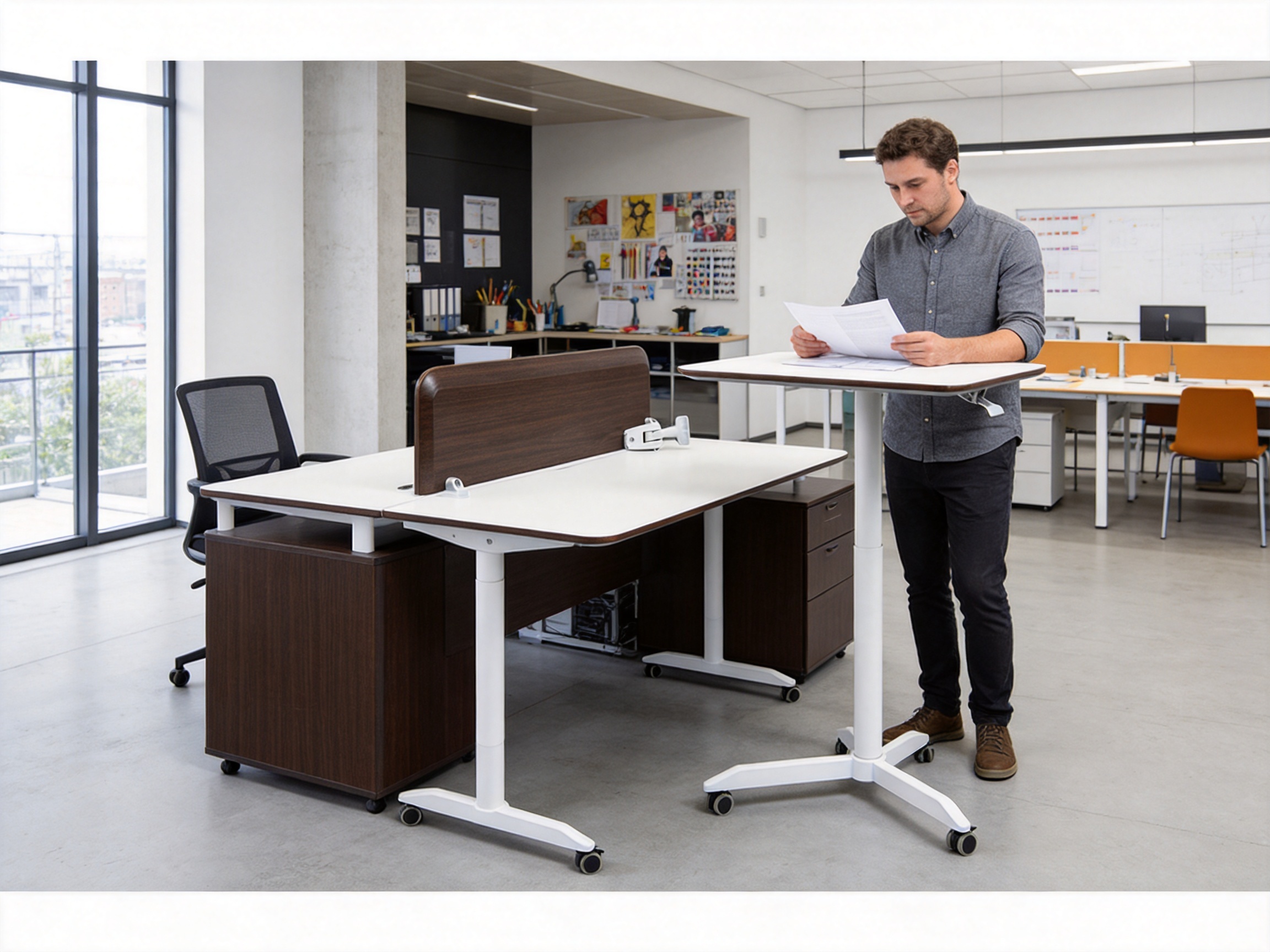
Work environments are changing rapidly. Offices, studios, laboratories, workshops, educational facilities, and home workspaces increasingly require furniture that can adapt to different users, tasks, and working positions. A fixed-height desk may be adequate for one activity, but it can become restrictive when a user needs to alternate between sitting and standing, reposition equipment, or work comfortably in a compact space. The TH10 Three-Claw Leg Pneumatic Height-Adjustable Desk addresses these needs with a compact tabletop, a tripod-style base, a manual gas spring lifting mechanism, and mobile casters that combine movement with stability.
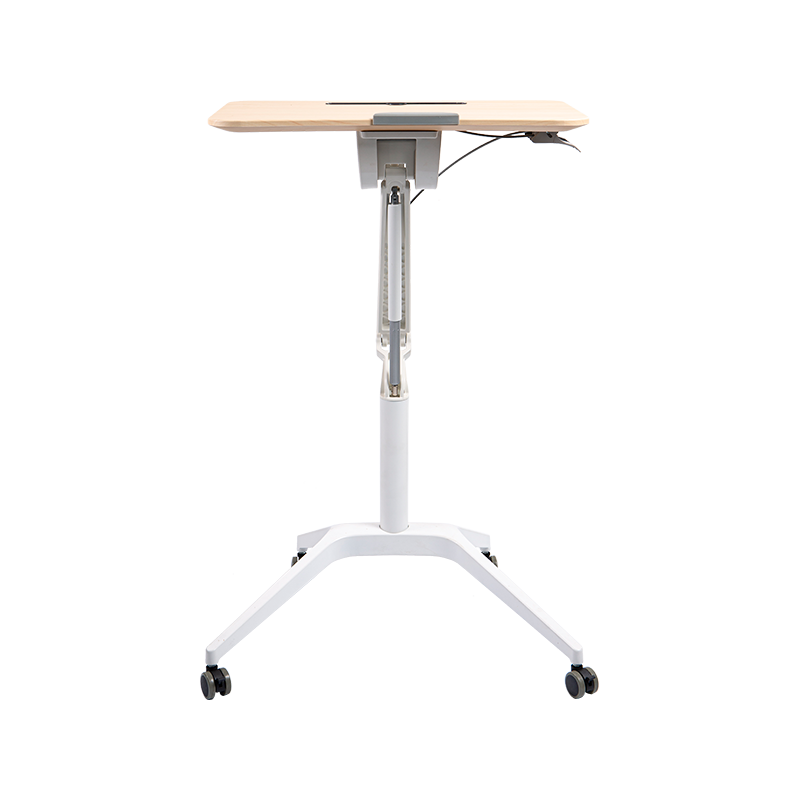
Designed as a pneumatic height-adjustable table, the TH10 provides a lifting range from 720 mm to 1100 mm. This range supports seated work, standing work, and intermediate positions without requiring electrical power. Its manually operated pneumatic system offers a straightforward alternative to motorized desks, especially in environments where simple operation, low maintenance, mobility, and space efficiency are important purchasing considerations.
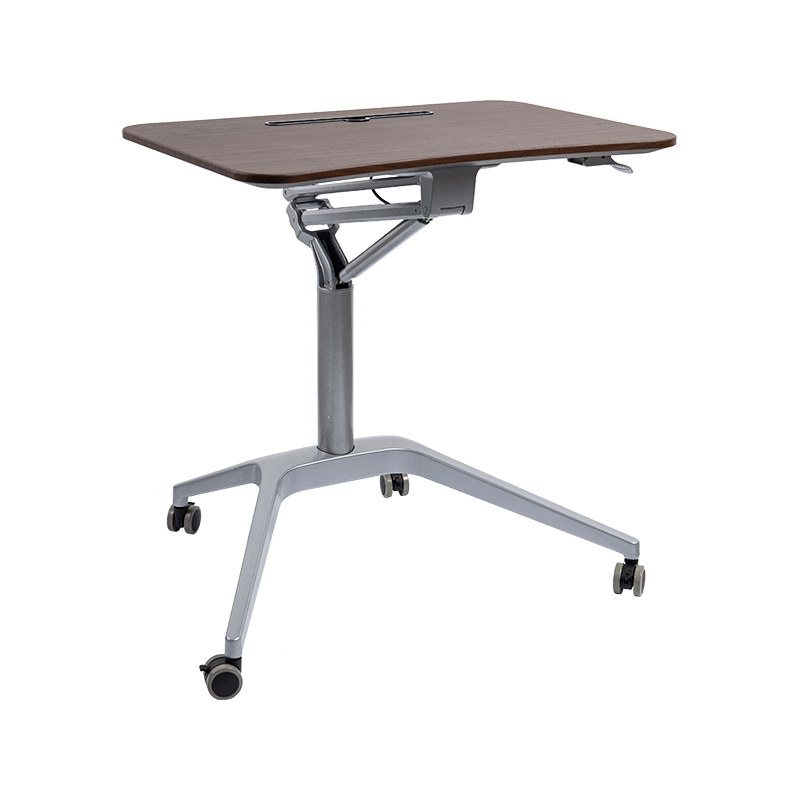
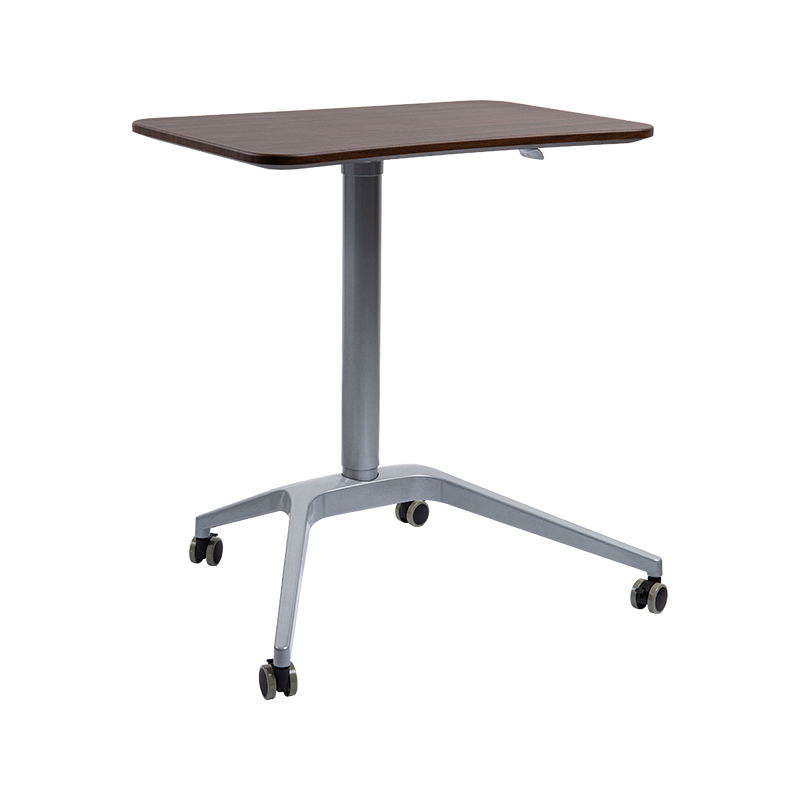
The desk combines aluminum and iron structural components with powder-coated surfaces. The tabletop measures 715 mm by 495 mm and has a 25 mm thickness. It is manufactured from MDF with a PVC vacuum-formed surface, offering a practical balance between visual appeal, cleanability, and everyday durability. Users can select from Walnut, White, and Maple tabletop finishes, while the frame is available in White or Silver.
With two locking casters and one non-locking caster, the TH10 is designed to be repositioned when necessary and secured during use. This combination is particularly useful for compact offices, professional studios, laboratories, drafting areas, and technical workstations where the desk may need to move between locations but should remain stable during an active task.
Understanding the TH10 Product Concept
The TH10 is built around a simple product concept: provide ergonomic height flexibility in a compact and accessible format without the complexity of an electrically powered lifting column. The desk uses a gas spring to assist manual height adjustment. When the adjustment control is operated, the pneumatic mechanism helps the tabletop move smoothly through its available range. The user can then work at a preferred height according to body size, posture, task requirements, or room arrangement.
This approach distinguishes the TH10 from conventional fixed-height tables. A fixed table normally forces the user to adapt to one predetermined working level. By contrast, the TH10 enables the work surface to adapt to the user. It can support seated computer work, standing reading, drafting, light assembly, crafting, inspection, and other activities that benefit from a more flexible working position.
The three-claw leg or tripod-style base is another defining feature. Instead of using a large rectangular base structure, the TH10 uses a compact three-point support arrangement. This configuration helps preserve floor space and allows the desk to fit into areas where a conventional four-leg table may be less convenient. The tripod form also contributes to the product’s distinctive appearance while providing a stable foundation for the tabletop.
Mobility is integrated into the base through three casters. Two casters include locks, while the third is non-locking. The locking casters can be engaged after the desk is positioned, helping reduce unwanted movement during work. When the locks are released, the desk can be moved to a new location with relatively little effort. This makes the product suitable for rooms that must be reconfigured frequently.
Core Technical Specifications
The following table summarizes the principal specifications of the TH10 Three-Claw Leg Pneumatic Height-Adjustable Desk.
| Specification | Product Detail |
|---|---|
| Product type | Pneumatic height-adjustable desk |
| Height adjustment range | 720 mm to 1100 mm |
| Tabletop dimensions | 715 mm × 495 mm × 25 mm |
| Tabletop construction | 25 mm MDF with PVC vacuum forming |
| Frame material | Aluminum and iron |
| Frame surface treatment | Powder coating |
| Frame color options | White and Silver |
| Tabletop color options | Walnut, White, and Maple |
| Base configuration | Three-claw leg or tripod-style base |
| Casters | Two locking casters and one non-locking caster |
| Lifting principle | Gas spring lifting |
The specifications show that the TH10 is intended as a compact functional workstation rather than a large executive desk. Its tabletop size provides enough room for many individual work activities while keeping the overall footprint manageable. The 25 mm tabletop thickness contributes to a substantial appearance and supports the product’s practical, professional character.
Ergonomic Height Adjustment Without Electrical Power
One of the principal advantages of the TH10 is its pneumatic height-adjustment system. Gas spring technology has long been used in furniture, equipment supports, seating systems, and other applications that require assisted movement. In the TH10, the gas spring helps the user raise or lower the tabletop manually rather than relying on an electric motor, control box, or external power source.
This creates several practical benefits. First, the desk can be used in locations where power outlets are limited or unavailable. It does not require a trailing power cable, which can simplify room organization and reduce cable clutter around a mobile workstation. Second, the operating principle is easy to understand. Users can adjust the desk through a direct mechanical action instead of navigating electronic controls.
Third, the absence of an electrical lifting system can simplify routine ownership. There is no motor, handset, control panel, or electrical control unit to operate. This can be beneficial in workshops, classrooms, laboratories, temporary project areas, or other locations where equipment may be moved often and uncomplicated operation is preferred.
The 720 mm to 1100 mm range is broad enough to support multiple working postures. At the lower end, the desk can be configured for seated or semi-seated tasks, depending on the user and chair height. At the upper end, it can support standing activities such as reading, reviewing documents, drafting, checking components, or using a laptop. Intermediate positions allow users to make smaller adjustments for better arm, shoulder, and wrist alignment.
Height flexibility can also support shared workspaces. Different users may have different body proportions and posture preferences. Rather than assigning each person to a fixed-height table, a pneumatic desk allows the workstation to be adjusted for the individual. This is especially helpful in offices, training facilities, laboratories, and studios used by multiple people.
Advantages Over Fixed-Height and Conventional Mobile Desks
The TH10 offers a combination of features that may be difficult to achieve with a conventional fixed-height table. Its first advantage is adaptability. A fixed-height product may have a lower purchase cost in some situations, but it does not provide the same ability to support different users or working postures. The TH10 adds functional flexibility without requiring a complex powered frame.
Its second advantage is compact mobility. Many mobile tables use four casters and a larger rectangular frame. Such designs can be practical, but they may occupy more floor area and can be less convenient in narrow spaces. The TH10’s tripod-style base is intended to maintain a compact footprint while still providing a stable support structure. Its caster arrangement allows the desk to be relocated when the room layout changes.
Its third advantage is the balance between mobility and positioning control. A desk with completely free-moving wheels can be inconvenient during precision work because it may shift when touched. The TH10 includes two locking casters, allowing the user to secure the desk after moving it. This is useful for writing, drawing, inspection, light assembly, and computer work.
Its fourth advantage is energy independence. Unlike electric height-adjustable desks, the TH10 does not depend on a power socket for height adjustment. This makes it easier to install in temporary work areas, open studios, demonstration rooms, and spaces where electrical infrastructure is limited. It also avoids some of the cable-management considerations associated with powered furniture.
Its fifth advantage is visual and material flexibility. The tabletop is available in Walnut, White, and Maple finishes, while the frame can be supplied in White or Silver. These options allow the product to coordinate with modern office interiors, technical environments, education spaces, and professional studios. The PVC vacuum-formed surface offers a consistent finish that is easy to integrate into different furniture styles.
Tabletop Design and Surface Performance
The TH10 tabletop measures 715 mm by 495 mm, creating a compact work surface suitable for personal tasks. The dimensions are appropriate for a laptop, documents, writing materials, small tools, or selected pieces of laboratory and studio equipment. Its relatively compact format can help users make efficient use of limited floor space while retaining a dedicated work surface.
The tabletop is made from 25 mm MDF with PVC vacuum forming. Medium-density fiberboard provides a uniform engineered-wood substrate, while the PVC surface contributes to a smooth and visually consistent finish. Vacuum forming allows the surface material to follow the tabletop profile closely, supporting a clean appearance and practical edge treatment.
Different tabletop finishes support different design goals. Walnut can provide a warmer, more traditional appearance for offices, reception-adjacent work areas, and home workspaces. White can support a bright, minimal, and contemporary environment. Maple offers a lighter wood-inspired appearance that can work well in studios, educational facilities, and collaborative interiors.
The tabletop should be used within the product’s intended application. Routine cleaning can normally be performed with a soft cloth and a mild, non-abrasive cleaning solution. Users should avoid prolonged exposure to standing moisture, harsh chemicals, sharp impact, or excessive heat. Following appropriate care practices helps preserve the surface appearance and supports long-term service.
The 25 mm thickness gives the tabletop a substantial feel compared with thin-panel alternatives. It also contributes to a visually balanced relationship between the work surface and the tripod base. In a compact desk, proportional design is important because the tabletop must look sufficiently robust without making the overall product appear oversized.
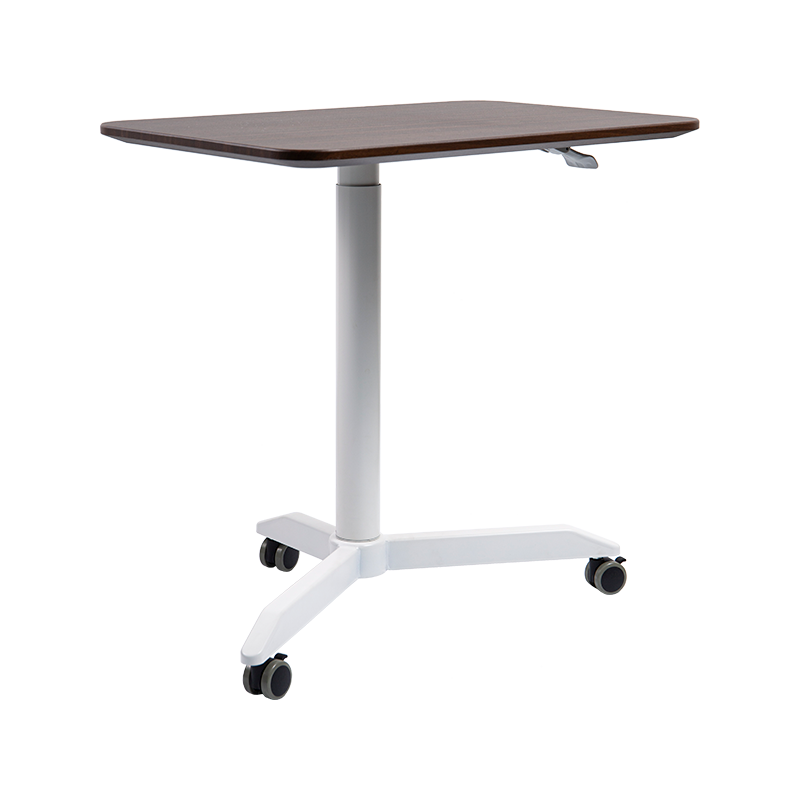
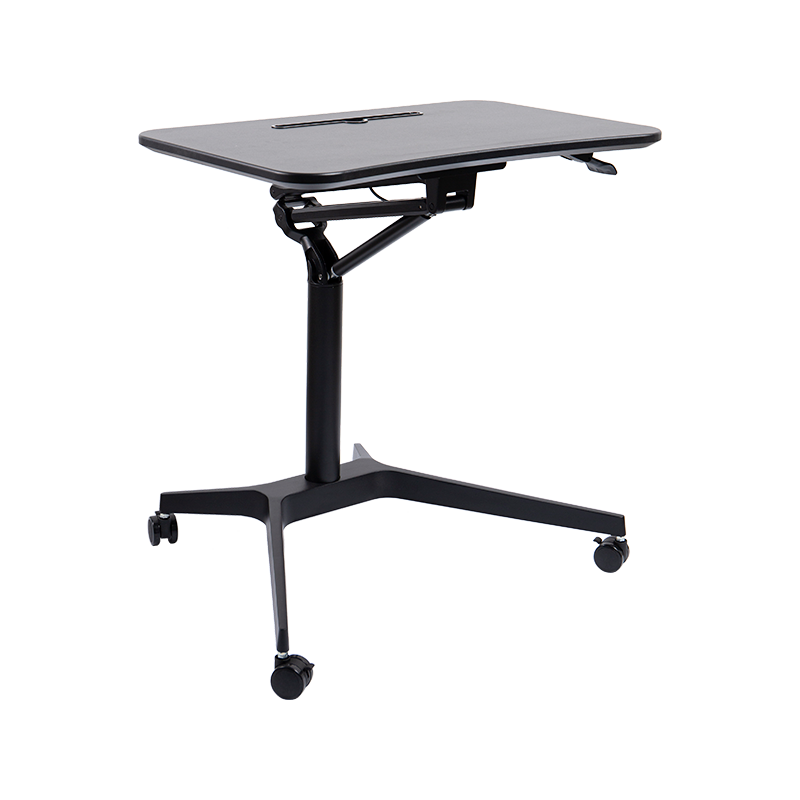
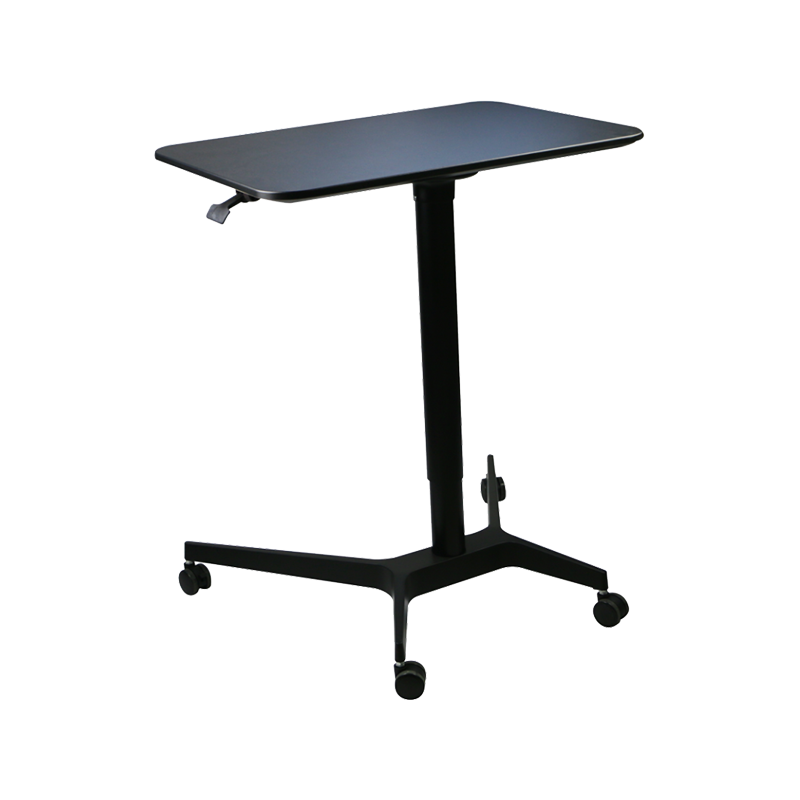
TH10 (Three-Claw Leg) Pneumatic Height-Adjustable Desk
Frame Construction: Aluminum and Iron
The frame combines aluminum and iron, using the advantages of both materials within a single structure. Aluminum is valued for its relatively low weight and corrosion-resistant characteristics, making it useful in components where easier handling and a clean appearance are important. Iron provides a robust structural foundation for load-bearing and connection areas.
This material combination supports the product’s balance between mobility and strength. A mobile workstation should not be unnecessarily heavy, because excessive weight can make relocation difficult. At the same time, the frame must provide sufficient rigidity for normal desk activities. Combining aluminum and iron helps address these two requirements through a practical construction strategy.
Material selection is only one part of product performance. The quality of the finished desk also depends on component forming, dimensional accuracy, connection design, surface preparation, coating consistency, and assembly control. A professional manufacturer must coordinate these processes to ensure that the finished product operates smoothly and maintains a consistent appearance across production batches.
The frame is finished with powder coating in White or Silver. Powder coating is a widely used industrial finishing process in which dry coating material is applied to a prepared metal surface and then cured. Compared with basic painted finishes, a properly applied powder coating can provide a durable and uniform surface suitable for everyday furniture use. It also supports consistent color presentation across the frame structure.
The surface treatment serves both functional and aesthetic purposes. It helps protect the metal from ordinary environmental exposure, improves resistance to routine scuffing, and gives the desk a clean professional appearance. White can create a bright, understated look, while Silver can emphasize the technical character of the aluminum-and-iron structure.
Tripod Stability and Caster Configuration
The three-claw leg design is central to the TH10’s identity. A tripod base distributes support through three contact points and can remain stable on ordinary indoor flooring when properly positioned. The design is compact and visually distinctive, making it suitable for spaces where a conventional rectangular base would appear too large or restrictive.
Because the base is mobile, floor contact and caster condition are important to proper use. The desk should be placed on a reasonably level surface, and the casters should be checked periodically for obstructions. When the desk is being used for tasks that require a firm position, the two locking casters should be engaged.
The two-locking, one-non-locking arrangement provides a practical compromise. The locking casters help restrain movement, while the non-locking caster supports smooth repositioning. This arrangement can make the desk easier to guide when it is moved and easier to secure when it reaches the desired location.
Users should avoid leaning heavily on the edge of the tabletop or applying concentrated force that is not consistent with ordinary desk use. As with any mobile table, stability is best maintained when loads are distributed reasonably across the tabletop and when the desk is not pushed or pulled aggressively during adjustment.
The base configuration is particularly useful in compact areas. A user can place the desk beside a larger workstation, move it into a presentation area, reposition it next to equipment, or store it against a wall when not required. This type of flexibility can help organizations use one product for several functions rather than installing separate fixed workstations for every activity.
Manufacturing Strengths and Production Capabilities
SuZhou Skyhone Intelligent Technology Co., Ltd. is a professional manufacturing enterprise focused on the research and development, production, sales, and service of standing desks and related adjustable workspace products. Based in Suzhou, Jiangsu Province, the company operates in the Yangtze River Delta, a region known for its developed manufacturing infrastructure, supplier networks, engineering resources, and furniture-industry capabilities.
The company’s position within this industrial environment can support coordinated product development and production. A standing desk is not a single-material product. It requires the integration of metal components, engineered wood panels, surface finishes, pneumatic mechanisms, casters, fasteners, packaging, and quality-control procedures. Manufacturing effectiveness therefore depends on the ability to manage multiple processes as one complete product system.
The TH10 reflects a product-development approach that combines functional design with practical manufacturability. Its structure uses a limited number of core materials and a clearly defined operating principle. The compact tabletop, three-claw base, gas spring mechanism, and caster arrangement can be organized into a repeatable production process. This can help support consistent assembly and efficient order fulfillment.
Research and development capability is important when producing adjustable furniture. Engineers must consider movement, balance, component fit, surface durability, user interaction, and packaging requirements at the same time. For a pneumatic table, the lifting system must be properly integrated with the frame so that height adjustment is smooth and the tabletop remains appropriately supported through the operating range.
Metal fabrication and finishing are also important manufacturing stages. Aluminum and iron parts must be formed and prepared according to the design requirements. Connection points need to align accurately so that the base can be assembled without unnecessary stress or looseness. Before powder coating, metal surfaces generally require suitable preparation to promote coating adhesion and a consistent finish.
The tabletop manufacturing process requires its own quality controls. MDF panels must be cut to the required dimensions, and the PVC surface must be applied evenly. Consistent panel thickness, clean edges, accurate hole positions, and reliable surface bonding all contribute to the final user experience. A professional production system should inspect these details before the tabletop is combined with the frame.
Assembly is the stage where individual components become a functioning desk. The manufacturer must verify the installation of the gas spring, lifting controls, casters, tabletop, frame connections, and related hardware. An organized assembly process can reduce variation between units and make later inspection more effective.
Quality assurance should cover both appearance and function. Visual checks may include tabletop finish, frame color, coating coverage, edge quality, and component alignment. Functional checks may include height movement, caster operation, locking performance, frame stability, and general fit. These checks are especially important for adjustable furniture because a product can appear attractive while still requiring correction in its movement or assembly performance.
Packaging and logistics are additional manufacturing strengths that influence customer satisfaction. A compact desk still contains multiple parts that must be protected during storage and transportation. Proper packaging design can help reduce scratches, edge damage, coating marks, and component loss. Clear assembly instructions and organized hardware packaging can also help distributors and end users complete installation more efficiently.
Why Powder Coating Matters in Commercial Furniture
Powder coating is well suited to metal furniture frames because it creates a dry, evenly distributed finish that can be cured into a continuous surface. The process supports the clean appearance expected in offices and professional environments. It also gives manufacturers the ability to offer coordinated color options, such as White and Silver, while maintaining a consistent production standard.
A powder-coated frame is easier to incorporate into different interior concepts. White frames can complement bright rooms, minimalist furniture, healthcare-adjacent environments, and educational spaces. Silver frames can coordinate with technical equipment, industrial studios, laboratories, and contemporary office interiors. The availability of two frame colors provides flexibility without requiring a completely different frame design.
Coating quality depends on proper preparation, application, curing, and inspection. The manufacturing process must be managed so that the surface is evenly covered and free from obvious defects. Attention to these details helps ensure that the finished product presents a professional appearance when it reaches the customer.
Applications Across Professional and Commercial Environments
Office Workstations
In an office, the TH10 can serve as a compact personal workstation, a temporary project desk, or a flexible auxiliary table. It can support laptop work, document review, short meetings, and alternating seated and standing tasks. Its small footprint makes it suitable for offices where every square meter must be used carefully.
Home Offices
Home users often need furniture that can fit into multipurpose rooms. A compact pneumatic desk can be moved when the room is used for another activity. The ability to adjust the height can also help family members of different sizes use the same table more comfortably.
Workshops and Technical Areas
Workshops may require a table for inspection, preparation, documentation, light assembly, or tool organization. The TH10 can be moved close to a project area and then secured using its locking casters. Its height range enables users to choose a more suitable level for different technical activities.
Studios and Creative Spaces
Artists, designers, makers, and photographers may benefit from a surface that can shift between sitting and standing positions. The Walnut, White, and Maple tabletop options also allow the desk to coordinate with creative interiors. Its compact dimensions are useful in studios where large worktables and equipment already occupy much of the available floor area.
Laboratories and Educational Facilities
In laboratories, training rooms, and educational spaces, furniture is often shared by multiple users. Height adjustability allows the workstation to be adapted for different students, technicians, or instructors. The mobile base can support changes in classroom layouts, demonstrations, and temporary experiments, provided that the product is used within its intended application and load conditions.
Healthcare-Adjacent and Service Environments
Some service environments require compact, movable tables for documentation, equipment support, or administrative tasks. The smooth surface and powder-coated frame can be practical for routine cleaning and everyday use. Specific healthcare applications should always be evaluated against the relevant institutional requirements, cleaning protocols, and equipment loads.
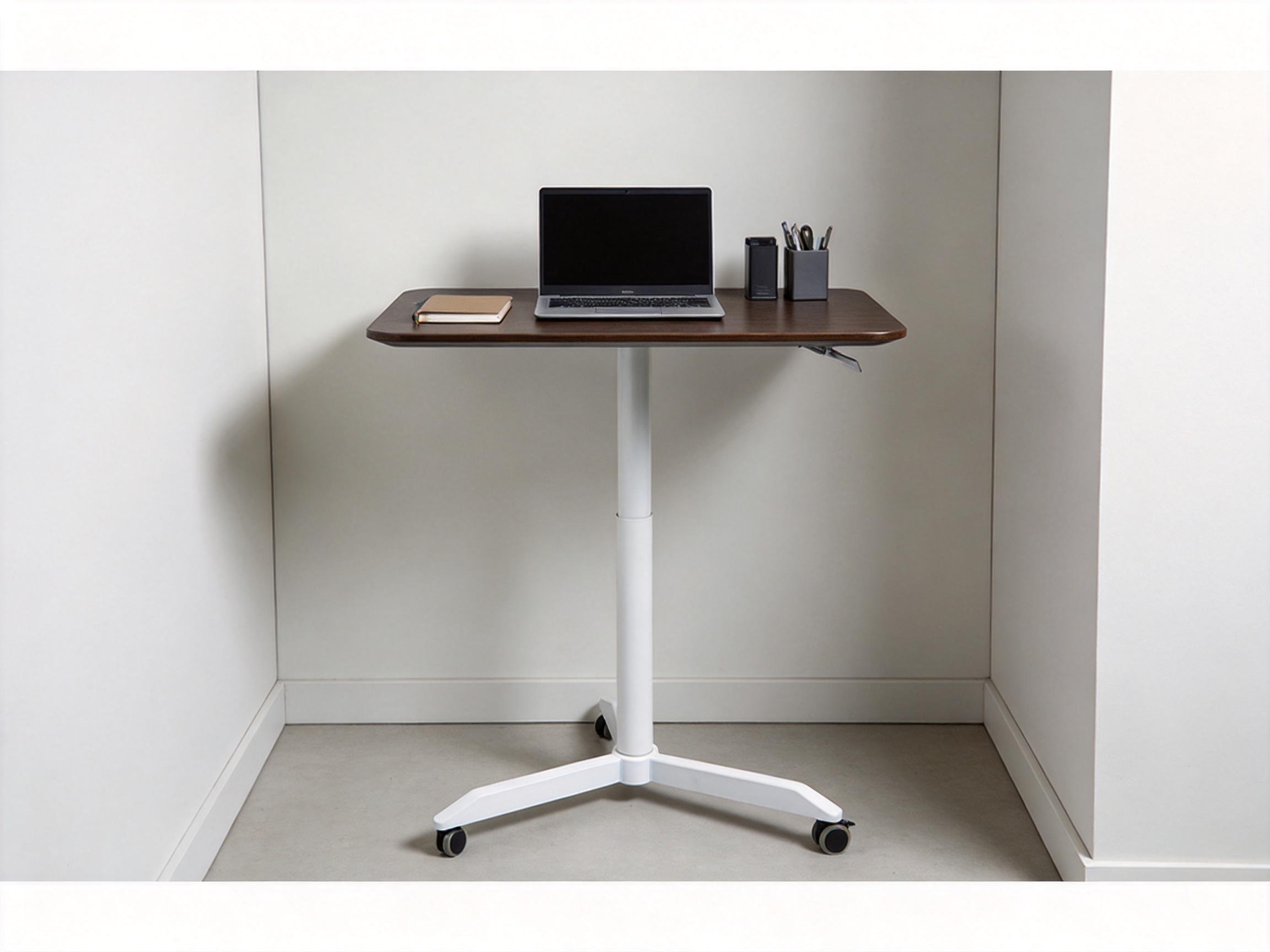
Designing a More Flexible Workspace with the TH10
A height-adjustable desk is most effective when it is integrated into a thoughtful workspace plan. Users should position the TH10 so that there is sufficient clearance for the tabletop and base throughout the adjustment range. Nearby shelves, cabinets, monitors, or equipment should not obstruct movement from 720 mm to 1100 mm.
For computer work, the user should place the monitor so that the top area of the screen is at a comfortable viewing level. The keyboard and mouse should be positioned to minimize excessive wrist extension and shoulder elevation. When changing from seated to standing work, the entire workstation arrangement should be adjusted rather than raising the desk alone.
For drafting or creative activities, the desk can be set at a height that allows the forearms to rest comfortably while maintaining a relaxed shoulder position. For inspection or assembly, the user may choose a higher level to bring the work closer to eye height. The useful height is not necessarily the highest setting; it is the setting that best matches the task and the user.
In shared environments, a simple adjustment procedure can improve usability. The user should clear unstable objects from the tabletop, operate the pneumatic control as intended, move the tabletop gradually, and confirm that the desk is at the desired level before beginning work. Once the desk has been positioned, the caster locks should be engaged when additional stability is needed.
Maintenance and Long-Term Use
The TH10 is designed for straightforward operation and low routine maintenance. The tabletop can be wiped with a soft cloth, and the frame can be cleaned using suitable mild cleaning materials. Abrasive pads, highly corrosive chemicals, and excessive water should be avoided because they may damage the PVC surface or affect the appearance of the powder-coated metal.
Casters should be inspected periodically for dust, fibers, or other debris that could affect rolling. The locking function should also be checked to confirm that the wheels engage and release correctly. If the desk is used in a workshop or studio, inspection may need to occur more frequently because small particles can accumulate around moving components.
Frame connections and visible fasteners should be checked as part of normal furniture maintenance. If any connection becomes loose, it should be tightened using the appropriate method. Users should not modify the frame, gas spring, caster arrangement, or lifting controls without professional guidance, because unauthorized modifications may affect stability and operation.
The pneumatic mechanism should be used according to the manufacturer’s instructions. Users should not attempt to open, puncture, heat, or disassemble the gas spring. If height adjustment becomes abnormal, unusually slow, uneven, or difficult, the desk should be removed from service until it has been inspected by a qualified technician or authorized service provider.
Proper maintenance is not only about preserving appearance. It also supports reliable movement, stable positioning, and longer service life. A simple inspection routine can help identify issues before they become more serious and can make the product a dependable part of a flexible workspace program.
Purchasing Considerations for Distributors and Project Buyers
Businesses and distributors evaluating the TH10 should consider the product’s intended use, room layout, user population, and procurement volume. The compact dimensions are an advantage where space efficiency matters, while the 720 mm to 1100 mm range provides broad ergonomic flexibility. Buyers should confirm that the tabletop size is appropriate for the equipment and materials that users plan to place on it.
The choice of tabletop color and frame color can be used to create consistent interior schemes. A distributor serving corporate offices may select White or Silver frames with White or Maple surfaces. A studio or hospitality-oriented customer may prefer a Walnut tabletop. Multiple finish options can make the same basic product suitable for a wider range of projects.
For larger orders, buyers should discuss packaging, assembly requirements, sample approval, product labeling, inspection standards, and delivery planning with the manufacturer. A professional supplier should be able to communicate clearly about product specifications and help customers understand the available configuration options.
Customization may be considered for projects with special branding, color, packaging, or functional requirements. Any proposed modification should be reviewed for compatibility with the product’s structure, lifting mechanism, stability, and manufacturing process. A strong manufacturer evaluates customization as an engineering and production issue rather than treating it only as a cosmetic change.
The company’s location in Suzhou provides access to a mature regional manufacturing ecosystem. This can support coordination with suppliers, production scheduling, engineering development, inspection, and export-oriented logistics. For international buyers, clear technical communication and stable production management are important factors in selecting a long-term adjustable-furniture partner.
Competitive Positioning of the TH10
The TH10 competes through a combination of features rather than through one isolated specification. Its competitive position is based on pneumatic height adjustment, a compact footprint, a tripod-style base, integrated mobility, multiple finish choices, and a material combination designed for practical daily use.
Compared with fixed-height office tables, it offers greater adaptability. Compared with electric standing desks, it provides height adjustment without a power connection. Compared with some larger mobile tables, it can occupy less visual and physical space. Compared with basic utility carts, it offers a more refined tabletop finish and a height range designed specifically for ergonomic work positions.
The product is also differentiated by its three-claw visual identity. The tripod configuration gives the desk a distinctive structure that can be attractive to buyers seeking furniture that is both functional and visually recognizable. At the same time, the design remains practical for compact work areas.
Another competitive strength is its balance of professional appearance and operational simplicity. A user does not need specialized training to understand that the desk can be moved, locked, and manually adjusted. This can reduce the learning curve in shared environments where many users interact with the same furniture.
The most suitable competitor comparison depends on the customer’s priorities. If a buyer requires programmable height presets, a powered desk may be more appropriate. If a buyer needs a large work surface, a larger adjustable table should be considered. However, for users seeking a compact, mobile, manually adjustable workstation, the TH10 offers a focused and practical solution.
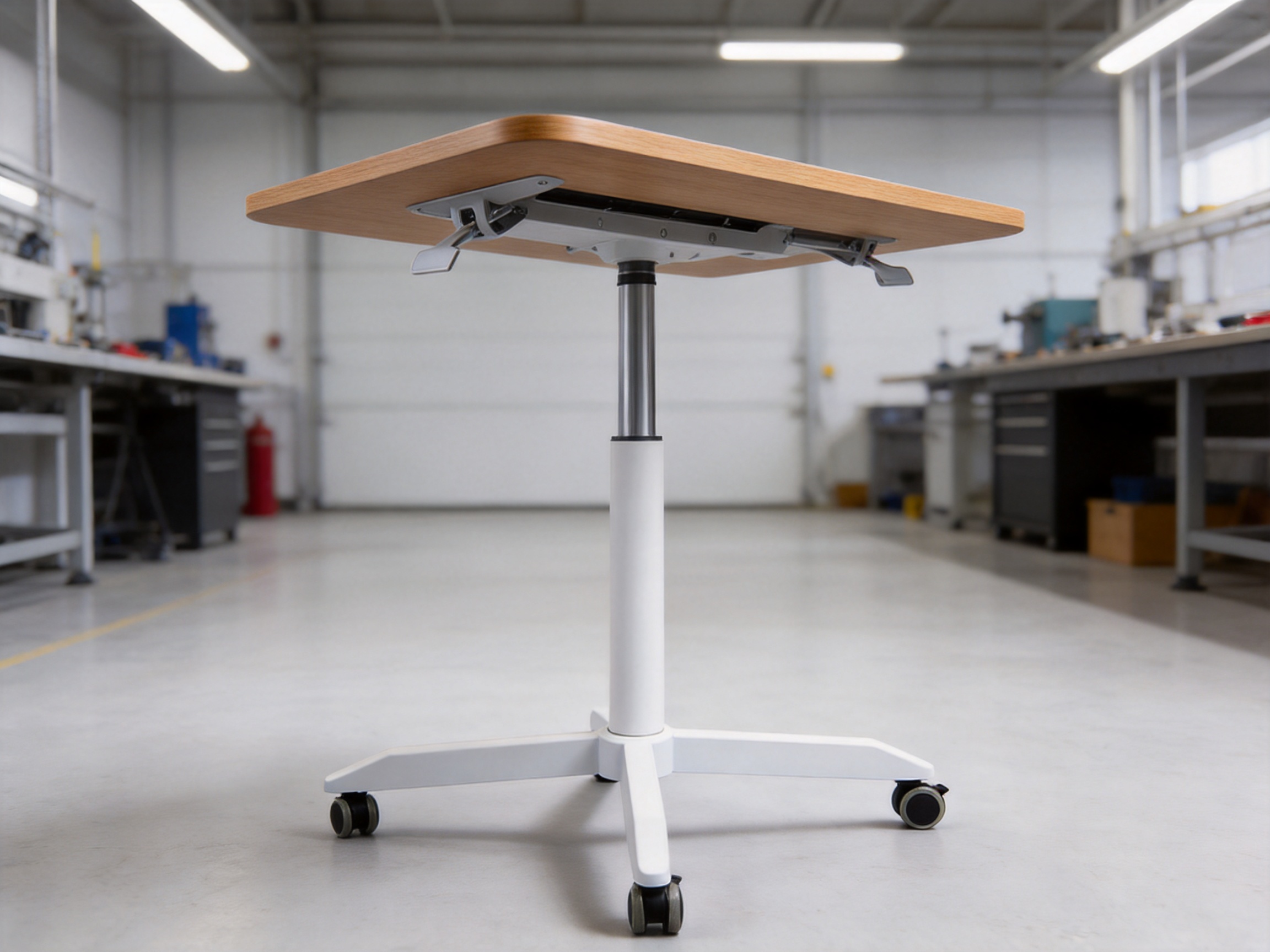
Quality-Oriented Manufacturing Philosophy
A successful adjustable desk manufacturer must think beyond the visible product. The user experiences the desk through its movement, stability, finish, assembly, packaging, and long-term service. Each of these aspects depends on manufacturing discipline.
Product development begins with understanding the intended application. The TH10 is designed for compact professional environments where height flexibility and mobility are valuable. This application focus helps define the appropriate tabletop dimensions, lifting range, base structure, caster arrangement, and surface choices.
Engineering then translates these requirements into components and processes. Aluminum and iron must be used in suitable structural roles. The gas spring must be integrated into the frame. The tabletop must be accurately formed and finished. Casters must be fitted securely, and the locking units must be accessible to the user.
Production consistency is supported by standardized procedures. Repeatable cutting, forming, coating, panel finishing, assembly, and inspection processes help reduce variation between products. The goal is not simply to produce one attractive sample, but to deliver dependable units across an ongoing production program.
Service capability is equally important. Customers may need support with installation, product selection, maintenance, replacement components, or future orders. A manufacturer that combines research and development, production, sales, and service can provide a more coordinated customer experience than a supplier focused only on one stage of the transaction.
Environmental and Operational Efficiency
The TH10 can contribute to operational efficiency by allowing one desk to support multiple tasks and users. A flexible table may reduce the need to purchase separate seated and standing workstations for every individual. Its mobile design can also help organizations reconfigure rooms instead of installing permanently fixed furniture for each possible arrangement.
Because the desk uses a manual pneumatic mechanism, it does not consume electricity during height adjustment. This can be useful in facilities that want to reduce the number of powered devices in a workspace or simplify cable management. The product is not intended to replace every electric desk, but its non-powered operation is a meaningful advantage in suitable applications.
Long-term product value also depends on durability and maintainability. A robust frame, protected surface, replaceable or serviceable components where applicable, and clear maintenance practices can help extend the useful life of the desk. Longer service life may reduce the frequency of replacement and support more responsible furniture purchasing decisions.
Installation and Everyday Operation
Before installation, the user should confirm that all components and hardware are present. The assembly area should be clean and large enough to protect the tabletop and frame during setup. The desk should be assembled according to the supplied instructions, with fasteners tightened correctly but without excessive force that could damage components.
After assembly, the user should check that the tabletop is secure, the base is properly connected, the casters roll as expected, and the locking casters engage correctly. The pneumatic lifting function should be tested without unnecessary load before regular use. Any unusual noise, obstruction, or uneven movement should be investigated before the desk is placed into service.
During regular operation, users should keep hands, cables, and loose objects clear of the moving structure. The tabletop should not be raised or lowered while people are leaning heavily on it. The desk should be moved carefully, especially when carrying materials, and the caster locks should be engaged when the workstation is in its working position.
These simple practices help maintain safe, smooth, and predictable operation. They also reduce the possibility of accidental damage to the frame, tabletop, pneumatic mechanism, or nearby furniture.
Frequently Asked Questions
What type of desk is the TH10?
The TH10 is a pneumatic height-adjustable desk with a three-claw leg or tripod-style base. It is designed for compact offices, studios, workshops, laboratories, educational spaces, and other professional environments that benefit from mobile height flexibility.
What is the height adjustment range?
The desk adjusts from 720 mm to 1100 mm. This range supports seated, standing, and intermediate working positions, depending on the user’s height, chair, equipment, and task.
Does the desk require electricity?
No. The TH10 uses a gas spring lifting mechanism and is manually operated. It does not require an electrical outlet, motor, control box, or power cable for height adjustment.
What are the tabletop dimensions?
The tabletop measures 715 mm by 495 mm and has a thickness of 25 mm. This compact size is suitable for individual work, laptops, documents, small tools, drafting tasks, and selected technical activities.
What is the tabletop made from?
The tabletop is made from 25 mm MDF with a PVC vacuum-formed surface. It is available in Walnut, White, and Maple finishes.
What materials are used for the frame?
The frame combines aluminum and iron. This material selection supports a balance of structural integrity, manageable weight, and professional appearance.
What colors are available for the frame?
The frame is available in White and Silver powder-coated finishes. These options can coordinate with modern offices, technical spaces, studios, laboratories, and educational interiors.
How many locking casters does the desk have?
The TH10 includes two locking casters and one non-locking caster. The locking casters can help secure the desk after it has been positioned, while the non-locking caster supports mobility.
Yes. Its adjustable height allows different users to select a more suitable working level. Its mobility also makes it useful in rooms that are frequently rearranged.
Can the desk be used in a laboratory or workshop?
It can be suitable for light laboratory, inspection, documentation, drafting, preparation, or workshop tasks when used within the intended application and load conditions. Buyers should evaluate the tabletop size, environment, chemicals, equipment, and cleaning requirements before selecting it for specialized use.
What is the advantage of the tripod-style base?
The three-claw base provides a compact and distinctive support structure. It can help the desk fit into space-constrained areas while supporting mobility through its caster configuration.
How should the tabletop be cleaned?
Use a soft cloth and a mild, non-abrasive cleaning solution. Avoid abrasive materials, harsh chemicals, prolonged moisture, and excessive heat to help protect the PVC surface.
What should be done if the pneumatic adjustment becomes abnormal?
Stop using the desk and have it inspected by a qualified technician or authorized service provider. Users should not open, puncture, heat, or disassemble the gas spring.
Can the product be customized?
Customization may be discussed for suitable projects, such as finish, packaging, labeling, or other requirements. Any modification should be reviewed by the manufacturer to ensure compatibility with the frame, lifting mechanism, stability, and production process.
Who manufactures the TH10?
The TH10 is manufactured by SuZhou Skyhone Intelligent Technology Co., Ltd., a Suzhou-based enterprise engaged in the research and development, production, sales, and service of standing desks and adjustable workspace solutions.
Conclusion
The TH10 Three-Claw Leg Pneumatic Height-Adjustable Desk is a compact workstation designed for users who need flexibility without electrical complexity. Its 720 mm to 1100 mm lifting range supports different working postures, while the gas spring mechanism enables manual adjustment without a power connection. The 715 mm by 495 mm tabletop provides an efficient personal work surface, and the 25 mm MDF panel with PVC vacuum forming offers a clean and adaptable finish.
The combination of aluminum and iron, powder-coated frame, three-claw base, and two locking casters creates a practical balance of structure, mobility, and appearance. Compared with fixed-height desks, the TH10 offers more ergonomic adaptability. Compared with powered standing desks, it provides a non-electric operating alternative. Compared with larger mobile tables, its compact form can be easier to integrate into limited spaces.
Its suitability for offices, home workspaces, workshops, studios, laboratories, and educational environments reflects the versatility of its design. The product also demonstrates how a focused manufacturing process can combine material selection, pneumatic engineering, surface finishing, assembly control, and customer-oriented configuration options into one coherent workstation solution.
For distributors, project buyers, and organizations seeking adjustable furniture, the TH10 provides a strong option where mobility, simple manual operation, compact dimensions, and finish flexibility are central requirements. Supported by SuZhou Skyhone Intelligent Technology Co., Ltd.’s manufacturing focus and Suzhou industrial resources, it represents a practical approach to creating more adaptable and efficient work environments.
References
1. Product specification sheet for the TH10 Three-Claw Leg Pneumatic Height-Adjustable Desk, including dimensions, materials, colors, caster configuration, and lifting principle.
2. Manufacturer-provided product information for pneumatic height-adjustable tables and compact standing workstations.
3. General ergonomic principles for alternating seated and standing work positions in office and professional environments.
4. General manufacturing references on powder coating processes for metal furniture components.
5. General materials references concerning MDF panels, PVC surface forming, aluminum components, and iron structural parts.
6. General furniture maintenance guidance for coated metal frames, laminated work surfaces, pneumatic mechanisms, and casters.
Product: TH10 (Three-Claw Leg) Pneumatic Height-Adjustable Desk


- Contact Info
-
-
 Phone+86-15950656125
 -
 Email
Email -
 AddressRoom 1007-1, South Building, Suyue Plaza, Suzhou Industrial Park, Suzhou City, Jiangsu Province, China
-
- Products
- Follow Us
- Need help? Please contact us
Copyright ©
SuZhou Skyhone Intelligent Technology Co., Ltd.
All Rights Reserved.
Privacy
Custom Ergonomic Adjustable Office Tables Manufacturers

