

 English
  русский
  Español
  عربى
عربى 
Content
- 1 1. The Growing Need for Adaptable Workstations
- 2 2. Product Overview
- 3 3. Gas Spring Height Adjustment
- 4 4. Flat-Legged Triangular Support Design
- 5 5. Tabletop Construction and Surface Performance
- 6 6. Advantages Over Conventional Fixed Tables
- 7 7. Advantages Over Electric Height-Adjustable Desks
- 8 8. Applications Across Professional Environments
- 9 9. Manufacturing Strengths and Production Approach
- 10 10. Quality Control Considerations
- 11 11. Customization and Project Support
- 12 12. Installation and Daily Use Recommendations
- 13 13. Ergonomic Use of the Desk
- 14 14. Why the SK01-3 Is a Competitive Choice
- 15 15. Recommended Buyer Profiles
- 16 16. Limitations and Selection Considerations
- 17 17. Maintenance and Product Longevity
- 18 18. Q&A
- 18.1 Q1: What is the height range of the SK01-3 desk?
- 18.2 Q2: Does the desk require electricity?
- 18.3 Q3: Is the desk suitable for sitting and standing?
- 18.4 Q4: What are the tabletop dimensions?
- 18.5 Q5: What is the tabletop made from?
- 18.6 Q6: What colors are available?
- 18.7 Q7: Can the desk be moved easily?
- 18.8 Q8: What is the purpose of the triangular flat-legged structure?
- 18.9 Q9: Is the desk an alternative to an electric standing desk?
- 18.10 Q10: Where can the desk be used?
- 18.11 Q11: Is the tabletop suitable for heavy industrial equipment?
- 18.12 Q12: What manufacturing capabilities support the product?
- 18.13 Q13: How should the desk be maintained?
- 19 19. Conclusion
- 20 References
- 21 Product: SK01-3 iPad (Flat-Legged) Pneumatic Height-Adjustable Desk
SK01-3 iPad Flat-Legged Pneumatic Height-Adjustable Desk: A Mobile Workstation for Flexible, Ergonomic Productivity
2026-08-12
Modern work environments are changing rapidly. Offices, laboratories, classrooms, retail demonstration areas, healthcare spaces, and home workstations increasingly require furniture that can adapt to different users, tasks, and postures. A fixed-height desk may be suitable for one activity and one person, but it can become restrictive when a workstation must support sitting, standing, collaboration, equipment testing, product presentation, or frequent relocation.
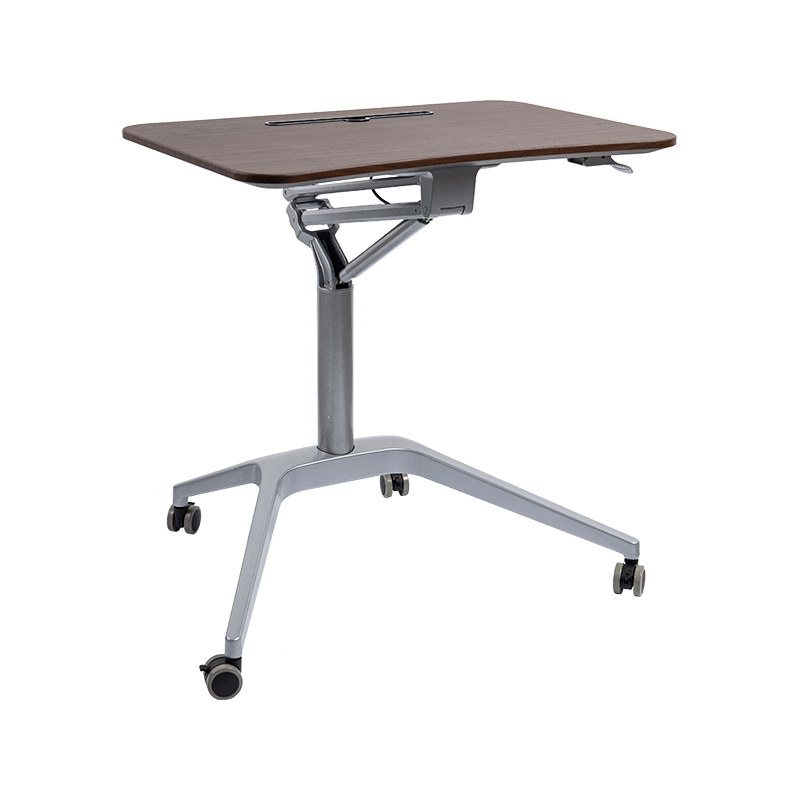
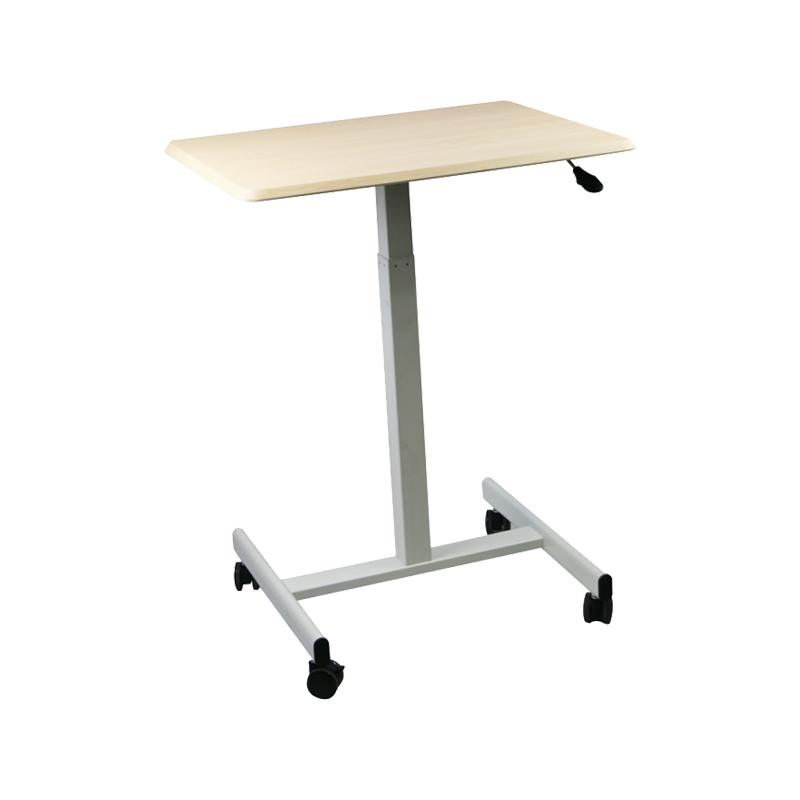
The SK01-3 iPad Flat-Legged Pneumatic Height-Adjustable Desk is designed to address these challenges with a compact mobile structure, a manually operated gas spring lifting system, a practical tabletop, and a triangular support frame. Combining aluminum and iron components with a durable powder-coated finish, the desk provides a balance of portability, stability, adjustability, and visual simplicity.
Its lifting range of 750mm to 1060mm allows users to transition between seated and standing working positions. The 715mm by 475mm tabletop provides sufficient space for a tablet, laptop, documents, test instruments, presentation materials, or other lightweight equipment. Four casters, including two lockable wheels, support mobility while allowing the desk to remain securely positioned during use.
As a product developed by a professional standing-desk manufacturer, the SK01-3 reflects a manufacturing approach centered on functional design, material coordination, production consistency, and customization. It is not simply a height-adjustable table. It is a compact workstation platform intended for organizations and individuals that need adaptable furniture without the complexity of a powered lifting system.
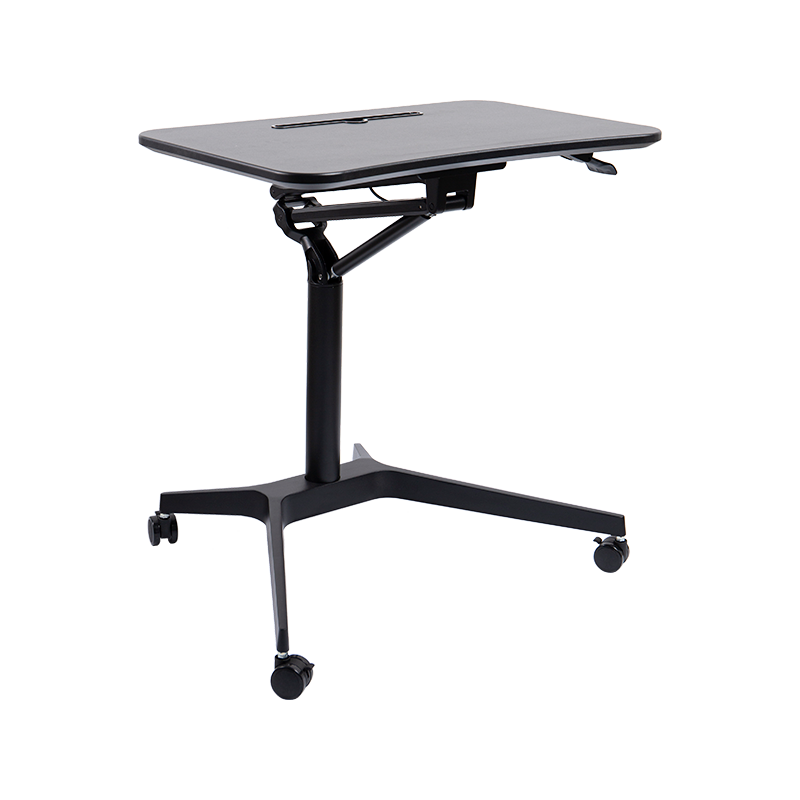
SK01-3 iPad (Flat-Legged) Pneumatic Height-Adjustable Desk
1. The Growing Need for Adaptable Workstations
Ergonomics is no longer limited to selecting a comfortable office chair. The complete workstation must support healthy posture, efficient movement, and appropriate working height. A desk that is too low can encourage users to lean forward or raise their shoulders. A desk that is too high may cause unnecessary arm and wrist strain. When multiple users share the same workstation, a fixed height becomes even less practical.
Height-adjustable desks provide a direct solution by allowing the working surface to be positioned according to the user and task. The SK01-3 extends this concept beyond the traditional office. Its mobile construction makes it useful wherever equipment, displays, documents, or work materials must be moved from one location to another.
Many height-adjustable desks depend on electric motors, control panels, power cables, and fixed floor placement. These products can be effective, but they are not always appropriate for compact work areas or mobile applications. A gas spring desk offers an alternative. It can be adjusted manually, operates without a power outlet, and avoids the need for electrical wiring beneath the tabletop.
This makes the SK01-3 particularly appropriate for spaces where the desk must be repositioned, where electrical access is limited, or where a simple and low-maintenance operating method is preferred. The product can function as a personal workstation, a presentation table, a testing station, or an auxiliary surface that moves with the user.
2. Product Overview
The SK01-3 iPad Flat-Legged Pneumatic Height-Adjustable Desk combines a compact work surface with a gas spring lifting mechanism. The desk is designed to support smooth manual height adjustment across a range of 310mm, from a minimum height of 750mm to a maximum height of 1060mm.
The tabletop measures 715mm by 475mm and has a thickness of 25mm. Its construction consists of a 25mm MDF core with a PVC vacuum-formed surface. This structure provides a practical balance between visual finish, usable strength, and manufacturing flexibility.
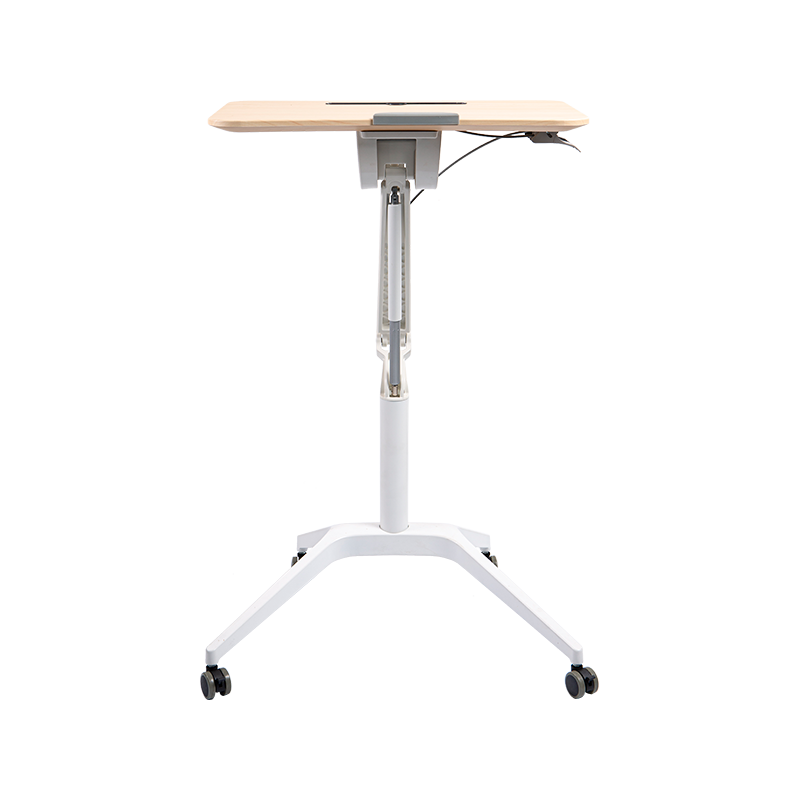
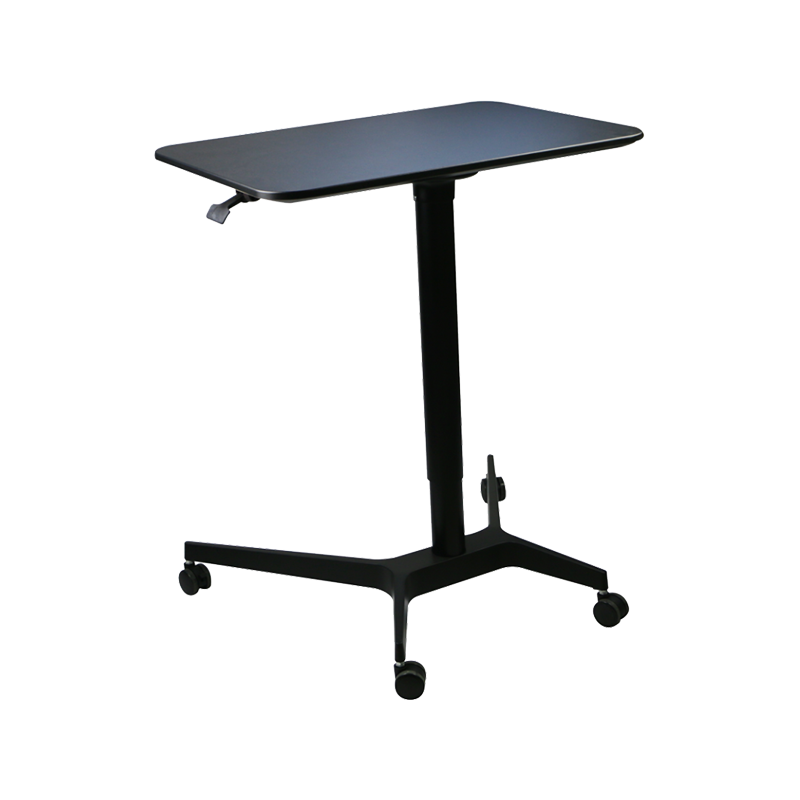
The frame is made from aluminum and iron. Aluminum contributes to a lighter and more manageable structure, while iron provides the rigidity required for a stable support system. The frame is finished with powder coating and is available in white, silver, or black.
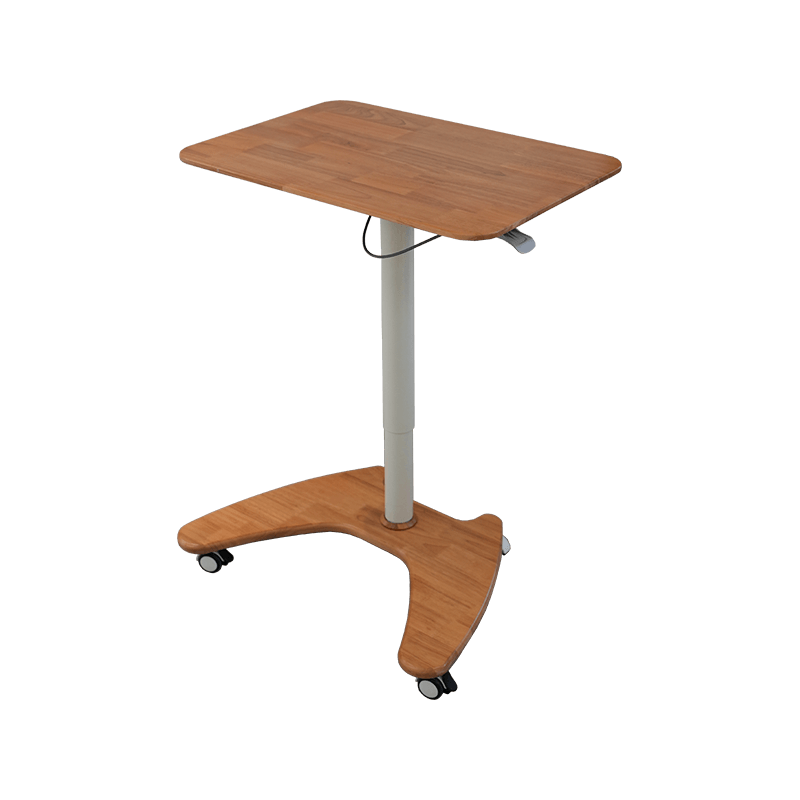
The standard tabletop color choices are white, maple, walnut, and black. These options allow the desk to coordinate with contemporary offices, educational facilities, laboratories, retail environments, and residential interiors.
Mobility is provided by four casters. Two casters include locking mechanisms, while the remaining two are non-locking swivel casters. This arrangement supports easy movement while enabling the user to secure the desk when a stable working position is required.
Technical Specification Summary
| Specification | Product Detail |
|---|---|
| Product model | SK01-3 iPad Flat-Legged Pneumatic Height-Adjustable Desk |
| Product category | Pneumatic Height-Adjustable Table |
| Lifting range | 750mm to 1060mm |
| Tabletop dimensions | 715mm by 475mm by 25mm |
| Tabletop construction | 25mm MDF with PVC vacuum-formed surface |
| Frame material | Aluminum and iron |
| Frame finish | Powder coating |
| Frame color options | White, silver, and black |
| Tabletop color options | White, maple, walnut, and black |
| Wheel configuration | Two lockable casters and two non-locking casters |
| Height adjustment method | Manual gas spring lifting |
| Support structure | Triangular flat-legged support design |
3. Gas Spring Height Adjustment
The central functional advantage of the SK01-3 is its pneumatic height-adjustment system. A gas spring stores energy within a sealed cylinder and assists the user when the work surface is raised or lowered. This reduces the effort required for manual adjustment and allows the desk to change position without an electric motor.
Compared with a basic fixed-height cart or table, the gas spring mechanism gives the user greater control over working posture. The desk can be positioned at a sitting height for computer work, reading, writing, or data entry. It can then be raised for standing use, product demonstration, equipment inspection, or collaborative discussion.
The 750mm to 1060mm range is broad enough to accommodate a variety of common work situations. The lower portion of the range is suitable for seated users, while the upper portion can support standing work for many adults. The intermediate positions are equally important because ergonomic comfort is not always achieved at the lowest or highest setting.
A pneumatic system also offers practical advantages in environments where electrical simplicity matters. There is no lifting motor to connect, no control handset to mount, and no power cable that may limit the desk’s movement. This can reduce visual clutter and simplify deployment in temporary or frequently changing work areas.
Manual Operation and User Control
Manual adjustment gives users direct control over the work surface. The user can make a height change when changing tasks rather than waiting for a motorized system to activate. In a shared environment, different people can quickly set the desk to a comfortable position without using a programmed control panel.
The gas spring is especially useful when the desk is used in short work cycles. A product demonstrator may raise the desk for a standing presentation and lower it afterward. A technician may adjust it to inspect a device from a more comfortable angle. A teacher may move it to match the height of a student group or demonstration area.
Because the system is mechanical rather than electrically powered, the workstation remains functional during power interruptions. It can also be installed in spaces where outlets are scarce, where cable management is difficult, or where electrical equipment is not desirable.
4. Flat-Legged Triangular Support Design
The flat-legged structure is one of the product’s most recognizable design characteristics. The triangular support arrangement creates a clear visual relationship between the legs and the central connection. Compared with a more rounded or heavily layered structure, the frame has a direct and linear appearance.
The outward angle of the legs is slightly larger, helping create a broad support footprint. A wider footprint can contribute to confidence when the desk is being moved or when users lean lightly against the work surface during normal operation. The central connection lines are also more distinct, giving the frame a purposeful architectural appearance.
The triangular support structure is not only a styling choice. A well-designed support geometry helps transfer tabletop loads toward the base and casters. By creating a direct route through the frame, the structure can reduce unnecessary visual and mechanical complexity.
The flat-legged design is also compatible with a variety of interior styles. White or silver frames can complement bright offices and educational spaces, while black frames can create a more technical or contemporary appearance. The simple geometry allows the desk to work alongside other furniture without appearing overly industrial.
Stability During Mobile Use
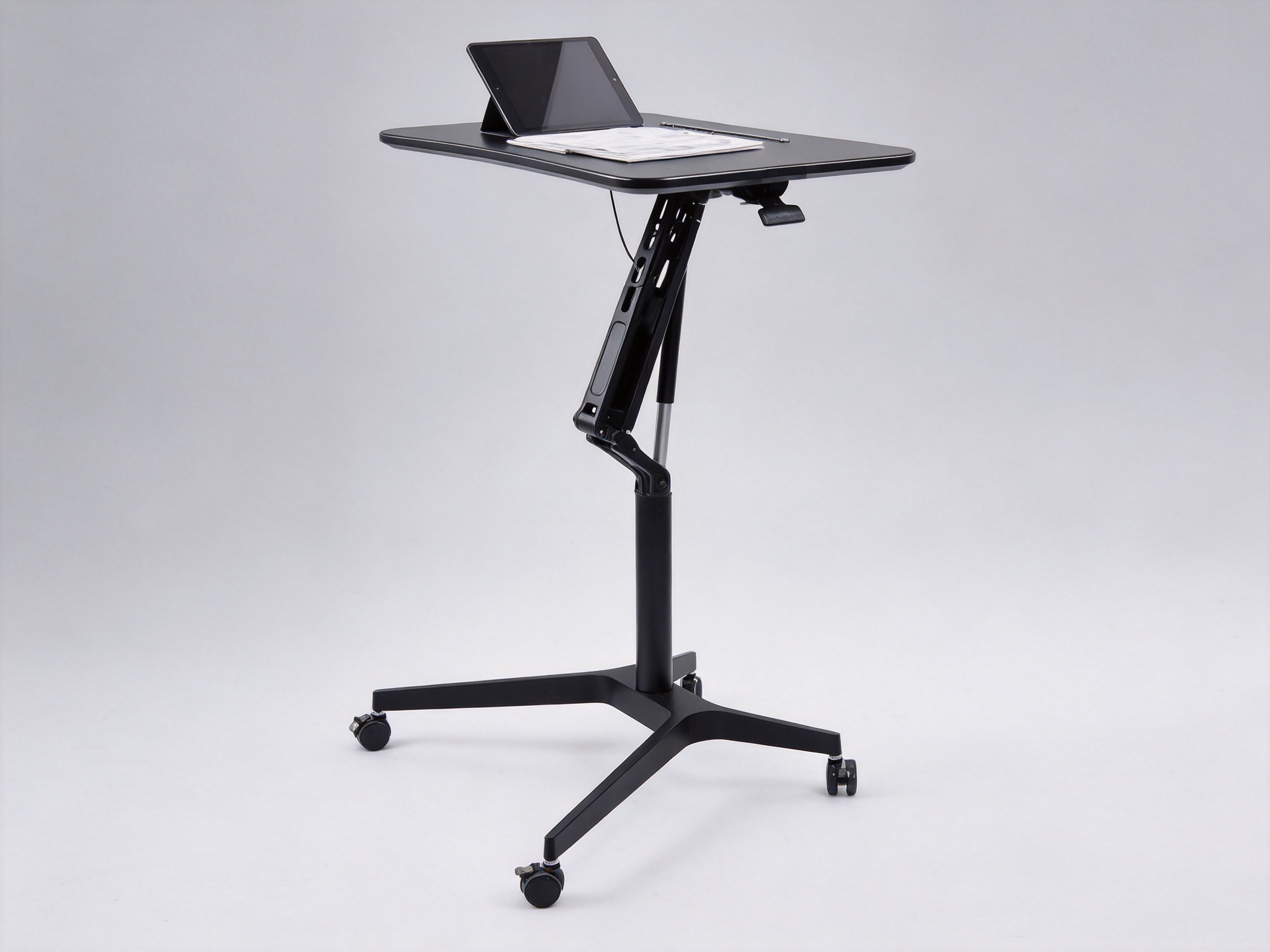
Mobility and stability must be balanced carefully. A workstation that moves easily but cannot be secured is inconvenient and potentially unsafe. The SK01-3 addresses this requirement with two lockable casters. Once the desk has been placed in its working position, the locking wheels help prevent unwanted movement.
The two non-locking casters support steering and repositioning. Together, the four-wheel configuration allows the user to move the desk with less lifting and less disruption to nearby equipment. This is valuable in classrooms, demonstration spaces, testing rooms, and offices where furniture layouts may change throughout the day.
Users should engage the caster locks whenever the desk is being used as a stationary workstation. The locking function is especially important when the desk is adjusted, when a device is placed on the tabletop, or when multiple people are working around the unit.
5. Tabletop Construction and Surface Performance
The tabletop is built with a 25mm MDF core and a PVC vacuum-formed surface. MDF provides a uniform engineered-wood substrate with a smooth face suitable for furniture production. Its consistent composition supports accurate shaping and finishing, while the 25mm thickness gives the tabletop a substantial appearance and a practical working surface.
The PVC vacuum-forming process allows the surface material to follow the tabletop profile closely. This can create a continuous finish across the visible top and edge areas, reducing the segmented appearance that may occur with separately applied edge strips and surface laminates.
A PVC surface is also convenient for everyday maintenance. Dust, light marks, and common office residue can generally be removed with a soft cloth and an appropriate mild cleaner. In environments such as product demonstration rooms or training areas, easy cleaning helps maintain a professional appearance throughout repeated use.
The tabletop dimensions of 715mm by 475mm are compact enough for mobile operation while providing more usable space than a narrow laptop stand. The surface can accommodate an iPad or tablet, a notebook, writing materials, a compact keyboard, a laptop, or small inspection tools.
Practical Use of the Work Surface
The tabletop is not intended to replace a large executive desk. Its strength lies in focused, flexible work. A user can place a primary device at the center and retain enough space for notes, accessories, or presentation materials. The rectangular shape also makes it easy to approach from the front or side.
In a classroom or training environment, the table can support a tablet or demonstration device while remaining easy to move between groups. In a retail space, it can present an electronic product at a comfortable height. In an office, it can serve as a shared touchdown station for short work sessions.
The available tabletop colors provide opportunities for visual coordination. White and black offer neutral contemporary choices. Maple and walnut introduce a warmer furniture appearance that may be better suited to reception areas, residential offices, or customer-facing environments.
6. Advantages Over Conventional Fixed Tables
A conventional fixed table normally has one predetermined working height. If that height does not suit a user, the user must adapt posture or add accessories. The SK01-3 provides a more flexible alternative by allowing the work surface to be adjusted according to the individual and the task.
The ability to move between seated and standing positions is one of its main ergonomic benefits. Alternating posture can help prevent the discomfort associated with remaining in one position for long periods. It also allows a workstation to serve multiple users without requiring separate furniture for each person.
Mobility is another important distinction. A fixed table may require lifting or several people to relocate it. The caster-based SK01-3 can be rolled to a different position by one user, subject to the load and floor conditions. This makes room reconfiguration faster and reduces the effort associated with changing layouts.
The gas spring mechanism offers a simpler alternative to motorized desks. It does not require a wall outlet and does not add a motor housing or power cord beneath the tabletop. For mobile demonstrations, temporary workstations, and flexible training areas, this simplicity can be a major operational advantage.
7. Advantages Over Electric Height-Adjustable Desks
Electric linear actuator desks are widely used in offices, but they are not the best choice for every application. They generally require a power source, control components, wiring, and more detailed installation. Their motors and control systems may also increase product weight and maintenance requirements.
The pneumatic SK01-3 avoids these dependencies. Its height adjustment is manual and gas-assisted, so the product can be deployed immediately in locations without convenient electrical access. This is particularly helpful for exhibition areas, classrooms, temporary project rooms, product demonstrations, and mobile service stations.
The absence of electrical components also simplifies cleaning and visual organization. There is no cable to trail from the desk to a wall socket. This reduces a common obstacle to mobility and can help create a cleaner appearance in customer-facing spaces.
Electric desks remain valuable when frequent automated adjustment, memory presets, or heavy-duty powered lifting is required. However, where the priority is compact mobility, straightforward operation, and independence from power, a pneumatic desk can provide a more efficient solution.
Comparison with Other Workstation Types
| Feature | Fixed Table | Electric Adjustable Desk | SK01-3 Pneumatic Desk |
|---|---|---|---|
| Height flexibility | Limited to one fixed height | Powered adjustment across a range | Manual gas spring adjustment from 750mm to 1060mm |
| Power requirement | None | Normally required | None |
| Mobility | Often limited | Depends on design | Four casters support relocation |
| Position security | Usually stable by fixed legs | Varies by model | Two lockable casters help secure the unit |
| Operating complexity | Very simple | Includes motor and controls | Simple manual pneumatic operation |
| Best suited to | Permanent single-height work | Frequent powered height changes | Mobile, flexible, power-independent work |
8. Applications Across Professional Environments
Electronic Device Testing
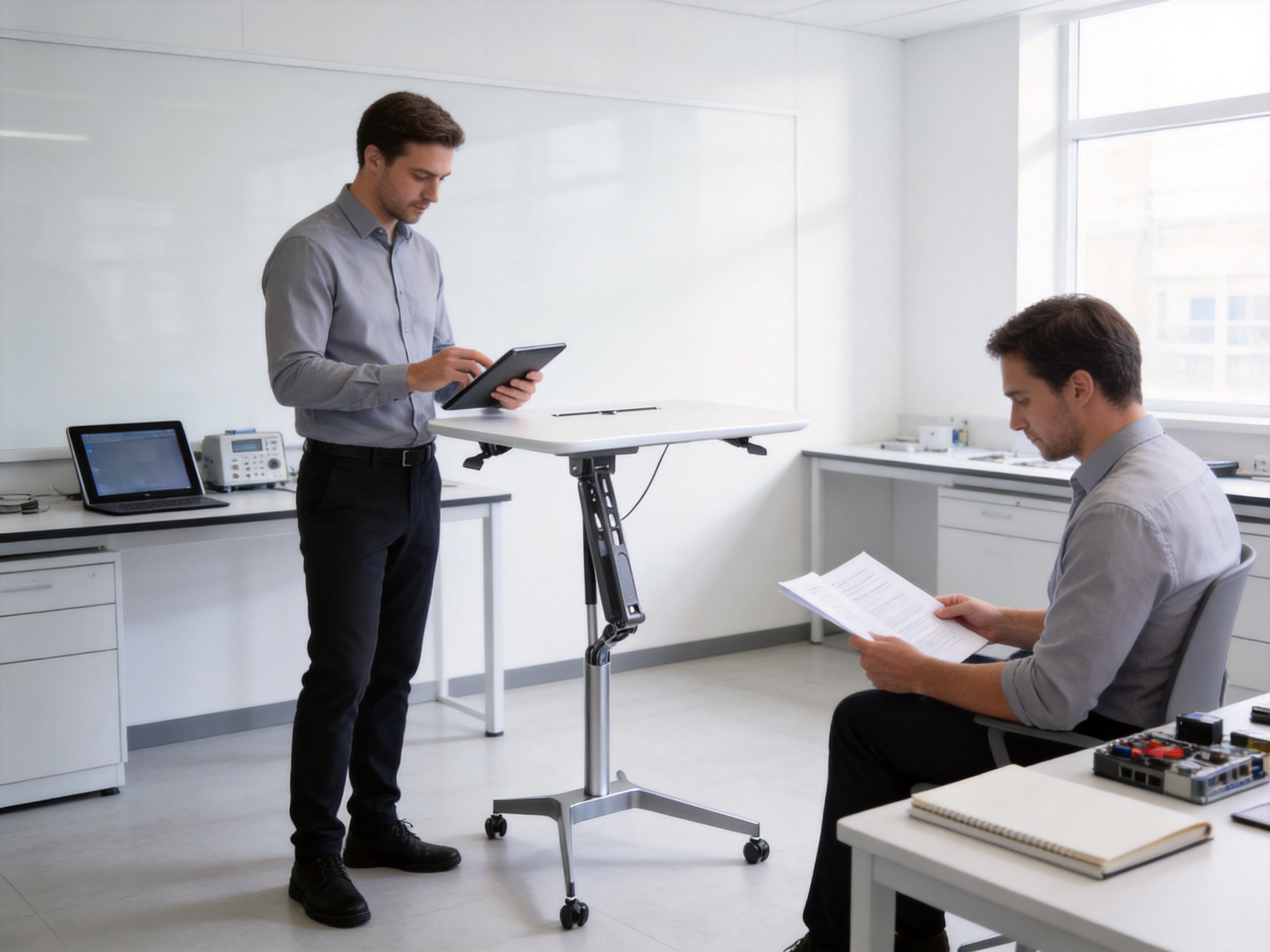
Testing activities often require workers to inspect devices from different angles and heights. The SK01-3 can support tablets, test documents, compact instruments, and demonstration samples. Its adjustable surface can be positioned to reduce unnecessary bending during inspection.
Because the desk is mobile, it can be moved between testing areas or positioned next to a larger workbench. The lack of a power cable is useful when the tabletop is supporting a battery-powered device or when the testing environment already contains multiple electrical connections.
Product Demonstration
Retail and showroom demonstrations benefit from a workstation that can be placed where customers can see and interact with the product. The desk can be raised for a standing presentation or lowered for a seated consultation. Its tabletop color and frame finish can also be selected to coordinate with the displayed product.
The lockable casters allow staff to position the desk in a defined area. When the demonstration layout changes, the unit can be unlocked and moved without disassembling the workstation.
Light Assembly Stations
Small assembly tasks often require workers to alternate between sitting and standing. A height-adjustable surface allows the workstation to be matched to the assembly operation, the worker’s posture, and the height of nearby equipment.
The tabletop is suitable for light-duty components, manuals, hand tools, and compact fixtures. For heavier industrial loads, the required load capacity and application conditions should be confirmed before selection. The SK01-3 is best positioned as a flexible workstation for light assembly rather than a replacement for a heavy industrial bench.
Educational and Training Spaces
Schools, training centers, and demonstration rooms often need furniture that can be rearranged quickly. The SK01-3 can function as an instructor station, a student device table, or a mobile presentation surface. Its height range supports different teaching postures and user groups.
When several units are used together, the choice of tabletop and frame colors can help create a coordinated visual environment. The compact footprint also helps preserve walking space in rooms that must support multiple activities.
Creative Workspaces
Creative work frequently involves changing between planning, sketching, digital work, and physical presentation. A mobile height-adjustable desk enables users to move the work surface closer to materials, equipment, or collaborators.
The tabletop can hold a tablet, drawing tools, reference materials, or a compact laptop. Adjusting the height can make it easier to view a screen, review a physical sample, or discuss work with another person.
Healthcare and Service Areas
In appropriate non-clinical applications, the desk may serve as a mobile documentation or device-support station. Its ability to move without a power cable can be beneficial in service areas where space and access change frequently.
Any healthcare deployment should consider cleaning protocols, infection-control requirements, floor conditions, and the suitability of the tabletop finish for the intended environment. Product selection should always match the specific operational and regulatory requirements of the facility.
9. Manufacturing Strengths and Production Approach
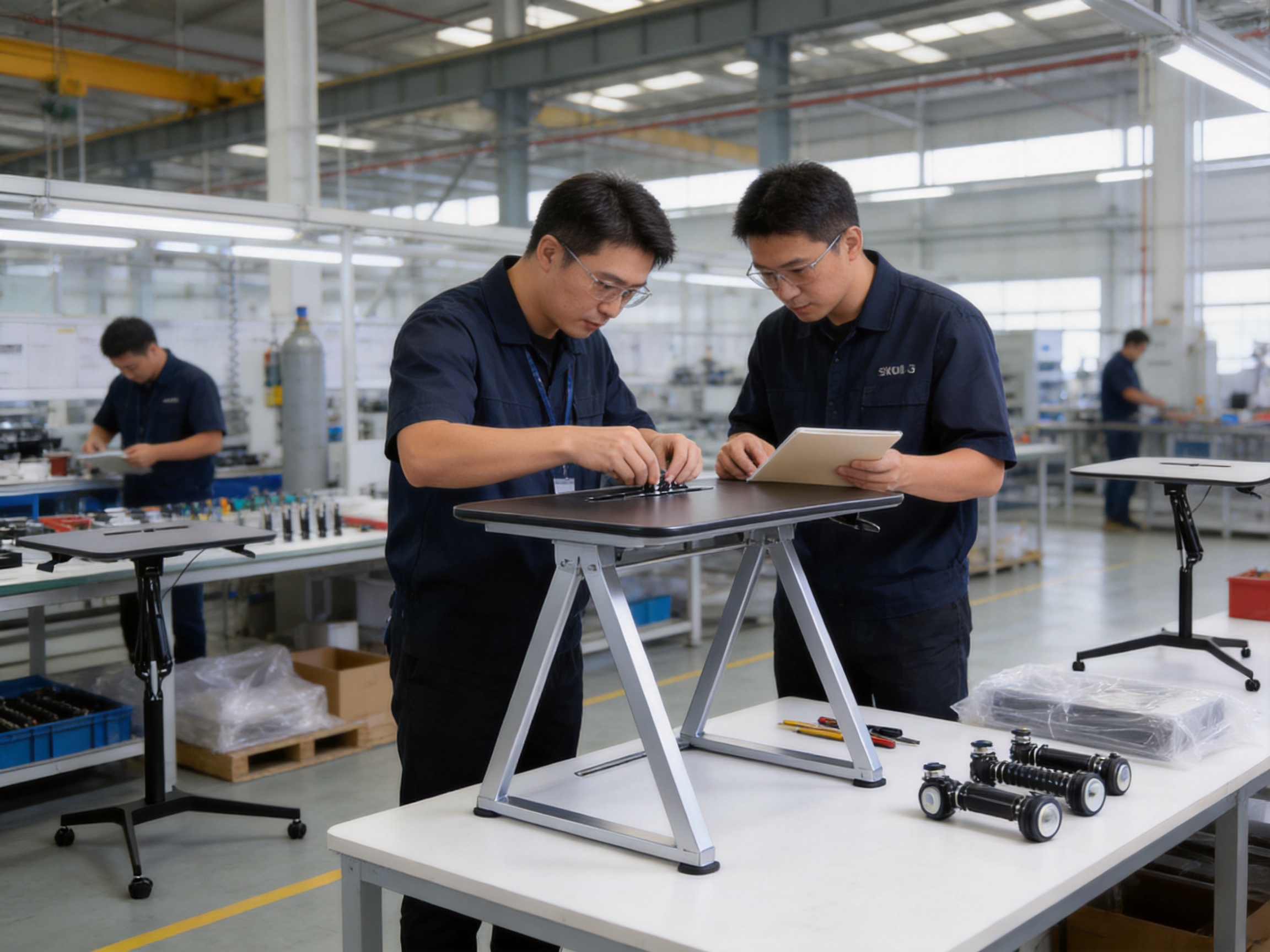
The product is supported by a manufacturing enterprise focused on the research and development, production, sales, and service of standing desks. Located in Suzhou, a major furniture manufacturing center in the Yangtze River Delta, the company benefits from access to a mature regional supply chain and an established industrial base.
A complete manufacturing ecosystem can provide several advantages. It can support more efficient sourcing of metal components, surface materials, hardware, casters, packaging materials, and production services. It can also make it easier to coordinate design revisions, sample development, quality inspection, and production scheduling.
The SK01-3 demonstrates the importance of coordinating several manufacturing processes within one product. The tabletop requires MDF preparation, PVC vacuum forming, trimming, and finishing. The frame requires metal forming, joining, surface preparation, powder coating, assembly, and functional inspection. The gas spring and caster systems must then be integrated into a stable mobile structure.
Research and Development
Effective standing-desk development begins with understanding how the product will be used. The SK01-3 reflects a design process that considers height range, tabletop proportions, frame geometry, caster arrangement, user movement, and visual appearance as a connected system.
The triangular support structure illustrates how product development can combine functional engineering with visual design. The larger outward leg angle, distinct center connection, and direct structural transition produce a recognizable appearance while supporting the desk’s mobile purpose.
Research and development also support adaptation for different markets. Color choices, tabletop finishes, packaging requirements, assembly instructions, and application-specific details may vary by customer or region. A manufacturer with design and production capabilities can respond more efficiently than a supplier that only distributes standard products.
Metal Processing and Frame Assembly
The aluminum and iron frame requires accurate processing to ensure that the components align correctly during assembly. Consistent dimensions are important because the frame must support the tabletop, carry the lifting mechanism, accept the casters, and maintain smooth operation during adjustment.
Metal components may undergo cutting, forming, drilling, joining, deburring, and inspection before surface finishing. Each stage contributes to the final user experience. Clean edges improve safety and appearance. Accurate connection points support assembly consistency. Proper alignment helps reduce unwanted movement and supports the operation of the gas spring system.
Frame assembly should include checks for fastener engagement, structural alignment, wheel installation, and the operation of locking casters. These checks are especially important for mobile products because the frame experiences movement and directional changes during normal use.
Powder-Coating Process
Powder coating is used for the frame in white, silver, and black. This finish is applied as a dry powder and cured to form a continuous coating. When properly prepared and cured, powder coating can provide a durable surface suitable for routine office, educational, and commercial use.
Surface preparation is a critical part of the process. Metal must be clean and appropriately prepared so that the coating adheres evenly. The curing stage must also be controlled to produce consistent color, coverage, and surface hardness.
A controlled powder-coating process offers both functional and aesthetic benefits. It helps protect the metal from everyday abrasion and creates a consistent appearance across different frame components. It also allows the manufacturer to provide multiple color options for project coordination.
Tabletop Vacuum Forming
The PVC vacuum-forming process allows the surface material to conform to the tabletop shape. In a typical process, a PVC sheet is heated until it becomes flexible, positioned over the prepared form, and drawn into contact through vacuum pressure. After cooling, the shaped surface is trimmed and prepared for assembly.
Process consistency is important because variations in heating, vacuum pressure, forming time, or trimming can affect the finished appearance. Careful production control helps maintain clean edges, even coverage, and reliable fit between the surface and MDF core.
The combination of MDF and PVC vacuum forming provides a practical platform for color and appearance variation. White, maple, walnut, and black surfaces can be produced to suit different environments while retaining the same basic desk structure.
10. Quality Control Considerations
Quality control for a pneumatic mobile desk should cover both individual components and the assembled product. A desk may look attractive but still require careful functional inspection to ensure that the height-adjustment mechanism, casters, tabletop, and frame operate together correctly.
Incoming material inspection can verify the condition and dimensions of MDF panels, PVC surface materials, metal profiles, gas springs, fasteners, and casters. Identifying inconsistencies before assembly helps reduce rework and supports more stable production.
During process inspection, manufacturers can check cut dimensions, drilled-hole positions, surface preparation, powder-coating coverage, tabletop bonding, edge treatment, and assembly alignment. These checks help ensure that the final desk has a consistent appearance and predictable operation.
Finished-product inspection may include height-adjustment testing, caster movement checks, lock-function checks, tabletop alignment, frame stability, visual inspection, and packaging verification. The desk should be reviewed at multiple points in the height range rather than only at its lowest or highest position.
Packaging and Delivery Preparation
Mobile furniture must be packaged to protect both visible surfaces and functional components. The tabletop should be shielded from impact and abrasion, while the frame, casters, gas spring, and hardware should be secured to prevent movement inside the package.
Clear assembly instructions can reduce installation time and help users understand the correct operation of the locking casters and height-adjustment mechanism. For commercial projects, consistent packaging and labeling also simplify warehouse handling and distribution.
11. Customization and Project Support
Different customers may require different combinations of tabletop colors, frame colors, packaging formats, labels, or product configurations. The available options for the SK01-3 provide a starting point for customization while retaining the proven core design.
Tabletop colors can be selected according to brand environment, interior design, or functional zoning. Frame colors can create contrast or blend with surrounding furniture. For large projects, color coordination may help distinguish workstation types or identify specific departments.
Customization should be evaluated together with production volume, material availability, lead time, sample approval, and quality requirements. A structured process helps ensure that the requested finish is reproduced consistently across production batches.
Professional project support may also include technical communication, product selection assistance, sample development, packaging coordination, and after-sales service. These services are important when the desk is being deployed across multiple rooms, branches, schools, stores, or facilities.
12. Installation and Daily Use Recommendations
Before use, the desk should be assembled on a clean, level surface according to the supplied instructions. All structural fasteners should be tightened properly, and the casters should be installed in the correct positions. The lifting mechanism should be checked before placing equipment on the tabletop.
When moving the desk, users should release the caster locks and guide the unit from a stable part of the frame or tabletop area. It is advisable to remove unstable objects before relocation, especially when the desk is being moved over thresholds or uneven flooring.
Once the desk is in position, the two lockable casters should be engaged. Users should avoid dragging the desk sideways while the locks are engaged, as this may place unnecessary stress on the caster assemblies or floor surface.
The tabletop should be cleaned with a soft cloth and a suitable mild cleaning solution. Abrasive pads, aggressive solvents, or excessive water should be avoided because they may damage the PVC surface or affect the edges of the tabletop.
Users should not exceed the appropriate working load for the product. Heavy equipment, concentrated loads, or dynamic impacts may affect stability and mechanism performance. For specialized applications, the required load, duty cycle, floor conditions, and equipment dimensions should be reviewed before purchase.
13. Ergonomic Use of the Desk
When seated, the user should adjust the tabletop so that the forearms can rest comfortably with the shoulders relaxed. The screen or tablet should be positioned to reduce excessive neck bending, and frequently used items should remain within easy reach.
When standing, the desk should be raised so that the user can work with relaxed shoulders and approximately neutral wrists. Users should avoid locking the knees and should change position periodically rather than standing rigidly in one posture for long periods.
The desk’s value comes from regular posture variation, not from remaining at one height indefinitely. Users can alternate between sitting and standing according to the task, personal comfort, and working schedule.
For shared use, each person should be encouraged to adjust the surface before beginning work. This is one of the advantages of a manually adjustable workstation: the adjustment process is immediate and does not require a personal control profile or electrical connection.
14. Why the SK01-3 Is a Competitive Choice
The SK01-3 stands out through the combination of features rather than a single specification. Its pneumatic height adjustment provides flexibility without requiring electricity. Its compact tabletop supports focused work while remaining easy to move. Its aluminum-and-iron frame balances manageable weight with structural support. Its triangular flat-legged design creates a distinctive and direct visual identity.
The product also offers a practical middle ground between a simple cart and a full-size electric standing desk. It provides more ergonomic flexibility than a fixed table and less operational complexity than a motorized workstation. This balance makes it suitable for customers who need adaptability but do not require electronic presets or continuous powered adjustment.
Color choices increase its suitability for different environments. A customer can select a neutral white or black finish, a metallic silver frame, or a warmer maple or walnut tabletop. This level of choice helps the product function in both technical and furniture-oriented settings.
Manufacturing capability further strengthens the product proposition. The combination of research and development, metal processing, powder coating, vacuum-forming tabletop production, assembly, inspection, and service support allows the manufacturer to manage more of the product lifecycle. This can help improve coordination, customization, and long-term supply reliability.
15. Recommended Buyer Profiles
Office and Workplace Buyers
Office buyers may select the SK01-3 for touchdown areas, meeting support, flexible project rooms, reception zones, or shared device stations. Its mobile format allows the furniture plan to change as teams and activities change.
Educational Institutions
Schools and training centers can use the desk for tablet-based learning, instructor demonstrations, student group work, and flexible classroom layouts. The manual height adjustment is straightforward, and the casters support quick room reconfiguration.
Retail and Exhibition Operators
Retail stores, showrooms, and exhibitions can use the desk to present products at different heights. Its clean appearance and selectable colors allow it to blend with commercial displays rather than appearing like a temporary utility cart.
Manufacturing and Technical Teams
Technical teams may use the unit for light testing, inspection, documentation, and portable support tasks. It is particularly useful where the work surface must move between stations and where electrical independence is convenient.
Home and Small-Office Users
For home offices and compact workspaces, the desk provides an alternative to a large fixed standing desk. It can be moved aside when the room is needed for another activity, making it suitable for multipurpose rooms.
16. Limitations and Selection Considerations
A responsible product evaluation should consider the intended application. The SK01-3 is designed as a compact pneumatic mobile workstation. Buyers who need heavy industrial loads, automated height presets, integrated cable management, or a very large tabletop may require a different product category.
Manual gas spring adjustment is simple and power-independent, but it does not provide the automated convenience of an electric actuator. Users must operate the adjustment mechanism themselves. This is an advantage in many situations, but it should be matched to the preferences and workflow of the intended users.
The 715mm by 475mm tabletop is suitable for focused work, devices, documents, and light equipment. It may not provide enough area for multiple monitors, large drawings, extensive tools, or collaborative production tasks. Buyers should compare the tabletop dimensions with the equipment and materials they intend to use.
Floor conditions should also be considered. The casters are most effective on relatively smooth, level surfaces. Uneven flooring, deep thresholds, loose rugs, or cluttered pathways may make movement more difficult. Locking the casters is recommended whenever the desk is in active use.
17. Maintenance and Product Longevity
Routine maintenance can help preserve the desk’s appearance and performance. The tabletop should be kept free of abrasive particles, and spills should be removed promptly. The frame can be wiped with a soft, slightly damp cloth and dried afterward.
Casters should be checked periodically for hair, thread, dust, or other debris that could interfere with rotation. The locking mechanisms should be operated occasionally to confirm that they engage and release correctly.
Fasteners may be inspected during routine facility maintenance, especially if the desk is moved frequently. If unusual looseness, noise, or resistance occurs during height adjustment, the product should be removed from service until the cause has been assessed.
The gas spring should not be disassembled by the user. It is a pressurized component and should be inspected or replaced only through an appropriate service process. Correct use, suitable loading, and regular visual checks can help protect the service life of the lifting system.
18. Q&A
Q1: What is the height range of the SK01-3 desk?
The desk adjusts from 750mm to 1060mm. This range is intended to support both seated and standing work, with intermediate positions available for different users and tasks.
Q2: Does the desk require electricity?
No. The SK01-3 uses a manual gas spring lifting system and does not require a motor, wall outlet, or power cable for height adjustment.
Q3: Is the desk suitable for sitting and standing?
Yes. Its height range is designed to accommodate seated work, standing work, and transitional positions between the two.
Q4: What are the tabletop dimensions?
The tabletop measures 715mm by 475mm and is 25mm thick.
Q5: What is the tabletop made from?
The tabletop consists of a 25mm MDF core with a PVC vacuum-formed surface.
Q6: What colors are available?
The tabletop is available in white, maple, walnut, and black. The frame can be finished in white, silver, or black through powder coating.
Q7: Can the desk be moved easily?
Yes. It has four casters, including two lockable casters and two non-locking casters. The locks should be released before moving and engaged after the desk is positioned.
Q8: What is the purpose of the triangular flat-legged structure?
The triangular support design creates a direct, linear frame appearance and contributes to a broad, stable support arrangement. It also gives the desk a distinctive visual identity compared with conventional straight-leg tables.
Q9: Is the desk an alternative to an electric standing desk?
It can be an alternative when the user values manual operation, mobility, and independence from electricity. Electric desks may be more appropriate when powered adjustment, memory settings, or frequent automated operation is required.
Q10: Where can the desk be used?
Potential applications include electronic device testing, product demonstration, light assembly, creative workspaces, educational training, shared offices, reception areas, and compact home offices.
Q11: Is the tabletop suitable for heavy industrial equipment?
The desk is intended for mobile workstation and light-duty applications. Buyers should confirm the appropriate load and operating conditions before placing heavy or concentrated equipment on the tabletop.
Q12: What manufacturing capabilities support the product?
The manufacturing process includes product research and development, metal frame production, powder coating, MDF and PVC tabletop processing, assembly, inspection, sales support, and after-sales service.
Q13: How should the desk be maintained?
Clean the tabletop and frame with suitable non-abrasive materials, keep debris away from the casters, inspect fasteners periodically, and do not disassemble the pressurized gas spring.
19. Conclusion
The SK01-3 iPad Flat-Legged Pneumatic Height-Adjustable Desk is a versatile solution for users who need a compact work surface that can move, adjust, and operate without electricity. Its gas spring mechanism provides a practical height range of 750mm to 1060mm, supporting seated and standing activities across a variety of environments.
The 715mm by 475mm tabletop offers a useful balance between working space and mobility. Its 25mm MDF construction with PVC vacuum-formed covering supports a clean appearance and convenient maintenance. The combination of aluminum and iron creates a frame suited to a mobile workstation, while powder coating provides white, silver, and black finish options.
The triangular flat-legged support structure gives the desk a clear, linear appearance and contributes to its functional identity. Two lockable casters help secure the unit after relocation, while two non-locking casters support movement and steering.
Compared with fixed tables, the SK01-3 offers greater ergonomic flexibility. Compared with electric desks, it provides a simpler, power-independent operating method. Its strongest competitive advantage is the way these features work together in one compact product.
Behind the product is a manufacturing approach that integrates design development, regional supply-chain resources, metal processing, tabletop vacuum forming, powder coating, assembly, quality control, and customer support. This combination gives buyers a practical workstation and a product-development partner capable of supporting different applications and project requirements.
For offices, educational spaces, testing areas, retail demonstrations, light assembly stations, creative environments, and compact workspaces, the SK01-3 provides an adaptable platform for healthier and more efficient working patterns.
References
1. Product technical specification provided for the SK01-3 iPad Flat-Legged Pneumatic Height-Adjustable Desk.
2. Product application information covering electronic device testing, product demonstration, light assembly, creative workspaces, and educational training.
3. General ergonomic principles concerning seated and standing workstation adjustment.
4. General manufacturing principles for MDF furniture panels and PVC vacuum-forming processes.
5. General technical information concerning powder-coated metal furniture frames.
6. General guidance on mobile workstation caster use, locking mechanisms, and routine maintenance.
7. Company information regarding standing-desk research and development, production, sales, service, and manufacturing capabilities in Suzhou, China.
Product: SK01-3 iPad (Flat-Legged) Pneumatic Height-Adjustable Desk


- Contact Info
-
-
 Phone+86-15950656125
 -
 Email
Email -
 AddressRoom 1007-1, South Building, Suyue Plaza, Suzhou Industrial Park, Suzhou City, Jiangsu Province, China
-
- Products
- Follow Us
- Need help? Please contact us
Copyright ©
SuZhou Skyhone Intelligent Technology Co., Ltd.
All Rights Reserved.
Privacy
Custom Ergonomic Adjustable Office Tables Manufacturers

