

 English
 русский
 Español
 عربى

Content
- 1 Product Overview
- 2 Distinctive Cat-Head Structural Design
- 3 Gas Spring Height Adjustment
- 4 Ergonomic Benefits for Modern Work
- 5 Compact Tabletop for Efficient Space Use
- 6 Mobility and Positioning Flexibility
- 7 Materials and Surface Treatment
- 8 Advantages Over Conventional Fixed Desks
- 9 Advantages Over Large Electric Standing Desks
- 10 Manufacturing Strengths and Production Approach
- 11 Quality Considerations in Product Manufacturing
- 12 Application Scenarios
- 13 Installation, Operation, and Care
- 14 How the SK12 Supports Sustainable Furniture Use
- 15 Why Choose a Specialized Adjustable Desk Manufacturer?
- 16 Purchasing Guidance for Different Buyers
- 17 Frequently Asked Questions
- 17.1 What type of desk is the SK12?
- 17.2 What is the height adjustment range?
- 17.3 Does the desk require electricity?
- 17.4 What are the tabletop dimensions?
- 17.5 What is the tabletop made of?
- 17.6 What colors are available?
- 17.7 How many casters does the desk have?
- 17.8 Can the desk be used in a home office?
- 17.9 Is the SK12 suitable for shared workspaces?
- 17.10 What is the advantage of powder coating?
- 17.11 How should the desk be cleaned?
- 17.12 What should be checked before moving the desk?
- 17.13 What makes the SK12 different from a conventional standing desk?
- 17.14 Can the desk be used outdoors?
- 18 Conclusion
- 19 References
- 20 Product: SK12 (Cat Head Leg Column + Cat Head Panel Column) Pneumatic Height-Adjustable Desk
SK12 Pneumatic Height-Adjustable Desk: A Flexible, Mobile, and Ergonomic Workstation Solution
2026-08-30
The SK12 Pneumatic Height-Adjustable Desk combines a distinctive cat-head leg column, a matching cat-head panel column, a compact work surface, and a gas spring lifting system in one practical workstation. Designed for modern offices, home workspaces, studios, classrooms, and other indoor environments, it provides a flexible alternative to fixed-height desks without requiring a complex electrical control system.
With a lifting range of 715 mm to 1130 mm, the SK12 supports seated and standing working positions. Its gas spring mechanism is designed for smooth manual adjustment, while its three-caster configuration makes the desk easy to relocate. Two of the casters include locking mechanisms, allowing users to secure the workstation after moving it into position.
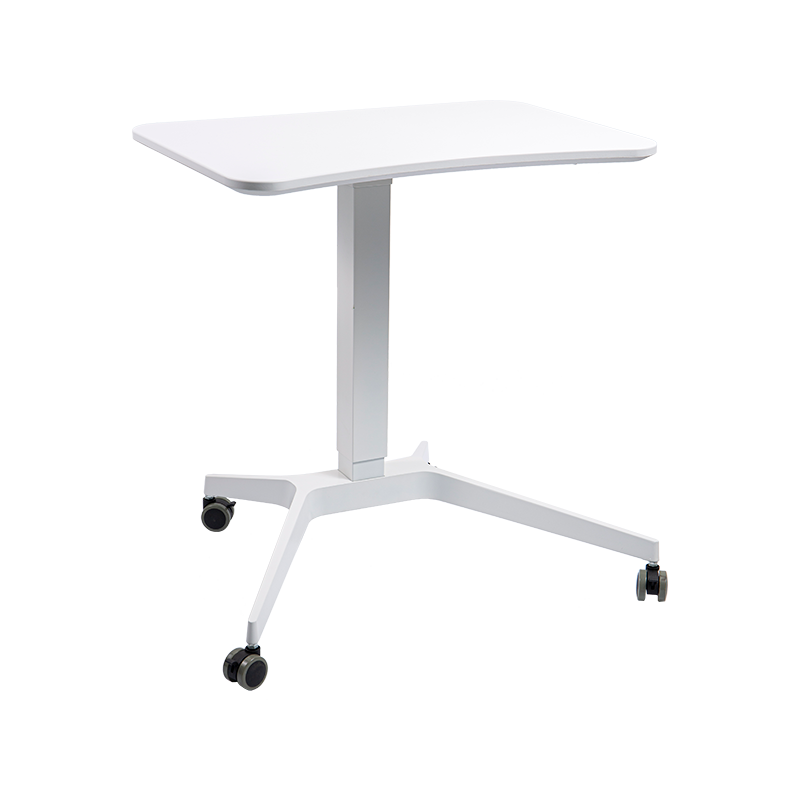
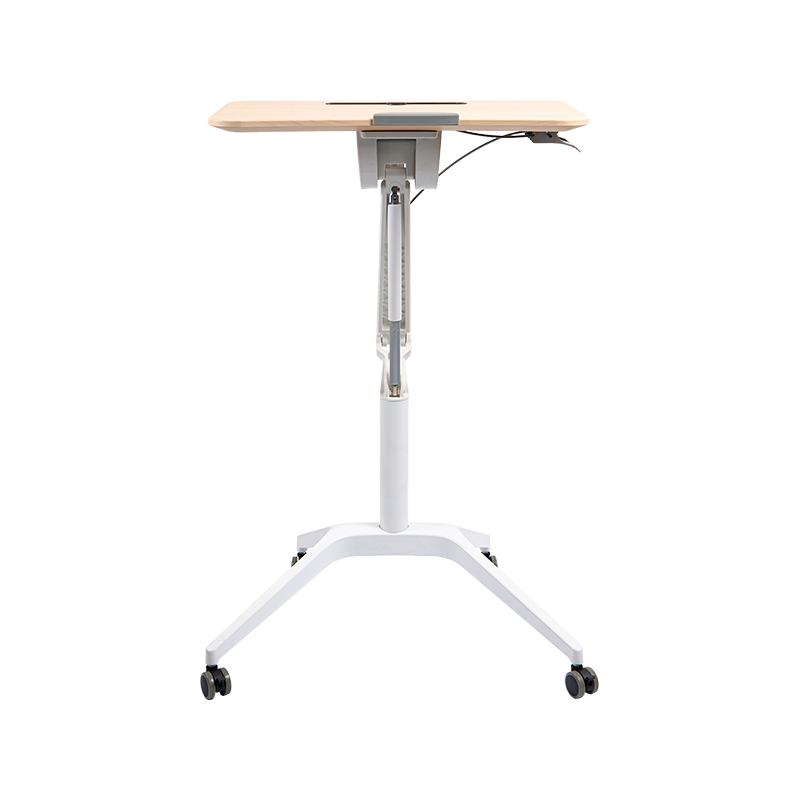
The product is constructed from aluminum and iron, finished with powder coating, and paired with a 25 mm MDF tabletop covered by PVC vacuum-formed material. The desktop is available in white or maple wood panel colors, while the structural frame features a white surface finish. This combination creates a clean appearance suitable for professional, educational, and residential interiors.
Beyond its appearance, the SK12 reflects a manufacturing approach centered on practical ergonomics, efficient material use, product mobility, and adaptable furniture design. It is particularly suitable for users who need a compact adjustable table that can move between rooms or working zones while maintaining a stable and durable structure.
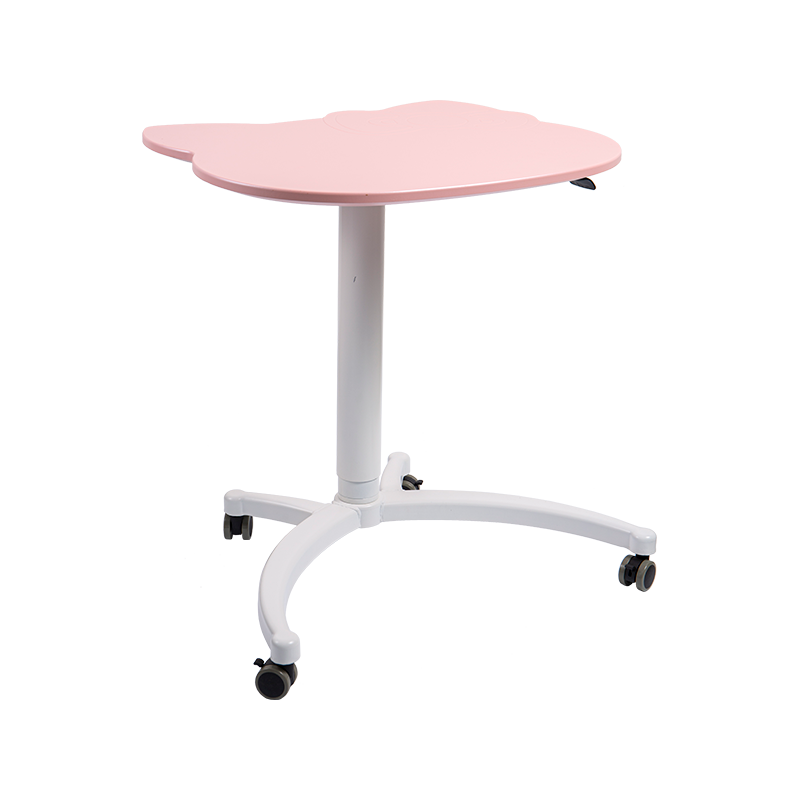
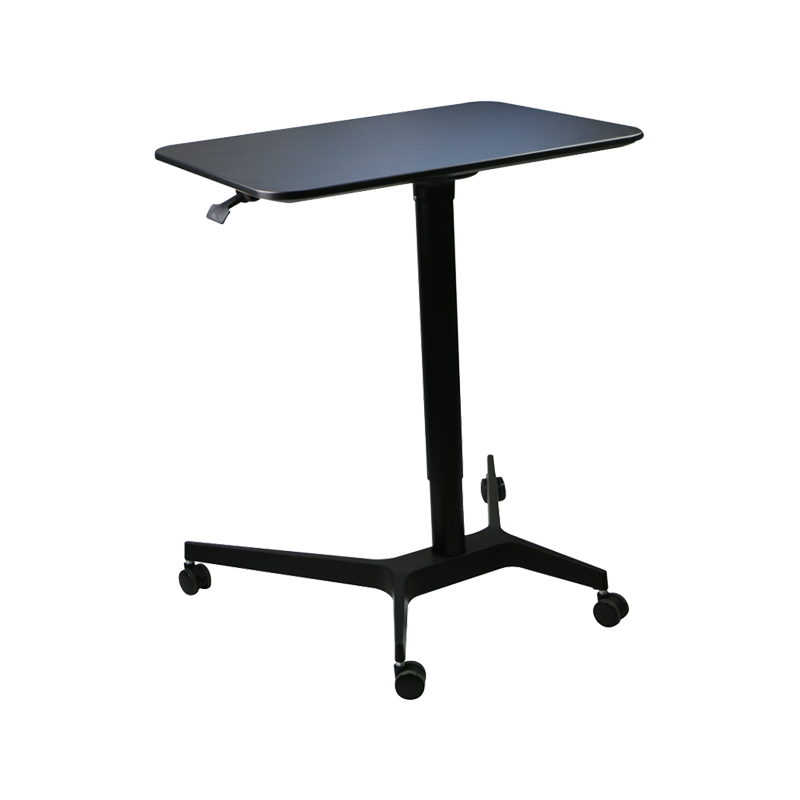
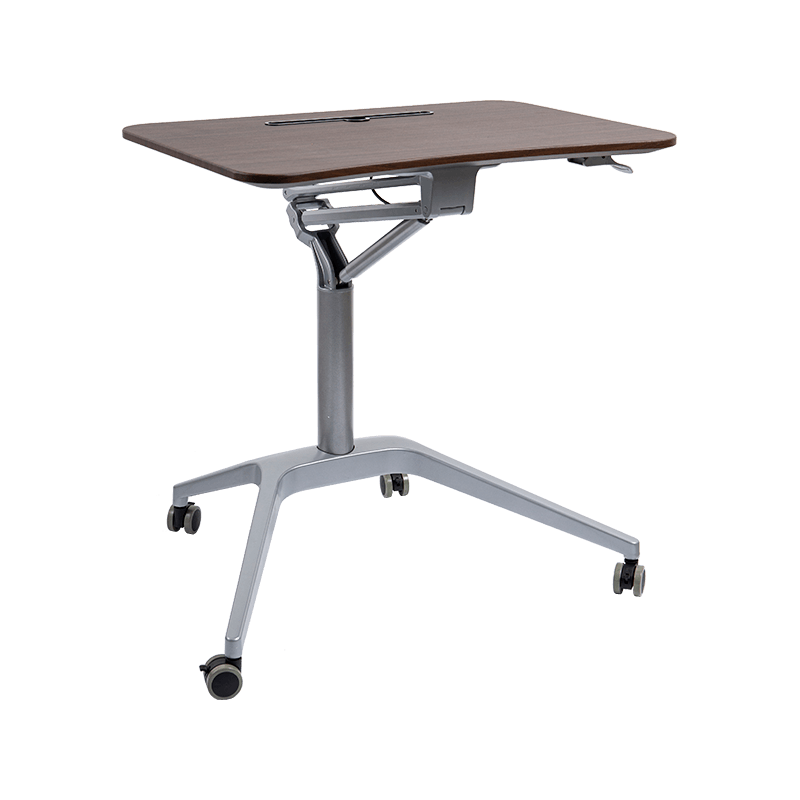
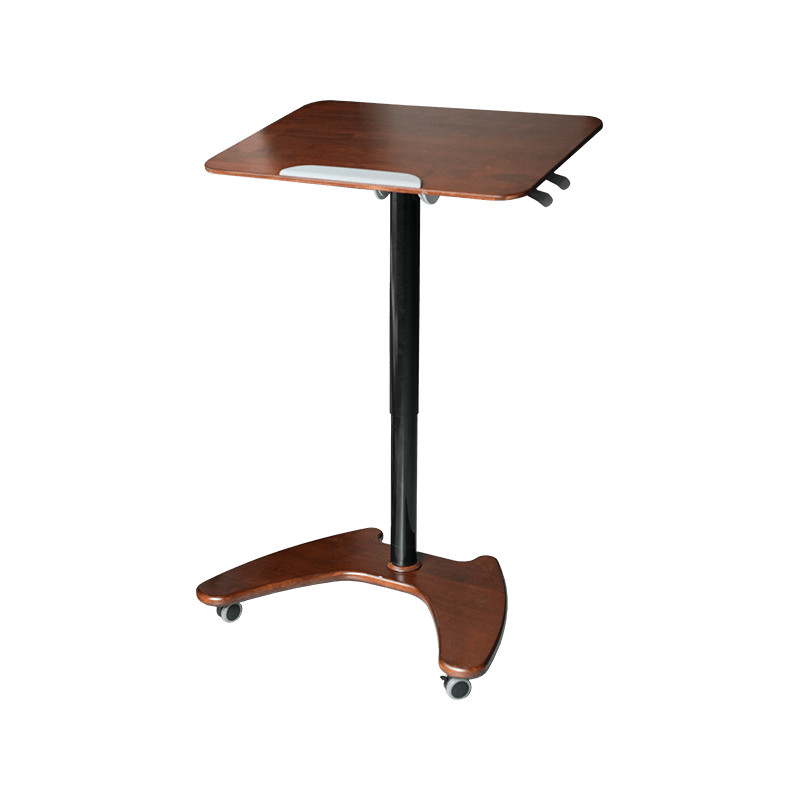
SK12 (Cat Head Leg Column + Cat Head Panel Column) Pneumatic Height-Adjustable Desk
Product Overview
The SK12 is a pneumatic height-adjustable table developed around a simple principle: provide useful height flexibility with a compact footprint and a low-maintenance lifting system. Instead of relying on electric motors, control panels, and power cables, the desk uses a gas spring lifting mechanism. This makes it suitable for applications where users prefer manual adjustment, where electrical access is limited, or where straightforward operation is a priority.
The desk measures 680 mm by 560 mm at the tabletop and has a tabletop thickness of 25 mm. This size provides enough room for common daily activities such as writing, reading, operating a laptop, using a monitor, completing paperwork, or supporting classroom materials. At the same time, the relatively compact dimensions help the desk fit into smaller offices, bedrooms, studios, consultation rooms, and teaching areas.
The lifting range extends from 715 mm to 1130 mm. At the lower setting, the desk can support seated work for many users. At the upper setting, it can be used as a standing workstation or a raised activity surface. The exact preferred height depends on the user’s stature, chair height, task, and posture, but the broad adjustment range allows the product to serve more than one working position.
The structural combination of aluminum and iron contributes to a balance between strength and manageable weight. Aluminum can support a clean, modern appearance and help reduce unnecessary mass, while iron provides a firm structural foundation for load-bearing areas. The result is a desk designed for everyday indoor mobility without abandoning the stability expected from a functional workstation.
| Specification | Details |
|---|---|
| Product model | SK12 |
| Product type | Pneumatic height-adjustable table |
| Lifting range | 715 mm to 1130 mm |
| Tabletop dimensions | 680 mm × 560 mm × 25 mm |
| Tabletop construction | 25 mm MDF with PVC vacuum-formed covering |
| Structural materials | Aluminum and iron |
| Frame surface treatment | Powder coating |
| Frame color | White |
| Panel colors | White and maple wood |
| Caster configuration | Two locking casters and one non-locking caster |
| Lifting principle | Gas spring lifting |
Distinctive Cat-Head Structural Design
One of the most recognizable aspects of the SK12 is its cat-head design language. The product title identifies both a cat-head leg column and a cat-head panel column, creating a coordinated visual relationship between the supporting structure and the upper panel assembly. This gives the desk a more distinctive appearance than a conventional rectangular-frame workstation.
In furniture design, visual identity matters because an adjustable desk must function as part of a room rather than as an isolated mechanical device. The SK12 uses a clean white frame and a compact silhouette to maintain a light, approachable appearance. The maple wood panel option can introduce a warmer visual character, while the white panel option creates a more uniform and minimalist look.
The cat-head form also helps differentiate the product in markets where many height-adjustable desks share similar straight-column designs. Competitors may emphasize large dual-motor frames, industrial control systems, or oversized desktops. The SK12 takes another direction by combining a compact footprint with a recognizable structural profile and manual pneumatic operation.
This design may be especially attractive to buyers seeking furniture that is practical but not visually generic. It can fit naturally into offices, training rooms, libraries, children’s learning spaces, healthcare-related indoor environments, creative studios, and residential work areas where appearance is important.
Gas Spring Height Adjustment
The central functional feature of the SK12 is its gas spring lifting system. A gas spring stores energy within a sealed cylinder and assists the movement of the desk when the adjustment control is activated. In a suitable application, this mechanism can make height changes smoother and easier than lifting a fixed frame manually.
Compared with an electric height-adjustable desk, a pneumatic desk does not require a motor, handset, control box, or connection to a power outlet for routine height adjustment. This reduces the number of electrical components integrated into the product. It also eliminates the need to manage power cables around the desk, which can be useful in flexible rooms or locations where the desk is frequently moved.
The gas spring approach can also support quiet operation. Without an electric motor running during adjustment, users may experience a more discreet adjustment process. This can be valuable in classrooms, shared offices, reading areas, meeting rooms, and other spaces where minimizing operational noise is desirable.
Another advantage is operational simplicity. Users can adjust the table according to the immediate task without navigating digital controls or preset buttons. The product is therefore suitable for environments where a straightforward mechanical interface is preferred. It can also serve as a useful option for buyers who want the ergonomic benefits of changing work height but do not require electronic memory settings.
The lifting range of 715 mm to 1130 mm provides meaningful versatility. The lower portion of the range supports conventional seated work. The higher portion supports standing tasks, short-duration presentations, reading, sorting, packing, and other activities that benefit from a raised surface. A user can alternate between positions during the day instead of remaining in one posture for an extended period.
As with any pneumatic height-adjustable product, the desk should be operated according to its intended load and adjustment instructions. Users should keep the tabletop balanced, avoid sudden impact, and ensure that surrounding objects do not obstruct the lifting path. Proper use supports smooth operation and helps preserve the service life of the lifting components.
Ergonomic Benefits for Modern Work
Ergonomics is not limited to the shape of a chair or the position of a computer screen. The height of the work surface also influences shoulder position, wrist alignment, viewing angle, and overall comfort. A fixed desk can force users of different heights to work at the same level, while an adjustable desk allows the working surface to be brought closer to an individual’s preferred position.
The SK12 supports posture variation by allowing the user to change from a lower seated height to a higher standing height. This does not mean that standing continuously is required or that adjustment alone guarantees healthy work habits. Rather, the value lies in giving users more options. Short periods of standing, alternating between tasks, and changing position can make a workstation more adaptable to different daily routines.
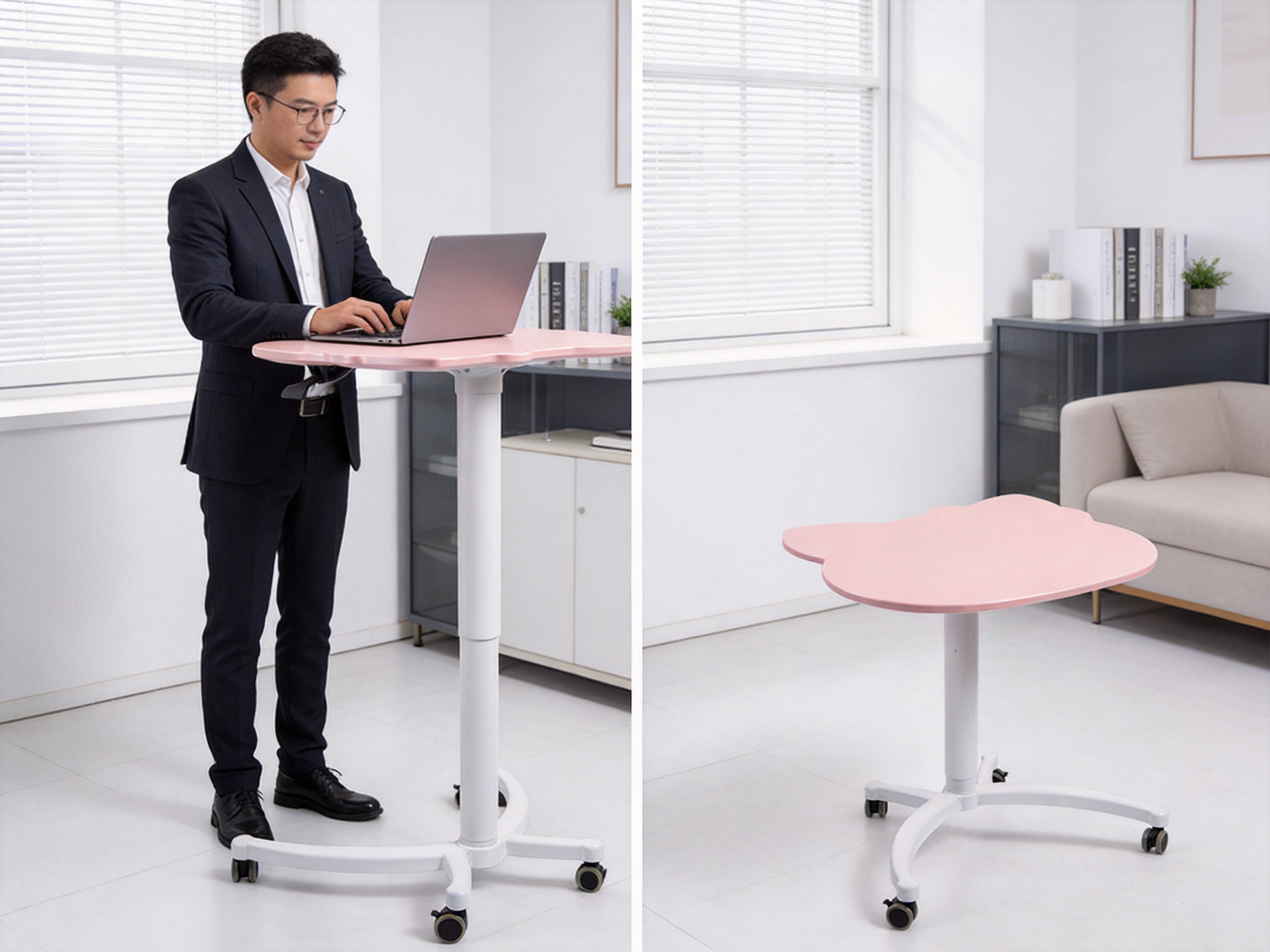
For seated work, the user can select a height that works with the chair and allows the forearms to approach a comfortable working angle. For standing work, the tabletop can be raised so that the user does not need to bend excessively while typing, reading, or writing. Because body proportions vary, the useful feature is not one fixed height but the ability to make an individual adjustment.
The SK12 can also support shared work environments. A desk used by several people may otherwise be comfortable for one user and unsuitable for another. Its adjustable range makes it easier to adapt the workstation for different operators, visitors, students, employees, or family members.
For educational environments, height flexibility can help accommodate different age groups and activities. For home offices, it can support transitions between concentrated computer work, reading, and short standing sessions. For studios and project rooms, the desk can provide an adaptable surface for sketching, organizing materials, or reviewing documents.
Ergonomic furniture works best when combined with other good practices. The monitor should be positioned appropriately, frequently used items should remain within easy reach, and users should take regular breaks. The SK12 provides the mechanical flexibility needed to make these practices easier to apply, but posture, movement, and workstation organization remain important parts of the overall solution.
Compact Tabletop for Efficient Space Use
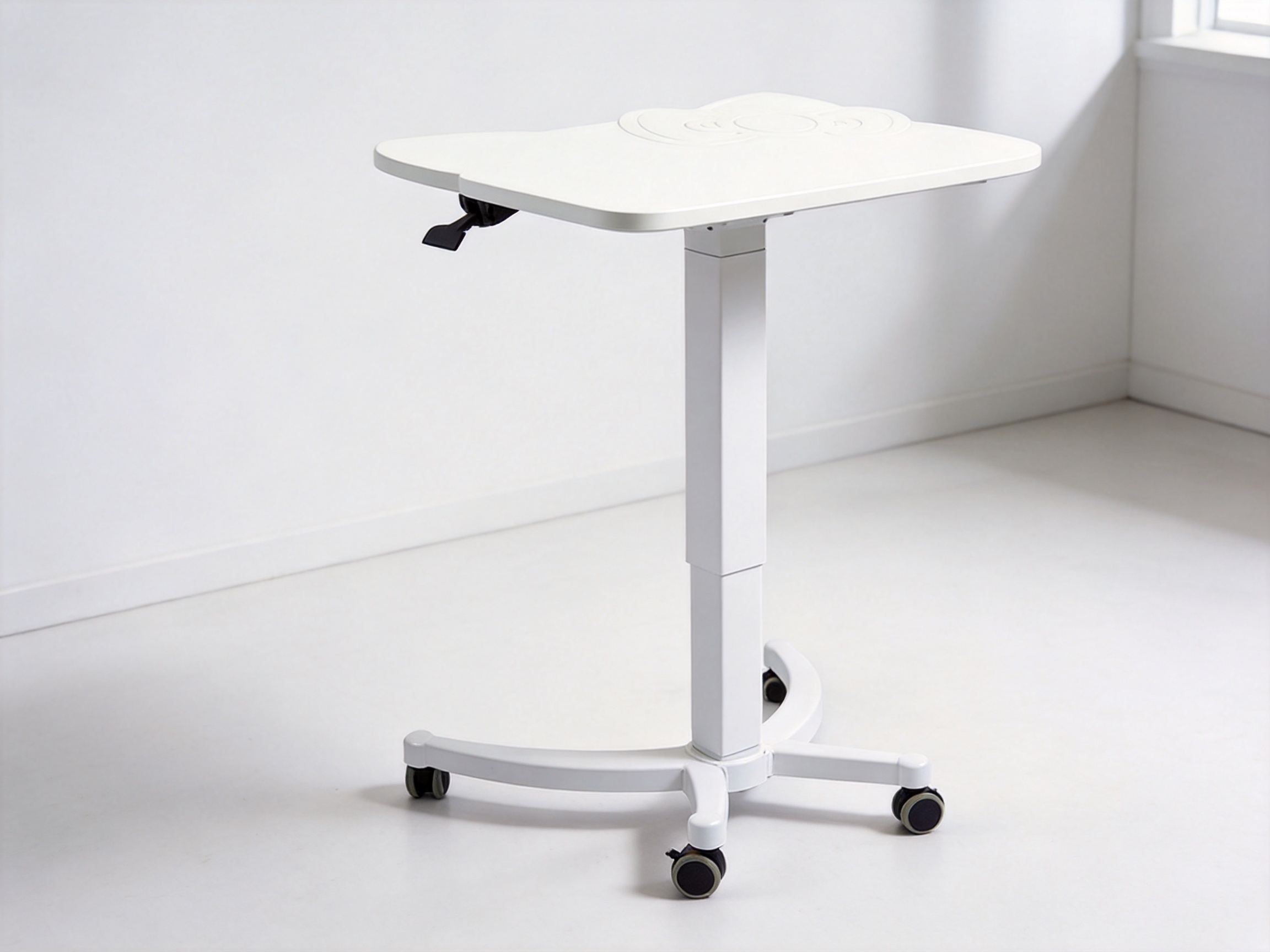
The tabletop measures 680 mm by 560 mm, creating a compact working area that is easier to place in rooms with limited floor space. Many large electric standing desks are designed for expansive offices and may be difficult to use in bedrooms, small studios, narrow classrooms, or shared work areas. The SK12 offers a more space-conscious alternative.
A compact tabletop can be especially useful when the user’s primary equipment is a laptop, tablet, notebook, or small monitor. It can provide an effective surface without dominating the room. The dimensions also make it easier to position the desk beside furniture, against a wall, near a window, or within a temporary project area.
The 25 mm thickness provides a substantial desktop profile. MDF offers a uniform substrate with a smooth surface, while the PVC vacuum-formed covering protects the visible exterior and supports easier cleaning. This construction is intended for practical everyday use, including writing, computer operation, reading, and document handling.
The PVC layer can help simplify routine maintenance because common surface dust and light marks can generally be wiped away more easily than from an unfinished board. The covering also contributes to a consistent visual finish across the tabletop. The white and maple wood options provide buyers with a choice between a clean contemporary style and a warmer furniture appearance.
Although compact, the tabletop should be organized according to the intended task. A laptop, keyboard, mouse, notebook, and frequently used accessories can be arranged efficiently. Users who require multiple large monitors, extensive paperwork, or substantial equipment should evaluate their space requirements before ordering. The product’s strength is not oversized capacity but adaptable personal-scale working.
Mobility and Positioning Flexibility
The SK12 is equipped with three casters: two with locking mechanisms and one without a lock. This arrangement supports a balance between mobility and positioning. The desk can be moved when the room layout changes, then stabilized by engaging the locking casters.
Mobility is valuable in flexible offices where workstations are reconfigured for different teams or activities. It can also benefit teachers, trainers, therapists, studio users, and home workers who need to move a desk between rooms. A mobile workstation may be used near a window during one task, relocated beside a meeting table during another, and stored against a wall when more floor space is needed.
The locking casters are important because movement and stability are complementary requirements. A desk that moves easily but cannot be secured may feel unsuitable for writing or computer work. By providing locking positions, the SK12 allows users to shift the desk into place and then reduce unwanted movement during use.
Users should engage the locks on an appropriate, reasonably level indoor surface. The desk should be moved carefully, particularly when the tabletop carries equipment. Before changing the height, users should also check that the casters are positioned safely and that the lifting path is free from obstacles.
The three-caster configuration contributes to the product’s compact design. Instead of requiring a broad, heavy base intended to remain permanently in one location, the desk uses a more mobile format. This can make it an appealing option for facilities that value flexible room layouts and for individuals who do not want a workstation permanently fixed to a single position.
Materials and Surface Treatment
The frame uses aluminum and iron, combining two materials with different but complementary characteristics. Aluminum is associated with a clean appearance and efficient structural design, while iron is commonly used where firm support and load-bearing performance are needed. The selected combination helps create a practical frame for a compact adjustable table.
The structure receives a powder-coated surface treatment. Powder coating applies a dry coating material to a prepared surface, followed by a curing process that forms a continuous finish. This type of treatment is widely used for metal furniture because it can provide a uniform appearance and improved resistance to routine wear compared with an untreated metal surface.
On the SK12, the white powder-coated finish supports a bright and modern visual identity. It can coordinate with contemporary office interiors, educational furniture, home décor, and clean studio environments. The finish also helps the frame maintain a consistent appearance during normal indoor use.
Surface treatment is not merely decorative. A well-finished metal structure is easier to integrate into a maintenance routine and can better withstand ordinary contact, handling, and environmental exposure in indoor settings. The product is intended for interior applications, so users should avoid prolonged exposure to rain, standing water, or severe outdoor conditions.
The tabletop’s MDF and PVC vacuum-formed construction complements the metal frame. MDF provides a consistent engineered-board base, while PVC creates a finished outer layer. Together, these materials support a flat, usable surface with a clean appearance and manageable maintenance requirements.
Advantages Over Conventional Fixed Desks
A conventional fixed-height desk may have a lower initial complexity, but it offers limited adaptability. If the height does not suit the user, the user must compensate through chair adjustment, footrests, cushions, or changes in posture. Even these adjustments may not fully solve the mismatch between the chair, the user, and the work surface.
The SK12 offers a more flexible alternative by allowing the work surface itself to be adjusted. This makes it easier to accommodate different users and tasks. It can also reduce the need to purchase separate seated and standing tables in applications where one compact workstation can serve both functions.
Compared with a large fixed workstation, the SK12 uses less visual and physical space. Its 680 mm by 560 mm tabletop can be placed in rooms where a full-size office desk would be impractical. Its casters also provide a level of mobility that many fixed desks do not offer.
Compared with a basic mobile cart, the SK12 provides a more specialized ergonomic solution. Many carts have a fixed shelf height or a limited adjustment method. The SK12 combines mobility with a meaningful 715 mm to 1130 mm lifting range, giving it greater usefulness for seated and standing activities.
The cat-head structural design is another differentiating factor. A conventional fixed desk may prioritize basic utility without offering a distinctive form. The SK12 presents a more recognizable silhouette, making it suitable for buyers who want furniture that contributes to the visual character of a room.
Advantages Over Large Electric Standing Desks
Electric standing desks are popular for larger workspaces, especially when users need memory presets, push-button operation, and high load capacity. However, they also introduce motors, control systems, power supplies, wiring, and additional electronic components. These features can increase product complexity, weight, and installation requirements.
The SK12 is designed for buyers who do not need electronic memory settings. Its gas spring mechanism provides manual pneumatic adjustment without depending on a power outlet. This can simplify placement, especially in temporary work zones, classrooms, mobile offices, and rooms where cable management is a concern.
The absence of a motor may also support quieter adjustment and reduce the number of electrical components that require service. This does not make a pneumatic desk universally better than an electric model; rather, it gives buyers an alternative based on their actual use case. For compact personal work, a manual gas spring system may deliver the necessary flexibility with a simpler overall architecture.
The SK12 may also be easier to reposition because its design is compact and its operating system does not require a power cable to follow the desk. When a workstation is frequently moved between locations, avoiding cable disconnection and reconnection can improve convenience.
For buyers comparing the product with an electric desk, the key considerations include expected equipment load, desired tabletop size, frequency of adjustment, need for programmable heights, access to electrical outlets, and room layout. The SK12 is especially compelling when compact dimensions, mobility, manual simplicity, and a distinctive appearance are more important than electronic presets.
Manufacturing Strengths and Production Approach
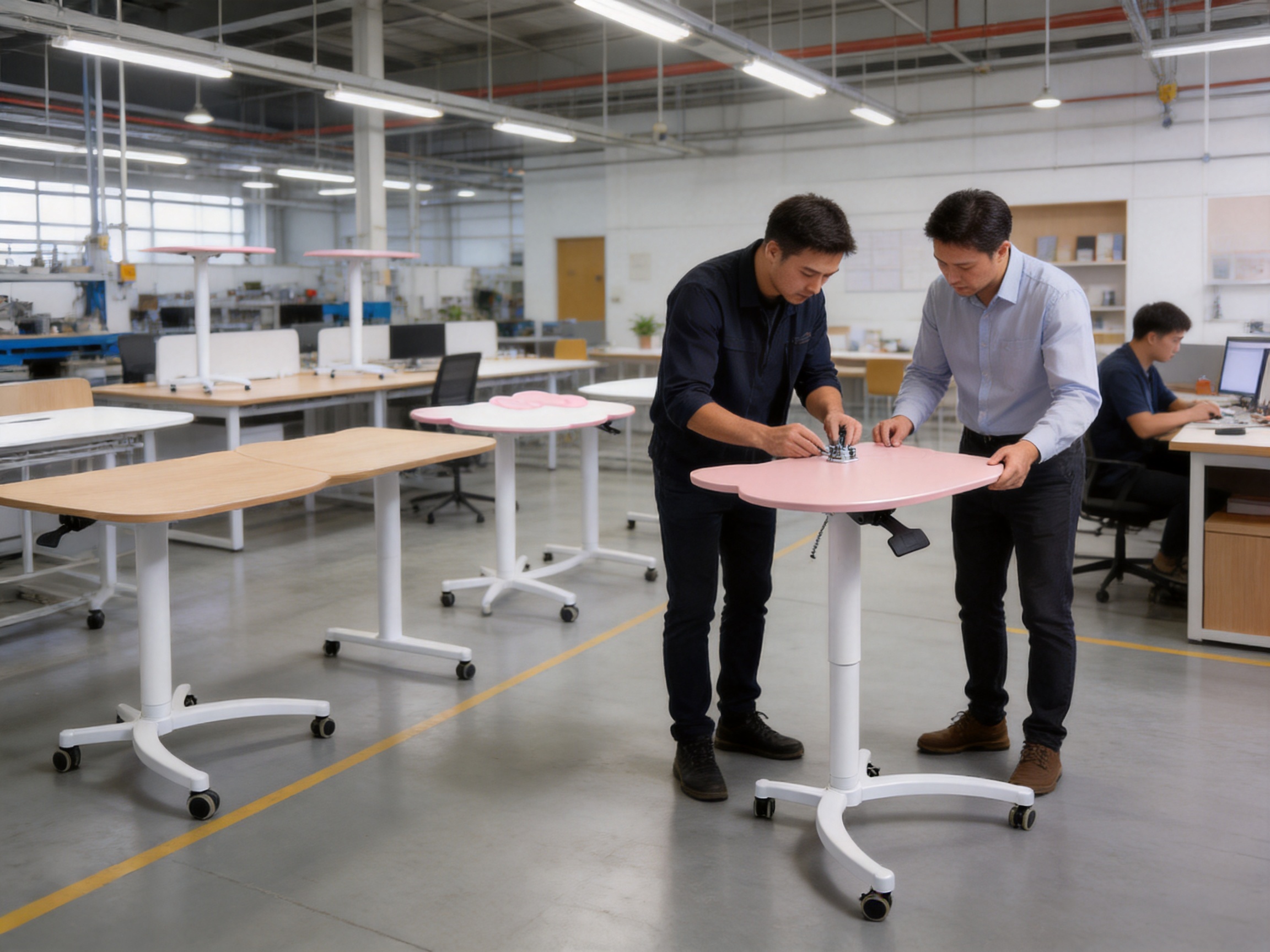
The manufacturer behind the product is a professional enterprise focused on the research and development, production, sales, and service of standing desks. Its location in Suzhou places the company within the Yangtze River Delta, a region known for developed furniture, manufacturing, engineering, logistics, and industrial supply-chain resources.
A strong regional industrial ecosystem can support more efficient coordination among material suppliers, component producers, surface-treatment providers, assembly operations, quality-control teams, and logistics partners. For an adjustable desk manufacturer, this type of environment is valuable because the final product depends on the integration of multiple disciplines, including metal fabrication, tabletop production, mechanical assembly, coating, packaging, and product testing.
The company’s focus on research and development allows product design to respond to changing workplace requirements. The SK12 demonstrates this orientation through its combination of pneumatic adjustment, compact dimensions, caster mobility, and coordinated visual styling. Instead of treating height adjustment as an isolated mechanical feature, the product integrates it with space efficiency and room flexibility.
Production competence is particularly important for pneumatic furniture. The lifting system must work together with the frame, tabletop, adjustment controls, and support points. Alignment, fastening, component fit, and movement smoothness all influence the user’s perception of quality. A manufacturer with experience in standing desks can use product development feedback to refine these relationships over time.
The use of powder coating also reflects a manufacturing process that includes surface preparation, coating application, curing, and inspection. Consistency in coating thickness, color, coverage, and adhesion contributes to the final appearance and helps protect the metal structure during normal use.
Tabletop production requires a separate set of controls. The MDF board must be accurately cut and finished, and the PVC vacuum-forming process must create a consistent covering around the visible surfaces. Dimensional accuracy is important because the tabletop must align correctly with the frame. Edge quality, surface flatness, color consistency, and protection during packaging all contribute to the finished product.
The manufacturer’s combined research, production, sales, and service capabilities can also support communication with distributors, commercial buyers, project customers, and overseas partners. This is useful when buyers need product information, configuration guidance, packaging coordination, replacement components, or assistance with application planning.
Quality Considerations in Product Manufacturing
Quality in an adjustable desk is created through many details rather than a single component. The tabletop must remain stable, the frame must be properly assembled, the casters must operate correctly, and the gas spring must provide a controlled lifting experience. Each part contributes to the overall usability of the workstation.
Dimensional control is important during production. The specified tabletop size of 680 mm by 560 mm and thickness of 25 mm should be maintained so that the panel matches the frame and the finished desk has a consistent appearance. Accurate drilling and fastening positions help prevent assembly difficulties and reduce unwanted movement.
Metal component quality also affects the desk’s performance. The aluminum and iron parts should be formed and joined with attention to alignment and structural integrity. Smooth edges and appropriate finishing help improve handling safety and visual quality. Powder coating should be applied consistently so that the frame has an even white finish.
The gas spring mechanism requires careful integration. Its mounting points should be properly aligned, and the adjustment control should operate in coordination with the lifting column. A smooth lifting experience depends on the relationship among the gas spring, the load on the tabletop, the frame geometry, and the user’s adjustment action.
Caster installation is another practical quality checkpoint. The two locking casters should engage and release reliably, while the non-locking caster should rotate and roll smoothly. Correct positioning supports both mobility and stability. Packaging must protect the casters, tabletop edges, coating, and mechanical components during transport.
Quality assurance should continue after production through appropriate inspection, documentation, and customer service. A manufacturer that supports the product from development through sales and service is better positioned to collect usage feedback and address recurring questions. This continuous connection between production and service can contribute to product improvement and customer confidence.
Application Scenarios
Home Offices
The SK12 is suitable for home workers who need a compact workstation that can change between seated and standing use. Its small tabletop can fit into a bedroom, living area, study corner, or multipurpose room. The casters allow the desk to be moved when the room is used for another purpose.
The white frame and white panel option can support a minimalist interior, while the maple wood panel can coordinate with warmer furniture. The gas spring system avoids the need to position the desk close to an electrical outlet solely for height adjustment.
Studios and Creative Spaces
Artists, designers, makers, and creative professionals often change between computer work, reading, sketching, and reviewing materials. A flexible tabletop can support these transitions. The adjustable range allows the user to select a lower or higher working position according to the activity.
The compact format is useful in studios where several work surfaces, storage units, or tools already occupy the available floor area. The desk can be moved closer to a project zone and then returned to a storage or collaboration position when required.
Educational Institutions
Schools, training centers, libraries, and learning laboratories may need furniture that accommodates users with different heights. The SK12 can be adjusted for seated study, standing demonstrations, reading, laptop use, or short collaborative activities.
The mobile design can help staff reorganize rooms for lessons, presentations, examinations, workshops, or group work. Lockable casters provide a means of securing the desk after it has been positioned.
Flexible Offices
Modern offices may use shared workstations, touchdown areas, project rooms, and temporary collaboration zones. The SK12 can support these environments by offering a mobile and adjustable surface without the infrastructure required by a larger powered desk.
It can be used as a personal workstation, a temporary laptop table, a document review station, or a compact standing desk. Its visual design also allows it to function as part of an interior rather than appearing solely as industrial equipment.
Residential and Indoor Service Environments
The product may also be useful in indoor settings where operators need a movable work surface, such as reception areas, consultation rooms, reading spaces, and private service environments. The adjustable function can help accommodate different users, while the powder-coated structure and PVC-covered tabletop support routine cleaning and maintenance.
Installation, Operation, and Care
Before assembly, users should verify that all tabletop, frame, lifting, caster, fastening, and adjustment components are present. The desk should be assembled on a clean, level surface to reduce the possibility of scratches and to help ensure accurate alignment.
During assembly, fasteners should be tightened according to the applicable instructions without excessive force. The tabletop should be supported while it is connected to the frame. Once assembled, users should check that the frame is stable, the casters are securely installed, and the height adjustment control operates correctly.
When adjusting the desk, users should keep hands, cables, and other objects away from moving sections. The tabletop should be kept reasonably balanced, and heavy items should not be placed near an edge where they could affect stability. The lifting mechanism should be operated smoothly rather than forced.
To move the desk, users should remove or secure loose equipment and confirm that the route is clear. The desk should be guided carefully rather than pulled abruptly. After reaching the desired location, the locking casters should be engaged before beginning detailed work.
The tabletop can generally be maintained with a soft cloth and a suitable mild cleaning solution. Harsh abrasives, sharp tools, excessive moisture, and aggressive chemicals should be avoided because they may damage the PVC covering or alter the surface appearance. Spills should be removed promptly.
The powder-coated frame can be wiped with a soft, slightly damp cloth and dried afterward. Users should inspect the frame, fasteners, casters, and adjustment components periodically. If unusual noise, uneven movement, looseness, or visible damage develops, the desk should be taken out of service until it has been evaluated.
How the SK12 Supports Sustainable Furniture Use
Product sustainability involves more than material selection. A workstation that can serve several tasks and users may reduce the need for multiple specialized tables. The SK12’s seated-to-standing range, mobile base, and compact footprint support a more flexible use pattern.
Because the desk does not depend on an electric motor for height adjustment, its basic operation does not require continuous power consumption. This may be advantageous in spaces where reducing cable clutter and electrical dependence is a priority. The product also avoids the need for a powered control system when users only require manual adjustment.
Durable surface treatment and a practical tabletop covering can support longer service when the desk is properly maintained. Extending the useful life of furniture reduces the frequency of replacement and the associated transportation, packaging, and disposal demands.
Responsible use remains essential. Users should operate the table within its intended application, avoid excessive loading, protect it during relocation, and follow appropriate care practices. Manufacturers and buyers can further support responsible product use through suitable packaging, replacement-part planning, and service communication.
Why Choose a Specialized Adjustable Desk Manufacturer?
Adjustable desks combine furniture design and mechanical engineering. A supplier that understands only tabletop production may not have the same expertise in lifting systems, frame integration, caster design, or ergonomic applications. A specialized standing-desk manufacturer can approach the product as a complete system.
The manufacturer’s involvement in research and development supports the creation of products for different user requirements. Some customers need large electric desks, while others need compact pneumatic models such as the SK12. A broad understanding of adjustable furniture allows the manufacturer to address different room types, working habits, and purchasing priorities.
Production capability is also important for customization and project supply. Buyers may need different panel colors, packaging arrangements, labeling, quantities, or delivery schedules. A manufacturer with integrated sales and service functions can provide a more coordinated purchasing experience than a trading channel with limited technical knowledge.
Located in Suzhou, the company benefits from access to a developed manufacturing region and positions itself as a provider of healthy, efficient, and intelligent office-space solutions. The SK12 represents the practical side of this mission: it improves flexibility through a simple pneumatic mechanism and a mobile, compact design.
For distributors and commercial buyers, cooperation with a specialized factory can provide clearer technical communication, more consistent product information, and better opportunities to develop a product portfolio. For end users, it can improve access to guidance about product selection, installation, operation, and after-sales support.
Purchasing Guidance for Different Buyers
Buyers should begin by identifying how the desk will be used. If the primary tasks include laptop work, writing, reading, or light office activity, the 680 mm by 560 mm tabletop may provide an efficient solution. If the user needs several monitors, large printers, or extensive project materials, a larger desk category may be more appropriate.
The desired adjustment method should also be considered. Users who need programmable presets or frequent push-button adjustment may prefer an electric model. Users who value manual simplicity, quiet operation, no power cable, and a compact structure may find the pneumatic SK12 more suitable.
Room layout is another important factor. The desk is well suited to flexible indoor environments where mobility matters. Buyers should measure doorways, corridors, storage areas, and the intended working zone before purchase. Adequate clearance should be left around the desk so that the tabletop can be raised and lowered safely.
Panel color can be selected according to the surrounding interior. White creates a bright, coordinated appearance, while maple wood provides a warmer contrast with the white frame. Commercial buyers may select a consistent color scheme across a facility or use different options to distinguish rooms or functions.
For larger orders, buyers should confirm packaging, assembly requirements, product quantities, delivery arrangements, documentation, and service procedures in advance. Clear communication helps ensure that the product is matched with the intended application and that installation teams understand the correct setup process.
Frequently Asked Questions
What type of desk is the SK12?
The SK12 is a pneumatic height-adjustable table. It uses a gas spring lifting mechanism rather than an electric motor to change the tabletop height.
What is the height adjustment range?
The lifting range is 715 mm to 1130 mm. This range supports both seated and standing working positions, depending on the user’s height, chair, and task.
Does the desk require electricity?
The height adjustment system is gas spring powered, so the desk does not require an electric motor or power connection for routine height adjustment. This helps reduce cable management requirements.
What are the tabletop dimensions?
The tabletop measures 680 mm by 560 mm and is 25 mm thick. It is designed for compact personal work, reading, writing, laptop operation, and similar indoor tasks.
What is the tabletop made of?
The tabletop consists of 25 mm MDF with a PVC vacuum-formed covering. The covering provides a finished appearance and supports convenient routine cleaning.
What colors are available?
The frame has a white powder-coated finish. The tabletop panel is available in white and maple wood color options.
How many casters does the desk have?
The desk has three casters. Two include locking mechanisms, and one does not include a lock. The configuration supports movement and positioning flexibility.
Can the desk be used in a home office?
Yes. Its compact dimensions, adjustable height, mobile base, and manual lifting system make it suitable for many home-office environments, provided the user’s equipment and working requirements fit the tabletop size.
Yes. The height range allows different users to select a more suitable working position. The casters also make it easier to reposition the desk within flexible offices, classrooms, studios, or project rooms.
What is the advantage of powder coating?
Powder coating provides a consistent finish for the metal frame and helps improve resistance to ordinary wear and environmental exposure in indoor applications. It also contributes to the desk’s clean white appearance.
How should the desk be cleaned?
The tabletop and frame should be cleaned with a soft cloth and a mild suitable cleaner. Abrasive materials, harsh chemicals, excess water, and sharp objects should be avoided to protect the PVC surface and powder-coated frame.
What should be checked before moving the desk?
Users should remove or secure loose items, check that the route is clear, and move the desk carefully. After placing it in the desired location, the locking casters should be engaged before work begins.
What makes the SK12 different from a conventional standing desk?
The SK12 combines pneumatic adjustment, a compact tabletop, three-caster mobility, a distinctive cat-head structural design, and a white powder-coated aluminum-and-iron frame. It is designed as a practical alternative to larger electric standing desks and fixed-height tables.
Can the desk be used outdoors?
The stated applications are indoor environments. The desk should be protected from rain, prolonged moisture, standing water, and severe outdoor exposure unless the manufacturer provides specific outdoor-use guidance.
Conclusion
The SK12 Pneumatic Height-Adjustable Desk is designed for users who want ergonomic flexibility without the complexity of a powered workstation. Its 715 mm to 1130 mm lifting range supports seated and standing work, while the gas spring mechanism offers a direct and practical adjustment method.
The 680 mm by 560 mm tabletop makes efficient use of space, and its 25 mm MDF construction with PVC vacuum-formed covering provides a stable, finished work surface. The aluminum-and-iron frame, white powder-coated finish, and white or maple wood panel options combine durability-oriented construction with a clean contemporary appearance.
Mobility is another important strength. Two locking casters and one non-locking caster allow the desk to move between working zones and then be secured in place. This makes the product suitable for flexible offices, classrooms, studios, home offices, and other indoor spaces where room layouts may change.
Compared with fixed desks, the SK12 provides greater height flexibility. Compared with large electric standing desks, it offers a simpler, cable-free pneumatic approach. Its cat-head leg and panel design also gives it a visual identity that distinguishes it from ordinary rectangular workstations.
Supported by a manufacturer focused on the research and development, production, sales, and service of standing desks, the SK12 reflects a complete approach to adjustable furniture. Its combination of ergonomic range, compact mobility, surface treatment, material selection, and distinctive design makes it a practical choice for modern work and learning environments.
References
1. Product specification sheet for the SK12 Pneumatic Height-Adjustable Desk, including dimensions, materials, lifting range, caster configuration, colors, and working principle.
2. Manufacturer-provided product information concerning gas spring lifting, tabletop construction, mobility, surface treatment, applications, and product advantages.
3. General ergonomic guidance on alternating seated and standing work positions and adapting workstation height to individual users.
4. General manufacturing references concerning powder coating for metal furniture surfaces.
5. General furniture-material references concerning MDF substrates and PVC surface coverings.
6. Company information describing research and development, production, sales, service capabilities, and manufacturing resources in Suzhou and the Yangtze River Delta region.
Product: SK12 (Cat Head Leg Column + Cat Head Panel Column) Pneumatic Height-Adjustable Desk


- Contact Info
-
-
 Phone+86-15950656125
-
 Email
-
 AddressRoom 1007-1, South Building, Suyue Plaza, Suzhou Industrial Park, Suzhou City, Jiangsu Province, China
-
- Products
- Follow Us
- Need help? Please contact us
Copyright ©
SuZhou Skyhone Intelligent Technology Co., Ltd.
All Rights Reserved.
Privacy
Custom Ergonomic Adjustable Office Tables Manufacturers

