

 English
 русский
 Español
 عربى

Content
- 1 1. The Role of a Dedicated Vertical Lifting Column
- 2 2. Multi-Stage Telescopic Construction
- 3 3. Performance Specifications and What They Mean
- 4 4. Stability Advantages Over Standard Linear Actuators
- 5 5. Safety Features for Controlled Operation
- 6 6. Corrosion Resistance and Environmental Protection
- 7 7. Clean Electric Operation Without Hydraulic Oil or Air Supply
- 8 8. Applications Across Multiple Industries
- 9 9. Manufacturing Strengths and Engineering Approach
- 10 10. Comparison With Competing Actuator Approaches
- 11 11. Selecting and Integrating the Column Correctly
- 12 12. Maintenance and Long-Term Reliability
- 13 13. Why the Product Is Suitable for OEM and Customized Equipment
- 14 14. Quality-Oriented Product Development
- 15 15. Practical Benefits for End Users
- 16 16. Application Limitations and Responsible Design
- 17 17. A Structured Evaluation Process for Buyers
- 18 18. Frequently Asked Questions
- 18.1 Q1: What is the TH-10 Multi-Stage Electric Lifting Column designed for?
- 18.2 Q2: How does a multi-stage column differ from a standard linear actuator?
- 18.3 Q3: What are the main force ratings?
- 18.4 Q4: What power supply does the column use?
- 18.5 Q5: Can the TH-10 be used in a multi-column desk or platform?
- 18.6 Q6: Does the column remain in position if power is removed?
- 18.7 Q7: What does the IP54 rating mean?
- 18.8 Q8: Is the TH-10 suitable for continuous operation?
- 18.9 Q9: Can the stroke be customized?
- 18.10 Q10: Can the mounting flange be customized?
- 18.11 Q11: What safety features are included?
- 18.12 Q12: Why is self-locking useful in vertical lifting?
- 18.13 Q13: What are the main advantages over hydraulic or pneumatic systems?
- 18.14 Q14: What manufacturing strengths support the product?
- 18.15 Q15: What should be checked before ordering?
- 19 19. Conclusion
- 20 References
- 21 Product: TH-10 Multi-Stage Electric Lifting Column
Precision Vertical Lifting for Safer, Smarter, and More Stable Workspaces
2026-08-28
Modern workspaces, medical facilities, industrial stations, and automated equipment increasingly require reliable vertical movement. A lifting system must do more than raise and lower a load. It must provide stability, repeatable positioning, adequate force, safe operation, efficient installation, and dependable performance over time. In many applications, the lifting mechanism is also expected to operate quietly, occupy limited space, resist environmental exposure, and integrate with electronic controls.
The TH-10 Multi-Stage Electric Lifting Column is designed specifically for these requirements. As a dedicated vertical lifting actuator, it combines a multi-stage telescopic column, an aerospace-grade integrated aluminum profile tube, an internal trapezoidal lead screw, electronic limit switches, overload protection, and a 24VDC power system. Its structure is intended to offer greater vertical stability than a conventional single-section linear actuator while supporting applications that require controlled lifting, firm load holding, and compact integration.
Manufactured by SuZhou Skyhone Intelligent Technology Co., Ltd., the TH-10 reflects the company’s specialization in standing desk systems, electric lifting technologies, intelligent office equipment, and customized vertical motion solutions. The company’s location in Suzhou, a major manufacturing center in China’s Yangtze River Delta, provides access to a mature industrial supply chain, engineering resources, and intelligent manufacturing capabilities.
This article examines the design, performance, advantages, manufacturing strengths, application potential, and selection considerations of the TH-10 Multi-Stage Electric Lifting Column. It also explains why a purpose-built lifting column can be a stronger choice than a standard linear actuator when vertical load stability is the primary requirement.
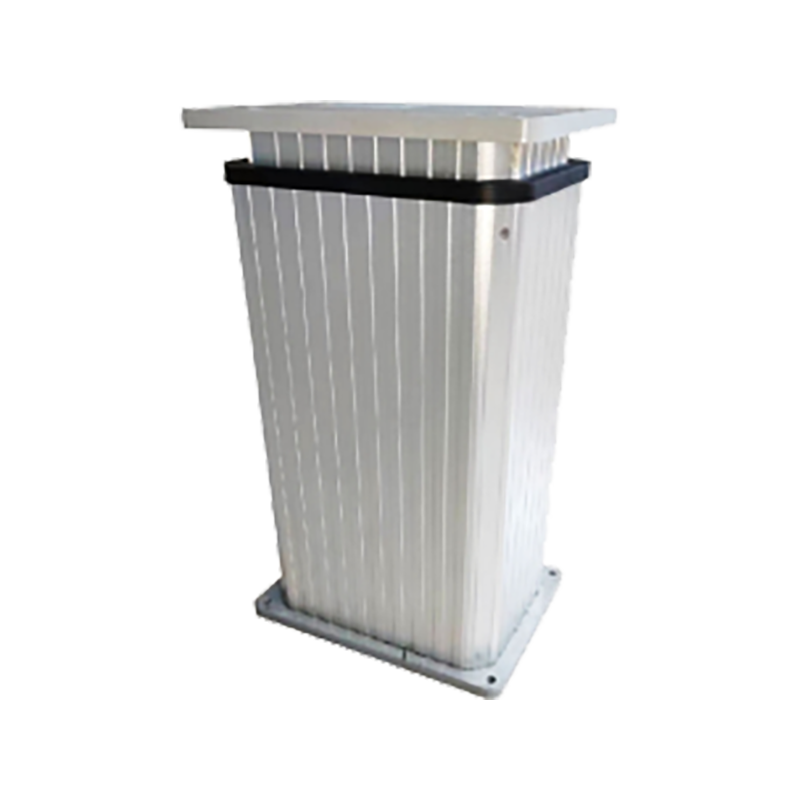
TH-10 Multi-Stage Electric Lifting Column
1. The Role of a Dedicated Vertical Lifting Column
Vertical lifting applications place special demands on an actuator. A typical linear actuator may be suitable for pushing or pulling a mechanism along a fixed axis, but vertical lifting introduces additional challenges. The actuator must support the weight of the moving structure, resist side loads and vibration, remain aligned throughout the stroke, and prevent unwanted movement when power is removed.
In a standing desk, for example, the lifting system must carry the desktop, frame, equipment, and personal accessories while allowing users to alternate between sitting and standing positions. In a medical examination bed, it must provide controlled height adjustment while maintaining a stable and reassuring platform. In an industrial inspection station, it may need to lift a heavy fixture repeatedly without excessive shaking or misalignment.
These requirements make vertical stability essential. If a mechanism experiences excessive play between internal components, the moving platform may wobble, tilt, or shift during operation. Such movement can reduce user confidence, affect measurement accuracy, increase wear, and shorten service life. A purpose-designed lifting column addresses these issues through its structural shape, guidance system, load path, drive mechanism, and control strategy.
The TH-10 is developed for this specific category of use. Rather than functioning as a general-purpose push rod, it is built as a multi-stage vertical lifting structure. Its telescopic column supports vertical movement while helping maintain alignment. The design is suitable for independent use or for installation in systems that use multiple columns operating together.
Key Design Objectives
The product is designed around several important objectives. First, it must generate sufficient force for demanding vertical loads. Second, it must provide stable extension and retraction with limited lateral movement. Third, it must lock the load effectively when power is interrupted. Fourth, it must offer practical electrical and mechanical protection. Finally, it must be adaptable to different equipment designs through stroke, flange, and synchronization customization.
These objectives distinguish a vertical lifting column from an ordinary actuator. In a conventional actuator, thrust capacity may be the main selection criterion. In a vertical lifting system, however, thrust is only one part of the performance equation. Structural rigidity, internal guidance, self-locking ability, duty cycle, mounting geometry, and controller compatibility are equally important.
2. Multi-Stage Telescopic Construction
The TH-10 adopts a multi-layer telescopic column structure. This means that the lifting column is formed from sections that extend and retract within one another. Compared with a single-section actuator, a multi-stage design can offer a more suitable balance between retracted size and usable lifting height, depending on the selected configuration.
A telescopic column is particularly useful where installation space is limited but a meaningful vertical stroke is required. When retracted, the column can occupy a relatively compact height. When energized, its sections extend progressively to raise the connected platform or equipment. This arrangement supports clean integration into desks, lifting frames, platforms, beds, and machinery.
The multi-layer structure also contributes to compression resistance. During vertical lifting, the column is exposed to compressive loads generated by the weight of the equipment and the force required to raise it. A carefully formed aluminum profile system distributes these loads through the column body while maintaining a defined telescopic path.
Another advantage is improved suitability for applications in which the actuator itself forms part of the supporting structure. A general linear actuator may require additional external guide rails or stabilizing components. A lifting column can reduce dependence on separate guiding elements, although the complete equipment design must still account for load distribution, off-center loading, and side forces.
Integrated Aluminum Profile Tube
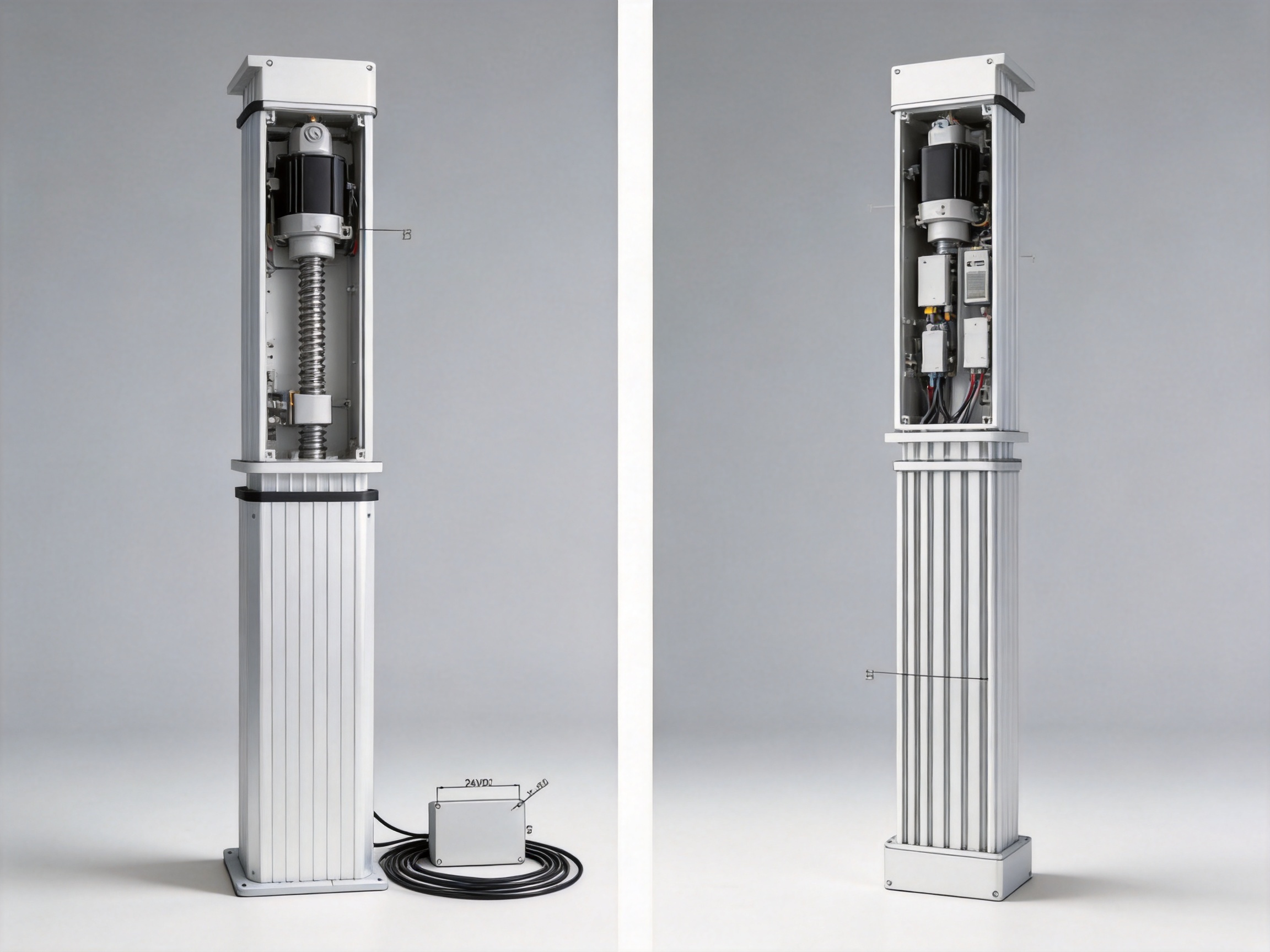
The body of the TH-10 is made from a thick aerospace-grade integrated aluminum profile tube. Aluminum is widely valued in motion equipment because it combines low weight with useful strength, corrosion resistance, and manufacturing flexibility. The integrated profile approach can also support a clean exterior appearance and consistent structural geometry.
The matte silver-white finish gives the product a professional appearance suitable for office, medical, and industrial installations. More importantly, the profile body is designed to resist corrosion and compression under normal operating conditions. Its surface and structural properties make it appropriate for equipment where appearance, cleanliness, and long-term usability are important.
The use of an integrated profile tube also supports easier product integration. Designers can incorporate the column into a frame without introducing an unnecessarily complex exterior housing. A compact and visually refined column is especially valuable for office furniture and medical equipment, where exposed mechanisms can negatively affect the appearance of the finished product.
For industrial use, the profile tube provides a practical protective body around the internal drive and guiding components. The stated IP54 protection rating further improves its suitability for environments where dust and water splashes may be present. IP54 does not mean the column is waterproof or suitable for immersion, so system designers should still evaluate the actual installation environment and provide appropriate protection when necessary.
3. Performance Specifications and What They Mean
Performance specifications provide a useful starting point when selecting a vertical lifting column. The TH-10 offers a push force of 5000N, a pull force of 4000N, and a self-locking force of 4000N. It operates from a 24VDC power supply, has a full-load current of 4A, and reaches a no-load telescopic speed of 5mm/s.
| Specification | Stated Value | Practical Significance |
|---|---|---|
| Product type | Multi-stage electric lifting column | Designed for controlled vertical lifting and lowering |
| Push force | 5000N | Supports upward movement under demanding load conditions |
| Pull force | 4000N | Provides controlled retraction and downward movement |
| Self-locking force | 4000N | Helps hold the load after power interruption |
| Power supply | 24VDC | Suitable for many low-voltage control systems |
| Full-load current | 4A | Important for power supply and controller selection |
| No-load speed | 5mm/s | Provides controlled, steady telescopic movement |
| Protection rating | IP54 | Provides protection against limited dust ingress and water splashes |
| Duty cycle | 10% | Suitable for intermittent operation and long-term static load-bearing |
The push force is relevant when the column raises a platform or structure. The pull force applies during retraction and downward movement, while the self-locking force indicates the column’s ability to resist movement under a load after the motor is no longer powered. These values should not be interpreted as a complete system load rating without considering mounting orientation, load center, column spacing, side forces, stroke length, and operating frequency.
A no-load speed of 5mm/s emphasizes controlled movement rather than high-speed positioning. In many office, medical, and industrial applications, a moderate speed is desirable because it allows users and operators to observe the motion, reduces sudden movement, and supports smoother positioning. When several columns operate together, coordinated control can help maintain a level lifting platform.
The 24VDC electrical design is practical for equipment builders. Low-voltage systems are common in adjustable furniture, automation equipment, mobile machinery, and control cabinets. A 24VDC supply can also simplify integration with controllers, switches, sensors, and other electronic components. System designers should select a power supply capable of meeting the specified current demand and any startup or synchronized operating requirements.
Understanding Duty Cycle
The TH-10 has a stated 10% standard duty cycle. Duty cycle is an important specification that is sometimes overlooked. It describes the proportion of operating time during which the actuator should be powered and moving compared with the required rest period. A 10% duty cycle is appropriate for intermittent adjustment rather than continuous movement.
For example, a desk may be adjusted several times during a workday, but it normally remains stationary for long periods. A medical bed may be raised or lowered when a patient is positioned, then remain at the selected height. An inspection platform may operate in short cycles followed by measurement or loading operations. These are compatible with the general operating pattern of a 10% duty cycle.
Correct duty-cycle management helps control motor temperature, protect internal components, and support service life. Applications requiring repeated movement without adequate rest should be evaluated separately. The final equipment design should follow the supplier’s operating instructions and consider ambient temperature, total load, controller behavior, and the number of columns used in the system.
4. Stability Advantages Over Standard Linear Actuators
One of the main advantages of the TH-10 is its focus on vertical load stability. Standard linear actuators are often effective for straightforward pushing and pulling, but they may not be optimized to serve as the primary vertical support for a large platform. A dedicated lifting column is designed with the vertical load path in mind.
The multi-stage column body provides a larger and more structured support surface than a narrow actuator rod. This can help reduce unwanted movement when the column is extended. The internal wear-resistant bushings provide additional guidance between telescoping sections, helping maintain alignment as the column moves.
Shaking during lifting can result from clearance between moving components, uneven loads, inadequate support, or a mismatch between the actuator and the application. The TH-10’s precision internal bushings are intended to reduce this movement by supporting the telescoping sections and limiting play. The result is a more stable vertical path and reduced risk of offset during extension and retraction.
This stability is important in adjustable desks because users expect the work surface to remain steady while typing, writing, or operating equipment. It is important in medical furniture because movement should be controlled and predictable. It is essential in inspection and automation equipment because vibration or displacement can affect positioning and measurement results.
Load Distribution in Multi-Column Systems
The TH-10 can be used independently or in a multi-column synchronous lifting linkage. Multi-column systems are useful for wide or heavy platforms that need support at several points. A controller can coordinate the columns so they move at a similar speed and maintain a level platform.
However, synchronization is not only an electronic issue. The mechanical structure must also be designed carefully. Columns should be mounted on a sufficiently rigid frame, with suitable spacing and balanced load distribution. The platform should not impose excessive side loads or twisting forces on one column. Proper alignment during installation is essential for smooth operation.
With an appropriate controller and mechanical design, synchronized columns can provide a more stable lifting solution than a single actuator supporting a large platform. The ability to customize synchronization control schemes allows equipment manufacturers to develop configurations suited to their specific products.
Compared with using several unrelated standard actuators, a coordinated lifting-column solution can simplify system design. The columns are intended for the same vertical purpose, and the control architecture can be planned around common movement requirements. This can support more consistent operation across the finished equipment.
5. Safety Features for Controlled Operation
Safety is a central requirement in any powered lifting product. The TH-10 includes built-in electronic limit switches and dual overload protection. These features help reduce the risk of excessive travel and overloading during normal operation.
Electronic Limit Switches
Electronic limit switches define the allowable travel range of the column. When the column reaches its designed upper or lower position, the control system can stop the motor to prevent continued movement. This protects the mechanism from unnecessary stress and helps the user achieve repeatable end positions.
Limit control is particularly important in furniture and equipment where the column is integrated into a frame. Without suitable travel limits, the moving platform could contact the surrounding structure, damage cables, or place excessive force on the column. Electronic limits also make it easier to coordinate multiple columns within a defined stroke range.
Dual Overload Protection
Overload protection helps respond to abnormal resistance or excessive load conditions. Such conditions may occur if an object obstructs the movement, if a platform is overloaded, or if the equipment becomes mechanically misaligned. Dual overload protection adds a further layer of operational security by helping reduce stress on the motor and transmission components.
Protection systems do not replace responsible system design. Equipment manufacturers should still provide suitable structural stops, cable routing, load limits, user instructions, and emergency procedures. Nevertheless, integrated overload protection reduces the likelihood that a temporary problem will immediately lead to component damage.
Self-Locking After Power Loss
The trapezoidal lead screw is designed to lock loads firmly after power is cut, with a stated self-locking force of 4000N. This is especially valuable for vertical equipment. If a platform were to descend freely after a power interruption, it could create a safety risk, damage the equipment, or compromise the position of a patient, tool, or workpiece.
A self-locking transmission helps keep the column in position without requiring continuous motor power. It also supports energy efficiency during static periods because the motor does not need to remain energized simply to hold the load. This feature is useful for standing desks, lifting platforms, medical beds, and industrial structures that may remain stationary for extended periods.
Actual holding performance depends on the complete mechanical system and the load arrangement. Designers should consider eccentric loading, vibration, external forces, wear, and installation conditions. Even with a self-locking actuator, appropriate safety practices remain necessary for maintenance and servicing.
6. Corrosion Resistance and Environmental Protection
The TH-10 is built with a corrosion-resistant aluminum profile tube and has an IP54 protection rating. These characteristics broaden the range of environments in which the product can be considered. Office and medical equipment often require clean, refined surfaces, while industrial equipment may be exposed to dust, occasional splashes, and frequent handling.
IP54 indicates protection against harmful dust accumulation and water splashes from various directions under defined test conditions. It does not indicate protection against high-pressure washing, immersion, condensation in all circumstances, or corrosive chemicals. The system designer should assess the specific environment before choosing the product.
Corrosion resistance can contribute to a longer usable life and help preserve the appearance of the finished equipment. This is particularly important in adjustable office furniture, where the lifting columns may remain visible. In medical and laboratory environments, smooth and cleanable surfaces can also be valuable, subject to the cleaning agents and procedures used by the facility.
For industrial installations, the column may be integrated inside a protective frame or enclosure. The IP54 rating can provide a useful baseline level of protection, while additional guards or covers may be required where the equipment is exposed to heavy dust, cutting fluids, aggressive chemicals, or outdoor weather.
7. Clean Electric Operation Without Hydraulic Oil or Air Supply
The TH-10 operates through an electric motor and mechanical lead-screw transmission. It does not require hydraulic oil or an external compressed-air source. This provides several practical advantages for equipment designers and end users.
Hydraulic systems can offer high force, but they may require pumps, reservoirs, hoses, valves, seals, and maintenance procedures related to fluid management. A leak can create contamination, cleaning, and environmental concerns. Pneumatic systems require a reliable air source, valves, tubing, and air preparation equipment. They may also generate noise and require attention to air leakage and pressure stability.
An electric lifting column can be installed as a self-contained motion unit. The main infrastructure typically consists of the column, controller, wiring, and power supply. This can reduce installation complexity and make the system easier to integrate into furniture or compact machinery.
Clean electric operation is especially suitable for offices, clinics, laboratories, and indoor production areas where oil contamination is undesirable. It also supports decentralized machine design because the actuator can operate independently without a hydraulic power unit or plant-wide pneumatic network.
Electric control provides additional flexibility. Users can operate the column through switches, programmable controls, or a central controller. Speed regulation and synchronous control can be implemented according to the requirements of the finished product. This is useful when the lifting system must coordinate with sensors, memory positions, safety logic, or automated sequences.
8. Applications Across Multiple Industries
Smart Standing Desks
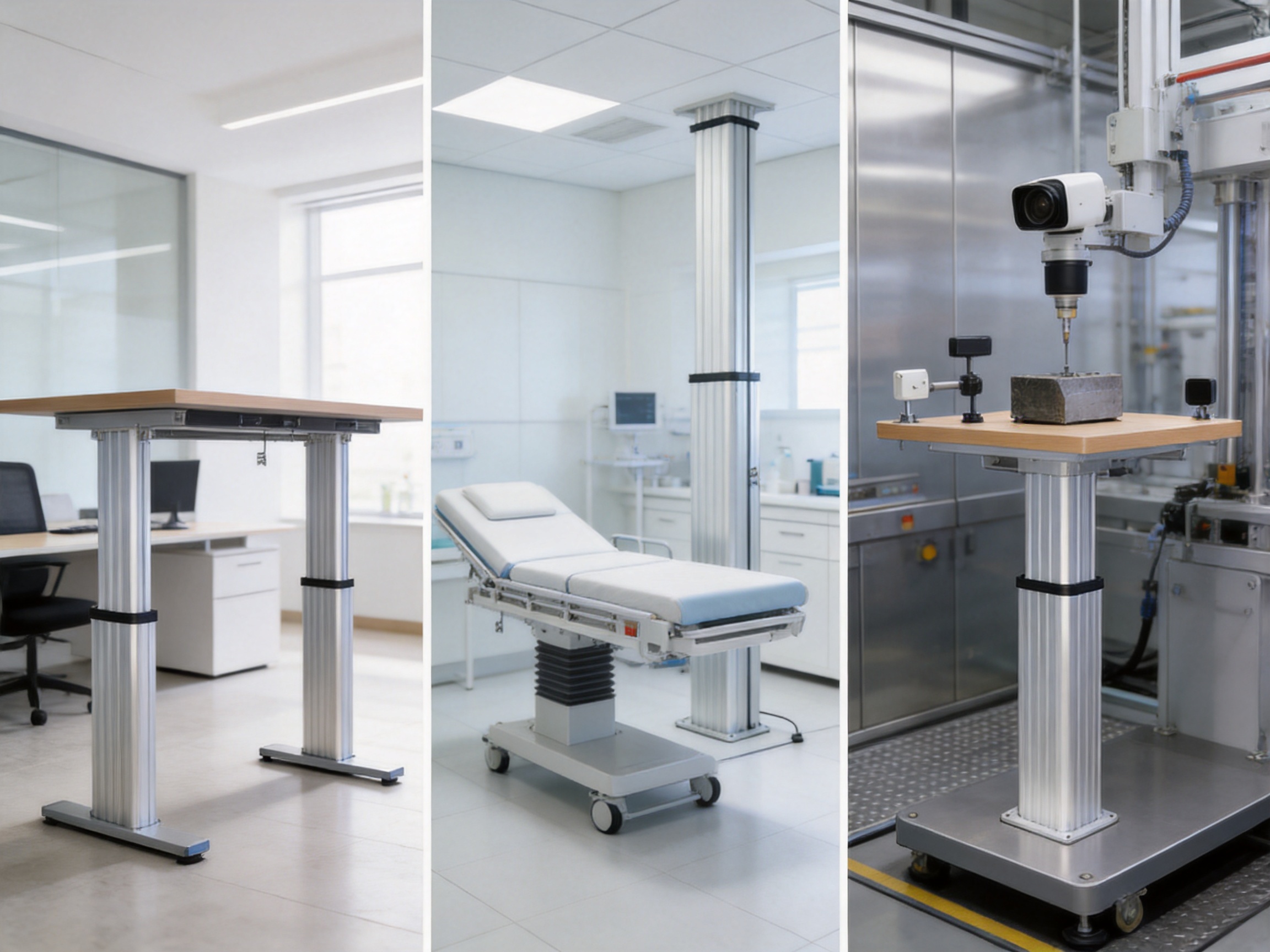
Standing desks are one of the most visible applications for electric lifting columns. Users expect smooth height adjustment, stable support, attractive appearance, and quiet, convenient operation. The TH-10’s multi-stage structure can support desks that require a substantial vertical adjustment range while maintaining a compact appearance when lowered.
The column’s silver-white matte finish can complement modern office furniture. Its 24VDC power system is compatible with many desk control architectures, while the electronic limit switches help define safe upper and lower positions. For larger desks, multiple columns can be linked through a synchronized controller to support the desktop at several points.
Stable movement is particularly important in a desk. A work surface that shakes or tilts during adjustment can reduce comfort and make users hesitant to use the sit-stand function. Internal wear-resistant bushings and the column’s structural design are intended to reduce such movement and promote a more stable experience.
Industrial Inspection Lifting Platforms
Inspection stations often require a platform, fixture, camera, sensor, or measuring device to move vertically. The position may need to be adjusted for different products or operators. A stable lifting column can help maintain the alignment of the inspection equipment during height changes.
The TH-10’s controlled speed, self-locking lead screw, and overload protection are useful in this context. Once the desired height is reached, the column can hold the load without continuous motor operation. The 24VDC supply also allows integration with industrial control systems and low-voltage automation components.
Because inspection platforms may be wide or carry off-center equipment, designers should evaluate the complete frame carefully. Multi-column synchronization may be appropriate where a single column cannot provide the required support distribution.
Medical Examination Beds
Medical examination beds and treatment platforms require controlled vertical adjustment to support patient access and clinician ergonomics. A stable lifting mechanism can make it easier to position the bed at a suitable working height while reducing unnecessary movement.
The electric design avoids hydraulic oil and compressed-air requirements, which can simplify installation in clinical environments. The corrosion-resistant exterior and IP54 protection rating may also be useful, although the final equipment must be designed around the facility’s cleaning, disinfection, and hygiene requirements.
Medical equipment manufacturers must conduct their own risk assessments, validation, and regulatory evaluations. The lifting column is a component, and its suitability depends on the bed structure, patient load, control system, emergency functions, and applicable medical equipment standards.
Heavy Equipment Vertical Jacking Structures
Heavy equipment may require controlled vertical positioning during assembly, maintenance, material handling, or process operations. The TH-10 offers a 5000N push force and a 4000N self-locking force, making it suitable for selected heavy-duty vertical lifting structures within the specified operating conditions.
The product’s multi-stage structure can help save space compared with a long single-piece support arrangement. Its integrated aluminum body provides a clean and organized mechanism, while the lead screw can hold the selected position when power is removed.
Engineers must distinguish between a lifting column and a certified safety jack or load-bearing support. Where personnel work beneath a raised load, independent mechanical safety supports and appropriate industrial safety procedures are essential.
Automated Warehouse Lifts
Automated warehouse equipment often requires precise vertical movement in compact spaces. A lifting column can be used in smaller lifts, positioning devices, storage interfaces, and vertical adjustment mechanisms where moderate speed and controlled positioning are suitable.
The column’s electronic limits and controller compatibility can support automated sequences. In multi-column applications, synchronized movement can help keep a platform level while transporting equipment or materials. The IP54 rating may be useful in indoor warehouse conditions with ordinary dust exposure, subject to the actual site environment.
9. Manufacturing Strengths and Engineering Approach
Product performance depends not only on the specification sheet but also on how the product is engineered, manufactured, tested, and supported. SuZhou Skyhone Intelligent Technology Co., Ltd. is a professional manufacturing enterprise focused on the research and development, production, sales, and service of standing desks and related intelligent office solutions.
The company is based in Suzhou, within the Yangtze River Delta’s extensive furniture and manufacturing network. This region is known for its concentration of component suppliers, metalworking companies, electronics manufacturers, automation resources, and furniture production capabilities. Access to this industrial ecosystem can support efficient coordination between mechanical design, electrical integration, assembly, and customization.
Research and Development Capability
The company’s focus on research and development allows it to address the practical requirements of adjustable furniture and vertical motion systems. A lifting column must be evaluated as a complete mechanism rather than as an isolated motor. Development work may involve structural design, transmission selection, telescopic guidance, control compatibility, surface treatment, and application-specific mounting.
The TH-10 demonstrates this application-focused approach. It is not presented simply as a motorized rod. Its design combines a telescopic structural body, internal wear-resistant bushings, a trapezoidal lead screw, electronic limits, overload protection, and controller-based synchronization. These elements respond directly to common challenges in vertical lifting.
For equipment manufacturers, an application-focused supplier can be valuable because the required solution often involves more than selecting a force rating. Stroke, flange dimensions, mounting orientation, controller architecture, cable routing, synchronization behavior, and duty cycle all influence the final design.
Intelligent Manufacturing Environment
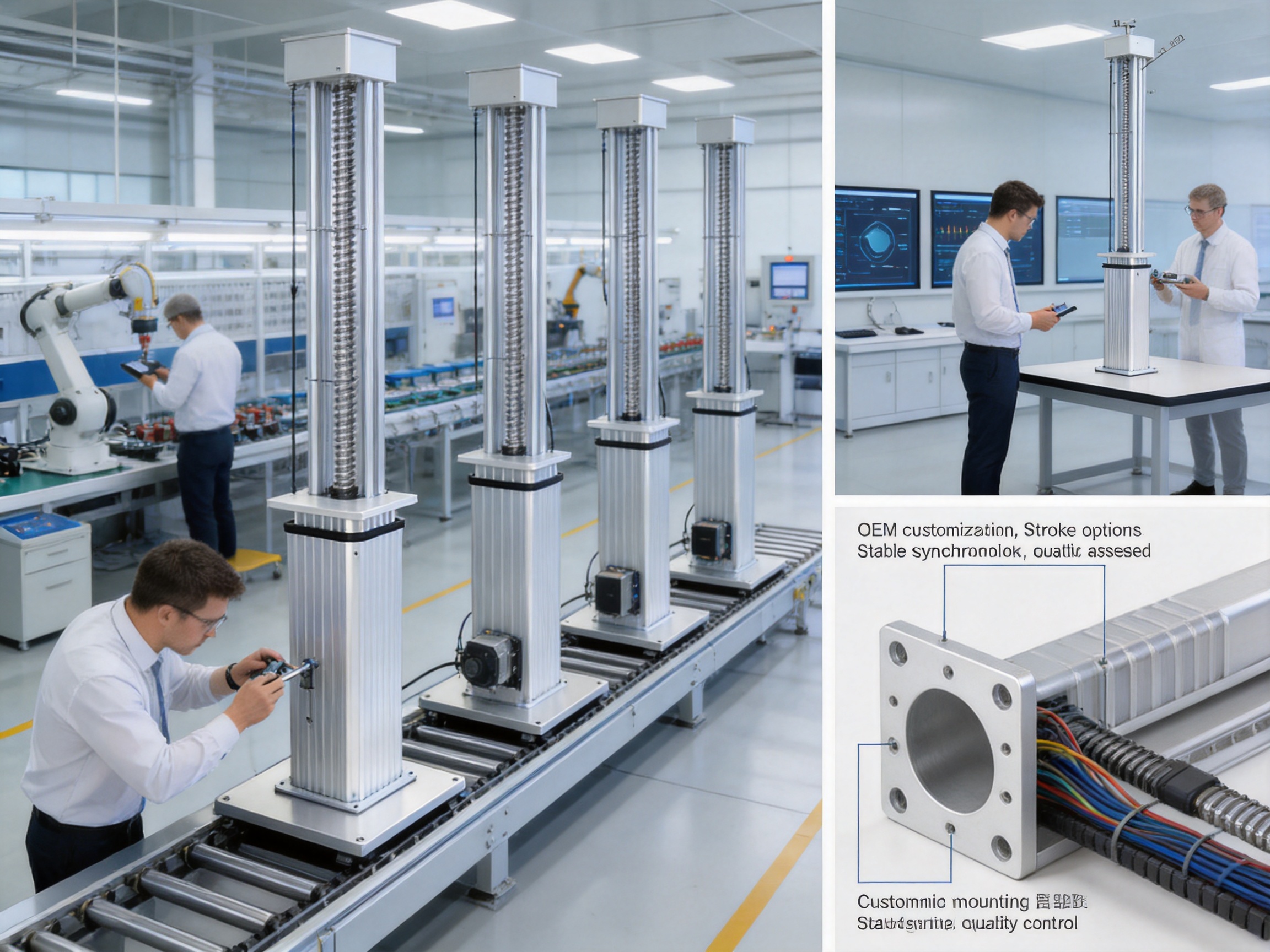
Intelligent manufacturing supports repeatable production through controlled processes, standardized assembly, inspection procedures, and coordinated quality management. For lifting columns, consistency is important because small variations in profile alignment, bushing fit, lead-screw assembly, or limit-switch positioning can influence noise, play, speed, and service life.
A mature manufacturing process should pay attention to material preparation, profile forming, surface finishing, mechanical assembly, electrical installation, inspection, and functional testing. Integrated aluminum profiles must maintain accurate dimensions so the telescoping sections can move smoothly. Bushings must be fitted correctly to provide guidance without creating excessive friction. The lead-screw transmission must be assembled in a way that supports reliable motion and self-locking behavior.
Electrical components also require careful installation. Limit switches, overload protection circuits, wiring, connectors, and controller interfaces must work together. Functional testing can confirm that the column extends and retracts correctly, stops at the intended positions, and responds appropriately to abnormal load or travel conditions.
Customization and Project Support
The company supports customization of total stroke, flange base, and synchronous control schemes. These options are important because vertical lifting systems rarely share exactly the same physical dimensions or operating requirements.
Total stroke customization allows the column to be matched to the required height range. A desk, inspection platform, and medical bed may each require a different retracted height and extension distance. Selecting an appropriate stroke helps avoid unnecessary structural changes and makes better use of the available installation space.
Flange base customization can simplify mechanical integration. The base connection determines how the column attaches to the frame and how loads are transferred into the supporting structure. A suitable flange design can improve installation convenience and help equipment manufacturers develop a cleaner finished product.
Synchronous control customization is valuable for platforms supported by multiple columns. Different products may require different control methods, movement speeds, synchronization tolerances, or communication arrangements. Working with a supplier that can discuss these requirements at the component level may shorten development time and reduce integration risk.
10. Comparison With Competing Actuator Approaches
Competition in the linear motion market includes single-section electric actuators, hydraulic cylinders, pneumatic cylinders, manual lifting mechanisms, and complete imported lifting columns. Each technology has appropriate uses. The TH-10’s advantages are most apparent when the application prioritizes vertical stability, clean electric operation, compact telescopic construction, and integrated safety functions.
| Solution Type | Typical Strength | Potential Limitation Compared With a Dedicated Lifting Column | Position of the TH-10 |
|---|---|---|---|
| Single-section linear actuator | Simple push-pull movement | May require additional guides and may provide less structural support for broad platforms | Uses a multi-stage column structure with internal guidance |
| Hydraulic cylinder | High force and robust industrial operation | Requires hydraulic infrastructure and may create oil leakage or maintenance concerns | Provides clean electric operation without hydraulic oil |
| Pneumatic cylinder | Fast movement and simple pneumatic control | Requires compressed air and may be less suitable for firm static holding | Uses 24VDC electrical power and a self-locking lead screw |
| Manual lifting mechanism | Low electrical complexity | Requires operator effort and may not support automated adjustment | Supports electronic control and synchronization |
| Generic telescopic actuator | Compact moving structure | May offer fewer application-specific customization and protection options | Supports stroke, flange, and synchronous-control customization |
Compared with a single-section actuator, the TH-10’s principal advantage is structural suitability for vertical applications. A standard actuator may still be useful when external rails or guides are already present. However, when the actuator must contribute to the vertical support structure, a multi-stage lifting column can reduce the need for additional guiding hardware.
Compared with hydraulic systems, the TH-10 offers a simpler and cleaner installation for moderate-force applications. It does not require a pump station, hydraulic reservoir, or oil lines. This can be particularly attractive in office, medical, and indoor industrial settings.
Compared with pneumatic equipment, the TH-10 does not depend on a compressed-air network. Its electric control system can provide precise movement commands, electronic limits, and synchronization. The lead screw’s self-locking characteristic also supports static positioning without continuous air pressure.
Compared with manual mechanisms, the product supports more convenient operation and integration into automated systems. Users can adjust the equipment through an electrical control interface, while manufacturers can incorporate memory functions, sensors, or programmable sequences where appropriate.
11. Selecting and Integrating the Column Correctly
Choosing a lifting column should begin with the complete application rather than the actuator alone. Engineers should identify the total moving mass, desired stroke, required speed, operating frequency, load center, platform dimensions, number of columns, environmental conditions, and control method.
Load Evaluation
The rated push and pull forces are important, but the actual design load should include the weight of the platform, frame, tools, equipment, and any contents. Dynamic effects, friction, uneven loading, and acceleration should also be considered. An off-center load may create bending or twisting that is more demanding than a centered vertical load.
For multi-column systems, the load may not be divided equally if the frame is flexible or the payload is positioned unevenly. The system should be designed so that each column operates within a suitable margin rather than assuming perfect load sharing.
Stroke and Installation Height
The required total stroke should be compared with the available retracted and extended heights. The telescopic structure may offer installation advantages, but the surrounding frame must still provide adequate clearance throughout the full movement range.
Cables should be routed so they do not become pinched, stretched, or caught between telescoping sections. Any attached equipment should remain clear of nearby structures. Mechanical end stops, guards, and access provisions should be included when the application requires them.
Control and Synchronization
A single-column application may use a straightforward switch or controller, while a multi-column system may need a dedicated synchronous control scheme. The controller should be compatible with the 24VDC supply and the column’s current requirements. It should also support the desired limit, overload, direction, and synchronization functions.
For automated equipment, the control system may need feedback or position-management capabilities. The appropriate approach depends on the application and the required positioning accuracy. A supplier should be consulted when several columns must move together or when the lifting system is part of a larger automated sequence.
Environmental Conditions
The IP54 rating and aluminum housing make the column suitable for many indoor environments, but the final application should be assessed carefully. Temperature, humidity, dust, water exposure, cleaning chemicals, vibration, and installation location can affect performance.
Where the column is used in a harsh environment, additional enclosure protection or a different product configuration may be necessary. Product selection should always be based on actual conditions rather than assuming that a general protection rating covers every possible hazard.
12. Maintenance and Long-Term Reliability
Electric lifting columns are generally straightforward to maintain, especially when compared with systems that require hydraulic fluid management or compressed-air maintenance. Nevertheless, regular inspection remains important for reliable operation.
Users and equipment operators should periodically check the column for unusual noise, visible damage, loose mounting hardware, cable wear, abnormal vibration, or changes in movement speed. The mounting structure should remain rigid and properly aligned. If a column begins to move unevenly or encounter repeated overload protection events, the equipment should be inspected before continued use.
The telescopic sections should be kept free from materials that could enter the moving interfaces. Cleaning methods should be compatible with the aluminum surface, protective finish, and application environment. Harsh chemicals or abrasive tools may damage the surface and reduce corrosion resistance.
In multi-column systems, all columns should be checked together. A difference in mechanical alignment, load distribution, or electrical behavior can cause one column to work harder than another. Synchronous control should be verified according to the equipment manufacturer’s maintenance schedule.
The self-locking lead screw helps hold the load, but it should not be treated as a substitute for safety supports during maintenance. When personnel need to work beneath or inside a raised structure, the load should be mechanically secured using appropriate procedures and equipment.
13. Why the Product Is Suitable for OEM and Customized Equipment
OEM manufacturers often need components that can be adapted to their own product architecture. A standard component may not be sufficient if the equipment requires a specific stroke, mounting interface, or synchronized movement pattern. The TH-10’s customization options are therefore an important part of its value.
Customization of the total stroke can help manufacturers create different desk sizes, platform heights, medical bed configurations, or industrial lifting modules while retaining a common product concept. Flange customization can support different frame geometries and connection requirements. Synchronous control customization can help match the column to the customer’s preferred controller or operating logic.
Using a dedicated lifting-column platform can also help reduce development effort. Instead of designing an entire vertical mechanism from the beginning, an equipment manufacturer can integrate an existing column architecture and focus engineering resources on the frame, user interface, safety system, and application-specific functions.
The company’s combined involvement in research, production, sales, and service supports communication across the product life cycle. This is important when customers need technical clarification during initial selection, assistance with prototype integration, or coordination during volume production.
14. Quality-Oriented Product Development
Reliable motion products require attention to detail at every stage. The aluminum profile must be dimensionally consistent. Telescoping interfaces must be properly matched. Internal bushings must provide smooth guidance. The lead screw and nut must operate with suitable mechanical precision. Electrical protections must function consistently, and the completed unit must be checked before shipment.
A quality-oriented manufacturing process should include incoming material checks, process controls, assembly verification, functional testing, and final inspection. While specific internal procedures may vary, these categories provide the foundation for consistent actuator performance.
Certification also contributes to product confidence. The TH-10 has official CE and RoHS certifications. CE marking indicates conformity with applicable European requirements within the scope of the product and its declared use. RoHS relates to restrictions on certain hazardous substances in electrical and electronic equipment. Customers should review the relevant technical documentation and intended-use conditions when applying the product in regulated equipment.
Certifications do not eliminate the need for system-level compliance. The complete desk, medical bed, platform, or machine may require additional testing and certification based on its final market and application. However, certified components can provide a more structured foundation for the equipment manufacturer’s compliance process.
15. Practical Benefits for End Users
Although the TH-10 is a technical component, its value is ultimately measured by the experience and reliability it provides in the finished product. In a standing desk, the user benefits from convenient height adjustment and a more stable work surface. In a medical bed, controlled lifting can support more comfortable positioning and better working ergonomics for medical staff. In industrial equipment, repeatable vertical movement can improve productivity and reduce manual effort.
The column’s electric operation allows adjustment at the touch of a control. The moderate telescopic speed supports deliberate motion rather than abrupt movement. Electronic limits help ensure that movement stops within the intended range. Overload protection helps reduce damage risk when abnormal resistance occurs. Self-locking helps retain the selected position during power interruption.
The absence of hydraulic oil and compressed air can also improve the user environment. Fewer external components may mean less visible infrastructure, reduced noise from pumps or compressors, and simpler equipment installation. These benefits are especially relevant where the finished product is located near users or in spaces that require a clean appearance.
16. Application Limitations and Responsible Design
A professional product evaluation should recognize both strengths and limitations. The TH-10 has a 10% duty cycle, so it is not intended for uninterrupted continuous movement. Its 5mm/s no-load speed is suited to controlled lifting but may not meet applications that require rapid vertical travel. The IP54 rating is useful for ordinary indoor dust and splash exposure but does not make the product suitable for immersion or severe washdown conditions.
The stated force values must be evaluated together with the mechanical design. High eccentric loads, side forces, long unsupported platforms, and poor alignment can affect performance even when the nominal mass appears to be within the force rating. In some applications, external guides, additional columns, mechanical stops, or safety supports may be necessary.
These considerations do not reduce the product’s value. Instead, they help ensure that it is used in the applications for which it was designed. Correct product selection, proper installation, suitable control programming, and regular inspection are essential to achieving dependable results.
17. A Structured Evaluation Process for Buyers
Organizations evaluating the TH-10 can use a structured process. Begin by documenting the required load, stroke, speed, duty cycle, and environmental conditions. Next, determine whether the application needs one column or multiple synchronized columns. Then review the required flange, controller, wiring, and safety interfaces.
The next step is to examine the complete mechanical structure. Confirm that the frame is rigid enough, that the load is properly centered or distributed, and that the column will not be exposed to excessive side loading. Check the full movement envelope for interference and make provisions for cable management.
After the mechanical review, test the control system. Verify upper and lower limits, overload behavior, power-loss holding, emergency stopping, and synchronization. Prototype testing should represent the actual load and operating frequency rather than relying only on unloaded movement.
Finally, establish a maintenance and documentation plan. Operators should understand the intended load, duty cycle, adjustment controls, and prohibited uses. Maintenance personnel should know how to inspect the column and how to secure a raised load safely before service.
18. Frequently Asked Questions
Q1: What is the TH-10 Multi-Stage Electric Lifting Column designed for?
The TH-10 is designed for vertical lifting applications such as smart standing desks, industrial inspection platforms, medical examination beds, heavy equipment jacking structures, and automated warehouse lifts. It is intended for situations where vertical stability, controlled motion, and load holding are important.
Q2: How does a multi-stage column differ from a standard linear actuator?
A multi-stage column uses telescoping structural sections that extend and retract within one another. It is designed to contribute more directly to vertical support and guidance. A standard linear actuator may primarily provide push-pull force and may require additional external guides when used beneath a wide or heavy platform.
Q3: What are the main force ratings?
The stated push force is 5000N, the pull force is 4000N, and the self-locking force is 4000N. Actual application capacity should be evaluated with regard to load distribution, mounting arrangement, side forces, duty cycle, and the complete system design.
Q4: What power supply does the column use?
The column uses a 24VDC power supply. Its stated full-load current is 4A. The power supply and controller should be selected to accommodate the required number of columns and the operating conditions of the finished equipment.
Q5: Can the TH-10 be used in a multi-column desk or platform?
Yes. The product can be used independently or in a multi-column synchronous lifting linkage. A compatible controller and a rigid, properly aligned frame are required for coordinated movement.
Q6: Does the column remain in position if power is removed?
The trapezoidal lead screw is designed to lock the load firmly after power is cut, with a stated self-locking force of 4000N. System designers should still consider eccentric loading, vibration, wear, and appropriate mechanical safety measures.
Q7: What does the IP54 rating mean?
IP54 indicates protection against harmful dust accumulation and water splashes under defined test conditions. It does not mean that the product can be immersed, exposed to high-pressure water, or used without additional protection in highly corrosive environments.
Q8: Is the TH-10 suitable for continuous operation?
The stated standard duty cycle is 10%, so the column is intended for intermittent movement with rest periods. It is suitable for applications such as desk adjustment, bed positioning, and periodic platform lifting, but continuous operation requires separate evaluation.
Q9: Can the stroke be customized?
The product supports customization of total stroke. Customers should provide the required retracted height, extended height, working stroke, load, and installation conditions so the appropriate configuration can be evaluated.
Q10: Can the mounting flange be customized?
Yes. Flange base customization is supported. This can help equipment manufacturers integrate the column into different frames, desks, platforms, and machine structures.
Q11: What safety features are included?
The TH-10 includes electronic limit switches and dual overload protection. These features help control the travel range and reduce the risk of damage during abnormal resistance or excessive load conditions.
Q12: Why is self-locking useful in vertical lifting?
Self-locking helps prevent the load from descending when power is removed. It can improve safety, support stable positioning, and reduce the need to keep the motor energized during static periods.
Q13: What are the main advantages over hydraulic or pneumatic systems?
The TH-10 does not require hydraulic oil, a pump station, or compressed air. Its electric design can simplify installation, reduce infrastructure requirements, and support electronic speed regulation and synchronization.
Q14: What manufacturing strengths support the product?
SuZhou Skyhone Intelligent Technology Co., Ltd. combines research and development, production, sales, and service within a manufacturing environment supported by Suzhou’s mature furniture and industrial supply chain. The product reflects integrated mechanical, electrical, structural, and application-oriented development.
Q15: What should be checked before ordering?
Customers should confirm the required force, stroke, speed, duty cycle, number of columns, flange design, controller compatibility, environmental conditions, cable routing, and load distribution. Prototype testing under representative conditions is recommended before mass production.
19. Conclusion
The TH-10 Multi-Stage Electric Lifting Column is a purpose-built solution for vertical lifting applications that demand more than basic linear movement. Its multi-stage telescopic architecture, thick integrated aluminum profile tube, internal wear-resistant bushings, trapezoidal lead screw, electronic limits, dual overload protection, and self-locking capability work together to provide stable and controlled vertical operation.
With a 5000N push force, 4000N pull force, 4000N self-locking force, 24VDC power supply, 5mm/s no-load speed, IP54 protection rating, and 10% duty cycle, the column is suited to intermittent lifting and long-term static load-bearing applications. It can operate independently or as part of a synchronized multi-column system.
Its advantages over standard linear actuators are most significant where structural stability, vertical alignment, and load holding are essential. Its clean electric operation provides an alternative to hydraulic and pneumatic mechanisms, while its customization options support OEM furniture, medical equipment, industrial platforms, and automation products.
Behind the product is a Suzhou-based manufacturer focused on research, production, sales, service, and intelligent office-space solutions. The company’s access to the Yangtze River Delta manufacturing ecosystem, together with its emphasis on customized stroke, flange, and synchronization solutions, makes it a practical partner for manufacturers developing adjustable and automated equipment.
When correctly selected, installed, controlled, and maintained, the TH-10 can provide a stable foundation for modern standing desks, lifting platforms, medical furniture, inspection equipment, and other vertical motion systems.
References
1. Product technical materials for the TH-10 Multi-Stage Electric Lifting Column, including force, speed, power, protection, duty-cycle, and customization information.
2. General principles of electric linear actuator selection, including load calculation, duty-cycle evaluation, mechanical alignment, and controller integration.
3. General guidance on IP protection ratings for electrical and mechanical equipment.
4. General engineering practices for trapezoidal lead-screw transmissions and self-locking mechanisms.
5. General manufacturing principles for aluminum profile structures, telescopic guidance systems, and precision bushing assemblies.
6. General design considerations for synchronized multi-column lifting platforms and adjustable-height furniture.
7. General safety practices for powered lifting equipment, mechanical load support, maintenance access, and overload protection.
Product: TH-10 Multi-Stage Electric Lifting Column


- Contact Info
-
-
 Phone+86-15950656125
-
 Email
-
 AddressRoom 1007-1, South Building, Suyue Plaza, Suzhou Industrial Park, Suzhou City, Jiangsu Province, China
-
- Products
- Follow Us
- Need help? Please contact us
Copyright ©
SuZhou Skyhone Intelligent Technology Co., Ltd.
All Rights Reserved.
Privacy
Custom Ergonomic Adjustable Office Tables Manufacturers

