

 English
 русский
 Español
 عربى

Content
- 1 1. Product Overview
- 2 2. Why Pneumatic Height Adjustment Matters
- 3 3. Center-Mounted Structural Design
- 4 4. Tabletop Construction and Finish Options
- 5 5. Mobility and Position Control
- 6 6. Ergonomic Benefits of a Sit-Stand Work Surface
- 7 7. Advantages Compared with Conventional Fixed Desks
- 8 8. Advantages Compared with Electric Adjustable Desks
- 9 9. Advantages Compared with Basic Manual Desks
- 10 10. Manufacturing Strengths and Product Development Capabilities
- 11 11. A Practical Quality-Control Perspective
- 12 12. Applications in Different Environments
- 13 13. Installation and Daily Use Recommendations
- 14 14. Maintenance and Service Considerations
- 15 15. Selecting the Right Desk for a Project
- 16 16. Comparison Table for Purchasing Decisions
- 17 17. Why the SK03 Is a Competitive Choice
- 18 18. Frequently Asked Questions
- 18.1 What type of desk is the SK03?
- 18.2 What is the height adjustment range?
- 18.3 Does the desk require electricity?
- 18.4 What are the tabletop dimensions?
- 18.5 What is the tabletop made of?
- 18.6 Which colors are available?
- 18.7 Can the desk be moved?
- 18.8 Where can the SK03 be used?
- 18.9 Is the desk suitable for a large monitor setup?
- 18.10 How should the surface be cleaned?
- 18.11 What should buyers consider before ordering multiple units?
- 18.12 What makes the manufacturer suitable for project orders?
- 19 19. Conclusion
- 20 References
- 21 Product: SK03 Center-Mounted Pneumatic Height-Adjustable Desk
SK03 Center-Mounted Pneumatic Height-Adjustable Desk: A Practical Guide to Ergonomic, Mobile Workspaces
2026-09-23
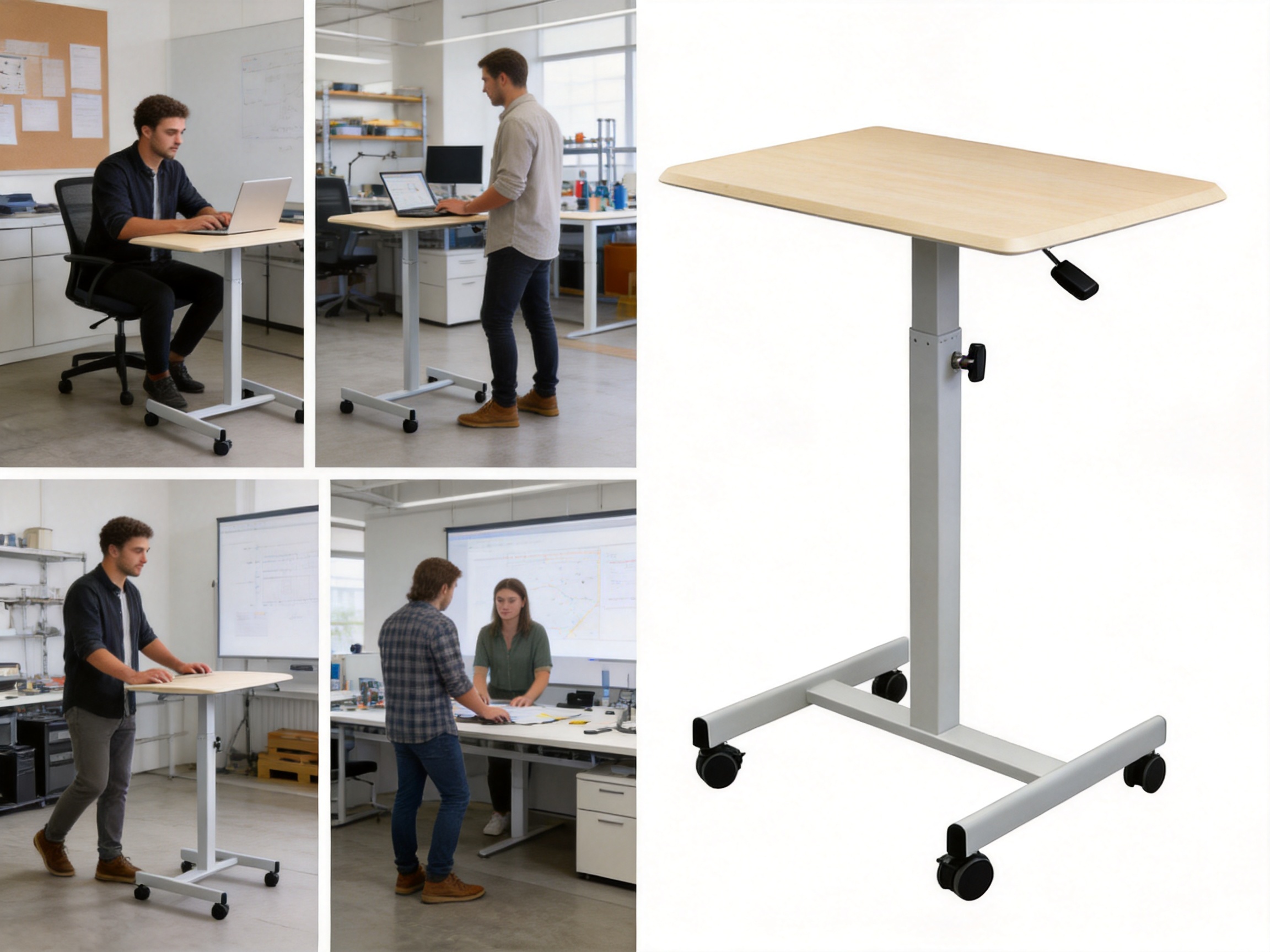
The modern workplace is becoming more flexible, more collaborative, and more focused on employee comfort. Offices are no longer designed only around fixed-height desks and permanent seating positions. Home offices, training rooms, laboratories, studios, and shared work areas increasingly require furniture that can adapt to different users, tasks, and working postures. The SK03 center-mounted pneumatic height-adjustable desk responds to this need with a compact work surface, a stable iron frame, smooth gas spring lifting, and mobile casters that support both repositioning and secure placement.
Unlike a conventional fixed desk, the SK03 can be adjusted between 745mm and 1060mm. This range allows users to alternate between seated and standing work without replacing the desk or installing a separate workstation. Unlike many electrically powered desks, it uses a pneumatic gas spring mechanism rather than a motor, control box, and wired power system. This gives the product a simple operating concept, reduced dependence on electrical infrastructure, and a clean appearance suitable for professional interiors.
The desk is designed and manufactured by SuZhou Skyhone Intelligent Technology Co., Ltd., a China-based enterprise focused on the research and development, production, sales, and service of standing desks and related office-space solutions. Operating in Suzhou, an important manufacturing center within the Yangtze River Delta, the company benefits from the region’s established furniture supply chain and intelligent manufacturing environment. These conditions support product development, material coordination, manufacturing efficiency, and customization for customers in different markets.
This article examines the SK03 in detail, including its construction, adjustment system, mobility, ergonomic value, manufacturing advantages, application scenarios, maintenance requirements, and comparison with other categories of height-adjustable desks.
1. Product Overview
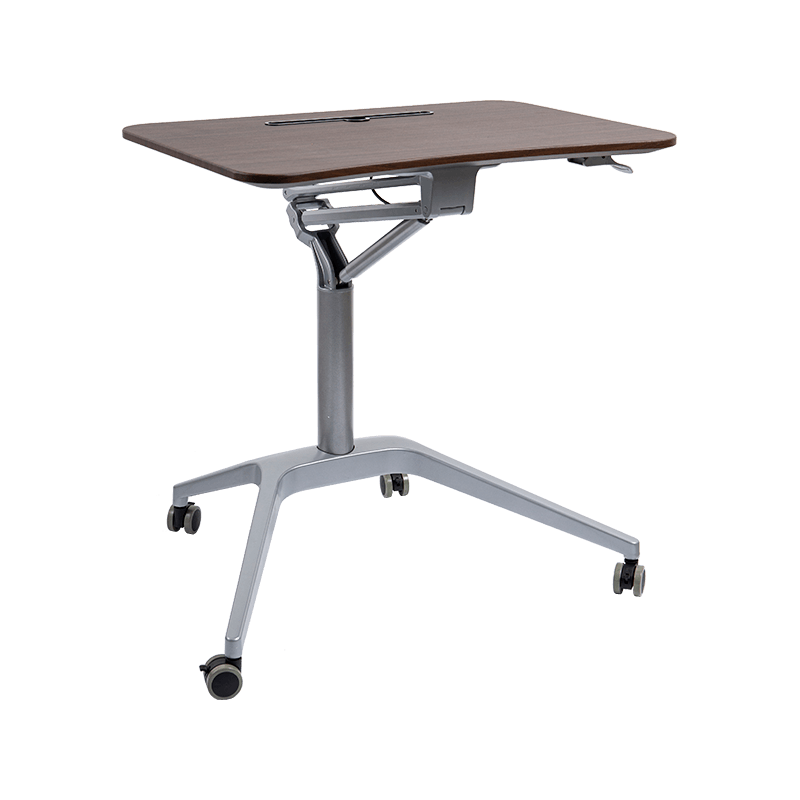
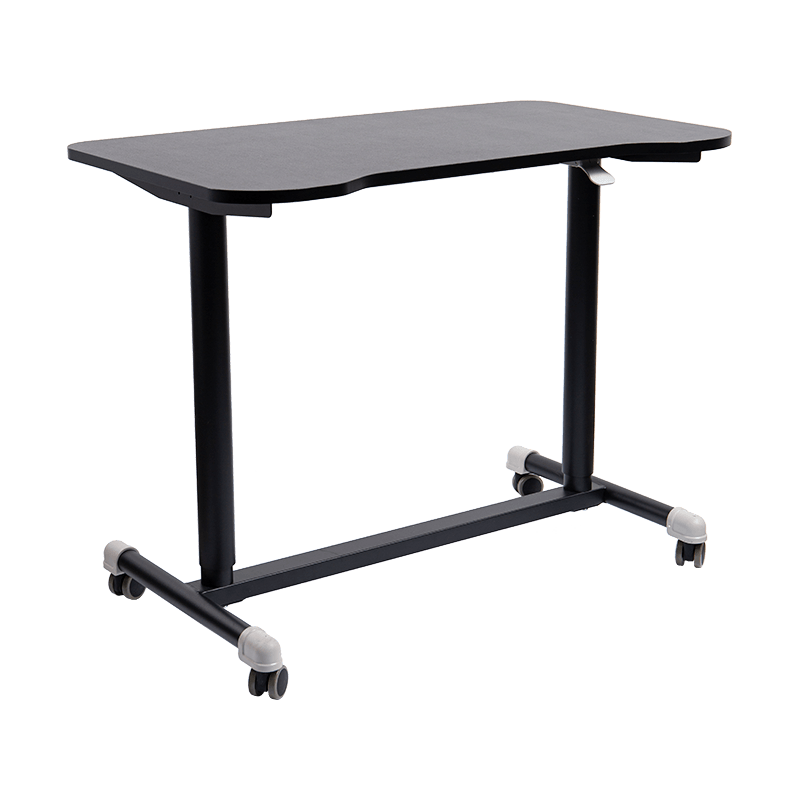
The SK03 is a center-mounted pneumatic height-adjustable desk intended for users who need a compact and flexible work surface. Its lifting column and adjustment structure are positioned centrally beneath the tabletop. This configuration helps distribute the tabletop load around the main support area and gives the desk a visually balanced appearance.
The desk uses a 650mm by 480mm tabletop with a thickness of 15mm. This size is suitable for a laptop, notebook, keyboard, small monitor, documents, or other compact work equipment. It is not intended to replace a large executive workstation, but its compact footprint is an advantage in environments where floor space is limited or where furniture must be moved regularly.
The lifting range extends from 745mm to 1060mm. At the lower setting, the desk can support seated work with an appropriate chair. At the higher setting, it can be used as a standing workstation, presentation surface, laboratory support table, or temporary collaboration station. The precise ideal height depends on the user’s body proportions and the task being performed, but the broad range gives the desk useful versatility across different applications.
The primary frame material is iron, and the frame receives a powder-coated surface treatment. Iron provides the structural basis required for repeated height adjustment and routine commercial use. Powder coating creates a durable exterior finish that can help protect the frame from everyday abrasion, general wear, and environmental exposure. The finish also gives manufacturers flexibility in producing a clean and consistent appearance.
The tabletop is made from 15mm MDF with a PVC vacuum-formed surface. Medium-density fiberboard offers a smooth and uniform substrate, while the PVC surface provides a decorative and practical exterior layer. Vacuum forming allows the surface material to follow the tabletop profile and supports consistent visual presentation across production batches.
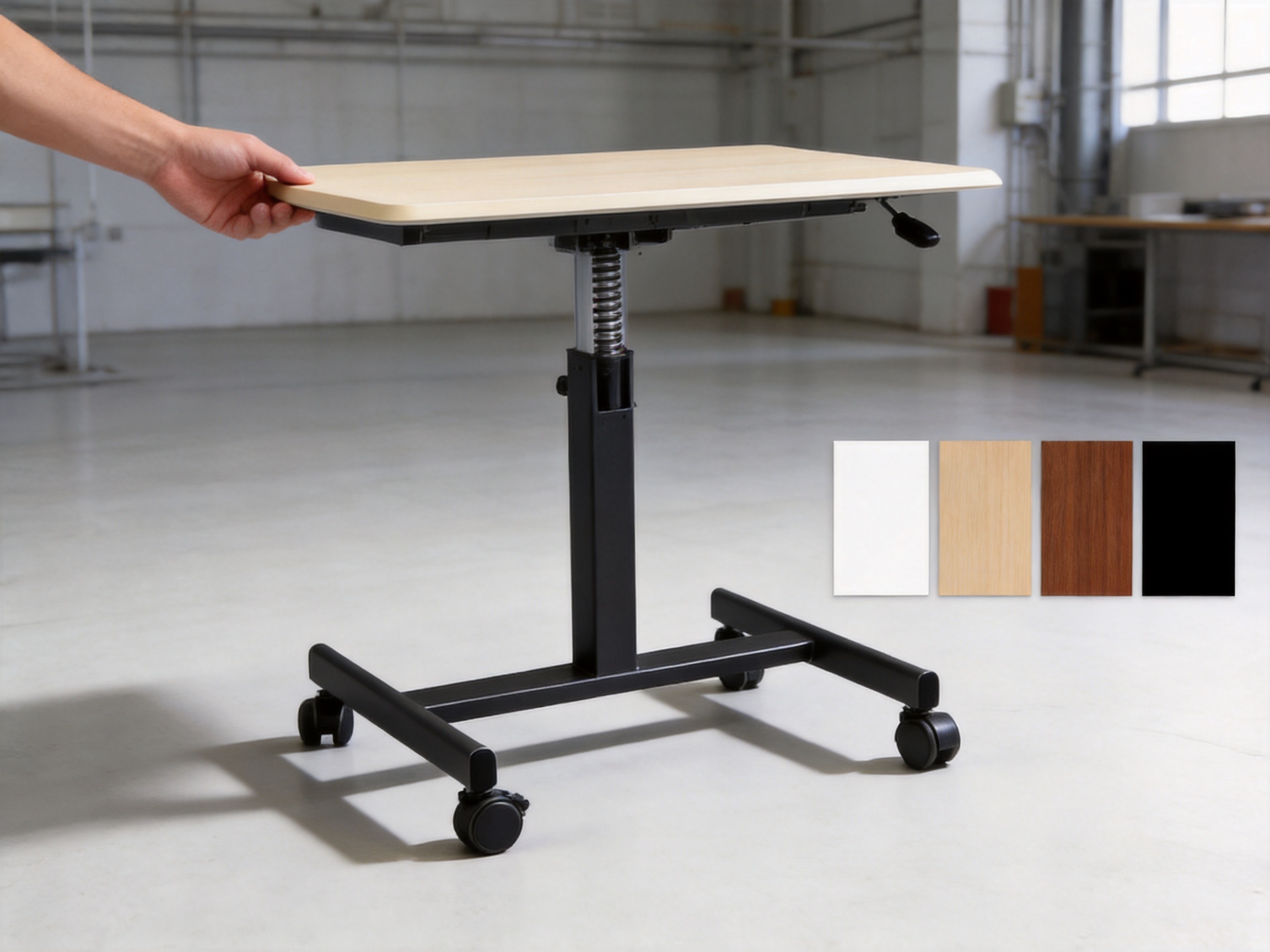
Four cast wheels are included. Two wheels are equipped with locking mechanisms, while the other two are non-locking. This combination makes it possible to move the desk when required and stabilize it after it has been positioned. The caster arrangement is particularly useful in training spaces, laboratories, shared offices, and studios where furniture layouts may change throughout the day.
| Specification | SK03 Configuration |
|---|---|
| Product type | Center-mounted pneumatic height-adjustable desk |
| Lifting range | 745mm to 1060mm |
| Tabletop dimensions | 650mm by 480mm |
| Tabletop thickness | 15mm |
| Tabletop material | 15mm MDF with PVC vacuum forming |
| Main frame material | Iron |
| Surface treatment | Powder coating |
| Casters | Two locking casters and two non-locking casters |
| Panel colors | White, Maple, Walnut, and Black |
| Adjustment principle | Gas spring lifting |
2. Why Pneumatic Height Adjustment Matters
Height adjustment can be achieved through several technologies, including manual telescoping systems, electric linear actuators, crank mechanisms, and pneumatic gas springs. Each method has its own benefits. The SK03 uses a gas spring lifting system, which is well suited to a compact desk that prioritizes simplicity, portability, and quick adjustment.
A gas spring stores energy inside a sealed cylinder. When the user activates the adjustment control, the stored force assists the movement of the tabletop and frame. This reduces the physical effort required to raise or lower the desk. The result is a smooth adjustment process without the need for a motor or external electrical connection.
Compared with a fixed-height desk, the pneumatic system gives the user a more adaptable working position. A desk can be set lower for reading, typing, or seated computer use and raised for standing discussions, short-duration tasks, demonstrations, or collaborative work. This flexibility supports the broader principle of changing posture during the working day rather than remaining in one position for extended periods.
Compared with an electric height-adjustable desk, the SK03 has fewer electrical components. There is no requirement for a power cable, control handset, motor controller, or electrical outlet during normal adjustment. This is useful in rooms where cables may create clutter, where power access is limited, or where the furniture is frequently relocated.
The pneumatic principle also supports a quiet and direct user experience. Electric desks may produce a motor sound during operation, while a gas spring system can provide a more mechanically simple adjustment process. The exact sound level and adjustment force depend on the product configuration and load, but the absence of a powered drive system is an important distinction.
Gas spring systems are also attractive for buyers who want to reduce the number of components that need electrical servicing. Routine attention can focus on the frame, tabletop, casters, fasteners, and adjustment mechanism. This can simplify installation, inspection, and maintenance in commercial or institutional environments.
3. Center-Mounted Structural Design
The center-mounted structure is one of the defining characteristics of the SK03. Rather than using two widely separated lifting columns, the desk concentrates its main support beneath the middle of the tabletop. This creates a compact footprint and can make the product easier to position in smaller rooms.
A center-mounted arrangement also contributes to visual balance. The tabletop appears to be supported from a clear central point, producing a clean and uncluttered silhouette. This is valuable in modern offices, reception areas, laboratories, and creative studios where furniture is expected to function well while maintaining a professional appearance.
Structural performance depends on several factors, including the geometry of the frame, the strength and thickness of the materials, the connection between the tabletop and base, the gas spring characteristics, the caster design, and the distribution of the working load. The SK03 combines an iron support structure with a compact tabletop to create a practical balance between strength and maneuverability.
The relatively compact tabletop is also relevant to stability. A smaller work surface produces less overhang beyond the supporting structure than a large desktop would. Users should still distribute equipment responsibly and follow the manufacturer’s instructions regarding loading and operation. However, the intended scale of the tabletop supports the desk’s role as a personal, mobile workstation rather than a heavy-duty conference table.
For purchasing departments, the center-mounted configuration can provide logistical benefits as well. A compact base may simplify storage, movement through narrow passages, and placement in rooms with closely arranged furniture. These benefits are especially relevant for schools, training providers, medical or technical facilities, and businesses that frequently reconfigure interior layouts.
4. Tabletop Construction and Finish Options
The SK03 tabletop uses 15mm MDF as its core material. MDF is manufactured from refined wood fibers combined into a consistent panel. Its uniform composition provides a smooth surface suitable for decorative finishing and helps avoid some of the visible irregularities that may be found in less uniform wood-based boards.
The tabletop receives a PVC vacuum-formed surface. PVC is commonly used in furniture applications because it can provide a durable decorative layer with consistent color and texture. Vacuum forming allows the surface material to be shaped over the panel, supporting a finished appearance across the tabletop profile.
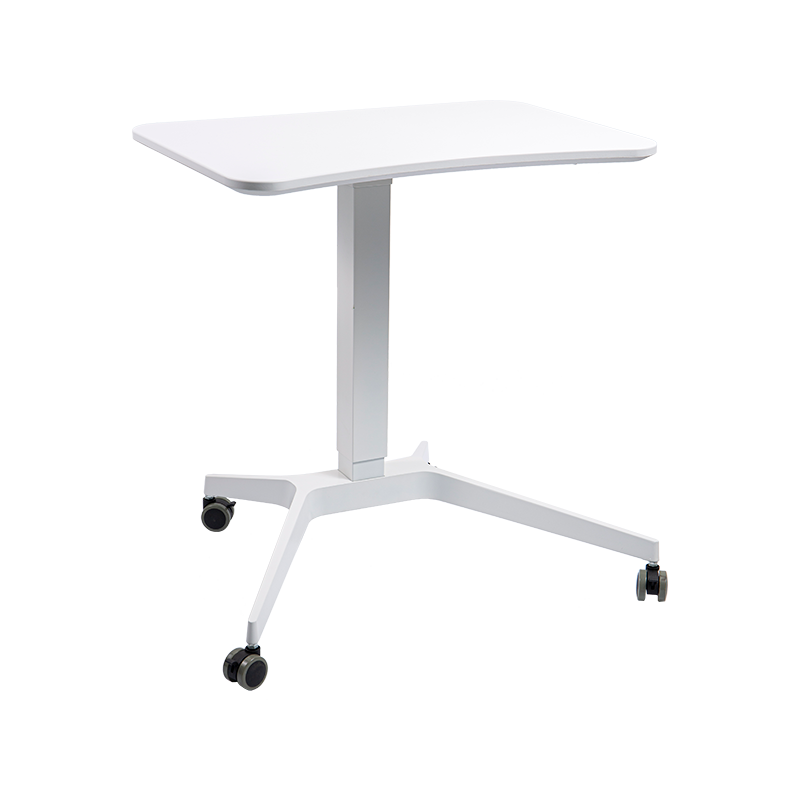
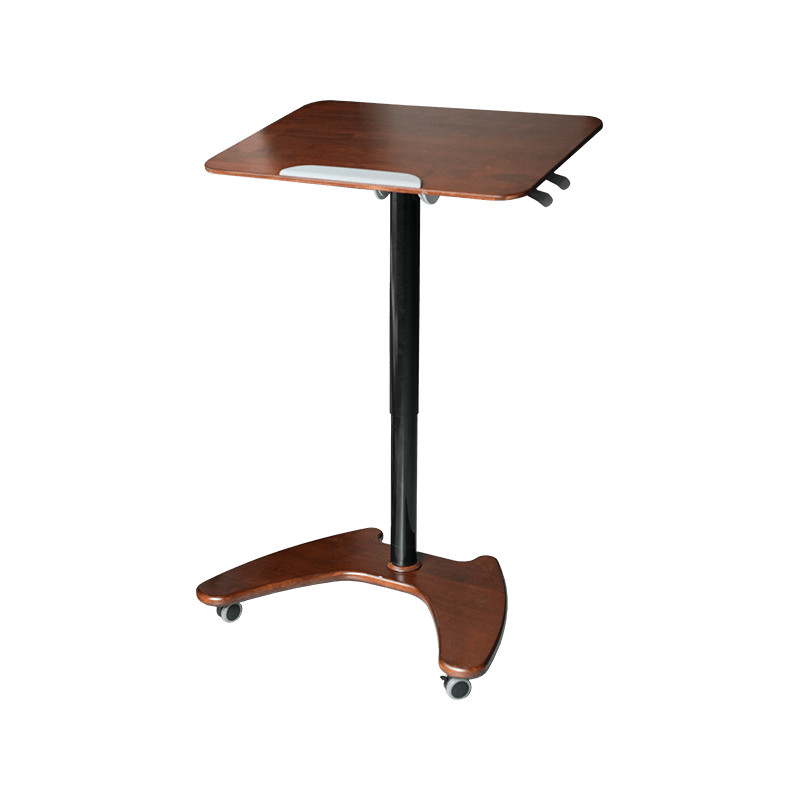
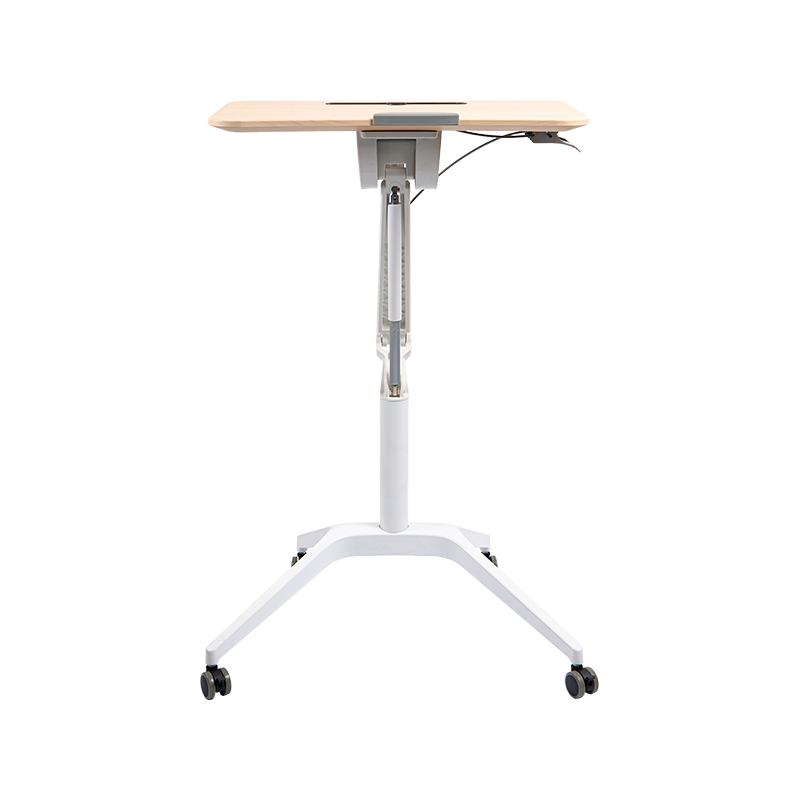
Four panel colors are available: White, Maple, Walnut, and Black. White can contribute to a bright, clean, and contemporary interior. Maple offers a lighter wood-inspired appearance. Walnut creates a warmer and more traditional visual impression, while Black provides a stronger contrast and can coordinate with dark office equipment or industrial-style interiors.
Color selection is more than a purely decorative decision for commercial buyers. Furniture finishes can influence how a room is perceived, how easily a desk integrates with existing products, and how consistently a company presents its workspace. By offering multiple panel choices, the SK03 can be specified for different interior concepts without requiring a completely different structural platform.
The surface should be protected from prolonged exposure to standing water, aggressive chemicals, excessive heat, and sharp objects. For routine cleaning, a soft cloth and a mild, non-abrasive cleaning solution are generally appropriate. Wiping spills promptly helps preserve the appearance of the PVC surface and prevents liquid from reaching seams or exposed edges.
5. Mobility and Position Control
Mobility is a practical advantage of the SK03. Many adjustable desks are intended to remain in one position, but the SK03 is equipped with four casters to support relocation. This makes it possible for one workspace to serve several users or for a room to be rearranged according to different activities.
The two locking casters are particularly important because movement and stability must be balanced. When the desk needs to be moved, the locks can be released and the unit can be guided to a new position. Once it is correctly placed, the locking mechanisms can be engaged to reduce unwanted rolling during use.
Lockable casters are useful in training rooms where desks may be grouped for instruction and separated for individual work. They are also valuable in laboratories, studios, and event areas where the same furniture may serve demonstrations, preparation work, presentations, or temporary project stations.
Users should position the desk on a reasonably level floor and engage the locks before beginning work. The casters should be inspected periodically for obstruction, wear, or accumulation of dust and debris. If the desk becomes difficult to move, forcing it may place unnecessary stress on the wheels or frame. A basic inspection and cleaning routine can help preserve mobility.
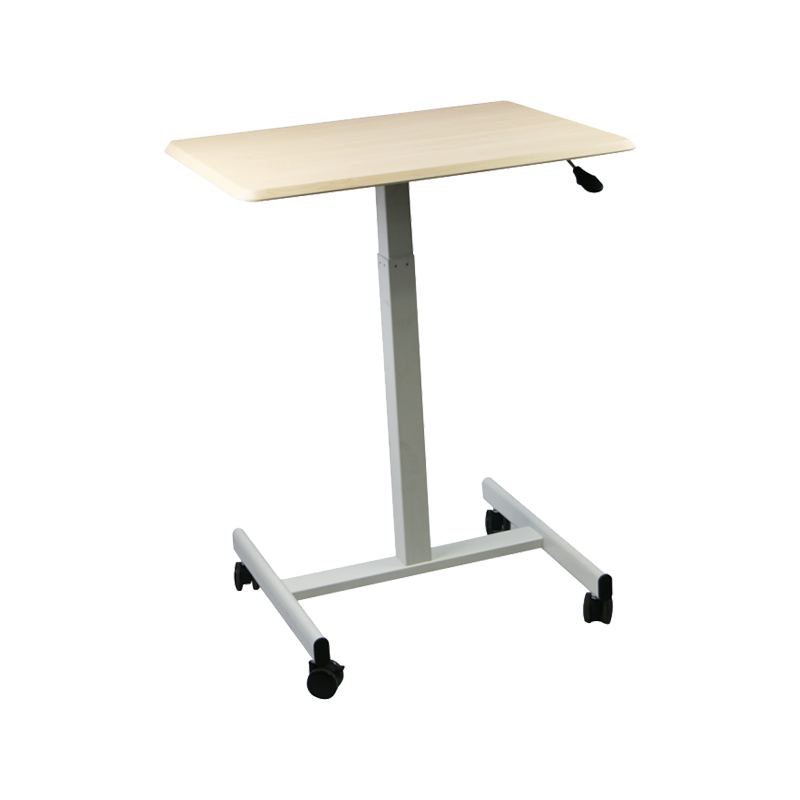
SK03 Center-Mounted Pneumatic Height-Adjustable Desk
6. Ergonomic Benefits of a Sit-Stand Work Surface
The purpose of an adjustable desk is not simply to provide more height settings. Its broader value lies in helping users vary their posture and working position. Remaining seated for a long period can contribute to discomfort, while standing continuously can also create fatigue. Alternating between positions allows users to respond to the demands of different tasks and personal preferences.
The SK03’s 745mm to 1060mm adjustment range supports a variety of working positions. A lower setting can be used with a conventional chair for typing, reading, or computer work. A higher setting can support standing computer use, short meetings, demonstrations, or tasks that benefit from a more elevated surface.
Correct setup remains important. When seated, the user should aim for a relaxed shoulder position, a comfortable elbow angle, and a viewing height that does not require excessive neck bending. When standing, the desk should be high enough to avoid persistent shoulder elevation but low enough to allow relaxed arm positioning. The ideal height differs between users, so a broad adjustment range is more useful than a single preset height.
Height variation should be introduced gradually. A user who is accustomed to sitting all day may benefit from short standing intervals rather than immediate prolonged standing. Footwear, floor conditions, task type, and personal health considerations should also be taken into account.
An adjustable desk is not a substitute for movement. Users should still take brief breaks, change position, walk when possible, and use suitable seating. The SK03 is best understood as a tool that makes posture variation easier and more convenient throughout the workday.
The compact tabletop also encourages users to keep the active work area focused. A laptop, monitor, documents, and essential accessories can be arranged without creating an oversized surface that encourages unnecessary storage. In shared environments, this can support a more organized workstation culture.
7. Advantages Compared with Conventional Fixed Desks
A fixed desk normally provides one working height for every user. If several people use the same desk, some may find it too high or too low. The SK03 addresses this problem through mechanical height adjustment, allowing different users to personalize the surface without changing the entire workstation.
Fixed desks also limit the range of activities that can be performed comfortably. A seated desk may be unsuitable for standing presentations or short collaborative discussions. With the SK03, the tabletop can be raised for activities that require a standing posture, then lowered again for seated work.
Mobility is another important distinction. A conventional fixed desk may be heavy or difficult to move, especially when it is connected to other furniture. The SK03’s caster system allows it to be repositioned more easily, which can reduce the time required to reorganize a room.
The SK03 may also provide a more efficient use of floor space. Instead of maintaining separate seated and standing stations, one adjustable unit can serve multiple purposes. This can be valuable for small offices, home work areas, classrooms, and facilities where every square meter must support several functions.
8. Advantages Compared with Electric Adjustable Desks
Electric height-adjustable desks are widely used and can offer convenient push-button adjustment, memory presets, and support for larger work surfaces. However, they also require electrical components and a suitable power connection. The SK03 offers a different value proposition based on pneumatic lifting.
The first difference is infrastructure. A pneumatic desk can be adjusted without plugging in a motor system. This makes it suitable for locations where electrical outlets are limited or where a clean, cable-free appearance is preferred. It can also be moved without having to disconnect a power cable.
The second difference is mechanical simplicity. An electric desk may contain motors, control boxes, wiring, switches, and electronic protection components. The SK03 relies on a gas spring mechanism, a frame, and a manual operating interface. Fewer electrical parts can simplify product handling and reduce concerns related to cable damage or controller replacement.
The third difference is portability. A compact pneumatic unit can be especially convenient in rooms that are frequently reconfigured. Although the weight and handling requirements of every desk must be considered, the absence of a power cable removes one obstacle during relocation.
Electric desks remain advantageous when users need very frequent powered adjustment, programmable heights, or large desktop capacities. The SK03 is more appropriate when buyers prioritize compactness, mechanical simplicity, mobility, and independence from a powered lifting system.
9. Advantages Compared with Basic Manual Desks
Basic manual desks may use fixed legs or require the user to remove bolts and reposition a frame. These solutions can be economical, but they are often inconvenient for frequent adjustment. If changing the height requires tools, the desk is unlikely to be adjusted regularly.
The SK03’s gas spring system is designed for operational ease. Users can change the height as part of their normal workflow instead of treating adjustment as a major maintenance task. This encourages more practical use of the sit-stand function.
The caster system also gives the SK03 an advantage over many basic manual products that are designed to remain stationary. The combination of adjustment and mobility makes it a more flexible choice for dynamic work environments.
10. Manufacturing Strengths and Product Development Capabilities
The manufacturer of the SK03 is a professional enterprise engaged in the research and development, production, sales, and service of standing desks. This full product-oriented structure is important because a successful adjustable desk requires more than isolated component production. It requires coordination between design, material selection, mechanical performance, surface treatment, assembly, inspection, packaging, and customer support.
The company is located in Suzhou, within the Yangtze River Delta, one of China’s important industrial and furniture-manufacturing regions. The area benefits from a mature industrial network, established logistics, skilled manufacturing resources, and access to supporting suppliers. These regional advantages can help a manufacturer coordinate metalwork, tabletop materials, coatings, casters, gas spring systems, packaging, and related components.
The company’s stated focus on intelligent manufacturing is relevant to the development of modern office furniture. Intelligent manufacturing can support repeatable production processes, more consistent assembly, improved production planning, and better coordination between design requirements and manufacturing execution. For adjustable furniture, consistency is particularly important because the user experience depends on accurate alignment, smooth operation, stable connections, and reliable finishing.
Research and development also play an important role. A pneumatic height-adjustable desk must be designed around the relationship between tabletop dimensions, frame geometry, gas spring force, user operation, caster placement, and expected working conditions. Product development teams must consider not only appearance but also balance, usability, transport, assembly, and long-term service requirements.
The company’s ability to offer several panel colors demonstrates attention to market adaptability. Customers in different regions and sectors may have different preferences for wood-inspired finishes, neutral colors, or modern monochrome interiors. A flexible product platform can help serve office furniture distributors, project contractors, commercial fit-out companies, and institutional buyers.
Customization is another potential strength for a professional furniture manufacturer. Depending on project requirements, customization may involve dimensions, finishes, packaging, labeling, component selection, or other product details. Any customization should be evaluated against structural performance, production feasibility, quality requirements, and applicable market standards.
Manufacturing strength should ultimately be judged by the consistency of finished products. For the SK03, relevant quality considerations include tabletop flatness, surface appearance, frame alignment, caster installation, gas spring operation, fastener security, adjustment smoothness, and packaging protection. A disciplined production process can help reduce variation and support reliable delivery for larger orders.
11. A Practical Quality-Control Perspective
Quality control for a height-adjustable desk begins with incoming materials. MDF panels should be checked for dimensions, surface condition, and suitability for finishing. PVC materials should be inspected for color consistency, surface defects, and bonding or forming quality. Iron components should be checked for dimensions, weld or connection integrity, and surface preparation before powder coating.
Powder coating quality depends on appropriate surface preparation, coating coverage, curing, and handling. A consistent coating helps produce a professional appearance and supports resistance to ordinary wear. Finished components should be protected during assembly and packaging to prevent scratches or impact damage.
The gas spring is a critical functional component. Its force characteristics must be compatible with the tabletop and frame configuration. Assembly should ensure correct orientation and secure connection. Functional testing can confirm whether the desk raises and lowers smoothly and whether the adjustment interface operates as intended.
Casters should be checked for correct installation and free rotation. Locking casters require particular attention because the locking function must engage and release correctly. A desk that moves easily but cannot be stabilized properly would not meet the practical needs of its intended users.
Final inspection should consider both appearance and operation. The tabletop should be visually consistent, the frame should be aligned, fasteners should be secure, and the product should be stable when placed on a suitable floor. Packaging inspection is also important because furniture can be exposed to vibration, compression, and handling during transportation.
12. Applications in Different Environments
Home Offices
In a home office, space is often limited and furniture may need to serve more than one purpose. The SK03 can function as a compact personal desk, a standing laptop station, or a temporary work surface. Its caster system allows it to be moved when the room needs to support another activity.
Professional Offices
In a professional office, the desk can support individual work, short meetings, or touchdown areas. The height range allows employees to adjust the surface according to their preferences, while the color options make it easier to coordinate with existing office furniture.
Training Rooms
Training rooms frequently require flexible layouts. Desks may be arranged in rows, clusters, or open configurations depending on the course. The SK03 can be moved and repositioned more easily than a heavy fixed desk, and its height can be adjusted for instruction, demonstrations, or group activities.
Laboratories
Laboratories often require work surfaces that support different users and tasks. The compact design can be useful where equipment and circulation paths must be carefully managed. Users should confirm that the tabletop material, cleaning procedures, and load capacity are appropriate for the specific laboratory environment before selection.
Creative Studios
Creative studios can benefit from work surfaces that change with the task. A lower position may support digital design or writing, while a higher position may help with sketching, reviewing samples, or presenting materials. The mobile base allows the desk to participate in changing studio layouts.
Healthcare and Service Areas
In suitable non-clinical areas, the desk may support reception work, administrative tasks, consultation preparation, or temporary documentation stations. The surface and frame should be maintained according to the cleaning and hygiene requirements of the facility.
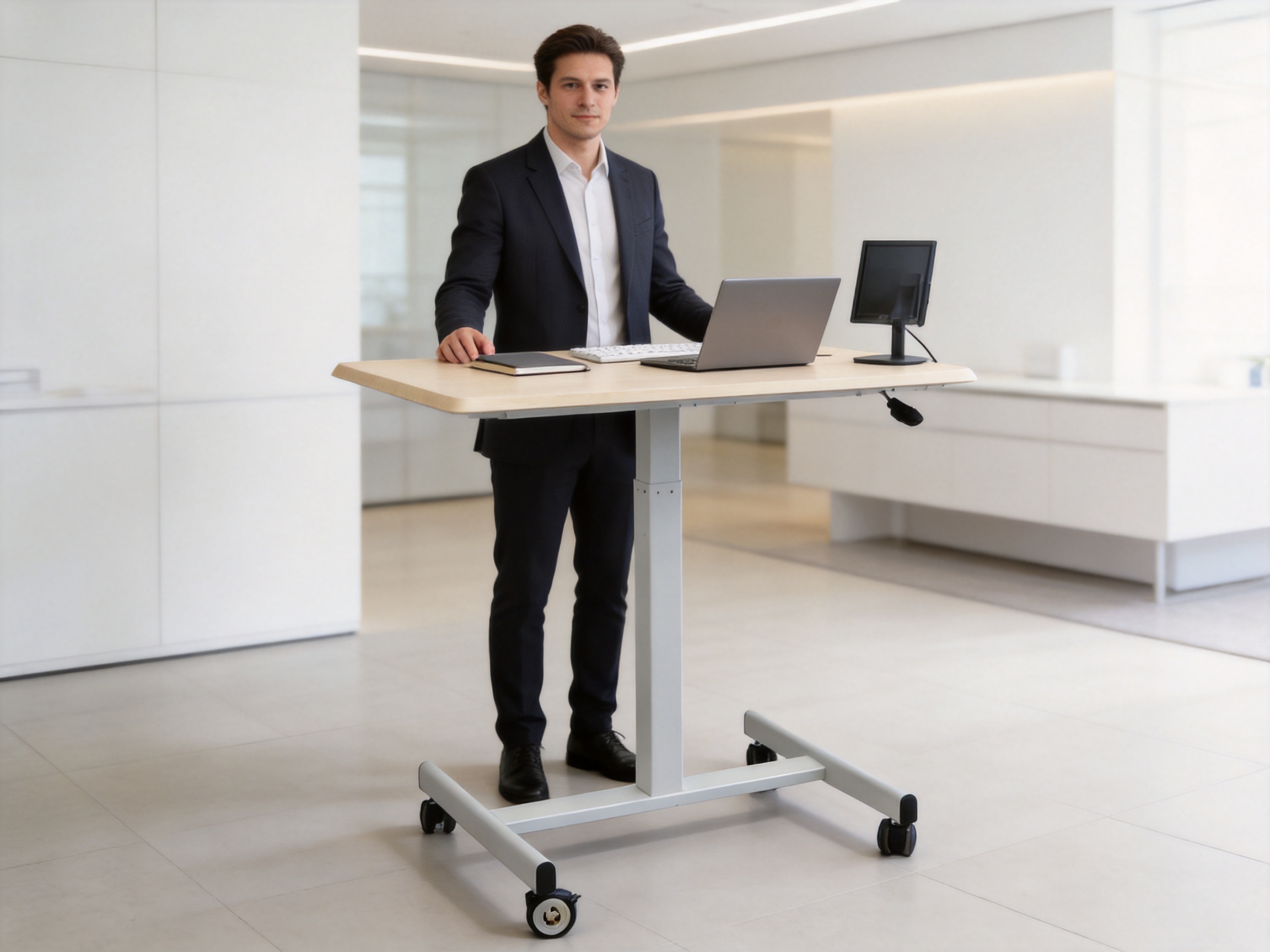
13. Installation and Daily Use Recommendations
The desk should be assembled on a clean, level surface using the appropriate tools and hardware. Users should follow the supplied assembly instructions and avoid forcing connections that do not align naturally. Correct assembly is essential for stability, smooth adjustment, and long-term performance.
After assembly, all visible fasteners should be checked. The tabletop should be firmly connected to the supporting frame, and the casters should be securely installed. Before placing equipment on the desk, the adjustment system should be operated through its available range to confirm that movement is smooth and unobstructed.
When raising or lowering the desk, users should keep hands, cables, and other objects away from moving areas. Equipment should be positioned so that it does not catch on nearby furniture, walls, or floor obstacles. Because the tabletop changes position, users should also consider the length and routing of any cables connected to devices.
The desk should not be used as a step, ladder, or leaning support. Heavy loads should not be concentrated at one edge. A balanced arrangement helps protect the tabletop, frame, gas spring, and casters.
Before moving the desk, the tabletop should be cleared of unstable objects. The caster locks should be released, and the desk should be pushed rather than pulled whenever practical. After relocation, the unit should be placed on a stable surface and the locking casters should be engaged.
14. Maintenance and Service Considerations
Routine maintenance for the SK03 is straightforward but should not be neglected. The tabletop can be cleaned with a soft cloth and a mild solution. Abrasive pads, harsh solvents, and excessive moisture should be avoided because they may affect the PVC surface or finish.
The frame should be inspected periodically for scratches, corrosion, loose fasteners, or signs of deformation. Powder coating provides a protective finish, but deep damage should be addressed promptly to reduce the possibility of further deterioration.
The casters should be checked for hair, dust, threads, or other debris that may affect rotation. Locking mechanisms should be tested periodically. If a caster does not lock securely, the desk should not be relied upon in a position where unintended movement could create a safety concern.
The gas spring and related adjustment parts should be kept clean and should not be dismantled by unqualified users. If adjustment becomes uneven, unusually difficult, or unstable, the desk should be taken out of service until it has been inspected by an appropriate service professional or supplier.
Commercial buyers should establish a simple inspection schedule. High-use environments may require more frequent checks than private home offices. Records of inspections, repairs, and replacement parts can help facility managers maintain consistent performance across multiple units.
15. Selecting the Right Desk for a Project
Before ordering the SK03, buyers should evaluate the intended user group, room dimensions, floor conditions, equipment requirements, and frequency of relocation. The 650mm by 480mm tabletop is compact, so it is best suited to focused personal work rather than large quantities of equipment.
Buyers should also consider the desired ratio of seated to standing work. If users need programmable electric presets, very large surfaces, or heavy-duty powered lifting, an electric linear actuator desk may be more appropriate. If they need a simple, mobile, and manually operated workstation, the pneumatic SK03 may be a better fit.
Color selection should be based on the surrounding interior, cleaning requirements, and visual identity of the facility. White and Black provide neutral contemporary options, while Maple and Walnut offer wood-inspired alternatives.
For larger projects, purchasers should ask about packaging, assembly requirements, delivery schedules, replacement components, customization possibilities, and after-sales service. A professional manufacturer should be able to clarify the product configuration and support process before an order is finalized.
16. Comparison Table for Purchasing Decisions
| Evaluation Point | SK03 Pneumatic Desk | Fixed Desk | Electric Adjustable Desk |
|---|---|---|---|
| Height adjustment | Manual gas spring adjustment from 745mm to 1060mm | Usually fixed at one height | Powered adjustment, often with controls |
| Power requirement | No power connection required for lifting | No power connection required | Normally requires electrical power |
| Mobility | Four casters, including two locking casters | Varies; many models are stationary | Varies by model |
| Tabletop size | Compact 650mm by 480mm surface | Available in many sizes | Often available with larger surfaces |
| Adjustment complexity | Mechanical and direct | No adjustment or tool-based adjustment | Electronic or motorized |
| Best suited for | Flexible, compact, mobile workstations | Stable single-height work areas | Frequent powered adjustment and larger workstations |
| Visual options | White, Maple, Walnut, and Black panels | Depends on supplier | Depends on supplier |
17. Why the SK03 Is a Competitive Choice
The SK03 competes through a combination of features rather than a single specification. Its main advantage is the balance between height adjustability, compactness, mobility, and mechanical simplicity. Some desks offer adjustment but lack mobility. Others provide mobility but remain fixed in height. Electric models may offer advanced controls but require power and may include more components than a project requires.
The center-mounted structure gives the product a clean form and a concentrated support layout. The pneumatic gas spring provides an accessible alternative to electric lifting. The tabletop dimensions make the unit suitable for environments where space efficiency matters. The four casters support relocation, while the two locks help stabilize the desk after movement.
Material selection also contributes to its market position. The iron frame provides a solid structural foundation, powder coating supports a durable finished appearance, and the MDF/PVC tabletop construction provides multiple visual options. These characteristics allow the desk to serve both practical and design-oriented purchasing requirements.
Another competitive factor is the manufacturer’s positioning as a dedicated standing-desk enterprise rather than a general trading company. Research, production, sales, and service capabilities can provide stronger coordination across the product life cycle. For distributors and project buyers, this may make communication, customization, quality feedback, and after-sales support more efficient.
The best product choice always depends on the application. The SK03 is not intended to replace every type of adjustable desk. Its strengths are most apparent when a buyer needs a compact tabletop, pneumatic adjustment, mobile operation, a clean design, and a choice of surface finishes without relying on a powered lifting system.
18. Frequently Asked Questions
What type of desk is the SK03?
The SK03 is a center-mounted pneumatic height-adjustable desk. It uses a gas spring lifting mechanism and is designed for seated and standing work positions.
What is the height adjustment range?
The desk adjusts from 745mm to 1060mm. This range supports seated work, standing work, presentations, demonstrations, and other flexible work modes.
Does the desk require electricity?
No electrical connection is required for the pneumatic lifting function. The desk uses a gas spring mechanism rather than an electric motor and control system.
What are the tabletop dimensions?
The tabletop measures 650mm by 480mm and has a thickness of 15mm. It is designed as a compact personal work surface.
What is the tabletop made of?
The tabletop uses 15mm MDF with a PVC vacuum-formed surface. This construction provides a consistent base and a finished decorative exterior.
Which colors are available?
The available panel colors are White, Maple, Walnut, and Black. These options allow the desk to coordinate with modern, traditional, neutral, or high-contrast interiors.
Can the desk be moved?
Yes. The desk has four cast wheels. Two wheels include locking mechanisms, while two do not. The locks should be engaged after the desk is positioned.
Where can the SK03 be used?
Typical applications include home offices, professional workstations, training rooms, laboratories, creative studios, and other areas that require a compact and adaptable work surface.
Is the desk suitable for a large monitor setup?
The 650mm by 480mm tabletop is compact. It can support a focused equipment arrangement, but buyers should confirm the dimensions and weight of their monitor, computer, accessories, and other equipment before ordering.
How should the surface be cleaned?
The surface can generally be cleaned with a soft cloth and mild cleaning solution. Abrasive materials, harsh chemicals, excessive water, and prolonged liquid exposure should be avoided.
What should buyers consider before ordering multiple units?
Buyers should review room dimensions, floor conditions, intended equipment, user requirements, color preferences, assembly procedures, packaging, delivery planning, replacement parts, and after-sales service arrangements.
What makes the manufacturer suitable for project orders?
The manufacturer focuses on the research and development, production, sales, and service of standing desks. Its location in Suzhou provides access to a developed industrial and furniture supply chain, while its intelligent manufacturing orientation supports coordinated product development and production.
19. Conclusion
The SK03 center-mounted pneumatic height-adjustable desk is designed for organizations and individuals seeking a practical alternative to fixed desks and powered electric workstations. Its 745mm to 1060mm lifting range supports changes between seated and standing work. Its gas spring mechanism provides mechanical adjustment without requiring a power connection. Its compact 650mm by 480mm tabletop is appropriate for focused personal work, while its four casters support relocation in dynamic environments.
The iron frame, powder-coated finish, MDF tabletop, PVC vacuum-formed surface, and multiple panel colors combine structural utility with visual flexibility. The two locking casters add control after movement, making the desk suitable for offices, training rooms, laboratories, studios, and home workspaces.
From a manufacturing perspective, the product benefits from a company focused on standing-desk research, production, sales, and service. Its Suzhou location places it within a strong furniture and industrial manufacturing region, and its intelligent manufacturing orientation supports the consistency, coordination, and customization expected in modern office-furniture supply.
For buyers comparing adjustable desks, the SK03 is most compelling when the priorities are compactness, mobility, pneumatic operation, straightforward maintenance, and a clean professional appearance. It provides a balanced solution for users who need their work surface to adapt not only in height, but also to changing rooms, tasks, and working styles.
References
1. Product specification sheet for the SK03 Center-Mounted Pneumatic Height-Adjustable Desk, including dimensions, materials, lifting range, caster configuration, colors, and operating principle.
2. Manufacturer-provided company profile for SuZhou Skyhone Intelligent Technology Co., Ltd., including its research and development, production, sales, and service activities.
3. General principles of ergonomic workstation design and posture variation for seated and standing work environments.
4. General technical literature on gas spring mechanisms, pneumatic lifting assistance, and manually adjustable furniture systems.
5. General furniture manufacturing guidance concerning MDF panels, PVC surface forming, iron frames, powder coating, caster systems, and routine product inspection.
Product: SK03 Center-Mounted Pneumatic Height-Adjustable Desk


- Contact Info
-
-
 Phone+86-15950656125
-
 Email
-
 AddressRoom 1007-1, South Building, Suyue Plaza, Suzhou Industrial Park, Suzhou City, Jiangsu Province, China
-
- Products
- Follow Us
- Need help? Please contact us
Copyright ©
SuZhou Skyhone Intelligent Technology Co., Ltd.
All Rights Reserved.
Privacy
Custom Ergonomic Adjustable Office Tables Manufacturers

