

 English
  русский
  Español
  عربى
عربى 
Content
- 1 Product Overview: A Compact Pneumatic Desk Built for Daily Flexibility
- 2 Key Specifications
- 3 Ergonomic Value in Contemporary Work Environments
- 4 Advantages Over Conventional Fixed-Height Desks
- 5 Advantages Over Electric Height-Adjustable Desks
- 6 Aluminum Tube Column Design and Structural Benefits
- 7 Tabletop Construction: MDF Core and PVC Vacuum-Formed Surface
- 8 Mobility and Stability: Why the Caster Configuration Matters
- 9 Applications in Offices, Training Rooms, Laboratories, and Homes
- 10 Manufacturing Strengths Behind the Product
- 11 Advanced Production Processes and Quality Considerations
- 12 Customization and Product Adaptability
- 13 Competitive Positioning: Practical Performance Rather Than Unnecessary Complexity
- 14 User Experience: From Unboxing to Daily Operation
- 15 Maintenance, Cleaning, and Long-Term Care
- 16 Sustainability and Workplace Efficiency
- 17 Why Buyers Should Consider This Product
- 18 Q&A Section
- 18.1 What is the height adjustment range of the desk?
- 18.2 Does the desk require electricity?
- 18.3 What is the tabletop made of?
- 18.4 What tabletop colors are available?
- 18.5 Is the desk easy to move?
- 18.6 What environments is this desk suitable for?
- 18.7 How does it compare with an electric standing desk?
- 18.8 How does the product reflect manufacturing quality?
- 18.9 Who manufactures the desk?
- 18.10 Why choose a pneumatic height-adjustable desk instead of a fixed desk?
- 19 Conclusion
- 20 References
- 21 Product: TH08 (Aluminum Tube Column) Pneumatic Height-Adjustable Desk
Aluminum Column Pneumatic Height-Adjustable Desk for Flexible Workspaces
2026-07-13
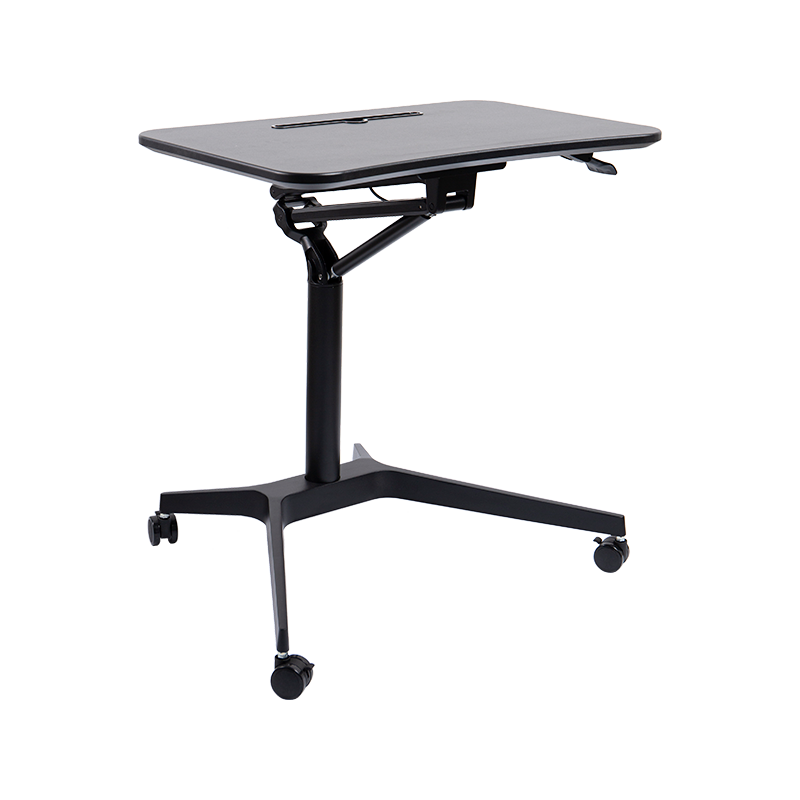
Modern workplaces increasingly demand furniture that can adapt to changing tasks, different users, and healthier working habits. The TH08 Aluminum Tube Column Pneumatic Height-Adjustable Desk is designed for exactly this purpose: a compact, mobile, manually adjustable work surface that allows users to transition between seated and standing postures without depending on electrical power. With a gas spring lifting mechanism, a 700 mm to 1120 mm height range, a durable MDF tabletop with PVC vacuum-formed surface, and a stable aluminum-and-iron support structure, this desk is suitable for offices, training areas, laboratories, home workstations, and shared work environments.
Unlike large electric standing desks that often require fixed installation, cable routing, and access to a power socket, this pneumatic height-adjustable desk emphasizes mobility and simplicity. Its stand-alone aluminum column design gives it a clean, professional appearance while keeping the footprint practical for daily movement. Four casters, including two lockable wheels, make it easy to reposition the desk and then secure it during use. For organizations seeking flexible office layouts, classrooms, temporary workstations, or multi-user collaboration zones, this product offers a balanced combination of ergonomic adjustment, mobility, durability, and ease of maintenance.
The product also reflects the manufacturing strengths of SuZhou Skyhone Intelligent Technology Co., Ltd., a professional enterprise engaged in the research, development, production, sales, and service of standing desks and related intelligent office solutions. Located in Suzhou, within the industrially developed Yangtze River Delta region, the company benefits from a mature furniture and metal-processing supply chain, efficient logistics, and strong manufacturing support. This background helps the company deliver adjustable desk products that combine practical structure, consistent finishing, reliable adjustment mechanisms, and user-oriented design.
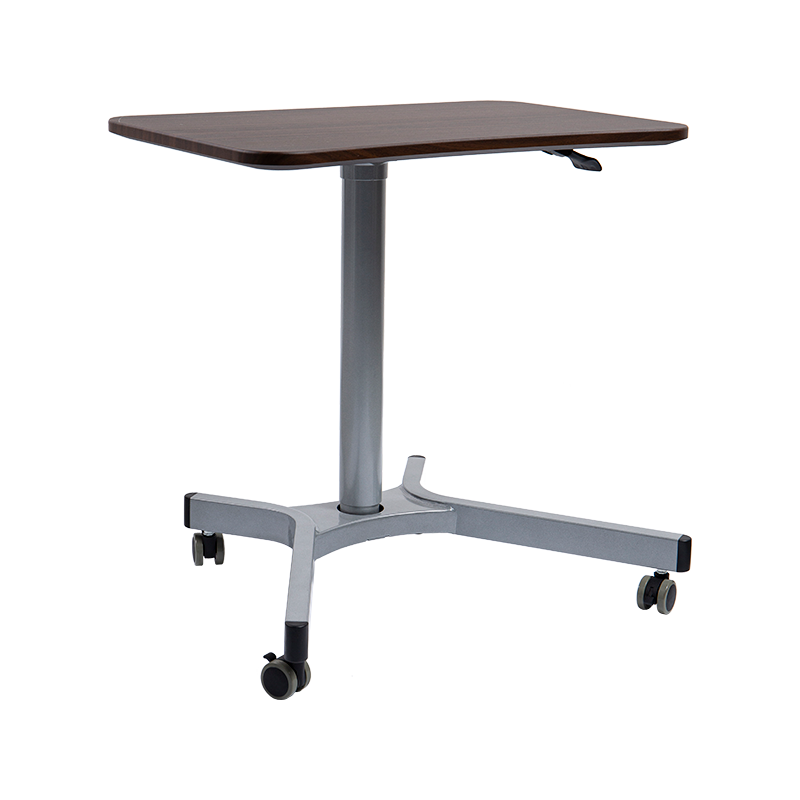
TH08 (Aluminum Tube Column) Pneumatic Height-Adjustable Desk
Product Overview: A Compact Pneumatic Desk Built for Daily Flexibility
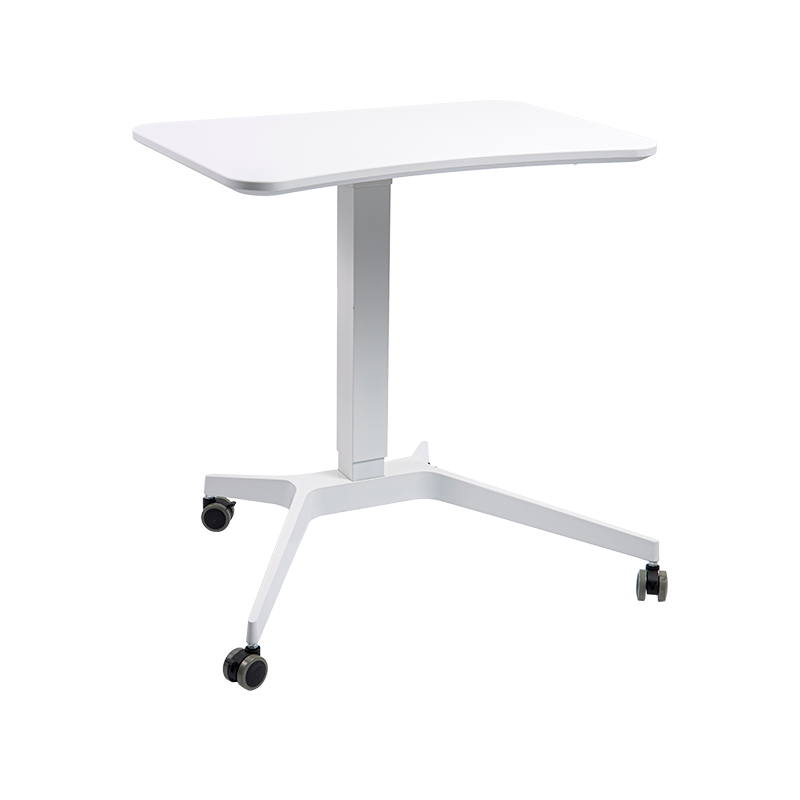
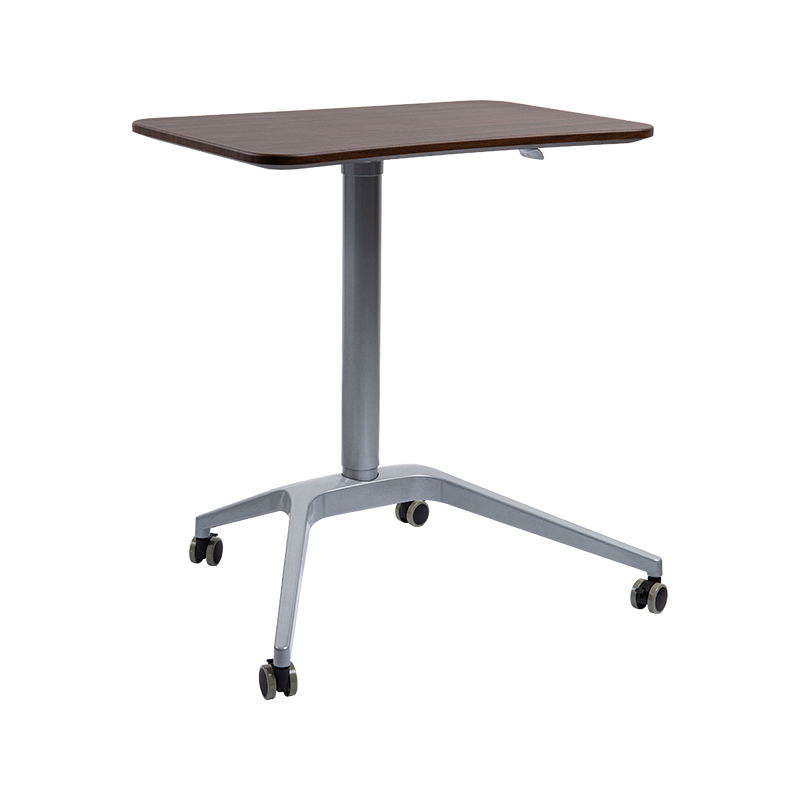
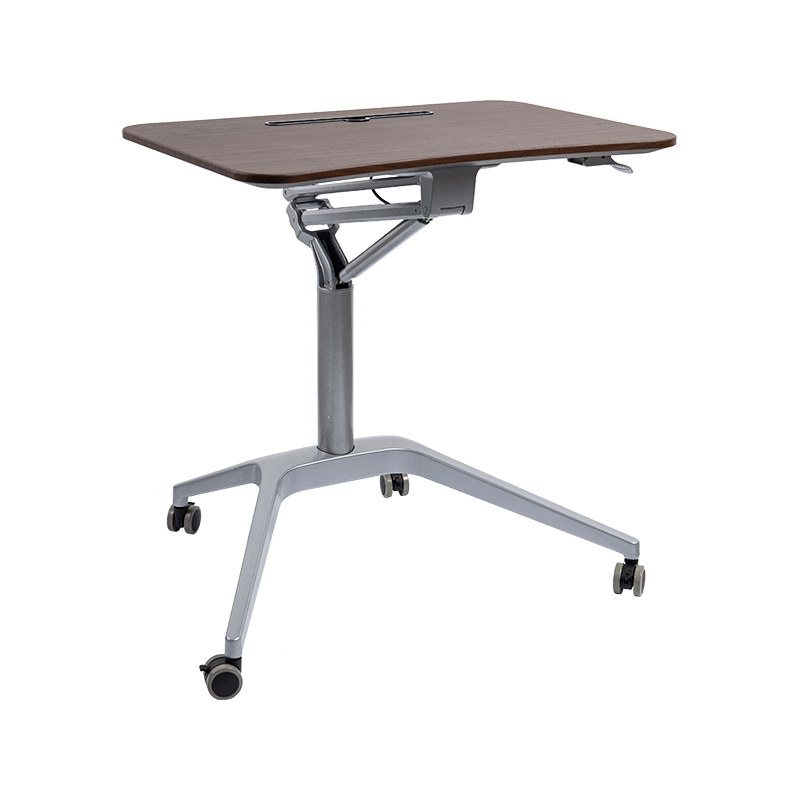
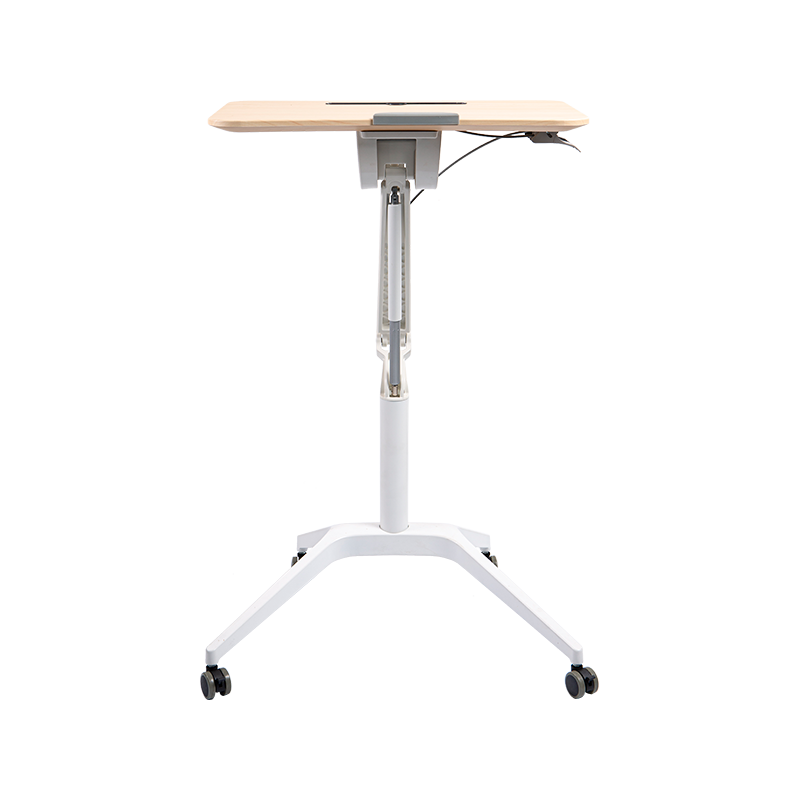
The TH08 is a pneumatic height-adjustable table with a distinctive aluminum tube column. Its tabletop measures 715 mm by 475 mm with a thickness of 25 mm, making it compact enough for limited spaces while still large enough for a laptop, documents, small equipment, or training materials. The desktop uses MDF as the substrate and a PVC vacuum-formed surface film, available in Maple, Walnut, and Black finishes. This combination provides a smooth appearance, straightforward cleaning, and practical resistance to everyday scratches and stains.
The main support structure combines aluminum and iron. Aluminum contributes to a refined appearance and favorable strength-to-weight characteristics, while iron components enhance structural support where additional rigidity is needed. The frame is finished in a uniform silver powder coating, offering a modern visual style that fits professional office interiors, home offices, laboratories, and education spaces. Powder coating also contributes to surface durability, corrosion resistance, and a cleaner, more consistent finish compared with basic painted surfaces.
The central functional feature of the desk is its gas spring lifting system. The lifting range extends from 700 mm to 1120 mm, enabling use in both seated and standing positions. Because the adjustment is pneumatic and manually controlled, users can raise or lower the work surface without an electric motor. This makes the desk especially useful where power access is limited, where quiet operation is preferred, or where furniture needs to be moved frequently between rooms.
The base includes four caster wheels: two with locking functions and two without locks. This configuration provides a balance between movement and stability. Users can roll the desk into position, lock two casters, and create a more secure work surface for typing, writing, presenting, or handling tools. For training rooms, multi-purpose offices, and clinical or laboratory environments where layouts may change often, this feature adds significant practical value.
Key Specifications
Item |
Specification |
Practical Benefit |
Lifting Range |
700 mm to 1120 mm |
Supports seated, standing, and transitional working postures. |
Tabletop Dimensions |
715 mm x 475 mm x 25 mm |
Compact footprint suitable for laptops, documents, and mobile work. |
Tabletop Material |
25 mm MDF with PVC vacuum forming |
Smooth, easy-to-clean surface with practical daily durability. |
Main Material |
Aluminum and iron |
Combines clean appearance with structural strength. |
Surface Color |
Silver |
Modern neutral finish suitable for professional interiors. |
Surface Treatment |
Powder coating |
Improves surface consistency, wear resistance, and finish quality. |
Casters |
Two with locks and two without locks |
Allows easy movement and stable positioning during work. |
Panel Colors |
Maple, Walnut, Black |
Provides design flexibility for different workspace styles. |
Working Principle |
Gas spring lifting |
Enables manual stepless height adjustment without electricity. |
Ergonomic Value in Contemporary Work Environments
Work habits have changed substantially in offices, educational institutions, and home environments. Many users now understand that remaining seated for long periods can lead to discomfort, reduced circulation, and lower concentration. A height-adjustable desk helps users alternate between sitting and standing, making movement a natural part of the working day. The TH08 supports this goal by providing a practical height range that accommodates multiple working modes.
The 700 mm lower height is appropriate for many seated tasks, particularly when paired with a suitable chair. The 1120 mm upper height allows a user to stand while typing, reading, presenting, demonstrating equipment, or discussing work with colleagues. Because the adjustment is stepless, users are not restricted to a small number of fixed height settings. Instead, they can fine-tune the surface position according to body height, task type, footwear, chair style, and personal comfort.
This fine adjustability is especially useful in shared spaces. In a training room, one desk may be used by several instructors throughout the day. In a laboratory, different technicians may use the same mobile workstation. In a home office, the same table may serve as a laptop station, writing surface, craft table, or temporary standing desk. A pneumatic height-adjustable mechanism enables quick changes without complex controls or electrical programming.
Ergonomics is not only about posture; it is also about reducing friction in everyday workflow. If a desk is difficult to adjust, users may leave it in one position and lose the benefits of sit-stand working. The gas spring system makes adjustment direct and accessible. Users can change height quickly, encouraging more frequent posture variation. This simplicity gives the TH08 a meaningful advantage over products that look ergonomic on paper but are inconvenient in daily use.
Advantages Over Conventional Fixed-Height Desks
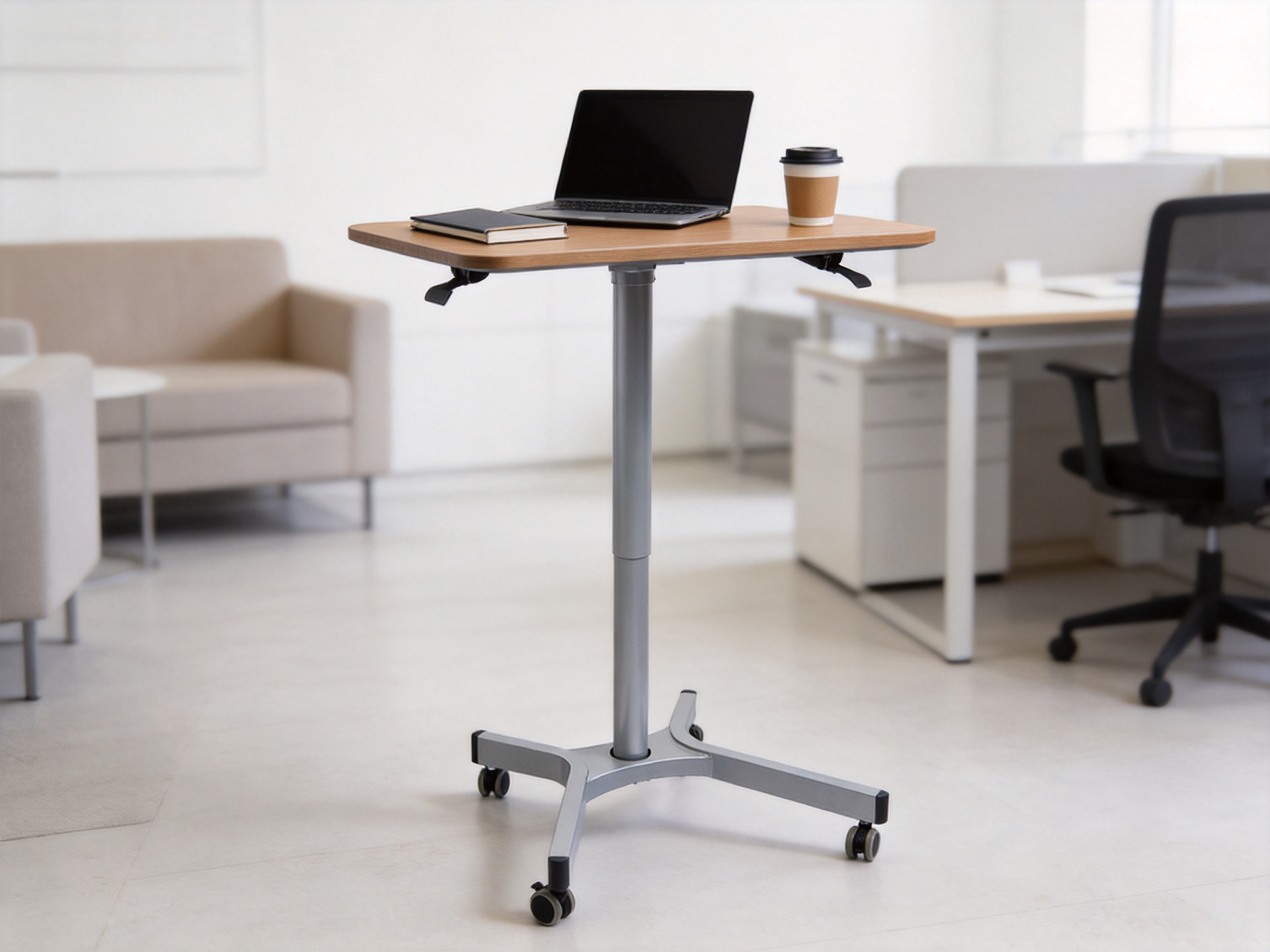
Traditional fixed-height desks remain common because they are simple and familiar, but they cannot adapt to changing user needs. A fixed desk is usually designed around a standard seated height. If the user is taller, shorter, or performing a task that requires standing, the furniture may become uncomfortable or inefficient. The TH08 solves this limitation with a broad lifting range and manual stepless positioning.
Another limitation of fixed desks is layout inflexibility. Many conventional desks are heavy, stationary, and difficult to move without assistance. The TH08 includes integrated casters, allowing one person to reposition the desk when room arrangements change. This is useful in training sessions, temporary project spaces, workshops, clinics, showrooms, and home offices where the work surface may need to move between locations.
Fixed desks can also consume more floor space than necessary. The TH08’s compact tabletop and single-column structure make it a space-efficient alternative. It can serve as a laptop desk, presentation stand, mobile lectern, auxiliary workstation, or equipment table without occupying the same space as a full-size office desk. For organizations that need multiple flexible work points, compact pneumatic desks can be deployed more easily than large fixed tables.
From a facility management perspective, a non-electric adjustable desk reduces installation complexity. There are no motors to wire, no power cords to route, and no control panels to maintain. This can reduce both setup time and potential points of failure. For environments that value simplicity and reliability, the pneumatic system offers a practical advantage.
Advantages Over Electric Height-Adjustable Desks
Electric standing desks are valuable in many office settings, especially when large tabletops and programmable memory positions are required. However, not every application requires an electric system. In mobile, compact, or shared environments, pneumatic height adjustment may be more suitable. The TH08 provides several advantages compared with electric competitors in these specific use cases.
First, the TH08 does not require power. This makes it ideal for rooms where electrical outlets are limited or where furniture is frequently rearranged. A powered standing desk may need access to a wall socket, power strip, or floor outlet. Cables may create visual clutter or tripping concerns. A pneumatic desk avoids these issues entirely, preserving a clean workspace and allowing unrestricted movement.
Second, the adjustment mechanism is direct and intuitive. Users do not need to press electronic buttons, wait for motors, or manage memory settings. The gas spring provides assisted lifting, making height changes quick and practical. In shared or public environments, simpler operation can reduce user confusion and minimize the need for instructions.
Third, pneumatic systems can offer quieter adjustment. Electric motors, while increasingly refined, still produce mechanical sound during operation. A gas spring mechanism is well suited for libraries, classrooms, consultation spaces, training rooms, and offices where minimal disturbance is preferred. Quiet height adjustment can improve the user experience, especially when several desks are used in the same room.
Fourth, the absence of electrical components may simplify maintenance. Electric desks typically include motors, control boxes, cables, switches, and sometimes sensors. Each component adds functionality but also complexity. The TH08 focuses on mechanical reliability, making it appropriate for applications where users want a dependable adjustable work surface without electronic dependence.
Finally, pneumatic mobility can be more practical for compact desks. A large electric standing desk is often intended to remain in one position. The TH08, with its caster base, is meant to move. This difference in use philosophy is important. The TH08 is not simply a smaller standing desk; it is a flexible mobile work platform designed for dynamic spaces.
Aluminum Tube Column Design and Structural Benefits
The stand-alone aluminum tube column is one of the defining design features of the TH08. It gives the desk a neat, vertical profile and helps create a professional appearance. Aluminum is widely valued in furniture manufacturing because it offers a favorable combination of appearance, corrosion resistance, and reduced weight compared with many steel-only structures.
At the same time, the desk incorporates iron components where additional structural reinforcement is required. This combination is practical: aluminum contributes to aesthetics and manageable weight, while iron supports stability and load-bearing performance. The result is a desk that feels modern without sacrificing essential strength.
The single-column design also helps keep the underside of the tabletop open and accessible. Users can sit closer to the desk without large side frames interfering with knees or chair movement. In standing mode, the compact central support leaves the area around the base easy to approach from different directions. This is useful when the desk is used as a presentation surface, mobile teaching platform, or collaborative station.
The silver powder-coated finish adds further value. Powder coating is a dry finishing process that can produce an even, durable surface. Compared with basic liquid paint, powder coating can provide strong adhesion and improved resistance to chipping, scratches, and corrosion when properly applied. In office furniture, a consistent finish is important because surfaces are frequently touched, cleaned, and exposed to movement.
Tabletop Construction: MDF Core and PVC Vacuum-Formed Surface
The tabletop uses a 25 mm MDF substrate with PVC vacuum forming. MDF is a widely used engineered wood product known for its smooth surface and stable machining characteristics. For compact office furniture, MDF provides a reliable base that can be shaped and finished consistently. The 25 mm thickness gives the surface a solid feel while maintaining a balanced weight for a mobile product.
The PVC vacuum-formed surface film adds both visual and functional value. Vacuum forming allows the surface film to conform smoothly to the board, creating a neat finish that is suitable for daily office use. The available Maple, Walnut, and Black options cover a wide range of interior design preferences. Maple creates a brighter and more casual look, Walnut adds warmth and traditional office character, while Black offers a clean and modern style.
The laminated surface is designed for straightforward cleaning and maintenance. In training rooms or shared offices, tabletops are used by many people and may encounter pens, notebooks, laptops, cups, and cleaning products. A surface that resists common scratches and stains helps preserve appearance over time. For laboratories or technical workstations, easy cleaning is especially important because users may handle tools, samples, or accessories.
The compact dimensions of 715 mm by 475 mm make the desktop particularly suitable for laptop-based work. It provides enough space for a laptop and a small notebook or input device without encouraging excessive clutter. In many modern workflows, a compact personal work surface is more useful than a large desk that remains fixed in place. The TH08 meets this demand by combining a practical tabletop size with height adjustability and mobility.
Mobility and Stability: Why the Caster Configuration Matters
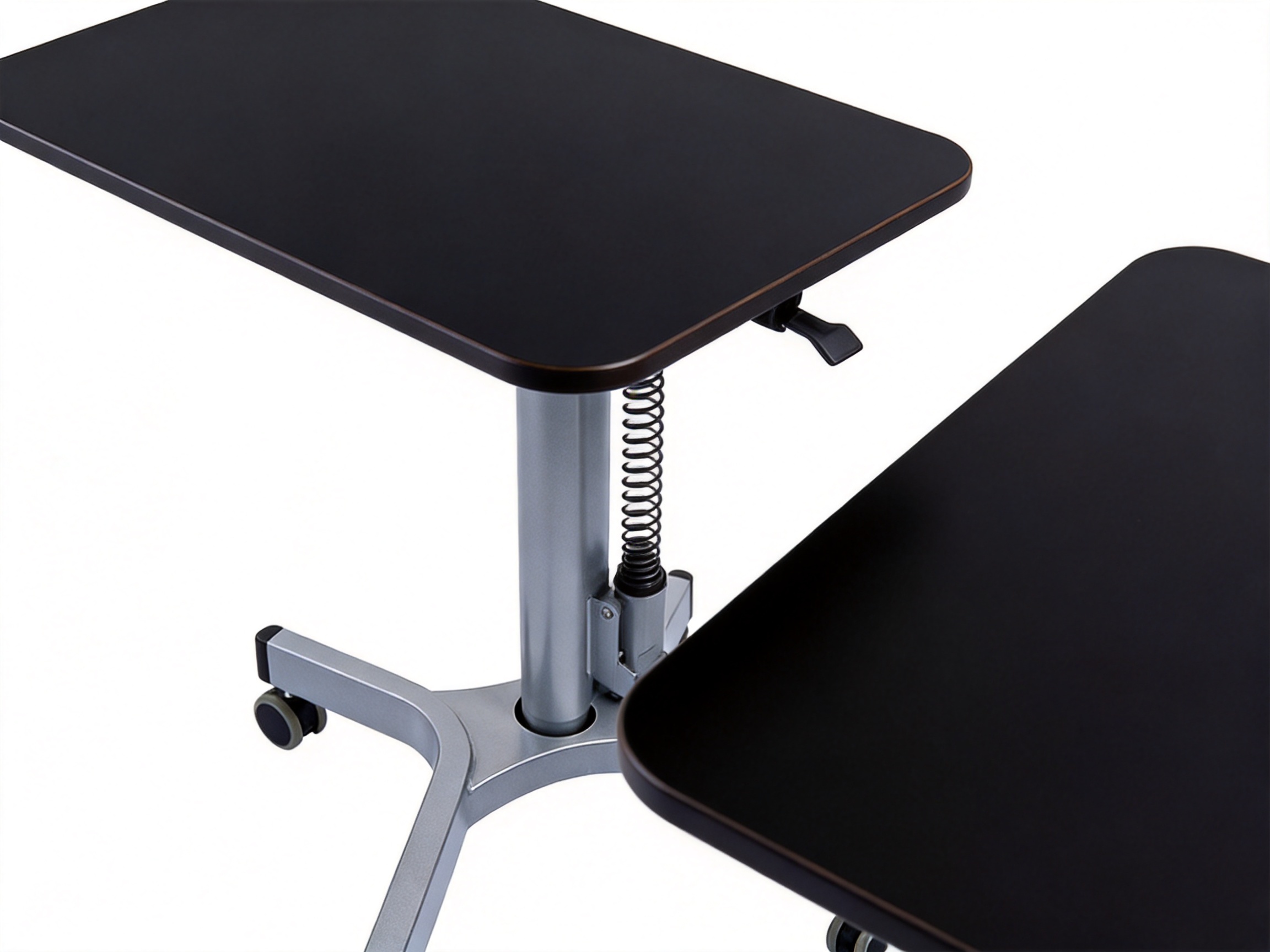
Mobility is one of the most important advantages of the TH08. Four casters allow the desk to move easily across appropriate indoor flooring. This is valuable in multipurpose rooms where furniture layout changes frequently. A training room may need rows of desks in the morning, group clusters in the afternoon, and an open presentation space later in the day. A mobile adjustable desk makes these transitions faster and easier.
The caster system includes two lockable wheels and two non-locking wheels. This arrangement is common in mobile furniture because it balances ease of movement with stationary control. When the desk needs to be moved, users can unlock the wheels and roll it to a new location. Once in position, the lockable casters can help reduce unwanted movement during use.
Compared with desks that have no wheels, the TH08 reduces the physical effort required to reorganize a workspace. Compared with lightweight carts that lack locking mechanisms, it offers improved stability after positioning. This middle ground is especially important for offices and institutions that need both flexibility and professional performance.
Mobility also supports cleaning and maintenance of the room itself. Facility staff can move the desk to clean floors, reconfigure spaces, or access wall areas. In home offices, users can shift the desk near a window, away from a doorway, or into a storage area when not in use. The caster system extends the usefulness of the desk beyond traditional office tasks.
Applications in Offices, Training Rooms, Laboratories, and Homes
In open-plan offices, the TH08 can serve as a mobile touchdown desk. Employees who do not need a permanent workstation can use it temporarily for laptop work, video calls, document review, or collaborative discussions. Its compact size allows it to fit into open zones without dominating floor space. The height-adjustable function supports both seated and standing work, making it suitable for varied daily tasks.
In training rooms, the desk can be used by instructors as a mobile lectern or teaching station. The tabletop can hold a laptop, notes, projector remote, or demonstration materials. Because the desk height can be adjusted, instructors can use it while seated or standing. The casters allow it to be moved to the front, side, or center of the room depending on the session format.
In laboratories and technical environments, the TH08 can function as an auxiliary workstation. Its adjustable height helps users position tools, instruments, or documentation at a comfortable level. The smooth laminated tabletop supports easy cleaning, while the compact footprint allows it to fit near benches, equipment, or inspection areas. The non-electric design is also useful in spaces where power outlets are reserved for instruments.
In home offices, the desk can solve several common problems. Many home workers lack space for a full standing desk. The TH08 offers a compact alternative that can be moved between rooms. It can serve as a laptop desk during work hours, a standing reading table in the evening, or a temporary study station for family members. The available tabletop colors help it blend with different home interiors.
In healthcare, consultation, and reception environments, a mobile adjustable desk may support documentation, patient interaction, or temporary equipment placement. Staff members often move between rooms and tasks, so a compact desk that adjusts quickly can improve convenience. In showrooms and commercial spaces, it can support tablets, brochures, product samples, or demonstration materials while maintaining a neat professional appearance.
Manufacturing Strengths Behind the Product
The performance of an adjustable desk depends not only on design but also on manufacturing execution. SuZhou Skyhone Intelligent Technology Co., Ltd. is positioned as a professional manufacturing enterprise deeply engaged in the research and development, production, sales, and service of standing desks. This integrated approach is important because adjustable furniture requires coordination between mechanical design, material selection, finishing, assembly, and quality control.
The company is based in Suzhou, an area with strong industrial resources and close connections to the furniture manufacturing supply chain of the Yangtze River Delta. This regional advantage supports access to metal components, surface treatment services, engineered wood materials, packaging resources, and logistics networks. A mature supply chain can improve production consistency, shorten lead times, and support customization requirements.
For a product like the TH08, manufacturing precision is essential. The aluminum column must align properly with the gas spring lifting mechanism. The base must provide balanced support. The tabletop must be securely mounted. The powder coating must be uniform, with careful surface preparation before finishing. The casters must roll smoothly and lock effectively. Each of these details contributes to the final user experience.
The company’s focus on standing desks and intelligent office space solutions also provides product development advantages. Rather than treating height-adjustable furniture as a generic metal-and-board assembly, the manufacturer can apply ergonomic thinking, stability evaluation, and usage-scenario analysis. This helps create products that are not only functional but also practical for real work environments.
Advanced Production Processes and Quality Considerations
The TH08 involves several manufacturing processes that must work together. Metal processing begins with the preparation of aluminum and iron components. Tubes, plates, brackets, and base elements need accurate cutting, forming, drilling, and assembly preparation. Dimensional consistency is especially important for adjustable furniture because misalignment can affect lifting smoothness, stability, or assembly efficiency.
Surface treatment is another critical stage. Powder coating generally requires cleaning and pretreatment of metal surfaces to improve adhesion. The powder is then applied electrostatically and cured under controlled heat. A well-managed powder coating process helps produce a uniform silver finish with improved durability. For office furniture, this finish must withstand routine handling, cleaning, and movement without quickly losing its appearance.
The tabletop production process requires careful board selection, machining, edge preparation, and PVC vacuum forming. The MDF substrate must be flat and properly processed so that the surface film adheres evenly. Vacuum forming requires control of temperature, pressure, and forming time to achieve a smooth and consistent surface. The final tabletop must then be inspected for surface quality, edge appearance, and dimensional accuracy.
The gas spring system must be selected and integrated according to the desk’s intended lifting range and operating feel. A gas spring should provide balanced assistance: strong enough to help lift the desktop but controlled enough to avoid abrupt movement. Proper assembly ensures that the mechanism functions smoothly through the 700 mm to 1120 mm range. This is a key quality point because adjustment performance directly affects user satisfaction.
Assembly quality determines whether the individual components become a reliable finished product. Fasteners must be tightened correctly. The column, base, casters, and tabletop must align. The desk should be checked for stability, smooth rolling, caster locking, surface finish, and height adjustment. A manufacturer with experience in adjustable desks is better positioned to establish inspection routines that identify issues before shipment.
Customization and Product Adaptability
Many organizations require furniture that fits specific interior designs or operational needs. The TH08 already offers practical tabletop color options: Maple, Walnut, and Black. These finishes allow buyers to coordinate the desk with different environments. Maple can suit bright educational or home spaces, Walnut can fit executive and traditional office interiors, and Black can match contemporary technical or minimalist work areas.
As a professional adjustable desk manufacturer, SuZhou Skyhone Intelligent Technology Co., Ltd. is also positioned to provide custom ergonomic adjustable office table solutions. Customization may involve color preferences, packaging requirements, project quantities, component coordination, or adaptations based on market needs. The ability to support customization is an important advantage for distributors, office furniture brands, project contractors, and institutional buyers.
Customization must be supported by manufacturing discipline. It is not enough to offer different appearances; the product must maintain consistent performance across variations. For example, any alternative tabletop finish should still provide suitable surface quality. Any packaging change should protect the product during transportation. Any structural change should preserve stability and lifting performance. A strong manufacturing system helps ensure that customization does not compromise reliability.
Competitive Positioning: Practical Performance Rather Than Unnecessary Complexity
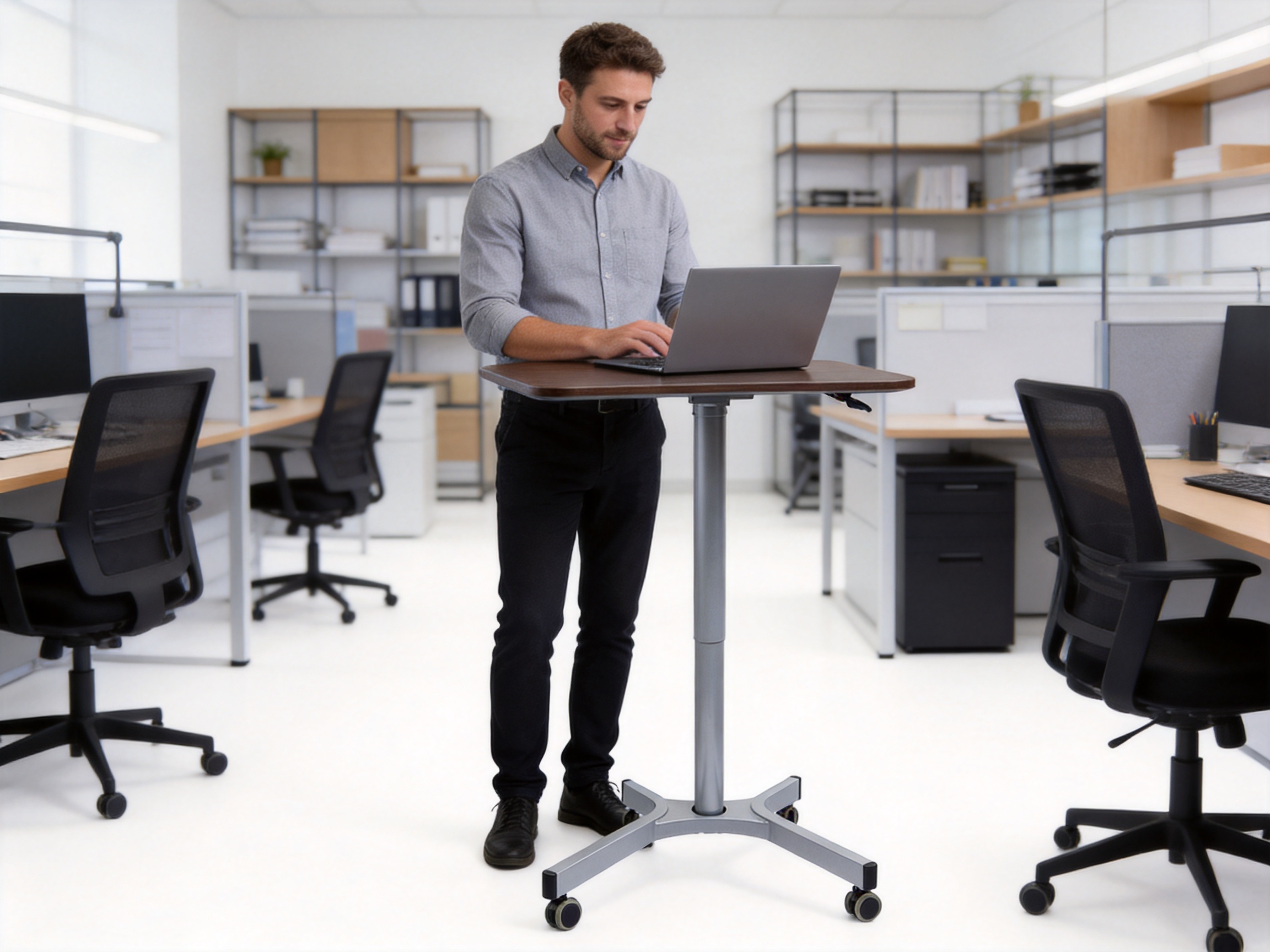
The TH08 competes in a market that includes fixed desks, electric sit-stand desks, mobile laptop carts, and simple standing work platforms. Its strongest position is among users who need height adjustment, mobility, and simplicity at the same time. Many products offer one or two of these qualities, but not all three in a balanced way.
Compared with a fixed desk, the TH08 offers ergonomic flexibility and posture variation. Compared with a large electric standing desk, it offers power-free mobility and simpler operation. Compared with a basic mobile cart, it offers a more professional structure, stepless height adjustment, and a stronger office-furniture identity. Compared with some lightweight standing platforms, it provides an integrated tabletop, column, base, and caster system in one complete product.
This practical balance is important because buyers often overestimate the value of complex features and underestimate the value of daily usability. Programmable electronic controls may be unnecessary for a mobile desk used by multiple people. Oversized tabletops may be inconvenient in small rooms. Very lightweight structures may roll easily but feel unstable during typing. The TH08 focuses on the core needs of flexible work: adjustability, mobility, sufficient stability, clean appearance, and easy maintenance.
The product’s non-electric mechanism also reduces dependence on local electrical standards. For international buyers, electrical components can introduce certification, plug type, voltage, and after-sales complexity. A pneumatic desk avoids many of these concerns. This can make the product attractive for global distribution, project purchasing, and multi-region office furniture programs.
User Experience: From Unboxing to Daily Operation
A good height-adjustable desk should be easy to understand from the first use. The TH08’s design supports this goal. The tabletop, column, base, and casters form a clear and intuitive structure. Users can identify the work surface, adjust the height, move the desk, and lock the casters without needing to learn a complex interface.
In daily use, the desk encourages natural transitions. A user may begin the morning seated at 700 mm to review emails, raise the desk for a standing video meeting, lower it for handwriting, and later move it to another room for a training session. Because the desk is not tied to a power outlet, these transitions are not limited by cable length or socket availability.
The tabletop dimensions support focused work. The surface is not so large that it becomes a storage area for clutter, but it is large enough for common office tools. This encourages a cleaner workflow, especially for laptop users. In shared spaces, a compact desk is easier to reset between users, maintaining a neat and professional environment.
The lockable casters add confidence during use. Users can position the desk, lock the wheels, and work with reduced unwanted movement. While any mobile desk should be used on suitable surfaces and within reasonable load expectations, the caster-locking system is an essential feature for practical stability.
Maintenance, Cleaning, and Long-Term Care
The TH08 is designed for straightforward maintenance. The PVC vacuum-formed tabletop surface can be cleaned with appropriate mild cleaning methods suitable for laminated furniture. Regular cleaning helps preserve appearance and hygiene, especially in shared workplaces or training rooms. Users should avoid harsh abrasives or excessive moisture, as with most laminated office furniture.
The powder-coated metal frame can be wiped to remove dust and fingerprints. Powder coating offers a durable surface, but users should still avoid dragging sharp metal objects across the finish. If the desk is used in laboratory or workshop environments, routine inspection helps identify any residue, impact marks, or loose fasteners.
The gas spring mechanism should be operated according to normal use conditions. Users should avoid forcing the desk beyond its intended height range. Smooth operation depends on proper internal pressure and alignment, so any abnormal resistance, sudden movement, or unusual sound should be checked. Periodic inspection can help maintain safe and reliable operation.
Caster maintenance is also simple but important. Wheels should be kept free of debris, thread, or dirt that may affect rolling performance. Locking mechanisms should be checked to ensure they engage and release properly. On delicate flooring, users should confirm that the casters are suitable for the surface or use protective mats where necessary.
Sustainability and Workplace Efficiency
Sustainable workplace design is not only about using particular materials; it is also about choosing furniture that remains useful across changing needs. A mobile height-adjustable desk can serve many roles over its life cycle. It can move from an office to a training room, from a home study to a workshop, or from a temporary project area to a permanent support station. This flexibility can reduce the need to purchase multiple single-purpose furniture items.
The non-electric design may also reduce energy consumption during operation. Because height adjustment is achieved through a gas spring, no electricity is required to move between positions. This can be valuable in large facilities where many mobile desks are used. It also simplifies end-user operation in environments where power management is inconvenient.
Powder coating is often valued in manufacturing because overspray can be collected and reused in many production systems, and the process can produce durable finishes with lower solvent emissions than some traditional liquid coatings. While specific environmental performance depends on the exact production system, powder coating is widely recognized as a practical finishing method for durable metal furniture.
Long-term value also comes from user health and productivity. Furniture that encourages posture changes may help users feel more comfortable during the day. Comfortable users can focus better, collaborate more easily, and adapt their work surface to different tasks. The TH08 contributes to a more flexible and human-centered workspace.
Why Buyers Should Consider This Product
Buyers looking for adjustable office furniture often face a choice between low-cost fixed tables, complex electric desks, and mobile carts that may lack professional quality. The TH08 provides a balanced solution for buyers who need mobility, ergonomic adjustment, and clean design. Its gas spring lifting mechanism provides stepless height adjustment from 700 mm to 1120 mm, while its caster base allows practical movement across flexible spaces.
The materials and finish support long-term daily use. The aluminum-and-iron structure combines appearance and strength. The silver powder coating provides a professional finish. The 25 mm MDF tabletop with PVC vacuum forming offers a clean surface in multiple color options. These features make the desk suitable for both commercial and residential settings.
From a purchasing perspective, the product’s simplicity is a major advantage. There are no motors, control boxes, or power cables. This can reduce installation effort and simplify use in different markets. For distributors and project buyers, the product offers a clear value proposition: a mobile pneumatic desk that supports sit-stand working without electrical complexity.
The manufacturing background of SuZhou Skyhone Intelligent Technology Co., Ltd. further strengthens the product’s position. As a professional standing desk manufacturer in Suzhou, the company combines product development, production capability, supply chain access, and service orientation. This is important for buyers who need consistent quality, customization support, and dependable communication.
Q&A Section
What is the height adjustment range of the desk?
The desk adjusts from 700 mm to 1120 mm. This range supports both seated and standing working positions and allows users to fine-tune the height according to their body size and task requirements.
Does the desk require electricity?
No. The desk uses a gas spring lifting mechanism, so it does not require an electrical outlet, motor, control box, or power cable. This makes it suitable for mobile and flexible work environments.
What is the tabletop made of?
The tabletop is made from 25 mm MDF with a PVC vacuum-formed surface. This construction provides a smooth appearance, practical daily durability, and easy cleaning for common office use.
What tabletop colors are available?
The available panel colors are Maple, Walnut, and Black. These options allow the desk to match different office, training, laboratory, or home interiors.
Is the desk easy to move?
Yes. The desk is equipped with four casters. Two casters have locking functions, allowing users to move the desk conveniently and then secure it more firmly during use.
What environments is this desk suitable for?
It is suitable for open-plan offices, training rooms, laboratory workstations, home offices, consultation areas, classrooms, and other spaces that require a compact, mobile, height-adjustable work surface.
How does it compare with an electric standing desk?
Compared with an electric standing desk, this pneumatic model is more mobile, does not need power, has fewer electrical components, and is easier to reposition. It is especially useful where simplicity and flexibility are more important than programmable height settings.
How does the product reflect manufacturing quality?
The product combines metal processing, powder coating, MDF tabletop production, PVC vacuum forming, gas spring integration, and final assembly inspection. These processes require dimensional accuracy, finish consistency, and controlled assembly to ensure reliable daily use.
Who manufactures the desk?
The desk is manufactured by SuZhou Skyhone Intelligent Technology Co., Ltd., a professional enterprise focused on standing desks and healthy, efficient office space solutions.
Why choose a pneumatic height-adjustable desk instead of a fixed desk?
A pneumatic height-adjustable desk allows users to alternate between sitting and standing, supports shared use by people of different heights, and improves flexibility in changing work environments. A fixed desk cannot provide the same ergonomic adaptability.
Conclusion
The TH08 Aluminum Tube Column Pneumatic Height-Adjustable Desk is a practical solution for workspaces that require flexibility, mobility, and ergonomic support. Its gas spring lifting mechanism provides a smooth, power-free adjustment range from 700 mm to 1120 mm. Its compact 715 mm by 475 mm tabletop supports focused work without occupying excessive space. Its aluminum-and-iron structure, silver powder coating, and lockable caster configuration make it suitable for daily use in professional and residential environments.
The desk’s strongest advantage is its balance. It is more adaptable than a fixed desk, simpler and more mobile than many electric desks, and more professional than basic laptop carts. It supports seated and standing work, moves easily between locations, and provides a clean surface that is easy to maintain. These qualities make it especially valuable for open offices, training rooms, laboratories, home offices, and multi-purpose facilities.
Behind the product is the manufacturing capability of SuZhou Skyhone Intelligent Technology Co., Ltd., a company focused on standing desk research, development, production, sales, and service. With access to the industrial strengths of Suzhou and the Yangtze River Delta, the company is positioned to deliver adjustable office furniture that meets the needs of modern workspaces. For buyers seeking a dependable, compact, and ergonomic mobile desk, the TH08 represents a well-considered choice.
References
Bridger, R. S. Introduction to Human Factors and Ergonomics. CRC Press.
Kroemer, K. H. E., and Grandjean, E. Fitting the Task to the Human: A Textbook of Occupational Ergonomics. Taylor & Francis.
Pheasant, S., and Haslegrave, C. M. Bodyspace: Anthropometry, Ergonomics and the Design of Work. CRC Press.
Sanders, M. S., and McCormick, E. J. Human Factors in Engineering and Design. McGraw-Hill.
International Organization for Standardization. ISO 9241: Ergonomics of Human-System Interaction.
Business and Institutional Furniture Manufacturers Association. Ergonomic Guidelines for Furniture Used in Office Work Spaces.
Product: TH08 (Aluminum Tube Column) Pneumatic Height-Adjustable Desk


- Contact Info
-
-
 Phone+86-15950656125
 -
 Email
Email -
 AddressRoom 1007-1, South Building, Suyue Plaza, Suzhou Industrial Park, Suzhou City, Jiangsu Province, China
-
- Products
- Follow Us
- Need help? Please contact us
Copyright ©
SuZhou Skyhone Intelligent Technology Co., Ltd.
All Rights Reserved.
Privacy
Custom Ergonomic Adjustable Office Tables Manufacturers

