

 English
  русский
  Español
  عربى
عربى 
Content
- 1 Why a Pneumatic Tablet Desk Matters in Today’s Workspaces
- 2 Core Product Overview
- 3 Ergonomic Advantages Over Conventional Fixed Tables
- 4 Pneumatic Gas Spring Lifting as a Practical Alternative to Electric Adjustment
- 5 Tabletop Design: Compact, Durable, and Easy to Maintain
- 6 Stable Mobility: The Importance of the Base and Casters
- 7 Material Strategy: Aluminum, Iron, Powder Coating, MDF, and PVC
- 8 Advantages Over Competing Tablet Stands and Mobile Desks
- 9 Manufacturing Strength Behind the Product
- 10 Research and Development Approach
- 11 Production Process and Quality Control Considerations
- 12 Customization and Aesthetic Adaptability
- 13 Application Scenario: Retail and Service Counters
- 14 Application Scenario: Classrooms, Libraries, and Learning Spaces
- 15 Application Scenario: Creative Studios and Home Work Corners
- 16 Space Efficiency and Mobility as Economic Value
- 17 User Experience Details That Influence Long-Term Satisfaction
- 18 How the Company’s Industrial Position Supports Product Reliability
- 19 Procurement Considerations for Buyers and Project Planners
- 20 Maintenance and Practical Use Guidelines
- 21 Q&A Section
- 21.1 What is the TH01-1 designed for?
- 21.2 What is the height adjustment range?
- 21.3 How does the height adjustment work?
- 21.4 Why choose pneumatic lifting instead of electric lifting?
- 21.5 What is the tabletop made of?
- 21.6 Is the desk easy to move?
- 21.7 What colors are available?
- 21.8 How does the base improve stability?
- 21.9 What makes this product different from a normal tablet stand?
- 21.10 What company manufactures the product?
- 22 Conclusion
- 23 References
- 24 Product: TH01-1 iPad High-Legged Pneumatic Height-Adjustable Desk
Pneumatic Height-Adjustable Tablet Desk for Mobile Ergonomic Workspaces
2026-07-11
Modern work, learning, retail, healthcare, and creative environments increasingly depend on digital devices that must be used comfortably in different positions and locations. A fixed-height table may be acceptable for traditional paperwork, but it often fails when users need to interact with tablets, demonstrate content, move between rooms, or shift between sitting and standing throughout the day. The TH01-1 iPad High-Legged Pneumatic Height-Adjustable Desk is designed to answer this practical demand with a compact tabletop, pneumatic gas spring lifting, mobile casters, and a stable three-way support structure.
This product belongs to the category of pneumatic height-adjustable tables and is closely aligned with the broader field of adjustable height desks, gas spring systems, and ergonomic office furniture. Instead of relying on a complex electric drive, the desk uses a gas spring lifting principle to create smooth, quick, and convenient height adjustment. This makes it particularly suitable for tablet-based interaction points, flexible teaching stations, mobile checkout counters, reading corners, showroom displays, compact home offices, and creative support areas where users value both mobility and ergonomic adaptability.
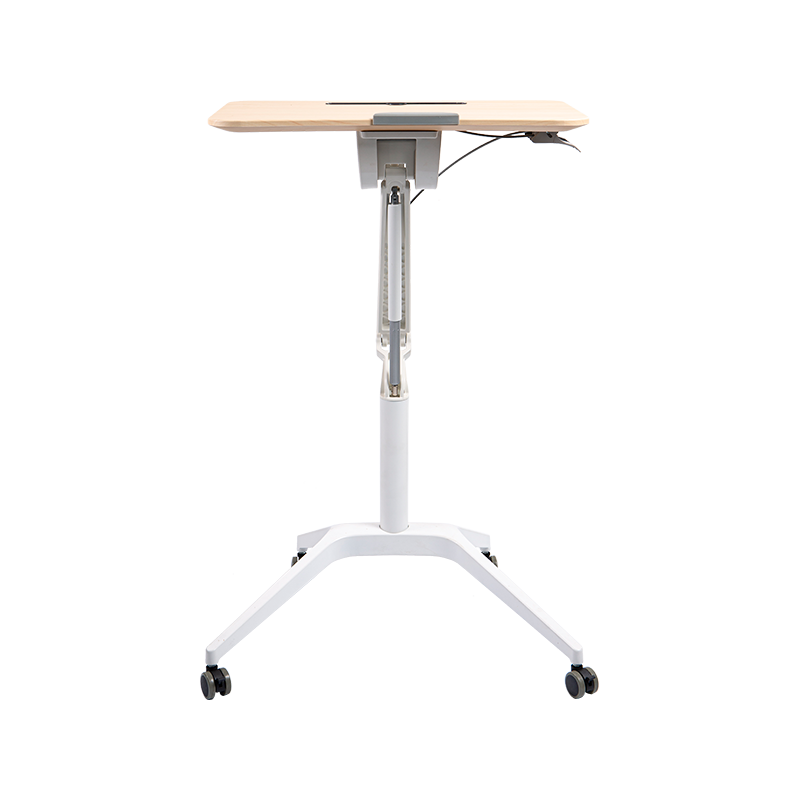
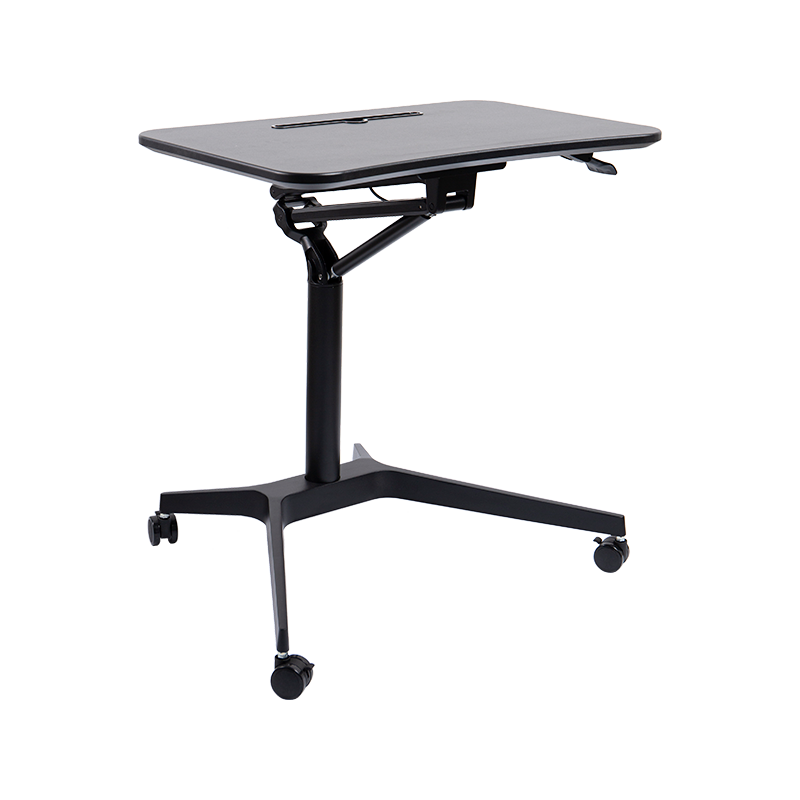
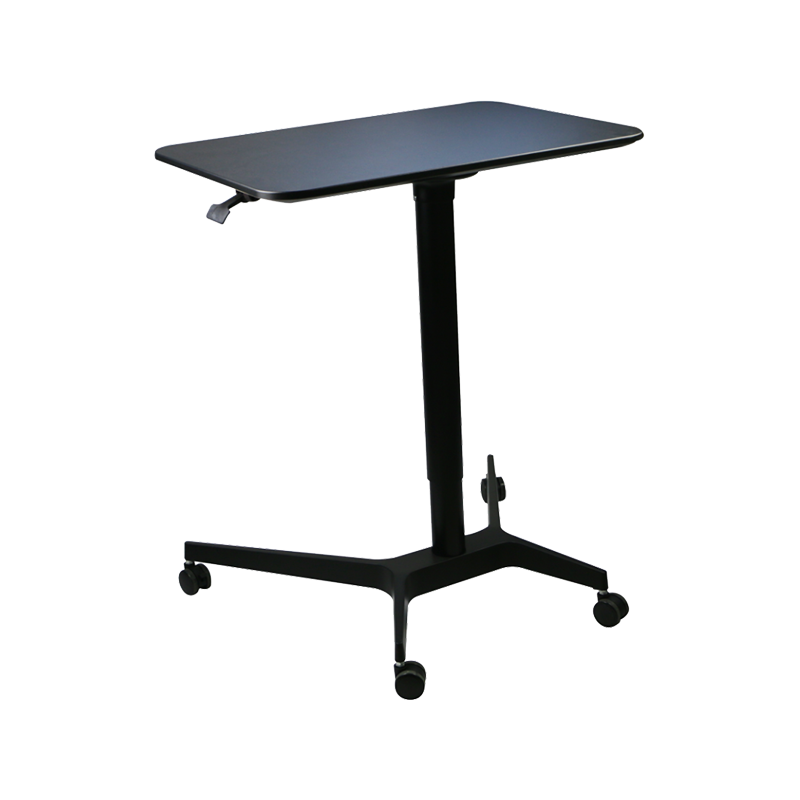
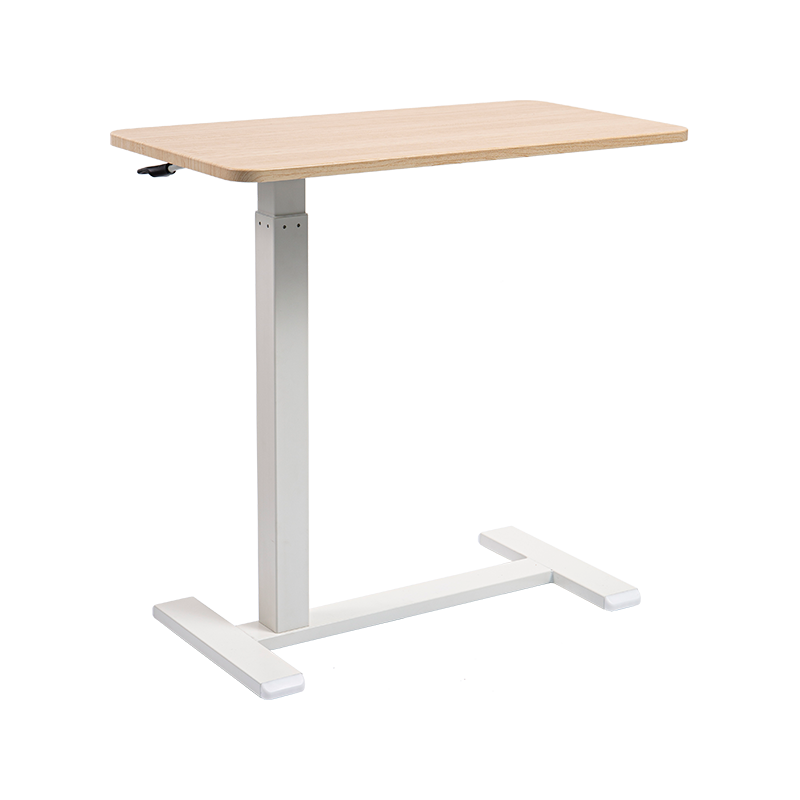
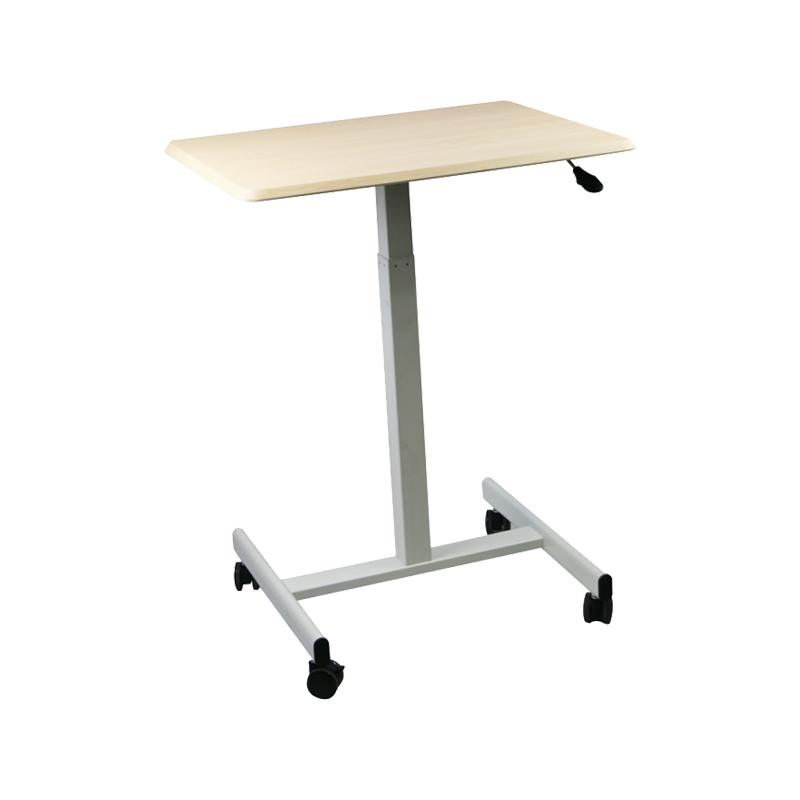
The TH01-1 combines a lifting range of 750 mm to 1060 mm with a tabletop size of 715 mm by 475 mm and a 25 mm tabletop thickness. Its tabletop is built from MDF with PVC vacuum forming, while the frame uses aluminum and iron with a powder-coated surface. Four casters, including two locking wheels, allow the desk to move when needed and remain stable when positioned. Available surface colors and panel finishes make it adaptable to different interiors, from clean white education spaces to warmer maple or walnut environments.
Beyond the product itself, the manufacturing background matters. SuZhou Skyhone Intelligent Technology Co., Ltd. is located in Suzhou, Jiangsu Province, within the Yangtze River Delta, one of China’s important manufacturing and furniture industry regions. The company focuses on the research, development, production, sales, and service of standing desks and adjustable office solutions. This industrial setting gives the product an advantage not only in design but also in supply chain integration, production efficiency, material processing, and scalable customization.
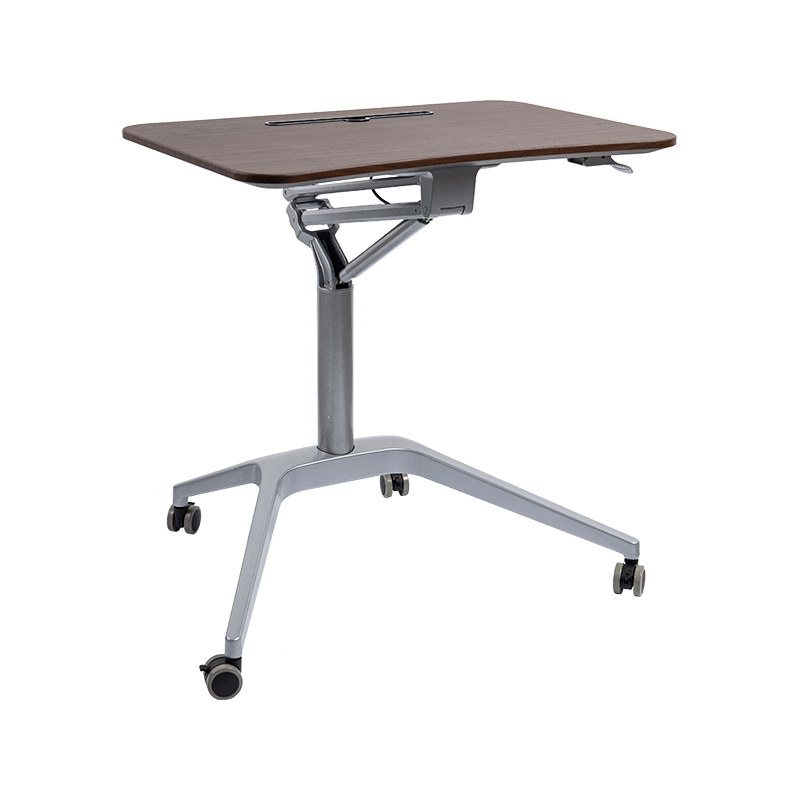
TH01-1 iPad High-Legged Pneumatic Height-Adjustable Desk
Why a Pneumatic Tablet Desk Matters in Today’s Workspaces
Workspaces are no longer defined by one fixed desk and one fixed chair. In offices, employees may move between focused work, collaboration, video meetings, and equipment demonstrations. In classrooms, teachers may need a mobile digital station to present lessons, manage classroom technology, or support interactive learning. In retail environments, staff may use tablets for checkout, inventory lookup, customer registration, and product demonstrations. In libraries, studios, and home spaces, compact adjustable surfaces support more comfortable use of digital devices without occupying the footprint of a full workstation.
A tablet-focused height-adjustable desk addresses the problem of posture mismatch. When a tablet is placed too low, users may bend the neck and shoulders forward. When it is placed too high, wrists and arms may become strained. A desk that adjusts from 750 mm to 1060 mm allows many users to create a more appropriate viewing and interaction height for sitting, perching, or standing. This is especially useful in shared spaces where multiple people use the same equipment.
Pneumatic adjustment also supports quick transitions. Unlike some manual crank desks that require repeated turning, the gas spring mechanism is intended to make movement smoother and easier. Unlike electric standing desks, it does not depend on a motorized lifting column, control box, or power access for height movement. This simplicity can be valuable in mobile environments where cords and outlets may limit placement options.
The TH01-1 is not a large executive desk, nor is it intended to replace every full-size workstation. Its value is in being purpose-built for compact, mobile, digital-device-centered use. The 715 mm by 475 mm tabletop provides enough surface for a tablet, notes, small accessories, or a compact device setup, while remaining narrow enough to fit into classrooms, store aisles, consultation areas, studios, and apartments.
Core Product Overview
The TH01-1 iPad High-Legged Pneumatic Height-Adjustable Desk is a compact mobile desk with a gas spring lifting mechanism and a stable support base. It is designed for iPad and similar tablet use, though its surface can also support other light work activities within appropriate use conditions. The desk provides ergonomic height flexibility, a durable tabletop, mobile positioning, and customizable appearance options.
The lifting range of 750 mm to 1060 mm covers many everyday sitting and standing interactions. At the lower end, the surface may suit seated work, reading, tablet control, or close interaction. At the upper end, it can support standing use, presentations, or service counter functions. The height range is especially meaningful because many tablet users interact through touch, meaning the surface must support both viewing and hand operation.
The tabletop is made from 25 mm MDF with PVC vacuum forming. MDF provides a smooth and consistent core, while PVC vacuum forming enables fully wrapped edges and a surface that is easier to clean than many unfinished wood-based panels. In environments such as classrooms, retail stores, or shared offices, cleanability and edge protection are significant practical advantages.
The structure uses aluminum and iron, combining lighter material advantages with load-bearing strength where needed. Powder coating is applied as the surface treatment, with frame colors available in white, silver, and black. Powder coating is widely used in furniture and equipment manufacturing because it can create a consistent finish and improve resistance to daily wear when properly applied.
The base adopts a three-way outward-expanding support structure. Instead of using a simple straight-line base or a minimal narrow support, the design expands outward in three directions. Rounded transitions and an arc-shaped central connection create smoother lines and reduce the visually harsh appearance that can occur in industrial-style mobile stands. This gives the desk a more refined look for offices, schools, retail areas, and home interiors.
Specification |
TH01-1 Product Detail |
User Benefit |
Lifting Range |
750 mm to 1060 mm |
Supports sitting, standing, and shared-user height adjustment. |
Tabletop Dimensions |
715 mm x 475 mm x 25 mm |
Compact but practical space for tablets, notes, and small accessories. |
Tabletop Material |
25 mm MDF with PVC vacuum forming |
Stable panel structure, wrapped edges, and easy-clean surface. |
Frame Material |
Aluminum and iron |
Balances strength, stability, and production practicality. |
Surface Treatment |
Powder coating |
Provides a clean, durable, and modern finish. |
Frame Colors |
White, silver, black |
Allows coordination with different interiors. |
Panel Colors |
White, maple, walnut, black |
Supports customized aesthetic matching. |
Casters |
Two locking and two non-locking wheels |
Enables both mobility and stationary use. |
Base Design |
Three-way outward-expanding support structure |
Improves balance and creates a smoother visual profile. |
Working Principle |
Gas spring lifting |
Offers fast pneumatic height adjustment without electric motors. |
Ergonomic Advantages Over Conventional Fixed Tables
The first major advantage of the TH01-1 is ergonomic flexibility. Fixed-height tables force users to adapt their bodies to the furniture. In contrast, a height-adjustable table allows the furniture to adapt to the user. This difference becomes especially important when the work surface supports tablets or other touch-based devices, because the user must look at the screen and physically interact with it.
A low fixed table can encourage forward neck bending, rounded shoulders, and wrist angles that become uncomfortable over repeated use. A high fixed table may make seated interaction awkward and may require the shoulders to rise unnaturally. By providing a 750 mm to 1060 mm lifting range, the TH01-1 gives users an effective way to fine-tune the surface position for different tasks and body heights.
Compared with conventional side tables or static podiums, this desk supports posture change. Users can sit while reading or writing, then raise the tabletop for standing demonstrations or tablet interaction. In a classroom, a teacher can lower the desk while preparing materials and raise it while presenting. In a store, staff can adjust the height depending on whether they are serving seated customers, standing customers, or using the tablet for internal tasks.
The desk’s compact surface also supports ergonomic intent. A very large tabletop can invite clutter and reduce mobility. The 715 mm by 475 mm surface encourages users to keep essential tools close, which can reduce unnecessary reaching. For tablet-oriented use, the surface is large enough for the device and a few supporting items while remaining focused and efficient.
Another ergonomic advantage is the pneumatic lifting principle. When adjustment is inconvenient, users often stop adjusting the desk and return to poor posture habits. A gas spring system is designed to make height changes easier and faster, which can encourage more frequent use of the adjustment function. The value of an adjustable desk is not only that it can move, but that users are willing to move it during real daily work.
Pneumatic Gas Spring Lifting as a Practical Alternative to Electric Adjustment
Electric height-adjustable desks are popular in full-size office workstations, but they are not always the best solution for every environment. A compact mobile tablet desk often needs to be simple, responsive, and easy to place anywhere. The TH01-1 uses gas spring lifting, which offers several practical advantages in this product category.
First, pneumatic adjustment removes dependence on power for height movement. In mobile applications, power cords can be inconvenient or unsafe. A desk that needs to move through classrooms, retail floors, libraries, or studios should not be limited by outlet location. With gas spring lifting, the adjustment function can be used without connecting to electricity.
Second, gas spring systems can reduce complexity. An electric lifting system usually includes a motor, control switch, control box, cables, and often a power adapter. These components can be very useful for heavy-duty workstations, but they add cost, weight, maintenance considerations, and possible failure points. The TH01-1’s pneumatic lifting mechanism is well matched to its compact form and device-focused purpose.
Third, the user experience is immediate. Pneumatic height adjustment can be quick and intuitive, making it suitable for shared environments. Users do not need to learn a digital control panel or wait for a motorized cycle. This can be beneficial in public or semi-public settings where many users may interact with the desk for short periods.
Fourth, the gas spring approach supports a clean exterior appearance. Without visible power cables for lifting, the desk can maintain a simpler profile. This is important for retail display stations, reception areas, and modern classrooms where equipment should look organized rather than improvised.
Competitor products in this space may use manual knobs, telescoping tubes with locking pins, crank mechanisms, or electric columns. Manual knobs can be slow and may require two hands. Locking-pin systems often allow only fixed height intervals. Crank systems are reliable but not always convenient for frequent transitions. Electric systems offer precision but may be excessive for a mobile tablet desk. The TH01-1’s pneumatic design occupies a practical middle ground: smoother and faster than many manual systems, simpler and more mobile than many electric alternatives.
Tabletop Design: Compact, Durable, and Easy to Maintain
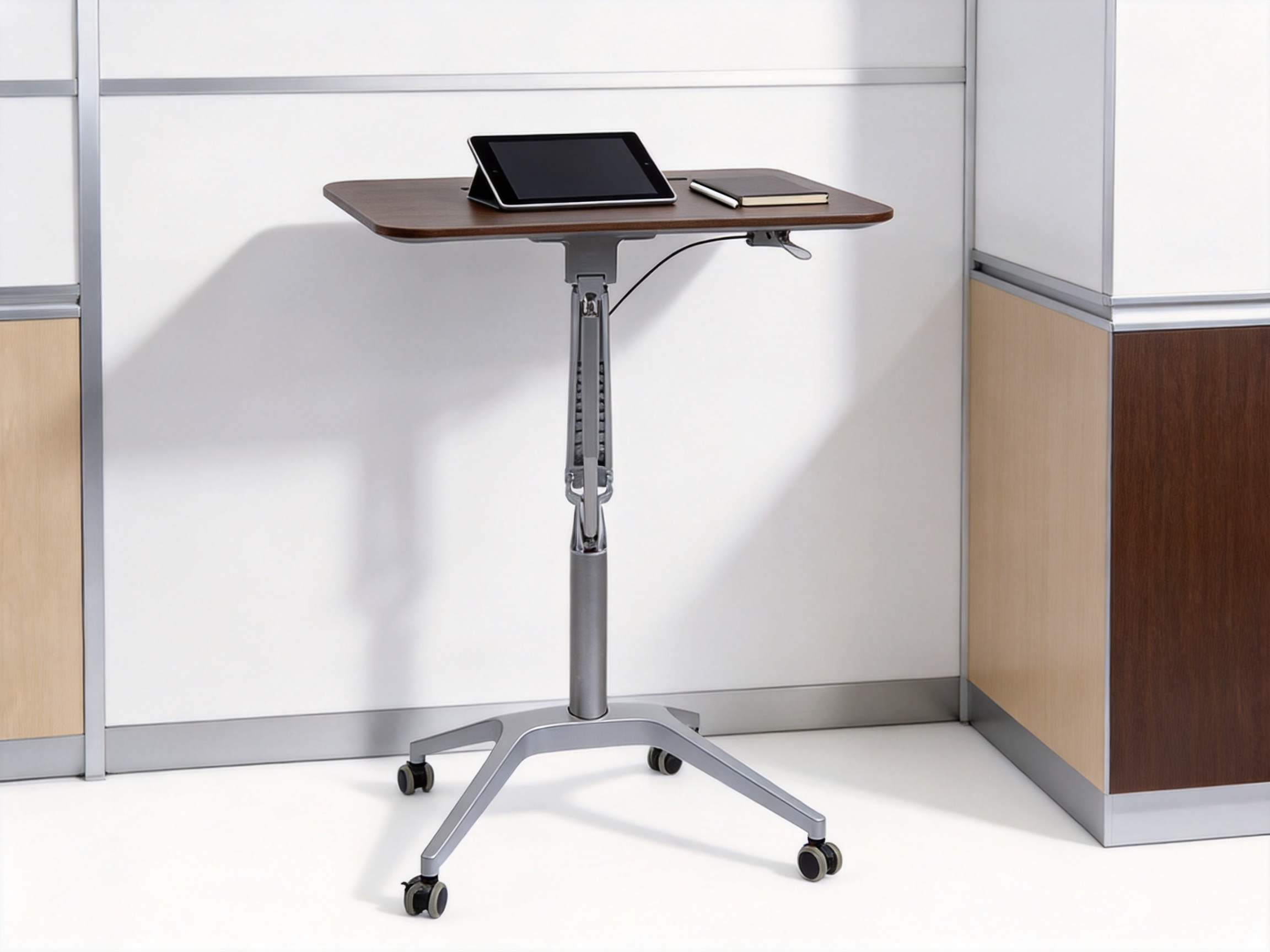
The tabletop is one of the most important touchpoints of any desk. For the TH01-1, the tabletop dimensions of 715 mm by 475 mm are carefully suited to tablet-based activities. The surface is wide enough to support an iPad or similar tablet, a small keyboard, documents, a stylus, or a compact accessory. At the same time, it avoids becoming unnecessarily bulky.
The 25 mm thickness adds a sense of solidity. Thin panels may feel unstable or fragile, especially on mobile furniture. A thicker tabletop can provide a more substantial user experience, making the desk feel reliable during touch interaction. Since tablet use often involves tapping, swiping, and writing gestures, surface stability matters.
The MDF core contributes to consistent panel quality. MDF is commonly used in furniture because it provides a uniform structure and a smooth surface for finishing. In this product, the MDF is combined with PVC vacuum forming. Vacuum forming helps create a wrapped edge effect, reducing exposed edges and giving the tabletop a finished appearance.
Fully wrapped edges are valuable for mobile furniture because the desk may be moved between rooms, placed near walls, or used in active environments. Edges are often the first areas to show wear on ordinary tables. A vacuum-formed PVC surface can improve resistance to daily handling and makes cleaning easier. This is particularly important in shared tablet stations, education areas, retail settings, and home study corners where surfaces may be touched frequently.
The available panel colors of white, maple, walnut, and black support different visual identities. White can suit clean technology environments, classrooms, and healthcare-like interiors. Maple provides a lighter wood appearance that feels warm but still modern. Walnut adds a more classic or premium tone. Black can coordinate with electronics, studio equipment, and contemporary interiors. This range allows the same desk design to serve multiple markets without requiring a complete redesign.
Stable Mobility: The Importance of the Base and Casters
Mobility is useful only when it is paired with stability. A mobile desk that moves easily but feels unstable during use can create frustration or safety concerns. The TH01-1 addresses this balance through its three-way outward-expanding support structure and caster configuration.
The base expands outward in three directions, which helps distribute support around the central column. This is especially relevant for a high-legged height-adjustable desk because the center of gravity changes as the tabletop is raised. A base that is too narrow may feel less secure at standing height. By spreading support outward, the design helps create a more confident user experience.
The rounded transitions and arc-shaped central connection are not merely decorative. Smooth transitions can reduce sharp visual interruptions and make the product feel more refined. In furniture design, perceived stability and actual stability both matter. A base that looks balanced can make users more comfortable interacting with the product, especially in customer-facing or educational environments.
The caster configuration includes two wheels with locks and two without locks. This combination supports daily practicality. When users need to reposition the desk, they can unlock the wheels and move it to another area. When the desk is in use, the locking casters help keep it stationary. This is particularly beneficial in classrooms, where the desk may be moved between teaching positions; in retail, where layout changes are common; and in studios, where workstations are often rearranged depending on the project.
Compared with competitor products that use fixed feet, the TH01-1 offers greater flexibility. Fixed-foot desks may be stable, but they are harder to reposition and may require lifting or dragging. Compared with light rolling stands that have small surfaces and narrow bases, the TH01-1 provides a more desk-like platform and a more visually substantial support structure. This makes it more suitable for professional environments where both function and presentation matter.
Material Strategy: Aluminum, Iron, Powder Coating, MDF, and PVC
A well-designed height-adjustable desk depends on the right combination of materials. The TH01-1 uses aluminum and iron for the structural frame, powder coating for the surface, MDF for the tabletop core, and PVC vacuum forming for the tabletop finish. Each material plays a role in cost, durability, appearance, processing efficiency, and user experience.
Aluminum is valued for its relatively light weight, corrosion resistance, and clean appearance. In furniture structures, it can help reduce unnecessary mass while maintaining a modern look. Iron contributes strength and rigidity in components that require more robust support. The combination allows the design to balance mobility with stability.
Powder coating is a practical finishing method for metal furniture. In a typical powder coating process, dry powder is applied to a prepared metal surface and then cured to form a continuous coating. When well controlled, the process can create a smooth and durable finish. The TH01-1 offers white, silver, and black powder-coated frame options, allowing it to fit different interior styles.
The tabletop combines MDF and PVC vacuum forming. MDF provides a consistent base, while PVC surfacing gives the panel a finished, cleanable exterior. Vacuum forming can cover contours and edges more completely than some flat lamination processes, supporting a neat appearance and reducing exposed seams. For users, this means the tabletop can feel integrated rather than assembled from mismatched parts.
This material strategy also supports manufacturing scalability. Aluminum and iron components can be processed using established cutting, forming, welding, machining, and finishing workflows. MDF and PVC tabletop production can be standardized while still allowing color variation. This is important for a manufacturer serving different customers, projects, and regional design preferences.
Advantages Over Competing Tablet Stands and Mobile Desks
The TH01-1 competes not only with other height-adjustable desks but also with tablet stands, rolling podiums, laptop carts, side tables, and improvised work surfaces. Its competitive strength comes from combining features that are often separated across different product categories.
Compared with basic tablet stands, the TH01-1 offers a larger work surface and greater furniture-level stability. A tablet stand may hold a device, but it often lacks space for paperwork, accessories, or user interaction beyond the screen itself. The TH01-1 provides a real tabletop while remaining compact.
Compared with standard rolling carts, it provides ergonomic height adjustment. Many carts are mobile but fixed in height. This limits comfort for users of different body sizes and for tasks that shift between seated and standing positions. The TH01-1’s 750 mm to 1060 mm lifting range allows the same unit to support more varied scenarios.
Compared with manual adjustable podiums, it offers the convenience of gas spring lifting. Manual locking mechanisms may work for occasional changes but can discourage frequent adjustment. Pneumatic movement supports a more fluid workflow, particularly in active settings where a user may change posture several times per day.
Compared with full-size electric standing desks, it is more compact and mobile. Electric desks are excellent for permanent office setups, but they are often too large, heavy, or power-dependent for tablet stations. The TH01-1 is designed for flexible placement rather than fixed installation.
Compared with low-cost lightweight mobile tables, it offers more refined construction details. The 25 mm tabletop, aluminum and iron structure, powder-coated surface, locking casters, and three-way support base collectively create a product that looks and functions more professionally. For buyers, this means the desk can serve in customer-facing environments as well as internal workspaces.
Manufacturing Strength Behind the Product
Product performance depends heavily on manufacturing capability. SuZhou Skyhone Intelligent Technology Co., Ltd. operates as a professional manufacturing enterprise engaged in standing desk research and development, production, sales, and service. Its location in Suzhou Industrial Park, within the broader Yangtze River Delta economic region, supports access to a developed industrial chain and a skilled manufacturing ecosystem.
The Yangtze River Delta is known for strong supplier networks, logistics infrastructure, precision processing resources, furniture manufacturing experience, and technology-oriented production. For an adjustable desk manufacturer, this environment can support faster sourcing of metal components, tabletop materials, surface finishing services, packaging solutions, and related mechanical parts such as gas springs and casters.
Advanced manufacturing strength is not limited to machines. It includes process planning, material control, supplier coordination, assembly discipline, quality inspection, and the ability to adapt products to customer requirements. The TH01-1 reflects these strengths through its combination of pneumatic mechanism, metal frame, powder coating, vacuum-formed tabletop, caster system, and color customization.
In production, metal components must be dimensionally consistent so that the lifting column, support base, caster mounts, and tabletop connection align correctly. Poor alignment can lead to wobble, uneven movement, or assembly difficulties. A manufacturer experienced in standing desks understands how small dimensional variations can affect final user experience.
The tabletop process also requires control. MDF panels must be cut accurately, surfaced properly, and formed with PVC in a way that creates clean edges and consistent appearance. Vacuum forming requires attention to temperature, pressure, material thickness, and trimming. A refined tabletop surface gives the product its daily touch quality, while a poorly formed surface would immediately reduce perceived value.
Powder coating demands careful surface preparation, coating application, curing, and handling. If the metal surface is not prepared well, adhesion and finish consistency may suffer. If curing conditions are inconsistent, the coating may not achieve the desired durability or appearance. By emphasizing production capability, the company supports both function and visual quality.
Research and Development Approach
The TH01-1 is the result of design decisions shaped by real application needs. An R&D-focused manufacturer must consider not only whether the desk can adjust in height, but also how it will be used, moved, cleaned, assembled, shipped, and integrated into different spaces.
The selection of a 750 mm to 1060 mm lifting range suggests a focus on practical ergonomic coverage rather than unnecessary extremes. The desk needs to serve seated and standing use without becoming unstable or overly complex. The tabletop dimensions also show task-specific thinking: wide enough for tablet work, compact enough for mobility.
The three-way outward-expanding base reflects attention to stability and visual design. A product like this may be used in front of customers, students, patients, or visitors. Therefore, it must not look like temporary equipment. Rounded and arc-shaped transitions help the desk fit into designed interiors and avoid the overly mechanical look of some mobile stands.
R&D also involves balancing cost and value. A product with too many unnecessary features may become expensive and difficult to maintain. A product with too few features may not solve real user problems. The TH01-1’s pneumatic system, locking casters, powder-coated frame, and vacuum-formed tabletop represent a balanced configuration for its intended market.
Because the company specializes in standing desks and adjustable office solutions, it can apply knowledge from broader height-adjustable product development to compact mobile designs. Understanding lifting behavior, user posture, stability, surface finishing, and assembly processes helps create a product that is more than a simple rolling table.
Production Process and Quality Control Considerations
The manufacturing process for a pneumatic height-adjustable desk can be understood as a sequence of coordinated stages. While each manufacturer has its own specific workflow, a product such as the TH01-1 typically requires design confirmation, material preparation, component processing, surface treatment, tabletop forming, gas spring integration, assembly, inspection, packaging, and shipment preparation.
Design confirmation begins with product drawings, dimensional standards, component specifications, and finish requirements. Since the desk has adjustable movement, both static dimensions and dynamic behavior must be considered. The lifting column must move smoothly, the tabletop must remain level, and the base must support the structure through the full height range.
Material preparation includes selecting appropriate aluminum, iron, MDF, PVC, gas spring components, casters, and fasteners. Reliable material supply is essential because inconsistent inputs can create inconsistent finished products. The company’s regional manufacturing ecosystem helps support stable sourcing and production scheduling.
Metal processing may include cutting, forming, drilling, welding, machining, and deburring. Each connection point affects assembly quality. For example, caster mounting points must be accurate to prevent uneven rolling. Base components must align to avoid tilt. Tabletop support brackets must hold the work surface securely.
Surface treatment through powder coating requires cleaning, pretreatment, powder application, curing, cooling, and inspection. The availability of white, silver, and black frame colors means the production system must manage color consistency and prevent cross-contamination. Proper handling after coating is also important to avoid scratches before assembly.
Tabletop production includes MDF cutting, edge preparation, PVC vacuum forming, trimming, drilling, and surface inspection. The tabletop is a visible and frequently touched component, so appearance defects can have a large impact on customer satisfaction. Fully wrapped edges require careful forming and finishing to maintain a clean profile.
Gas spring integration is central to the product. The gas spring must be matched to the weight and movement requirements of the tabletop and frame. If the force is not appropriate, lifting may feel too heavy, too sudden, or unstable. Correct assembly and testing help ensure the desk adjusts smoothly within its intended 750 mm to 1060 mm range.
Final assembly brings together the tabletop, lifting mechanism, frame, base, casters, and hardware. Quality control may include checking height adjustment, caster movement, locking function, surface finish, panel color, frame color, connection tightness, packaging completeness, and overall appearance. For export-oriented furniture, packaging also matters because products must withstand transportation and handling before reaching the customer.
Customization and Aesthetic Adaptability
One reason the TH01-1 can serve different markets is its appearance flexibility. The frame is available in white, silver, and black, while the panel is available in white, maple, walnut, and black. This creates multiple combinations for buyers who need the desk to match existing interiors.
In education environments, white or maple panels with white or silver frames can create a bright and approachable appearance. In retail technology stores, black or white combinations may match electronic devices and display fixtures. In libraries, maple or walnut panels can blend with wood-toned shelving and reading furniture. In studios, black frames and panels can coordinate with cameras, audio equipment, and digital workstations.
Customization is not only visual. A manufacturer with standing desk expertise may support project-based requirements, such as packaging preferences, order quantities, color planning, or integration with broader adjustable desk programs. For dealers, distributors, and project buyers, this manufacturing flexibility can be a competitive advantage.
The product’s compact dimensions also make it easier to deploy in quantity. A school may use several units across classrooms. A retail chain may place units in multiple store zones. A company may use them as mobile digital sign-in stations or flexible meeting room supports. Consistent appearance across multiple units helps create a professional environment.
Application Scenario: Retail and Service Counters
Retail environments increasingly use tablets for checkout, product information, membership registration, queue management, and customer demonstrations. A fixed counter may not always be located where customer interaction happens. The TH01-1 provides a mobile and height-adjustable surface that can be positioned where service is needed.
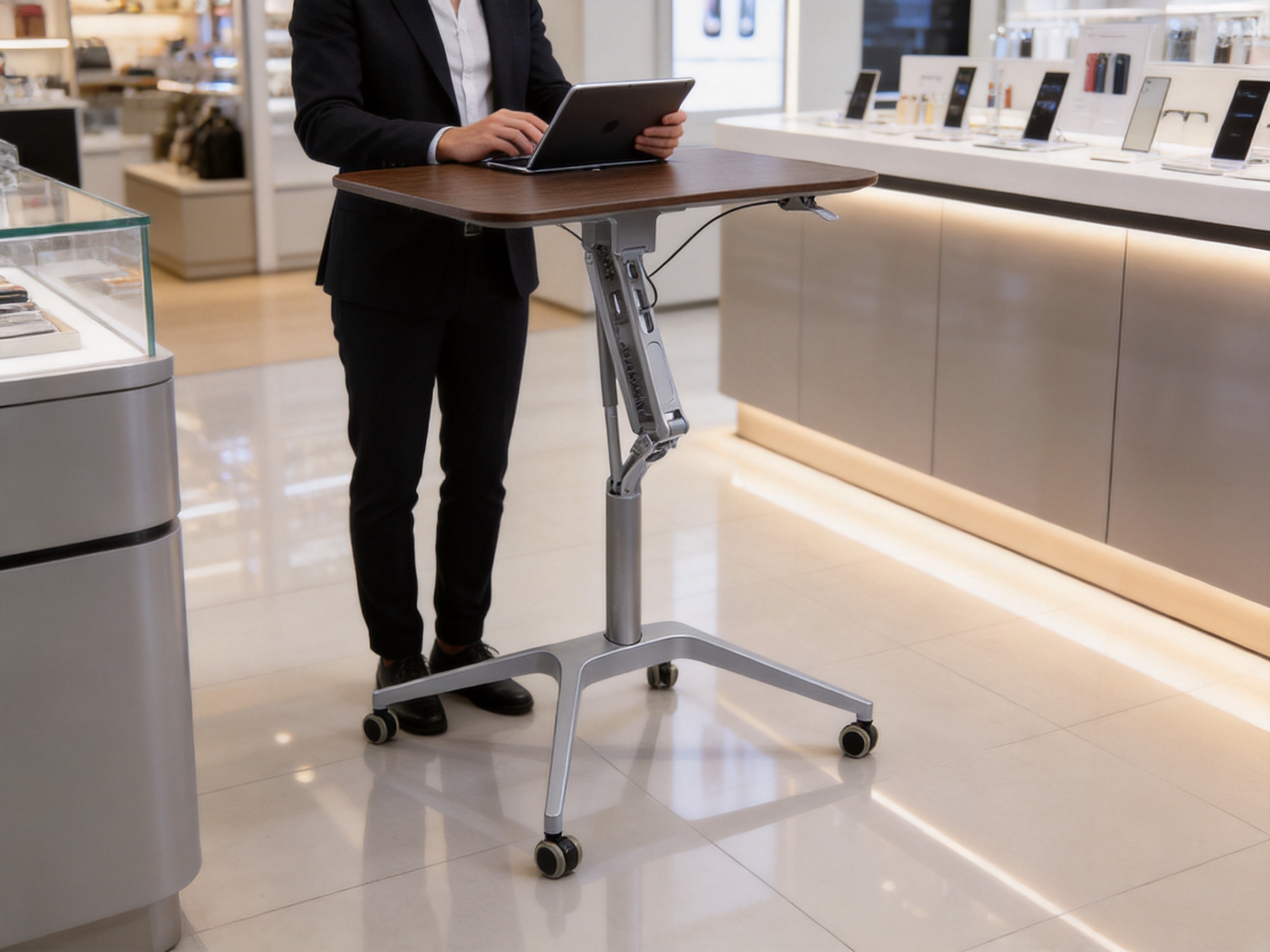
For mobile checkout, the desk can be placed near promotional areas, temporary displays, or event spaces. Staff can adjust the height for comfortable standing use and lock the casters when the station is in place. The compact tabletop can hold a tablet, small payment accessories, or documents without occupying the space of a full counter.
For product demonstrations, the desk can support an iPad or similar device at a height that customers can view and interact with. The ability to move the unit helps retailers adjust layouts quickly. This is valuable in stores where seasonal promotions, product launches, and customer flow patterns change regularly.
Compared with fixed kiosks, the TH01-1 is easier to reposition. Compared with lightweight tablet stands, it offers a broader surface and a furniture-like presence. This combination makes it useful for retail brands that need flexibility without sacrificing a professional appearance.
Application Scenario: Classrooms, Libraries, and Learning Spaces
Education spaces benefit from furniture that supports different teaching and learning modes. Teachers may move around the classroom, present digital content, assist students, or manage online resources. Students may use tablets for reading, research, testing, or interactive activities. A mobile height-adjustable desk supports these changing needs.
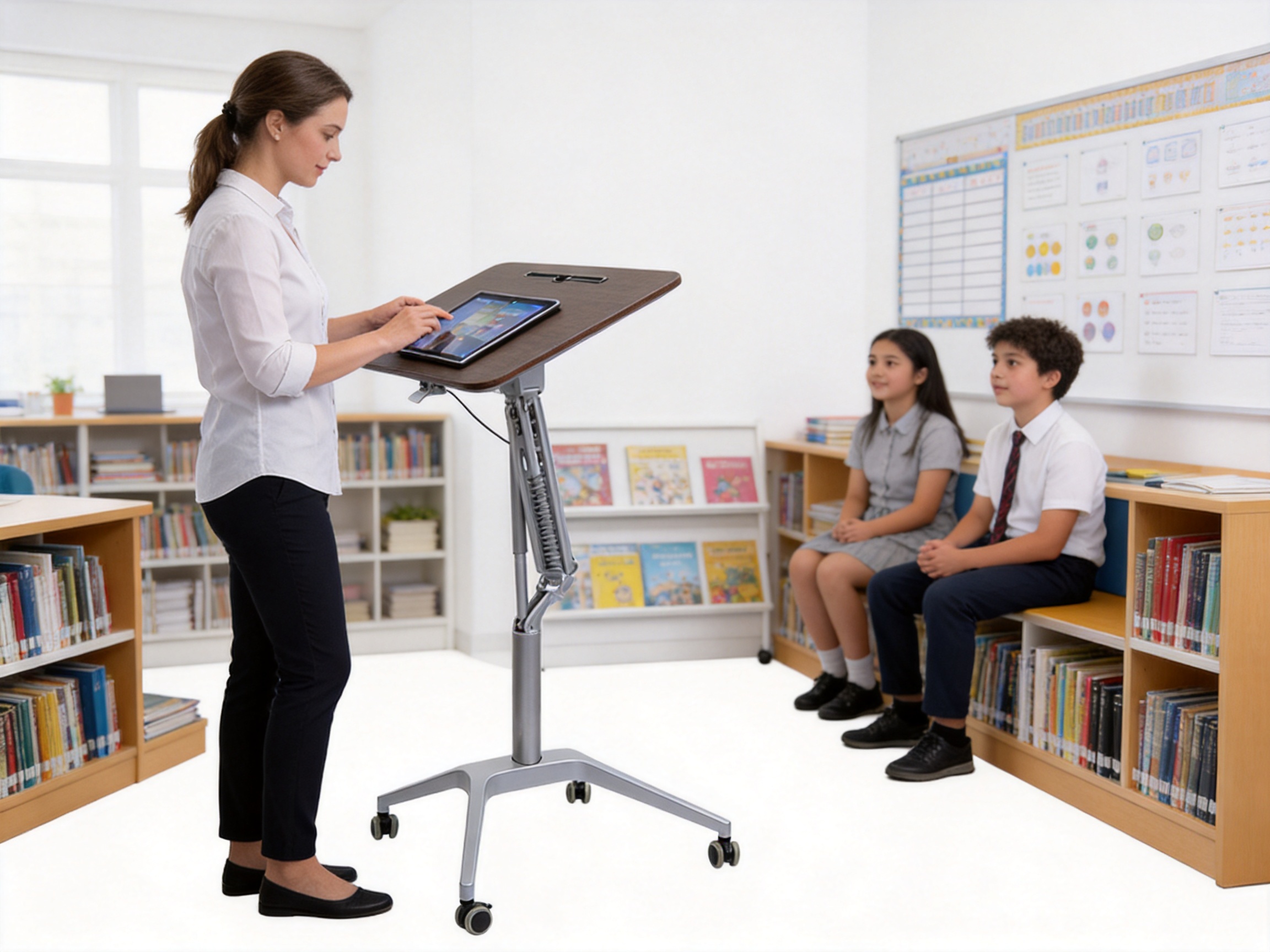
In classrooms, the TH01-1 can serve as a teacher’s digital control station. It can hold a tablet while the teacher moves between the front, side, and center of the room. The height can be adjusted for seated preparation or standing instruction. Locking casters help keep the desk stable during use.
In libraries, the desk can function as an electronic reading stand, catalog search station, or temporary information point. Its compact footprint allows placement near shelves, seating areas, or service desks. The panel color options allow libraries to choose a warmer wood tone or a clean modern finish.
In training centers and laboratories, the desk can hold instructional tablets, checklists, or mobile control devices. Because it does not require electric power for height adjustment, it can be placed in locations where powered furniture may be inconvenient. This improves layout flexibility and reduces cable management issues.
Application Scenario: Creative Studios and Home Work Corners
Creative studios often require flexible surfaces. Designers, photographers, video editors, artists, and makers may move between tools, display screens, drawing areas, and digital references. The TH01-1 can serve as an auxiliary drafting or tablet reference table that moves with the task.
A designer may use the desk to hold a tablet for sketching or reference images. A photographer may place it near a shooting area for tethering notes, shot lists, or image review. A video creator may use it as a mobile control station. The height adjustment allows the surface to align with different equipment and working positions.
In home environments, the desk can support flexible study or work corners. Not every home has space for a large standing desk. The TH01-1 provides a compact alternative for tablet-based learning, remote meetings, reading, or casual work. It can be moved aside when not needed and brought into position when required.
The availability of walnut, maple, white, and black panels helps the desk fit domestic interiors more naturally than many industrial-looking carts. This is important because home users often want functional furniture that does not disrupt the appearance of living spaces.
Space Efficiency and Mobility as Economic Value
Space efficiency is not only a comfort issue; it is also an economic factor. Commercial real estate, classrooms, studios, and apartments all have limited floor area. A product that can serve multiple functions in multiple locations can reduce the need for several fixed pieces of furniture.
The TH01-1’s compact tabletop and mobile base allow it to act as a flexible workstation, presentation surface, digital device stand, auxiliary table, or temporary counter. Instead of installing a fixed station in every location, organizations can move the desk where it is needed. This is valuable for schools, retail stores, libraries, training rooms, showrooms, and shared offices.
Mobility also supports faster reconfiguration. A room used for instruction in the morning may be used for group discussion in the afternoon. A retail area may need to shift from display to checkout support during peak hours. A studio may rearrange equipment for different projects. The desk’s casters and locking function support this type of operational flexibility.
Compared with buying multiple fixed tables or counters, one mobile adjustable unit can deliver better utilization. The economic benefit is not only the purchase price but the ability to keep the product in active use across changing scenarios.
User Experience Details That Influence Long-Term Satisfaction
Long-term satisfaction with furniture often depends on small daily details. The TH01-1 addresses several of these details through its adjustment method, tabletop surface, caster design, and visual options.
The gas spring lifting system supports convenient adjustment. If users can change height without frustration, they are more likely to use the feature. This can improve comfort over time and make the desk more valuable in shared environments.
The tabletop surface is designed for easy cleaning, which matters in spaces where multiple people touch the same area. A desk that looks clean and maintained contributes to a professional environment. Fully wrapped edges also help the tabletop maintain a finished appearance through ordinary use.
Locking casters improve confidence. Users can move the desk easily but also secure it when interacting with the tablet. This is important because tapping or writing on a tablet can create small forces on the surface. A desk that rolls unexpectedly would be inconvenient. The two-locking and two-non-locking caster configuration balances movement with control.
The base shape adds to perceived quality. Rounded transitions, outward support, and a smoother central connection make the desk look intentional rather than improvised. This visual refinement is particularly important for customer-facing applications where furniture contributes to brand image and visitor confidence.
How the Company’s Industrial Position Supports Product Reliability
SuZhou Skyhone Intelligent Technology Co., Ltd. benefits from being based in Suzhou, within a region known for manufacturing depth and supply chain resources. For adjustable desk products, this location supports access to metal processing, furniture panels, coating services, mechanical components, packaging, and logistics networks.
The company’s focus on standing desks and healthy office space solutions is important. A manufacturer that works deeply in adjustable office furniture develops practical knowledge about lifting systems, stability, ergonomics, component durability, and customer expectations. This specialization can improve product development and production consistency.
For international buyers, an integrated manufacturer can provide advantages in communication, customization, quality management, and after-sales support. Instead of treating height-adjustable furniture as a generic metal product, the company positions it as part of a healthy, efficient, and intelligent workspace solution. This broader perspective supports product lines that respond to modern work patterns.
The TH01-1 reflects the company’s ability to combine functional hardware and user-centered design. Gas spring lifting, a stable mobile base, color options, vacuum-formed tabletop, and compact dimensions all show a product strategy focused on practical deployment rather than feature overload.
Procurement Considerations for Buyers and Project Planners
When evaluating a pneumatic height-adjustable tablet desk, buyers should consider more than initial appearance. Key factors include height range, stability, lifting convenience, tabletop durability, caster quality, finish options, manufacturing background, and suitability for the intended environment.
The TH01-1’s height range of 750 mm to 1060 mm should be evaluated against the expected users and tasks. For many tablet-based sitting and standing applications, this range is practical and easy to understand. Buyers should consider whether the desk will be used mainly by staff, students, customers, visitors, or home users.
Stability is essential, especially at higher positions. The three-way outward-expanding support structure gives the TH01-1 an advantage over narrower rolling stands. Buyers should also consider floor conditions, caster use, and whether the desk will be frequently moved.
Tabletop durability matters in shared settings. The 25 mm MDF and PVC vacuum-formed construction provides a more finished and easy-clean solution than many basic panels. Color options also help project planners match interior design requirements.
Manufacturing strength matters for repeat orders and project deployment. A supplier with R&D, production, sales, and service capabilities can better support customization and consistency. For distributors or procurement teams, this can reduce risk when ordering multiple units or planning long-term cooperation.
Maintenance and Practical Use Guidelines
To maintain good performance, users should operate the desk according to reasonable furniture care practices. The tabletop should be cleaned with suitable non-abrasive methods. Harsh chemicals or sharp tools should be avoided to protect the PVC surface and overall finish.
The casters should be kept free of debris, especially if the desk is moved frequently. Dust, thread, or small particles can affect rolling quality over time. Locking mechanisms should be checked periodically to confirm that the desk remains stationary when required.
The gas spring lifting function should be used within its intended design conditions. Users should avoid forcing the mechanism beyond its height range or overloading the tabletop. Proper use helps maintain smooth adjustment and stable performance.
Powder-coated metal surfaces should be protected from unnecessary impact or scratching. If the desk is used in high-traffic environments, routine inspection can identify loose fasteners or surface damage early. Simple preventive care can extend the useful life and maintain the desk’s professional appearance.
Q&A Section
What is the TH01-1 designed for?
The TH01-1 is designed as a pneumatic height-adjustable desk for iPad and similar tablet-based work. It is suitable for mobile digital stations, classrooms, retail service points, libraries, creative studios, and compact home work areas.
What is the height adjustment range?
The desk adjusts from 750 mm to 1060 mm, allowing users to shift between seated and standing positions or adapt the surface height for different users and tasks.
How does the height adjustment work?
The desk uses a gas spring lifting mechanism. This pneumatic system provides convenient height adjustment without requiring an electric motor or power connection for lifting.
Why choose pneumatic lifting instead of electric lifting?
Pneumatic lifting is practical for a compact mobile desk because it is simple, fast, and not dependent on power access. It reduces cable concerns and can be easier to use in classrooms, retail stores, studios, and flexible workspaces.
What is the tabletop made of?
The tabletop is made from 25 mm MDF with PVC vacuum forming. This structure provides a stable panel, fully wrapped edges, and an easy-clean surface suitable for shared-use environments.
Is the desk easy to move?
Yes. The desk has four casters, including two locking wheels and two non-locking wheels. This allows it to move when needed and remain more secure when positioned for use.
What colors are available?
The frame is available in white, silver, and black. The tabletop panel is available in white, maple, walnut, and black, allowing the desk to match different interior styles.
How does the base improve stability?
The base uses a three-way outward-expanding support structure. This helps distribute support around the central column, while rounded and arc-shaped transitions improve both stability perception and appearance.
What makes this product different from a normal tablet stand?
Unlike many tablet stands, the TH01-1 provides a real tabletop, adjustable height, a stable support base, and mobile casters. It functions more like compact ergonomic furniture than a simple device holder.
What company manufactures the product?
The product is offered by SuZhou Skyhone Intelligent Technology Co., Ltd., a professional manufacturing enterprise focused on standing desks and adjustable office space solutions.
Conclusion
The TH01-1 iPad High-Legged Pneumatic Height-Adjustable Desk is a focused solution for modern digital workspaces that need mobility, ergonomic adjustment, compact size, and professional appearance. Its 750 mm to 1060 mm gas spring lifting range supports posture changes and shared use. Its 715 mm by 475 mm tabletop provides a practical surface for tablet-centered tasks without occupying the footprint of a large workstation. Its MDF and PVC vacuum-formed tabletop, aluminum and iron structure, powder coating, locking casters, and three-way outward-expanding base all contribute to a balanced product design.
Compared with fixed tables, basic tablet stands, manual adjustable carts, and oversized electric desks, the TH01-1 offers a strong combination of convenience, mobility, stability, and clean design. It is especially suitable for retail service points, classrooms, libraries, studios, and home work corners where flexibility is essential.
The manufacturing capabilities behind the product further strengthen its value. SuZhou Skyhone Intelligent Technology Co., Ltd. benefits from its location in Suzhou and its focus on standing desk research, development, production, sales, and service. With access to the industrial chain of the Yangtze River Delta and experience in adjustable office solutions, the company is positioned to support quality production, customization, and scalable supply.
As work and learning continue to become more mobile, digital, and posture-aware, compact pneumatic height-adjustable desks will play a growing role in creating healthier and more adaptable environments. The TH01-1 stands out as a practical example of how thoughtful engineering, ergonomic awareness, and manufacturing strength can come together in one efficient product.
References
1. Kroemer, K. H. E., and Grandjean, E. Fitting the Task to the Human: A Textbook of Occupational Ergonomics.
2. Pheasant, S., and Haslegrave, C. M. Bodyspace: Anthropometry, Ergonomics and the Design of Work.
3. Bridger, R. S. Introduction to Human Factors and Ergonomics.
4. Dul, J., and Weerdmeester, B. Ergonomics for Beginners: A Quick Reference Guide.
5. Panero, J., and Zelnik, M. Human Dimension and Interior Space: A Source Book of Design Reference Standards.
6. Product specification materials for the TH01-1 pneumatic height-adjustable desk.
Product: TH01-1 iPad High-Legged Pneumatic Height-Adjustable Desk


- Contact Info
-
-
 Phone+86-15950656125
 -
 Email
Email -
 AddressRoom 1007-1, South Building, Suyue Plaza, Suzhou Industrial Park, Suzhou City, Jiangsu Province, China
-
- Products
- Follow Us
- Need help? Please contact us
Copyright ©
SuZhou Skyhone Intelligent Technology Co., Ltd.
All Rights Reserved.
Privacy
Custom Ergonomic Adjustable Office Tables Manufacturers

