

 English
  русский
  Español
  عربى
عربى 
Content
- 1 1. The Need for More Flexible Workstations
- 2 2. Product Overview
- 3 3. Pneumatic Height Adjustment for Practical Daily Use
- 4 4. Stepless Tilt for Better Viewing and Operation
- 5 5. Construction Designed for Frequent Use
- 6 6. Mobility, Positioning, and Stabilization
- 7 7. Advantages Compared with Conventional Alternatives
- 8 8. Application Scenarios
- 9 9. Manufacturing Strengths and Product Development Capabilities
- 10 10. Quality Considerations for Buyers
- 11 11. Ergonomic Use Recommendations
- 12 12. Maintenance and Long-Term Product Care
- 13 13. Why This Product Is a Strong Choice for Project Buyers
- 14 14. Customization and Integration Potential
- 15 15. Frequently Asked Questions
- 15.1 Q1: What is the main purpose of the TH01-2 desk?
- 15.2 Q2: What is the available height range?
- 15.3 Q3: Does the desk require electricity for height adjustment?
- 15.4 Q4: How far can the tabletop tilt?
- 15.5 Q5: What are the tabletop dimensions?
- 15.6 Q6: What materials are used in the desk?
- 15.7 Q7: Is the desk easy to move?
- 15.8 Q8: What color options are available?
- 15.9 Q9: Can the desk be used outside conventional offices?
- 15.10 Q10: What should buyers confirm before ordering?
- 15.11 Q11: How does it compare with a fixed tablet stand?
- 15.12 Q12: Who manufactures the product?
- 16 16. Conclusion
- 17 References
- 18 Product: TH01-2 iPad High-Legged Pneumatic Height-Adjustable Desk
Why Pneumatic Height-Adjustable Desks Are Transforming Mobile Workstations
2026-07-21
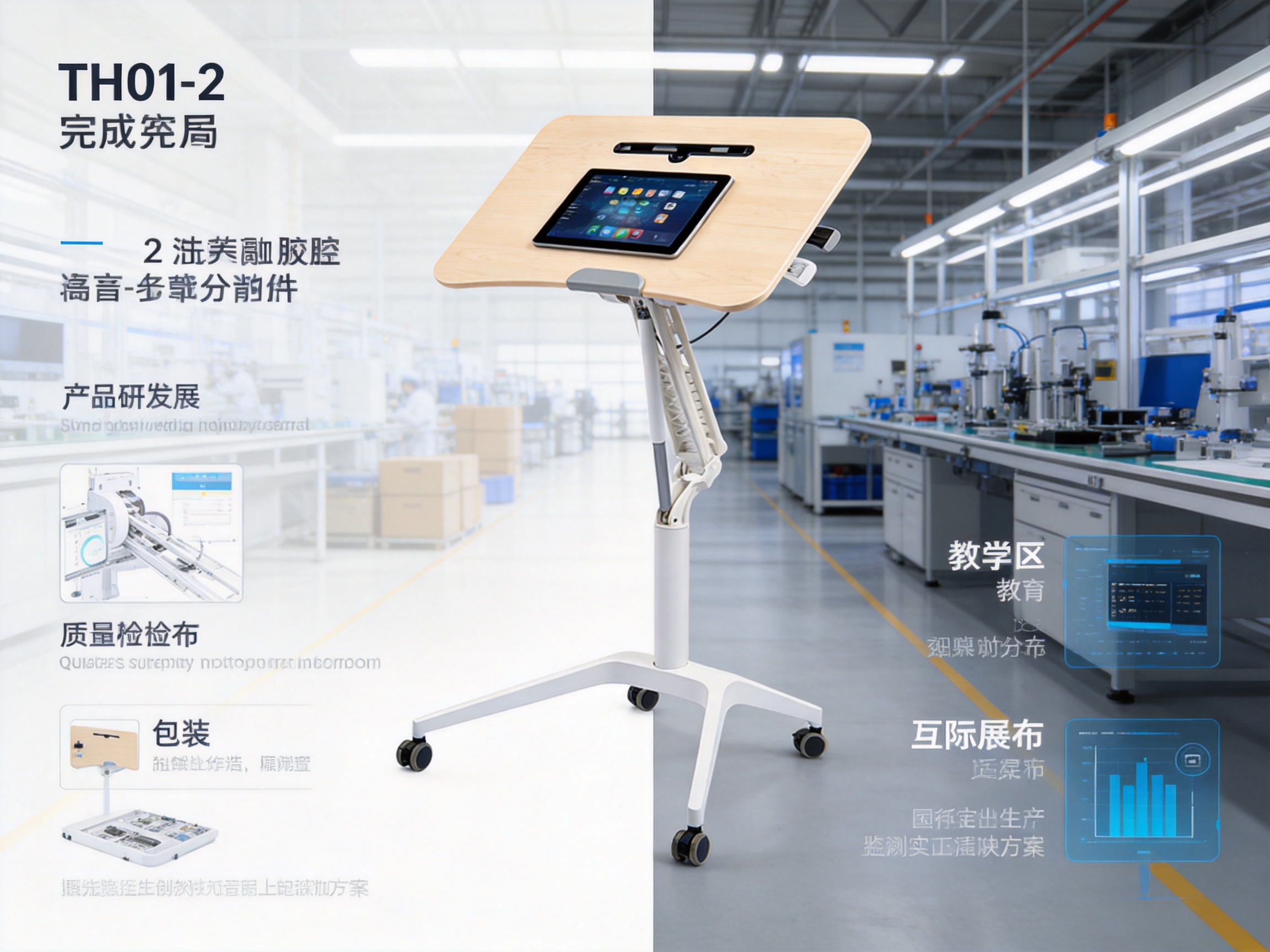
Modern work environments increasingly depend on mobile devices, digital inspection systems, interactive displays, and compact control interfaces. As a result, the traditional fixed-height desk is no longer sufficient for many professional applications. Operators may need to stand, sit, change viewing angles, reposition equipment, or move a workstation between different areas of a facility. A workstation that cannot adapt to these requirements may create unnecessary discomfort, reduce productivity, and limit the usefulness of the equipment placed on it.
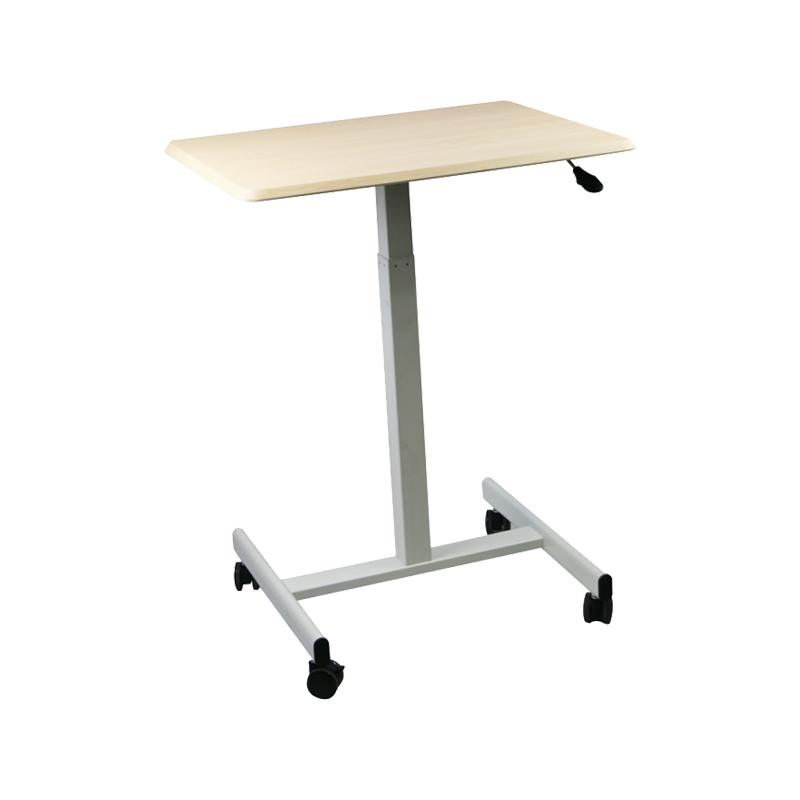
The TH01-2 iPad High-Legged Pneumatic Height-Adjustable Desk is designed to address these challenges. It combines pneumatic height adjustment, a stepless tabletop tilt system, a compact working surface, durable aluminum-and-iron construction, and mobile casters. The result is a flexible workstation for iPads, tablets, mobile control devices, inspection terminals, presentation equipment, and other compact electronic systems.
Unlike a basic side table or a conventional fixed computer desk, this pneumatic height-adjustable table is intended for frequent adjustment and repositioning. Its lifting range of 750 mm to 1060 mm supports different user heights and working postures, while its tabletop can tilt through a stepless mechanism with an angle of up to 90 degrees. This combination makes the desk suitable for environments where viewing angle and operator position change throughout the working day.
Manufactured by SuZhou Skyhone Intelligent Technology Co., Ltd., the product reflects the company’s focus on standing desks, adjustable office furniture, intelligent workstation solutions, and practical ergonomic design. Based in Suzhou, Jiangsu Province, the company operates within one of China’s major manufacturing regions and provides research and development, production, sales, and service for adjustable desk products.
1. The Need for More Flexible Workstations
Workstation design has traditionally focused on a fixed desk height, a fixed tabletop angle, and a fixed location. That arrangement can work for routine office tasks, but it is less suitable for industrial, laboratory, medical, educational, and retail environments. In these settings, users may need to observe a screen from different directions, move equipment closer to a work area, or alternate between standing and seated positions.
Mobile devices have made this need more apparent. An iPad or similar tablet may serve as a production instruction terminal, quality-control interface, equipment monitor, training display, data-entry tool, or presentation screen. The device itself is lightweight and portable, but portability is not enough when the supporting workstation is difficult to adjust.
A well-designed mobile workstation should provide several functions at the same time. It should support the device securely, allow the user to establish a comfortable operating position, make the screen easy to view, and remain stable during use. It should also be simple to move when the workstation is needed elsewhere. The TH01-2 addresses these requirements through a combination of pneumatic lifting, stepless tilting, structural materials, and locking casters.
Ergonomics is another important consideration. When a desk is too low, users may bend their necks and shoulders forward. When it is too high, the arms and wrists may be placed in an uncomfortable position. A desk with adjustable height allows operators to adapt the working surface to their own body dimensions and task requirements. This is particularly useful when different people share the same workstation.
The ability to tilt the tabletop is equally important for tablet-based work. A nearly horizontal position may be convenient for writing, tapping, or placing small tools beside the device. A more upright position can improve visibility during presentations, monitoring, or hands-free viewing. Since the TH01-2 uses a stepless tilt mechanism, the operator can choose an intermediate angle instead of being limited to a small number of preset positions.
2. Product Overview
The TH01-2 is a high-legged pneumatic height-adjustable desk designed for iPads and other mobile devices. Its construction combines aluminum and iron to balance strength, practical durability, and manageable weight. The tabletop is made from a 25 mm MDF substrate with PVC vacuum forming, creating a uniform surface suitable for regular commercial and industrial use.
The desk has a lifting range from 750 mm to 1060 mm. This range is suitable for a variety of seated and standing applications, although the final working position will depend on the user, the device being used, and the task being performed. The high-legged structure provides an elevated working platform while maintaining a compact tabletop footprint.
The tabletop measures 715 mm by 475 mm by 25 mm. This size is designed to provide enough room for an iPad or similar device while remaining compact enough for corridors, production areas, training rooms, display points, and other locations where space may be limited.
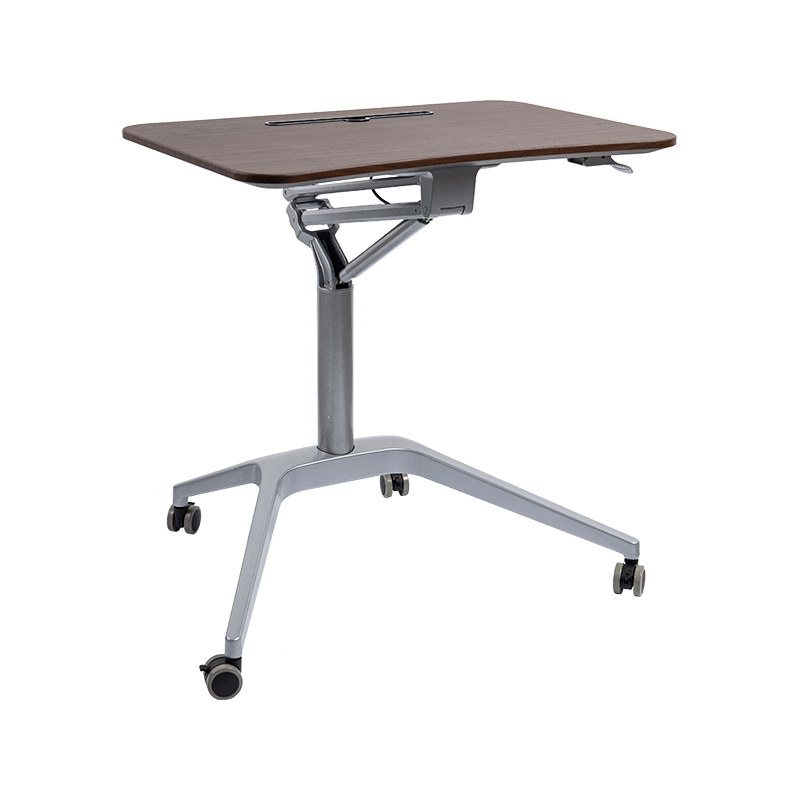
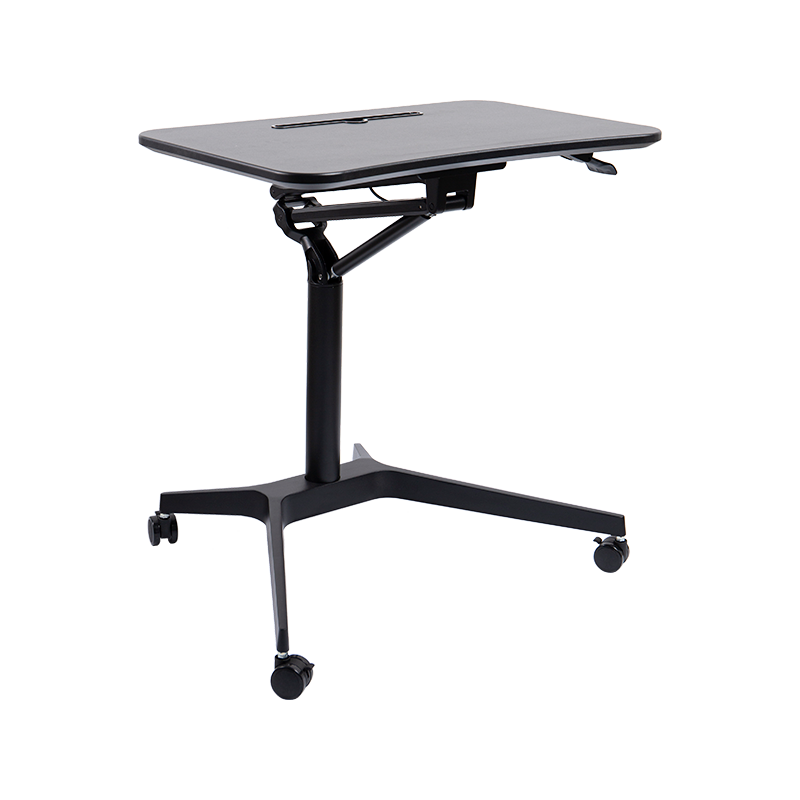
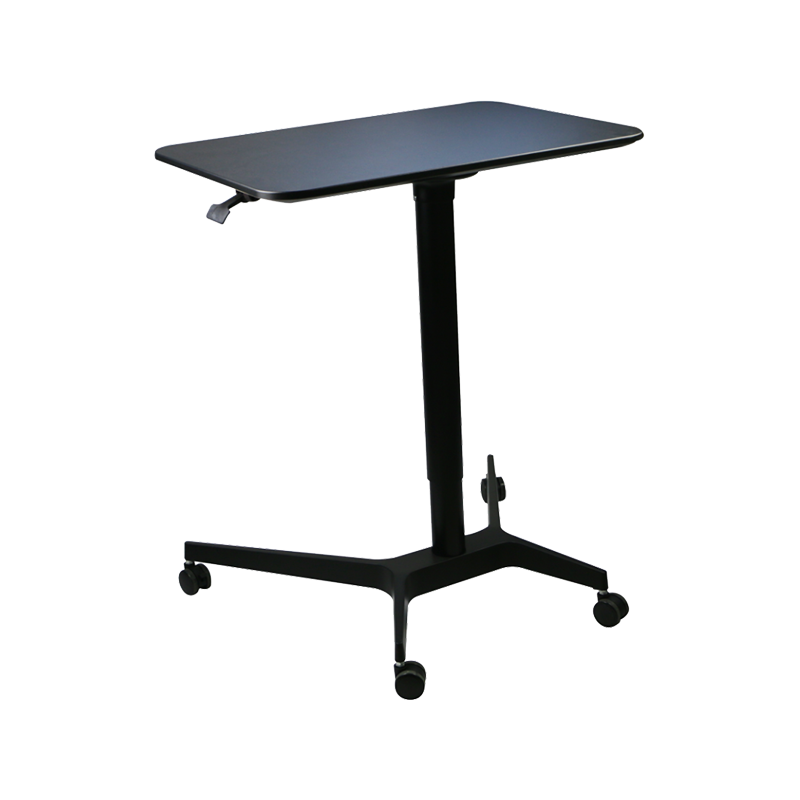
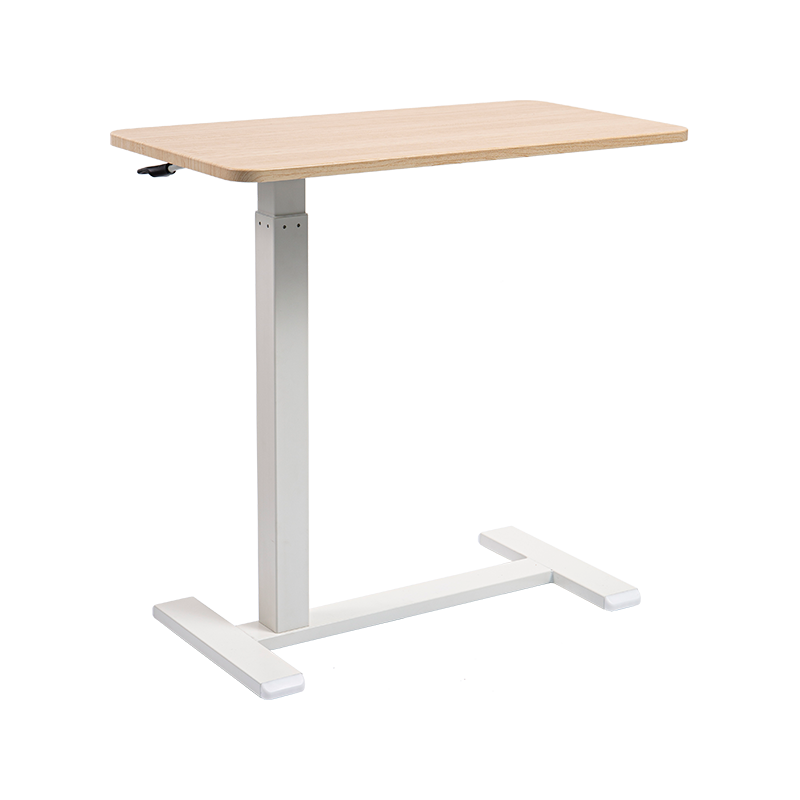
The product is equipped with four casters. Two casters have locking functions, while the other two are non-locking. This configuration supports mobility when the desk needs to be relocated and stabilization when it reaches the desired operating position. The powder-coated frame is available in white or silver, while panel finishes include White, Maple, Walnut, and Black.
Product feature | Specification | Practical benefit |
Product type | Pneumatic height-adjustable table | Supports flexible seated and standing work |
Lifting range | 750 mm to 1060 mm | Accommodates different users and working postures |
Tabletop size | 715 mm × 475 mm × 25 mm | Provides a compact but usable device-supporting surface |
Tabletop construction | 25 mm MDF with PVC vacuum forming | Creates a consistent, durable, easy-to-coordinate working surface |
Main frame material | Aluminum and iron | Combines structural support with practical product weight |
Height adjustment | Gas spring lifting | Provides smooth, intuitive manual adjustment |
Tabletop adjustment | Stepless tilt up to 90 degrees | Allows users to select a task-specific viewing angle |
Casters | Two locking and two non-locking casters | Supports movement and positioning |
Frame colors | White or silver powder coating | Supports different workspace styles |
Panel colors | White, Maple, Walnut, or Black | Allows integration into industrial, commercial, and office environments |
3. Pneumatic Height Adjustment for Practical Daily Use
The central operating principle of the TH01-2 is gas spring lifting. A gas spring stores energy in a sealed pneumatic cylinder and helps the user raise or lower the working surface with controlled force. For a mobile workstation, this approach offers several practical advantages over a basic fixed frame.
First, pneumatic adjustment does not require an electrical power connection for ordinary height changes. This is useful in production areas, laboratories, classrooms, medical support spaces, and temporary display locations where a power cable may be inconvenient or where the workstation must be moved frequently. The user can adjust the desk manually without waiting for a motor or searching for a control switch.
Second, the pneumatic mechanism is intuitive. Operators generally understand the basic action of releasing the adjustment control, positioning the desk, and allowing the mechanism to hold the selected height. This reduces the training required for shared workstations. A simple operating method is especially valuable where different workers use the same desk during different shifts.
Third, a gas spring system can provide a smooth adjustment experience when properly matched to the desk structure and intended load. The TH01-2 is designed as an industrial-grade workstation, and its lifting mechanism supports repeated changes between lower and higher positions. This makes the product more suitable for dynamic work than a conventional table that requires manual disassembly or the use of fixed height settings.
In comparison with electrically powered adjustable desks, the pneumatic approach also reduces dependence on motors, control panels, wiring, and power outlets. Electric desks can be highly effective in conventional office applications, especially when precise powered movement is required. However, a pneumatic workstation can be more convenient in environments where mobility, simple operation, and reduced electrical complexity are priorities.
It is important to select the working height according to the operator and the task. A lower position may be appropriate for seated data entry or close inspection. A middle position may support a transition posture. A higher position can be used for standing operation, demonstrations, or screen viewing. Since the available range extends from 750 mm to 1060 mm, users have meaningful flexibility without requiring a large floor area.
4. Stepless Tilt for Better Viewing and Operation
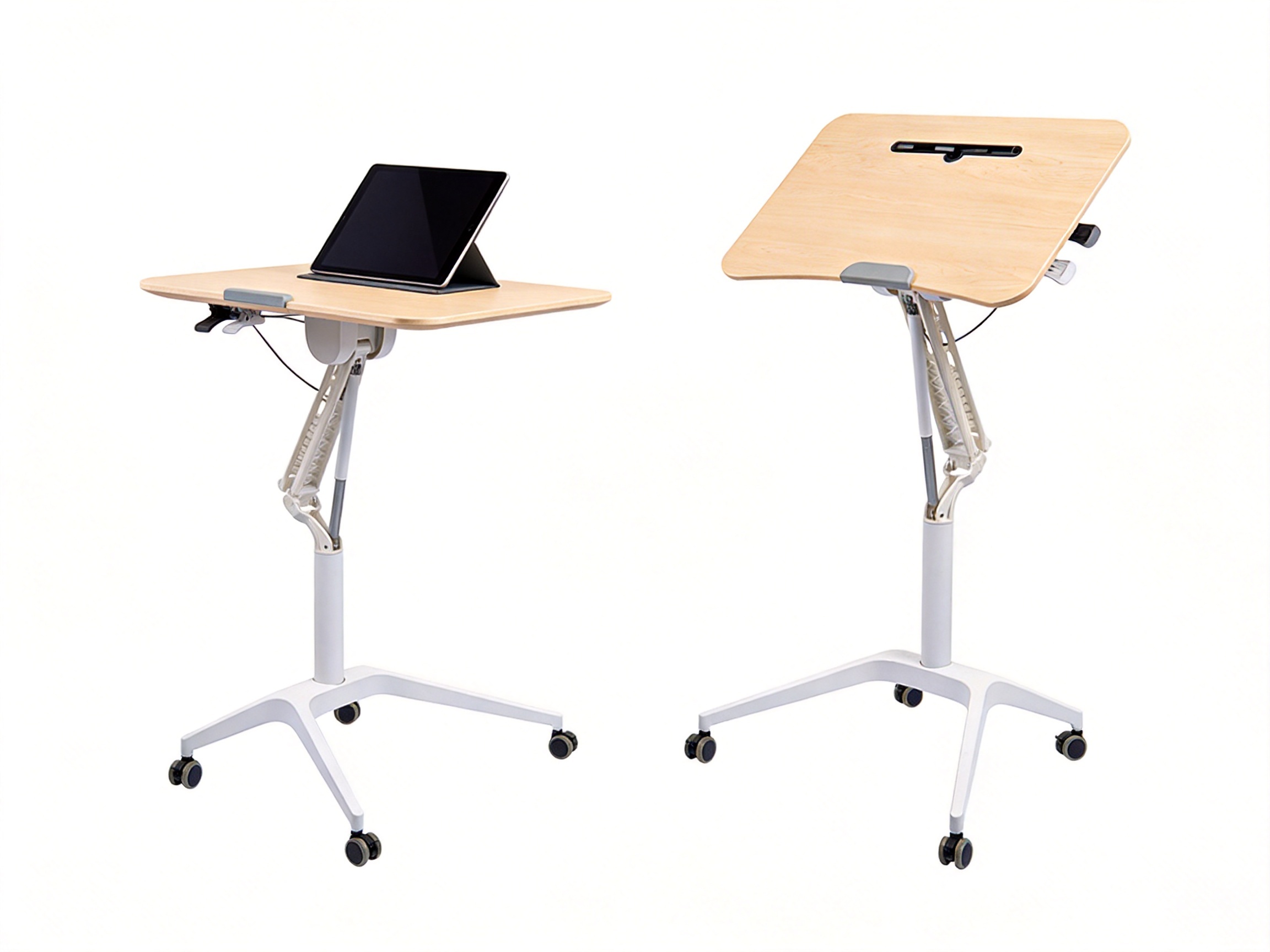
Many adjustable tables change only their height. The TH01-2 adds another important adjustment: tabletop tilt. Its stepless tilt mechanism allows the tabletop to move through a continuous range, with a maximum tilt angle of 90 degrees. This feature gives the operator more control over the relationship between the screen, the hands, and the line of sight.
For an iPad or tablet used as a display, an upright angle can make the screen easier to see from a short distance or across a small work area. For a worker entering data or operating a touch interface, a moderate angle may reduce glare and make tapping more natural. For writing, examining components, or placing accessories on the tabletop, a flatter angle may be more convenient.
The ability to select intermediate positions is a significant advantage over fixed-angle stands. A limited stand may offer only one or two viewing positions, which can force users to adapt their bodies to the equipment. A stepless system instead allows the workstation to adapt to the operator. This is consistent with the broader ergonomic principle that equipment should be adjustable to suit the person and the task.
Tilt adjustment can also improve communication and presentation. In a training room, the device can be positioned toward a learner. At an interactive display point, it can be raised toward visitors. In a medical or laboratory setting, the screen can be oriented for the professional who needs to read information while working nearby.
The tilt function should be used in conjunction with appropriate device support. The product is designed for iPads and other mobile devices, but users should ensure that the device is positioned securely and that accessories, cables, and cases do not interfere with movement. In commercial or industrial applications, the specific device mounting method should be selected according to the organization’s operating requirements.
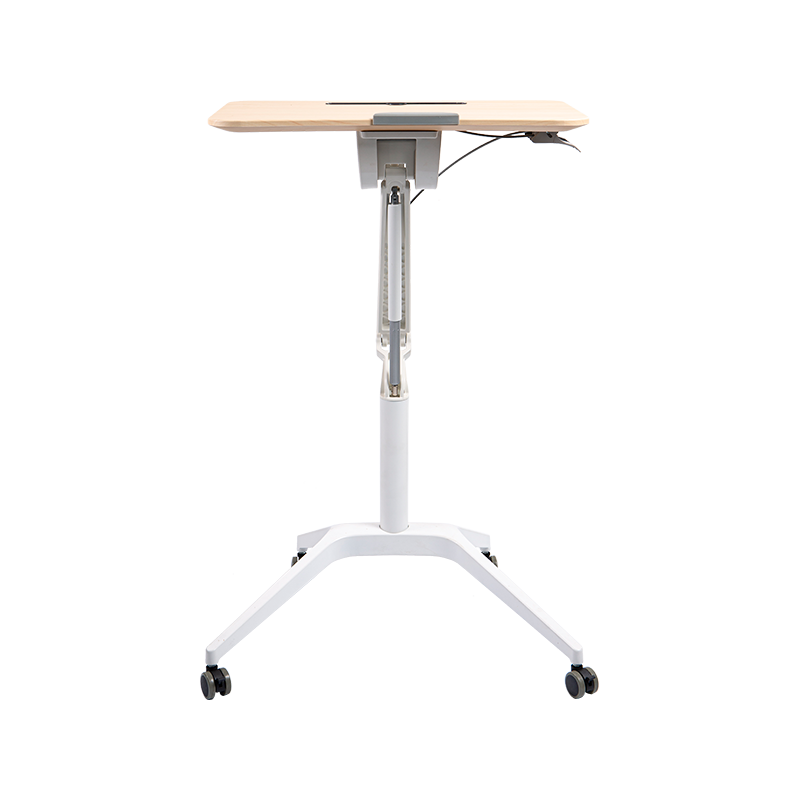
TH01-2 iPad High-Legged Pneumatic Height-Adjustable Desk
5. Construction Designed for Frequent Use
The TH01-2 uses an aluminum-and-iron composite structure. These materials provide complementary properties. Aluminum is widely valued for its relatively low weight and resistance to surface corrosion, while iron contributes substantial structural support. Together, they create a frame that is suitable for a workstation expected to be moved, adjusted, and used repeatedly.
Material selection is especially important in a mobile desk. A frame that is too light may feel unstable during touch operation or repositioning. A frame that is unnecessarily heavy may be difficult for staff to move. The aluminum-and-iron combination provides a practical compromise between portability and support for a compact device workstation.
The frame receives a powder-coated surface treatment. Powder coating involves applying dry coating material to a prepared metal surface and curing it to form a continuous finish. In addition to contributing to the visual appearance, a properly applied powder-coated finish can support routine durability and make the frame easier to integrate into professional environments.
The available frame colors are white and silver. These neutral finishes are suitable for laboratories, offices, production lines, medical facilities, classrooms, and display areas. They can also be coordinated with different tabletop panel colors, including White, Maple, Walnut, and Black. This gives purchasing teams and project designers more freedom when matching the workstation to an existing interior or corporate environment.
The tabletop uses a 25 mm MDF substrate with PVC vacuum forming. MDF provides a consistent engineered-wood base, while PVC vacuum forming helps create a finished outer surface with a uniform appearance. The 25 mm thickness gives the tabletop a substantial profile appropriate for a workstation rather than a lightweight temporary tray.
Tabletop design must account for more than appearance. It should provide enough surface area for the device, allow comfortable hand placement, and remain manageable in confined spaces. The dimensions of 715 mm by 475 mm offer a useful balance. The tabletop is large enough for an iPad-centered operating station, but it does not create the footprint of a full-size office desk.
6. Mobility, Positioning, and Stabilization
Mobility is one of the defining qualities of the TH01-2. Four casters allow the desk to be moved without lifting the frame. This makes it practical for areas where a workstation may serve several production cells, classrooms, laboratory benches, or presentation points.
Two of the casters include locks. Once the desk reaches its intended location, the locking casters can help prevent unwanted rolling. This is particularly useful when the operator is tapping an iPad, entering information, adjusting equipment, or presenting content. A workstation should not drift away from the user during normal operation.
The combination of casters and locks gives the product two operating modes. In mobile mode, the desk can be relocated to another area. In stationary mode, the casters can be locked to provide a more secure working position. This dual-purpose design is more versatile than a fixed desk and more stable than a completely unrestrained rolling stand.
Organizations can also benefit from this mobility when floor layouts change. Manufacturing lines may be rearranged, classrooms may be reconfigured, and temporary projects may require different workstation positions. A mobile adjustable table can follow the workflow instead of forcing the workflow to remain tied to one permanent desk location.
When moving the table, users should ensure that the tabletop is clear, cables are managed, and the route is free of obstacles. When the desk is in use, the locking casters should be engaged as appropriate. These basic practices help preserve safe and efficient operation.
7. Advantages Compared with Conventional Alternatives
7.1 Compared with Fixed-Height Tables
A fixed-height table provides limited ergonomic flexibility. If the user changes from sitting to standing, the device must either be repositioned on another surface or used at an unsuitable height. The TH01-2 avoids this limitation by allowing the working height to be changed across a range of 750 mm to 1060 mm.
The adjustable design is also useful in shared environments. A fixed desk may suit one user but not another. A pneumatic workstation can be adapted at the beginning of each shift, class, inspection session, or presentation. This flexibility can improve the usability of the same piece of equipment for multiple people.
7.2 Compared with Simple Tablet Stands
A tablet stand may provide a convenient viewing angle, but it usually does not offer a full workstation structure, height adjustment, mobile casters, or a larger supporting tabletop. A stand is appropriate when the device is used on an existing desk. The TH01-2 is more suitable when the device needs its own dedicated, movable, height-adjustable platform.
The TH01-2 also provides a more complete solution for professional applications. It can support a defined operating station rather than acting only as an accessory. The tabletop can hold the device and selected work materials, while the frame provides the height and mobility functions required in a production, laboratory, educational, or commercial setting.
7.3 Compared with Electric Height-Adjustable Desks
Electric desks are often selected for large office workstations or applications requiring powered height movement. However, they also introduce motors, electrical controls, cables, and power requirements. For a compact iPad-focused workstation, those features may not always be necessary.
The pneumatic design of the TH01-2 can be advantageous where manual adjustment is preferred, where the table must be moved between areas, or where the installation location does not have a convenient power outlet. It can also simplify the overall operating system by reducing the number of electrical components associated with height adjustment.
This does not mean that pneumatic adjustment is better for every application. The appropriate technology depends on the task, load, frequency of movement, and user expectations. The strength of the TH01-2 is that it offers a focused solution for mobile device workstations without adding unnecessary electrical complexity.
7.4 Compared with Heavy Industrial Workbenches
Heavy workbenches may provide significant load capacity, but they are often larger, less mobile, and less visually adaptable than a compact adjustable table. They may also be excessive for applications centered on an iPad, tablet, or small control device.
The TH01-2 is designed around a different requirement: controlled flexibility in a compact footprint. Its aluminum-and-iron frame, smaller tabletop dimensions, pneumatic lift, tilt function, and casters create a workstation that can be positioned closer to the actual point of use.
8. Application Scenarios
8.1 Electronics Manufacturing and Testing
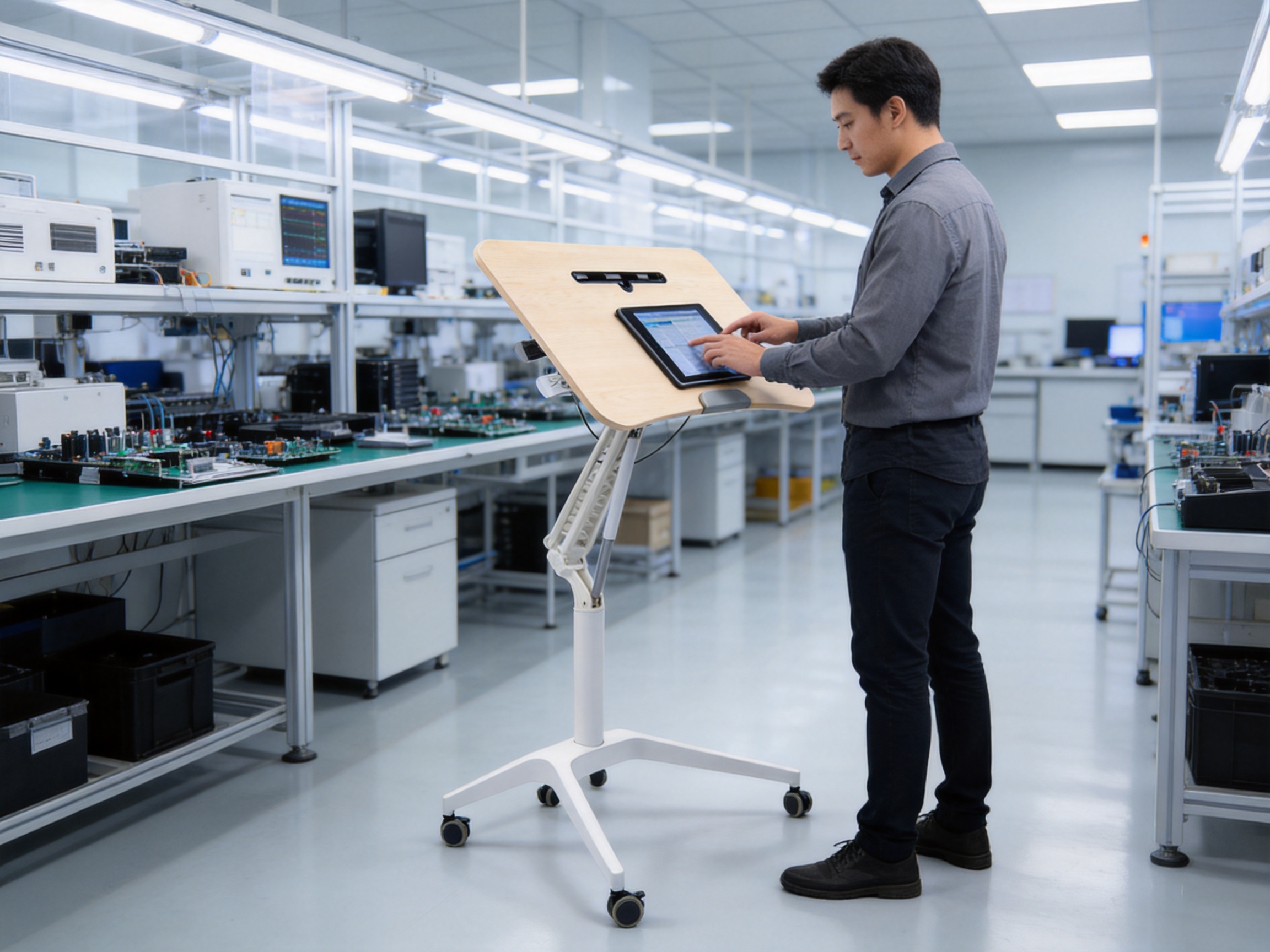
In electronics manufacturing, digital instructions, test results, assembly records, and quality-control information are increasingly displayed on tablets. A TH01-2 workstation can position an iPad near a production operator without taking up the space of a large desk.
The height adjustment can accommodate different production tasks, while the tilt function can orient the screen toward the operator. When the station is needed at another point on the line, the casters provide practical mobility. The locking function can then be used once the new location has been selected.
8.2 Laboratory Work Areas
Laboratories often combine instruments, samples, documentation, and digital records. A tablet workstation can support data entry, equipment monitoring, experiment instructions, or access to digital procedures. The compact tabletop helps conserve valuable bench space.
The stepless tilt system can be useful when the screen must be viewed from a standing position or from the side of a laboratory bench. The powder-coated frame and selectable finishes also allow the product to fit into clean, organized professional environments.
8.3 Medical Equipment Support
Medical environments may require mobile information terminals, patient data interfaces, equipment controls, or educational displays. A movable desk can be positioned near the relevant treatment, diagnostic, or training area. Height adjustment allows different staff members to use the same workstation more comfortably.
In healthcare applications, organizations should evaluate their own cleaning, infection-control, device-mounting, and safety requirements before deployment. The desk’s surface materials and finish should be maintained according to the facility’s approved procedures.
8.4 Educational and Training Facilities
Training rooms and educational spaces frequently change layout. A tablet may be used for lesson content, interactive demonstrations, attendance records, technical instruction, or remote communication. A mobile workstation can be moved between teaching positions and adjusted for different instructors or learners.
The panel color options can also help the desk blend into classrooms, laboratories, demonstration rooms, and multipurpose learning spaces. The adjustable tilt allows the screen to face the user or a group of observers.
8.5 Interactive Display Points
Retail stores, showrooms, museums, visitor centers, and exhibitions often use tablets for product information, visitor registration, surveys, or interactive content. The TH01-2 can serve as a dedicated display platform that is easier to reposition than a built-in counter.
Its height and angle can be adjusted to suit standing visitors, seated users, or demonstrations. The choice of White, Maple, Walnut, or Black panel finishes provides options for matching different display themes and interior styles.
8.6 Production-Line Documentation
Many facilities are replacing paper instructions with digital work orders, process checklists, and inspection forms. A height-adjustable mobile desk can support this transition by placing the digital interface near the worker without requiring a permanent computer station.
The ability to lock the casters after repositioning helps create a stable point for touch input. The tabletop size is also suitable for a device-centered workflow where the principal work surface is the screen itself.
9. Manufacturing Strengths and Product Development Capabilities
SuZhou Skyhone Intelligent Technology Co., Ltd. is a professional manufacturing enterprise focused on the research and development, production, sales, and service of standing desks and adjustable workstation products. This full-process orientation is important because an adjustable table is not simply a collection of separate parts. The frame, lifting mechanism, tabletop, tilt function, casters, finish, and packaging must work together as one product.
The company is based in Suzhou Industrial Park, Suzhou City, Jiangsu Province, China. Suzhou is located within the Yangtze River Delta, a region known for strong industrial networks, manufacturing resources, engineering talent, and supply-chain connections. Operating in this environment gives an adjustable-furniture manufacturer access to a broad ecosystem of component suppliers, processing services, logistics providers, and technical resources.
The company’s stated focus is to provide healthy, efficient, and intelligent office-space solutions to global users. The TH01-2 demonstrates how this objective can be applied beyond the traditional office. Its pneumatic lifting system, mobile structure, and device-centered tabletop make it relevant to offices as well as industrial, educational, laboratory, medical, and display environments.
Research and development plays an important role in products of this type. A height-adjustable desk must be evaluated as a complete mechanism. The lifting range must correspond to the frame geometry, the tabletop must remain properly supported, the tilt system must be controllable, and the casters must support both mobility and positioning. Product development therefore requires coordination between mechanical design, material selection, surface treatment, assembly, and user requirements.
Production quality also depends on process consistency. Metal components need to be formed and assembled accurately. Moving parts need appropriate alignment. The tabletop must be produced to consistent dimensions. Powder coating needs proper surface preparation and curing. Casters and locking components need to be installed correctly. A manufacturer with experience in adjustable desks can organize these processes around the functional demands of the finished product.
Another strength is the ability to support different aesthetic requirements. The TH01-2 is offered with white or silver frame finishes and four panel color options. This indicates an approach that recognizes both technical performance and workspace appearance. Buyers may need the same product family to fit a laboratory, an office, a showroom, or a training area, and color selection can help support that requirement.
For international customers, manufacturing strength also includes communication and service. The company provides sales and service alongside production and research activities. This integrated approach can help buyers discuss product selection, intended application, appearance requirements, order coordination, and after-sales questions through one supplier relationship.
10. Quality Considerations for Buyers
When evaluating an adjustable workstation, buyers should look beyond the lifting range alone. The complete product should be assessed according to the intended application, frequency of adjustment, device size, available space, mobility requirements, and expected operating environment.
The first consideration is height compatibility. The 750 mm to 1060 mm range should be compared with the users’ seated and standing requirements. Organizations with many users should assess whether the range is suitable for the majority of operators and whether additional ergonomic accessories are needed.
The second consideration is tabletop capacity and layout. The 715 mm by 475 mm surface is compact and appropriate for an iPad-centered station. Buyers should consider whether they need room for a keyboard, scanner, paperwork, tools, charging equipment, or other accessories. If the workstation is intended for a larger computer or multiple devices, the application should be reviewed carefully before ordering.
The third consideration is movement. Casters are valuable when the desk must be relocated, but the floor surface and route should be evaluated. A facility should determine whether the desk will cross thresholds, pass through narrow aisles, or be used on smooth or uneven flooring. Once in position, the locking casters should be engaged when appropriate.
The fourth consideration is the tilt requirement. The stepless mechanism provides flexibility, but users should decide whether they need a nearly flat operating angle, a moderate reading angle, or a near-vertical display position. The selected angle may vary according to screen glare, user position, content type, and whether the device is being operated or simply viewed.
The fifth consideration is appearance and coordination. White, Maple, Walnut, and Black panel finishes allow the product to match different design schemes. Neutral frame colors can support a consistent appearance across multiple work areas.
11. Ergonomic Use Recommendations
Adjustability delivers the greatest benefit when users make deliberate adjustments rather than leaving the desk at one position permanently. Operators should position the tabletop so that the shoulders remain relaxed, the elbows are comfortable, and the screen can be viewed without excessive neck bending.
For touch-based work, the tabletop angle should support natural hand movement. A slight tilt may make tapping and swiping easier, while a more upright angle may be better for viewing. Users should avoid placing the device at an angle that causes repeated wrist extension or forces the head to remain tilted for long periods.
For standing work, the desk should be high enough to prevent excessive forward bending but not so high that the shoulders rise. For seated work, the height should allow the forearms to approach the working surface comfortably. Since body dimensions vary, the correct setting should be determined by the individual user rather than by a single universal measurement.
Alternating between seated and standing positions can help introduce variety into a work routine. The TH01-2 is designed to support this type of positional change. However, adjustability is only one part of a healthy workstation. Users should also take regular breaks, vary tasks where possible, and maintain appropriate lighting and screen distance.
12. Maintenance and Long-Term Product Care
Routine maintenance helps preserve the performance and appearance of an adjustable workstation. The tabletop should be kept free of excessive dust, liquid accumulation, and materials that could interfere with the tilt mechanism. Cleaning methods should be compatible with the PVC-finished surface and the facility’s operating procedures.
The metal frame should be inspected periodically for visible damage, loose fasteners, or signs of abnormal wear. Moving parts should be checked according to the manufacturer’s maintenance guidance. Users should not modify the gas spring, disassemble pressurized components, or attempt unauthorized repairs.
Casters should remain free of debris that could restrict rolling. The locking function should be checked regularly, especially in a high-frequency production or commercial environment. If a caster does not lock or release correctly, the table should be removed from service until it has been inspected.
The desk should be moved with care. Users should remove unstable objects, protect connected cables, and avoid pushing the workstation over obstacles. When the desk is stationary, the locking casters should be engaged as required by the task.
Proper use also includes respecting the intended purpose of the product. The TH01-2 is designed as a mobile device workstation, not as a climbing surface, heavy storage trolley, or substitute for specialized industrial machinery. Following the supplier’s operating and load recommendations is essential for safe service.
13. Why This Product Is a Strong Choice for Project Buyers
Project buyers often need more than an attractive desk. They need a product that can be deployed consistently across different locations and adapted to different users. The TH01-2 offers a combination of functional features that supports this requirement.
Its pneumatic height adjustment eliminates the need to provide power at every workstation position. Its stepless tilt mechanism supports different screen orientations. Its compact tabletop works well in space-conscious environments. Its aluminum-and-iron frame provides a practical structural foundation. Its powder-coated finish and multiple panel colors support visual coordination. Its casters provide mobility, and its locking casters help with stabilization.
These features can reduce the need to combine several separate accessories. Instead of purchasing a fixed table, a separate tablet stand, and a mobile trolley, a buyer can use one integrated workstation for many applications. Consolidating functions into one product can simplify deployment, training, and daily operation.
The desk is also adaptable across industries. A production facility may use it for digital work instructions. A laboratory may use it for instrument records. A school may use it for training. A showroom may use it for interactive content. A medical organization may use it as a mobile support station. This cross-industry applicability can make it easier for organizations to standardize equipment across departments.
Compared with products that focus only on office use, the TH01-2 has a more mobile and application-oriented design. It is not limited to a conventional desk arrangement. Its value comes from the way height, angle, movement, and device support are combined in a compact form.
14. Customization and Integration Potential
Different customers may have different requirements for color, device type, operating environment, and deployment quantity. The available panel and frame colors provide a starting point for aesthetic coordination. Buyers can also discuss the intended application with the manufacturer before placing an order to confirm suitability and any project-specific considerations.
For organizations deploying many units, consistency can be important. A standardized workstation design can help create a uniform appearance and operating method across production lines, classrooms, laboratories, or service areas. The same basic product can be assigned to different departments while maintaining a recognizable equipment standard.
Integration should also consider the device itself. An iPad may be used with a protective case, charging cable, barcode scanner, keyboard, or specialized software. Buyers should verify that the selected configuration allows the device and its accessories to be placed securely without interfering with height or tilt adjustment.
In a digital transformation project, the physical workstation is part of a larger system. It may need to work alongside wireless networks, cloud applications, manufacturing execution systems, laboratory information systems, training software, or visitor-management platforms. The TH01-2 provides the physical platform, while the customer’s digital systems determine the device’s specific function.
15. Frequently Asked Questions
Q1: What is the main purpose of the TH01-2 desk?
The TH01-2 is a pneumatic height-adjustable workstation designed primarily for iPads, tablets, and other mobile devices. It is intended for applications such as digital control, inspection, data entry, presentation, training, and equipment support.
Q2: What is the available height range?
The lifting range is 750 mm to 1060 mm. This range supports a variety of seated, standing, and transitional working positions, subject to the user’s height and the specific task.
Q3: Does the desk require electricity for height adjustment?
The product uses gas spring lifting, so normal height adjustment is pneumatic and manual rather than motor-powered. This can be useful in locations where power access is limited or where a simple operating method is preferred.
Q4: How far can the tabletop tilt?
The tabletop uses a stepless tilt mechanism with a tilt angle of up to 90 degrees. Users can select an appropriate intermediate position for viewing, touch operation, writing, or presentation.
Q5: What are the tabletop dimensions?
The tabletop measures 715 mm by 475 mm by 25 mm. It is designed as a compact platform for an iPad or similar device and selected supporting materials.
Q6: What materials are used in the desk?
The frame uses aluminum and iron. The tabletop consists of a 25 mm MDF substrate with PVC vacuum forming. The frame receives a powder-coated surface treatment.
Q7: Is the desk easy to move?
Yes. It is equipped with four casters, including two casters with locks and two without locks. The casters support relocation, while the locking function helps stabilize the desk when it is placed in the desired position.
Q8: What color options are available?
The powder-coated frame is available in white or silver. The panel can be selected in White, Maple, Walnut, or Black.
Q9: Can the desk be used outside conventional offices?
Yes. Its design is suitable for electronics manufacturing, laboratory benches, medical equipment support, educational training, interactive displays, production-line documentation, and other mobile-device applications.
Q10: What should buyers confirm before ordering?
Buyers should confirm the intended device size, working height, required tabletop accessories, floor conditions, mobility needs, operating environment, color preference, and any project-specific requirements. They should also review the manufacturer’s guidance concerning use, maintenance, and applicable load limits.
Q11: How does it compare with a fixed tablet stand?
A fixed tablet stand normally provides only device support and perhaps one viewing angle. The TH01-2 adds height adjustment, stepless tabletop tilt, a larger dedicated surface, a structural frame, and mobile casters, making it a more complete workstation solution.
Q12: Who manufactures the product?
The product is manufactured by SuZhou Skyhone Intelligent Technology Co., Ltd., a Suzhou-based enterprise engaged in the research and development, production, sales, and service of standing desks and adjustable workstation solutions.
16. Conclusion
The TH01-2 iPad High-Legged Pneumatic Height-Adjustable Desk is designed for work environments where a mobile device must be accessible, visible, and easy to operate. Its 750 mm to 1060 mm lifting range supports different users and postures. Its gas spring mechanism provides a practical alternative to powered adjustment in applications that value simplicity and mobility. Its stepless tilt system, extending up to 90 degrees, gives users more control over viewing and operating angles.
The product’s aluminum-and-iron frame, powder-coated finish, 25 mm MDF-and-PVC tabletop, compact dimensions, selectable colors, and four-caster configuration create a balanced solution for professional use. Compared with a fixed-height table, a simple tablet stand, or a conventional heavy workbench, it offers a stronger combination of adjustment, movement, device support, and workspace adaptability.
Its application range extends from electronics manufacturing and laboratories to medical support, education, training, interactive displays, and production-line documentation. This versatility is supported by the manufacturer’s broader focus on adjustable desks and intelligent office-space solutions.
For organizations seeking a flexible, compact, and manually adjustable workstation, the TH01-2 provides a practical platform for integrating tablets and mobile devices into daily operations. Its greatest advantage is not one isolated feature, but the coordinated relationship between height adjustment, tabletop tilt, mobility, stabilization, materials, and manufacturing experience.
References
1. Product specification sheet for the TH01-2 iPad High-Legged Pneumatic Height-Adjustable Desk, supplied materials.
2. Product information and application overview for the TH01-2 Pneumatic Height-Adjustable Table, supplied materials.
3. General principles of ergonomic workstation design and adjustable working heights.
4. General manufacturing principles for powder-coated metal furniture and engineered-wood tabletop construction.
5. Company profile information for SuZhou Skyhone Intelligent Technology Co., Ltd., supplied materials.
Product: TH01-2 iPad High-Legged Pneumatic Height-Adjustable Desk


- Contact Info
-
-
 Phone+86-15950656125
 -
 Email
Email -
 AddressRoom 1007-1, South Building, Suyue Plaza, Suzhou Industrial Park, Suzhou City, Jiangsu Province, China
-
- Products
- Follow Us
- Need help? Please contact us
Copyright ©
SuZhou Skyhone Intelligent Technology Co., Ltd.
All Rights Reserved.
Privacy
Custom Ergonomic Adjustable Office Tables Manufacturers

