

 English
  русский
  Español
  عربى
عربى 
Content
- 1 Product Overview and Design Purpose
- 2 Key Technical Specifications
- 3 Gas Spring Lifting: Smooth Adjustment Without Electricity
- 4 Ergonomic Benefits for Active Work
- 5 Tripod Base Stability and Mobility
- 6 Material Selection and Surface Durability
- 7 Advantages Over Competing Desk Solutions
- 8 Manufacturing Strength Behind the Product
- 9 Research and Development Orientation
- 10 Quality Control and Reliability
- 11 Applications in Office, Studio, Laboratory, and Workshop Settings
- 12 Space Efficiency and Modern Workplace Planning
- 13 Aesthetic Flexibility
- 14 Why Pneumatic Adjustment Can Be the Better Choice
- 15 Procurement Value for Distributors and Project Buyers
- 16 Advanced Manufacturing Processes in Practice
- 17 Sustainability and Practical Resource Use
- 18 User Experience and Daily Operation
- 19 Maintenance Recommendations
- 20 Frequently Asked Questions
- 20.1 What type of height adjustment does this desk use?
- 20.2 What is the height adjustment range?
- 20.3 Does the desk need to be plugged into a power outlet?
- 20.4 What are the tabletop dimensions?
- 20.5 What materials are used in the desk?
- 20.6 What colors are available?
- 20.7 Is the desk easy to move?
- 20.8 How does this product compare with an electric standing desk?
- 20.9 Where can this desk be used?
- 20.10 Why is the tripod base important?
- 20.11 Is the product suitable for shared workspaces?
- 20.12 What manufacturing strengths support the product quality?
- 21 Conclusion
- 22 References
- 23 Product: TH10 (Three-Claw Leg) Pneumatic Height-Adjustable Desk
Pneumatic Height-Adjustable Desk for Flexible Sit-Stand Workspaces
2026-07-09
Modern work environments require more than a fixed surface and a chair. Offices, laboratories, studios, workshops, clinics, training rooms, and compact home workstations increasingly need furniture that can adapt quickly to different users, different tasks, and different working postures. The TH10 three-claw leg pneumatic height-adjustable desk is designed for precisely this purpose. It combines a compact tabletop, a stable tripod-style base, smooth gas spring lifting, mobile caster support, and durable metal construction to create a practical workstation for sitting, standing, presenting, drafting, inspecting, and performing light technical work.
This product belongs to the broader family of adjustable height desks, while its lifting principle is based on gas spring technology rather than electric motor drive. That distinction is important. Electric height-adjustable desks are effective for large workstations and high-load office systems, but they require power, wiring, control boxes, motors, and more installation space. A pneumatic height-adjustable desk offers another kind of advantage: instant manual adjustment, no electrical dependence, lower maintenance complexity, quieter operation, flexible placement, and excellent mobility. For many professional environments, the ability to move and adjust a desk quickly is more valuable than a large powered frame.
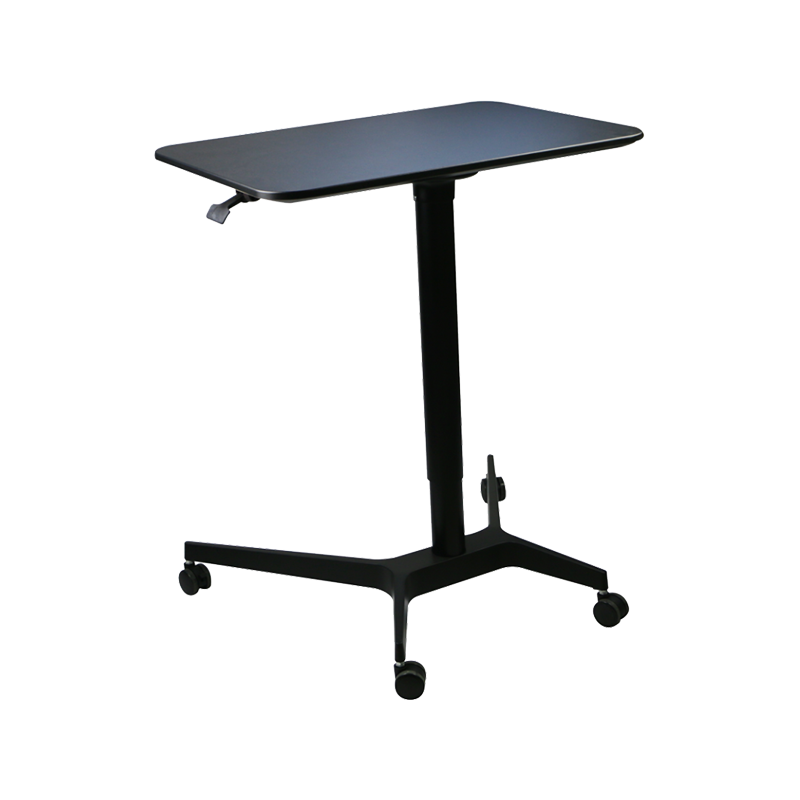
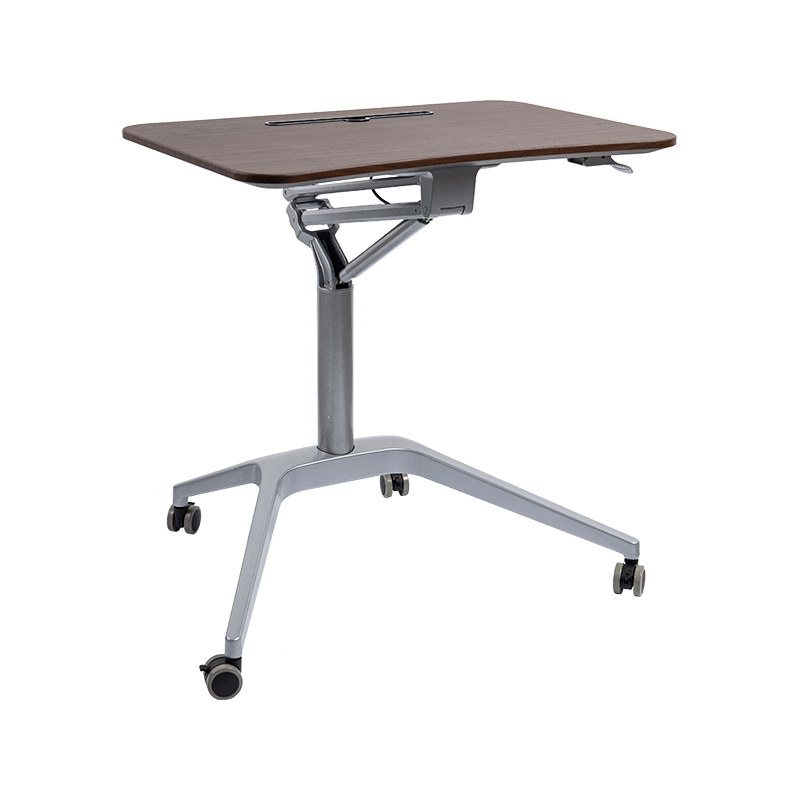
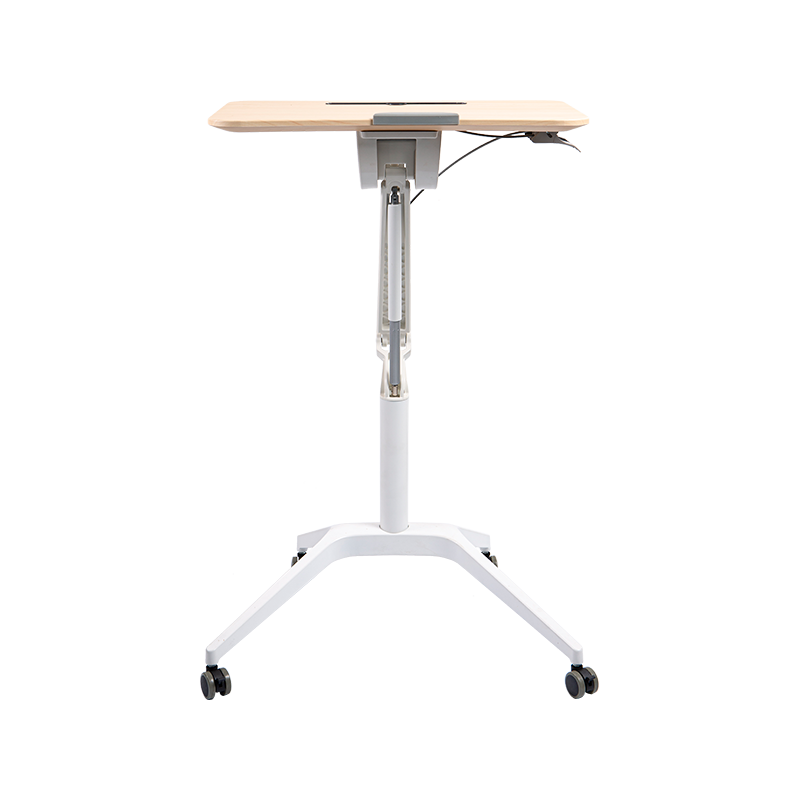
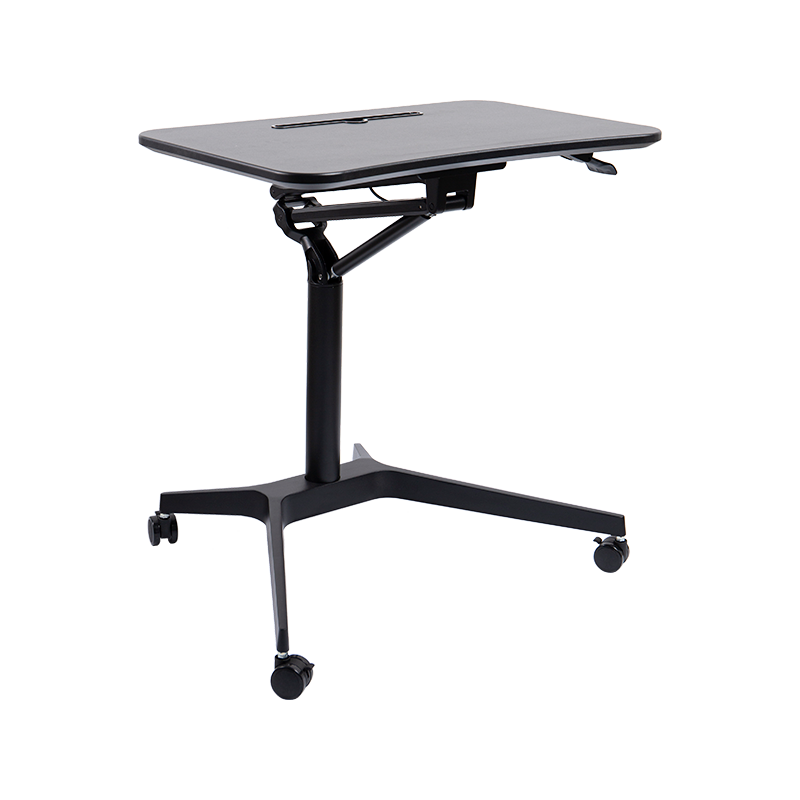
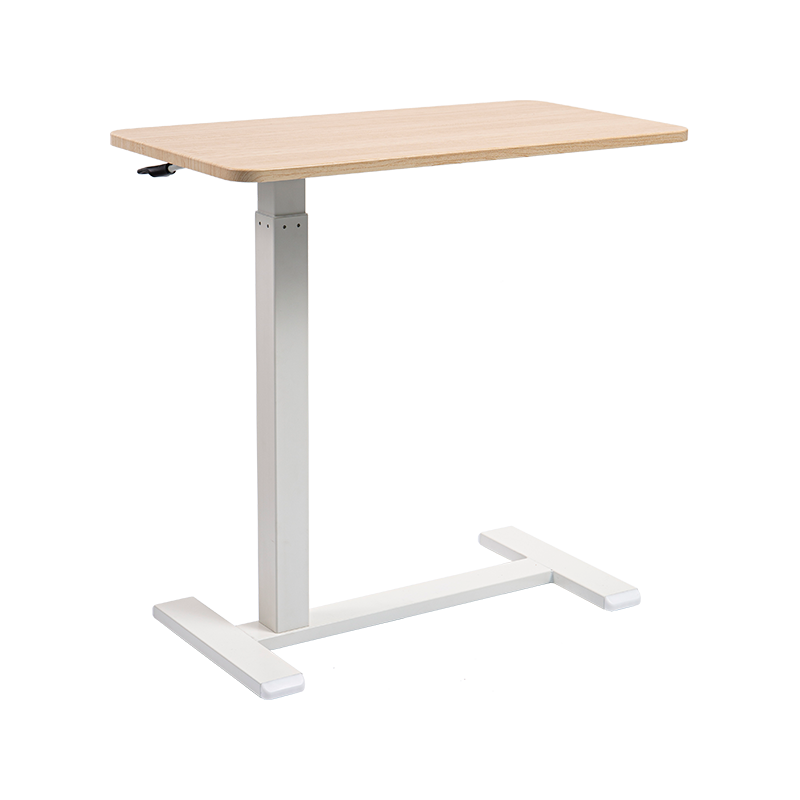
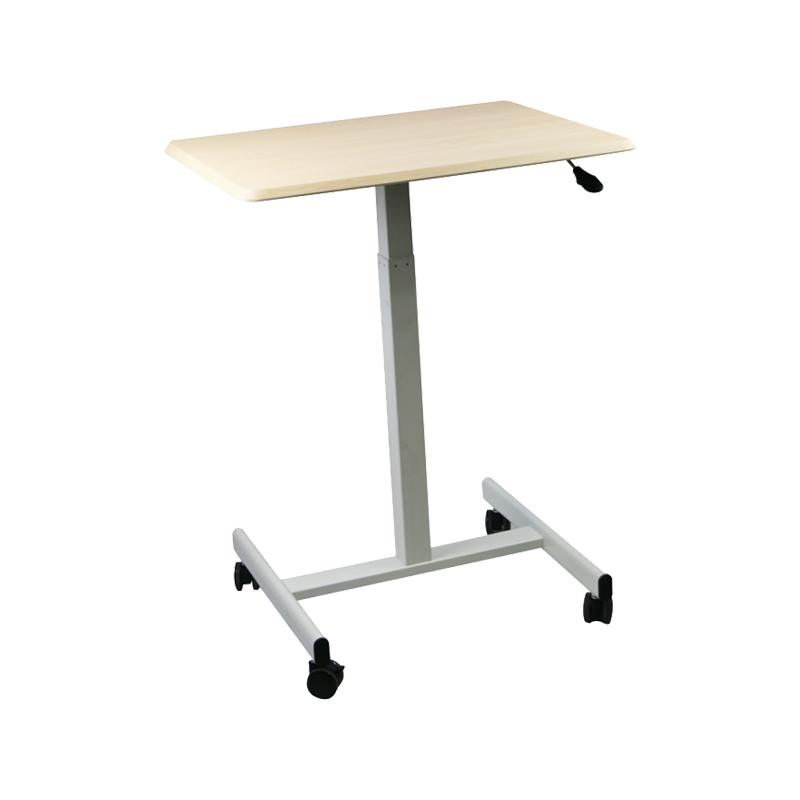
The TH10 model provides a height adjustment range from 720 mm to 1100 mm, allowing it to support both seated and standing postures. The tabletop measures 715 mm by 495 mm with a 25 mm thickness, creating a surface that is large enough for laptops, documents, instruments, tools, tablets, monitors of moderate size, or demonstration materials, yet compact enough for space-constrained rooms. The tabletop is made from 25 mm MDF with PVC vacuum forming, providing a clean finish and practical resistance for daily use. The frame combines aluminum and iron, with powder coating available in white or silver. The base uses a three-claw design with two locking casters and one non-locking caster, allowing both movement and secured positioning.
TH10 (Three-Claw Leg) Pneumatic Height-Adjustable Desk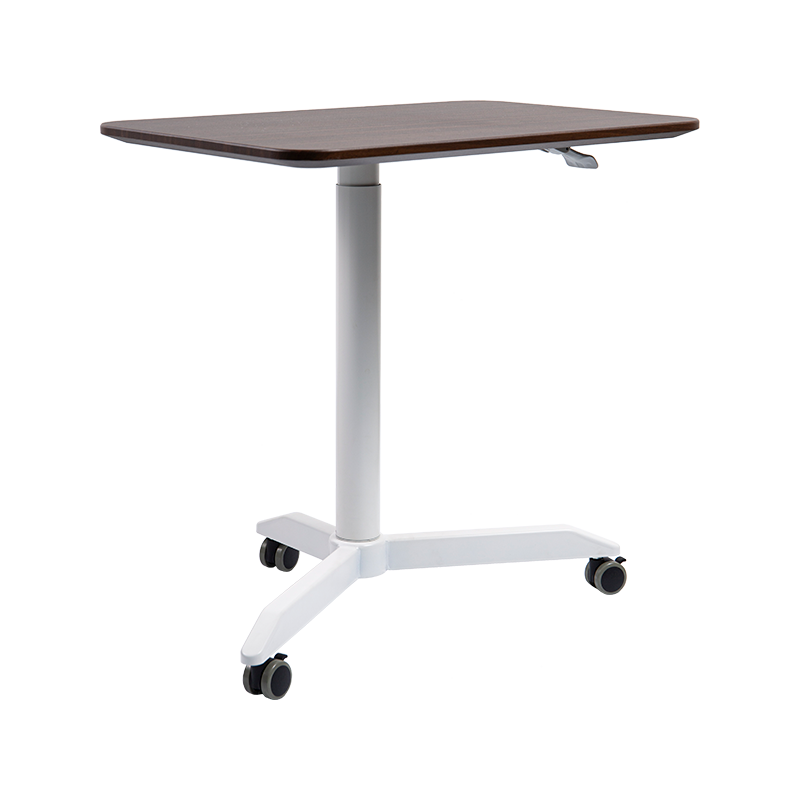
Product Overview and Design Purpose
The TH10 pneumatic height-adjustable desk is engineered as a compact, mobile, and versatile worktable. Its core purpose is to give users the freedom to change working height without relying on electricity. In many real environments, a desk is not always placed beside a wall outlet, and a workstation may need to move between rooms, departments, machines, displays, bedsides, testing benches, or training areas. A pneumatic desk eliminates the restrictions of power cables and enables users to reposition the workstation freely.
The product’s three-claw leg structure is one of its defining design characteristics. A tripod-style base is naturally stable on many floor conditions because three contact points define a plane. This makes the desk suitable for active environments where a compact footprint and stable support are both required. The base is fitted with three casters, two of which include locking functions. Users can roll the desk into place, lock the casters, and begin work without complicated setup. This makes the desk suitable for shared work areas, temporary stations, collaborative discussions, inspection tasks, and multipurpose professional settings.
The height adjustment range of 720 mm to 1100 mm covers common seated working heights as well as standing support heights. At the lower end, the desk functions as a practical seated office table, side workstation, writing table, or laptop stand. At the upper end, it supports standing work, presentations, tool handling, sample checking, and technical tasks that benefit from a higher surface. This range helps users reduce long periods of static sitting and encourages more dynamic posture changes throughout the day.
The tabletop size is carefully balanced. A very large top would reduce mobility and make the desk less convenient in compact areas. A very small top would limit practical usefulness. The 715 mm by 495 mm format offers a balanced working zone for daily productivity while maintaining easy movement. The 25 mm tabletop thickness supports a substantial feel, and the PVC vacuum-formed surface provides a smooth, visually appealing finish in walnut, white, or maple options. These finishes allow the product to fit different interior styles, from bright modern offices to warmer studio or home environments.
Key Technical Specifications
The following table summarizes the core specifications of the TH10 pneumatic height-adjustable desk and explains the practical value of each feature.
| Specification | Product Detail | Practical Benefit |
|---|---|---|
| Lifting Range | 720 mm to 1100 mm | Supports both seated and standing work positions for different users and tasks. |
| Tabletop Dimensions | 715 mm × 495 mm × 25 mm | Provides a compact but functional surface for office, technical, and creative work. |
| Tabletop Material | 25 mm MDF with PVC vacuum forming | Offers a stable board structure with a clean, attractive, and practical surface finish. |
| Frame Material | Aluminum and iron | Balances structural strength, durability, and manageable product weight. |
| Surface Color | White or silver | Allows the frame to match modern office and professional environments. |
| Surface Treatment | Powder coating | Improves corrosion resistance, appearance consistency, and long-term durability. |
| Casters | Two locking casters and one non-locking caster | Enables smooth movement and secure placement after positioning. |
| Panel Colors | Walnut, white, or maple | Provides aesthetic choices for different workplace designs. |
| Working Principle | Gas spring lifting | Allows smooth, power-free height adjustment with low maintenance needs. |
Gas Spring Lifting: Smooth Adjustment Without Electricity
The heart of the TH10 desk is its gas spring lifting system. A gas spring uses compressed gas to provide controlled force assistance, helping users raise or lower the desktop with minimal effort. Unlike a purely mechanical screw system, a gas spring can deliver smoother movement and faster adjustment. Unlike an electric actuator system, it does not require a motor, control panel, power cable, or electronic control unit. This makes the desk simple, practical, and highly adaptable.
For users, the main advantage is intuitive operation. When the height needs to change, the pneumatic mechanism supports the motion, making the adjustment process feel light and controlled. This is especially useful in environments where many different users may share the same workstation. A shared desk must be easy to adjust quickly; otherwise, users often leave it at the previous height and work in an unsuitable posture. A pneumatic design encourages more frequent and natural height changes.
The absence of electrical components also reduces several common concerns. There are no power cords to manage, no motors to synchronize, no control box to protect, and no electrical outlet requirement. This matters in training rooms, laboratories, studios, exhibition areas, workshops, mobile offices, and professional service settings where furniture layouts may change frequently. A desk that can move and adjust independently is often more useful than a fixed powered desk.
Gas spring technology also contributes to low noise. Electric desks can be quiet, but they still generate motor and gear sounds during operation. The pneumatic system operates with a softer mechanical feel, which can be valuable in quiet workplaces, consultation rooms, libraries, classrooms, and shared offices. When people adjust the desk, they can do so without causing significant disturbance.
From a maintenance perspective, pneumatic height adjustment is straightforward. The mechanism is designed for repeated manual adjustment and does not depend on electronic boards or software settings. For facilities managers and procurement teams, this simplicity can reduce operational risk. In environments where desks are moved, used by many people, or installed in different rooms, fewer electrical components often mean easier long-term management.
Ergonomic Benefits for Active Work
Ergonomics is not only about comfort; it is also about supporting healthier work habits and improving task efficiency. A fixed-height desk often forces the user to adapt to the furniture. An adjustable desk allows the furniture to adapt to the user. The TH10 helps create a workstation that can better match body height, chair height, task type, and personal preference.
At approximately 720 mm, the desk can serve as a seated workstation for writing, typing, reading, laptop use, instrument handling, or documentation. At higher positions, it supports standing tasks such as reviewing drawings, checking samples, giving short presentations, operating mobile devices, or performing light assembly and inspection work. The 1100 mm maximum height gives many users a practical standing work surface, especially for short-duration tasks and active posture changes.
The ability to alternate between sitting and standing can reduce the discomfort associated with prolonged static posture. While a desk alone cannot solve all ergonomic issues, an adjustable surface is a key part of a healthier workstation strategy. Users can change posture during the day, vary muscle activity, and adjust the desktop to different tasks. This flexibility is especially important in modern work routines that combine computer use, paper review, meetings, video calls, hands-on technical tasks, and collaborative discussion.
The compact surface also supports focused workflows. Rather than encouraging clutter, the tabletop offers enough room for essential tools and documents while keeping the station easy to move. For many users, a smaller mobile adjustable desk becomes a secondary active workstation next to a main desk, a mobile laptop podium, a standing discussion table, or a specialized task surface.
Tripod Base Stability and Mobility
One of the most important product features is the column tripod base. Stability is essential in any height-adjustable desk, because the center of gravity changes as the desk rises. The three-claw structure creates a balanced support geometry while maintaining a compact footprint. The desk is designed to remain practical and stable across its height range when used within appropriate working conditions.
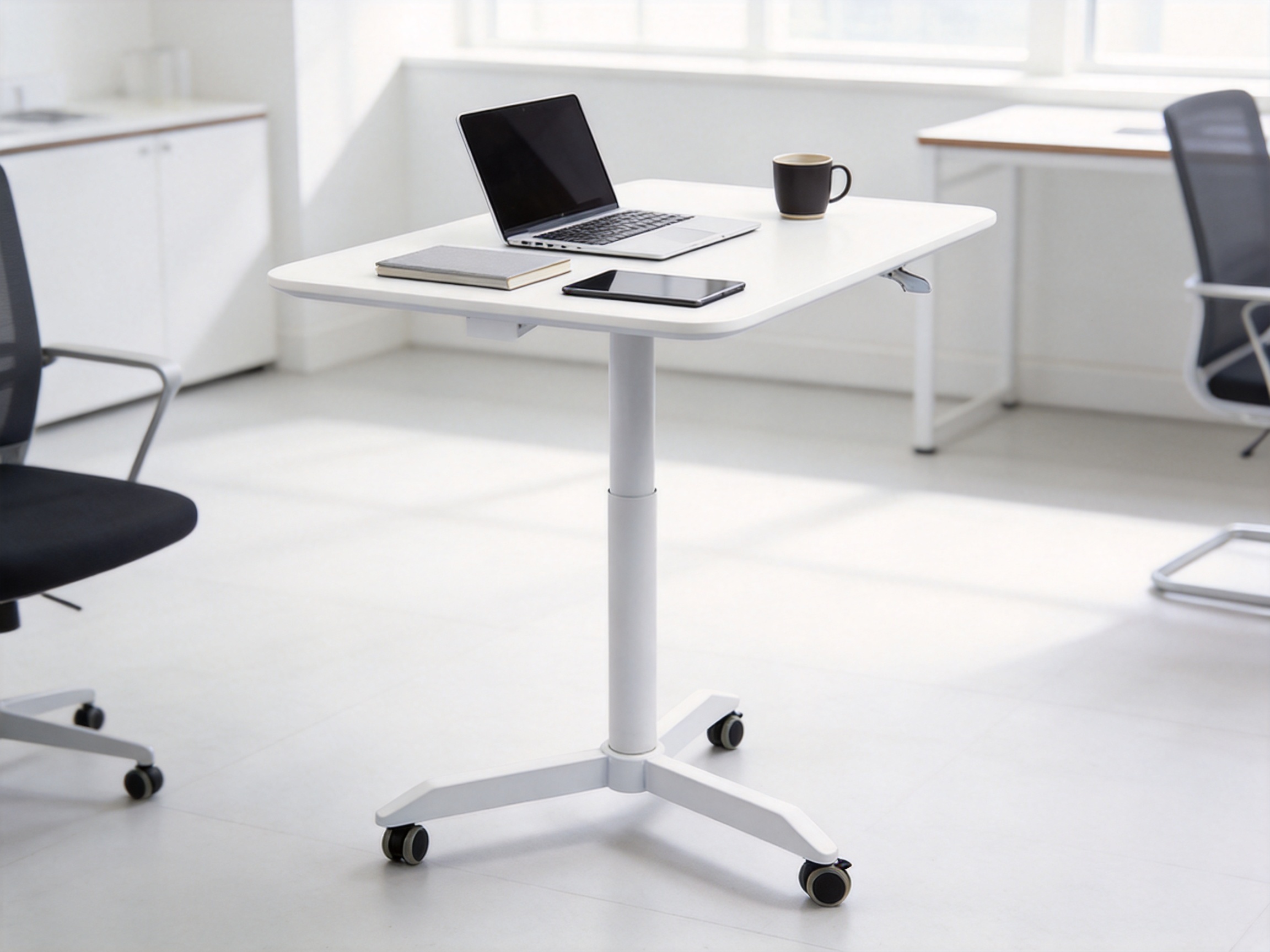
The use of two locking casters and one non-locking caster is a practical mobility solution. The non-locking caster contributes to easy movement, while the locking casters secure the desk when it is positioned. This configuration supports the typical user workflow: unlock, move, place, lock, adjust, and work. A desk with no wheels may be stable but not mobile. A desk with wheels but no locks may move when the user applies pressure. The TH10 balances both needs.
Mobility is especially valuable in professional environments where work happens in changing locations. In a studio, the desk may move between a computer area and a photography area. In a laboratory, it may serve as a temporary documentation station near different benches. In an office, it can function as a flexible laptop table for team discussions. In a workshop, it can provide a movable surface for drawings, measurement tools, and checklists. In a medical or service environment, it can be positioned where temporary support is required.
Compared with large rectangular standing desks, the TH10 offers easier maneuverability. It is not intended to replace every full-size workstation; rather, it fills the need for a mobile, compact, adjustable platform. This is a major competitive advantage in spaces where large desks are impractical or where a mobile work surface is more valuable than a fixed installation.
Material Selection and Surface Durability
The TH10 combines aluminum and iron in its structural frame. This material strategy is practical because each metal contributes useful properties. Iron offers strength and rigidity, especially where load-bearing support is required. Aluminum contributes a lighter structure and a refined appearance. Together, they help create a desk that feels durable while remaining suitable for movement.
The frame surface is finished with powder coating, available in white or silver. Powder coating is widely used in quality furniture and industrial products because it creates a durable, uniform finish. Compared with simple liquid painting, powder coating can provide better adhesion, more consistent coverage, improved resistance to chipping, and enhanced corrosion protection when properly applied. This is valuable for furniture that may be moved frequently and used in busy environments.
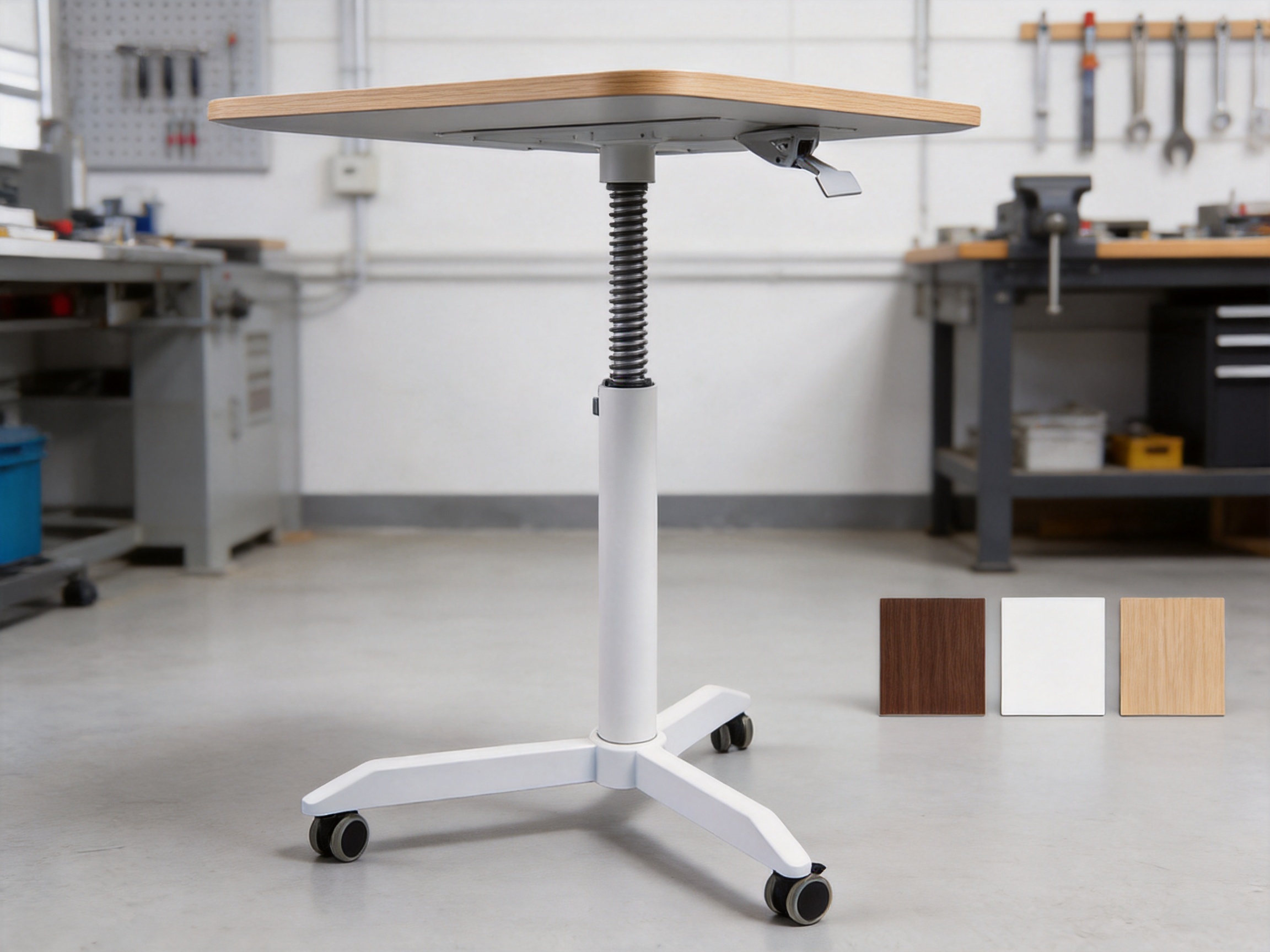
The tabletop is made from 25 mm MDF with PVC vacuum forming. MDF provides a flat and stable board structure that supports consistent shaping and finishing. PVC vacuum forming allows the surface to be wrapped cleanly, producing a smooth and attractive result. The available panel colors of walnut, white, and maple make the desk suitable for various design preferences. Walnut provides a warmer and more traditional tone, white supports a clean modern look, and maple offers a lighter natural appearance.
The 25 mm tabletop thickness is another sign of practical design. A thinner board may reduce cost but can feel less stable and less premium. A thicker board provides a more substantial working surface and improves the overall perception of quality. For users who place laptops, documents, tablets, tools, or small devices on the tabletop, this stable surface contributes to confidence during use.
Advantages Over Competing Desk Solutions
The TH10 competes not only with other pneumatic desks but also with fixed desks, electric standing desks, rolling laptop carts, and mobile podiums. Its advantages become clearer when compared with these alternatives.
Compared with fixed-height desks, the TH10 provides ergonomic flexibility. A fixed desk can be suitable for one seated posture but cannot easily support standing work or users of different heights. In shared workspaces, fixed desks often force compromises. The TH10 reduces that limitation by allowing quick height changes between 720 mm and 1100 mm.
Compared with electric standing desks, the TH10 offers independence from power. Electric desks are excellent for heavy office setups, but they require access to electricity and often include cables, motors, controllers, and control panels. The TH10 eliminates these dependencies. It is easier to place anywhere, easier to move, and simpler to manage in dynamic environments. For mobile tasks, power-free adjustment is a major advantage.
Compared with basic rolling carts, the TH10 offers a more refined height-adjustment experience and a stronger ergonomic purpose. Many carts are designed only for transport or storage and may not provide a smooth sit-stand range. The TH10 is built as a worktable, not merely a cart. Its tabletop, pneumatic lifting mechanism, and stable tripod base make it more suitable for active work.
Compared with bulky mobile workstations, the TH10 is compact and visually clean. It does not overwhelm a small room, and it can be moved with minimal effort. Its design is especially suitable for environments that need flexibility without visual clutter. The white or silver frame and multiple tabletop colors support modern workspace aesthetics.
Compared with lower-cost adjustable tables, the TH10 emphasizes balanced construction, functional casters, powder-coated metal surfaces, and gas spring lifting. The combination of aluminum and iron provides practical strength. The caster design improves movement and locking. The 25 mm tabletop adds substance. These elements create a product that is designed for repeated everyday use rather than occasional adjustment only.
Manufacturing Strength Behind the Product
The product reflects the manufacturing strengths of SuZhou Skyhone Intelligent Technology Co., Ltd., a professional enterprise focused on the research, development, production, sales, and service of standing desk solutions. Located in Suzhou, within the Yangtze River Delta region, the company benefits from one of China’s most developed furniture and intelligent manufacturing industrial clusters. This regional advantage provides access to mature supply chains, skilled labor, advanced processing capabilities, reliable component suppliers, and efficient logistics.
Advanced manufacturing is not only about machines; it is about disciplined process control. A height-adjustable desk requires coordination between metal processing, surface treatment, gas spring integration, board finishing, assembly accuracy, caster installation, packaging protection, and quality inspection. Each step affects the user experience. If the frame is not aligned, the desk may feel unstable. If the powder coating is inconsistent, the finish may wear prematurely. If the lifting mechanism is not properly matched, height adjustment may feel too heavy or too loose. If packaging is insufficient, the product may be damaged during transport. A professional manufacturing system controls these variables.
For a product like the TH10, precision metal fabrication is central. The aluminum and iron parts must be produced with reliable dimensional accuracy so that the column, base, tabletop support, and casters assemble correctly. Welding, forming, cutting, punching, drilling, and finishing processes must be controlled to ensure consistency. A good manufacturing team also considers long-term repeated use, not only first appearance. Structural parts must resist deformation, remain aligned, and support the expected working conditions.
Powder coating is another area where manufacturing capability matters. Quality powder coating requires proper surface preparation, clean application, controlled curing, and finish inspection. The result should be smooth, uniform, and durable. In white or silver finishes, surface defects can be visually obvious, so coating consistency is important. A manufacturer with experience in standing desks understands that appearance and durability are both essential for professional furniture.
The tabletop manufacturing process is also significant. MDF board must be selected and processed to achieve the required thickness and flatness. PVC vacuum forming must be performed with appropriate temperature, pressure, and edge control to create a clean surface. A good tabletop should look consistent, feel stable, and match the frame aesthetically. The availability of walnut, white, and maple finishes requires reliable color and surface management.
Assembly quality is the final bridge between components and user experience. The gas spring mechanism must be installed so the adjustment range performs correctly. The tripod base must be balanced. The casters must rotate smoothly and lock properly. The tabletop must be secured firmly. A manufacturer experienced in adjustable furniture applies inspection standards to confirm that the product functions as intended before shipment.
Research and Development Orientation
The company’s background in standing desk research and development supports continuous product improvement. Height-adjustable furniture requires understanding of ergonomics, mechanical balance, user behavior, material durability, and assembly efficiency. A desk may appear simple, but the details determine whether it performs reliably in daily use.
For the TH10, development priorities include smooth lifting, stable support, compact mobility, attractive appearance, and practical manufacturing efficiency. The gas spring must be matched to the table structure and intended use. The base must provide stability without becoming unnecessarily large. The tabletop must offer enough usable space without reducing mobility. The caster arrangement must support movement while preventing unwanted rolling when locked. These are design decisions based on real user needs.
Research and development also support customization potential. Buyers may require different colors, surface finishes, packaging methods, branding arrangements, or product configurations. A manufacturer with strong product development capability can respond to market needs more effectively than a basic trading supplier. This is important for distributors, project buyers, office furniture companies, and professional procurement teams that need dependable product adaptation.
In the broader adjustable desk market, R&D capability helps the company serve different product categories, including adjustable height desks, electric linear actuator systems, and gas spring solutions. This technical background gives the company a wider understanding of height adjustment mechanisms. By working with both electric and pneumatic principles, the manufacturer can select the appropriate technology for different applications rather than forcing one solution for every use case.
Quality Control and Reliability
Reliability is one of the most important concerns for adjustable furniture. Users expect the desk to adjust smoothly, remain stable, move easily, and maintain its finish over time. Procurement teams expect consistent quality across batches. The TH10’s design is supported by material selection, controlled production, and practical inspection.
Quality control begins with incoming materials. Metal components, gas springs, casters, MDF boards, PVC films, fasteners, and coating materials must meet defined requirements. If a component varies too much, the final desk may not perform consistently. Incoming inspection helps prevent problems before assembly begins.
During production, dimensional control ensures that parts fit together correctly. For a height-adjustable column and base, small errors can affect alignment and stability. Surface treatment inspection ensures that the powder-coated finish meets appearance and durability expectations. Tabletop inspection checks color, surface quality, edge treatment, and flatness. Gas spring inspection confirms functional lifting behavior. Caster inspection confirms rolling and locking performance.
Final assembly inspection is especially important. The desk should be checked for height adjustment range, smooth operation, tabletop stability, caster function, frame appearance, and packaging integrity. A product that passes these checks is more likely to satisfy users and reduce after-sales issues.
Reliability also comes from design simplicity. Because the TH10 uses pneumatic adjustment rather than electric lifting, there are fewer electronic failure points. There is no motor synchronization issue, no control panel malfunction, and no cable damage concern. For many buyers, this simplicity is a strategic advantage, especially in high-use shared environments.
Applications in Office, Studio, Laboratory, and Workshop Settings
The TH10 is designed for broad application. In personal offices, it can function as a compact sit-stand desk for laptop work, document review, video calls, and task changes. It is especially useful as a secondary workstation beside a larger desk, allowing users to stand for certain tasks without replacing their main office setup.
In shared offices, the desk can be moved between meeting areas, quiet corners, and collaborative spaces. A team member may use it as a temporary laptop station during a discussion, then another user may adjust it for standing work. Its power-free adjustment and casters make it practical for agile office layouts.
In studios, the desk can support drawing tablets, reference materials, design tools, camera accessories, or craft materials. Creative work often requires posture variation and frequent movement between zones. The TH10’s compact tabletop and mobile base make it useful for designers, photographers, artists, and content creators.
In laboratories, the desk can serve as a documentation surface, laptop platform, instrument support table, or mobile note-taking station. Many lab environments require workers to move between benches and equipment. A compact adjustable desk can improve workflow by placing documentation or digital tools at the correct height near the active work area. Users should always evaluate chemical, load, and cleanroom requirements before selecting any furniture, but for general technical support tasks, the desk is highly practical.
In workshops, the desk can hold drawings, checklists, measurement tools, tablets, small parts, or assembly documents. Workers may need a raised surface while standing near equipment. The ability to move and lock the desk helps support flexible production or repair activities.
In education and training spaces, the desk can serve as a mobile teaching podium, demonstration table, or instructor workstation. Because it does not require electricity for height adjustment, it can be placed wherever visibility and access are best. The adjustable height supports different instructors and presentation styles.
In healthcare-adjacent or service environments, the desk can be used as a mobile support table for documentation, consultation materials, or digital devices. Its smooth height adjustment and compact size are useful where users must move between different rooms or service points. As with all professional environments, specific safety and hygiene requirements should be considered according to the application.
Space Efficiency and Modern Workplace Planning
Space efficiency is one of the TH10’s strongest advantages. Many offices and professional rooms do not have space for additional full-size desks. However, they still need flexible surfaces for temporary tasks. The TH10 provides a functional work surface without dominating the room. Its compact size allows it to fit beside desks, near equipment, in corners, or between work zones.
In modern workplace planning, flexibility is often more valuable than permanent furniture density. A room may need to function as a meeting space in the morning, a training area in the afternoon, and a project workspace later in the day. Mobile adjustable furniture supports this kind of transformation. The TH10 can be repositioned quickly, adjusted to the current user, and stored more easily than large fixed desks.
The product also supports hybrid work behavior. Many users now switch between laptop work, video conferencing, document review, collaboration, and mobile device tasks. A compact adjustable desk can follow the user’s workflow. Instead of being limited to one fixed station, the user can create a temporary ergonomic station wherever needed.
For facility managers, a fleet of compact pneumatic desks can improve workplace adaptability. They can be deployed as temporary workstations, standing meeting tables, training support surfaces, or mobile technology stands. Because they do not depend on power for adjustment, deployment is simpler. This can reduce planning constraints and make space management more efficient.
Aesthetic Flexibility
Furniture must perform well, but it also needs to fit visually into the environment. The TH10 offers frame colors in white and silver, along with tabletop finishes in walnut, white, and maple. These choices allow buyers to match different design directions.
A white frame with a white tabletop creates a clean, minimalist appearance suitable for modern offices, healthcare-inspired interiors, training spaces, and bright studios. A silver frame with a maple tabletop offers a lighter natural tone that works well in educational, creative, or Scandinavian-style settings. A white or silver frame with a walnut tabletop provides warmth and contrast, making the desk suitable for executive offices, consultation rooms, and home work areas.
The clean appearance of the desk is strengthened by the absence of visible electrical controls and cables. Electric desks often require cable management, especially when moved. The pneumatic TH10 keeps the design visually simple. This supports a tidy environment and reduces clutter around the workstation.
Why Pneumatic Adjustment Can Be the Better Choice
Many buyers automatically compare all height-adjustable desks with electric standing desks. However, the best choice depends on the application. Pneumatic adjustment can be the better choice when mobility, simplicity, quiet operation, and power independence are priorities.
For example, if a workstation holds multiple monitors and heavy equipment, an electric desk may be suitable. But if the need is a compact mobile desk for laptop work, inspection, presentations, or shared use, a pneumatic desk may offer better efficiency. It adjusts quickly, moves easily, and avoids the complications of power access.
Pneumatic adjustment also encourages spontaneous use. Users do not need to locate a switch or wait for motorized travel. They can change height directly and continue working. In shared settings, this immediate operation is valuable. A simple mechanism is often used more frequently because it feels natural.
The TH10 therefore occupies a specific and important position in the adjustable desk market. It is not just a smaller version of an electric standing desk. It is a purpose-built mobile pneumatic worktable for environments where flexibility matters.
Procurement Value for Distributors and Project Buyers
For distributors, office furniture suppliers, and project buyers, product value depends on more than specifications. A successful product must meet market demand, be easy to explain, be reliable in use, and fit a range of applications. The TH10 has strong procurement appeal because it solves a clear problem: users need compact, mobile, adjustable work surfaces that do not require electricity.
The product is easy to position in the market. It can be presented as a pneumatic sit-stand desk, mobile laptop table, adjustable office table, studio worktable, training podium, laboratory support table, or compact ergonomic workstation. This versatility expands its customer base. Instead of being limited to one niche, it can serve many sectors.
The available color options also support channel sales. Different customers may prefer different finishes, and the walnut, white, and maple tabletop choices make the product easier to match with existing furniture. White and silver frame options further improve adaptability.
From a logistics perspective, compact adjustable desks can be more convenient than large office tables. While packaging design must still protect all components, the product’s size supports efficient handling compared with full-size frames. For project buyers, the ease of movement after installation is another advantage. Furniture can be deployed, rearranged, and reused as needs change.
The manufacturer’s background in standing desk solutions adds procurement confidence. Buyers often prefer suppliers with technical specialization because they understand the details of lifting mechanisms, frame stability, surface treatment, and ergonomic requirements. A professional standing desk manufacturer is better positioned to provide consistent products and support long-term cooperation.
Advanced Manufacturing Processes in Practice
Advanced manufacturing for the TH10 can be understood through several coordinated process areas. The first is component engineering. The desk’s structural components must be designed for repeatable production, accurate assembly, and reliable performance. Metal parts require careful forming and machining to maintain dimensional consistency.
The second area is surface preparation and powder coating. Before coating, metal surfaces must be cleaned and prepared so the powder adheres properly. The coating is then applied evenly and cured under controlled conditions. This creates a durable finish that improves resistance to daily wear and environmental exposure.
The third area is gas spring integration. The lifting mechanism must provide the right balance of force and control. If the gas spring is not properly selected or installed, the desk may rise too quickly, lower too abruptly, or require excessive effort. Proper integration ensures smooth operation across the full height range.
The fourth area is tabletop processing. MDF board preparation, PVC vacuum forming, edge quality, finish consistency, and dimensional accuracy all affect the final product. The tabletop is a visible and functional component, so its manufacturing quality directly influences user satisfaction.
The fifth area is assembly and inspection. Skilled assembly ensures that the column, base, casters, lifting mechanism, and tabletop work together. Inspection verifies that the desk meets performance expectations before packaging. This includes checking adjustment, stability, caster locking, finish quality, and overall appearance.
The sixth area is packaging engineering. Adjustable furniture includes both surface-finished parts and mechanical components, so packaging must prevent scratches, dents, and movement during shipping. Well-designed packaging helps the product arrive in good condition and reduces after-sales costs.
Sustainability and Practical Resource Use
Sustainability in furniture is often discussed in terms of materials, energy use, product longevity, and maintenance. The TH10 contributes to practical sustainability in several ways. Because its height adjustment is pneumatic, it does not consume electricity during operation. There are no motors drawing power and no electronic control parts that may require replacement.
The desk’s mobility also supports efficient space use. Instead of purchasing multiple fixed tables for different areas, organizations can use mobile adjustable desks where needed. A flexible product can serve several roles over its lifetime, reducing unnecessary furniture duplication.
Durability is another sustainability factor. A product that lasts longer and remains useful through changing layouts creates less waste than a product that is quickly discarded. The metal frame, powder coating, substantial tabletop, and simple lifting mechanism all support long-term use when properly maintained.
Finally, the desk supports healthier work behavior, which is a form of human-centered sustainability. Workspaces that encourage movement, posture variation, and user comfort can contribute to better daily work experiences. Sustainable design should consider not only materials but also how people interact with products over time.
User Experience and Daily Operation
The daily experience of using the TH10 is straightforward. A user can move the desk to the desired location, lock the casters, adjust the height, and begin work. The process requires no power connection and no complex setup. This simplicity makes the desk accessible to a wide range of users.
In seated mode, the desk can support focused laptop work or writing. In standing mode, it can become a quick review station or presentation surface. In mobile use, it can carry essential work materials from one area to another. Because the tabletop is compact, users are encouraged to keep the surface organized and task-focused.
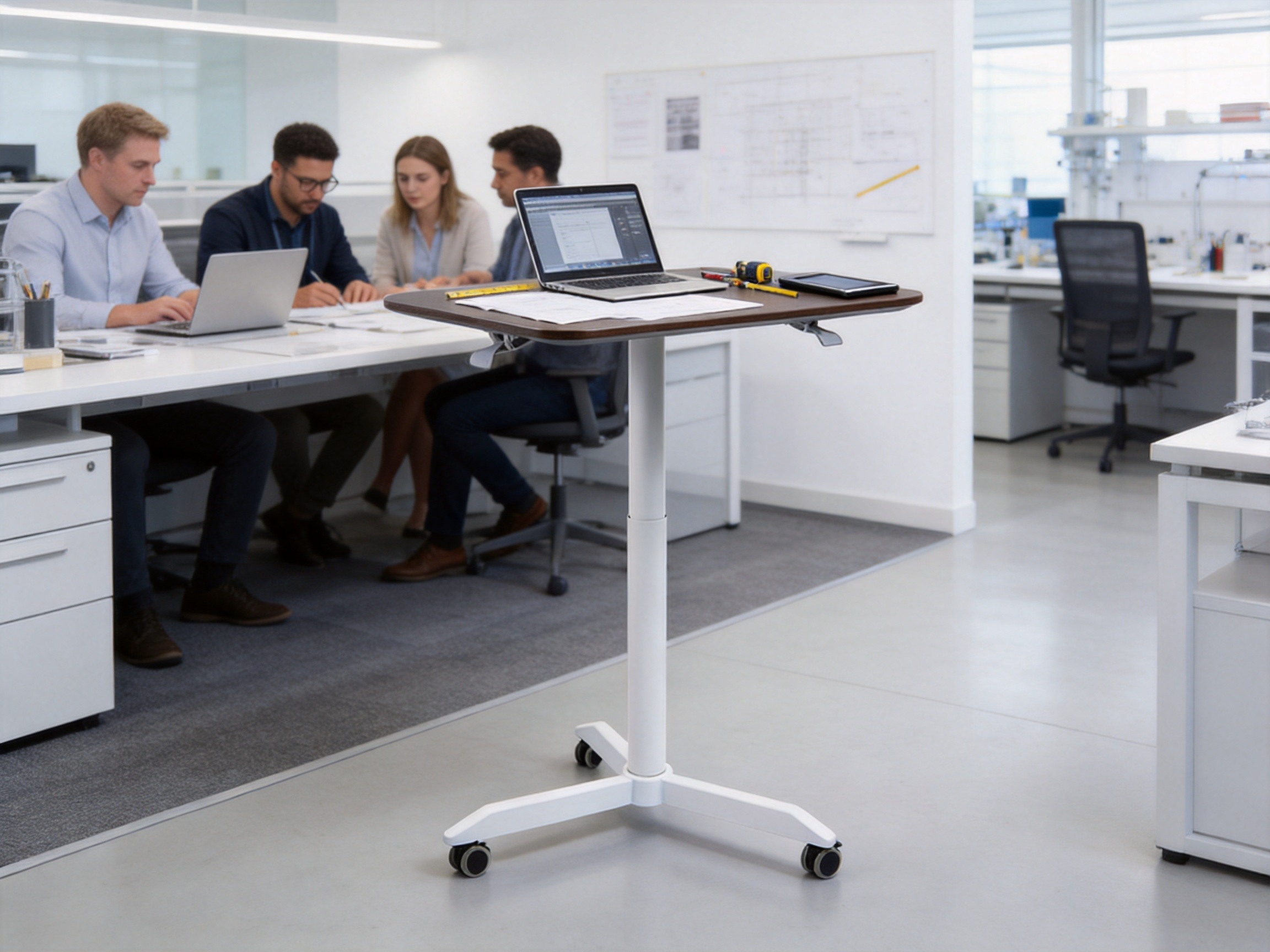
The desk can also support collaborative work. For example, during a project discussion, it can hold a laptop or document at a convenient standing height while team members gather around. In a training room, it can serve as an instructor’s mobile station. In a workshop, it can hold inspection sheets near the workpiece. These use cases demonstrate the value of combining mobility with height adjustment.
Maintenance Recommendations
The TH10 is designed for low maintenance, but proper care helps preserve performance and appearance. Users should keep the tabletop clean with suitable non-abrasive cleaning methods. Excess moisture should be avoided, especially at edges and joints. The powder-coated frame can be wiped with a soft cloth to remove dust and marks.
Casters should be kept free from debris that may affect rolling. If the desk is used in workshops or studios, small particles can collect around caster wheels, so periodic inspection is helpful. Locking casters should be checked to ensure they engage properly before work begins.
The gas spring mechanism should be used within normal operating expectations. Users should avoid forcing the desk beyond its designed height range. Heavy overload should be avoided, as all height-adjustable furniture has practical load limitations. The desk should be adjusted smoothly and used on suitable floor surfaces.
Fasteners may be checked periodically, especially in high-use shared environments. Mobile furniture can experience vibration during movement, so occasional tightening and inspection can help maintain long-term stability.
Frequently Asked Questions
What type of height adjustment does this desk use?
The desk uses a gas spring lifting mechanism. This pneumatic system allows smooth manual height adjustment without electricity, motors, or control boxes.
What is the height adjustment range?
The lifting range is from 720 mm to 1100 mm. This range supports common seated working positions and many standing work applications.
Does the desk need to be plugged into a power outlet?
No. The desk does not require electrical power for height adjustment. This makes it easy to place and move in different rooms or work areas.
What are the tabletop dimensions?
The tabletop measures 715 mm by 495 mm and has a thickness of 25 mm. This provides a compact but practical work surface for laptops, documents, tools, tablets, and similar items.
What materials are used in the desk?
The tabletop is made from 25 mm MDF with PVC vacuum forming. The frame combines aluminum and iron, and the surface is finished with powder coating.
What colors are available?
The frame is available in white or silver. The tabletop is available in walnut, white, or maple finishes.
Is the desk easy to move?
Yes. The desk includes three casters: two with locking functions and one without a lock. This allows the desk to be moved easily and secured when positioned.
How does this product compare with an electric standing desk?
An electric standing desk is often suitable for larger and heavier workstations, but it requires power and includes electrical components. This pneumatic desk is better suited for compact, mobile, power-free, and flexible work applications.
Where can this desk be used?
It is suitable for personal offices, shared offices, workshops, studios, laboratories, classrooms, training rooms, and other environments where adjustable height and mobility are useful.
Why is the tripod base important?
The three-claw base provides stable support while keeping the footprint compact. It helps the desk remain practical for mobile and space-efficient use.
Yes. The simple pneumatic adjustment, compact size, and caster mobility make it highly suitable for shared environments where different users need quick height changes.
What manufacturing strengths support the product quality?
The product benefits from specialized standing desk manufacturing experience, metal fabrication capability, powder coating processes, tabletop finishing, gas spring integration, assembly control, and quality inspection.
Conclusion
The TH10 three-claw leg pneumatic height-adjustable desk is a practical solution for modern flexible workspaces. It combines smooth gas spring lifting, a 720 mm to 1100 mm height range, compact tabletop dimensions, durable aluminum and iron construction, powder-coated frame finishes, PVC vacuum-formed tabletop surfaces, and a mobile tripod base with locking casters. These features create a desk that is easy to adjust, easy to move, and easy to integrate into many professional environments.
Its advantages over competing solutions are clear. Compared with fixed desks, it offers ergonomic height flexibility. Compared with electric standing desks, it provides power-free mobility and simpler maintenance. Compared with basic carts, it delivers a more purposeful worktable experience. Compared with bulky mobile workstations, it offers a cleaner and more space-efficient design.
Behind the product is a manufacturer with experience in standing desk research, development, production, sales, and service. SuZhou Skyhone Intelligent Technology Co., Ltd. benefits from the industrial strengths of the Yangtze River Delta region and applies professional manufacturing processes to support product consistency. From metal fabrication and powder coating to tabletop processing, gas spring integration, assembly, and inspection, the product reflects a practical understanding of adjustable furniture requirements.
For offices, studios, laboratories, workshops, training spaces, and compact work areas, the TH10 provides a valuable balance of ergonomics, mobility, durability, and simplicity. It is not merely a desk that moves up and down; it is a flexible work platform designed for the changing ways people work today.
References
Bridger, R. S. Introduction to Human Factors and Ergonomics. CRC Press.
Kroemer, K. H. E., and Grandjean, E. Fitting the Task to the Human: A Textbook of Occupational Ergonomics. Taylor and Francis.
Pheasant, S., and Haslegrave, C. M. Bodyspace: Anthropometry, Ergonomics and the Design of Work. CRC Press.
Sanders, M. S., and McCormick, E. J. Human Factors in Engineering and Design. McGraw-Hill.
Helander, M. A Guide to Human Factors and Ergonomics. CRC Press.
International Organization for Standardization. Ergonomic Requirements for Office Work with Visual Display Terminals and Related Workplace Standards.
Materials and Processes in Manufacturing. DeGarmo, Black, and Kohser. Wiley.
Product: TH10 (Three-Claw Leg) Pneumatic Height-Adjustable Desk


- Contact Info
-
-
 Phone+86-15950656125
 -
 Email
Email -
 AddressRoom 1007-1, South Building, Suyue Plaza, Suzhou Industrial Park, Suzhou City, Jiangsu Province, China
-
- Products
- Follow Us
- Need help? Please contact us
Copyright ©
SuZhou Skyhone Intelligent Technology Co., Ltd.
All Rights Reserved.
Privacy
Custom Ergonomic Adjustable Office Tables Manufacturers

