

 English
  русский
  Español
  عربى
عربى 
Content
- 1 1. Why Height Adaptability Matters in Modern Workspaces
- 2 2. Product Overview
- 3 3. Gas Spring Lifting: A Practical Alternative to Motorized Adjustment
- 4 4. 700 mm to 1100 mm: Supporting Sitting and Standing Positions
- 5 5. Main Panel Tilt Function
- 6 6. Desktop Construction and Surface Options
- 7 7. Frame Materials and Structural Balance
- 8 8. Mobility Without Sacrificing Position Control
- 9 9. Advantages Compared with Conventional Fixed Desks
- 10 10. Advantages Compared with Electric Height-Adjustable Desks
- 11 11. Manufacturing Capabilities Supporting Product Quality
- 12 12. Production Process from Concept to Finished Desk
- 13 13. Company Strengths in Research, Production, and Service
- 14 14. Applications for the TH11
- 15 15. Installation, Use, and Maintenance Considerations
- 16 16. Customization and Procurement Considerations
- 17 17. Why the TH11 Is a Competitive Product
- 18 18. Frequently Asked Questions
- 18.1 18.1 What type of desk is the TH11?
- 18.2 18.2 What is the height adjustment range?
- 18.3 18.3 Does the desk require electricity?
- 18.4 18.4 Is the main panel adjustable in angle?
- 18.5 18.5 What materials are used?
- 18.6 18.6 What colors are available?
- 18.7 18.7 Can the desk be moved?
- 18.8 18.8 What environments are suitable for the TH11?
- 18.9 18.9 Does the product have a specified maximum load?
- 18.10 18.10 How does the TH11 compare with an electric standing desk?
- 18.11 18.11 Is the product available for customized projects?
- 19 19. Conclusion
- 20 References
- 21 Product: TH11 (Cat Head Leg) Pneumatic Height-Adjustable Desk
TH11 Pneumatic Height-Adjustable Desk: Flexible Ergonomics Without Electrical Power
2026-07-25
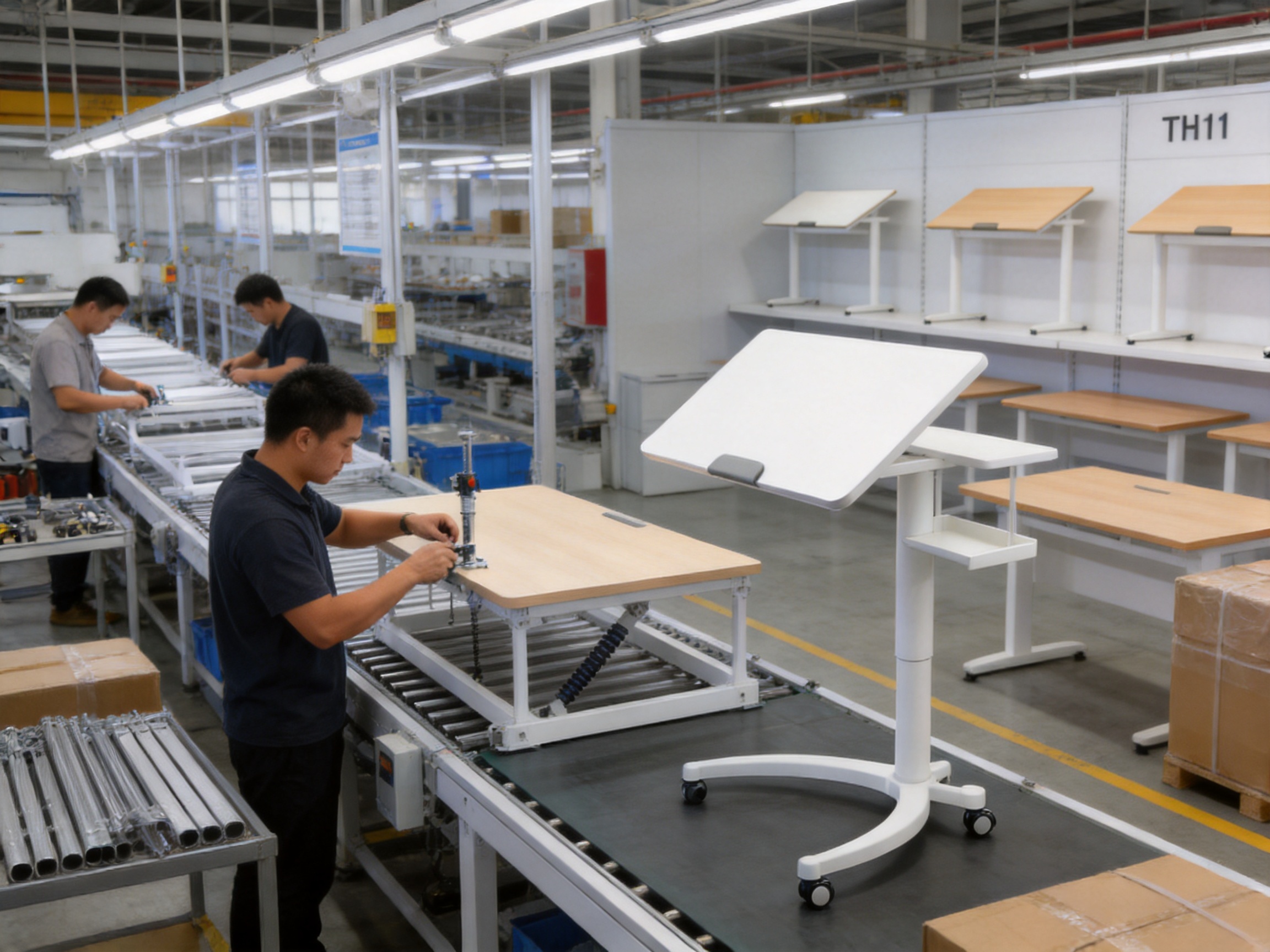
Modern workspaces increasingly require furniture that can adapt to different users, working positions, and operating tasks. A fixed-height desk may be adequate for a limited range of activities, but it can become restrictive when several people share a workstation or when one task requires sitting while another requires standing. The TH11 Pneumatic Height-Adjustable Desk addresses these needs with a gas spring lifting system, a tilting main panel, a mobile base, and a practical height range of 700 mm to 1100 mm.
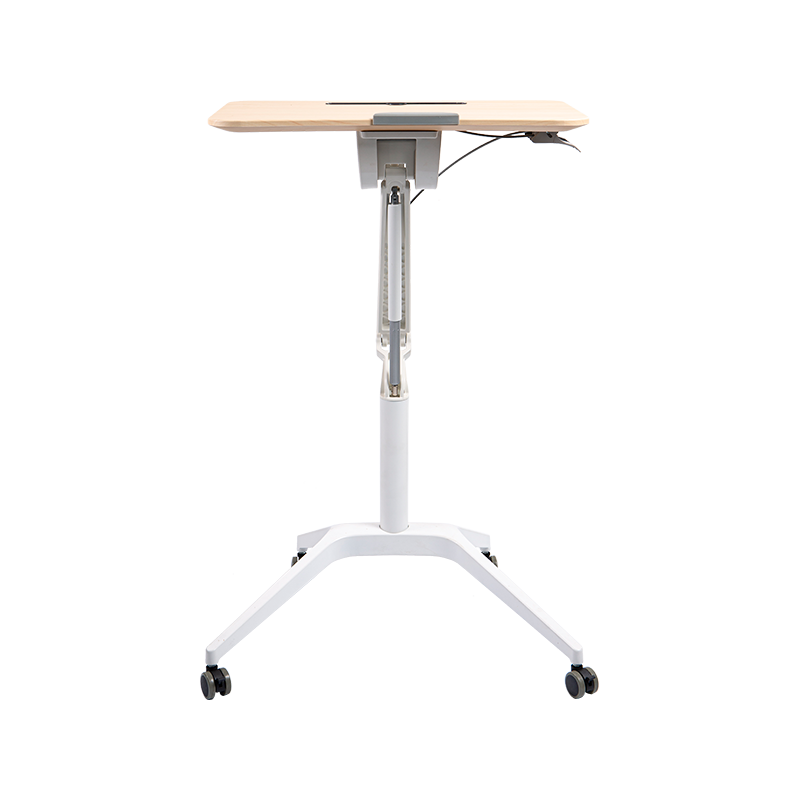
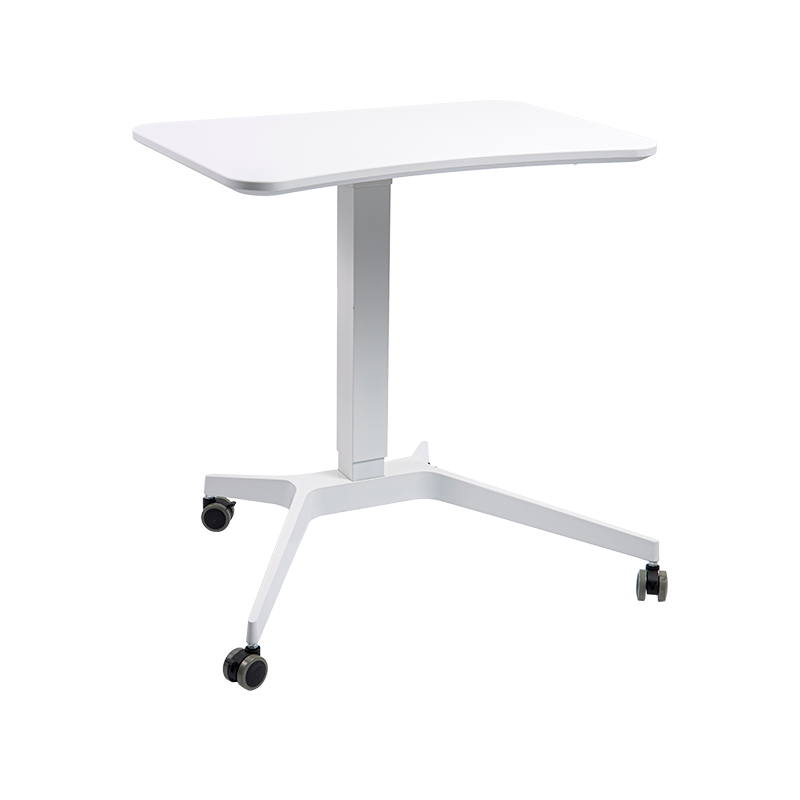
Designed as a pneumatic height-adjustable table, the TH11 combines a compact footprint with a structure made from aluminum and iron. Its 760 mm by 400 mm main tabletop provides a useful working area, while the additional 760 mm by 20 mm tabletop component contributes to the overall configuration. The desk is available with white or maple wood panel colors, and its white powder-coated surface gives the frame a clean appearance suitable for offices, classrooms, laboratories, studios, and industrial workstations.
Unlike electrically powered standing desks, the TH11 does not depend on motors, control boxes, power cords, or wall outlets for height adjustment. Its gas spring mechanism is intended to provide quiet, smooth, and intuitive movement. This makes the desk particularly attractive in spaces where electrical simplicity, low maintenance, mobility, and flexible positioning are important.
The product is manufactured and supplied by SuZhou Skyhone Intelligent Technology Co., Ltd., a Suzhou-based enterprise specializing in the research and development, production, sales, and service of standing desks. By combining product development with manufacturing capabilities in the Yangtze River Delta furniture industry, the company supports the creation of adjustable workspace solutions for users with varied ergonomic and operational requirements.
1. Why Height Adaptability Matters in Modern Workspaces
Workstations are no longer designed for only one posture or one user. A home office may be used by adults of different heights. A school or laboratory may need to accommodate students, instructors, and technicians. An industrial workstation may be shared between shifts, with every operator requiring a slightly different working height. In these situations, a fixed desk can force users to compromise their posture or modify the surrounding environment to compensate.
An adjustable desk provides a more practical alternative. By changing the working height, users can bring the tabletop closer to a comfortable elbow position, reduce excessive shoulder elevation, and create a more natural relationship between the user and the work surface. When a task requires standing, the desk can be raised. When seated work is preferred, the surface can be lowered. The adjustment range of the TH11, from 700 mm to 1100 mm, supports both positions for a broad group of users and applications.
Height adjustment also helps organizations make better use of shared furniture. Instead of purchasing separate desks for different users or tasks, one pneumatic table can serve several purposes. The compact design is valuable in environments where floor space is limited, while the concealed wheels allow the unit to be repositioned when the room layout changes.
Ergonomics is not limited to height. The angle of the work surface can also influence comfort, visibility, and task precision. The TH11 includes a tilt function on the main panel, allowing users to adapt the surface to reading, drawing, inspection, demonstration, or other activities that benefit from a non-horizontal working angle.
2. Product Overview
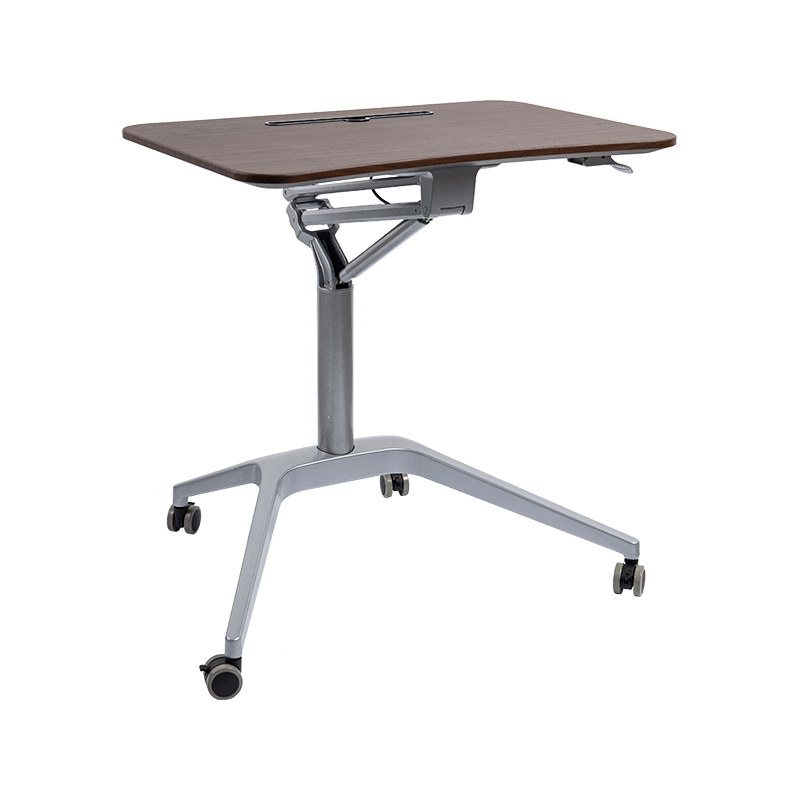
The TH11 is a pneumatic height-adjustable desk with a cat-head-leg or cat-paw-style base configuration. This distinctive base design contributes to the product’s visual identity while supporting a compact and practical structure. The frame combines aluminum and iron, balancing the advantages of both materials within a single desk construction.
Aluminum can contribute to a lighter and more manageable structure, which is useful when a desk needs to be moved within a room. Iron provides structural strength for components that require firm support. The combination is finished with a white powder coating, creating a consistent surface that is easy to integrate into professional and educational interiors.
The main tabletop uses 25 mm MDF with a PVC vacuum-formed finish. MDF offers a uniform board structure suitable for furniture manufacturing, while the PVC surface can provide a smooth, visually consistent exterior. The tabletop dimensions are listed as 760 mm by 400 mm by 25 mm, with an additional 760 mm by 20 mm component. These dimensions are designed for focused workstation activities rather than oversized executive-style desk use.
The desk includes two concealed wheels and two leveling feet. This combination is more versatile than a base that is either fully mobile or completely fixed. The wheels permit controlled movement when the desk must be relocated, while the leveling feet help stabilize it after positioning. Concealing the wheels also preserves a cleaner appearance and reduces visual clutter around the base.
Product specification | TH11 configuration |
Product type | Pneumatic height-adjustable desk |
Lifting range | 700 mm to 1100 mm |
Main tabletop dimensions | 760 mm × 400 mm × 25 mm |
Additional tabletop component | 760 mm × 20 mm |
Tabletop material | 25 mm MDF with PVC vacuum forming |
Frame material | Aluminum and iron |
Surface color | White |
Surface treatment | Powder coating |
Mobility configuration | Two concealed wheels and two leveling feet |
Panel color options | White and maple wood |
Operating principle | Gas spring lifting with a tilting main panel |
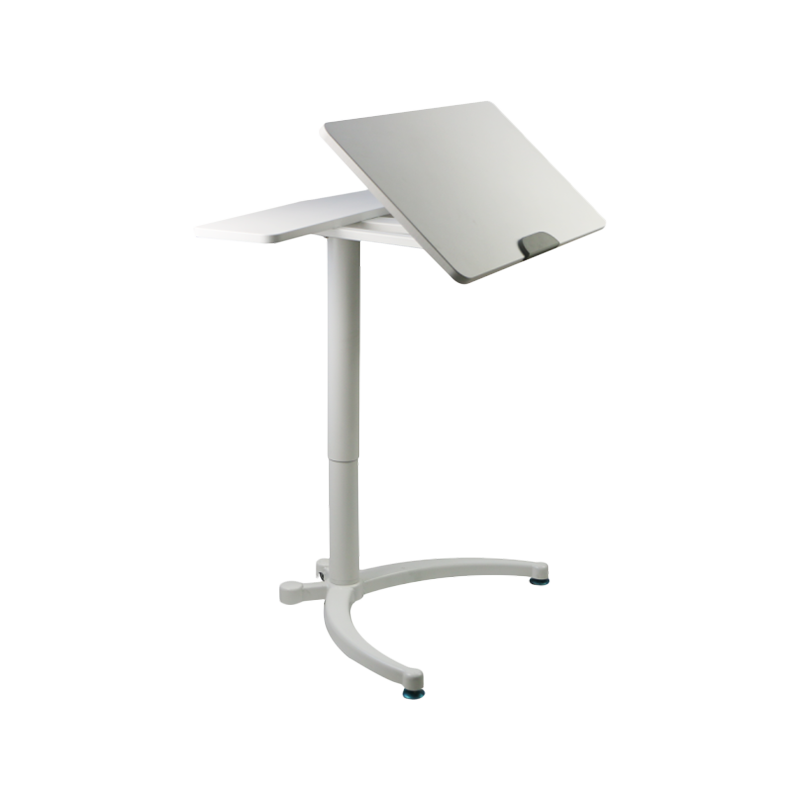
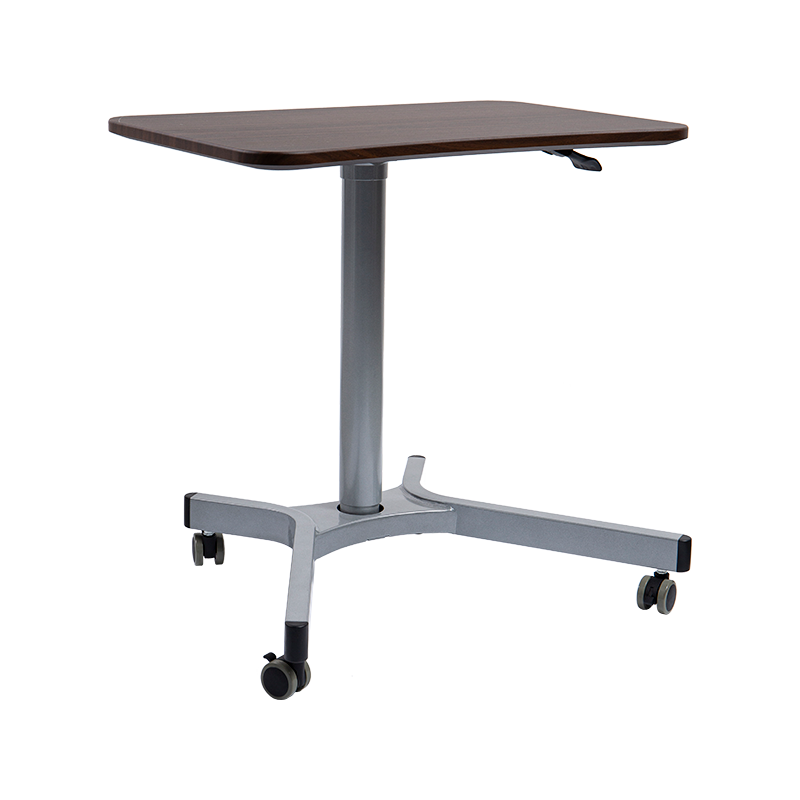
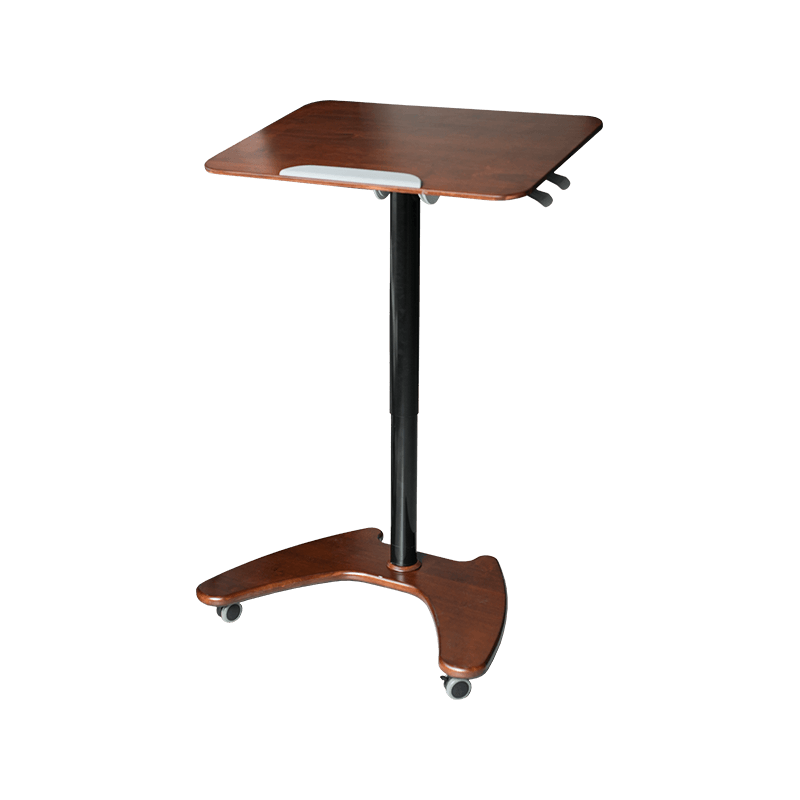
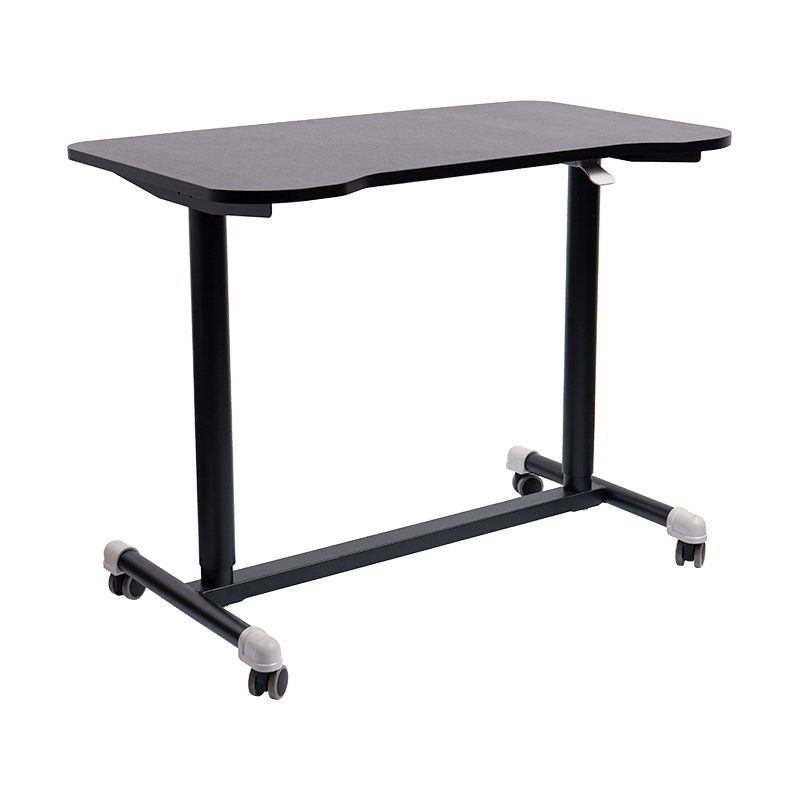
TH11 (Cat Head Leg) Pneumatic Height-Adjustable Desk
3. Gas Spring Lifting: A Practical Alternative to Motorized Adjustment
The central feature of the TH11 is its gas spring lifting system. A gas spring stores energy within a sealed cylinder and releases that energy in a controlled manner to assist movement. In an adjustable desk, this principle can reduce the effort required to raise or lower the tabletop while supporting a smooth transition between working positions.
One of the clearest differences between pneumatic and electric desks is the absence of an electrical drive system. A motorized desk generally requires a power source, wiring, a control panel, a control box, and one or more electric lifting columns. The TH11 uses a mechanical gas spring arrangement instead. This reduces dependence on electricity and allows the desk to be used in locations where power access is inconvenient or where a cable-free workspace is preferred.
The lack of a motor can also contribute to a quieter user experience. In an office, classroom, consultation room, or laboratory, minimizing operational noise is beneficial. A gas spring mechanism can be operated without the motor sound associated with powered adjustment. This is particularly useful when users need to change the desk height during a presentation, examination, meeting, or focused work session.
Mechanical simplicity may also support straightforward maintenance. There is no electrical control software to configure and no motorized control panel to replace. Routine care can focus on keeping the moving structure clean, checking visible hardware, and ensuring that the wheels and leveling feet remain functional. As with any mechanical product, users should follow the supplier’s instructions concerning adjustment, load distribution, and inspection.
The gas spring system is also appropriate for users who want immediate manual control. Instead of pressing a button and waiting for a motor to complete its movement, the user can make a direct adjustment. This direct interaction can be convenient when the desired height changes frequently or when the desk is used for short, task-specific operations.
4. 700 mm to 1100 mm: Supporting Sitting and Standing Positions
The TH11’s height range is one of its most important practical advantages. At approximately 700 mm, the desk can support seated work for many users. At approximately 1100 mm, it can support standing work, demonstrations, inspections, or other activities requiring a raised surface. The full range gives users the ability to select an intermediate position rather than being limited to two preset heights.
Not every user has the same body proportions, chair height, or working habits. A desk that feels comfortable for one person may be too high or too low for another. The TH11 allows users to make a personal adjustment, which is especially valuable in shared work environments. The adjustment can also be changed according to the task. Typing, writing, reading, drawing, assembling, and inspecting may each benefit from a different surface height.
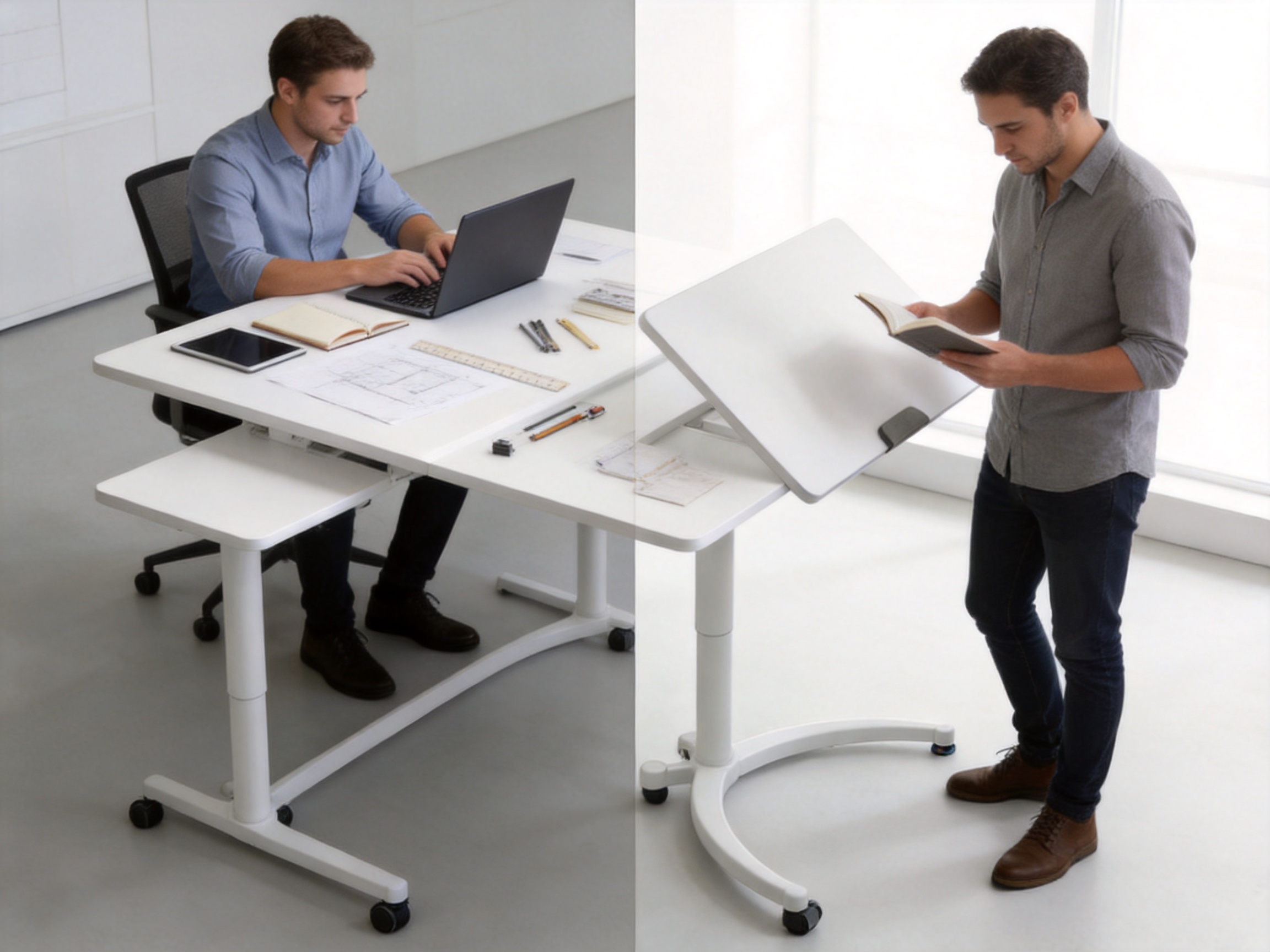
Alternating between seated and standing work can help users avoid remaining in one posture for an extended period. The desk does not promise to eliminate all ergonomic concerns, because comfort also depends on the chair, monitor, tools, lighting, and user behavior. However, its height flexibility gives users an important means of changing posture and organizing the workstation around the task.
The range is also useful in educational and institutional settings. An instructor can raise the desk for a demonstration or lower it for seated preparation. A laboratory worker can select a height that supports more precise handling of equipment. A student or technician can adjust the table without requiring a different piece of furniture.
5. Main Panel Tilt Function
Many adjustable tables change only their vertical position. The TH11 adds another layer of adaptability through the tilt function of its main panel. Tilting the working surface can be helpful for reading documents, reviewing drawings, sketching, displaying materials, or performing tasks where a slightly inclined angle improves visibility.
A tilted surface may reduce the need for users to bend their necks excessively when reading or viewing an object. It may also help materials remain within a more convenient visual field. In creative studios, the angled panel can support drawing and design activities. In educational spaces, it can be used for demonstrations or individual study. In inspection environments, the operator may benefit from changing both the height and the viewing angle.
The tilt function should be adjusted according to the task and the stability requirements of the materials being used. Flat objects, papers, tablets, and lightweight tools may be suitable for an inclined panel, while heavier or rolling items may require additional restraint. The important advantage is that the product gives users more control over the relationship between the work surface and the body.
The combination of vertical adjustment and tilt adjustment distinguishes the TH11 from many basic fixed tables and from height-adjustable products that offer only up-and-down movement. This two-dimensional adjustment approach makes the desk more appropriate for varied activities rather than only conventional computer work.
6. Desktop Construction and Surface Options
The desktop is built from 25 mm MDF with a PVC vacuum-formed surface. MDF is widely used in furniture applications because its consistent composition can provide a smooth basis for finishing and shaping. The 25 mm thickness gives the panel a substantial appearance and supports a stable working platform when used within the product’s intended application.
PVC vacuum forming is a manufacturing method in which a PVC surface material is shaped over a prepared substrate using heat and vacuum pressure. This process can produce a close-fitting finish around the panel, helping create a continuous appearance. It is also suitable for furniture surfaces that need to be visually consistent and easy to clean during normal use.
The available panel colors are white and maple wood. White supports a bright, minimalist appearance and can coordinate with contemporary office, laboratory, and classroom interiors. Maple wood introduces a warmer visual effect and can help the desk blend with furniture that uses natural wood tones. Providing more than one panel appearance gives buyers greater flexibility when planning an interior environment.
The tabletop dimensions are intentionally compact. A 760 mm by 400 mm main panel can fit into smaller rooms, individual study areas, therapy spaces, and workstations where a large desk would be impractical. At the same time, the additional 760 mm by 20 mm component contributes to the desk’s overall tabletop arrangement. Buyers should consider the required equipment, user movement, and available floor area before selecting the product for a particular application.
Because the tabletop has a smooth finished surface, normal cleaning can be carried out with a soft cloth and a suitable mild cleaning solution. Abrasive materials, excessive moisture, and harsh chemicals should generally be avoided unless the supplier provides specific approval. Proper cleaning helps preserve both the appearance and the service condition of the PVC surface.
7. Frame Materials and Structural Balance
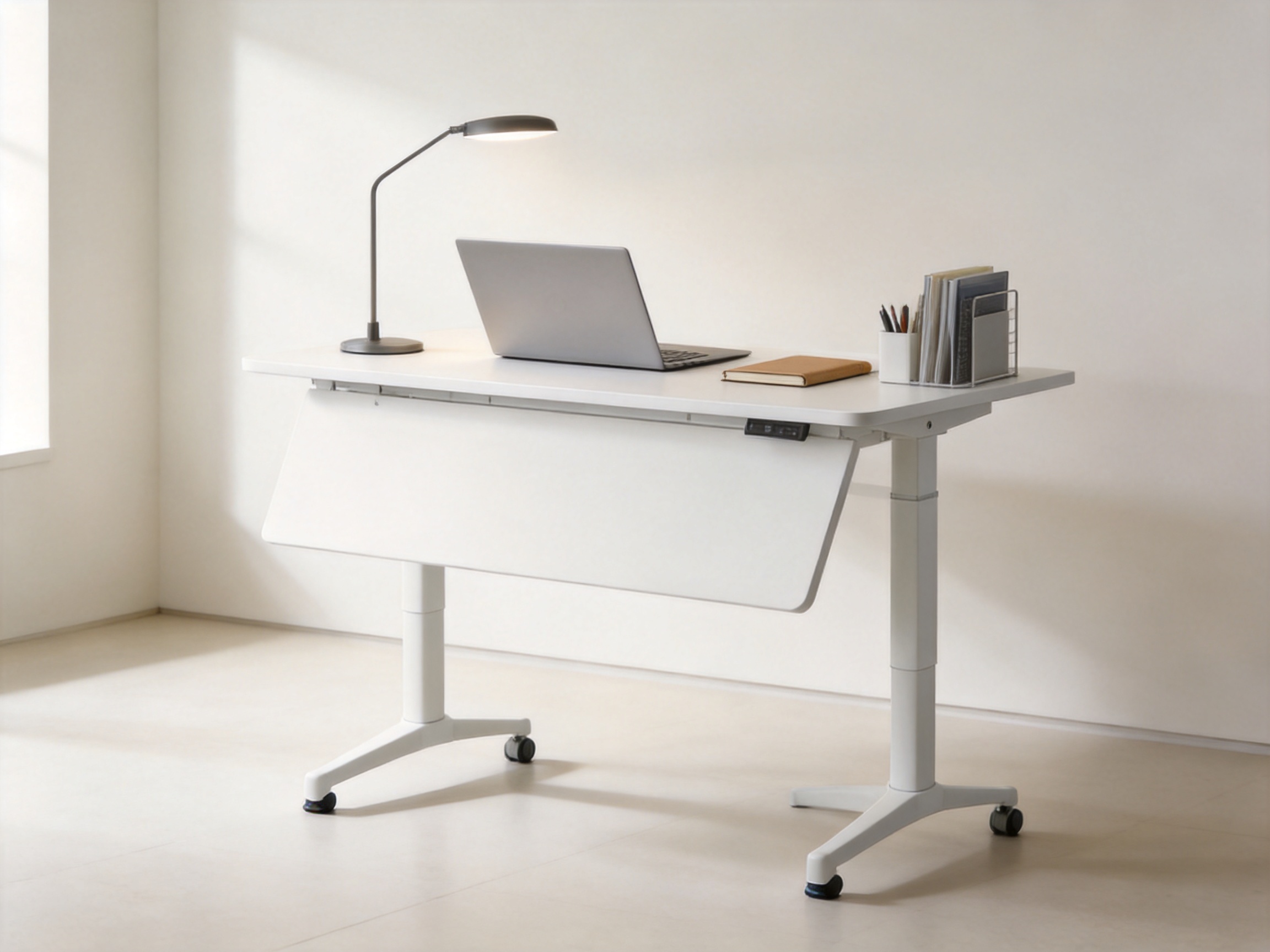
The TH11 uses aluminum and iron in its structural design. This material combination reflects a practical approach to adjustable furniture manufacturing. Aluminum is associated with a favorable strength-to-weight relationship and can help make a product easier to handle. Iron is used where a stronger or more rigid structural element is required.
A successful adjustable desk must balance several factors. It needs to support the tabletop and normal working loads, remain stable while users operate the adjustment system, and be manageable enough to relocate when necessary. Excessive weight can reduce mobility, while insufficient structural support can affect user confidence. The aluminum-and-iron construction is intended to balance these competing requirements.
Structural stability also depends on how the desk contacts the floor. The TH11 uses two concealed wheels and two leveling feet rather than placing all four contact points on wheels. When the desk is being moved, the concealed casters can assist with repositioning. Once the desk is placed, the leveling feet can help compensate for minor floor irregularities and create a more secure stationary setup.
The leveling feet are particularly useful on floors that are not perfectly even. A small amount of rocking can be distracting during writing, drawing, assembly, or computer work. Correctly adjusting the feet can improve the user’s perception of stability. Users should position the desk on an appropriate indoor surface and avoid exceeding the intended working conditions.
The cat-head-leg or cat-paw base shape gives the product a recognizable design language. It can make the desk appear more approachable in educational, creative, or care-related environments while retaining a functional structural purpose. The white frame finish reinforces the clean and modern character of the base.
8. Mobility Without Sacrificing Position Control
Workspaces often need to change. A classroom may be rearranged for group activities. A studio may require more open floor space. A laboratory may need a table moved closer to a particular instrument. In a home office, the user may want to reposition the desk near a window or storage unit. The TH11’s concealed wheels are designed to support this type of occasional movement.
Mobility is most useful when it is controlled. A desk with four exposed wheels may be easy to roll but can be less stable during some activities if the casters are not properly locked. The TH11’s combination of concealed wheels and leveling feet gives movement and stationary support separate roles. The wheels help the user relocate the unit, while the feet help establish the working position.
The compact tabletop also contributes to easier maneuverability. A smaller desk is generally simpler to guide through a room than a large workstation. However, users should always move the product carefully, especially when equipment or materials are placed on the surface. The tabletop should be cleared when practical, and the movement path should be checked in advance.
This mobility makes the TH11 suitable for flexible rooms. It can serve as a personal workstation during one activity, a presentation surface during another, and a temporary support table when the room is being reorganized. This adaptability can help organizations achieve more use from each piece of furniture.
9. Advantages Compared with Conventional Fixed Desks
The first advantage over a fixed desk is adjustability. A conventional table locks the user into one height. If the table is too low, the user may bend forward. If it is too high, the shoulders may rise and the wrists may be placed in an awkward position. The TH11 allows the user to respond to individual body dimensions and task requirements.
The second advantage is the ability to support more than one posture. A fixed desk is usually optimized for sitting or for standing, but not both. The TH11 supports a transition between seated and standing positions. This gives users more freedom to organize their day and reduces the limitations associated with a single working posture.
The third advantage is the tilt function. Even a fixed-height desk with a large tabletop may not offer a suitable viewing angle for reading, drafting, or inspection. The TH11 provides both height and angle flexibility, making it more task-oriented than a simple flat table.
The fourth advantage is mobility. Many fixed desks are heavy, difficult to move, or dependent on a permanent room arrangement. The TH11 can be repositioned with the assistance of concealed wheels, allowing the workspace to evolve as requirements change.
The fifth advantage is the absence of electrical dependence. In locations where power outlets are limited, a pneumatic desk can be easier to install. It does not require cable routing across the floor and can remain operational during a power interruption. This is particularly useful for temporary work areas, classrooms, laboratories, and facilities that prioritize simple mechanical operation.
10. Advantages Compared with Electric Height-Adjustable Desks
Electric desks are valuable for users who prefer button-controlled adjustment, but they are not the only solution. The TH11 offers several advantages in situations where electrical simplicity is more important than automated operation.
Because the TH11 does not use a motorized lifting column, its operation does not depend on a power supply. This eliminates the need to locate the desk near an outlet and reduces concerns about cords becoming tangled with chairs, equipment, or other furniture. A cable-free base can contribute to a neater and safer floor area.
The product also avoids several electrical components commonly found in motorized systems. There is no powered control panel, electrical control box, or motor cable described in the product configuration. Fewer electrical components can make the product more suitable for environments where basic mechanical maintenance is preferred.
Noise is another consideration. Electric lifting systems can create audible motor noise while moving. A gas spring mechanism is intended to provide quiet adjustment, which can be valuable in libraries, offices, training rooms, examination areas, and consultation spaces.
The TH11 may also be more practical for occasional adjustment. If a user changes desk height only when switching between major activities, a manual pneumatic system can provide the needed flexibility without adding powered equipment. The choice between pneumatic and electric adjustment should depend on the application, the expected frequency of height changes, the required load, and the user’s preferred operating method.
The product is not intended to replace every type of electric desk. Users who need automated presets, synchronized multi-motor lifting, or remote control may prefer an electric model. However, for users seeking a straightforward, quiet, power-independent, and manually responsive table, the TH11 presents a strong alternative.
11. Manufacturing Capabilities Supporting Product Quality
The performance of an adjustable desk depends not only on its design but also on the consistency of its manufacturing process. The company behind the TH11 is engaged in research and development, production, sales, and service of standing desks. This integrated business structure allows product requirements, manufacturing feedback, customer needs, and after-sales support to inform one another.
Based in Suzhou, the company benefits from the industrial ecosystem of the Yangtze River Delta. The region has a developed furniture and manufacturing supply chain, supporting access to materials, processing resources, component suppliers, engineering talent, and logistics services. Such an environment can help a manufacturer coordinate the production of frames, tabletop components, surface finishes, mechanical assemblies, and packaging.
Product development is an important part of this process. A pneumatic height-adjustable desk must coordinate the gas spring, lifting structure, tabletop, tilt mechanism, base, wheels, and leveling feet. These components need to work together as a complete product rather than as isolated parts. Development work can include evaluating the relationship between desk dimensions, user movement, stability, material selection, and assembly requirements.
The TH11’s material combination illustrates the value of coordinated manufacturing. Aluminum and iron components must be prepared and assembled with compatible dimensions. The MDF tabletop must be accurately shaped before PVC vacuum forming. The finished panel must then connect properly with the frame and tilt mechanism. Consistency at each stage helps reduce gaps, misalignment, unwanted movement, and assembly difficulty.
Powder coating is another important manufacturing stage. The process requires suitable surface preparation, controlled coating application, and curing. A consistent white coating improves appearance while helping protect the underlying metal surfaces during normal indoor use. Correct handling before and after coating is also important to avoid scratches, contamination, or damage during assembly.
Intelligent manufacturing can support the company’s ability to coordinate production more efficiently. In practical terms, this may involve organized production planning, process standardization, equipment-assisted fabrication, traceable inspection steps, and coordinated assembly operations. The exact production equipment and inspection standards should be confirmed with the supplier for a specific order, but the company’s focus on intelligent office solutions and manufacturing provides a foundation for scalable product development.
12. Production Process from Concept to Finished Desk
12.1 Product Design and Engineering
Manufacturing begins with product definition. Engineers determine the target lifting range, tabletop size, base structure, material selection, tilt function, mobility configuration, and color options. For the TH11, the design must accommodate movement from 700 mm to 1100 mm while maintaining a compact and stable form.
Engineering decisions also address how the gas spring interacts with the lifting structure. The mechanism needs to provide practical assistance during adjustment while remaining compatible with the tabletop and frame. The tilt panel requires its own connection and support arrangement so that the user can change the angle without compromising the overall table configuration.
12.2 Metal Component Preparation
Aluminum and iron frame components are prepared according to the product design. Depending on the component, preparation may include cutting, forming, drilling, welding, deburring, and dimensional inspection. Accurate preparation is essential because small deviations can affect frame alignment, wheel installation, tabletop connection, and the smoothness of the adjustment mechanism.
Deburring and edge treatment are especially important for user-facing furniture. Removing sharp edges improves handling safety and supports a cleaner final appearance. Components may also be checked before finishing to identify defects that could become more visible after powder coating.
12.3 Surface Treatment
The frame receives a powder-coated white finish. Before coating, the metal surface must be prepared so that the coating can adhere properly. The coating is then applied and cured under controlled conditions. A consistent process helps produce an even appearance across the base and structural components.
Powder coating is well suited to furniture frames because it creates a dry, durable finish without the same type of liquid paint overspray associated with some conventional methods. The finished surface can contribute to resistance against ordinary scuffing and environmental exposure in indoor settings. Actual durability depends on coating thickness, preparation, curing, use conditions, and maintenance.
12.4 Tabletop Fabrication
The tabletop begins with 25 mm MDF. The board is cut and prepared to the required dimensions, after which the PVC surface is applied through a vacuum-forming process. Heat softens the PVC material, and vacuum pressure helps draw it over the prepared panel shape.
This process requires attention to temperature, pressure, timing, surface preparation, and edge formation. A properly formed surface should present a consistent appearance and fit the tabletop profile closely. The finished panel is then checked for visual defects, edge problems, surface contamination, and dimensional consistency.
12.5 Mechanical Assembly
After the frame and tabletop components are prepared, assembly brings together the lifting mechanism, gas spring, tilt structure, panel, concealed wheels, and leveling feet. Assembly accuracy is critical because the user must be able to adjust the table smoothly and position it securely.
Assembly personnel may inspect fasteners, movement points, panel alignment, and the relationship between the frame and tabletop. The desk should be evaluated in both raised and lowered positions. The tilt function should also be checked to ensure that the main panel operates as designed.
12.6 Functional Inspection and Packaging
Before shipment, a finished unit can be inspected for appearance, dimensional conformity, adjustment operation, tilt performance, and base stability. Packaging must protect the powder-coated frame and PVC-finished panel from scratches, impact, moisture, and movement during transportation.
Effective packaging is especially important for a product that combines metal parts, a finished tabletop, and a mechanical lifting system. Components should be separated or cushioned as necessary, and assembly instructions should be clear for the destination customer. Buyers requiring specific packaging, labeling, or inspection documentation should discuss those requirements with the manufacturer before production.
13. Company Strengths in Research, Production, and Service
The company’s core strength is its specialization in standing desks and related adjustable workspace solutions. Rather than treating the TH11 as an unrelated furniture item, this product fits within a broader focus on healthy, efficient, and intelligent office environments.
Research and development provides the basis for adapting products to different user and market requirements. Adjustable furniture may need to meet different expectations concerning height ranges, tabletop dimensions, color, mechanical operation, packaging, and installation. A manufacturer with development capabilities can evaluate these requirements as part of a product platform instead of relying only on fixed, one-size-fits-all designs.
Production capability is important for maintaining consistency between individual units. The TH11 includes multiple materials and functions, so manufacturing coordination matters. The aluminum-and-iron frame, powder-coated surface, MDF and PVC tabletop, gas spring system, tilt panel, concealed wheels, and leveling feet must be produced and assembled as a compatible whole.
Sales and service capabilities also contribute to the product experience. Buyers of commercial furniture may need assistance with product selection, application planning, customization, order coordination, packaging, and after-sales questions. An integrated manufacturer can communicate across these stages more efficiently than a company that only resells a finished product.
The company’s location in Suzhou provides access to a strong manufacturing environment and a mature industrial network. This can support procurement, production scheduling, engineering cooperation, and export-oriented logistics. For international buyers, communication about technical specifications, panel colors, order quantities, lead times, and inspection requirements remains essential.
14. Applications for the TH11
14.1 Home Offices
Home offices often need to serve multiple purposes. The same room may be used for computer work, reading, creative activities, online meetings, and household administration. A compact desk with adjustable height can adapt to these different tasks without requiring several pieces of furniture.
The TH11’s white or maple wood panel options can be selected according to the home interior. Its concealed wheels may help users move the desk when cleaning or rearranging the room. Because the lifting system does not require electricity, the product can be positioned where it is most convenient rather than where a power outlet is located.
14.2 Studios and Creative Spaces
Artists, designers, makers, and students may need a surface that supports both horizontal and inclined work. The TH11’s tilting main panel can be useful for sketching, drawing, reviewing plans, or examining visual materials. Height adjustment allows users to alternate between seated detail work and standing review.
The desk’s compact dimensions can also help studios use floor space efficiently. Several desks may be positioned within the same room, or one desk may be moved between different activity zones as required.
14.3 Educational Institutions
Schools, training centers, and universities frequently require furniture that can accommodate users of different ages and heights. A pneumatic table can be adjusted without electrical wiring, making it suitable for flexible classroom arrangements. The desk can be used for individual learning, demonstrations, project work, and group activities.
Teachers and staff may also benefit from the mobility of the base. The desk can be repositioned to improve visibility or create additional space. The leveling feet can then help stabilize the unit during use.
14.4 Laboratories
Laboratory activities can vary from seated documentation to standing observation and hands-on procedures. The TH11 can support these changing working positions, provided the selected application is compatible with the tabletop size, load requirements, and laboratory safety procedures.
The absence of electrical lifting equipment may be an advantage in areas where minimizing cables is desirable. Nevertheless, the desk should not be used with hazardous materials or equipment unless the laboratory manager confirms that the product’s materials, load capacity, cleanability, and stability meet the specific requirements.
14.5 Industrial Workstations
Industrial operators may perform different tasks at different stages of a process. A workstation that can be adjusted for the operator and task can improve workflow flexibility. The TH11 may be suitable for light-duty assembly, inspection, documentation, training, or support operations where the tabletop dimensions and product specifications are appropriate.
Industrial buyers should evaluate the desk against the intended tools, materials, impact exposure, contamination conditions, and load. For demanding production environments, the manufacturer should be consulted about customization and suitability before purchase.
15. Installation, Use, and Maintenance Considerations
Correct installation helps preserve the desk’s intended performance. The frame, tabletop, gas spring, tilt mechanism, wheels, and leveling feet should be assembled according to the supplier’s instructions. Fasteners should be tightened appropriately, and the moving parts should be checked before the desk is placed into regular service.
The desk should be positioned on a stable indoor floor. After movement, the leveling feet should be adjusted so that the structure sits firmly without unnecessary rocking. The desk should not be dragged sideways when the feet are engaged, because this may damage the feet or the floor surface.
Users should distribute materials reasonably across the tabletop rather than placing excessive weight at one edge, particularly when the main panel is tilted. The intended load capacity should be confirmed with the supplier because the available product information does not specify a maximum load rating.
Regular maintenance can include cleaning the tabletop and frame, checking visible fasteners, inspecting the concealed wheels, and observing the smoothness of the lifting and tilting functions. If unusual resistance, noise, looseness, or instability develops, the desk should be removed from service until it has been checked.
The gas spring is a sealed mechanical component and should not be opened or modified by the user. Any replacement or repair should be handled according to the manufacturer’s instructions. Similarly, the tilt mechanism should not be forced beyond its designed range.
16. Customization and Procurement Considerations
Businesses and institutions often require more than a standard product description. They may need a particular panel color, packaging method, quantity, delivery schedule, labeling format, or documentation package. The TH11 is available with white and maple wood panel options, but buyers should confirm the available customization scope before placing an order.
Important questions may include whether the tabletop dimensions can be modified, whether other surface colors are available, whether the base finish can be changed, and whether different wheel or foot configurations can be supplied. Buyers should also confirm the gas spring specification, recommended load, adjustment method, tilt range, assembly requirements, and warranty terms.
For larger projects, it is useful to prepare a written specification that identifies the number of units, intended environment, required colors, packaging requirements, inspection standards, and delivery destination. Clear documentation helps align the buyer, engineering team, production department, and logistics provider.
Samples or pre-production units may be appropriate when a project has strict interior design, ergonomic, or operational requirements. A sample allows the buyer to evaluate the tabletop appearance, movement, stability, mobility, and overall dimensions before committing to a larger order.
17. Why the TH11 Is a Competitive Product
The TH11 competes through a combination of functions rather than through height adjustment alone. Its gas spring system provides power-independent movement. Its 700 mm to 1100 mm range supports seated and standing work. Its tilting main panel offers additional task flexibility. Its aluminum-and-iron frame balances manageability and structural support. Its concealed wheels and leveling feet combine mobility with positioning control.
The tabletop construction also differentiates the product. The 25 mm MDF panel with PVC vacuum forming provides a finished surface suitable for professional and institutional environments, while the white and maple wood options support different interior styles. The compact 760 mm by 400 mm main panel makes the desk appropriate for spaces where a larger workstation would be impractical.
Compared with a basic fixed table, the TH11 provides a more adaptable working experience. Compared with a motorized standing desk, it offers mechanical simplicity and independence from electricity. Compared with a fully mobile cart, it provides a more deliberate combination of wheels and leveling feet for movement and stationary use.
Its suitability depends on the application, but the product is particularly strong where users value quiet adjustment, flexible posture, compact dimensions, a tilting work surface, and low dependence on electrical infrastructure.
18. Frequently Asked Questions
18.1 What type of desk is the TH11?
The TH11 is a pneumatic height-adjustable desk. It uses a gas spring lifting mechanism rather than an electrically powered motor system. The main panel also includes a tilt function.
18.2 What is the height adjustment range?
The listed lifting range is 700 mm to 1100 mm. This range is intended to support both seated and standing work, as well as intermediate heights for different users and tasks.
18.3 Does the desk require electricity?
No electrical power is required for the gas spring lifting principle described for the TH11. This allows the desk to be used without a power cord or nearby electrical outlet.
18.4 Is the main panel adjustable in angle?
Yes. The product information specifies that the main panel has a tilt function. The tilt feature can support reading, drawing, inspection, and other tasks that benefit from an inclined surface.
18.5 What materials are used?
The frame combines aluminum and iron. The tabletop uses 25 mm MDF with a PVC vacuum-formed surface. The frame has a white powder-coated finish.
18.6 What colors are available?
The listed panel color options are white and maple wood. Buyers should confirm current availability and any project-specific color requirements with the supplier.
18.7 Can the desk be moved?
Yes. The desk is equipped with two concealed wheels. It also has two leveling feet to help stabilize the table when it is positioned for use.
18.8 What environments are suitable for the TH11?
The desk is suitable for potential use in home offices, studios, educational institutions, laboratories, and industrial workstations. The buyer should verify load, cleanliness, safety, and environmental requirements for specialized applications.
18.9 Does the product have a specified maximum load?
A maximum load rating is not included in the supplied product information. Buyers should request the applicable load specification from the manufacturer before using the desk with equipment, tools, or heavy materials.
18.10 How does the TH11 compare with an electric standing desk?
The TH11 does not require electricity, a motor, or a powered control system. It is designed for manual pneumatic adjustment and can offer a quieter and mechanically straightforward alternative. An electric desk may be preferable when users require programmable height presets or automated button control.
18.11 Is the product available for customized projects?
The company provides adjustable workspace solutions and should be consulted regarding project-specific requirements. Potential topics include tabletop dimensions, colors, packaging, order quantities, and other manufacturing details.
19. Conclusion
The TH11 Pneumatic Height-Adjustable Desk is designed for users who need more flexibility than a fixed table can provide but do not necessarily require an electric lifting system. Its gas spring mechanism supports quiet, power-independent height adjustment from 700 mm to 1100 mm. The tilting main panel extends the desk’s usefulness beyond conventional seated computer work, while the compact tabletop configuration supports efficient use of floor space.
The product’s combination of aluminum and iron, white powder-coated frame, MDF tabletop, PVC vacuum-formed surface, concealed wheels, and leveling feet creates a balanced solution for flexible indoor workspaces. It can serve home offices, studios, schools, laboratories, and selected industrial applications where height and angle adjustment are valuable.
Behind the product is a Suzhou-based manufacturer focused on the research and development, production, sales, and service of standing desks. Its position within the Yangtze River Delta manufacturing environment supports coordinated product development, material sourcing, processing, finishing, assembly, and customer service. For buyers seeking a configurable and practical adjustable table, the TH11 offers a compelling combination of ergonomic flexibility, mechanical simplicity, mobility, and modern manufacturing capability.
References
1. Product specification sheet for the TH11 Pneumatic Height-Adjustable Desk, including dimensions, materials, finish, colors, mobility configuration, and operating principle.
2. Manufacturer-provided product information concerning the TH11 gas spring lifting mechanism, tilting main panel, intended applications, and structural characteristics.
3. General ergonomic principles for alternating seated and standing work positions and adjusting workstation height to support user comfort.
4. General manufacturing references concerning MDF furniture panels, PVC vacuum forming, powder coating, aluminum and iron fabrication, and mechanical assembly.
5. General workplace furniture planning guidance for offices, educational facilities, laboratories, studios, and industrial workstations.
Product: TH11 (Cat Head Leg) Pneumatic Height-Adjustable Desk


- Contact Info
-
-
 Phone+86-15950656125
 -
 Email
Email -
 AddressRoom 1007-1, South Building, Suyue Plaza, Suzhou Industrial Park, Suzhou City, Jiangsu Province, China
-
- Products
- Follow Us
- Need help? Please contact us
Copyright ©
SuZhou Skyhone Intelligent Technology Co., Ltd.
All Rights Reserved.
Privacy
Custom Ergonomic Adjustable Office Tables Manufacturers

