

 English
  русский
  Español
  عربى
عربى 
Content
- 1 Product Overview
- 2 Key Specifications
- 3 Why Pneumatic Height Adjustment Matters
- 4 Ergonomic Advantages
- 5 Competitive Advantages Over Conventional Desks
- 6 Advantages Over Electric Height-Adjustable Desks in Mobile Applications
- 7 Gas Spring Lifting Principle
- 8 Tabletop Design and Material Benefits
- 9 Frame Structure and Material Strength
- 10 Mobility and Locking Stability
- 11 Surface Treatment and Long-Term Appearance
- 12 Manufacturing Strength Behind the Product
- 13 Process Control in Metal Fabrication
- 14 Powder Coating and Surface Quality Management
- 15 Tabletop Processing and PVC Vacuum Forming
- 16 Assembly Accuracy and Final Quality Inspection
- 17 Customization and Procurement Advantages
- 18 Applications in Home Offices
- 19 Applications in Offices and Shared Workspaces
- 20 Applications in Education and Training
- 21 Applications in Studios and Creative Work
- 22 Applications in Healthcare, Wellness, and Consultation Spaces
- 23 User Experience and Daily Operation
- 24 Maintenance Recommendations
- 25 Space Planning and Interior Integration
- 26 Safety and Practical Use Considerations
- 27 How the TH12 Supports Modern Work Trends
- 28 Environmental and Efficiency Considerations
- 29 Buyer Evaluation Guide
- 30 Why This Product Is a Strong Choice
- 31 Frequently Asked Questions
- 31.1 What is the height adjustment range of the desk?
- 31.2 Does the desk require electricity?
- 31.3 What is the tabletop size?
- 31.4 What materials are used in the desk?
- 31.5 Is the desk easy to move?
- 31.6 What panel colors are available?
- 31.7 How does this desk compare with an electric standing desk?
- 31.8 Is the desk suitable for home offices?
- 31.9 Can it be used in schools or training rooms?
- 31.10 How should the desk be maintained?
- 31.11 What are the main competitive advantages?
- 31.12 Who manufactures the product?
- 32 Conclusion
- 33 References
Pneumatic Height-Adjustable Desk for Mobile Sit-Stand Workspaces
2026-05-16
Modern work environments increasingly require furniture that can move, adapt, and support healthier working habits without adding unnecessary complexity. The TH12 pneumatic height-adjustable desk is designed for exactly that purpose. It combines a gas spring lifting system, a compact tabletop, a stable metal structure, and mobile caster support to create a flexible workstation for offices, homes, studios, classrooms, training rooms, and shared work areas.
Unlike many traditional desks that remain fixed at one height, this pneumatic desk allows users to move between seated and standing positions across a practical lifting range of 715 mm to 1130 mm. This range supports many common working scenarios, including laptop use, reading, writing, device operation, teaching support, and temporary presentation work. Its compact 680 mm by 560 mm tabletop is large enough for essential daily tasks while remaining easy to reposition in changing indoor layouts.
The product is built from aluminum and iron, providing a balance of structural strength, manageable weight, and long-term durability. Its 25 mm tabletop uses MDF with PVC vacuum forming, creating a flat, stable, and easy-to-clean surface. The powder-coated white frame improves corrosion resistance and wear resistance, while panel color options such as white and maple wood allow the desk to fit different interior styles.
For buyers comparing adjustable desks, the TH12 stands out because it does not depend on electric motors, power cables, or complicated electronic controls. Its gas spring lifting principle provides smooth manual height adjustment, making it suitable for spaces where mobility, simplicity, and reliable mechanical performance are more important than programmable electronic functions.
Product Overview
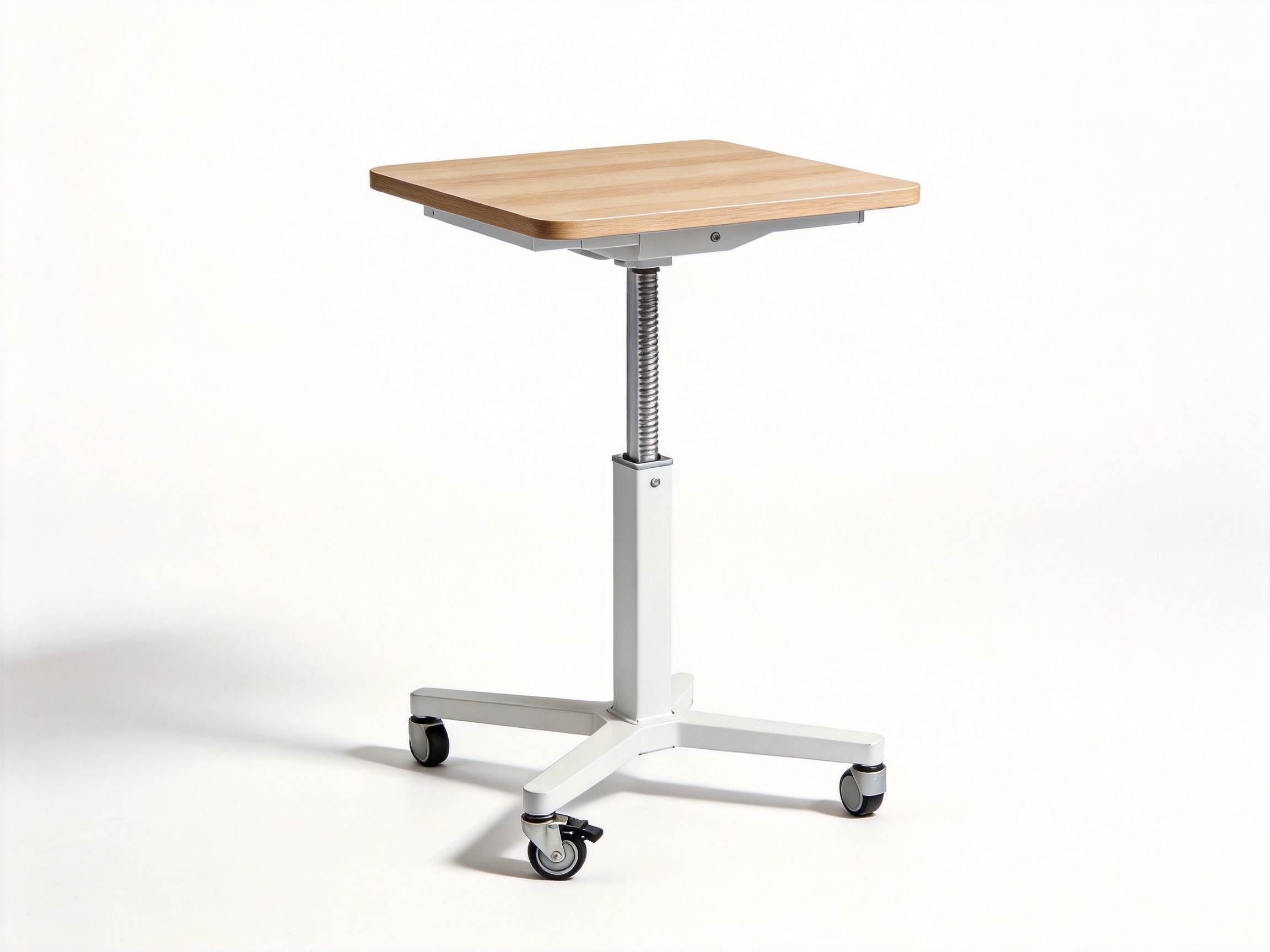
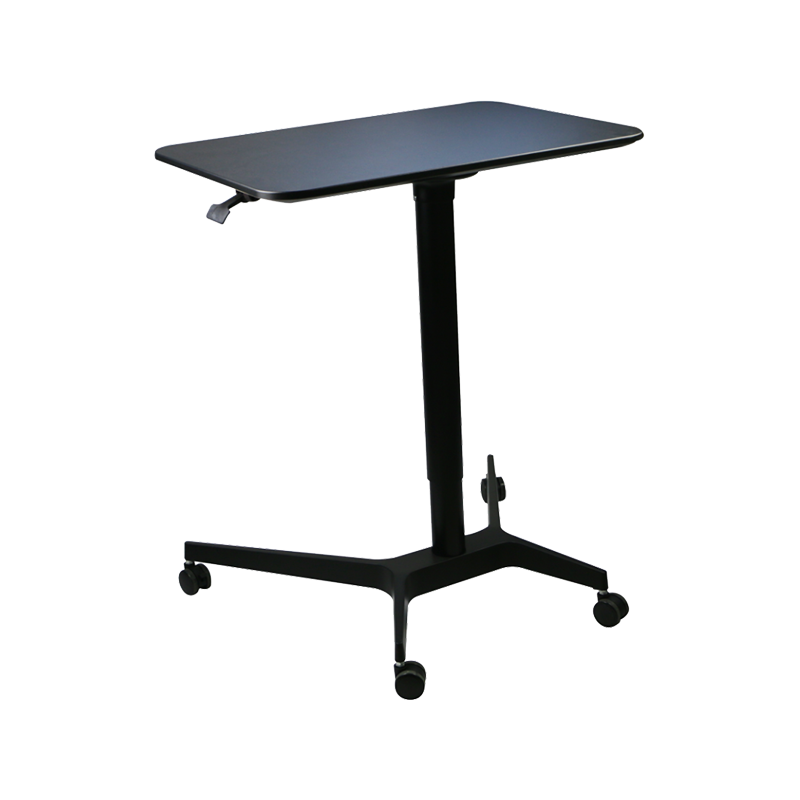
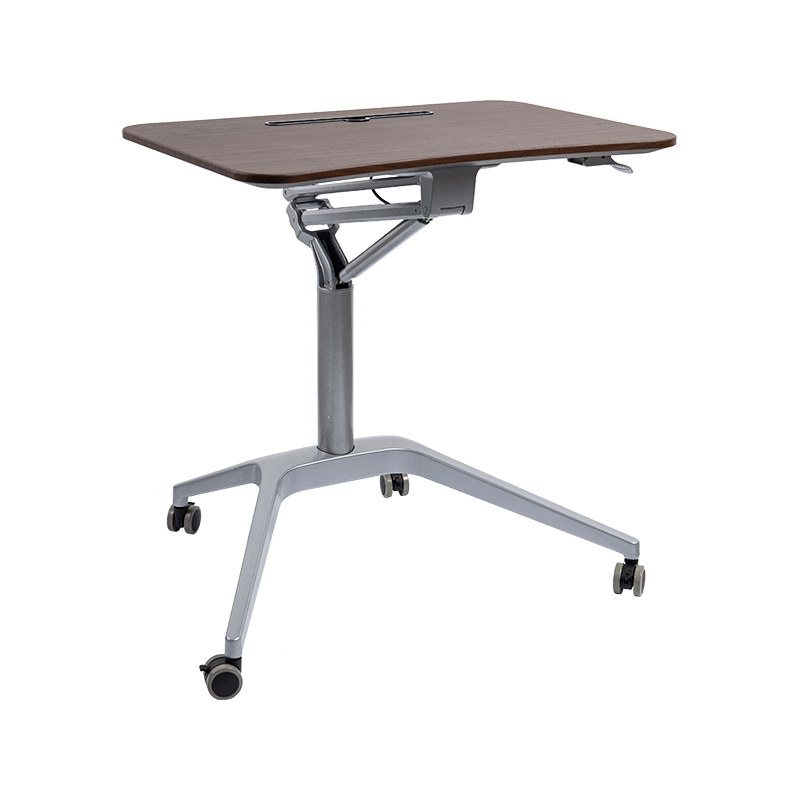
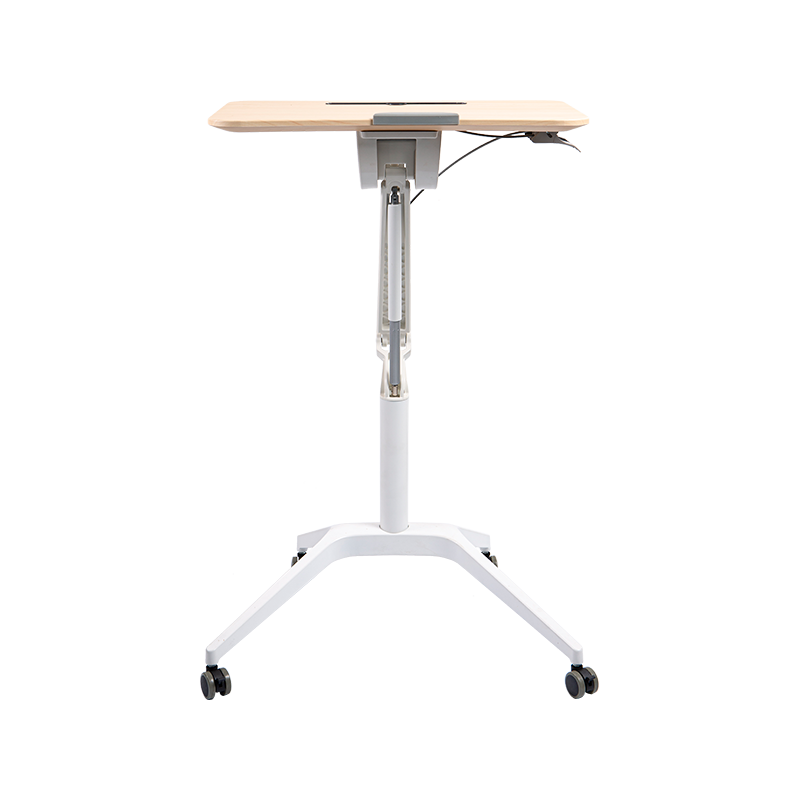
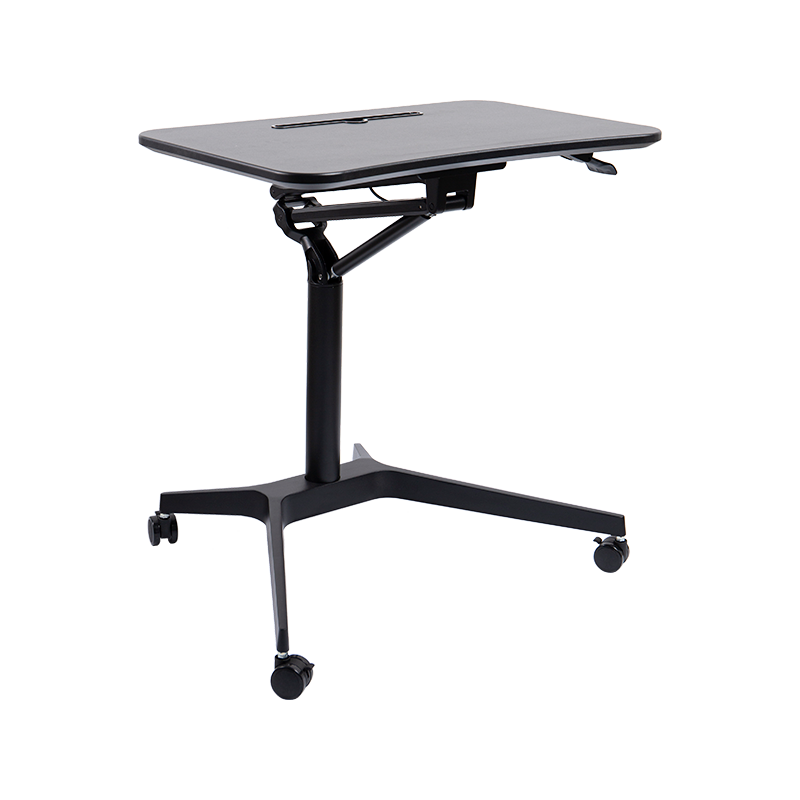
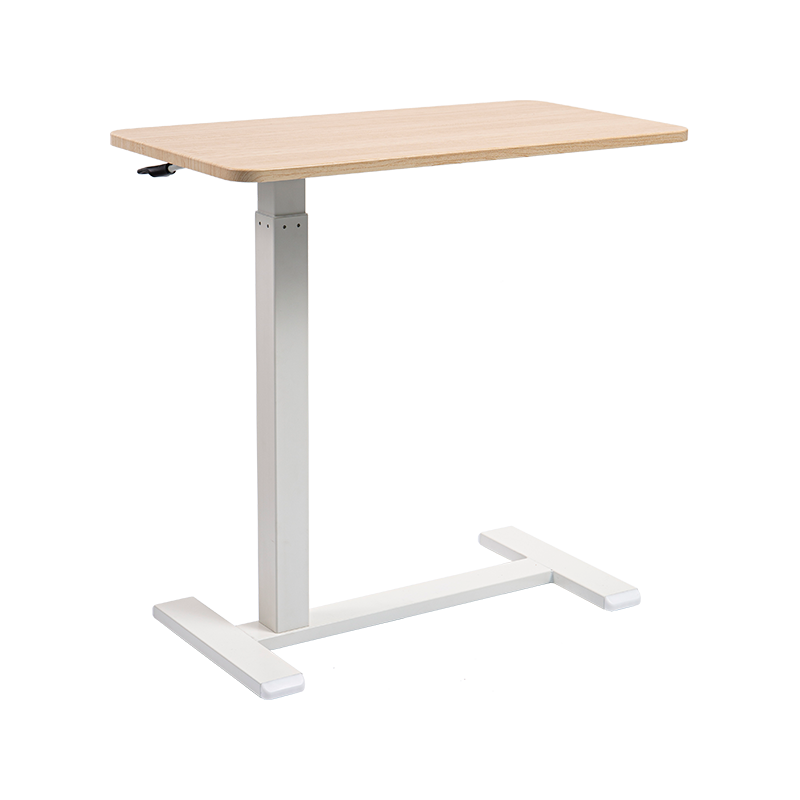
The TH12 is a pneumatic height-adjustable table built around a gas spring lifting mechanism. Its form includes a distinctive columnar base design and a shaped tabletop style that helps it stand apart from conventional rectangular mobile desks. The design is functional, compact, and visually friendly, making it suitable for environments where furniture must be practical but not visually heavy.
The desk’s lifting range begins at 715 mm, which is suitable for seated work for many users, and extends to 1130 mm, allowing standing work, demonstrations, reading, or light-duty equipment support. This height range creates a broad usability window without requiring electrical connection. The user can adjust the height according to posture, activity, or spatial need.
The tabletop measures 680 mm by 560 mm and has a 25 mm thickness. This size is especially valuable in flexible workspaces because it offers a usable surface without occupying the footprint of a full workstation. It can support a laptop, notebook, tablet, documents, writing tools, or small accessories. The tabletop material combines MDF with PVC vacuum forming, resulting in a surface that is smooth, practical, and convenient for everyday cleaning.
The frame and column components are made from aluminum and iron. This material combination supports structural stability while helping the product remain practical for mobile use. The white powder-coated finish gives the desk a clean appearance and improves resistance against surface wear, humidity-related degradation, and general indoor corrosion.
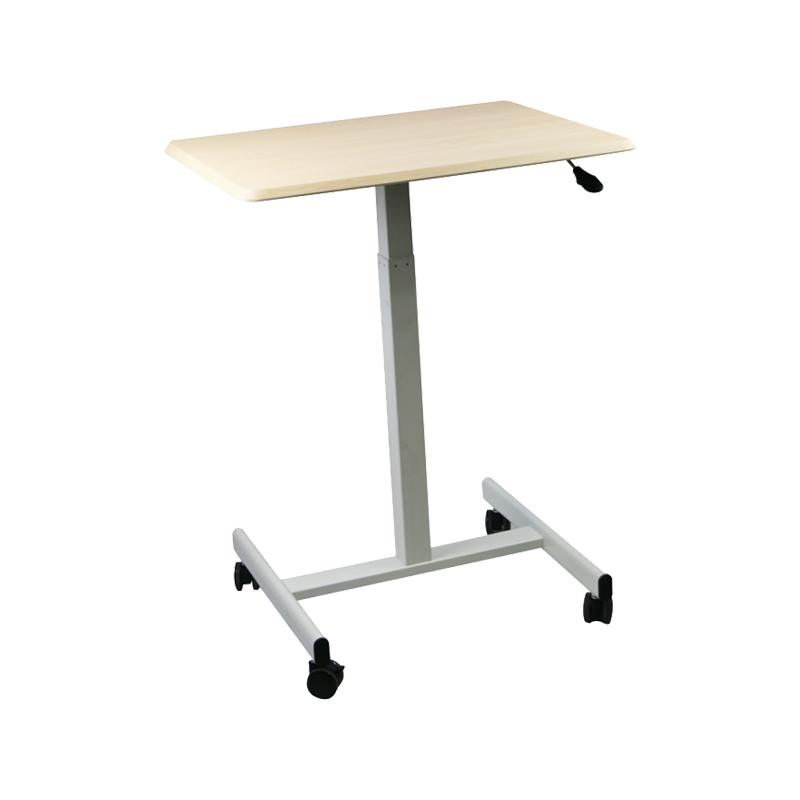
Mobility is another defining feature. The TH12 includes three casters: two with locking mechanisms and one without a lock. This arrangement enables users to move the desk easily when needed and then secure it in position for work. In shared offices, teaching spaces, clinics, studios, or home environments, this mobile configuration can significantly improve space efficiency.
Key Specifications
Item |
Specification |
Practical Benefit |
Lifting Range |
715 mm to 1130 mm |
Supports seated and standing work positions |
Tabletop Dimensions |
680 mm × 560 mm × 25 mm |
Compact but functional surface for everyday tasks |
Tabletop Material |
25 mm MDF with PVC vacuum forming |
Stable, flat, durable, and easy to maintain |
Frame Material |
Aluminum and iron |
Balances strength, stability, and mobility |
Surface Color |
White |
Clean appearance for office and residential interiors |
Surface Treatment |
Powder coating |
Improves wear resistance and corrosion protection |
Casters |
Two locking casters and one non-locking caster |
Provides mobility and secure positioning |
Panel Colors |
White and maple wood |
Allows selection for different interior styles |
Working Principle |
Gas spring lifting |
Smooth height adjustment without electrical power |
Why Pneumatic Height Adjustment Matters
Height-adjustable furniture has become an important part of healthy working environments. Long periods of uninterrupted sitting can contribute to discomfort, stiffness, reduced circulation, and lower workplace energy. A desk that allows users to alternate between sitting and standing can help encourage movement and posture variation throughout the day.
The TH12 uses a gas spring mechanism rather than an electric actuator. This distinction is important. Electric height-adjustable desks are often excellent for large, permanent workstations, but they depend on motors, controllers, power supplies, wiring, and sometimes more complicated maintenance. In contrast, a pneumatic desk can be adjusted without a power outlet, making it more suitable for mobile use and flexible indoor layouts.
The gas spring lifting system provides a controlled upward and downward movement. When properly engineered, it supports the tabletop during adjustment and reduces the effort needed to change height. This allows users to adapt the work surface quickly when switching between sitting, standing, reading, writing, or device use.
For environments with multiple users, pneumatic adjustment can be particularly practical. A shared desk may be used by people of different heights and for different tasks throughout the day. Because the adjustment process is simple and does not require electronic memory settings, users can reposition the surface quickly without training or technical knowledge.
The absence of electrical components also supports cleaner visual organization. There are no power cords needed for desk movement, and no control panel must be protected from spills or impact. This is valuable in classrooms, training rooms, clinics, laboratories, showrooms, and other places where furniture must remain easy to move and simple to operate.
Ergonomic Advantages
The main ergonomic value of the TH12 is posture flexibility. A fixed-height desk forces the user to adapt to the furniture. A height-adjustable desk allows the furniture to adapt to the user. This difference can affect comfort, productivity, and long-term work habits.
At the lower end of the lifting range, the desk can support seated work. Users can position a laptop, writing materials, or reading materials at a comfortable level. At the upper end of the range, the desk can support standing work, helping users reduce continuous sitting time and remain more active during the day.
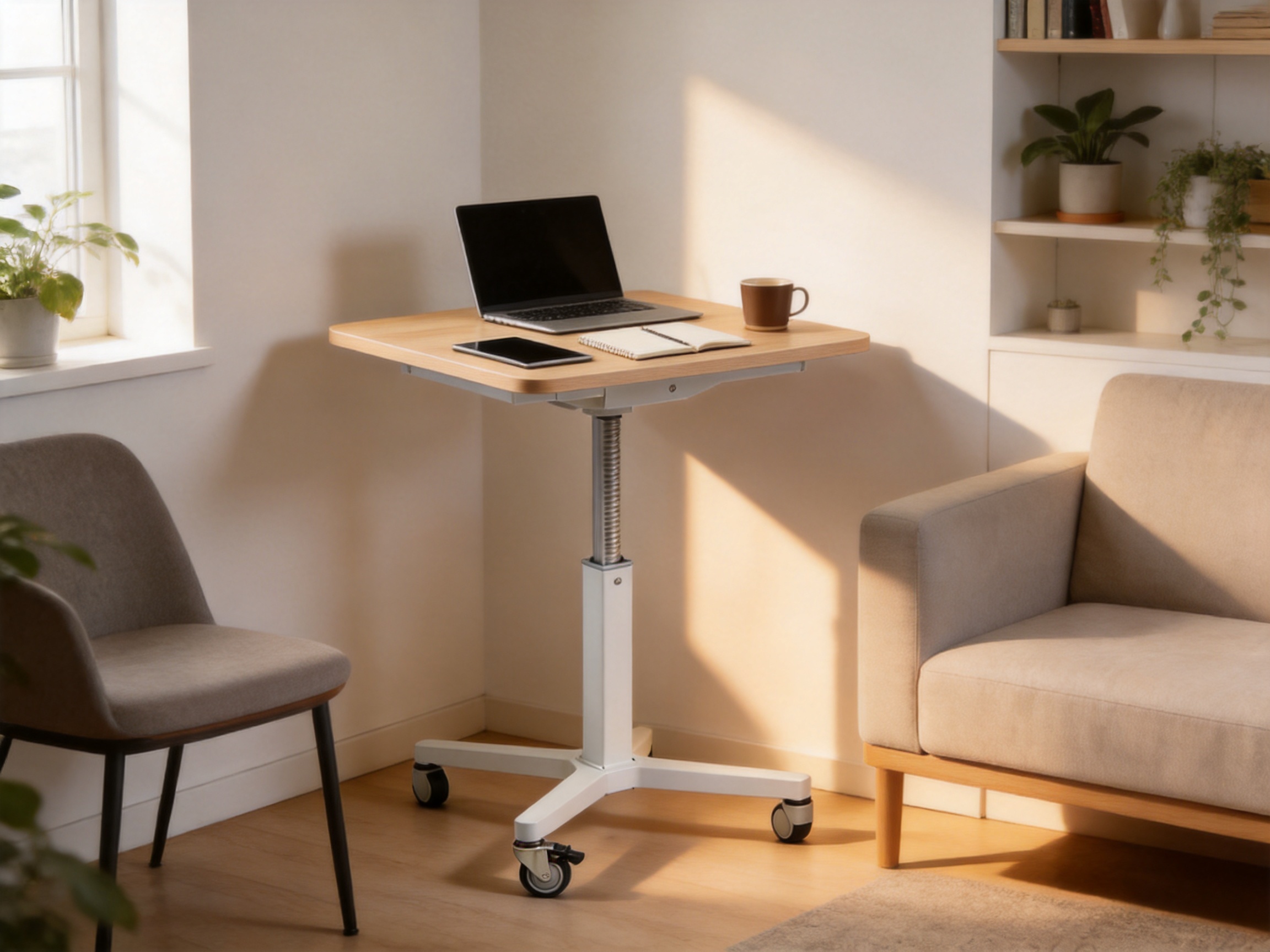
Because the tabletop is compact, the desk can be positioned close to the user. This makes it useful as a primary small workstation, auxiliary workstation, bedside work table, teaching support table, laptop cart, or mobile reading desk. The ability to bring the work surface to the user can be as important as the ability to adjust height.
Ergonomic effectiveness depends on correct use. Users should adjust the desk so that the shoulders remain relaxed, the forearms can rest at a comfortable angle, and the neck does not need to bend excessively. The TH12’s height range makes this practical for many common indoor activities.
Another ergonomic advantage is movement. A mobile height-adjustable desk encourages changes in work location and posture. A user might sit while reviewing documents, stand while presenting, and move the desk to another area for collaboration. This natural variability helps create a more dynamic work routine.
Competitive Advantages Over Conventional Desks
Compared with standard fixed-height desks, the TH12 offers a much higher level of adaptability. A conventional desk usually has one main function: providing a flat work surface at a fixed height. The TH12 provides a flat work surface that can also rise, lower, move, and lock in place. This turns the desk into a flexible tool rather than a static piece of furniture.
In small offices or apartments, space is limited. A large fixed desk may dominate the room even when it is not being used. The TH12’s compact tabletop and mobile base allow it to serve as a workstation when needed and then be moved aside. This advantage is especially important for hybrid workers, students, and users who need multifunctional rooms.
Compared with many heavy electric standing desks, the TH12 offers greater freedom from power infrastructure. It can be used in areas where power access is inconvenient, where cables would create trip hazards, or where furniture needs to be rearranged frequently. The gas spring lifting system also reduces dependency on electrical maintenance.
Compared with lightweight laptop stands or basic rolling tables, the TH12 provides a more robust and professional solution. Its aluminum and iron construction, powder-coated finish, 25 mm tabletop, and locking casters create a more stable and durable user experience. It is compact, but it is not merely a temporary accessory.
Another competitive advantage is operational simplicity. Users do not need to understand electronic controls, reset systems, or troubleshoot motor errors. The desk’s adjustment principle is mechanical and direct. This makes it easier to deploy across organizations with many users, such as schools, training centers, clinics, coworking areas, and administrative offices.
Advantages Over Electric Height-Adjustable Desks in Mobile Applications
Electric height-adjustable desks have an important place in modern workstations, especially for large office setups with dual monitors and heavy equipment. However, they are not always the best solution for every environment. In mobile and compact applications, the TH12’s pneumatic design offers several practical advantages.
First, the TH12 does not require a power connection for height adjustment. This means it can be moved freely around a room without concern for wall outlets or extension cords. In flexible training rooms, classrooms, or temporary work areas, this can save time and reduce cable management problems.
Second, the desk avoids motor noise. While many electric desks are relatively quiet, they still create mechanical sound during adjustment. A gas spring desk can offer a quieter adjustment experience, which is useful in libraries, shared offices, classrooms, consultation rooms, and home environments.
Third, the pneumatic system reduces the number of electronic failure points. There is no control box, wiring harness, keypad, or motor synchronization system. For organizations managing multiple desks, this simplicity can reduce support needs and improve long-term usability.
Fourth, pneumatic adjustment provides immediate responsiveness. The user can change height as part of a natural work movement rather than waiting for a motorized lift cycle. For quick transitions between seated and standing tasks, this responsiveness is a meaningful benefit.
Finally, the TH12 is visually simpler. Without motor housings, cables, or control panels, the product maintains a clean appearance. The white powder-coated frame and optional tabletop colors help the desk fit into modern interiors without creating a technical or industrial look.
Gas Spring Lifting Principle
The gas spring lifting principle is based on controlled force assistance. A gas spring contains compressed gas that helps support motion and reduce the effort needed to lift or lower a surface. In a height-adjustable desk, this allows the user to reposition the tabletop smoothly within the designed lifting range.
The advantage of a gas spring system is that it combines mechanical reliability with user convenience. It does not require electricity, yet it still assists movement in a way that feels more controlled than a simple manual sliding mechanism. This makes it suitable for compact furniture that must remain both mobile and adjustable.
For the TH12, the lifting range of 715 mm to 1130 mm is designed to address common working heights. The system supports movement between these positions while maintaining structural support through the column and base design. This combination helps create a stable work surface across the adjustment range.
Gas spring systems are also valuable because they can contribute to product longevity when properly selected and installed. The lifting component must be matched to the intended load, travel distance, and user interaction pattern. In professional manufacturing, component selection and assembly accuracy directly affect the quality of the final adjustment experience.
The TH12 benefits from a design philosophy that prioritizes simplicity, smoothness, and dependable operation. For users, the result is a desk that can be adjusted quickly and intuitively. For buyers, the result is a furniture solution with fewer electronic dependencies and strong suitability for mobile work settings.
Tabletop Design and Material Benefits
The tabletop is one of the most important user-contact surfaces on any desk. The TH12 uses a 25 mm MDF tabletop with PVC vacuum forming. This structure provides a practical combination of stability, surface quality, and daily usability.
MDF is widely used in furniture because it offers a consistent and smooth core material. It supports precise shaping and provides a stable base for surface finishing. The 25 mm thickness gives the tabletop a substantial feel and improves resistance to everyday bending or vibration compared with thinner panels.
The PVC vacuum-formed surface improves cleanability and visual consistency. Vacuum forming helps the surface layer conform to the tabletop shape, creating a smooth exterior that can be wiped clean more easily than many raw or porous materials. This is useful in offices, education spaces, home workstations, and other environments where frequent contact and routine cleaning are expected.
The tabletop dimensions of 680 mm by 560 mm create a balanced work area. It is not oversized, which helps mobility and placement flexibility. At the same time, it is large enough for a laptop, notebook, tablet, mouse, documents, or small desktop accessories. This makes the desk especially suitable for focused work rather than cluttered storage.
The availability of white and maple wood panel colors gives users and procurement teams more design flexibility. White supports a clean, modern appearance and blends with the powder-coated frame. Maple wood adds warmth and a softer residential or educational feel. Both options allow the desk to fit into a range of interior environments.
Frame Structure and Material Strength
The TH12 frame uses aluminum and iron, a material combination chosen for strength, durability, and practical handling. Iron contributes structural robustness and load-bearing reliability. Aluminum can help reduce unnecessary weight while supporting corrosion resistance and a refined finish. Together, these materials create a frame suitable for repeated height adjustment and mobile use.
A height-adjustable mobile desk must resist multiple types of stress. It must support vertical loads, handle lateral movement, remain stable during rolling, and maintain alignment during height adjustment. The frame materials and connection points are therefore essential to product performance.
Powder coating adds an important layer of protection. Unlike simple surface painting, powder coating forms a durable finish that can improve resistance to scratching, abrasion, and corrosion. For furniture that may be moved often or used in shared spaces, this finish helps preserve appearance and extend service life.
The white finish also contributes to interior compatibility. It can match modern office furniture, education furniture, healthcare interiors, and home décor. A clean white frame visually reduces heaviness, which is helpful for a mobile desk that may be used in smaller rooms.
Structural quality is not only about material selection. It also depends on manufacturing precision, welding or fastening quality, surface preparation, coating consistency, and final inspection. A well-made frame helps the desk remain stable, attractive, and reliable over time.
Mobility and Locking Stability
The TH12 includes three casters, two of which are equipped with locking mechanisms. This caster configuration supports easy movement and secure positioning. Users can move the desk to a preferred location and then lock the wheels to reduce unwanted movement during use.
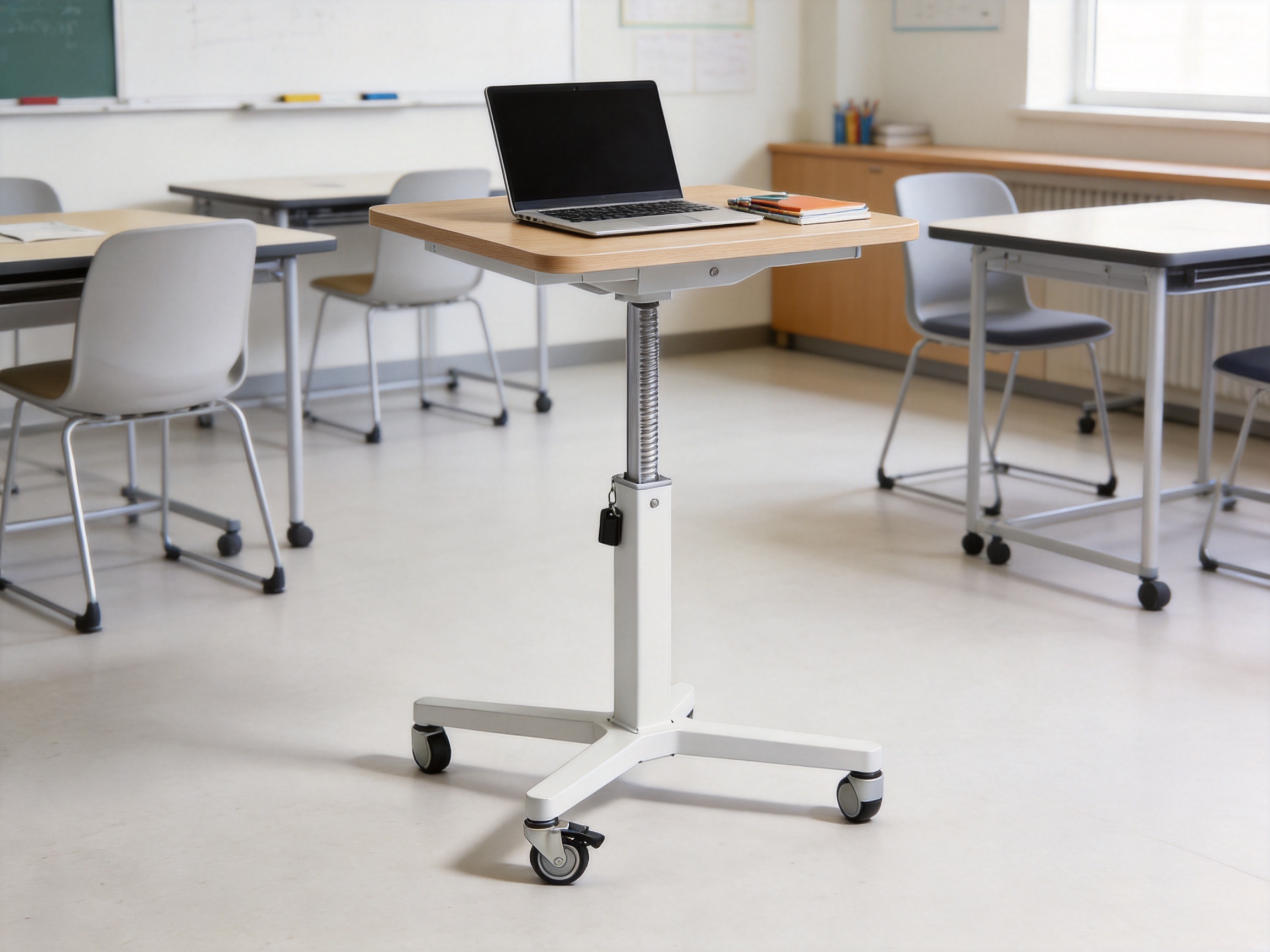
Mobility changes how a desk can be used. In an office, the desk can move between individual work, group discussion, and presentation support. In a classroom, it can serve as a teacher’s movable lectern, a student support station, or a device cart. In a home, it can move from a bedroom to a living room or from a study corner to a sofa-side position.
Locking casters are important because mobility without stability can become inconvenient. A desk that rolls too easily while typing, writing, or reading may distract the user. The two locking wheels help the desk transition from mobile mode to fixed mode, making the product more practical for real work.
The three-wheel configuration supports a compact base concept and reduces unnecessary bulk. It helps the desk remain maneuverable in tight spaces. This is useful for rooms where furniture must move around chairs, beds, sofas, equipment, or other desks.
For buyers evaluating mobile adjustable desks, caster quality should be considered alongside height range and tabletop size. A good mobile desk must roll smoothly, lock reliably, and remain stable enough for daily tasks. The TH12 is designed to satisfy these practical requirements.
Surface Treatment and Long-Term Appearance
Surface treatment plays a major role in product durability. The TH12 uses powder coating on its metal structure. Powder coating is valued in furniture manufacturing because it creates a uniform, protective, and visually refined finish.
During powder coating, dry powder is applied to a prepared metal surface and then cured, forming a solid coating layer. This process can provide better resistance to chipping, scratching, and corrosion than many basic liquid coatings. For a mobile desk, this matters because the frame may contact hands, walls, chairs, or other furniture during daily movement.
The white powder-coated surface gives the desk a clean and professional character. It supports modern minimalist interiors and can blend well with both white and maple tabletop panels. This makes the desk suitable for offices, home workspaces, studios, libraries, training rooms, and medical or wellness settings.
Long-term appearance also affects user perception. Furniture that remains clean-looking and structurally sound contributes to a better work environment. For commercial buyers, durability can reduce replacement frequency and help maintain consistent interior standards across multiple rooms or facilities.
The value of powder coating depends on process control. Surface cleaning, pretreatment, coating thickness, curing temperature, and inspection all influence final quality. Advanced manufacturing systems help ensure consistent coating performance from batch to batch.
Manufacturing Strength Behind the Product
SuZhou Skyhone Intelligent Technology Co., Ltd. is positioned as a professional manufacturing enterprise focused on the research, development, production, sales, and service of standing desks and adjustable workspace solutions. Located in Suzhou, within the highly developed Yangtze River Delta furniture industry region, the company benefits from a mature supply chain, experienced technical resources, and strong intelligent manufacturing infrastructure.
This regional advantage is important. Adjustable furniture production requires coordination among metal processing, surface treatment, gas spring integration, panel fabrication, quality inspection, packaging, and logistics. A company based in a manufacturing cluster can access specialized suppliers, faster component development, and more efficient production coordination.
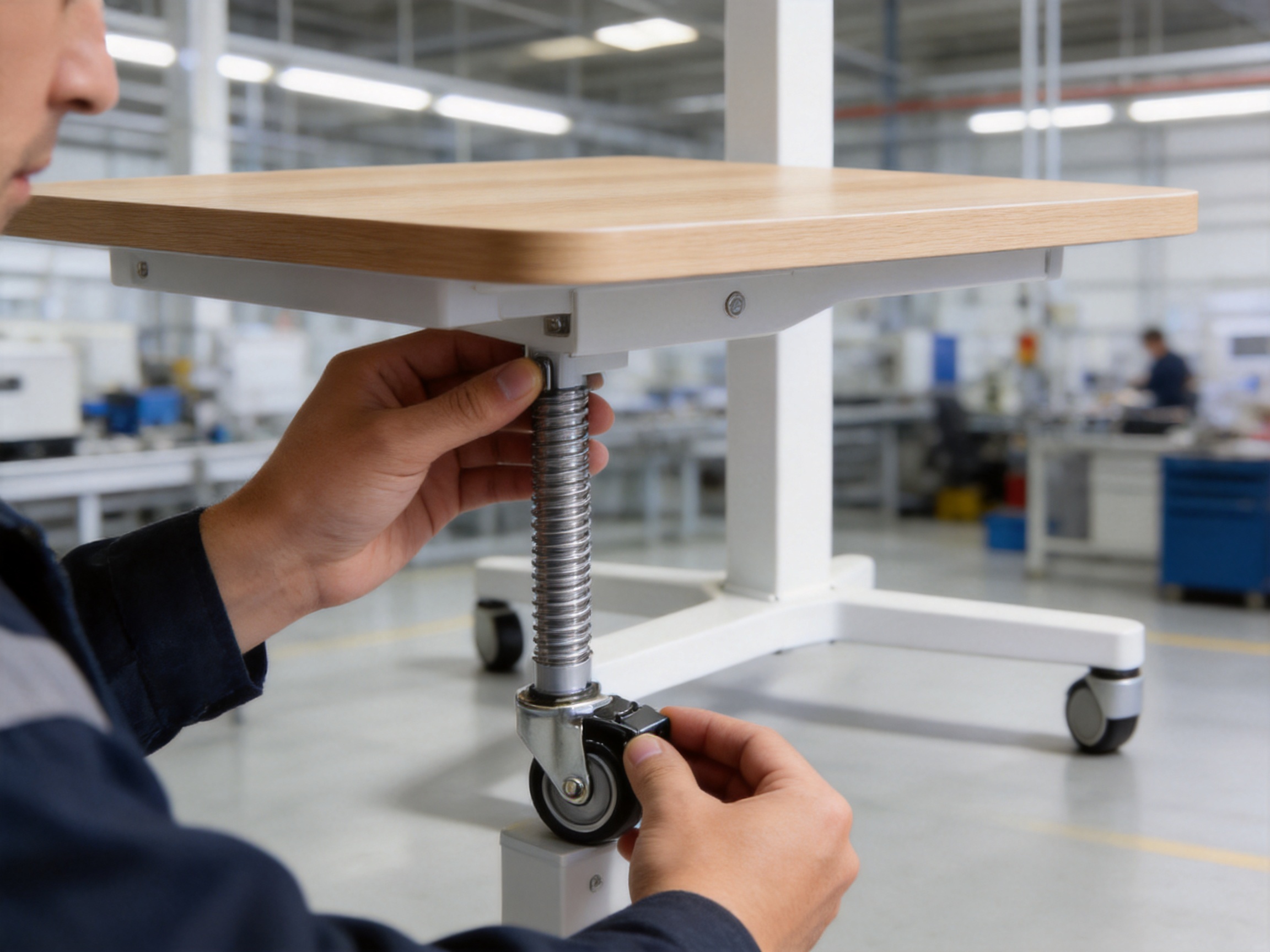
The TH12 reflects an engineering-oriented approach to product development. Its design combines a mechanical lifting system, metal frame structure, caster mobility, surface finishing, and tabletop processing into one integrated product. Each part must be manufactured and assembled accurately for the desk to perform reliably.
Advanced manufacturing is not limited to machinery. It also includes process planning, material control, quality standards, inspection routines, staff training, and continuous product improvement. These factors influence whether a height-adjustable desk feels stable, adjusts smoothly, and maintains appearance after repeated use.
The company’s focus on standing desks and related components gives it category-specific knowledge. This matters because adjustable furniture has different requirements from ordinary furniture. It must manage motion, stability, user safety, ergonomic function, and durability at the same time.
Process Control in Metal Fabrication
The metal structure of a pneumatic height-adjustable desk must be manufactured with precision. If the column, base, and connection parts are not accurately formed, the desk may feel unstable, produce uneven movement, or show premature wear. For this reason, metal fabrication control is a key manufacturing strength.
Aluminum and iron components may involve cutting, forming, machining, welding, drilling, grinding, and surface preparation. Each step must meet dimensional requirements. Small errors can accumulate across assemblies, especially in products with moving columns and lifting systems.
Quality-focused production uses measurement checks during fabrication rather than relying only on final inspection. This helps identify alignment issues before coating and assembly. It also improves production consistency, which is essential for large orders and custom projects.
Connection strength is another important factor. Mobile adjustable furniture experiences repeated movement and occasional impact. The frame joints must remain secure under daily use. Proper fastening, welding quality, and assembly torque control help ensure structural reliability.
Metal fabrication quality directly affects user confidence. A desk that feels solid encourages users to adjust and move it freely. A desk that wobbles or feels weak discourages proper use. The TH12’s material and structural approach are designed to support a stable and dependable user experience.
Powder Coating and Surface Quality Management
Powder coating requires disciplined process management. Before coating, metal surfaces must be cleaned and prepared to support adhesion. Contamination, oil, dust, or uneven surface preparation can reduce coating quality. For a product like the TH12, where appearance and durability are both important, preparation is a critical step.
After pretreatment, powder is applied evenly to the surface. Coating thickness must be controlled to avoid weak coverage or excessive buildup. Uniformity is especially important on visible furniture components because inconsistent coating can affect appearance and perceived quality.
Curing must also be carefully controlled. If temperature or time is insufficient, the coating may not reach full strength. If conditions are excessive, color or surface quality may be affected. Well-managed curing helps create a durable finish suitable for long-term indoor use.
Final inspection may include checks for color consistency, surface smoothness, coating defects, adhesion, and coverage. These steps help ensure that the desk reaches users with a professional appearance and protective finish.
The white powder-coated structure of the TH12 is not only a design choice; it is the result of manufacturing process control. A high-quality coating makes the desk easier to maintain and helps it remain visually consistent in demanding environments.
Tabletop Processing and PVC Vacuum Forming
The TH12 tabletop uses MDF combined with PVC vacuum forming. This tabletop process requires accuracy in panel preparation, shaping, surface application, and finishing. A high-quality tabletop should be flat, smooth, durable, and visually consistent.
MDF panel selection affects the tabletop’s strength and machining quality. The material must be suitable for shaping and must provide a stable core for the surface layer. The 25 mm thickness gives the tabletop a solid feel and supports everyday use.
PVC vacuum forming involves applying the surface material over the panel shape using controlled heat and vacuum pressure. The process helps the PVC conform to the tabletop, creating a clean surface and edge finish. Proper process control prevents bubbling, wrinkling, poor adhesion, or uneven texture.
For users, the benefit is practical. The tabletop can be cleaned easily, resists everyday contact better than unfinished materials, and provides a pleasant working surface. For buyers, the benefit is consistency across multiple units, especially in commercial or institutional purchases.
Panel color options such as white and maple wood also depend on surface material quality. Color consistency, pattern clarity, and edge finishing all contribute to the product’s final appearance. Good tabletop processing ensures that the desk looks refined rather than improvised.
Assembly Accuracy and Final Quality Inspection
A height-adjustable desk is only as good as its assembly. Even strong materials and high-quality components can perform poorly if assembly is inaccurate. The TH12 requires careful integration of the gas spring mechanism, column structure, tabletop, base, and casters.
Assembly accuracy affects height adjustment smoothness. The lifting system must be aligned correctly, and moving parts must operate without unnecessary friction or looseness. The tabletop must be securely attached, and the base must support the desk evenly.
Caster installation is also important. The wheels must roll smoothly and lock securely. Poor caster alignment can affect movement, stability, and user satisfaction. Locking function should be checked before packaging to ensure the desk can be fixed in place during use.
Final inspection may include visual checks, dimensional verification, lifting function testing, stability assessment, caster operation, surface quality review, and packaging inspection. These quality steps help reduce defects and improve customer confidence.
The company’s manufacturing strength is expressed through these details. Users may not see the full production process, but they can feel it in the smoothness of adjustment, the steadiness of the frame, the quality of the finish, and the reliability of daily operation.
Customization and Procurement Advantages
For commercial buyers, furniture selection often involves more than one standard product. Different projects may require specific colors, packaging, quantities, delivery schedules, or configuration adjustments. A manufacturer with experience in adjustable office furniture can support more flexible procurement requirements.
The TH12 already offers panel color choices, including white and maple wood. This allows customers to match different interiors without changing the core mechanical design. White can support clean modern spaces, while maple wood can create a warmer and more natural atmosphere.
Customization strength also comes from manufacturing integration. When a company controls design, production coordination, and quality inspection, it can respond more effectively to project needs. This is valuable for distributors, office furniture contractors, institutional buyers, and corporate clients.
Procurement teams often consider product reliability, repeat order consistency, packaging strength, and after-sales communication. The manufacturer’s focus on standing desk solutions provides a stronger foundation for these needs than general furniture suppliers without height-adjustable product expertise.
For buyers seeking ergonomic adjustable office tables, the TH12 offers a practical combination of mobility, mechanical simplicity, and modern appearance. It can be deployed as a flexible workstation rather than a fixed furniture installation.
Applications in Home Offices
Home offices often require furniture that can adapt to limited space. Many people do not have a dedicated workroom, so a desk may need to fit in a bedroom, living room, study corner, or shared family area. The TH12 is well suited to these environments because it is compact, mobile, and height adjustable.
A home user can use the desk for laptop work during the day, move it aside after work, and reposition it for reading or study in the evening. The casters make this transition simple, while the locking wheels help keep the desk stable during use.
The adjustable height range supports posture variation. A remote worker can sit for focused typing, stand for video calls, and change position throughout the day. This helps create a healthier routine without requiring a large electric standing desk.
The white and maple color options also work well in residential interiors. White creates a clean and bright look, while maple wood can match warmer furniture styles. The compact footprint prevents the desk from visually dominating a room.
For apartments, dormitories, or multipurpose rooms, the TH12 can serve as a practical ergonomic upgrade. It gives users the benefits of height-adjustable work without the installation complexity or space demand of a traditional full-size workstation.
In offices, work styles are changing. Teams may need flexible areas for temporary work, collaboration, training, hot desking, or standing discussions. The TH12 provides a mobile work surface that can be quickly adapted to these changing activities.
For shared workspaces, the desk’s gas spring adjustment is especially useful. Different users can set the height according to their needs without relying on programmed settings. The desk can move between rooms and be used wherever a temporary workstation is required.
In meeting rooms, the TH12 can support laptops, projectors, notes, sample products, or presentation materials. In open offices, it can serve as an auxiliary sit-stand station. In reception or administrative areas, it can provide a flexible surface for forms, devices, or visitor support.
The clean white finish supports professional office aesthetics. Its compact size makes it easier to store or reposition compared with large desks. The locking casters allow it to remain stable once placed for a task.
Organizations looking to improve ergonomic options without replacing every workstation may use mobile pneumatic desks as supplemental solutions. The TH12 can help introduce sit-stand flexibility at a lower complexity level than many fixed electric desk systems.
Applications in Education and Training
Educational spaces benefit from furniture that can be rearranged quickly. Classrooms, training centers, laboratories, libraries, and seminar rooms often shift between lectures, group work, demonstrations, and individual study. A mobile height-adjustable desk can support these changing layouts.
The TH12 can serve as a teacher’s mobile station, a student laptop table, a demonstration platform, or a flexible reading desk. Its height adjustment allows it to work for seated instruction, standing presentation, or device support.
The gas spring mechanism is practical in education because it is simple to use and does not require access to power. Teachers and students can reposition the desk without dealing with cables or electronic controls. This helps reduce setup time and keeps rooms uncluttered.
The tabletop size is appropriate for many educational tasks. It can hold a laptop, tablet, textbook, notebook, or small demonstration item. The easy-to-clean PVC surface also supports regular classroom maintenance.
For training environments, the desk can be moved among participants, used for instructor materials, or placed beside equipment. Its mobility and lockable casters make it useful in active learning settings where static furniture would limit flexibility.
Applications in Studios and Creative Work
Creative studios need adaptable surfaces. Designers, artists, content creators, photographers, and makers often move between digital work, sketching, review, and presentation. The TH12 provides a compact mobile platform that can follow these activities.
A designer can use the desk for laptop review, move it beside a larger table for reference materials, and raise it for standing discussion. A photographer or content creator can use it to hold a laptop, small monitor, control device, or notes during shooting. A craft user can adjust the height for detail work or layout review.
The desk’s compact footprint helps in studios where equipment, materials, and lighting stands already occupy space. The casters allow easy repositioning, while locking wheels help secure the desk once placed.
The white finish can also be beneficial in creative interiors. It looks clean, reflects a neutral design language, and avoids visual clutter. The maple tabletop option can provide a warmer look for studios with natural materials.
Because the desk does not require power for adjustment, it can be used freely around equipment setups. This is especially helpful when outlets are already occupied by computers, lighting, audio devices, or production tools.
Applications in Healthcare, Wellness, and Consultation Spaces
Healthcare and wellness environments often require furniture that is clean-looking, mobile, and easy to adjust. Consultation rooms, therapy spaces, clinics, and wellness studios may need small work surfaces for laptops, documents, devices, or patient communication.
The TH12 can function as a mobile consultation desk or device support table. Its height adjustment allows practitioners to work seated or standing, and its casters allow quick repositioning within a room. Locking wheels help stabilize the desk during use.
The white powder-coated frame supports a clean professional appearance. The PVC vacuum-formed tabletop is easy to wipe, which is valuable in environments where routine surface cleaning is important. The compact size helps the desk fit beside chairs, examination areas, or treatment equipment.
In wellness spaces, the desk can support registration, coaching sessions, equipment control, or reading materials. Its non-electric height adjustment is useful where simplicity and quiet operation are preferred.
While specific healthcare compliance requirements vary by region and application, the TH12’s practical features make it a strong candidate for many general indoor wellness and consultation uses.
User Experience and Daily Operation
A good adjustable desk should feel natural to use. The TH12 emphasizes straightforward operation. Users can change height without searching for a power socket, pressing electronic buttons, or waiting for a programmed movement. The desk is intended to be adjusted as part of normal daily activity.
In a typical workflow, a user may begin seated at the lower height range, raise the tabletop for a standing call, move the desk across the room for a discussion, and then lock the casters for focused work. This type of fluid use is where the product provides its strongest value.
The tabletop size encourages organization. Because it is compact, users are more likely to keep only essential items on the surface. This can support focused work and reduce clutter. The desk is not designed as a storage-heavy workstation; it is designed as an adaptive work surface.
The visual design also affects the user experience. A clean white frame and simple tabletop options allow the desk to blend with many spaces. The distinctive base and panel styling make it more approachable than purely industrial mobile carts.
For daily maintenance, users can wipe the tabletop and frame with appropriate cleaning materials, keep the casters free of debris, and avoid exceeding practical load expectations. Simple care helps preserve smooth movement and appearance over time.
Maintenance Recommendations
To maintain the TH12 in good condition, users should keep the tabletop clean and dry. The PVC vacuum-formed surface can typically be wiped with a soft cloth and mild cleaning solution. Abrasive cleaners should be avoided because they may affect surface appearance.
The powder-coated frame should also be cleaned with non-abrasive materials. Although powder coating improves durability, harsh chemicals or sharp impacts can still damage the finish. Regular light cleaning helps maintain the desk’s professional appearance.
Casters should be checked periodically. Dust, hair, or small debris may affect wheel movement over time. Cleaning the caster area helps maintain smooth rolling. The locking mechanisms should also be tested occasionally to ensure they engage and release properly.
Users should adjust the desk within its intended range and avoid forcing the mechanism beyond its limits. The gas spring lifting system is designed for smooth movement, and excessive force or improper use may reduce performance.
For commercial environments, it is useful to include the desk in routine furniture inspections. Staff can check the tabletop attachment, caster function, frame stability, and adjustment smoothness. Preventive attention helps extend service life and reduce interruptions.
Space Planning and Interior Integration
The TH12 is valuable because it supports flexible space planning. Many modern interiors are designed for multiple functions rather than one fixed use. A room may serve as an office in the morning, a training space in the afternoon, and a meeting area later in the day. Mobile adjustable furniture makes these transitions easier.
The compact tabletop helps the desk fit into narrow or crowded spaces. It can be placed beside a sofa, near a bed, next to a conference table, at the side of a classroom, or in a studio corner. When not needed, it can be moved away more easily than a full-size desk.
The height adjustment range expands placement options. At lower heights, the desk works with chairs and seated users. At higher settings, it can support standing work or temporary presentation tasks. This versatility reduces the need for multiple specialized tables.
Color selection helps with design integration. White is suitable for bright, modern, minimalist, and clinical interiors. Maple wood can coordinate with natural, warm, educational, or residential themes. Having both options makes it easier to standardize the product across different room types.
For facility managers, the desk can help improve room utilization. Instead of dedicating a fixed station to every possible activity, a mobile height-adjustable desk can be assigned where needed. This supports better flexibility and potentially reduces furniture redundancy.
Safety and Practical Use Considerations
Any height-adjustable and mobile furniture should be used thoughtfully. Users should lock the casters when performing tasks that require stability, such as typing, writing, drawing, or using electronic devices. Movement should be controlled, especially when items are on the tabletop.
The desk should be placed on suitable indoor flooring. Smooth, level surfaces help caster movement and overall stability. Uneven floors, thick rugs, or obstacles may affect mobility. Users should also avoid sudden pushing or pulling when equipment is on the tabletop.
Height adjustment should be performed with attention to objects around the desk. Users should ensure that the tabletop will not collide with shelves, walls, chairs, or other furniture during movement. This is especially important in compact spaces.
Load distribution matters. Items should be placed reasonably on the tabletop, and heavy objects should not be positioned in a way that could affect balance. The TH12 is best used for common work items such as laptops, documents, books, tablets, and small accessories.
When used in shared environments, basic user guidance can help protect the product and improve safety. Simple instructions on locking wheels, adjusting height, and moving the desk can prevent misuse and extend product life.
How the TH12 Supports Modern Work Trends
Work is becoming more mobile, hybrid, and activity-based. People no longer work only at one assigned desk for the entire day. They may move between home and office, between sitting and standing, between individual focus and group collaboration. Furniture must support this shift.
The TH12 aligns with these trends by offering a portable and adjustable work surface. It supports users who need a desk that can appear where work is happening rather than forcing work to happen only at a fixed workstation.
Hybrid work has increased demand for compact ergonomic furniture. Many home users want adjustable functionality but cannot accommodate large electric desks. The TH12 provides a practical alternative with less complexity and strong flexibility.
Activity-based workplaces also benefit. A mobile pneumatic desk can support temporary workstations, agile teams, shared resources, and flexible meeting formats. It can be repositioned quickly, adjusted to task height, and locked for stable use.
In education and training, flexible furniture supports active learning. In studios, it supports changing creative workflows. In healthcare and consultation spaces, it supports practical interaction. Across these environments, the product’s value comes from adaptability.
Environmental and Efficiency Considerations
Furniture sustainability is influenced by durability, repairability, material efficiency, and useful life. A product that remains functional and relevant across multiple scenarios may reduce the need to purchase separate specialized furniture pieces.
The TH12’s compact design uses space efficiently. Its adjustability allows one desk to serve seated and standing purposes, while its mobility allows one unit to support different rooms or activities. This flexible use can improve furniture utilization.
The non-electric lifting system also reduces dependence on electronic components. While electric desks are appropriate for many applications, pneumatic adjustment avoids motors, control boxes, and power systems for this type of mobile desk. This can simplify maintenance and reduce electronic complexity.
Powder coating contributes to longevity by protecting the metal structure. A durable finish helps the desk remain attractive and usable for longer periods. The MDF and PVC tabletop structure is practical for everyday use and easy cleaning, supporting continued service in active environments.
Manufacturing quality is essential to sustainability. Products that fail early create waste and replacement costs. By emphasizing process control, material selection, and inspection, the manufacturer supports longer product life and better overall value.
Buyer Evaluation Guide
When evaluating a pneumatic height-adjustable desk, buyers should consider the intended use environment first. If the desk must move frequently, caster quality and locking function are essential. If the desk will support sit-stand work, height range and adjustment smoothness are key factors.
The TH12 offers a practical 715 mm to 1130 mm lifting range, making it suitable for many seated and standing activities. Its gas spring mechanism is ideal for users who want fast manual adjustment without electric power.
Tabletop size should also match the work style. The 680 mm by 560 mm surface is suitable for laptops, tablets, notebooks, documents, and light accessories. Buyers needing multiple large monitors or heavy desktop systems may require a larger workstation, but for compact mobile work, the size is highly efficient.
Material and finish should be reviewed carefully. The aluminum and iron structure provides strength, while powder coating supports long-term appearance. The 25 mm MDF and PVC tabletop provides a practical work surface for daily tasks.
Finally, buyers should consider the manufacturer’s category expertise. A company focused on standing desks and adjustable workspace solutions is better positioned to deliver reliable motion performance, consistent production quality, and appropriate product support.
Why This Product Is a Strong Choice
The TH12 combines multiple strengths in one product: height adjustability, mobility, compact size, durable materials, simple operation, and clean appearance. It is not merely a small table, and it is not simply a standing desk. It is a flexible mobile workstation designed for changing indoor work needs.
Its strongest advantage is practical adaptability. The gas spring lifting system allows users to change height without electricity. The casters allow movement across rooms. The locking wheels provide stability when work begins. The compact tabletop supports essential activities without wasting space.
Compared with fixed desks, it provides more ergonomic flexibility. Compared with electric desks in mobile scenarios, it offers simpler deployment and less dependence on power. Compared with basic rolling tables, it offers a more refined adjustable structure and stronger professional value.
The product also benefits from dedicated manufacturing capability. The company’s focus on standing desks, its location within an advanced industrial region, and its emphasis on production, surface treatment, assembly, and inspection all contribute to the desk’s overall quality.
For home offices, schools, shared workplaces, studios, consultation rooms, and multipurpose interiors, the TH12 offers a compelling balance of function, simplicity, and design. It is a practical solution for users who need a work surface that moves with them and adapts to their posture.
Frequently Asked Questions
What is the height adjustment range of the desk?
The desk adjusts from 715 mm to 1130 mm. This range supports many seated and standing tasks, including laptop work, reading, writing, teaching support, and temporary presentation use.
Does the desk require electricity?
No. The desk uses a gas spring lifting mechanism, so height adjustment does not require a power outlet, motor, control box, or electrical cable.
What is the tabletop size?
The tabletop measures 680 mm by 560 mm and has a thickness of 25 mm. It is compact enough for mobile use while still providing a practical surface for common work items.
What materials are used in the desk?
The frame is made from aluminum and iron. The tabletop is made from 25 mm MDF with PVC vacuum forming. The metal structure is finished with powder coating.
Is the desk easy to move?
Yes. The desk is equipped with three casters, including two locking casters and one non-locking caster. This allows the desk to move easily and then remain stable when locked in place.
What panel colors are available?
The tabletop panel is available in white and maple wood. These options allow the desk to fit different office, education, residential, and studio interiors.
How does this desk compare with an electric standing desk?
An electric standing desk is often suitable for large permanent workstations, especially where heavy equipment or programmed height memory is required. This pneumatic desk is better suited for mobile, compact, and flexible settings because it does not require power and can be moved more freely.
Is the desk suitable for home offices?
Yes. Its compact size, clean appearance, and sit-stand height range make it a strong choice for home offices, apartments, dormitories, and multipurpose rooms.
Can it be used in schools or training rooms?
Yes. The desk is well suited for education and training environments because it is mobile, adjustable, simple to operate, and does not require electrical connection for height adjustment.
How should the desk be maintained?
Users should wipe the tabletop and frame with non-abrasive cleaning materials, keep the casters free of debris, lock the wheels during work, and avoid forcing the lifting mechanism beyond its intended range.
What are the main competitive advantages?
The main advantages are pneumatic height adjustment, freedom from power cables, compact mobility, locking caster stability, durable metal construction, powder-coated finish, easy-clean tabletop, and suitability for many indoor work environments.
Who manufactures the product?
The product is manufactured by SuZhou Skyhone Intelligent Technology Co., Ltd., a company engaged in the research, development, production, sales, and service of standing desks and adjustable workspace solutions.
Conclusion
The TH12 pneumatic height-adjustable desk offers a highly practical response to the changing needs of modern work and learning environments. Its gas spring lifting system, 715 mm to 1130 mm adjustment range, mobile caster base, durable frame, powder-coated surface, and 25 mm PVC-formed tabletop create a well-balanced product for flexible indoor use.
Its advantages are especially clear in spaces where mobility and simplicity matter. It does not require power for adjustment, does not rely on electronic controls, and can be repositioned quickly. This makes it suitable for home offices, shared workplaces, education spaces, studios, consultation rooms, and multipurpose interiors.
Beyond the product itself, strong manufacturing capability supports its value. Careful metal fabrication, powder coating, tabletop processing, assembly accuracy, and quality inspection all influence the final user experience. The company’s professional focus on adjustable desks and its manufacturing environment in the Yangtze River Delta provide a strong foundation for consistent production and product development.
For buyers seeking an ergonomic adjustable office table that is compact, mobile, reliable, and easy to use, the TH12 is a strong choice. It bridges the gap between fixed desks, basic rolling tables, and larger electric standing desks, offering a distinctive solution for flexible sit-stand work.
References
Bridger, R. S. Introduction to Ergonomics. CRC Press.
Kroemer, K. H. E., and Grandjean, E. Fitting the Task to the Human: A Textbook of Occupational Ergonomics. Taylor and Francis.
Pheasant, S., and Haslegrave, C. M. Bodyspace: Anthropometry, Ergonomics and the Design of Work. CRC Press.
Helander, M. A Guide to Human Factors and Ergonomics. CRC Press.
Sanders, M. S., and McCormick, E. J. Human Factors in Engineering and Design. McGraw-Hill.
Karwowski, W. International Encyclopedia of Ergonomics and Human Factors. CRC Press.


- Contact Info
-
-
 Phone+86-15950656125
 -
 Email
Email -
 AddressRoom 1007-1, South Building, Suyue Plaza, Suzhou Industrial Park, Suzhou City, Jiangsu Province, China
-
- Products
- Follow Us
- Need help? Please contact us
Copyright ©
SuZhou Skyhone Intelligent Technology Co., Ltd.
All Rights Reserved.
Privacy
Custom Ergonomic Adjustable Office Tables Manufacturers

