

 English
  русский
  Español
  عربى
عربى 
Content
- 1 Product Overview: A Purpose-Built Adjustable Workstation
- 2 Key Specifications
- 3 Ergonomic Value in Real Working Conditions
- 4 Gas Spring Lifting: Smooth, Efficient, and Power-Free
- 5 Stepless Tilt up to 90 Degrees
- 6 Stable Materials for Industrial and Professional Use
- 7 Advantages Over Conventional Tablet Stands
- 8 Advantages Over Fixed-Height Work Tables
- 9 Advantages Over Electric Adjustable Desks in Specific Applications
- 10 Application Scenarios
- 11 Design Details That Improve Daily Use
- 12 Manufacturing Strengths Behind the Product
- 13 Quality Control and Process Discipline
- 14 Customization and Project Support
- 15 Why the TH01-2 Stands Out in a Competitive Market
- 16 Purchasing Considerations for Buyers
- 17 Q&A Section
- 17.1 What is the main purpose of the TH01-2 pneumatic height-adjustable desk?
- 17.2 What is the height adjustment range?
- 17.3 How does the desk adjust height?
- 17.4 How far can the tabletop tilt?
- 17.5 What materials are used?
- 17.6 Is the workstation easy to move?
- 17.7 What colors are available?
- 17.8 How does it compare with an electric adjustable desk?
- 17.9 How does it compare with a regular tablet stand?
- 17.10 Who manufactures the product?
- 18 Conclusion
- 19 References
Industrial Pneumatic Height-Adjustable iPad Workstation for Flexible Operations
2026-05-20
Modern work environments increasingly depend on compact digital devices for control, inspection, documentation, data entry, presentation, and mobile workflow management. In factories, laboratories, healthcare support areas, training rooms, testing stations, and interactive display spaces, the tablet has become more than a consumer device; it is now a practical interface between people, machines, data, and processes. The TH01-2 iPad High-Legged Pneumatic Height-Adjustable Desk is designed for precisely these scenarios. It combines pneumatic height adjustment, stepless tabletop tilt, industrial-grade mobility, and durable material construction in a compact workstation platform that supports frequent repositioning and comfortable operation.
Unlike ordinary office tables or simple tablet stands, this workstation is engineered as a dedicated adjustable-height platform. Its lifting range of 750 mm to 1060 mm allows users to work while seated, semi-standing, or standing, depending on the operational context. Its tabletop can tilt up to 90 degrees through a stepless tilt mechanism, giving operators a wide angle range for viewing and interacting with tablets, control panels, documents, instruments, or lightweight devices. The product also integrates a gas spring lifting principle, giving users smooth, controllable, and power-free adjustment without the complexity of electric motors, wiring, or external power supply dependence.
For buyers seeking an ergonomic adjustable office table, a mobile industrial tablet station, or a pneumatic height-adjustable table for specialized applications, the TH01-2 offers a balanced combination of usability, durability, aesthetics, and production quality. Manufactured by SuZhou Skyhone Intelligent Technology Co., Ltd., a professional enterprise focused on standing desks and intelligent office space solutions, the product reflects the company’s broader strengths in research and development, precision manufacturing, material processing, surface treatment, and practical ergonomic design.
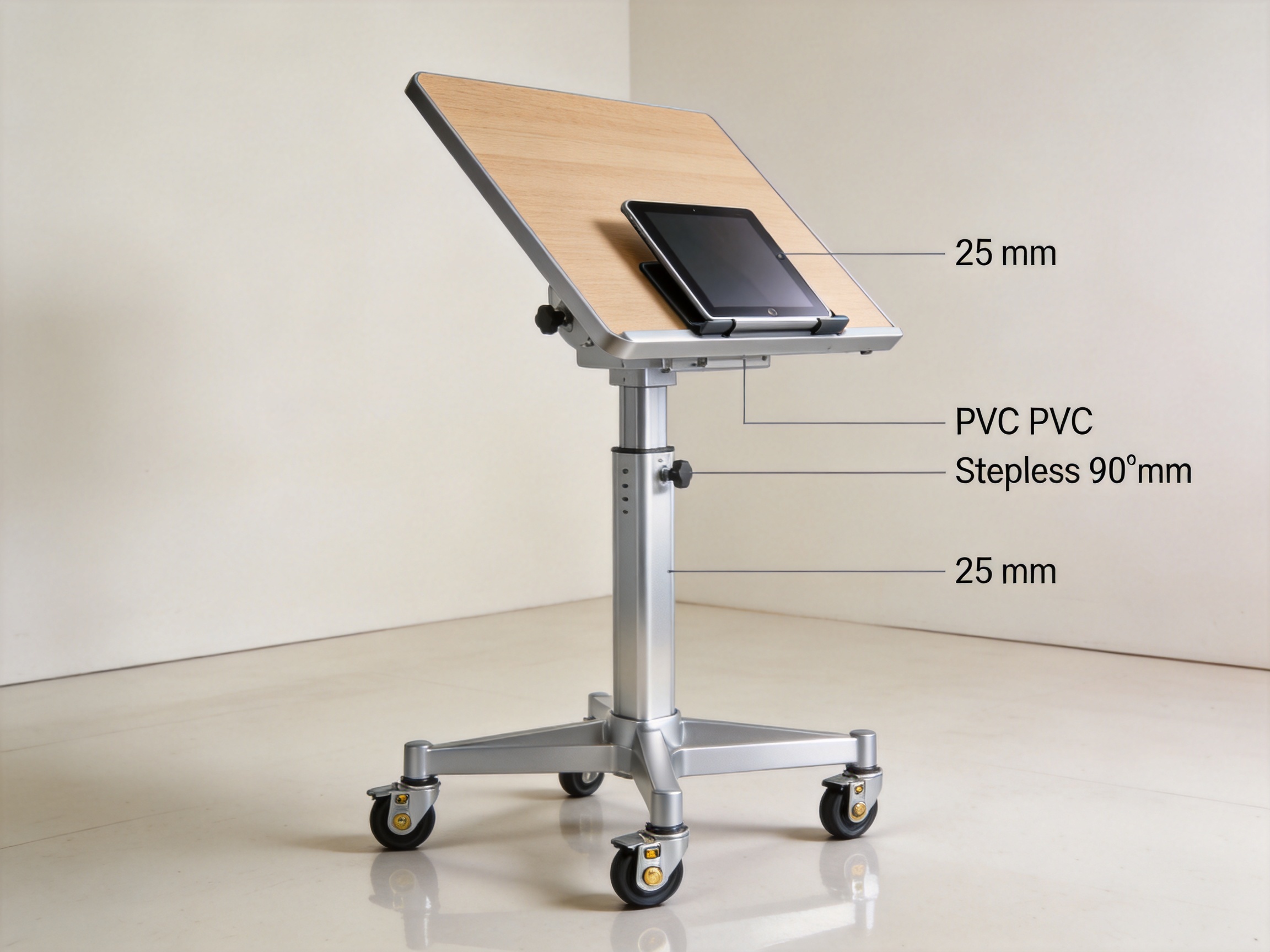
Product Overview: A Purpose-Built Adjustable Workstation
The TH01-2 is not simply a movable table with wheels. It is a high-legged pneumatic workstation designed to support iPads and other mobile devices in demanding work environments where height, viewing angle, mobility, and stability all matter. Many tablet stands solve only one problem: they hold a device at a fixed angle. Many office desks solve another problem: they provide a work surface. The TH01-2 combines these functions into a flexible industrial platform that can be repositioned, locked, tilted, raised, lowered, and visually matched to the surrounding environment.
The product category is pneumatic height-adjustable table, and its working principle is based on gas spring lifting combined with a stepless tilt mechanism. This combination gives the user two essential types of adjustment. First, vertical adjustment changes the working height from 750 mm to 1060 mm. Second, angular adjustment allows the tabletop to tilt up to 90 degrees. Together, these adjustments support a variety of operational needs, including upright display, inclined viewing, close data entry, standing operation, seated inspection, and compact storage or repositioning.
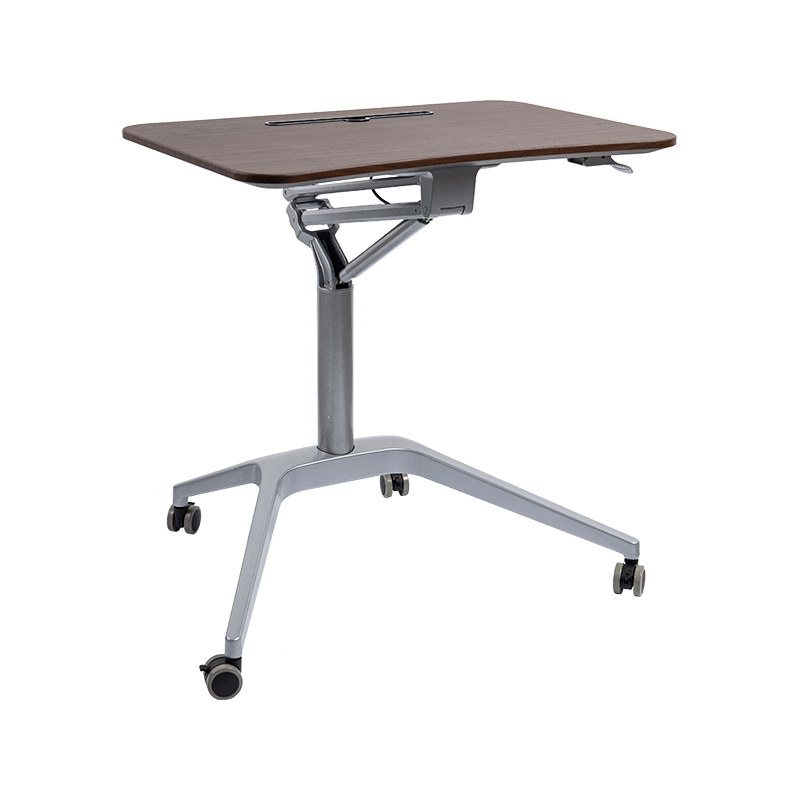
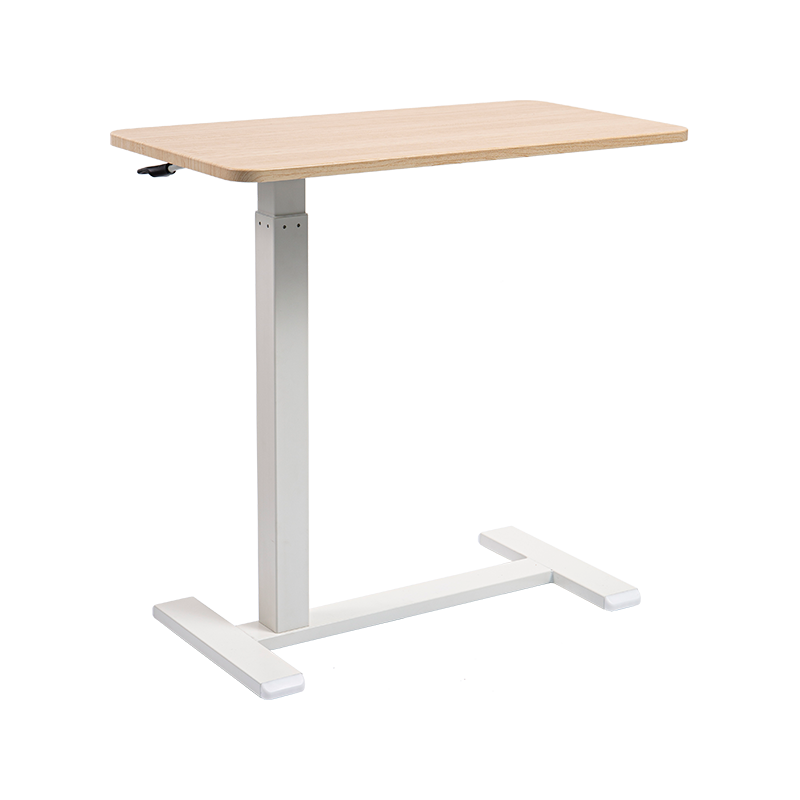
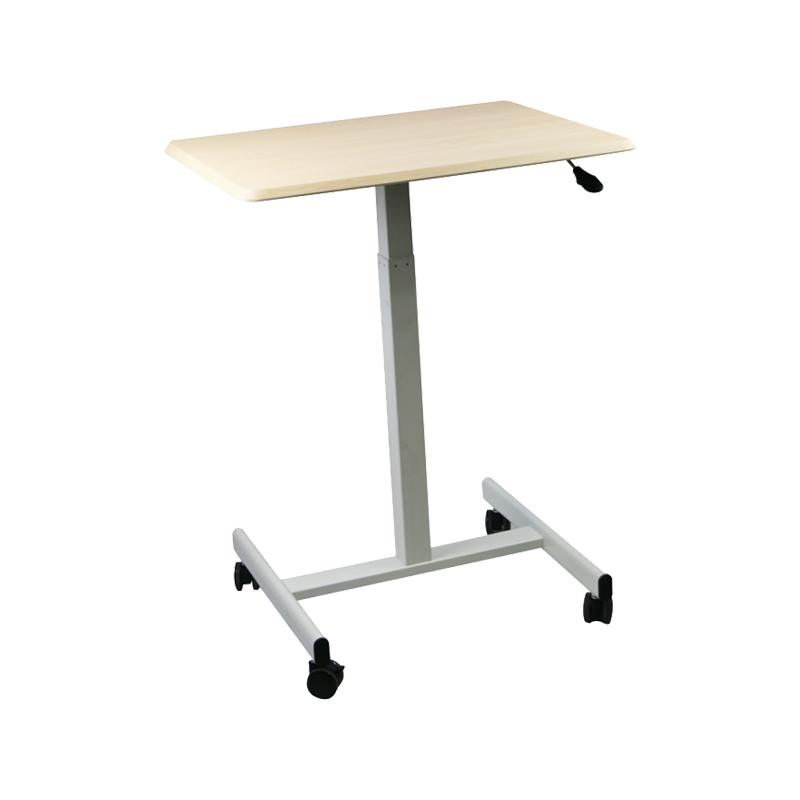
The tabletop measures 715 mm by 475 mm with a thickness of 25 mm. This size is large enough to support a tablet, documents, a keyboard, inspection sheets, small tools, or lightweight accessories, while remaining compact enough for use in laboratories, production aisles, training spaces, or medical support areas where floor space must be carefully managed. The tabletop material is 25 mm MDF with PVC vacuum forming, providing a consistent surface finish and reliable dimensional stability. The main structure uses aluminum and iron, combining lightness, strength, and cost-effective durability.
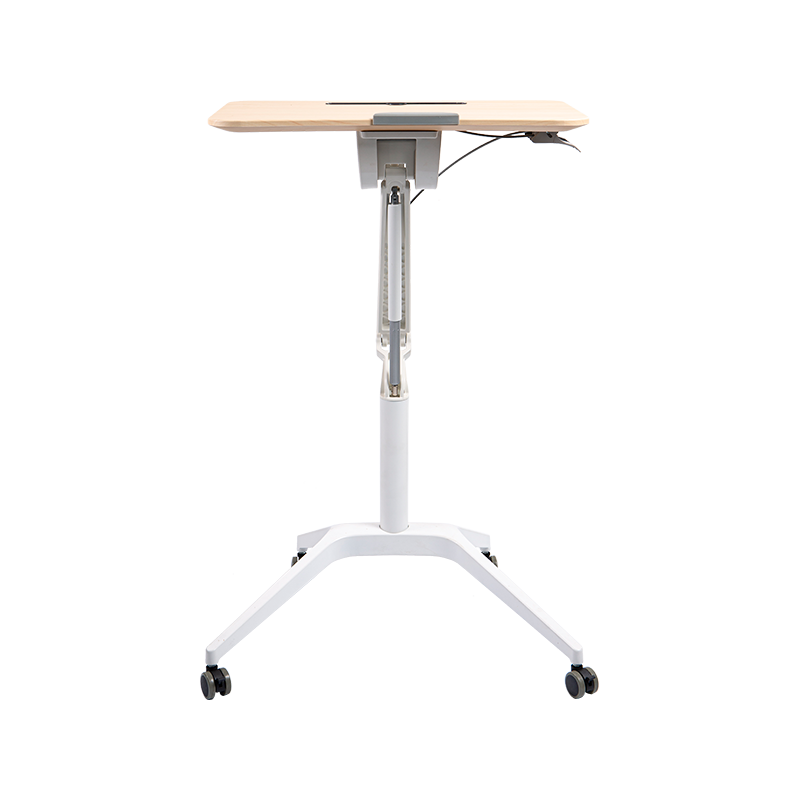
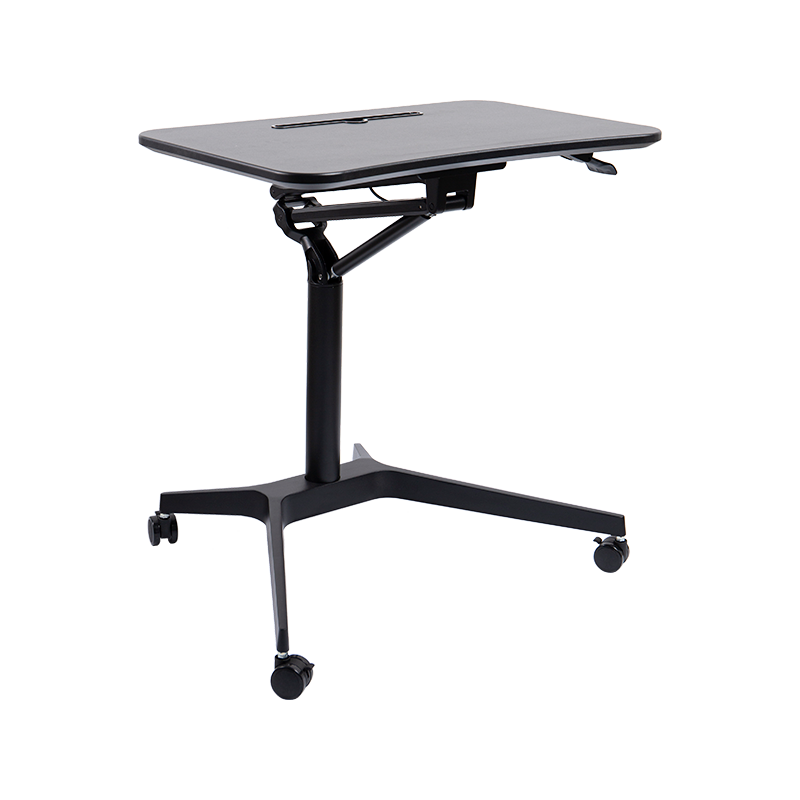
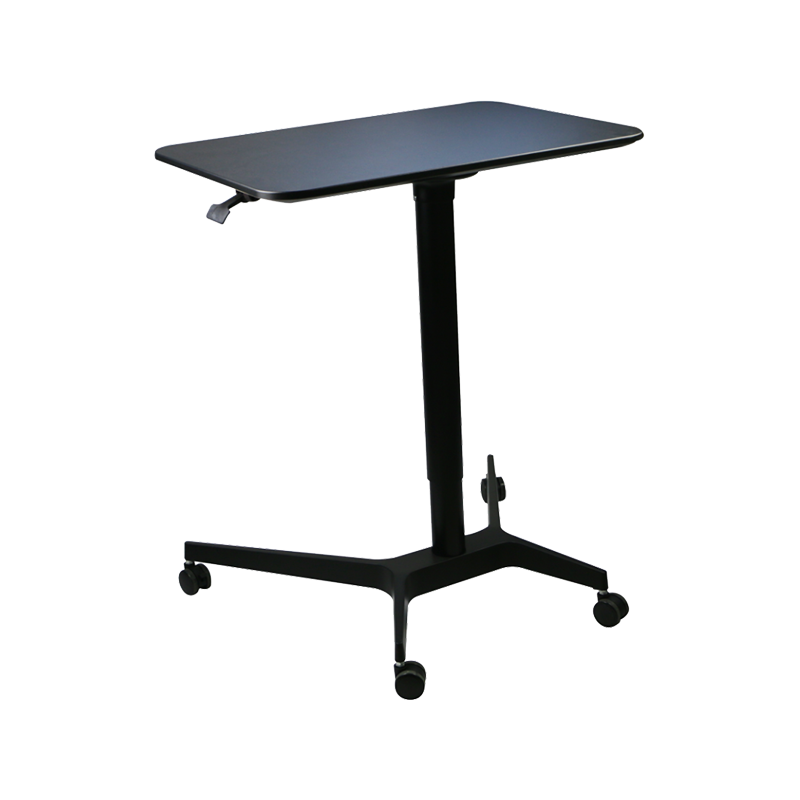
The powder-coated surface is available in white or silver, two finishes that are easy to integrate into industrial, laboratory, office, educational, and display environments. The panel itself is available in White, Maple, Walnut, and Black, giving project buyers and facility managers a choice between clean technical appearance, warmer wood-like finishes, or a stronger modern contrast. The base is equipped with four casters, including two locking casters and two non-locking casters, supporting both mobility and stationary stability.
Key Specifications
Specification Item |
TH01-2 Configuration |
Practical Value |
Lifting Range |
750 mm to 1060 mm |
Supports seated, standing, and transitional working postures. |
Tabletop Dimensions |
715 mm x 475 mm x 25 mm |
Provides a compact yet functional work surface for tablets and accessories. |
Tabletop Material |
25 mm MDF with PVC vacuum forming |
Delivers stable structure, smooth finish, and practical durability. |
Main Frame Material |
Aluminum and iron |
Combines strength, rigidity, and manageable product weight. |
Surface Treatment |
Powder coating |
Improves resistance to wear, corrosion, and daily handling. |
Surface Colors |
White and silver |
Matches modern industrial, laboratory, and office environments. |
Caster Configuration |
Two locking casters and two non-locking casters |
Allows easy movement and secure positioning. |
Panel Colors |
White, Maple, Walnut, and Black |
Enables design coordination with different workspace styles. |
Working Principle |
Gas spring lifting plus stepless tilt mechanism |
Provides smooth manual height and angle adjustment without electric power. |
Maximum Tilt Angle |
90 degrees |
Supports a wide range of viewing, display, and operating positions. |
Ergonomic Value in Real Working Conditions
Ergonomics is often discussed in relation to traditional office desks, but it is equally important in industrial and technical environments. Operators who repeatedly bend over a fixed tablet stand, twist their necks toward a poorly positioned screen, or reach awkwardly across a workstation may experience fatigue over time. In high-frequency work scenarios, even a small mismatch between user height, device position, and viewing angle can reduce efficiency and comfort.
The TH01-2 addresses these issues by giving users quick control over both height and angle. A shorter operator can lower the tabletop to a comfortable level, while a taller operator can raise it to avoid bending. When the task changes from reading to touchscreen input, the user can modify the tilt angle. When a device must be shown to another person, the tabletop can be positioned more upright. When a technician needs to enter data while standing beside equipment, the height and angle can be adjusted to create a direct and comfortable interface.
This adjustability is especially valuable in shared workstations. In many factories and laboratories, one workstation may be used by several people across different shifts. Fixed furniture tends to favor one body type or one operating method. Adjustable furniture supports diversity in user height, work posture, and task requirements. The TH01-2 therefore contributes to a more inclusive and adaptable workplace.
Compared with traditional fixed-height tables, the product reduces the need to adapt the body to the table. Instead, the table adapts to the user and task. This difference is central to modern ergonomic thinking. A well-designed workstation should not force users into static positions; it should allow movement, adjustment, and task-specific alignment. The pneumatic lifting structure of the TH01-2 makes this adjustment intuitive and accessible without requiring electrical controls.
Gas Spring Lifting: Smooth, Efficient, and Power-Free
One of the defining advantages of the TH01-2 is its gas spring lifting mechanism. Gas springs are widely used in ergonomic furniture, medical equipment, automotive systems, industrial covers, and adjustable supports because they provide controlled motion within a compact structure. In this workstation, the gas spring supports vertical movement and enables smooth height adjustment across the 750 mm to 1060 mm range.
The practical benefit of a gas spring system is simplicity. Unlike electric lifting systems, the pneumatic structure does not require motors, control boxes, power cables, or electrical outlets. This is especially important in environments where cable clutter is undesirable, where equipment must be moved frequently, or where power availability is limited. A mobile workstation with an electric system may require charging or connection management; the TH01-2 avoids this issue by using a mechanical-pneumatic adjustment method.
Gas spring lifting also offers fast response. Operators do not have to wait for a motor to raise or lower the table. They can quickly reposition the desk to a suitable height and continue working. In production and inspection environments, where small time savings are repeated many times per day, fast manual adjustability can support smoother workflow.
Another advantage is quiet operation. Electric actuators can be quiet when well-designed, but they still involve motor movement. A gas spring mechanism offers a more direct and silent adjustment experience, making it suitable for laboratories, classrooms, medical support areas, and display environments where low noise is preferred. It also reduces the number of electronic components, which can simplify maintenance and improve reliability in certain applications.
This does not mean pneumatic systems replace electric height-adjustable desks in every case. Electric linear actuators remain important for heavier work surfaces, programmable height presets, and large office desk platforms. However, for a compact iPad-oriented mobile workstation that prioritizes quick repositioning, mobility, and independence from power, the gas spring approach is highly appropriate. The TH01-2 uses this principle in a focused and practical way.
Stepless Tilt up to 90 Degrees
Height adjustment alone is not enough for a tablet workstation. Tablets, touchscreens, and mobile interfaces are highly angle-sensitive. A tablet used for reading may need a different angle from one used for typing. A tablet used as a display point may need to face outward toward visitors or operators. A tablet used for production control may need to be placed at a stable angle that minimizes glare and allows repeated touch input.
The TH01-2 includes a stepless tilt mechanism with a maximum tilt angle of 90 degrees. The word stepless is important because it means the user is not restricted to a few fixed positions. Instead of choosing between only flat, medium, or upright settings, the user can select the most suitable angle within the available range. This is particularly useful when lighting conditions, user height, and task type vary during the day.
A 90-degree tilt range creates possibilities beyond ordinary tabletop use. In an upright position, the tabletop can act as a display surface or tablet presentation support. In a moderately inclined position, it can support comfortable touch interaction. In a flatter position, it can function more like a conventional work surface for writing, inspection, or temporary placement of accessories. This flexibility allows the same workstation to serve multiple roles in one workspace.
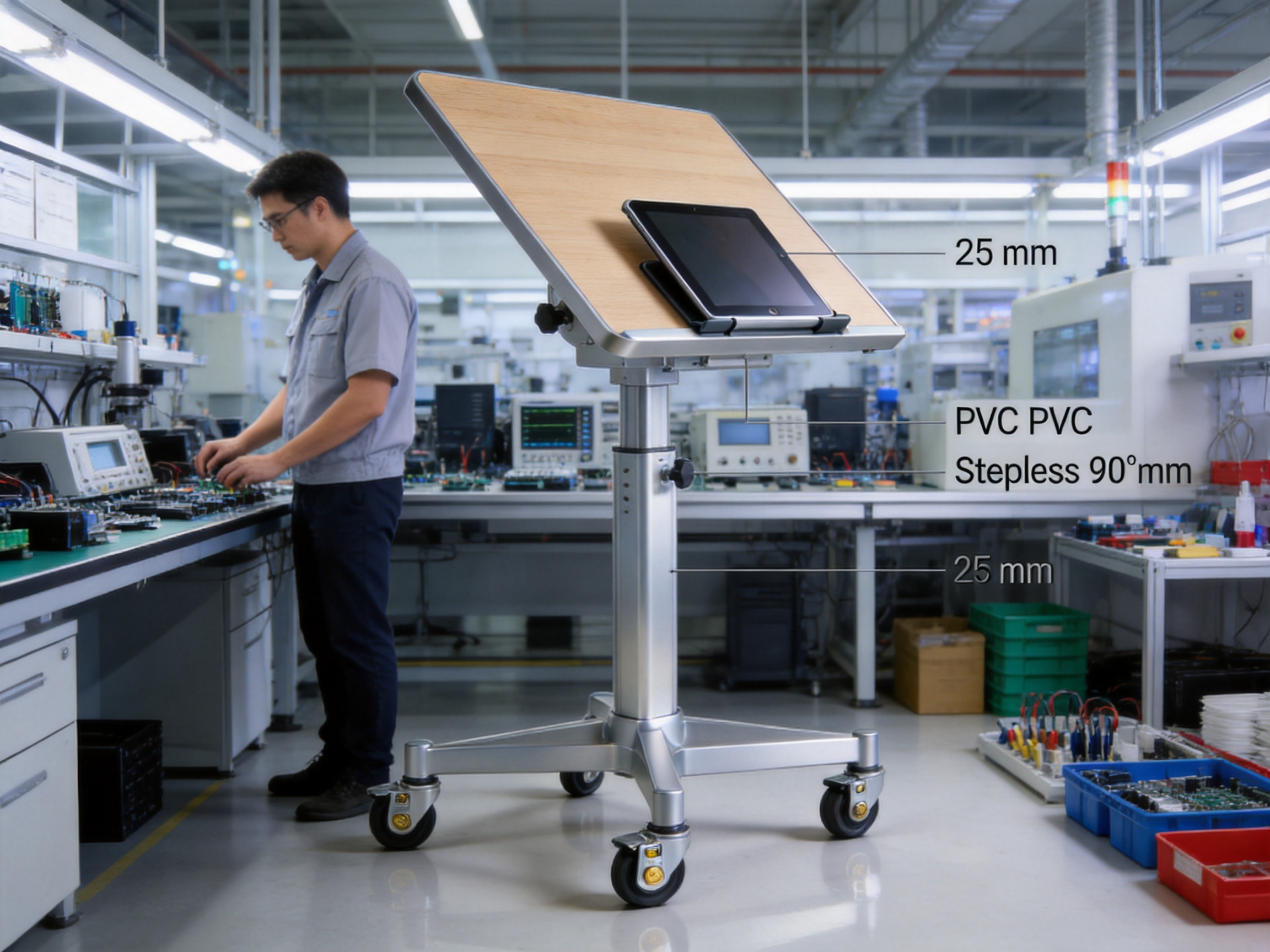
For example, in an electronics testing station, the tabletop may be tilted slightly upward for operators to view test data on an iPad while handling components. In a laboratory, it may be positioned at a comfortable angle for reading procedures while wearing gloves. In a training room, it may be raised and tilted upright to show information to a group. In a medical equipment support area, it may hold a tablet interface near a cart or device while allowing staff to adjust the viewing angle quickly.
Compared with many competing products that offer only fixed tilt brackets or limited angle positions, the TH01-2 provides a more refined user experience. The user can adapt the angle to the task rather than accepting a compromise. This contributes not only to comfort but also to operational accuracy, because screens and documents are easier to read when positioned correctly.
Stable Materials for Industrial and Professional Use
The material selection of the TH01-2 reflects its role as a practical industrial-grade workstation. The frame combines aluminum and iron. Aluminum contributes lighter weight and corrosion resistance, while iron contributes strength and structural rigidity. This combination helps the desk remain mobile without feeling fragile. For a product that may be moved between stations, locked in place, adjusted frequently, and used by different operators, this balance is important.
The tabletop uses 25 mm MDF with PVC vacuum forming. MDF is widely used in furniture and workstation manufacturing because it provides a smooth, consistent, and stable board structure. The 25 mm thickness gives the tabletop a substantial feel and helps support everyday use. PVC vacuum forming provides a formed surface layer that improves appearance and usability. It can create a neat finish with consistent edges and surface coverage, which is helpful for environments that value both function and cleanliness.
Powder coating is used for the metal surface treatment. Compared with basic paint application, powder coating is known for durability, uniform coverage, and resistance to chipping and surface wear when properly processed. It also supports a clean, professional appearance in white or silver. These colors are common in technical environments because they suggest cleanliness, precision, and compatibility with equipment and laboratory interiors.
The use of locking casters adds another layer of practical stability. Mobility is useful only when it can be controlled. Four casters allow the workstation to move easily, while two locking casters help secure it once it reaches the desired position. This is a meaningful advantage over tables that either lack mobility or move too freely after placement. In a busy workplace, the ability to lock the workstation supports safety, accuracy, and user confidence.
Advantages Over Conventional Tablet Stands
Many buyers first consider ordinary tablet stands when they need an iPad support solution. However, a simple stand often lacks the structural flexibility required in professional environments. It may sit on an existing table, creating dependence on another surface. It may offer limited height adjustment, limited stability, or no mobility. It may also be unsuitable for shared use or industrial settings where repositioning is frequent.
The TH01-2 offers several advantages over conventional tablet stands. First, it is a complete workstation rather than only a holder. Its tabletop can support an iPad along with documents, tools, scanners, or small accessories. Second, it provides meaningful height adjustment, not merely angle adjustment. Third, it is mobile, so it can be moved to where the task is being performed. Fourth, it is designed with a durable metal structure and powder-coated finish, making it more suitable for professional environments.
Another important difference is user posture. A small tablet stand placed on a fixed table may still force the user into an awkward height. The TH01-2 allows the whole work surface to move vertically, improving alignment between the user and the device. This is a more complete ergonomic solution. In environments where operators repeatedly interact with screens, this difference can reduce fatigue and improve task continuity.
The stepless tilt mechanism also gives the product a wider functional range than many tablet stands. Instead of adjusting only the device holder, the entire tabletop angle can be changed. This allows the table to support different device sizes and work materials, not only one tablet model. It also makes the workstation adaptable as technology changes over time.
Advantages Over Fixed-Height Work Tables
Fixed-height work tables remain common because they are simple and inexpensive. However, they are limited in multi-user and multi-task environments. A fixed table height may be comfortable for one person but uncomfortable for another. It may support seated work but not standing work, or it may support standing work but not close seated interaction. When a workplace uses tablets for control, inspection, or entry tasks, fixed furniture often becomes a hidden source of inefficiency.
The TH01-2 improves on fixed-height tables by offering a 310 mm vertical adjustment range. This is significant enough to support different users and postures. It allows a production technician to raise the surface for standing operation, a seated worker to lower it for close interaction, or a trainer to position the table for visibility during demonstration. In contrast, a fixed table requires the user to adapt through bending, stretching, or adding secondary supports.
Mobility is another key advantage. Fixed tables often occupy permanent space even when not in use. The TH01-2 can be moved to a station, locked, used, and then relocated. This makes it especially useful for flexible manufacturing cells, temporary testing points, mobile inspection workflows, classrooms, and demonstration areas. It helps facilities avoid unnecessary duplication of fixed workstations.
Additionally, fixed tables usually lack integrated tilt. Users may add separate stands or wedges to create a viewing angle, but these additions can be unstable and visually cluttered. The TH01-2 integrates height, tilt, and mobility into one coordinated product. This integrated design is more efficient, more professional, and easier to standardize across multiple work areas.
Advantages Over Electric Adjustable Desks in Specific Applications
Electric adjustable desks are valuable products, especially for full-size office workstations. They commonly use electric linear actuators, control panels, and programmable height presets. SuZhou Skyhone Intelligent Technology Co., Ltd. operates within a product ecosystem that includes adjustable height desks, electric linear actuators, and gas springs, giving it a broad understanding of different lifting technologies. The TH01-2 demonstrates that the best solution depends on the application.
For a compact mobile iPad workstation, pneumatic adjustment offers several advantages over electric systems. It does not require a power cord, making movement simpler and safer. It reduces the risk of cable interference in production aisles or laboratory spaces. It avoids dependence on batteries or charging. It also reduces the number of electrical components, which can be useful in environments where simple mechanical reliability is preferred.
The gas spring system can also be faster for short, frequent adjustments. Instead of pressing a button and waiting for a motor, the user can manually reposition the height quickly. For a lightweight tabletop and tablet-oriented use case, this is efficient and intuitive. The workstation becomes a direct extension of the user’s movement.
Electric desks may be better for heavy monitors, large desktop setups, or users who need exact memory positions. However, the TH01-2 is not trying to be a large executive standing desk. It is a specialized, mobile, high-legged pneumatic table for iPads and related devices. In that role, the pneumatic mechanism provides an excellent balance of performance, simplicity, mobility, and cost efficiency.
Application Scenarios
Electronics Manufacturing and Testing Stations
In electronics manufacturing, operators often need access to digital instructions, testing data, barcode systems, quality inspection forms, or device control interfaces. The TH01-2 can serve as a compact iPad workstation beside a production line, test bench, or assembly cell. Its casters allow it to be moved as production layouts change, while locking casters help maintain stability during operation.
The height adjustment is valuable because electronics tasks may involve seated assembly, standing inspection, or movement between machines. The tilt function helps reduce screen glare under factory lighting and improves readability. Because the surface is larger than a simple tablet holder, it can also support small documents, labels, handheld scanners, or checklists.
Laboratory Equipment Benches
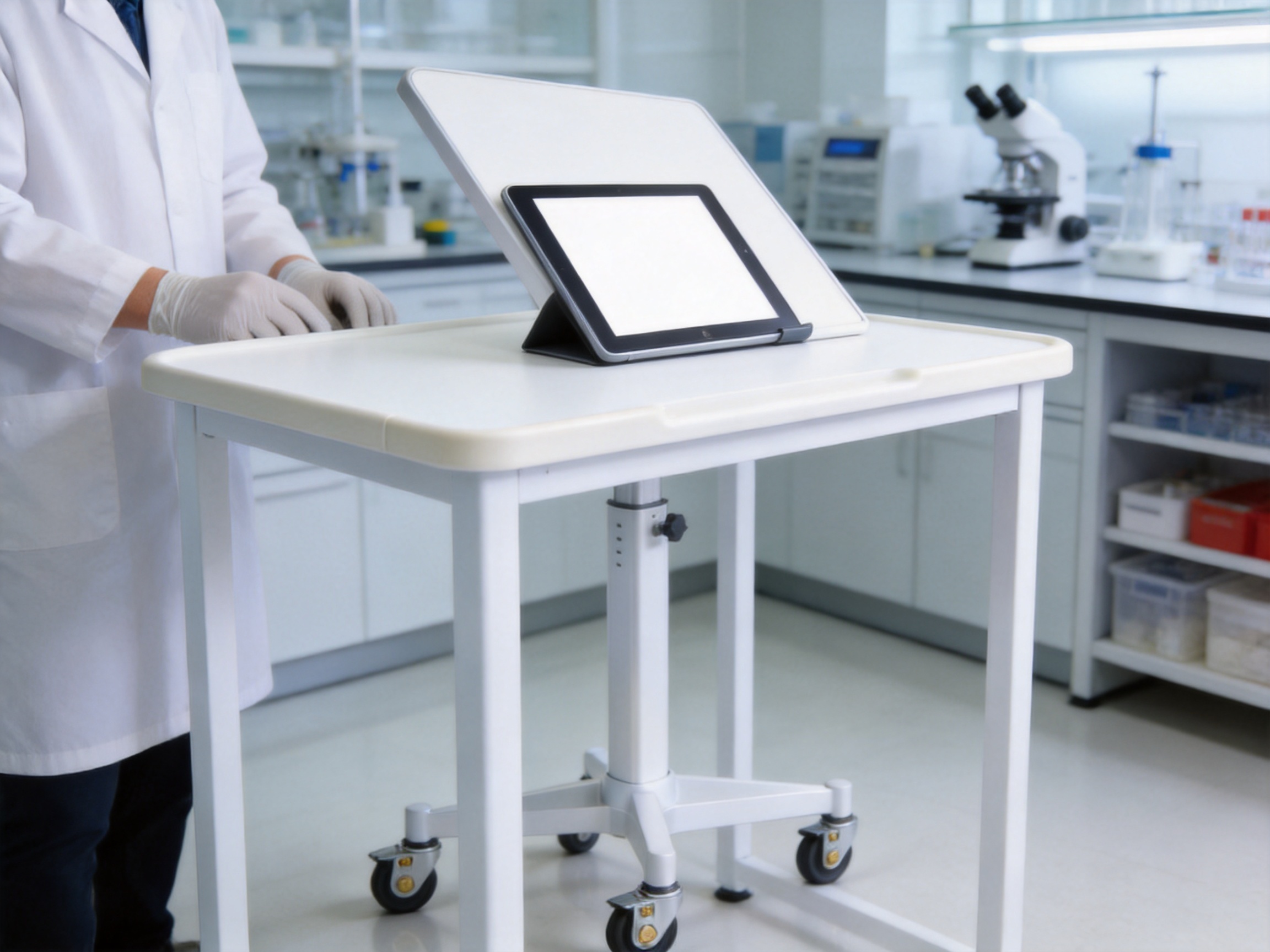
Laboratories frequently use tablets for procedure display, data logging, instrument control, and digital records. A fixed tablet location can be inconvenient when tasks shift between instruments or bench positions. The TH01-2 provides a mobile and adjustable platform that can be brought close to the active work area.
The white or silver powder-coated frame and clean panel options can visually integrate with laboratory environments. The ability to adjust height and angle can improve usability while wearing gloves or working near equipment. The compact footprint helps conserve bench and floor space, while the 90-degree tilt range supports both reading and interactive operation.
Interactive Display Points
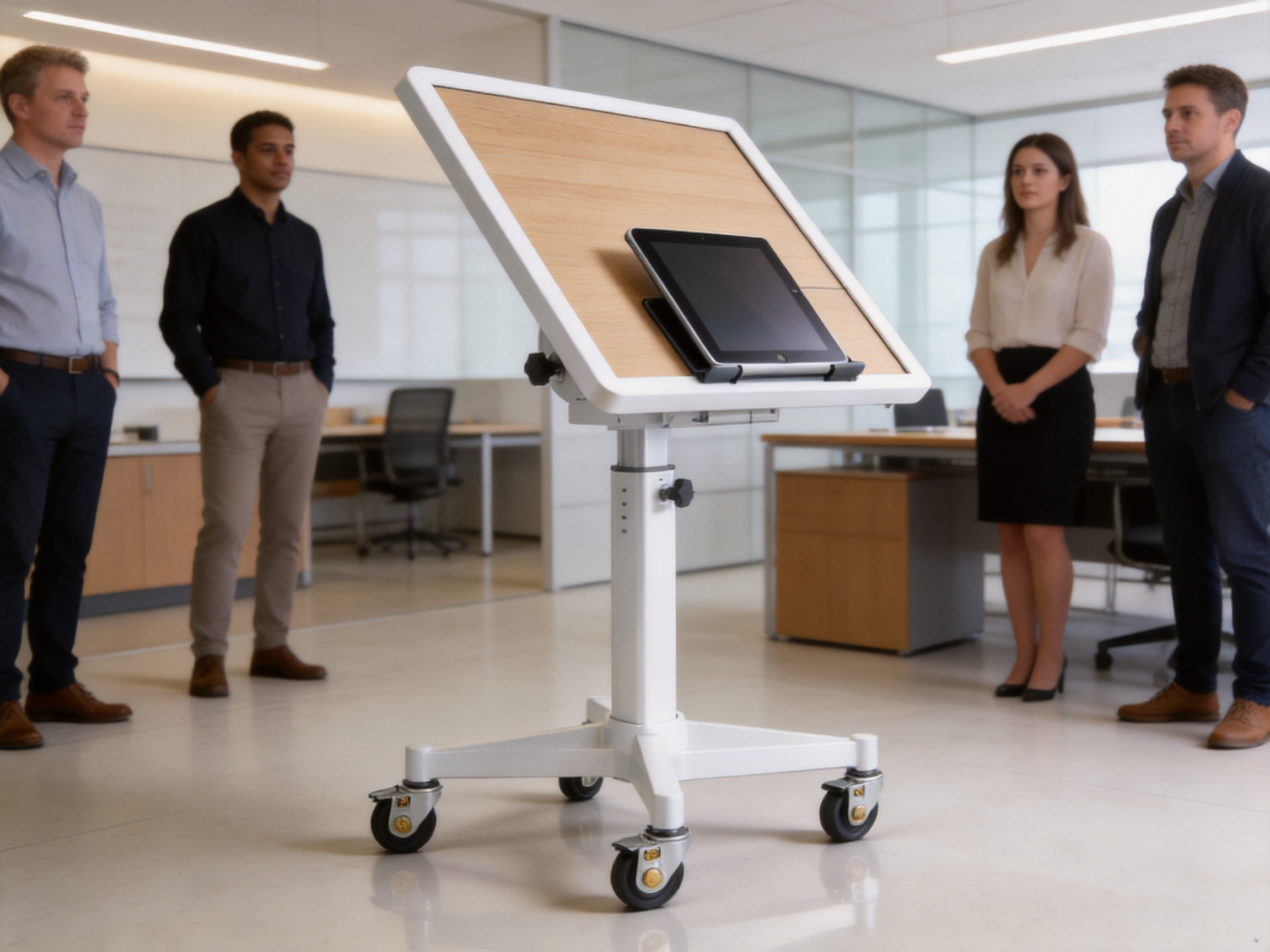
In showrooms, exhibitions, training areas, and reception spaces, tablets are often used for sign-in, product browsing, demonstrations, or interactive presentations. The TH01-2 can act as a professional display platform with adjustable height and tilt. Its panel color options allow it to match different interior styles, from clean white technical environments to warmer wood-tone spaces.
Unlike a fixed kiosk, the workstation can be relocated for different events or layouts. Unlike a lightweight consumer stand, it provides a more substantial tabletop and industrial structure. This makes it suitable for semi-public spaces where appearance and stability both matter.
Medical Equipment Support Workstations
Medical and healthcare support environments often require mobile information access. Tablets may be used for equipment instructions, patient-related documentation, device interfaces, or staff communication. The TH01-2 can provide a movable support table near equipment without the need for permanent installation.
The height range helps accommodate different staff members and postures. The tilt function supports clear viewing in changing lighting conditions. The locking casters contribute to stable placement when the workstation is in use. While application-specific hygiene requirements should always be evaluated by the buyer, the product’s smooth surfaces and powder-coated structure make it suitable for many general support roles.
Educational Training Facilities
Training rooms and technical education facilities often require flexible furniture. Instructors may need a mobile tablet platform for demonstrations, digital teaching materials, or equipment control. Students may use tablets during practical exercises. The TH01-2 supports these use cases by offering quick repositioning, adjustable height, and multiple viewing angles.
The tabletop can be tilted upright for demonstration or lowered for individual use. The caster system allows the table to move between classrooms, labs, or training zones. The panel color options help institutions coordinate furniture with interior design standards.
Design Details That Improve Daily Use
A successful workstation depends not only on major specifications but also on the details of everyday use. The TH01-2 is designed around practical movement, intuitive adjustment, and visual integration. The tabletop size is carefully balanced: large enough for useful work, but not so large that it becomes difficult to move through compact spaces. The 25 mm thickness gives a sense of strength while maintaining a clean profile.
The lifting range starts at 750 mm, a height that can suit seated or lower working positions depending on chair and user configuration. It rises to 1060 mm, supporting standing interaction for many users. The range is particularly useful for environments where the workstation must support multiple postures rather than a single fixed task.
The four-caster configuration improves maneuverability. Two locking wheels are enough to secure the workstation for many daily applications while keeping operation simple. Users can unlock, move, position, and lock the desk without special tools. This is important in fast-moving work environments where furniture must support productivity rather than slow it down.
The panel color choices also matter more than they may first appear. White can support clean laboratory and medical-style environments. Maple and Walnut can soften the appearance for education, office, and display areas. Black can create a modern technical look and match many electronics and industrial devices. By offering multiple finishes, the product can serve both functional and aesthetic requirements.
Manufacturing Strengths Behind the Product
The quality of an adjustable workstation depends heavily on manufacturing capability. SuZhou Skyhone Intelligent Technology Co., Ltd. is located in Suzhou, Jiangsu Province, within the Yangtze River Delta, one of China’s most developed manufacturing regions. This location provides access to a mature industrial chain, skilled suppliers, material processing resources, logistics networks, and intelligent manufacturing expertise. For global buyers, these regional advantages can translate into stable production, responsive customization, and reliable cost control.
The company is deeply engaged in the research and development, production, sales, and service of standing desks and adjustable workstation solutions. This focus is important because height-adjustable products require an understanding of ergonomics, structural mechanics, lifting systems, surface treatment, packaging, and long-term use behavior. A manufacturer that works continuously in this product category is better positioned to improve details, standardize quality, and respond to customer feedback.
Advanced manufacturing begins with design and engineering. For a pneumatic workstation such as the TH01-2, the frame must support stable lifting, controlled tilt, and rolling movement. Component dimensions must align accurately. The gas spring mechanism must be selected and integrated according to load requirements and motion expectations. The tilt mechanism must provide secure adjustment while remaining easy to operate. The caster layout must balance mobility and stability. These considerations require coordinated engineering rather than simple assembly.
Metal processing is another important strength. Aluminum and iron components must be cut, formed, welded or connected, finished, and inspected to achieve consistent structure. Powder coating requires surface preparation, controlled application, curing, and color consistency management. A reliable powder-coated finish depends on process discipline; poor preparation can lead to weak adhesion, uneven appearance, or early wear. By applying powder coating as part of a controlled production process, the product gains both durability and visual quality.
The tabletop manufacturing process also contributes to product performance. MDF board selection, cutting accuracy, edge preparation, and PVC vacuum forming all influence the final surface quality. Vacuum forming can create smooth coverage and a clean appearance, but it requires controlled heat, pressure, material handling, and finishing. A well-formed tabletop improves user experience and supports consistent appearance across production batches.
Quality Control and Process Discipline
For adjustable furniture, quality control must go beyond appearance. The product must feel stable, move smoothly, hold position reliably, and remain safe during routine use. Quality inspection therefore includes dimensional checks, surface evaluation, assembly verification, functional adjustment testing, caster movement assessment, and packaging review.
Height adjustment should operate smoothly across the full range. The gas spring should provide controlled support without sudden movement. The tilt mechanism should allow angle adjustment while maintaining stability at the selected position. Casters should roll properly and locking casters should engage securely. The tabletop should be properly fixed and visually consistent. These functional details determine whether the workstation performs well after delivery.
Manufacturing discipline also supports repeatability. For buyers ordering multiple units, consistency is essential. A training center may need every workstation to adjust in the same way. A factory may deploy units across several stations and expect the same user experience. An equipment integrator may need predictable dimensions for layout planning. A professional manufacturing system helps deliver this consistency.
Packaging is another part of quality. Adjustable furniture contains finished surfaces, moving parts, and structural components that must be protected during transport. Proper packaging design reduces the risk of scratches, deformation, and component damage. For export customers, packaging reliability is especially important because products may pass through multiple handling stages before reaching the final site.
Customization and Project Support
As a manufacturer of ergonomic adjustable office tables and related workstation products, SuZhou Skyhone Intelligent Technology Co., Ltd. can support custom requirements for different projects. Buyers may need specific panel colors, surface finishes, packaging arrangements, volume production planning, or application-based recommendations. The TH01-2 already offers multiple panel colors and two frame surface colors, giving customers a practical starting point for visual customization.
Customization is valuable because different industries prioritize different details. A laboratory may prefer white surfaces and compact mobility. A training institution may prefer Maple or Walnut panels to create a warmer learning environment. A display area may choose black for a modern digital appearance. A production line may prefer silver or white for compatibility with equipment frames. The availability of these choices helps the product integrate into more environments without requiring a fully custom design.
Project support also includes understanding the intended use. A workstation used for occasional display may have different requirements from one used every shift in a factory. A manufacturer with experience in standing desks, gas springs, and adjustable work platforms can help customers select suitable configurations and evaluate practical considerations such as height range, work surface size, mobility, and durability.
For global buyers, communication and service are also important. The company provides contact channels by phone and email and operates from Suzhou Industrial Park, an area known for manufacturing and commercial infrastructure. This supports professional cooperation for distributors, project contractors, office furniture buyers, equipment integrators, and specialized workstation customers.
Why the TH01-2 Stands Out in a Competitive Market
The adjustable desk market contains many different product types, from large electric office desks to simple laptop carts and tablet stands. The TH01-2 stands out because it occupies a focused and useful position between these categories. It is more flexible and ergonomic than a fixed stand, more mobile than a traditional table, simpler than an electric desk, and more professional than a consumer accessory.
Its first competitive advantage is integrated adjustability. Height adjustment and angle adjustment are built into one product. This eliminates the need for separate stands, risers, or improvised supports. The user gets a complete platform designed around changing tasks and body positions.
Its second advantage is power-free operation. In many environments, freedom from cables is not just convenient; it is a safety and workflow benefit. A mobile pneumatic workstation can move with the task without requiring access to a power outlet. This gives facility planners more flexibility.
Its third advantage is industrial material construction. Aluminum, iron, powder coating, 25 mm MDF, and PVC vacuum forming create a product that is more robust than light-duty consumer furniture. The desk is suitable for frequent movement and adjustment, making it relevant for professional environments.
Its fourth advantage is visual adaptability. With white, silver, White, Maple, Walnut, and Black finish options, the product can serve multiple interior styles. Many technical workstations look purely industrial, while many office products are not durable enough for technical settings. The TH01-2 bridges these needs by combining practical structure with clean design choices.
Its fifth advantage is manufacturing support. A product is only as reliable as the company that designs, produces, and supports it. SuZhou Skyhone Intelligent Technology Co., Ltd. benefits from specialization in adjustable desks and from the manufacturing ecosystem of the Yangtze River Delta. This helps the company deliver stable production, practical customization, and product improvement based on market needs.
Purchasing Considerations for Buyers
When evaluating the TH01-2, buyers should consider how the workstation will be used. The product is ideal for iPads and mobile devices, but it can also support documents, small tools, and lightweight accessories. The tabletop dimensions should be compared with the size of the intended device and work materials. The height range should be evaluated against user postures and workplace layout.
Buyers should also consider mobility requirements. If the workstation must move between multiple positions, the caster design is a major benefit. If it will remain mostly stationary, the locking casters still provide security while preserving the option of relocation. For environments with uneven floors or special cleanliness requirements, site-specific evaluation is recommended.
The choice between pneumatic and electric adjustment should be based on the actual task. If the workstation needs to carry heavy loads or store exact height presets, an electric adjustable desk may be better. If the priority is compact mobility, quick manual adjustment, and no power dependence, the TH01-2 is a strong solution. Understanding this distinction helps buyers choose the right product rather than simply choosing the most complex system.
Color selection should also be considered during planning. Matching the workstation to existing equipment or interior design improves professional appearance. White and silver frames support clean technical spaces, while panel colors such as Maple, Walnut, White, and Black allow further coordination.
Q&A Section
What is the main purpose of the TH01-2 pneumatic height-adjustable desk?
The TH01-2 is designed as a mobile, adjustable workstation for iPads and other mobile devices. It is suitable for control, inspection, data entry, presentation, training, laboratory work, electronics testing, and similar scenarios where height and viewing angle must be adjusted frequently.
What is the height adjustment range?
The lifting range is 750 mm to 1060 mm. This range supports different users and working postures, including seated, semi-standing, and standing operation depending on the application.
How does the desk adjust height?
The desk uses a gas spring lifting mechanism. This pneumatic system allows smooth manual adjustment without electric motors, power cables, control boxes, or external power supply requirements.
How far can the tabletop tilt?
The tabletop can tilt up to 90 degrees through a stepless tilt mechanism. This allows users to select the preferred viewing or operating angle rather than being limited to fixed positions.
What materials are used?
The main frame is made from aluminum and iron. The tabletop is made from 25 mm MDF with PVC vacuum forming. The metal surface is treated with powder coating for durability and a clean finish.
Is the workstation easy to move?
Yes. The product is equipped with four casters. Two casters include locking functions, allowing users to move the workstation easily and then secure it in position during use.
What colors are available?
The metal surface is available in white or silver. The tabletop panel is available in White, Maple, Walnut, and Black. These options help the workstation match different industrial, office, laboratory, education, and display environments.
How does it compare with an electric adjustable desk?
An electric adjustable desk is useful for larger workstations, heavier equipment, and programmable height settings. The TH01-2 is better suited for compact mobile use where power-free operation, quick repositioning, and simple pneumatic adjustment are preferred.
How does it compare with a regular tablet stand?
A regular tablet stand usually provides limited angle support and depends on another table or surface. The TH01-2 is a complete mobile workstation with height adjustment, tabletop tilt, casters, and a durable frame, making it more suitable for professional use.
Who manufactures the product?
The product is manufactured by SuZhou Skyhone Intelligent Technology Co., Ltd., a professional manufacturing enterprise focused on standing desks, adjustable workstation solutions, and intelligent office space products.
Conclusion
The TH01-2 iPad High-Legged Pneumatic Height-Adjustable Desk provides a practical answer to a growing workplace need: how to position digital devices comfortably, safely, and flexibly in professional environments. By combining gas spring lifting, a 750 mm to 1060 mm height range, stepless 90-degree tabletop tilt, durable aluminum and iron construction, PVC vacuum-formed MDF tabletop, powder-coated surface treatment, and mobile locking caster support, it delivers a versatile workstation for modern operations.
Its advantages over ordinary tablet stands, fixed-height work tables, and certain electric desk solutions come from its focused design. It is compact but functional, mobile but stable, adjustable but simple, and industrial yet visually adaptable. It supports users who need to move, reposition, view, enter data, demonstrate, inspect, and interact with tablets or mobile devices throughout the workday.
Behind the product is the manufacturing strength of SuZhou Skyhone Intelligent Technology Co., Ltd., supported by the industrial advantages of Suzhou and the Yangtze River Delta. With experience in adjustable height desks, gas springs, electric linear actuators, ergonomic office tables, and intelligent workspace solutions, the company is positioned to provide both standard products and project-oriented support for global customers.
For electronics manufacturing stations, laboratory benches, interactive displays, medical support workstations, and educational training facilities, the TH01-2 offers a reliable and ergonomic platform. It reflects an important direction in workstation design: furniture should be flexible enough to support changing devices, changing users, and changing work methods. In that sense, the TH01-2 is more than an adjustable table; it is a compact productivity tool for digital, mobile, and ergonomic work.
References
Bridger, R. S. Introduction to Human Factors and Ergonomics. CRC Press.
Pheasant, S., and Haslegrave, C. M. Bodyspace: Anthropometry, Ergonomics and the Design of Work. Taylor and Francis.
Kroemer, K. H. E., and Grandjean, E. Fitting the Task to the Human: A Textbook of Occupational Ergonomics. CRC Press.
Eastman, C. M. Design for Manufacturability and Assembly: Concepts, Architectures, and Implementation. Oxford Engineering Studies.
Kalpakjian, S., and Schmid, S. R. Manufacturing Engineering and Technology. Pearson.
Hedge, A. Ergonomic Workplace Design for Health, Wellness, and Productivity. CRC Press.


- Contact Info
-
-
 Phone+86-15950656125
 -
 Email
Email -
 AddressRoom 1007-1, South Building, Suyue Plaza, Suzhou Industrial Park, Suzhou City, Jiangsu Province, China
-
- Products
- Follow Us
- Need help? Please contact us
Copyright ©
SuZhou Skyhone Intelligent Technology Co., Ltd.
All Rights Reserved.
Privacy
Custom Ergonomic Adjustable Office Tables Manufacturers

