

 English
  русский
  Español
  عربى
عربى 
Content
- 1 Product Overview
- 2 Why Pneumatic Height Adjustment Matters
- 3 Compact Dimensions for Space-Efficient Workstations
- 4 Folding Column and Tripod-Base Concept
- 5 Mobility Combined with Position Stability
- 6 Durable Materials and Surface Treatment
- 7 Advantages Over Conventional Fixed Tables
- 8 Advantages Over Large Motorized Standing Desks
- 9 Ergonomic Use and Posture Flexibility
- 10 Applications in Different Environments
- 11 Manufacturing Strengths and Product Development Capability
- 12 Quality Control Considerations
- 13 Design Efficiency Compared with Competitors
- 14 Installation and Daily Operation
- 15 Procurement Value for Commercial Buyers
- 16 Company Manufacturing and Service Strengths
- 17 Recommended Selection Guide
- 18 Frequently Asked Questions
- 18.1 What type of height-adjustable desk is the TH06?
- 18.2 What is the height range?
- 18.3 Does the desk require electricity?
- 18.4 How large is the tabletop?
- 18.5 What is the tabletop made from?
- 18.6 What materials are used for the frame?
- 18.7 Can the desk be moved?
- 18.8 Is the desk suitable for a shared office?
- 18.9 Can it be used in a classroom?
- 18.10 Is the TH06 suitable for a home office?
- 18.11 What is the benefit of powder coating?
- 18.12 How should the table be maintained?
- 18.13 Can the TH06 replace every electric standing desk?
- 18.14 What should buyers consider before ordering?
- 19 Conclusion
- 20 References
- 21 Product: TH06 (Fold-Eight Leg Column) Pneumatic Height-Adjustable Desk
TH06 Fold-Eight Leg Column Pneumatic Height-Adjustable Desk: A Flexible Solution for Modern Workspaces
2026-07-27
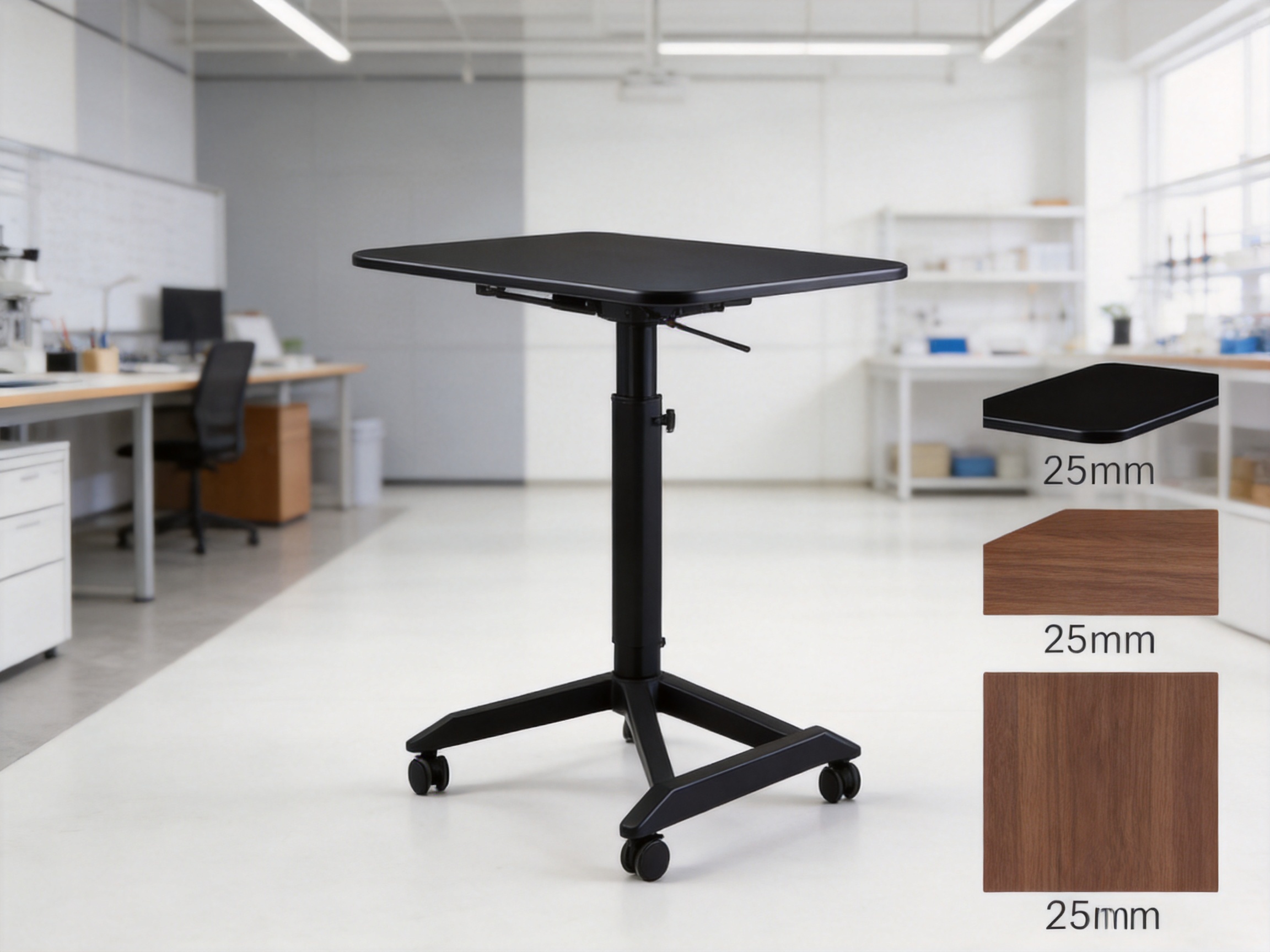
Modern workspaces are becoming more flexible, collaborative, and health-conscious. Employees may alternate between seated and standing positions, shared offices may need furniture that can be reconfigured quickly, and home users increasingly expect professional functionality from compact equipment. In these environments, a conventional fixed-height desk can limit comfort, reduce space efficiency, and make it more difficult to create a workstation that suits different users.
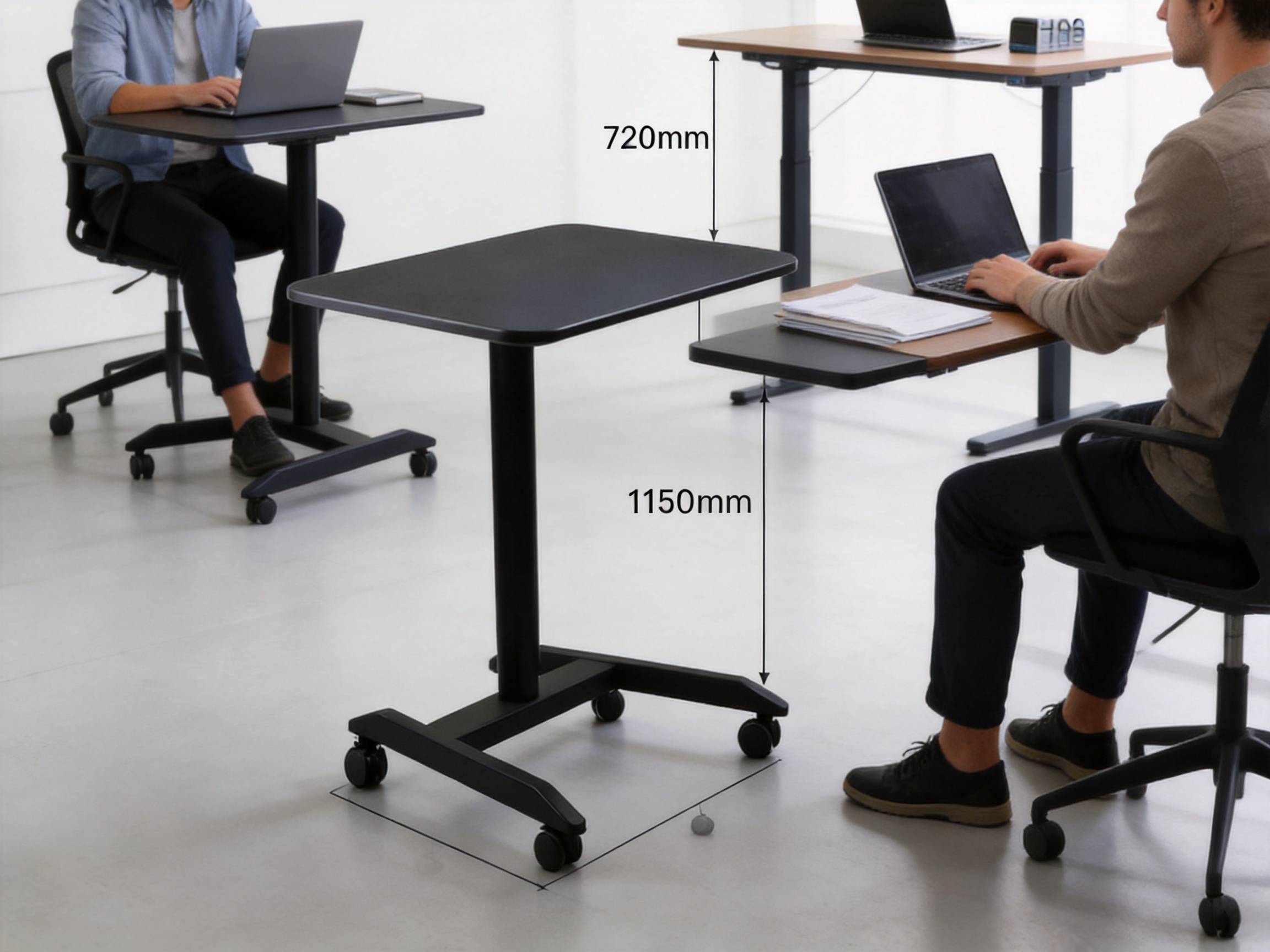
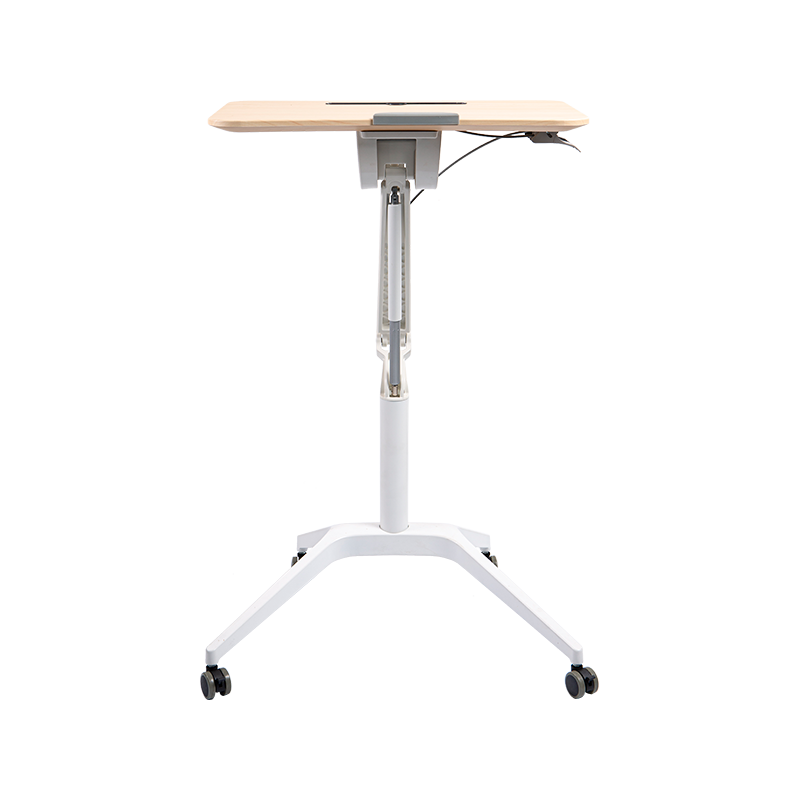
The TH06 Fold-Eight Leg Column Pneumatic Height-Adjustable Desk is designed to address these requirements with a compact tabletop, a mobile base, a gas spring lifting mechanism, and a durable aluminum-and-iron support structure. Its height can be adjusted from 720mm to 1150mm, allowing users to work at a seated or standing position without relying on an electric motor, control panel, or power outlet. The folding column and tripod-base concept also support flexible placement in offices, classrooms, studios, laboratories, and other areas where efficient use of floor space is important.
Unlike large dual-motor standing desks intended for permanent installation, the TH06 focuses on mobility, simplicity, and localized height adjustment. It provides a practical alternative for users who need an adaptable workstation but do not require a full-size executive desktop. Its four casters, including two lockable wheels, allow the table to be repositioned when needed and stabilized during use.
Product Overview
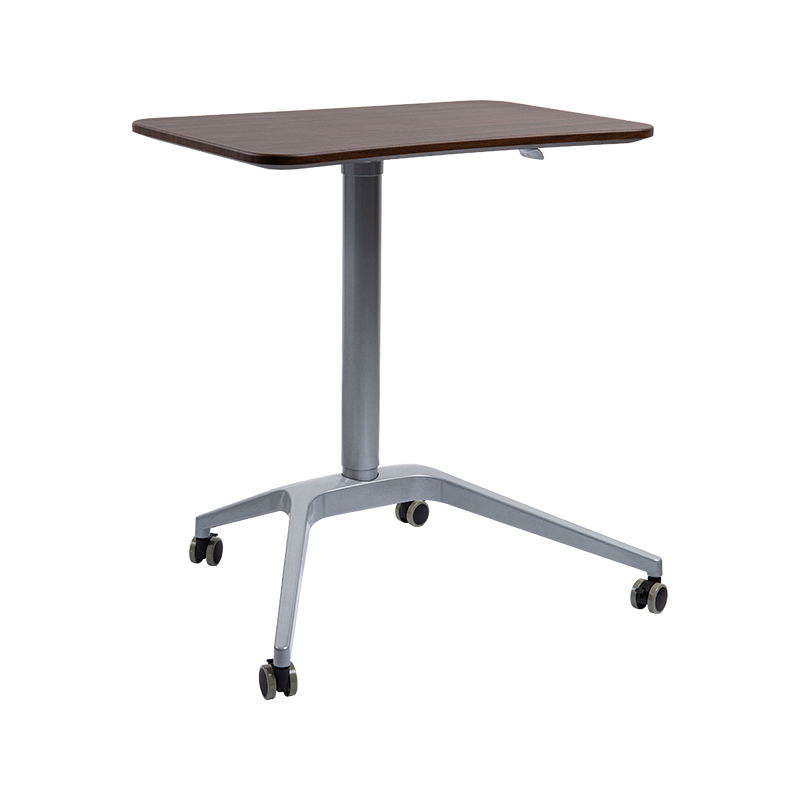
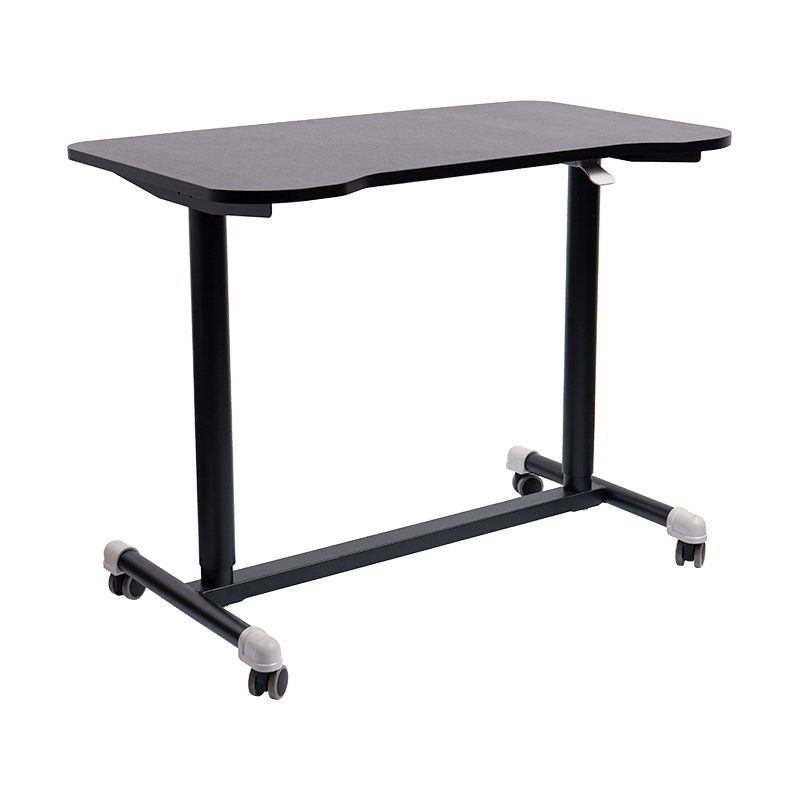
The TH06 is a pneumatic height-adjustable table with a compact tabletop measuring 715mm by 495mm by 25mm. The tabletop is made from a 25mm MDF panel with a PVC vacuum-formed surface. Users can select between walnut and black panel colors, making it easier to coordinate the desk with different interior styles, from warm home offices to modern commercial environments.
The support structure combines aluminum and iron. Aluminum contributes to a relatively light and manageable frame, while iron provides useful structural support in the base and connection areas. The exterior surface is finished with black powder coating, giving the product a consistent appearance and helping protect the frame against ordinary wear associated with daily use and movement.
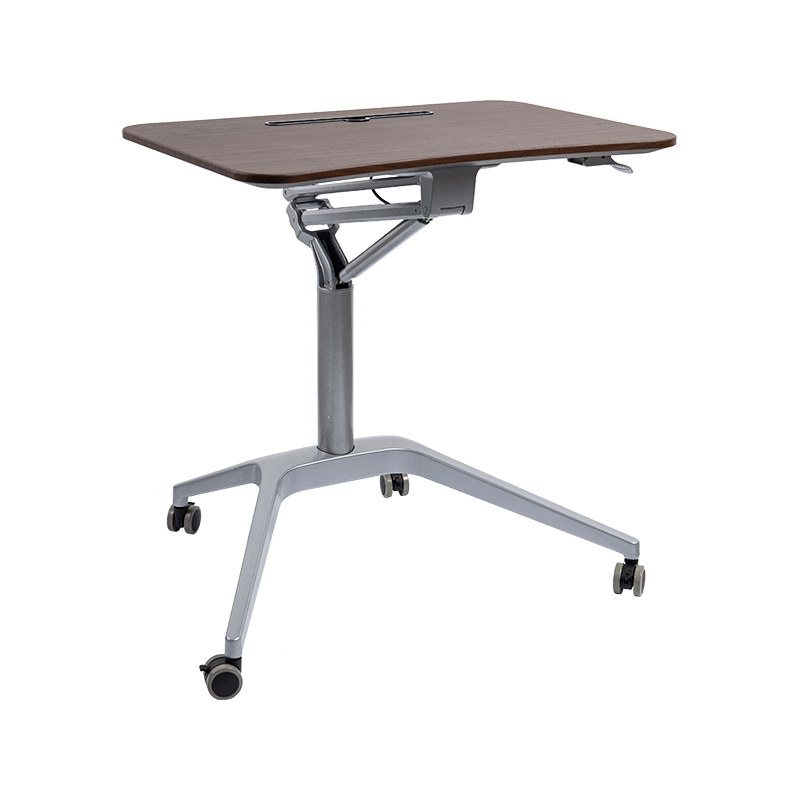
The working principle is gas spring lifting. A gas spring stores energy and assists the user during height adjustment, reducing the effort required to raise or lower the tabletop. Because the mechanism is pneumatic rather than electrically powered, the table does not need a motor, power cord, handset, or control box. This makes the product convenient for locations where electrical access is limited or where users prefer a cleaner, less complicated workstation.
Specification | TH06 Configuration |
Product type | Pneumatic height-adjustable table |
Lifting range | 720mm to 1150mm |
Tabletop dimensions | 715mm by 495mm by 25mm |
Tabletop construction | 25mm MDF with PVC vacuum forming |
Frame material | Aluminum and iron |
Frame surface | Black powder coating |
Casters | Four casters: two lockable and two non-lockable |
Panel colors | Walnut and black |
Lifting system | Gas spring |
The specification shows that the TH06 is intended to be compact without being limited to a single posture. Its adjustment range of 430mm offers meaningful flexibility for different users and working modes. The desk can serve as a seated workstation, a standing support surface, or an intermediate-height table for short tasks, presentations, demonstrations, and collaborative activities.
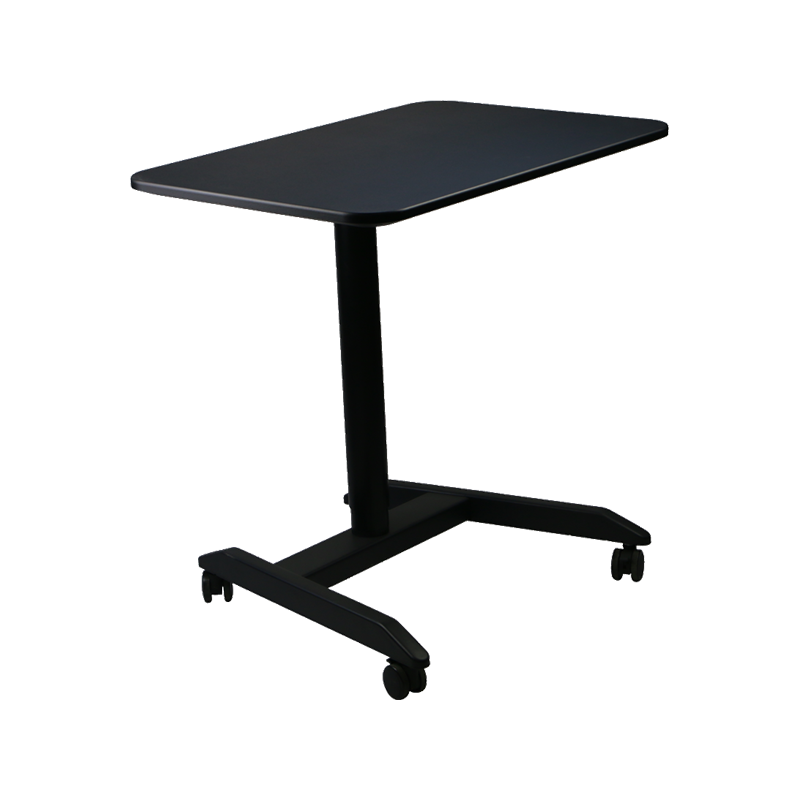
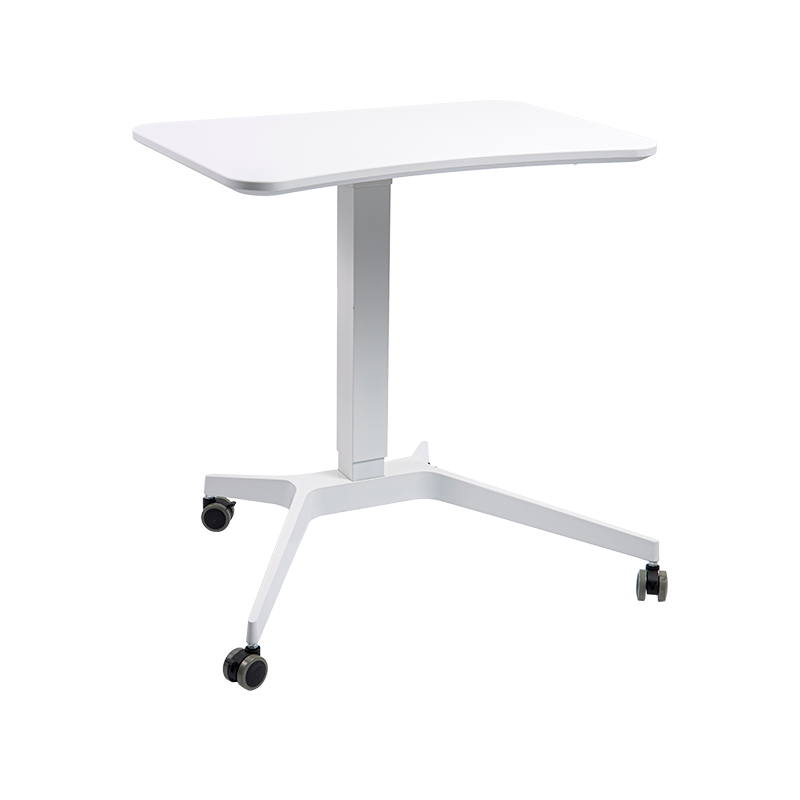
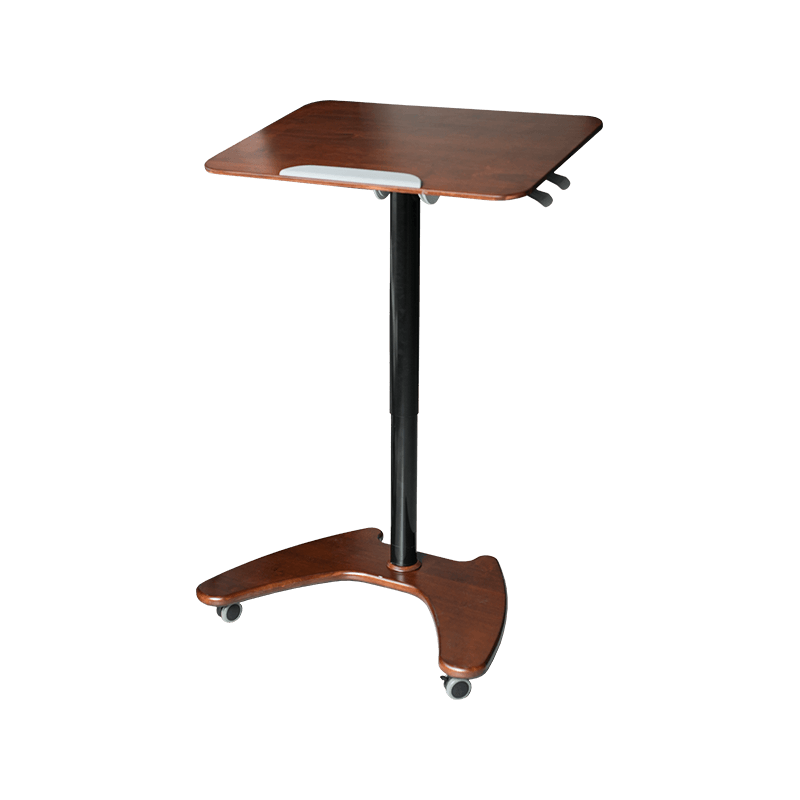
TH06 (Fold-Eight Leg Column) Pneumatic Height-Adjustable Desk
Why Pneumatic Height Adjustment Matters
Height adjustment is one of the most important features in an ergonomic workstation. A fixed desk forces the user to adapt to a predetermined height, even when body dimensions, chair height, task type, and working posture vary. By contrast, a height-adjustable table allows the work surface to be positioned according to the user and the activity.
The TH06 uses a gas spring instead of an electric actuator. This design brings several practical advantages. First, adjustment is independent of electricity. The table can be installed in the center of an open office, placed temporarily in a classroom, or used in a laboratory where power cables could create clutter or safety concerns. Second, the absence of a motor reduces the number of electrical components that need to be integrated into the product. Third, users can adjust the table without locating a control switch or connecting the unit to a power source.
A gas spring also supports a straightforward user experience. When the release mechanism is engaged, the stored force in the spring assists the lifting movement. When the table is lowered, the user can guide the tabletop down in a controlled manner. This is particularly useful for shared workspaces, where different people may require different working heights throughout the day.
The 720mm to 1150mm range is suitable for a wide variety of ordinary office and educational activities. At the lower end of the range, the tabletop can be used with a chair or stool. At the upper end, it can support standing work, quick meetings, demonstrations, and short-duration tasks. The correct height should always be selected according to the individual user, task, and equipment arrangement.
Compared with a basic fixed-height table, the pneumatic mechanism creates a more adaptable product. Compared with a motorized standing desk, it offers a simpler alternative that does not depend on electrical infrastructure. These distinctions position the TH06 between traditional furniture and fully electronic sit-stand desks, making it suitable for applications that value flexibility and uncomplicated operation.
Compact Dimensions for Space-Efficient Workstations
The tabletop measures 715mm by 495mm, providing a compact working surface for a laptop, writing materials, tablet, documents, or selected instruments. The dimensions are especially useful in areas where a full-size desk would occupy too much floor space. A compact table can be placed beside a wall, in a shared room, next to a laboratory station, or in a home office with limited available area.
Small dimensions do not mean that the product is restricted to one specific environment. Instead, the TH06 can be used as a focused workstation. It is appropriate for tasks that require a primary device and a limited number of accessories. Users can also combine it with other storage products, side tables, monitor stands, or mobile cabinets to create a modular work area.
The 25mm tabletop thickness gives the desk a substantial appearance and supports a durable furniture construction. MDF provides a uniform panel structure, while the PVC vacuum-formed surface creates a finished exterior that can be produced in coordinated colors and patterns. The walnut option brings a wood-inspired visual character, whereas the black version supports a more technical or minimalist appearance.
The compact tabletop can also simplify office planning. More units can be positioned in a room without creating the visual density associated with large desks. In training rooms, for example, several TH06 tables can be arranged for individual work, paired activities, or presentations. In home offices, the desk can be placed in a multi-purpose room and moved when the room is needed for another activity.
Folding Column and Tripod-Base Concept
The product title identifies a fold-eight leg column configuration, while the product information describes a column tripod base structure. This concept reflects a design focused on support efficiency and practical mobility. Rather than relying on a wide, permanent pedestal or a large fixed frame, the base is arranged to provide support while maintaining a relatively compact footprint.
A folding or space-conscious column design can be beneficial during transportation, installation, storage, and room reconfiguration. When furniture is moved frequently, the ability to manage the base efficiently can reduce inconvenience for users and facility operators. It can also make the desk easier to position in rooms where circulation paths are narrow or where furniture must be stored outside normal working hours.
The base structure must balance several requirements at once. It needs to support the tabletop, tolerate repeated height adjustments, accommodate the lifting mechanism, and remain stable while the user is working. The aluminum-and-iron construction is intended to address these requirements by combining two commonly used structural materials with different performance characteristics.
Aluminum is valued in furniture construction for its relatively light weight and resistance to ordinary corrosion. Iron contributes to load-bearing support and connection strength. The combined structure can therefore provide a practical balance between maneuverability and rigidity. The black powder-coated finish unifies the appearance of the different materials and creates an additional protective surface.
The tripod-base approach can offer an advantage over some conventional four-leg tables in situations where the base must be integrated closely with a central lifting column. It can simplify the visual structure and help preserve usable floor area around the workstation. At the same time, the presence of four casters gives the product a mobile foundation for daily repositioning.
Mobility Combined with Position Stability
Mobility is one of the most distinctive features of the TH06. The desk is equipped with four casters, including two with locking functions and two without locks. This arrangement allows users to move the table when necessary while still providing a way to secure it during ordinary work.
Mobile furniture is valuable in modern offices because layouts often change. Teams may shift from individual work to group discussion, meeting areas may need to be cleared, and shared equipment may need to be moved between rooms. A mobile height-adjustable desk supports these changes without requiring heavy lifting or complete disassembly.
In educational environments, mobility allows a classroom to support several teaching methods. Tables can be positioned for individual exercises, arranged in rows for instruction, or grouped for project work. In laboratories and control rooms, a mobile work surface can be brought closer to the point of use and moved aside when access is required.
Lockable casters are equally important. Mobility without stabilization can create an unstable or inconvenient workstation. Once the desk is placed in the desired location, the locking wheels can help reduce unwanted movement. Users should engage the locks whenever the table is being used in a fixed position, particularly when writing, operating equipment, or working with materials that should remain steady.
The two lockable and two non-lockable casters provide a practical compromise between directional movement and positioning. This arrangement avoids making every wheel a locking component while still giving the user a clear method of securing the desk. It also supports a simple operating routine: release the locks to relocate the unit, then engage them after the final position has been selected.
Durable Materials and Surface Treatment
Material selection is central to the long-term value of an adjustable table. The TH06 uses aluminum and iron for the frame and a 25mm MDF panel with PVC vacuum forming for the tabletop. Each material contributes to a different aspect of the product’s function.
The aluminum-and-iron frame is designed for everyday furniture use. The structure must withstand repeated movement, height changes, and normal contact with the surrounding environment. Aluminum can help manage the overall weight of the table, while iron can provide reinforcement in areas requiring additional structural support. The result is a composite frame intended to balance portability and strength.
The black powder-coated finish is applied to the metal frame. Powder coating is a dry finishing process in which coating material is electrostatically applied and then cured to form a continuous surface. In furniture applications, this type of finish is valued for its consistent appearance and useful resistance to routine abrasion, handling, and environmental exposure.
Powder coating also supports manufacturing consistency. A controlled coating process can create a uniform color across multiple frame components, helping the finished product maintain a coordinated appearance. Black is a versatile choice because it can be paired with both walnut and black tabletop panels and can fit into professional, educational, industrial, and residential environments.
The tabletop uses MDF as its core material. MDF has a smooth, uniform surface that is suitable for furniture panels and decorative finishing. The PVC vacuum-formed surface adds a finished layer that can provide visual consistency and simplify routine cleaning. The walnut finish can introduce a warmer appearance, while the black finish can support a clean and understated visual language.
In daily use, the tabletop should be protected from prolonged moisture, sharp impact, excessive heat, and loads beyond the intended application. Proper care helps preserve both the decorative layer and the underlying panel. The frame and tabletop should be cleaned according to standard furniture-care practices, using a soft cloth and avoiding harsh chemicals that may affect the surface.
Advantages Over Conventional Fixed Tables
The most direct alternative to the TH06 is a conventional fixed-height table. Fixed tables are often economical and simple, but they cannot accommodate significant differences between users or tasks. A person may need to adjust a chair, add a footrest, or tolerate an unsuitable working height. These solutions do not provide the same flexibility as moving the entire work surface.
The TH06 can be adjusted to support seated and standing work. This is valuable for shared facilities because one table can serve users with different body sizes and preferences. It is also useful for individuals who alternate between computer work, writing, reading, and short standing tasks during the day.
A fixed table may also be difficult to relocate if it lacks casters. Moving it can require two people, can disturb nearby equipment, and can leave scratches on the floor. The TH06 is specifically configured for mobility, allowing users to change its position with less effort when the casters are released.
The adjustable mechanism adds value without requiring the complexity of an electric system. Users who need basic height flexibility but do not need programmable presets, charging ports, or motor synchronization may find the gas spring approach more appropriate. The product therefore offers a focused feature set rather than adding electronic functions that may not be necessary for every application.
Advantages Over Large Motorized Standing Desks
Motorized standing desks are useful in many offices, but they are not the only solution for adjustable work. They usually require a power connection and may include motors, control panels, cables, and electronic components. For large work surfaces and frequent powered adjustment, these features can be beneficial. However, they may also increase installation complexity, cost, weight, and dependence on electrical infrastructure.
The TH06 provides a different approach. Its gas spring lifting mechanism works without a motor or power cable. This can be an advantage in temporary work areas, classrooms, event spaces, mobile laboratories, and shared rooms where cable management is inconvenient. It also allows the desk to be used during power interruptions, provided the product is operated within its intended conditions.
The compact size of the TH06 can be another advantage over large electric desks. Some users need a personal work surface rather than a broad platform for multiple monitors and accessories. A smaller desk can be easier to move, easier to store, and less visually dominant in a room.
The product is not intended to replace every motorized desk. Users requiring heavy equipment, a very large desktop, memory height presets, or synchronized dual-motor lifting may need a different category of product. The strength of the TH06 lies in its simplicity, mobility, and practical pneumatic adjustment for compact workstation requirements.
Ergonomic Use and Posture Flexibility
Ergonomics is not determined by the desk alone. Chair adjustment, monitor position, keyboard placement, lighting, working habits, and the user’s physical needs all influence comfort. Nevertheless, an adjustable table gives users an important tool for improving the relationship between the body and the work surface.
When sitting, the tabletop should be positioned so that the user can work without raising the shoulders or bending the wrists excessively. When standing, the surface should allow the elbows to remain in a relaxed position and the screen to be viewed without prolonged neck flexion. The correct setting varies from one person to another, which is why a fixed height cannot serve every user equally well.
The TH06 can support changes in posture throughout the working day. Users may begin with seated computer work, raise the tabletop for reading or reviewing materials, and lower it again for a different task. These changes can help create a more dynamic routine, although users should still maintain good posture and take regular breaks.
In shared offices, adjustable furniture can reduce the need for individual furniture allocation. A workstation can be configured by each user rather than permanently assigned to one body size or work style. In education, the same table can be adjusted for students, teachers, laboratory staff, or visitors.
The compact surface is particularly suitable when the primary activity is concentrated in front of the user. A laptop, notebook, tablet, or small instrument can be positioned within reach while the user changes between sitting and standing. Larger equipment should be evaluated carefully to ensure that the total load and center of gravity are appropriate for the table.
Applications in Different Environments
Office Workstations
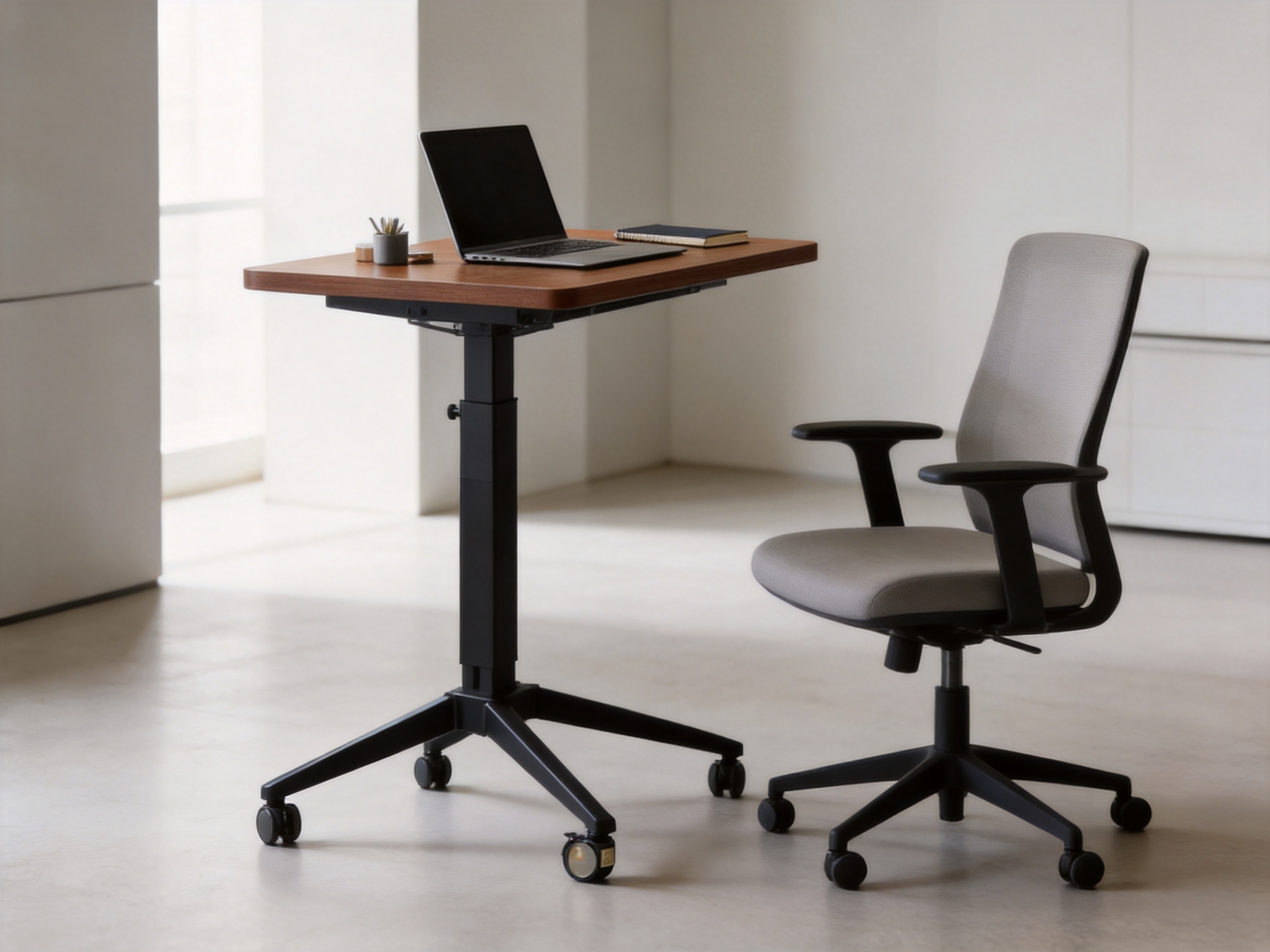
In an office, the TH06 can be used as an individual workstation, a touchdown table, a temporary project desk, or a flexible support table. It can be placed in an open-plan office, near a collaboration zone, or in a quiet area for focused work. The pneumatic adjustment allows the same table to serve people with different preferences, while the casters make it easier to reorganize the room.
Because the tabletop is compact, it can also complement rather than replace a larger desk. For example, it may serve as a movable laptop table, a document-review station, or a standing surface for short tasks. This makes it useful in offices where floor space is carefully managed.
Home Offices
Home offices often need to share space with living rooms, bedrooms, guest rooms, or creative areas. A large permanent desk may not be practical in such settings. The TH06 can provide a more adaptable alternative because it can be repositioned when the room is used for another purpose.
The walnut panel option can blend with residential furniture, while the black panel option can coordinate with modern home-office equipment. The absence of a power cable for height adjustment can also help maintain a cleaner appearance, particularly in rooms where cable management is limited.
Educational Institutions
Classrooms, training rooms, and laboratories require furniture that can support different teaching formats. The TH06 can be used for individual learning, group activities, demonstrations, and practical instruction. Its adjustable range enables the tabletop to be used by students and teachers with different working heights.
Mobility is useful when rooms must be cleared quickly or rearranged for examinations, workshops, presentations, or collaborative projects. Lockable casters can help keep tables in place after a layout has been selected.
Laboratories and Control Rooms
Laboratories and control rooms may require work surfaces that can be positioned around equipment, instruments, and access points. A compact mobile table can be brought closer to a workstation when needed and moved away to improve circulation or provide service access.
Since the TH06 does not depend on electric height adjustment, it can reduce the number of cables near the work surface. Users must still follow the safety requirements of the specific laboratory or control-room environment and ensure that the table is appropriate for the equipment and materials being used.
Creative Studios
Creative studios often involve changing activities, from sketching and digital work to reviewing materials or demonstrating a process. A height-adjustable table can provide a more flexible surface than a fixed desk. The mobile base allows the table to move between work zones, while the walnut or black panel can suit different studio aesthetics.
Manufacturing Strengths and Product Development Capability
The TH06 reflects a product-development approach that combines functional furniture design with mechanical adjustment technology. Its design integrates the tabletop, lifting column, gas spring, frame, caster system, and surface finishes into a single coordinated product. Successful manufacturing of such a table requires attention to dimensional accuracy, material compatibility, assembly sequence, finishing quality, and operational testing.
A professional adjustable-furniture manufacturer must manage more than the appearance of the finished desk. The lifting mechanism must be installed correctly so that the tabletop moves through its intended range. Connection points must be aligned so that the frame operates smoothly. Casters must be attached securely and positioned appropriately. The tabletop must be finished consistently and mounted in a way that supports regular use.
The use of aluminum and iron requires process coordination. Different materials may have different machining, forming, coating, and assembly requirements. A controlled manufacturing system can organize these steps so that frame components meet design specifications before they are assembled into the completed product.
Powder coating also requires process control. Surface preparation, coating coverage, curing conditions, and handling procedures influence the appearance and durability of the finished frame. A consistent production process helps reduce color variation, exposed areas, surface contamination, and handling marks.
The tabletop manufacturing process likewise benefits from standardization. MDF panels must be cut to the required dimensions, edges should be treated appropriately, and the PVC surface must be formed and applied evenly. The vacuum-forming process must be managed to achieve an even finish around the panel profile. Careful inspection can help identify bubbles, wrinkles, incomplete coverage, edge damage, or color inconsistencies before shipment.
Product development also involves balancing user needs with production efficiency. The TH06 offers two tabletop color choices, allowing customization without creating an unnecessarily complicated product range. A standardized frame with selectable panel colors can support efficient production while giving customers a degree of visual choice.
Quality Control Considerations
Quality control for a pneumatic height-adjustable desk should cover both individual components and the complete product. Incoming materials can be checked for dimensions, surface condition, and conformity with the required specifications. Metal components should be inspected before coating, while tabletop panels should be checked before and after PVC finishing.
During assembly, manufacturers can verify the alignment of the lifting column, frame, tabletop, and caster system. Fasteners should be installed according to the required assembly method, and moving components should be checked for interference. The gas spring and release mechanism should be evaluated for smooth operation throughout the specified height range.
Finished products can be inspected for height adjustment, stability, caster movement, locking function, surface appearance, and general assembly quality. The desk should move in a controlled manner and remain appropriately stable when placed on a level floor with the casters locked. The tabletop should be securely connected to the supporting structure, and the frame should not show obvious coating defects or damage.
Packaging is another important part of manufacturing strength. Furniture products may encounter vibration, stacking, handling, and temperature changes during transportation. Suitable packaging should protect the tabletop corners, coated frame, caster assemblies, and pneumatic components. Clear assembly instructions and organized hardware can also improve the customer’s installation experience.
For international customers, manufacturing capability includes communication, documentation, order coordination, and the ability to support different market requirements. A supplier that understands product specifications and application conditions can help buyers select an appropriate configuration and avoid mismatches between the table and its intended use.
Design Efficiency Compared with Competitors
The TH06 competes in a market that includes fixed tables, manual crank desks, electric standing desks, mobile laptop tables, and specialized laboratory furniture. Its advantage is not based on a single feature but on the combination of several practical characteristics.
Comparison factor | TH06 advantage | Typical alternative limitation |
Height adjustment | Gas spring adjustment from 720mm to 1150mm | Fixed tables cannot adapt to different working heights |
Power requirement | No electric power is required for lifting | Motorized desks require a power source and cable management |
Mobility | Four casters support relocation | Many conventional desks are difficult to move |
Position stability | Two casters include locking functions | Uncontrolled mobile furniture may shift during use |
Space use | Compact 715mm by 495mm tabletop | Large desks may be unsuitable for small rooms |
Surface choice | Walnut and black panel options | Some products offer limited visual choices |
Frame construction | Aluminum-and-iron structure with powder coating | Lower-grade furniture may prioritize appearance over structural design |
This comparison should be interpreted according to application needs. A large electric desk may be preferable for a permanent executive workstation, while a fixed table may be sufficient for a single-purpose room. The TH06 is particularly competitive when a buyer needs compact dimensions, mobility, pneumatic adjustment, and simple installation without electrical dependence.
Installation and Daily Operation
Before installation, users should confirm that all frame parts, tabletop components, casters, fasteners, and adjustment components are present. The table should be assembled on a clean, level surface to reduce the risk of scratching the panel or frame. During assembly, fasteners should be tightened evenly and checked again after the desk has been positioned for use.
Once assembled, the desk should be placed on a level floor. The casters can be unlocked while the table is being moved. After the desired location has been selected, the lockable casters should be engaged. Users should avoid dragging the desk while the locks are engaged because this may stress the caster assemblies or damage the floor.
To adjust the height, the user should follow the product’s operating instructions for releasing the gas spring. The tabletop should be guided smoothly rather than forced. Objects placed on the desk should be secured during adjustment, especially if they are fragile, tall, or likely to slide.
The product should be used within its intended application. Heavy equipment, concentrated loads, or items positioned far beyond the tabletop center can affect stability. Users should also avoid standing on the tabletop, leaning heavily against the edge, or using the desk as a support for activities outside normal workstation use.
Routine maintenance is straightforward. The tabletop can be wiped with a soft, slightly damp cloth and dried after cleaning. The metal frame can be cleaned with a mild solution that does not attack the powder-coated surface. Caster wheels should be kept free of dust, hair, packaging materials, and other debris that could restrict movement. The lifting mechanism should be inspected periodically for abnormal noise, loose connections, or changes in operating behavior.
Procurement Value for Commercial Buyers
For offices, schools, institutions, and distributors, the value of the TH06 extends beyond the individual unit. A compact adjustable table can support more flexible space planning and may reduce the need to purchase separate furniture for seated, standing, mobile, and temporary activities.
Standardized product dimensions can simplify room planning, while the two panel colors provide a basic level of visual customization. The use of a gas spring can reduce dependence on electrical installation during deployment. This may be particularly useful for large projects in which many tables must be positioned quickly.
Commercial buyers should evaluate the product according to the intended user group, floor conditions, equipment load, storage requirements, and expected frequency of relocation. They should also confirm packaging, assembly, delivery, color selection, and after-sales support requirements with the supplier before placing an order.
For distributors, the TH06 can occupy a useful position within an adjustable-furniture portfolio. It is differentiated from large electric desks by its pneumatic lifting system and mobility, yet it provides more flexibility than an ordinary fixed-height table. This makes it suitable for customers seeking a practical, compact, and visually adaptable workstation.
Company Manufacturing and Service Strengths
SuZhou Skyhone Intelligent Technology Co., Ltd. is engaged in the research, development, production, sales, and service of standing desks and related workspace solutions. Its location in Suzhou places its operations within the Yangtze River Delta, a region known for extensive industrial infrastructure, manufacturing resources, engineering talent, and supply-chain support.
For adjustable furniture, access to a developed manufacturing environment can support cooperation between material suppliers, metal-processing facilities, surface-treatment providers, component manufacturers, assembly teams, and logistics partners. This industrial ecosystem can help a manufacturer coordinate product development and production more efficiently.
The company’s focus on intelligent office-space solutions reflects the changing expectations of the furniture market. Buyers increasingly look for products that combine ergonomics, mobility, durability, appearance, and efficient use of space. The TH06 responds to these expectations through a pneumatic adjustment system, compact configuration, mobile base, and selectable panel finishes.
Manufacturing strength is also reflected in the ability to convert design requirements into repeatable products. For the TH06, this includes managing the lifting range, tabletop dimensions, material combination, powder-coated frame, caster arrangement, and color options. Consistency across these elements is essential for commercial buyers who need reliable products across multiple workstations or locations.
Service capability is equally important. A professional supplier should be able to communicate technical specifications clearly, support application selection, coordinate production requirements, and provide guidance for installation and use. These capabilities help customers obtain a product that matches their working environment rather than simply purchasing a table based on appearance alone.
Recommended Selection Guide
The TH06 is a strong choice when the following requirements are present:
The user needs to change between seated and standing positions without using an electric motor.
The work area has limited floor space and requires a compact tabletop.
The table must be moved between rooms, work zones, or activity layouts.
The environment benefits from reduced power-cable clutter.
The buyer wants a durable metal frame with a black powder-coated finish.
The workspace requires a choice between a walnut-style panel and a black panel.
The table will support laptops, documents, writing materials, small devices, or other ordinary workstation items.
A different product may be more appropriate when the user needs a full-size desktop, electronic memory presets, high-capacity equipment support, integrated cable management, or specialized laboratory resistance. Clear application assessment allows buyers to take advantage of the TH06’s strengths while selecting other products where necessary.
Frequently Asked Questions
What type of height-adjustable desk is the TH06?
The TH06 is a pneumatic height-adjustable table. It uses a gas spring lifting system rather than an electric motor or manual crank.
What is the height range?
The lifting range is 720mm to 1150mm. This range supports seated, standing, and intermediate working positions, depending on the user’s height and task.
Does the desk require electricity?
No. The gas spring lifting mechanism does not require an electrical outlet for height adjustment. This can simplify placement and reduce power-cable clutter.
How large is the tabletop?
The tabletop measures 715mm by 495mm and has a thickness of 25mm. It is intended for compact workstation applications involving a laptop, documents, writing materials, or selected equipment.
What is the tabletop made from?
The tabletop uses a 25mm MDF panel with a PVC vacuum-formed surface. The panel is available in walnut and black color options.
What materials are used for the frame?
The frame combines aluminum and iron. Its surface is finished in black powder coating.
Can the desk be moved?
Yes. The desk has four casters, including two lockable casters and two non-lockable casters. The locks should be engaged when the desk is in its working position.
Yes. The adjustable height and mobile base make it suitable for shared workstations, touchdown areas, project rooms, and flexible office layouts. Each user can set the table to a suitable height and reposition it when necessary.
Can it be used in a classroom?
Yes. The TH06 can support individual learning, group activities, demonstrations, and multi-purpose classroom arrangements. Its casters allow the room layout to be changed more easily.
Is the TH06 suitable for a home office?
Yes. Its compact tabletop can fit in smaller rooms, and its mobile structure allows the desk to be moved when the space is needed for another purpose. The walnut and black panel options provide different visual styles.
What is the benefit of powder coating?
Powder coating creates a consistent protective finish on the metal frame. It supports a clean appearance and helps the surface withstand ordinary wear associated with handling and daily furniture use.
How should the table be maintained?
Users should clean the tabletop and frame with suitable mild cleaning materials, keep the caster wheels free of debris, and periodically check fasteners and moving components. The gas spring and adjustment system should be operated according to the product instructions.
Can the TH06 replace every electric standing desk?
No. It is designed as a compact pneumatic alternative. Users who require electronic height presets, a very large tabletop, or high-capacity motorized lifting may need a different product category. The TH06 is most suitable for users who prioritize mobility, simplicity, and non-electric adjustment.
What should buyers consider before ordering?
Buyers should evaluate the available floor space, required tabletop area, user height range, equipment load, flooring conditions, frequency of relocation, preferred panel color, installation requirements, and intended environment. Commercial buyers should also confirm packaging, delivery, quantity, and service arrangements with the supplier.
Conclusion
The TH06 Fold-Eight Leg Column Pneumatic Height-Adjustable Desk combines practical height flexibility with a compact and mobile design. Its 720mm to 1150mm lifting range supports different working postures, while its gas spring system eliminates the need for electric height adjustment. The 715mm by 495mm tabletop provides a focused work surface for offices, homes, classrooms, studios, laboratories, and control rooms.
The aluminum-and-iron frame, black powder-coated finish, 25mm MDF tabletop, PVC vacuum-formed surface, and available walnut and black panels create a balanced combination of structure, appearance, and application flexibility. Four casters support movement, and two locking casters help stabilize the desk after relocation.
Compared with fixed tables, the TH06 offers greater adaptability. Compared with large motorized standing desks, it provides a simpler, power-independent solution for users who do not need electronic controls. Its strongest competitive position comes from the combination of pneumatic lifting, compact dimensions, mobility, material integration, and flexible application.
Supported by manufacturing resources, product-development capability, material coordination, surface-treatment processes, assembly control, and service experience, SuZhou Skyhone Intelligent Technology Co., Ltd. is positioned to provide adjustable workspace products for customers seeking practical and customizable office solutions. For organizations and individuals looking to create more flexible work environments without unnecessary mechanical or electrical complexity, the TH06 is a compelling option.
References
1. Product specification sheet for the TH06 Fold-Eight Leg Column Pneumatic Height-Adjustable Desk.
2. General principles of ergonomic workstation design and adjustable work-surface positioning.
3. Manufacturing guidance for MDF furniture panels and PVC vacuum-forming applications.
4. Technical overview of powder-coating processes for metal furniture frames.
5. General practices for the inspection, assembly, and maintenance of mobile office furniture.
6. Product and company information supplied by SuZhou Skyhone Intelligent Technology Co., Ltd.
Product: TH06 (Fold-Eight Leg Column) Pneumatic Height-Adjustable Desk


- Contact Info
-
-
 Phone+86-15950656125
 -
 Email
Email -
 AddressRoom 1007-1, South Building, Suyue Plaza, Suzhou Industrial Park, Suzhou City, Jiangsu Province, China
-
- Products
- Follow Us
- Need help? Please contact us
Copyright ©
SuZhou Skyhone Intelligent Technology Co., Ltd.
All Rights Reserved.
Privacy
Custom Ergonomic Adjustable Office Tables Manufacturers

