

 English
  русский
  Español
  عربى
عربى 
Content
- 1 Product Overview: A Compact Pneumatic Desk Designed for Daily Adaptability
- 2 Key Specifications
- 3 Gas Spring Lifting: Smooth Adjustment Without Electricity
- 4 Ergonomic Benefits for Seated and Standing Work
- 5 Mobility and Space Efficiency
- 6 Material Selection and Surface Treatment
- 7 Advantages Over Common Competitor Designs
- 8 Manufacturing Strengths Behind the Product
- 9 Research and Development: Designing for Real Work Environments
- 10 Production Process Considerations
- 11 Quality and Reliability in Everyday Use
- 12 Applications in Office Environments
- 13 Applications in Education and Training
- 14 Applications in Laboratories, Studios, and Light-Duty Technical Areas
- 15 Why Buyers Choose a Pneumatic Mobile Desk
- 16 Customization and Supply Strength
- 17 Practical User Guidance
- 18 Q&A Section
- 18.1 What is the main advantage of the TH-13 Pneumatic Height-Adjustable Desk?
- 18.2 What is the height adjustment range?
- 18.3 Does the desk need electricity to adjust height?
- 18.4 How large is the tabletop?
- 18.5 What materials are used in the structure?
- 18.6 What colors are available?
- 18.7 How many caster wheels does the desk have?
- 18.8 How does this desk compare with an electric standing desk?
- 18.9 Is the TH-13 suitable for home offices?
- 18.10 Can it be used in classrooms or training rooms?
- 18.11 Is it appropriate for laboratory use?
- 18.12 Why is powder coating important?
- 18.13 Who manufactures the product?
- 19 Conclusion: A Practical Sit-Stand Solution for Flexible Workspaces
- 20 References
- 21 Product: TH-13 (Cat Head Leg Column with Square Panel Column) Pneumatic Height-Adjustable Desk
Pneumatic Height-Adjustable Desk for Flexible Sit-Stand Workstations
2026-06-29
In modern work environments, flexibility is no longer a secondary feature. Offices, classrooms, laboratories, studios, and home workspaces increasingly need furniture that can adapt to different users, different tasks, and changing room layouts. The TH-13 Pneumatic Height-Adjustable Desk answers this demand with a compact square tabletop, a stable cat-head leg column structure, smooth gas spring lifting, and caster-based mobility. It is designed for users who need a practical sit-stand work surface without relying on electrical power, complex controls, or fixed installation.
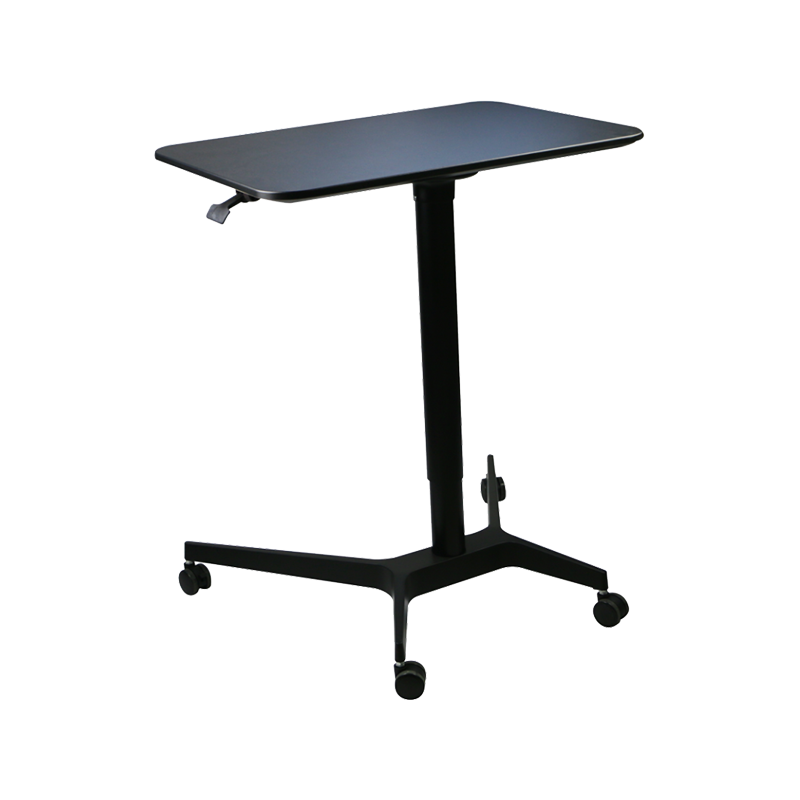
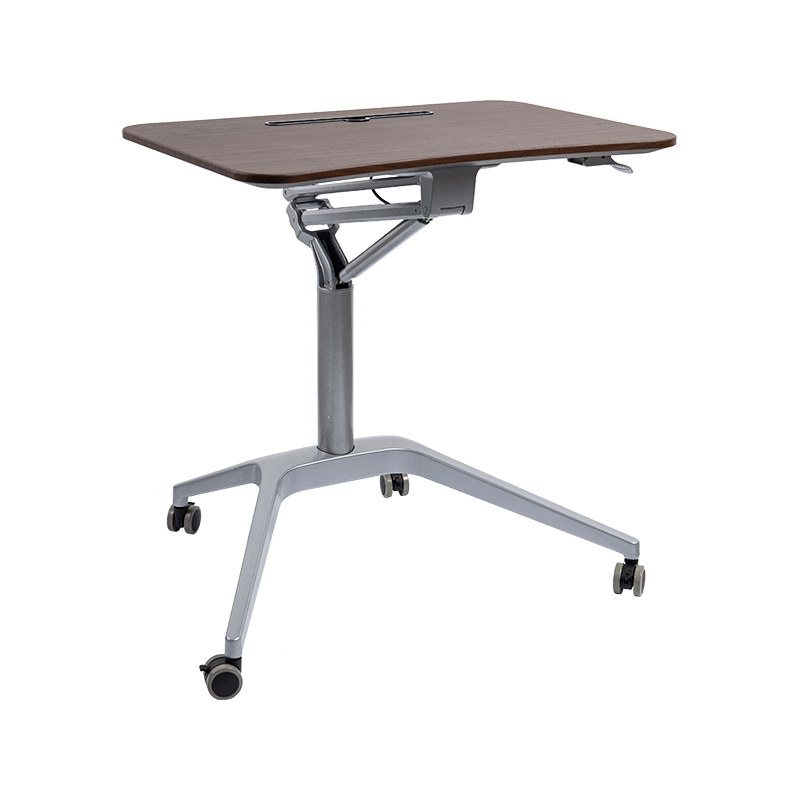
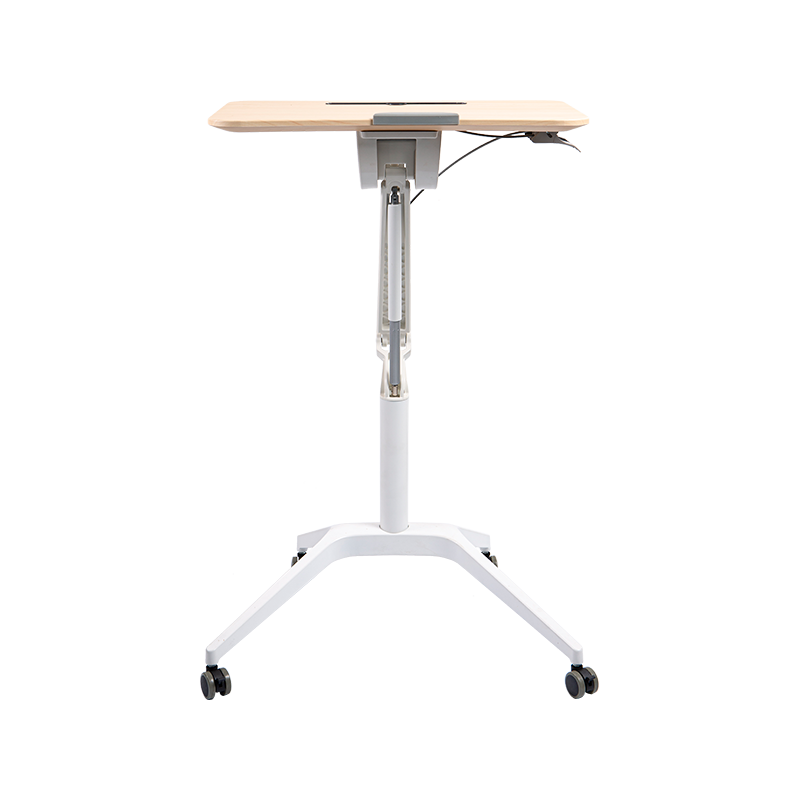
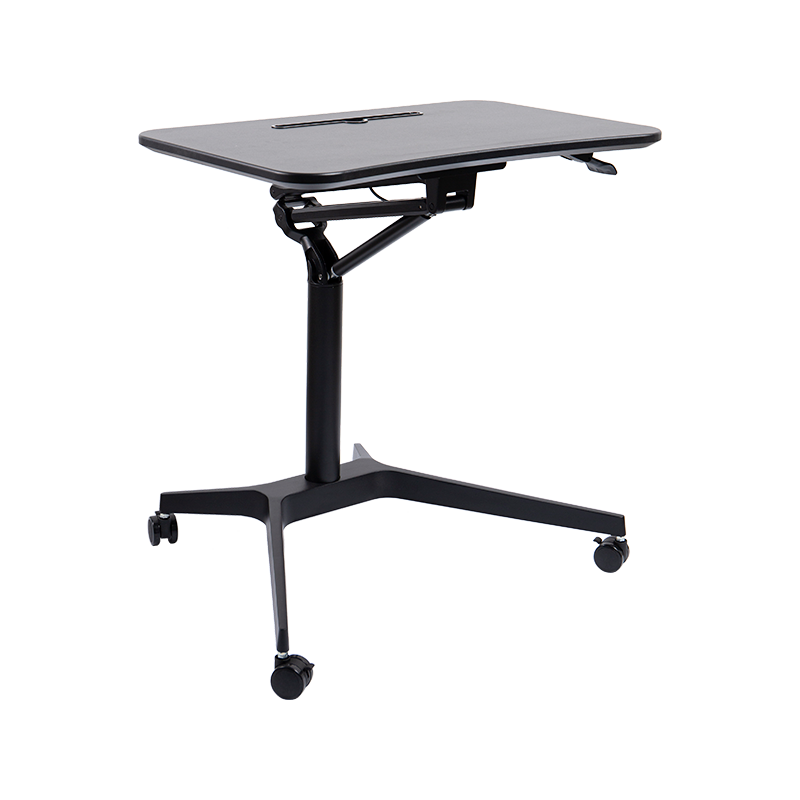
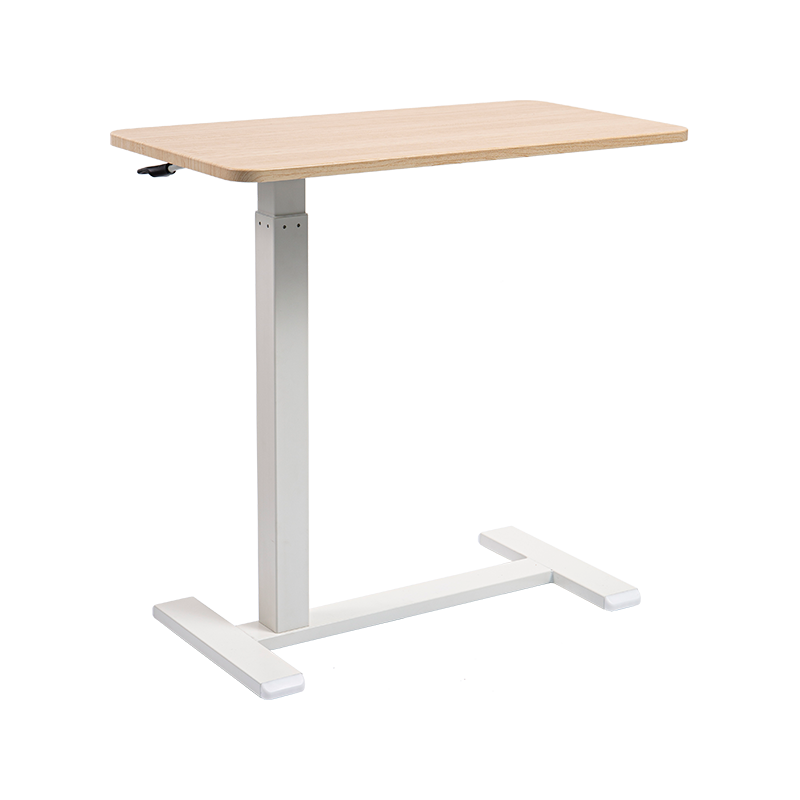
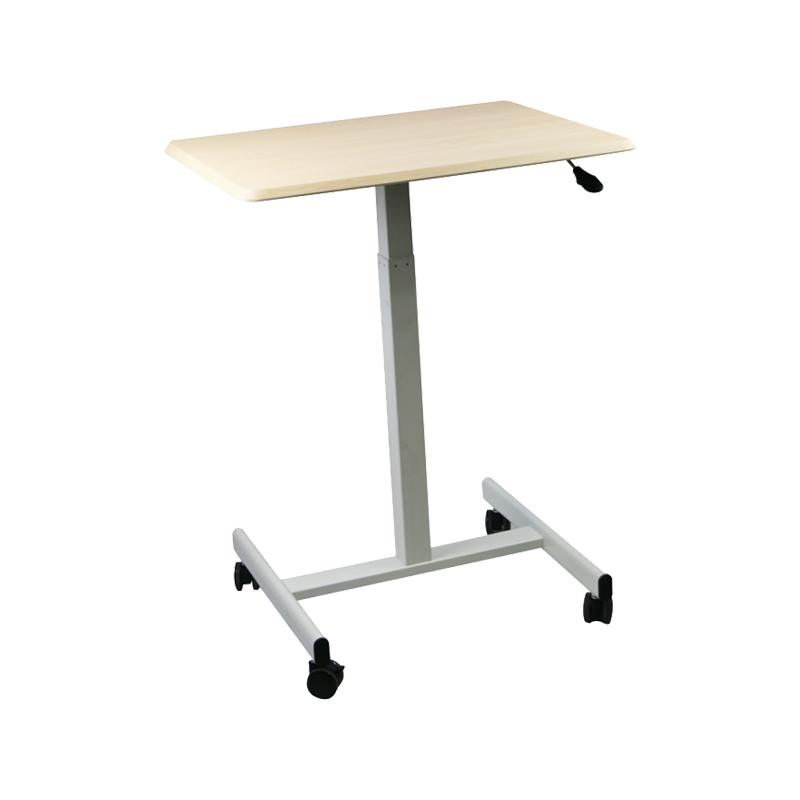
This desk belongs to the pneumatic height-adjustable table category and is closely related to adjustable height desks, gas spring workstations, and mobile ergonomic office tables. Its central value is simple: it provides a manually adjustable work surface that can move from 720 mm to 1130 mm, allowing both seated and standing work positions. With a tabletop size of 715 mm by 495 mm, an aluminum and iron structure, powder-coated black or white finish options, and four caster wheels including two locking wheels, it is built for adaptable workspaces where mobility, stability, and ease of use are equally important.
Unlike many electric height-adjustable desks, the TH-13 uses a gas spring lifting mechanism. This means the height can be adjusted without a motor, control box, power cord, or electrical outlet. For spaces where cables are inconvenient, where frequent relocation is required, or where simple long-term maintenance is preferred, a pneumatic system offers meaningful advantages. The desk is especially suitable for hot-desking offices, home offices, training rooms, school classrooms, medical or laboratory support areas, creative studios, and light-duty industrial workstations.
The product is supplied by SuZhou Skyhone Intelligent Technology Co., Ltd., a manufacturing enterprise focused on the research, development, production, sales, and service of standing desks and adjustable office solutions. Located in Suzhou, within the Yangtze River Delta industrial region, the company benefits from a strong furniture and intelligent manufacturing supply chain. This background supports consistent product development, metal processing, surface treatment, assembly control, and customization capabilities for global customers seeking ergonomic adjustable office furniture.
TH-13 (Cat Head Leg Column with Square Panel Column) Pneumatic Height-Adjustable Desk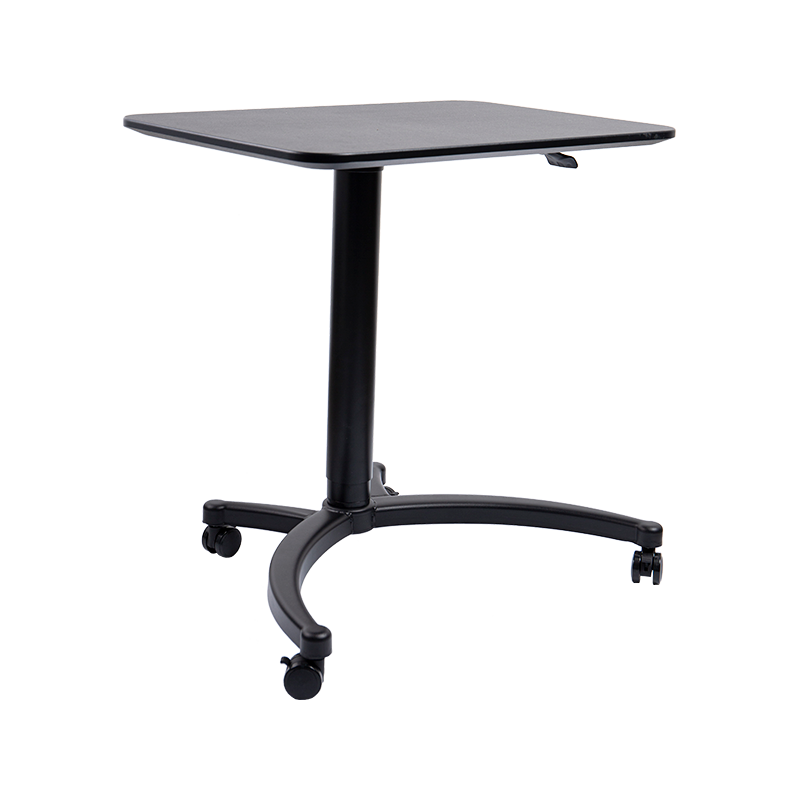
Product Overview: A Compact Pneumatic Desk Designed for Daily Adaptability
The TH-13 Pneumatic Height-Adjustable Desk combines a square desktop with a column-style lifting base. The phrase “cat head leg column with square panel column” refers to the distinctive base and column structure that supports the work surface while maintaining a compact footprint. The design is not only visual; it is functional. The base helps distribute support, while the vertical column houses the gas spring lifting system that enables smooth manual height adjustment.
The lifting range of 720 mm to 1130 mm makes the desk useful for a broad range of everyday working positions. At the lower end, it can function as a seated workstation for typing, reading, laptop use, writing, or light equipment operation. At the higher end, it supports standing tasks such as presentations, inspection work, teaching support, quick meetings, or posture-alternating computer use. This range makes the desk more versatile than many fixed-height tables, which lock users into a single posture and can lead to discomfort during long work sessions.
The 715 mm by 495 mm tabletop is deliberately compact. It is large enough for a laptop, keyboard, mouse, documents, teaching materials, small monitor, test instruments, or office accessories, yet small enough to fit into narrow rooms, shared offices, classrooms, apartment work corners, and flexible workstation zones. For organizations planning space-efficient layouts, this balance between usable surface area and mobility is highly valuable.
The material combination of aluminum and iron gives the desk a practical balance of structure and durability. Aluminum helps reduce excessive weight while offering resistance to corrosion, while iron contributes strength and rigidity where support is required. The powder-coated surface, available in black and white, provides a clean finish that resists common wear and is easy to maintain. Powder coating is also widely preferred in furniture manufacturing because it creates a consistent surface layer without the mess and solvent concerns often associated with traditional liquid paint processes.
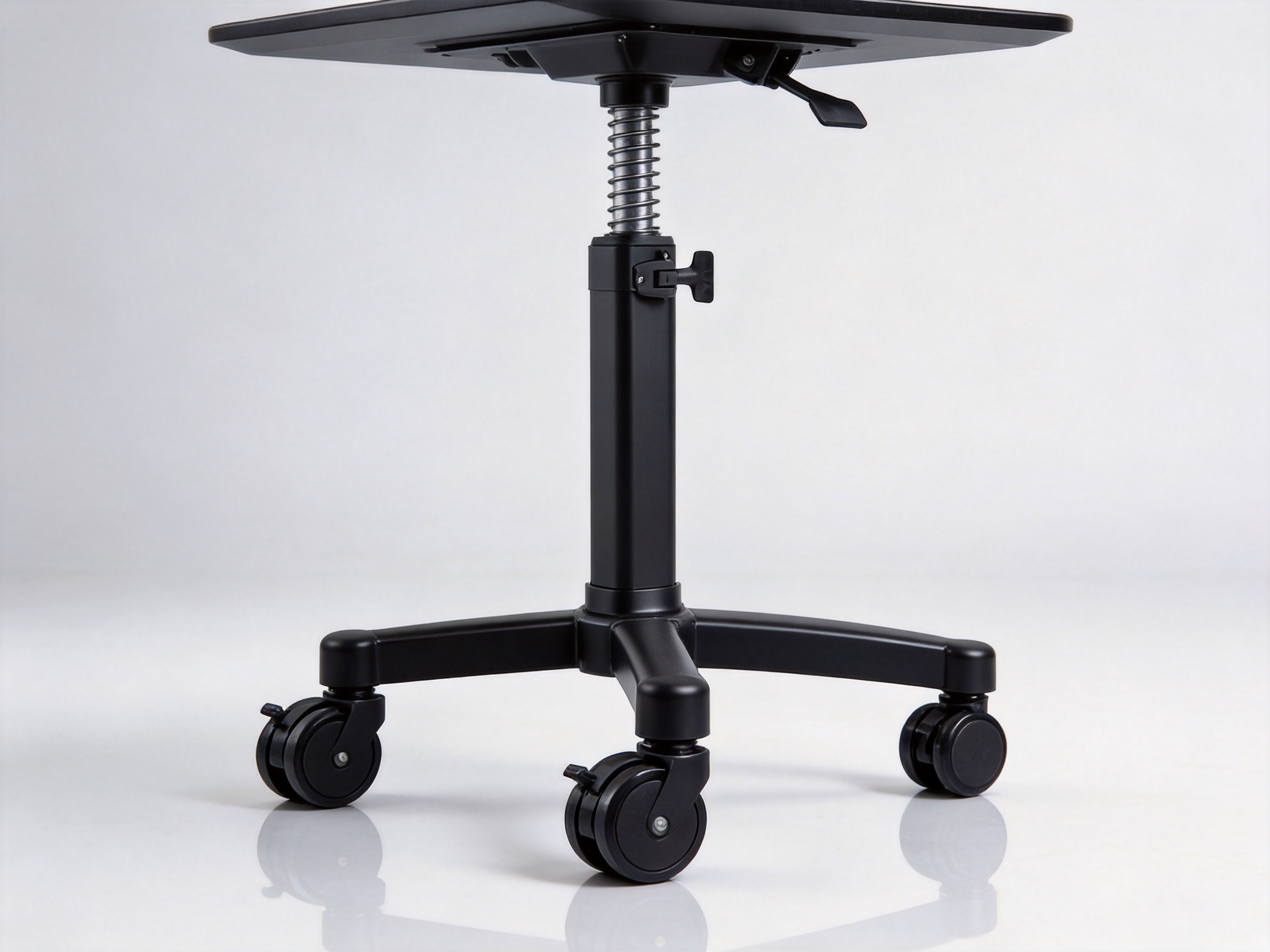
Mobility is another essential part of the product’s identity. The base includes four caster wheels: two with locking functions and two without locks. This configuration allows the desk to be moved easily when needed and secured when stationary. In offices and classrooms, this enables fast room reconfiguration. In laboratories or studios, it allows the desk to follow the task rather than forcing the task to remain fixed in one place. For home users, it makes it easier to reposition the workstation as space needs change throughout the day.
Key Specifications
Product Model |
TH-13 Pneumatic Height-Adjustable Desk |
Product Category |
Pneumatic Height-Adjustable Table |
Lifting Range |
720 mm to 1130 mm |
Tabletop Size |
715 mm by 495 mm |
Main Materials |
Aluminum and iron |
Surface Colors |
Black and white |
Surface Treatment |
Powder coating |
Caster Wheels |
Two locking casters and two non-locking casters |
Working Principle |
Gas spring lifting |
Typical Use |
Mobile sit-stand office, teaching, laboratory, studio, and light-duty workstations |
Gas Spring Lifting: Smooth Adjustment Without Electricity
The defining feature of the TH-13 is its pneumatic gas spring lifting system. Instead of using an electric motor, lifting columns, control panels, cables, or a power adapter, the desk relies on gas spring force to assist vertical movement. The user manually activates and positions the desktop within the available height range. Once set, the desktop remains at the selected height, making the adjustment process direct and intuitive.
For many users, the greatest advantage of a gas spring system is independence from electricity. In a traditional electric adjustable desk, the user must place the desk near an outlet or manage power cables across the floor. This can limit furniture placement and create cable management concerns, especially in shared rooms or training spaces. With the TH-13, there is no need to consider power access for height adjustment. The desk can be placed wherever it is useful, moved whenever the layout changes, and adjusted without interruption.
Compared with crank-adjustable desks, pneumatic adjustment is faster and more convenient. A crank system requires repeated rotation, which can discourage users from changing posture frequently. In contrast, a gas spring mechanism supports quick height transitions. This is important because the ergonomic value of a height-adjustable desk depends not only on its range but also on how likely users are to adjust it during the day. When adjustment is easy, people are more likely to alternate between sitting and standing.
Compared with many budget electric models, the pneumatic structure also reduces reliance on electronic components. Electric desks can include motors, controllers, wiring harnesses, display panels, and power supplies. These components are valuable for heavy-duty applications and memory-position control, but they also add complexity. For compact mobile workstations and shared-use settings, simplicity can be an advantage. The TH-13 avoids motor noise, power cable clutter, and electronic troubleshooting while still providing height adjustment.
This does not mean pneumatic desks replace every electric standing desk. Large executive desks, multi-monitor setups, or heavy equipment stations may require electric lifting platforms with higher load capacity and programmable control. However, for compact, mobile, light-duty, and flexible work surfaces, the TH-13 offers a strong alternative. It focuses on the essential ergonomic function: raising and lowering the work surface smoothly and conveniently.
Ergonomic Benefits for Seated and Standing Work
Ergonomics is often discussed in terms of office chairs, monitor stands, and keyboard trays, but work surface height is equally important. A fixed-height desk can be too high for some users and too low for others. When the desk height does not match the user’s body size and task, the result can be shoulder tension, wrist strain, neck discomfort, or awkward posture. A height-adjustable desk helps address this issue by allowing the work surface to be positioned according to the user and the activity.
The TH-13 supports a vertical range from 720 mm to 1130 mm. This allows users to create a seated workstation at conventional desk height and then raise the surface for standing tasks. For seated use, the goal is usually to keep the forearms near level with the tabletop while the shoulders remain relaxed. For standing use, the work surface should generally allow elbows to rest near a comfortable angle without forcing the user to hunch or elevate the shoulders. The adjustable column helps users find a practical height for these positions.
Posture variation is a key advantage of sit-stand work. The purpose of a height-adjustable desk is not to stand all day; rather, it is to make movement and posture change easier. Alternating between sitting and standing may help reduce static loading on the body, encourage circulation, and create more natural task transitions. A mobile pneumatic desk like the TH-13 makes this routine simple because the user does not need to find a control panel, wait for a motor, or remain near a power outlet.
In shared spaces, height adjustability is even more important. One desk may be used by different employees, students, teachers, technicians, or family members. A fixed-height desk can only suit an average user, while others must adapt themselves to the furniture. The TH-13 reverses this relationship: the furniture can adapt to the user. This makes it particularly useful in hot-desking zones, collaborative rooms, classroom support areas, and temporary workstations.
The compact tabletop also encourages focused work. It offers enough room for essential tools without creating an overly large surface that collects clutter. In small offices or multipurpose rooms, this supports a cleaner and more flexible layout. Users can set up a laptop station, document review area, mobile teaching podium, or inspection surface without dedicating an entire large desk to the task.
Mobility and Space Efficiency
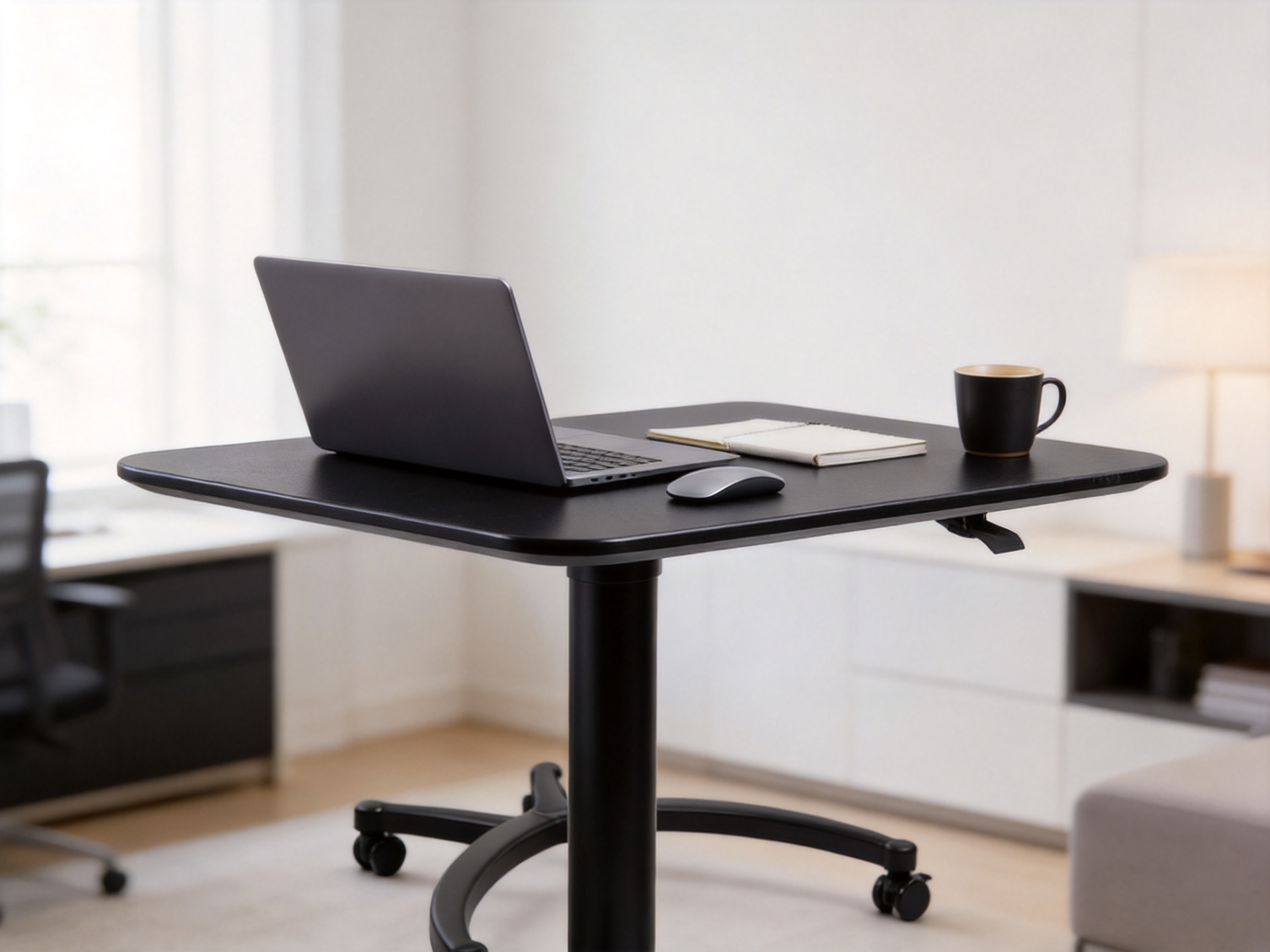
One of the most practical advantages of the TH-13 is its mobility. A height-adjustable desk becomes significantly more useful when it can move easily from one location to another. The four caster wheels allow the desk to be rolled between rooms, repositioned within an office, aligned beside other workstations, or stored when not in use. Two of the casters include locking functions, enabling users to secure the desk after placement.
This mobility is especially beneficial in flexible work environments. Modern offices often include shared desk areas, small meeting rooms, breakout zones, and temporary project spaces. Instead of purchasing separate fixed furniture for every room, organizations can use mobile adjustable desks to support different activities throughout the day. A desk can serve as a standing workstation in the morning, a presentation support table in the afternoon, and a collaborative review surface later.
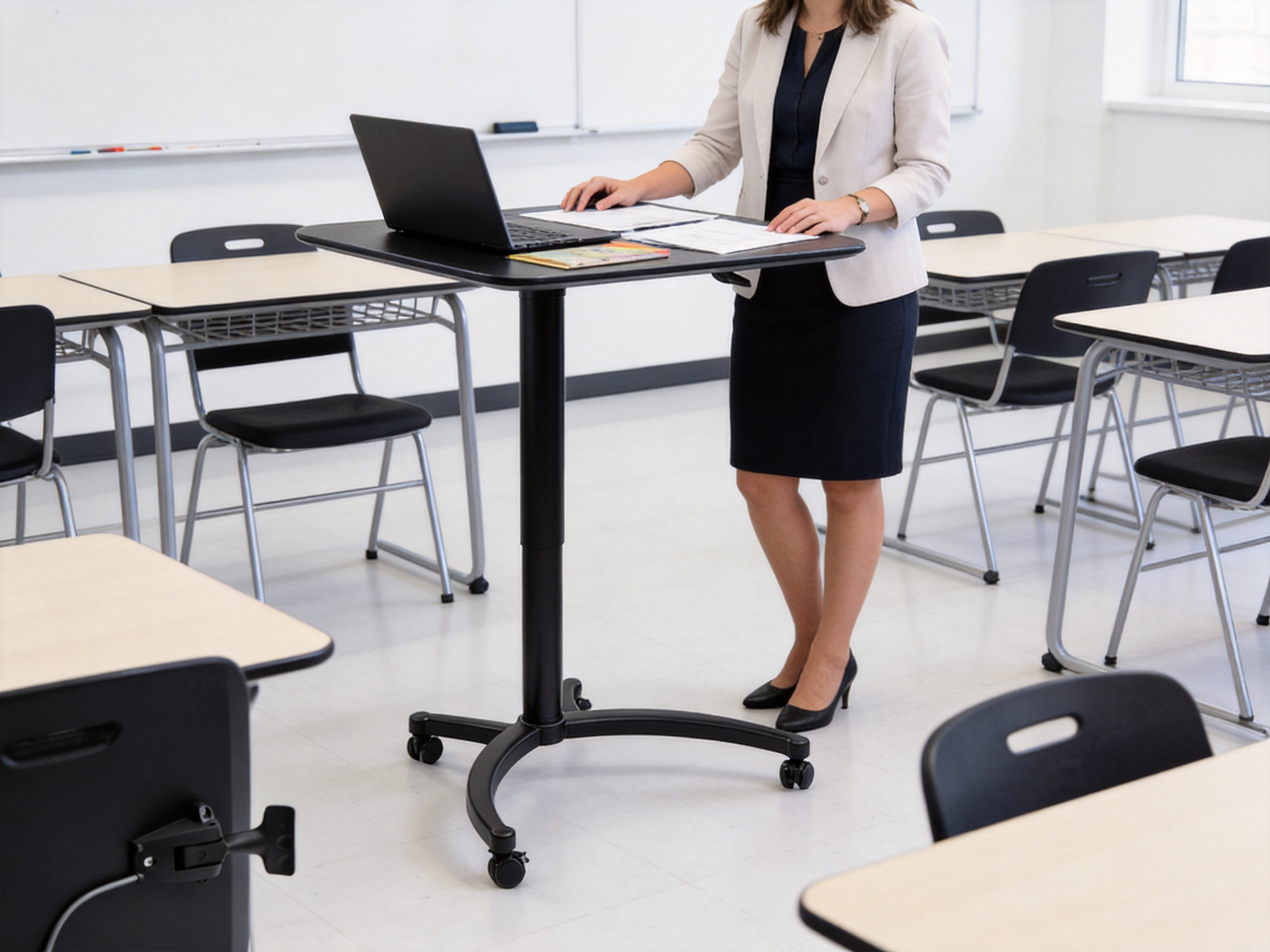
In classrooms and training centers, mobility makes it easier for instructors to change teaching arrangements. The desk can be used as a compact teaching station, a demonstration surface, or a mobile support table for teaching materials. Since the height can be adjusted manually, it can be set for sitting review, standing instruction, or student interaction. The caster locks help keep the desk in position when needed.
In laboratories, clinics, and technical environments, mobile work surfaces are valuable because tasks may occur at different stations. The TH-13 can support light-duty instruments, documents, laptops, sample handling tools, or inspection materials. Its powder-coated metal structure is easy to clean, and the absence of electrical height adjustment components can be an advantage in areas where cable reduction is preferred. Users should always assess load and environmental requirements for specific laboratory or industrial applications, but the desk’s general design supports flexible light-duty use.
For home offices, the mobility feature solves a common problem: limited space. Many remote workers do not have a dedicated office room. They may work in a bedroom, living room, or shared family area. A large electric standing desk may be impractical, while a fixed table may not support good posture. The TH-13 provides a compact alternative that can be moved aside when the room is needed for other activities.
Material Selection and Surface Treatment
The TH-13 is constructed from aluminum and iron, two materials commonly selected for metal furniture structures because they offer strength, formability, and reliability. In adjustable desks, material selection is important because the frame must support repeated movement, maintain alignment, and provide stability during daily use. A poorly designed adjustable desk may wobble, wear prematurely, or lose smooth operation over time. A well-built structure must balance weight, strength, and manufacturing precision.
Aluminum is valued for its relatively light weight and resistance to corrosion. In a mobile desk, reducing unnecessary weight improves maneuverability. Iron, meanwhile, offers strong support in structural components where stiffness and durability are essential. By combining these materials, the TH-13 can provide a practical frame for a mobile height-adjustable workstation.
The powder-coated surface adds another layer of value. Powder coating involves applying dry powder to a prepared metal surface and curing it to form a durable finish. Compared with ordinary painting methods, powder coating often provides strong adhesion, consistent coverage, and resistance to scratches and everyday wear. It also creates a clean appearance suitable for office, education, and professional environments.
Black and white color options make the desk adaptable to different interior styles. Black offers a professional, technical, and understated appearance, often matching monitors, office chairs, and equipment. White provides a bright, clean, and modern look, suitable for classrooms, healthcare-related spaces, creative studios, and contemporary offices. These color options help buyers integrate the desk into existing furniture systems without requiring a custom finish for every project.
Durability is not only about material strength; it is also about maintenance. A powder-coated metal frame is easy to wipe clean and maintain. For shared workspaces where multiple users touch and move the desk, simple maintenance is a meaningful advantage. The pneumatic system also avoids maintenance concerns associated with electrical control systems, such as switch damage, cable wear, or power module issues.
Advantages Over Common Competitor Designs
The market for adjustable desks includes several major product types: fixed-height desks, electric standing desks, crank-adjustable desks, desktop converters, and mobile carts. Each type has its place, but the TH-13 offers a combination of characteristics that can outperform competitors in specific use cases.
Compared with Fixed-Height Desks
Fixed-height desks are simple and often low-cost, but they lack adaptability. A fixed desk cannot easily support both seated and standing work. It also cannot accommodate users of different heights as effectively. The TH-13 provides a height range from 720 mm to 1130 mm, allowing the same workstation to be used in multiple positions. This makes it more ergonomic and more flexible than a static table.
Fixed desks also tend to be less mobile. While some small tables may be moved manually, they are not usually designed for frequent repositioning. The TH-13 includes caster wheels for smooth relocation and locking wheels for stable placement. This makes it more suitable for changing layouts and shared environments.
Compared with Electric Standing Desks
Electric standing desks are popular because they can lift larger surfaces and often include memory presets. However, they require power, contain more components, and may be heavier or less convenient to relocate. The TH-13 avoids those limitations by using gas spring lifting. There is no motor, no control box, no electrical cable for the lifting function, and no need to position the desk near an outlet.
For users who need a compact mobile workstation rather than a large permanent desk, the pneumatic approach can be more practical. It also removes concerns about motor noise and electrical troubleshooting. In schools, training rooms, temporary offices, and flexible work zones, the simplicity of a non-electric system is often a major benefit.
Compared with Crank-Adjustable Desks
Crank-adjustable desks are also non-electric, but they require manual rotation to change height. This can be slow, especially when users change posture multiple times per day. If adjustment feels inconvenient, users may stop using the sit-stand function. The TH-13’s gas spring system provides a smoother and faster adjustment experience, encouraging more frequent height changes.
A crank mechanism may be acceptable for occasional adjustment, such as setting a desk for one user and leaving it there. The TH-13 is more suitable for dynamic use, shared workstations, and spaces where users need quick transitions between sitting and standing.
Compared with Desktop Sit-Stand Converters
Desktop converters sit on top of an existing desk and raise a keyboard and monitor platform. They can be useful, but they depend on the presence of a stable base desk. They also add weight to the original desk and may reduce usable surface space. The TH-13 is a complete mobile workstation, not an accessory. It can be placed wherever needed and moved independently.
Because it has its own frame, tabletop, lifting column, and casters, the TH-13 offers greater layout flexibility. It is not tied to existing furniture and does not require a large fixed desk underneath. This is especially helpful in compact rooms and multipurpose environments.
Compared with Basic Mobile Carts
Some mobile carts provide wheels and shelves, but many do not offer ergonomic height adjustment or a comfortable work surface. The TH-13 combines mobility with sit-stand functionality. It is more than a transport cart; it is a height-adjustable workstation. This combination makes it useful for laptop work, teaching, document handling, inspection, and light equipment operation.
Basic carts may also lack the appearance required for office environments. With its powder-coated metal structure and black or white finish options, the TH-13 is suitable for professional interiors while still maintaining practical mobility.
Manufacturing Strengths Behind the Product
A height-adjustable desk may look simple from the outside, but consistent performance depends on manufacturing control. The lifting column must move smoothly, the tabletop must align correctly, the frame must remain stable, the casters must roll and lock reliably, and the surface finish must resist daily use. These outcomes require more than basic assembly. They require material selection, machining precision, surface preparation, coating control, and final quality inspection.
SuZhou Skyhone Intelligent Technology Co., Ltd. is positioned as a professional manufacturing enterprise engaged in standing desk research, development, production, sales, and service. The company’s location in Suzhou gives it access to the strong industrial ecosystem of the Yangtze River Delta. This region is known for developed manufacturing resources, supply chain coordination, skilled labor, metal fabrication capability, and export-oriented production experience. For adjustable desk manufacturing, these advantages help support stable component sourcing and efficient production organization.
The company’s product focus on standing desks and ergonomic office solutions is important. Adjustable furniture requires specialized understanding of lifting systems, stability, user experience, and assembly reliability. A manufacturer that is deeply engaged in this category can refine product structures, evaluate user feedback, and improve manufacturing processes over time. This is different from general furniture production, where height adjustment may be treated as a secondary feature.
Advanced manufacturing for a product like the TH-13 can include precision cutting, forming, welding or fastening operations, column fitting, gas spring integration, powder coating, caster assembly, and final inspection. Each stage influences the final user experience. If the column tolerances are poor, lifting may feel uneven. If the frame geometry is inconsistent, the desk may wobble. If surface treatment is inadequate, the finish may chip or wear prematurely. If casters are poorly installed, mobility and locking stability may suffer.
By focusing on controlled production and quality-oriented assembly, the manufacturer can deliver a desk that feels reliable in everyday use. For business buyers, distributors, and project customers, manufacturing stability is just as important as product appearance. A workstation may be deployed in offices, schools, laboratories, or commercial environments where many users interact with it. Consistent quality reduces service issues and supports a better customer experience.
Research and Development: Designing for Real Work Environments
Research and development in adjustable desk manufacturing begins with understanding how people actually work. Users do not simply sit or stand in one perfect posture. They reach, type, write, move documents, rotate equipment, reposition furniture, and share desks with others. A successful product must support these behaviors without becoming complicated. The TH-13 reflects this approach through its simple height range, compact tabletop, mobile base, and non-electric lifting mechanism.
The 720 mm to 1130 mm lifting range is suitable for a variety of seated and standing tasks. The desktop size of 715 mm by 495 mm supports common office and task-related items without occupying excessive floor area. The caster system acknowledges that many modern workspaces are not static. The black and white color options recognize that furniture must integrate visually with different interiors.
Product development also requires balancing competing design goals. A mobile desk should be easy to move, but it must also feel stable when in use. A compact tabletop should save space, but it must still provide enough work area. A pneumatic system should be simple, but it must still hold height reliably. A metal frame should be strong, but it should not be unnecessarily heavy. These balances are achieved through structural design, material choice, and manufacturing refinement.
The TH-13’s design is especially relevant for organizations seeking practical ergonomic upgrades without major renovation. Because it does not require electrical installation for height adjustment, the desk can be deployed quickly. It can be added to existing rooms, moved between departments, or used as a shared resource. This makes it a flexible choice for companies and institutions that want to improve workstation adaptability while controlling complexity.
Production Process Considerations
Although each manufacturer may manage production according to internal standards, the creation of a pneumatic height-adjustable desk generally involves several important process stages. The first is material preparation. Aluminum and iron components must be selected and processed according to the structural design. Dimensional accuracy at this stage influences later assembly and performance.
The next stage involves cutting, forming, and machining. Metal parts may be cut to length, shaped, drilled, or prepared for fastening. For height-adjustable furniture, accurate hole placement and surface alignment are essential. Small dimensional inconsistencies can become larger problems during assembly, especially in moving components.
Frame and column assembly follow. The lifting column must be integrated with the gas spring mechanism so that the desktop can move smoothly through the intended height range. The relationship between the column, base, and tabletop must be carefully controlled. A stable desk depends on proper alignment between these parts.
Surface preparation and powder coating are also critical. Before coating, metal surfaces must be cleaned and prepared to support adhesion. Powder is then applied and cured to create the final surface layer. The quality of this step affects appearance, corrosion resistance, scratch resistance, and ease of cleaning. A uniform coating also improves the product’s professional presentation.
Caster installation is another practical detail that can affect user satisfaction. The wheels must roll smoothly, support the desk correctly, and allow locked positioning when required. Since the TH-13 includes two locking and two non-locking casters, the locking function must be checked to ensure stable stationary use.
Final inspection should include visual evaluation, assembly checks, height adjustment testing, caster function testing, and packaging review. For export and distribution, packaging is especially important because adjustable desks include both structural parts and finished surfaces that must arrive undamaged. Good packaging protects the powder-coated finish, tabletop, column, and caster components during transport.
Quality and Reliability in Everyday Use
Users judge an adjustable desk by how it feels every day. Does it move smoothly? Does it stay in place? Does the surface remain easy to clean? Does it fit the room? Does it support the intended tasks? The TH-13 is designed around practical reliability rather than unnecessary complexity. Its gas spring lifting mechanism, compact metal structure, and caster base create a desk that is easy to use and easy to reposition.
Reliability also comes from reducing failure points. Electric desks are valuable in many settings, but their electronic components introduce additional points that can require service. In contrast, the pneumatic design of the TH-13 simplifies the height adjustment system. There is no electric motor for lifting, no control panel for height setting, and no power cable required for operation. This can make the desk particularly appealing in shared environments where equipment must be easy for anyone to use.
The powder-coated aluminum and iron structure supports durability in common indoor applications. Regular cleaning can typically be handled with simple wiping, depending on workplace requirements. For offices, classrooms, and studios, this reduces maintenance burden. For laboratories or technical settings, users should follow facility-specific cleaning and chemical compatibility guidelines, but the metal construction and coated surface provide a practical base for routine care.
Stability is another core aspect of reliability. The cat-head leg column structure is intended to provide a supportive base while retaining mobility. The locking casters help prevent unwanted movement when the desk is in position. As with any mobile workstation, users should lock the wheels before focused work and avoid overloading the tabletop beyond appropriate use. When used as intended, the desk provides a stable platform for daily light-duty tasks.
Applications in Office Environments
In office settings, the TH-13 can serve several roles. It can function as a compact personal sit-stand desk, a mobile laptop station, a shared hot-desk surface, a temporary workstation for visiting staff, or a support table for meetings and presentations. Its ability to move and adjust makes it useful wherever fixed furniture would limit flexibility.
For open offices, the desk can provide an alternative work position for employees who want to stand for part of the day. Instead of replacing every workstation with a large electric desk, organizations can deploy mobile pneumatic desks in shared zones. Employees can use them for focused standing tasks, quick collaboration, or short-term project work.
In meeting rooms, the desk can act as a standing presenter’s table or mobile equipment support station. A laptop, notes, presentation remote, and small accessories can fit on the tabletop. The height can be adjusted for sitting or standing presenters, and the wheels allow the desk to be moved out of the way when not needed.
In reception or administrative areas, the desk can support temporary paperwork, visitor registration, document review, or mobile computer use. Because it does not require electrical height adjustment, it can be placed wherever it is most convenient. The black or white finish can match different interior themes.
Applications in Education and Training
Educational spaces benefit from furniture that can adapt quickly. Classrooms may need different layouts for lectures, group work, testing, demonstrations, and presentations. The TH-13 supports these changing needs by combining height adjustment with caster mobility.
Teachers can use the desk as a mobile instruction station. At standing height, it can hold lesson materials, a laptop, or demonstration objects. At seated height, it can support grading, preparation, or one-on-one student assistance. The desk can be rolled to different areas of the classroom and locked in place when needed.
Training centers can use multiple TH-13 desks to create flexible learning stations. Participants may work individually or in groups, and the room can be reorganized between sessions. Because the desks are compact, they do not dominate the room. Because they are height adjustable, they support users with different preferences and body sizes.
In libraries and learning commons, the desk can provide an accessible temporary workstation for laptop use, research assistance, or staff support. Its compact footprint helps preserve open space while still offering a functional work surface.
Applications in Laboratories, Studios, and Light-Duty Technical Areas
Laboratories, creative studios, and light-duty technical areas often require workstations that can move to the task. A fixed desk may be too limiting when users need to shift between benches, instruments, storage areas, and collaboration zones. The TH-13 can serve as a mobile support surface for documentation, laptop entry, sample notes, small tools, or inspection tasks.
In laboratory settings, the non-electric lifting system may be useful where reducing power cables is desirable. Users can position the desk as needed without searching for an outlet for height adjustment. The powder-coated metal surface is easy to clean for general use, though specific lab requirements should always be considered.
In creative studios, the height range supports drawing review, laptop work, standing discussion, and material sorting. Designers, artists, photographers, and makers often move around the workspace rather than remaining seated for long periods. A mobile adjustable desk can follow this workflow.
In light-duty industrial or assembly environments, the TH-13 can support paperwork, scanning devices, quality checklists, lightweight tools, or inspection materials. Its ability to adjust height can help workers position tasks more comfortably. However, users should evaluate load, vibration, contamination, and safety requirements before using any office-style adjustable desk in industrial conditions.
Why Buyers Choose a Pneumatic Mobile Desk
Purchasing decisions are often based on a combination of ergonomics, cost, maintenance, deployment speed, and space planning. The TH-13 provides a strong value proposition because it improves workstation flexibility without introducing high complexity. It can be used immediately after assembly, moved as space needs change, and adjusted without electricity.
For distributors and project buyers, the product is also easy to explain. Its main benefits are visible and practical: height range, gas spring lifting, compact tabletop, metal structure, powder-coated finish, and casters. These are features that users can understand quickly. In a market crowded with electric desks and large workstation systems, the TH-13 occupies a clear position as a compact, mobile, non-electric sit-stand solution.
For companies managing workplace wellness programs, the desk offers a simple way to introduce posture variation. Instead of requiring every employee to adopt a new workstation at once, mobile adjustable desks can be added gradually. They can serve shared areas, temporary needs, or departments with limited space. This makes ergonomic improvement more accessible.
For buyers concerned about maintenance, the pneumatic design is attractive. With fewer electrical components, there are fewer electronic issues to diagnose. This can reduce downtime and simplify support in environments where furniture is used by many people. The powder-coated metal structure further supports easy upkeep.
Customization and Supply Strength
As a manufacturer of adjustable office table solutions, SuZhou Skyhone Intelligent Technology Co., Ltd. supports global users with ergonomic office furniture and related products. Manufacturing strength is not only about producing one model; it is also about the ability to respond to market needs, provide stable supply, and support customization where appropriate. Buyers may require different colors, packaging, product combinations, or project-based supply arrangements. A company with specialized standing desk experience is better positioned to handle these requirements.
The company’s presence in the Suzhou Industrial Park area supports access to regional logistics, component suppliers, production resources, and skilled manufacturing services. This industrial environment can help improve lead time coordination, quality control, and product development cycles. For international buyers, reliable manufacturing and communication are essential parts of long-term cooperation.
The TH-13 also fits within a broader product ecosystem related to adjustable height desks, electric linear actuators, and gas springs. This technical background is useful because adjustable furniture depends on motion components and structural performance. Understanding gas spring behavior, lifting systems, and ergonomic desk design allows the manufacturer to create products that meet different use scenarios.
Customization should always be discussed according to project requirements, technical feasibility, order volume, and compliance needs. However, the company’s position as an ergonomic adjustable office table manufacturer and factory indicates the ability to work with customers seeking tailored solutions for offices, education, laboratories, and commercial projects.
Practical User Guidance
To get the best experience from the TH-13, users should place the desk on a flat indoor surface and lock the locking casters after positioning. Before adjusting height, the user should ensure that items on the tabletop are stable and that cables connected to laptops or devices have enough slack. Although the desk does not require power for lifting, electronic equipment placed on the tabletop may still have cables that need safe routing.
When setting the desk for seated work, users should adjust the height so that the arms can rest comfortably while typing or writing. The chair height should also be considered, because desk and chair ergonomics work together. For standing work, the tabletop should be set at a height that allows relaxed shoulders and comfortable forearm position. Users should avoid leaning heavily on the desk or placing unsuitable loads on the surface.
The desk should be cleaned with methods appropriate for powder-coated metal and the tabletop material. Abrasive cleaners should generally be avoided because they may damage the finish. In shared environments, routine cleaning helps maintain the desk’s appearance and user comfort.
For organizations, it is helpful to create usage guidelines for shared mobile desks. These can include locking wheels before use, returning the desk to a designated area, reporting any caster or lifting issues, and avoiding excessive loads. Simple guidelines can extend product life and improve safety.
Q&A Section
What is the main advantage of the TH-13 Pneumatic Height-Adjustable Desk?
The main advantage is its combination of smooth gas spring height adjustment, compact size, and caster-based mobility. It allows users to switch between seated and standing positions without electricity and can be easily moved between work locations.
What is the height adjustment range?
The lifting range is 720 mm to 1130 mm. This range supports common seated work heights and standing work positions for many users and tasks.
Does the desk need electricity to adjust height?
No. The desk uses a gas spring lifting mechanism. Height adjustment is manual and does not require an electric motor, control box, or power outlet.
How large is the tabletop?
The tabletop measures 715 mm by 495 mm. It is compact but suitable for a laptop, keyboard, mouse, documents, small monitor, teaching materials, or light-duty work tools.
What materials are used in the structure?
The main structure is made from aluminum and iron. This combination provides a practical balance of strength, durability, and manageable weight for a mobile workstation.
What colors are available?
The surface color options are black and white. Both options use powder coating for a clean and durable finish.
How many caster wheels does the desk have?
The desk has four caster wheels. Two casters include locking functions, and two do not. This arrangement supports both easy movement and secured placement.
How does this desk compare with an electric standing desk?
An electric standing desk may be better for large surfaces or heavier equipment, but it requires power and includes more electronic components. The TH-13 is more suitable for compact, mobile, non-electric sit-stand use, especially where simple maintenance and flexible placement are priorities.
Is the TH-13 suitable for home offices?
Yes. Its compact tabletop and mobile base make it suitable for apartments, bedrooms, living rooms, and small home office spaces. It can be moved aside when not in use.
Can it be used in classrooms or training rooms?
Yes. The desk is well suited for education and training environments because it can be moved easily, adjusted for seated or standing instruction, and locked in position when needed.
Is it appropriate for laboratory use?
It can be used as a light-duty mobile support desk in laboratory or technical environments, especially for laptops, documents, and small tools. Users should confirm that the desk meets the specific load, cleaning, chemical, and safety requirements of the facility.
Why is powder coating important?
Powder coating provides a durable and uniform surface finish. It improves resistance to everyday wear, supports easy cleaning, and gives the desk a professional appearance.
Who manufactures the product?
The product is supplied by SuZhou Skyhone Intelligent Technology Co., Ltd., a professional manufacturing enterprise focused on standing desks and ergonomic adjustable office solutions.
Conclusion: A Practical Sit-Stand Solution for Flexible Workspaces
The TH-13 Pneumatic Height-Adjustable Desk is designed for the reality of modern work: people move, rooms change, and users need furniture that adapts. Its 720 mm to 1130 mm height range supports posture variation. Its gas spring lifting system provides smooth adjustment without electricity. Its 715 mm by 495 mm tabletop offers a compact but useful work surface. Its aluminum and iron construction, powder-coated finish, and caster base make it durable, easy to maintain, and convenient to reposition.
Compared with fixed desks, it offers ergonomic flexibility. Compared with electric standing desks, it reduces cable dependence and electronic complexity. Compared with crank desks, it offers faster adjustment. Compared with desktop converters, it functions as a complete independent workstation. Compared with ordinary mobile carts, it provides true height-adjustable work capability.
Behind the product is the manufacturing strength of SuZhou Skyhone Intelligent Technology Co., Ltd., a company engaged in the development and production of standing desks and ergonomic office solutions. Its location in Suzhou and the Yangtze River Delta manufacturing region supports supply chain strength, production capability, and product refinement. For buyers seeking a compact, mobile, non-electric adjustable desk for offices, homes, classrooms, laboratories, studios, or light-duty work areas, the TH-13 is a practical and competitive choice.
References
Grandjean, E. Fitting the Task to the Man: An Ergonomic Approach. Taylor and Francis.
Kroemer, K. H. E., and Grandjean, E. Fitting the Task to the Human: A Textbook of Occupational Ergonomics. CRC Press.
Bridger, R. S. Introduction to Human Factors and Ergonomics. CRC Press.
Pheasant, S., and Haslegrave, C. M. Bodyspace: Anthropometry, Ergonomics and the Design of Work. CRC Press.
International Organization for Standardization. Ergonomic Requirements for Office Work with Visual Display Terminals.
Human Factors and Ergonomics Society. Human Factors Engineering of Computer Workstations.
Occupational ergonomics literature on sit-stand workstation design, posture variation, and workplace furniture usability.
Product: TH-13 (Cat Head Leg Column with Square Panel Column) Pneumatic Height-Adjustable Desk


- Contact Info
-
-
 Phone+86-15950656125
 -
 Email
Email -
 AddressRoom 1007-1, South Building, Suyue Plaza, Suzhou Industrial Park, Suzhou City, Jiangsu Province, China
-
- Products
- Follow Us
- Need help? Please contact us
Copyright ©
SuZhou Skyhone Intelligent Technology Co., Ltd.
All Rights Reserved.
Privacy
Custom Ergonomic Adjustable Office Tables Manufacturers

