

 English
 русский
 Español
 عربى

Content
- 1 Product Overview
- 2 Ergonomic Height Adjustment
- 3 Gas Spring Lifting Mechanism
- 4 Tabletop Design and Surface Performance
- 5 Frame Structure and Flat-Legged Design
- 6 Mobility and Caster Configuration
- 7 Competitive Advantages
- 8 Manufacturing and Engineering Strengths
- 9 Applications Across Multiple Environments
- 10 Daily Operation and Maintenance
- 11 Installation and Deployment Considerations
- 12 Customization and Procurement Value
- 13 Why This Product Fits Flexible Work Environments
- 14 Frequently Asked Questions
- 14.1 What type of desk is the SK01-3?
- 14.2 How high and low can the desk be adjusted?
- 14.3 Does the desk require electricity?
- 14.4 Is the height adjustment automatic?
- 14.5 What are the tabletop dimensions?
- 14.6 What is the tabletop made from?
- 14.7 What tabletop colors are available?
- 14.8 What materials are used in the frame?
- 14.9 What frame finishes are available?
- 14.10 Can the desk be moved easily?
- 14.11 Can the desk be used for heavy industrial work?
- 14.12 What makes the flat-legged structure different?
- 14.13 Is the desk suitable for shared workspaces?
- 14.14 How should the desk be maintained?
- 14.15 Can the product be customized?
- 15 Conclusion
- 16 References
- 17 Product: SK01-3 iPad (Flat-Legged) Pneumatic Height-Adjustable Desk
SK01-3 iPad Flat-Legged Pneumatic Height-Adjustable Desk: A Mobile Workstation for Flexible Ergonomics
2026-09-11
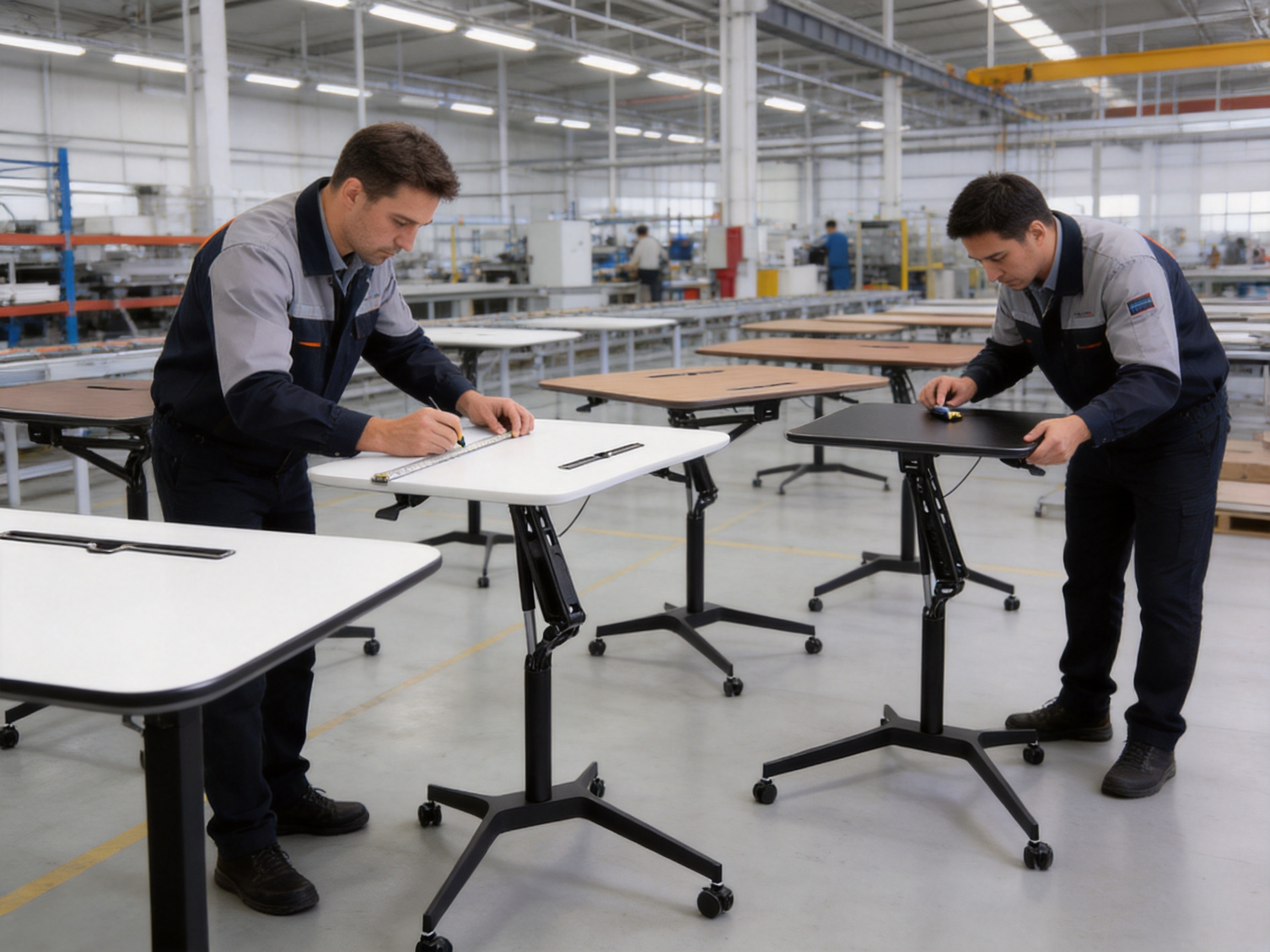
Modern work environments increasingly require furniture that can adapt to different users, tasks, and working positions. A fixed-height desk may be suitable for one person and one activity, but it can become inefficient when used for collaborative work, product demonstrations, electronic device testing, training, or short-term standing tasks. The SK01-3 iPad Flat-Legged Pneumatic Height-Adjustable Desk addresses these challenges with a compact mobile workstation that combines manual gas spring height adjustment, a durable work surface, a stable triangular support structure, and smooth mobility.
With a lifting range of 750 millimeters to 1060 millimeters, the desk supports both seated and standing work. Its 715 millimeter by 475 millimeter tabletop provides a practical platform for an iPad, laptop, documents, demonstration equipment, testing tools, or light assembly materials. The design is compact enough for space-conscious interiors while offering substantially more flexibility than a conventional fixed workstation.
The product is manufactured by SuZhou Skyhone Intelligent Technology Co., Ltd., a professional enterprise focused on the research, development, production, sales, and service of standing desks and related intelligent office furniture. Based in Suzhou, Jiangsu Province, the company benefits from the Yangtze River Delta’s strong furniture supply chain, manufacturing infrastructure, engineering resources, and logistics network.
This article examines the product’s construction, operating principle, ergonomic value, competitive advantages, manufacturing strengths, application scenarios, maintenance requirements, and purchasing considerations.
Product Overview
The SK01-3 is a pneumatic height-adjustable table designed for users who need a movable surface at different working heights. Unlike electrically powered desks, it does not rely on a motor, control panel, or power cable for adjustment. Instead, its gas spring mechanism supports smooth manual lifting and positioning within the specified range.
The desk is particularly suitable for environments where mobility and quick repositioning are important. It can be moved between rooms, workstations, display areas, classrooms, laboratories, retail spaces, and light production areas. Two lockable casters allow the desk to be secured during use, while two additional casters support movement when the workstation needs to be relocated.
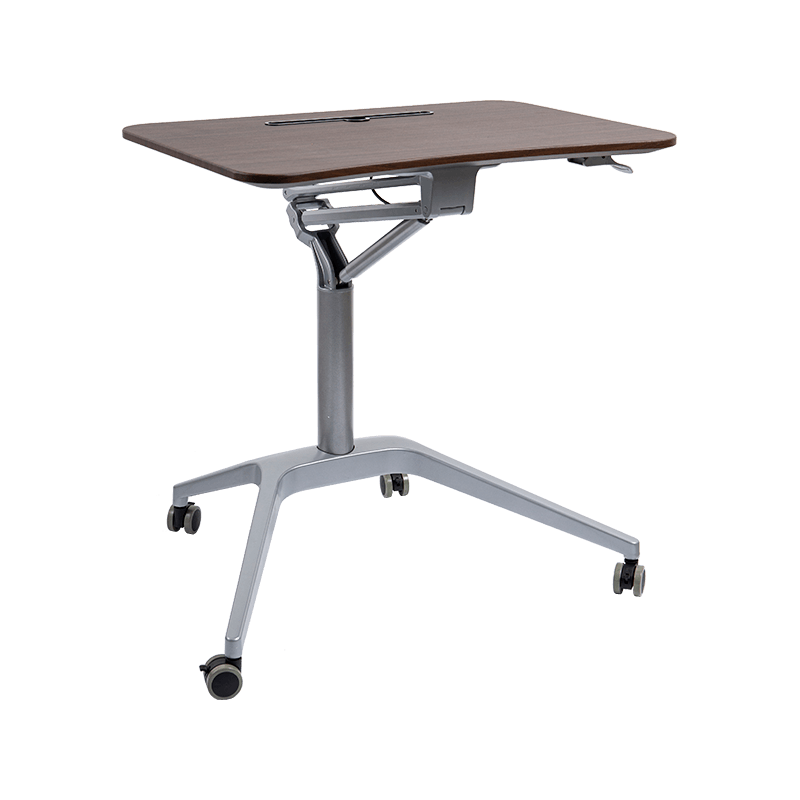
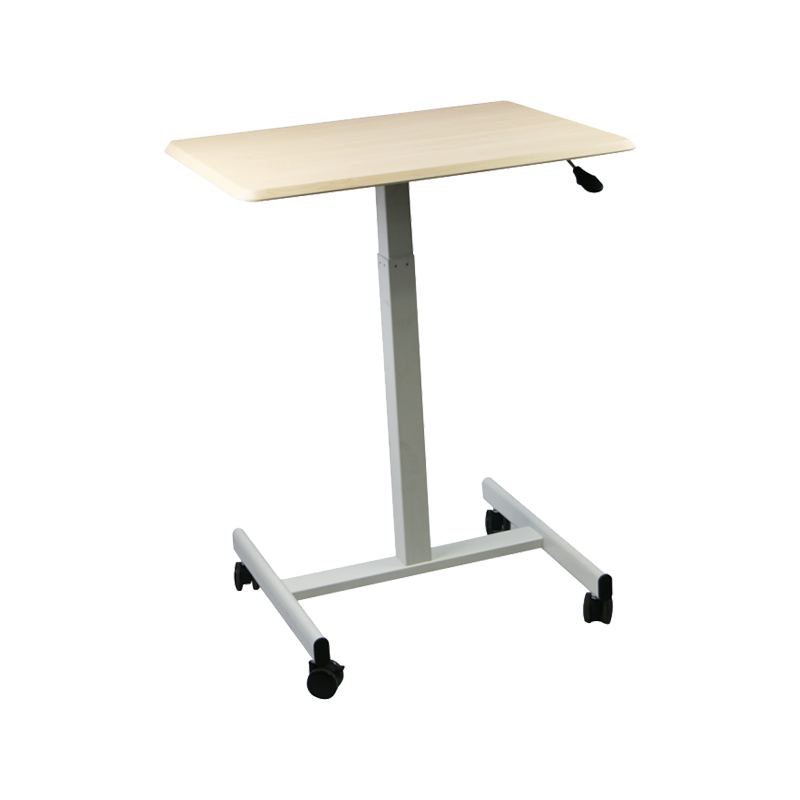
The flat-legged triangular support design gives the desk a clear and contemporary appearance. The outward angle of the legs is slightly pronounced, the central structural connection is visually defined, and the transition between the supporting components is direct. This geometry helps distinguish the SK01-3 from simpler tables that use straight vertical posts or bulky cross-base structures.
Product attribute | Specification |
Product name | SK01-3 iPad Flat-Legged Pneumatic Height-Adjustable Desk |
Product category | Pneumatic height-adjustable table |
Height range | 750 millimeters to 1060 millimeters |
Tabletop dimensions | 715 millimeters by 475 millimeters by 25 millimeters |
Tabletop construction | 25 millimeter MDF with PVC vacuum forming |
Frame material | Aluminum and iron |
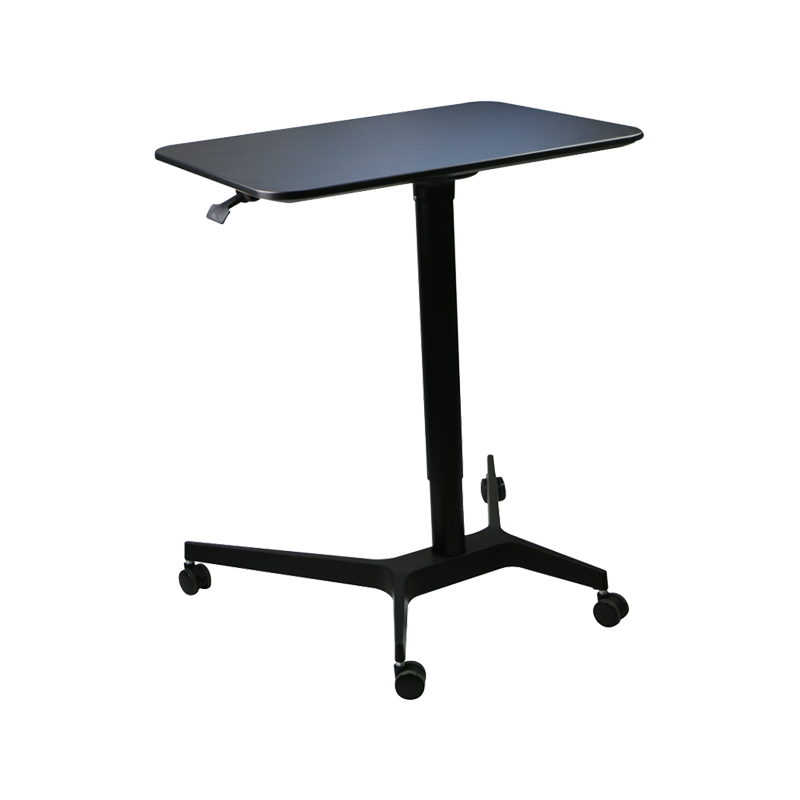
Frame finish | Powder coating in white, silver, or black |
Caster configuration | Two lockable casters and two non-locking casters |
Panel colors | White, maple, walnut, or black |
Adjustment method | Gas spring lifting |
Ergonomic Height Adjustment
The central advantage of the SK01-3 is its adjustable height range. The lowest specified position is 750 millimeters, while the highest position reaches 1060 millimeters. This range enables the same workstation to support seated computer work, standing presentations, device inspection, and short-duration light assembly.
Height flexibility is important because users differ in body height, preferred posture, task type, and work habits. A surface that is comfortable for one user may be too high or too low for another. A movable adjustable desk reduces this limitation by allowing the working surface to be repositioned according to the situation.
At the lower end of the range, the desk can function as a seated workstation for writing, tablet use, documentation, or computer-related tasks. At intermediate settings, it can support demonstrations, collaborative discussions, and product inspection. At the upper end, the desk can be used for standing presentations, training sessions, electronic device testing, and light assembly operations.
The pneumatic system is designed for manual adjustment rather than powered operation. This makes the product useful in locations where power outlets are limited, electrical cables would create obstacles, or quiet operation is preferred. A gas spring can also simplify daily operation because the user does not need to operate a motorized control panel.
Manual adjustment is especially practical for shared environments. A classroom instructor, retail demonstrator, laboratory technician, or service employee can reposition the tabletop without waiting for a motor to run. The process is direct and does not require software, charging, electrical maintenance, or electronic controls.
Benefits of the 750 to 1060 Millimeter Range
The height range covers a broad group of common work scenarios. It is not limited to a single sitting or standing posture. Instead, it gives users the freedom to select a position that matches the task and their preferred working style.
For seated work, the lower height setting provides a compact alternative to a standard office desk. For standing work, the higher settings enable users to conduct demonstrations or inspections without placing equipment on an improvised surface. The middle range is useful when the desk must be shared by users with different physical requirements.
Height adjustment can also support posture variation throughout the day. Alternating between sitting and standing may help reduce the discomfort associated with remaining in one position for extended periods. The desk should not be considered a medical device, but its adjustable structure provides a practical ergonomic option for workplaces that want more flexible furniture.
Gas Spring Lifting Mechanism
The SK01-3 uses a gas spring lifting system. Gas springs are mechanical components that use compressed gas to assist movement and support a load. In an adjustable table, the mechanism helps the user raise or lower the working surface with controlled manual force.
Compared with electrically powered lifting systems, the pneumatic design has several practical advantages. It does not require a motor, power supply, wired controller, battery, or electrical connection. This can reduce operating complexity and make the desk easier to deploy in temporary or changing locations.
The absence of an electric lifting motor may also make the product attractive for applications where low operating noise is important. Product demonstrations, classrooms, office reception areas, training rooms, and customer-facing environments can benefit from a mechanism that does not generate the sound associated with motorized adjustment.
A gas spring system can also simplify the overall appearance. Without a control panel or visible electrical cable, the desk maintains a clean and uncluttered profile. This is beneficial for modern offices, showrooms, educational spaces, and areas where furniture must coordinate with a carefully designed interior.
Users should operate the adjustment mechanism according to the manufacturer’s instructions and avoid placing loads on the tabletop that exceed the product’s intended application. The desk is designed for workstation and light-duty uses, so heavy industrial loads should not be assumed without confirmation from the supplier.
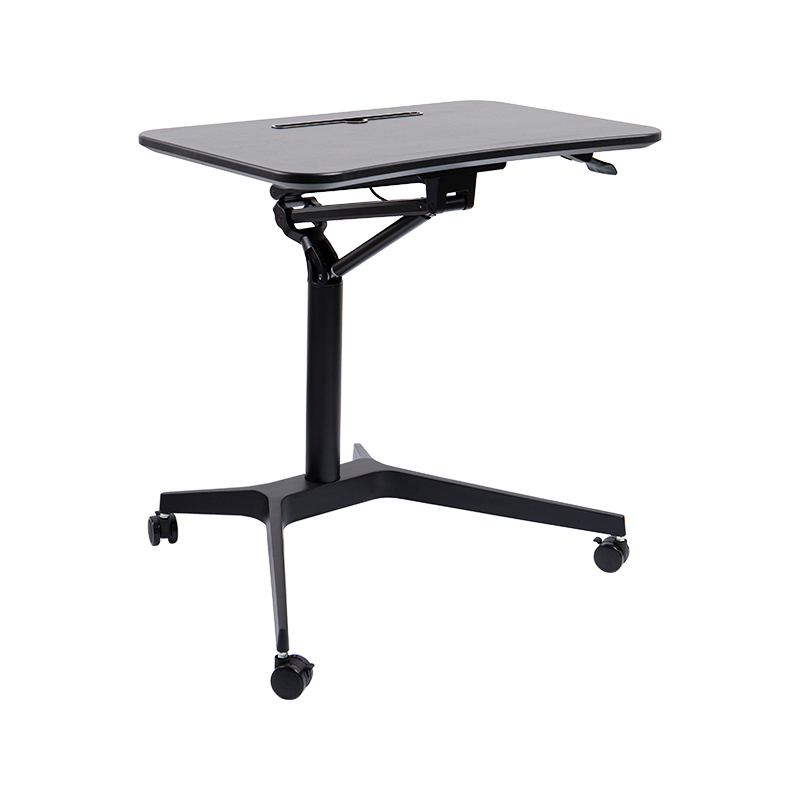
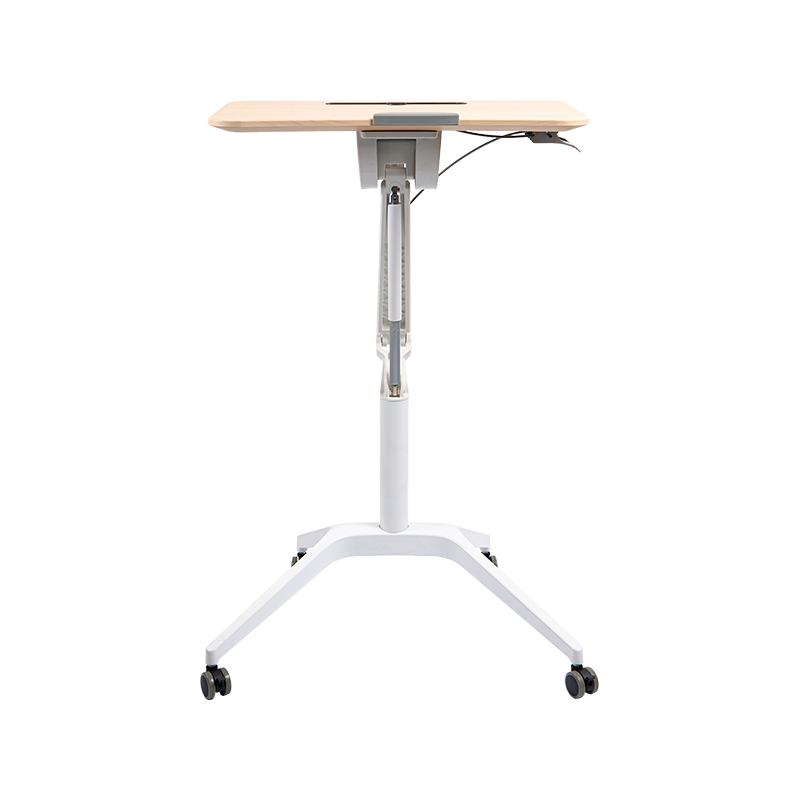
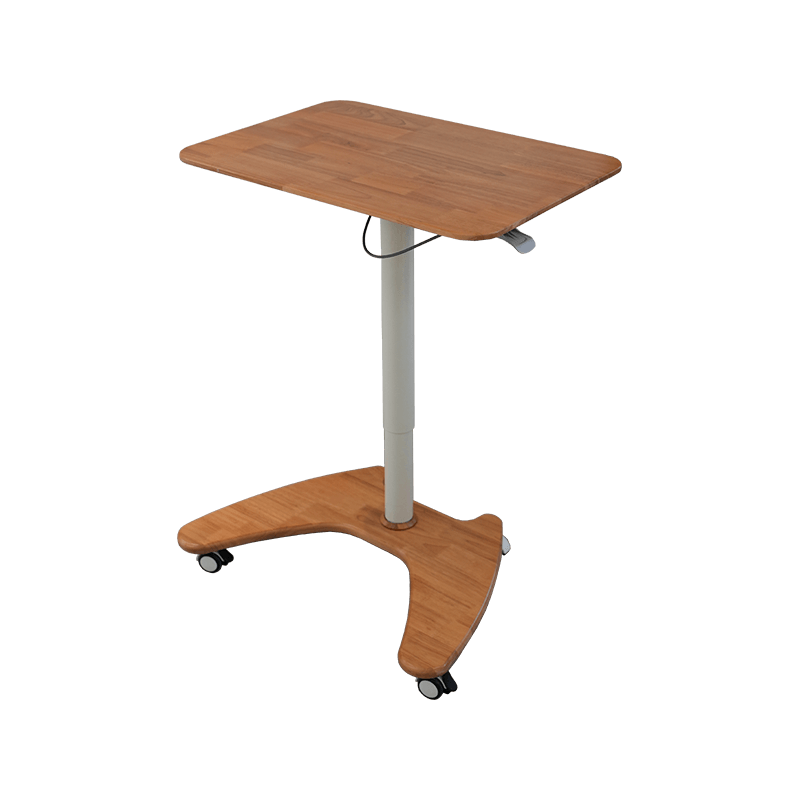
SK01-3 iPad (Flat-Legged) Pneumatic Height-Adjustable Desk
Tabletop Design and Surface Performance
The tabletop measures 715 millimeters by 475 millimeters and has a thickness of 25 millimeters. This size offers a useful balance between working area and mobility. It is large enough for an iPad, laptop, keyboard, documents, small tools, or demonstration materials, while remaining compact enough to move through offices, classrooms, retail areas, and narrow circulation spaces.
The tabletop uses a 25 millimeter MDF core with a PVC vacuum-formed surface. Medium-density fiberboard provides a consistent and stable engineered-wood base. Its uniform structure makes it suitable for shaped panels and finished furniture surfaces. The PVC vacuum-forming process creates a continuous outer layer that follows the tabletop profile.
The PVC surface helps provide resistance to ordinary wear, routine contact, and light impact associated with daily workstation use. It also makes the tabletop easier to wipe and maintain than an unfinished wood-based panel. The finished surface is suitable for common office, educational, demonstration, and light assembly conditions.
The available panel colors include white, maple, walnut, and black. These choices allow purchasers to coordinate the desk with different interior styles. White can support a bright and clean appearance, maple can create a warmer visual impression, walnut can provide a more traditional furniture character, and black can complement contemporary industrial or technology-oriented spaces.
The tabletop dimensions also support the product’s intended mobile function. A larger tabletop might provide more surface area but would increase the desk’s footprint and make movement more difficult. The selected dimensions are appropriate for applications where the user needs a dedicated working platform without the bulk of a full-size office desk.
Functional Work Surface for iPad and Device Use
The product name highlights iPad use, but the tabletop can support many comparable tasks. It can hold a tablet, laptop, barcode scanner, technical document, portable monitor, or demonstration device. Retail staff can use it for customer interaction, while instructors can use it for digital presentations and training exercises.
The surface can also be used in electronic device testing. Technicians may need to position a device at a comfortable height, move it between work areas, and maintain access to documents or tools. The compact tabletop makes it possible to establish a temporary test station without installing a permanent bench.
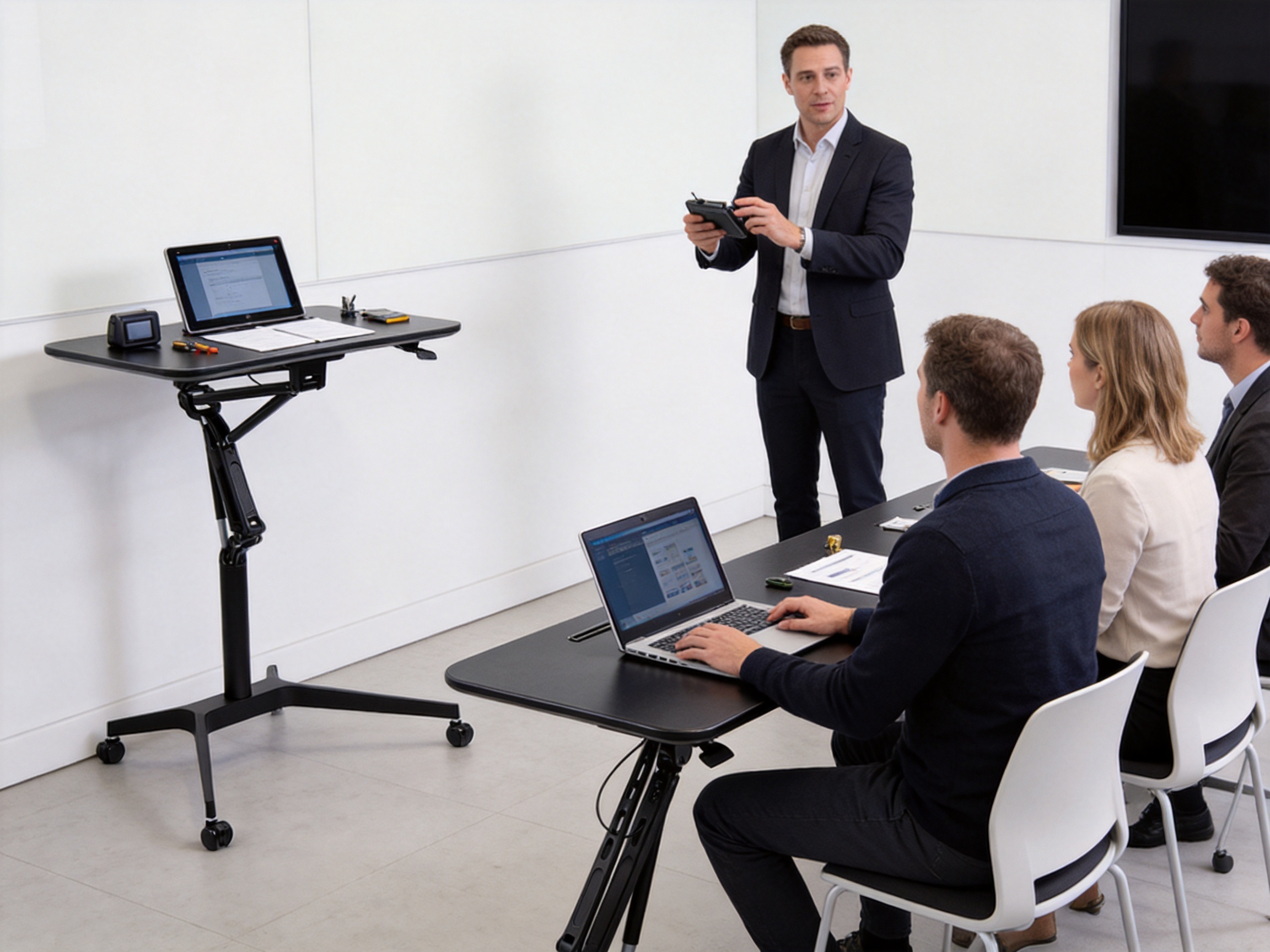
For product demonstrations, the desk’s mobility is especially valuable. A demonstrator can move the workstation toward an audience, adjust the height for visibility, and lock the casters once the desired position is reached. This combination of adjustability and mobility is more flexible than a fixed display pedestal.
Frame Structure and Flat-Legged Design
The frame combines aluminum and iron. These materials offer different structural benefits. Aluminum is valued for its relatively low weight and corrosion resistance, while iron contributes strength and rigidity in structural components that require greater load support.
The combination helps the product balance portability with stability. A mobile workstation should be light enough to move conveniently but sufficiently rigid for daily use. Material selection is therefore important because an overly lightweight structure may feel unstable, while an unnecessarily heavy structure may reduce mobility.
The flat-legged triangular support structure is one of the desk’s most distinctive design elements. The structure uses clear linear forms, a defined central connection, and legs that extend outward at a measured angle. This creates a visual sense of openness while distributing the support geometry across the base.
Compared with a simple single-column design, a triangular support structure can provide a more visibly balanced foundation. Compared with a wide cross-shaped base, the flat-legged design may appear less visually crowded and can provide a cleaner relationship between the tabletop and the floor.
The outward leg angle also contributes to the product’s visual identity. The design is not merely decorative; the shape communicates how the desk is supported. The direct structural transition gives the product a modern, engineered appearance suitable for technology-focused workspaces and contemporary offices.
Stability Considerations
Stability depends on several factors, including the base geometry, caster position, floor condition, tabletop load, and height setting. The SK01-3 combines a structured base with a four-caster configuration to support controlled movement and stationary use.
When the desk is positioned for work, the two lockable casters should be engaged. Locking the casters helps prevent unwanted movement during writing, device operation, demonstrations, or light assembly. When the desk needs to be relocated, the locks can be released so the unit can be moved to another position.
Users should place loads evenly across the tabletop and avoid leaning heavily on one edge. As with any mobile table, uneven loading or use on an irregular floor can affect stability. The product is intended for normal workstation applications, and special loads or demanding industrial conditions should be discussed with the manufacturer before purchase.
Mobility and Caster Configuration
The desk includes two lockable casters and two casters without locks. This configuration enables a practical combination of movement and positioning. The non-locking casters support rolling, while the lockable casters allow the user to secure the desk once it reaches the desired location.
Mobility is a significant advantage over fixed-height desks and permanently installed workstations. In shared rooms, the desk can be moved according to the activity taking place. A classroom can change from lecture layout to group training layout. A showroom can reposition the workstation to accommodate a product launch. An office can move the desk between meeting areas and individual work areas.
The caster arrangement is also useful for cleaning and floor maintenance. Staff can move the desk away from walls or other furniture, clean the surrounding area, and return it to position. In environments where space is frequently reconfigured, this convenience can improve operational efficiency.
Mobility should be combined with appropriate operating discipline. The desk should be moved carefully, especially when the tabletop carries equipment. Users should release the locks before moving the unit and re-engage them after positioning. Cables, thresholds, floor joints, and other obstacles should be checked before relocation.
Competitive Advantages
The SK01-3 competes with several categories of adjustable and mobile furniture, including fixed-height utility tables, electric standing desks, manual crank tables, and basic mobile carts. Its advantages result from the combination of pneumatic adjustment, compact dimensions, material selection, triangular support, and caster mobility.
Advantage Over Fixed-Height Tables
A fixed-height table may be less expensive in simple applications, but it cannot accommodate different users or postures without adding accessories. The SK01-3 provides a broader range of use from one workstation. This can reduce the need to purchase separate seated and standing tables for the same room.
Its mobility further improves flexibility. A fixed table typically remains in one location, whereas the SK01-3 can be moved to where it is needed. This is valuable in multipurpose spaces where furniture must be rearranged frequently.
Advantage Over Electric Standing Desks
Electric desks offer powered adjustment, but they require electrical components and access to power. The SK01-3 operates through a gas spring mechanism, making it independent of wall outlets and reducing cable management requirements.
The pneumatic design can be advantageous for temporary workstations, demonstration areas, classrooms, laboratories, and mobile service operations. It may also reduce the number of electronic components that require troubleshooting or replacement over the product’s service life.
Another difference is deployment simplicity. A pneumatic desk can be placed in a location without planning for power sockets. This can be helpful in historic buildings, exhibition venues, open training areas, and spaces where electrical cabling would be inconvenient or visually distracting.
Advantage Over Manual Crank Tables
Manual crank tables require repeated rotation of a handle to change height. This can be suitable for permanent workstations but may be less convenient when the desk must be adjusted frequently or moved between users.
The gas spring system is designed for direct manual lifting rather than prolonged cranking. This makes height changes quicker and helps preserve the desk’s clean appearance by eliminating an extended crank mechanism.
Advantage Over Basic Mobile Carts
Many mobile carts offer casters but lack ergonomic height adjustment. Others provide a small platform without a structured workstation base. The SK01-3 combines a mobile platform with a meaningful height range, allowing it to perform more functions than a standard utility cart.
The 25 millimeter finished tabletop also provides a more furniture-oriented appearance than a basic industrial trolley. Multiple panel colors and frame finishes make the desk easier to integrate into professional interiors, customer-facing spaces, and education environments.
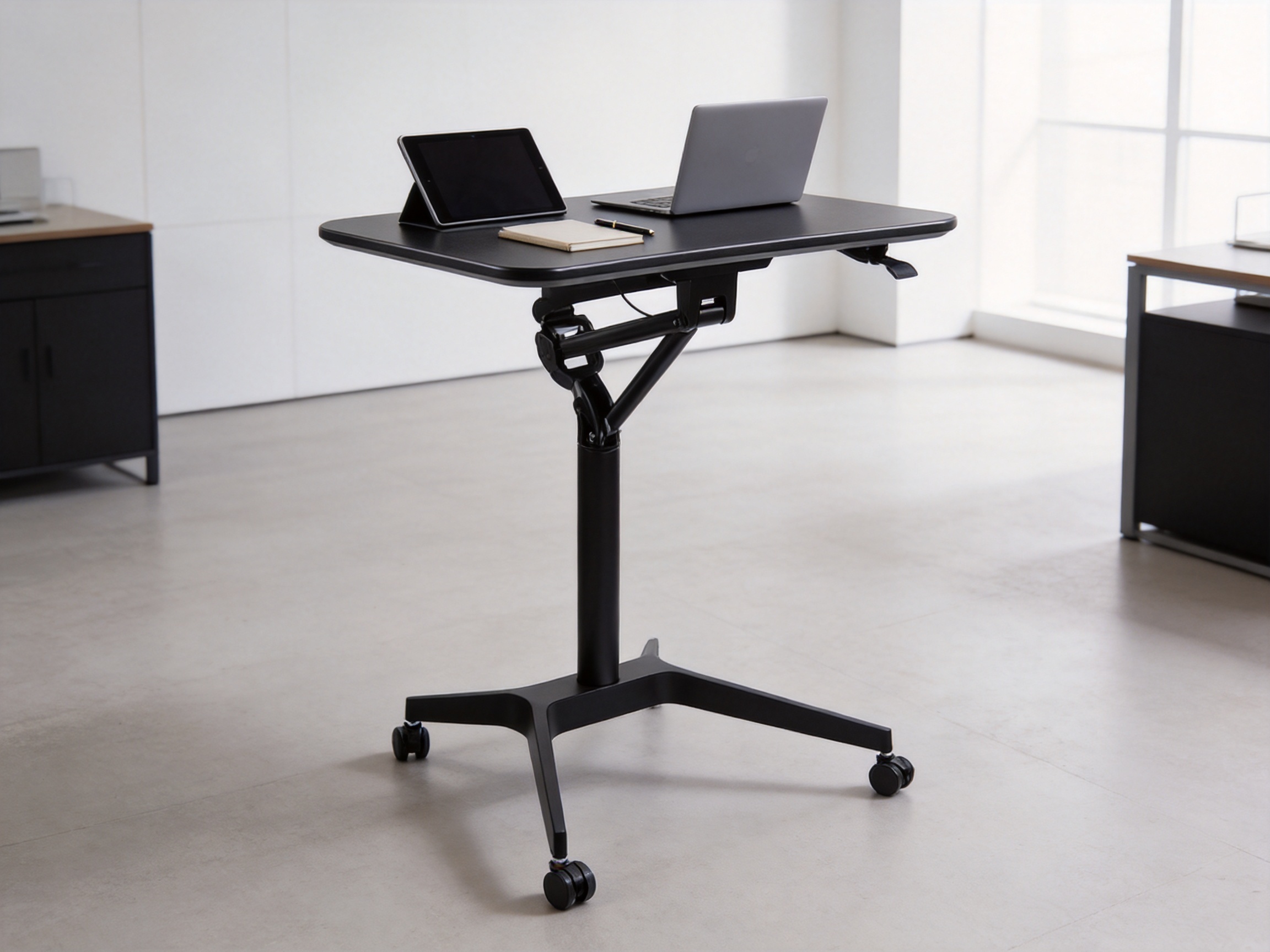
Manufacturing and Engineering Strengths
SuZhou Skyhone Intelligent Technology Co., Ltd. is positioned as a professional manufacturer specializing in standing desks and related adjustable furniture. Its company profile emphasizes research and development, production, sales, and service, indicating an integrated approach rather than a single-function trading operation.
The company is located in Suzhou Industrial Park in Jiangsu Province. Suzhou is part of the Yangtze River Delta, one of China’s most developed manufacturing regions. This location provides access to suppliers, component manufacturers, metal-processing capabilities, furniture production resources, engineering talent, and domestic and international logistics infrastructure.
For adjustable desks, manufacturing quality depends on coordination between several processes. These include material sourcing, metal cutting and forming, structural welding or assembly, surface finishing, gas spring integration, tabletop production, caster installation, inspection, packaging, and after-sales support. An experienced manufacturer can coordinate these stages to improve consistency and reduce communication gaps.
Research and Development Capability
Adjustable furniture requires more than an attractive appearance. The design must consider movement, structural balance, user ergonomics, material compatibility, installation, and long-term daily operation. A dedicated research and development function allows the manufacturer to refine these aspects through product engineering and user-oriented design.
The SK01-3 demonstrates attention to both functional and visual details. Its height range is suited to seated and standing tasks. Its tabletop size is compact but practical. Its flat-legged triangular structure gives the frame a recognizable identity. Its caster configuration supports both mobility and stationary use.
Research and development can also support customization. Commercial buyers may require different panel colors, frame finishes, packaging configurations, or application-specific adaptations. Any modification should be evaluated by the manufacturer to ensure that it does not compromise the gas spring system, structural performance, or safe operation.
Material and Component Integration
The desk integrates MDF, PVC, aluminum, iron, gas spring components, and casters. Each material serves a specific purpose. MDF forms the tabletop core, PVC provides the finished exterior, aluminum and iron form the structural frame, the gas spring supports height adjustment, and the casters enable movement.
Good manufacturing depends on the compatibility of these components. The tabletop must attach securely to the frame. The gas spring must work with the lifting structure. The casters must align with the base and support controlled movement. The powder-coated surface must cover the relevant frame areas evenly and remain suitable for routine handling.
Integrated production and quality control help reduce the risk of mismatched components. This is particularly important for buyers who purchase multiple units for an office, school, retail chain, or industrial facility. Consistent components help maintain a uniform user experience across an installation.
Metal Processing and Powder Coating
The frame uses aluminum and iron with powder-coated surface treatment. Powder coating is a dry finishing process in which coating material is applied to a prepared metal surface and cured to form a continuous finish. Compared with untreated metal, the coated surface provides improved visual consistency and additional resistance to routine handling and environmental exposure.
The available frame colors are white, silver, and black. These finishes provide options for different design requirements. White and silver can support a light, modern interior, while black can emphasize a stronger technical or industrial appearance.
Surface preparation is important to the final quality of powder coating. Metal components should be appropriately cleaned and prepared before coating so that the finish adheres consistently. Uniform coverage around edges, joints, and visible surfaces contributes to the product’s appearance and helps protect the underlying material.
Tabletop Forming and Finishing
The tabletop uses PVC vacuum forming over an MDF core. This process allows the outer material to follow the shape of the panel and produce a continuous finished surface. It supports repeatable production of tabletops with a consistent appearance across different units.
Manufacturing control is important during this stage. The MDF core must be properly prepared, the PVC material must be heated and formed appropriately, and the finished panel must be inspected for surface defects, edge quality, bonding, and dimensional consistency.
The combination of engineered wood and PVC also offers practical benefits for commercial furniture. It enables a finished surface that is easier to clean than exposed MDF and provides a range of decorative colors suitable for different customer preferences.
Applications Across Multiple Environments
The SK01-3 is suitable for a wide range of professional and educational uses. Its compact design, manual height adjustment, and mobile base allow it to adapt to changing tasks without requiring permanent installation.
Electronic Device Testing
Testing personnel can use the desk as a temporary or supplementary platform for tablets, mobile devices, small displays, sensors, and related equipment. The adjustable height can help users position a device for inspection, interaction, or demonstration.
Because the unit does not need to remain connected to a power outlet for height adjustment, it can be positioned in different areas of a testing room. The lockable casters allow the desk to remain stable during use.
Product Demonstrations
Sales teams and demonstrators can use the desk to present products at a height that improves visibility and user interaction. The workstation can be moved toward a customer group, adjusted for the presenter, and secured during the demonstration.
The choice of tabletop colors and frame finishes also allows the desk to coordinate with brand-neutral showroom interiors, technology displays, educational exhibits, and temporary event spaces.
Light Assembly Stations
In light assembly environments, employees may need a flexible surface for small components, packaging, inspection, or preparation work. The height range can support different operators and tasks, while the mobile base allows the workstation to be repositioned as workflow requirements change.
The desk is intended for light assembly rather than heavy industrial loads. Buyers should confirm load requirements, working conditions, and any special safety needs with the manufacturer before using it in a production environment.
Creative Workspaces
Designers, makers, and creative professionals can use the desk for sketching, digital design, tablet work, model preparation, or project review. The ability to alternate between sitting and standing can make the workstation more adaptable during long creative sessions.
Education and Training
Training centers, schools, and universities can use the desk for instructors, students, equipment demonstrations, and flexible classroom layouts. Its mobility makes it easier to adapt a room from individual study to group discussion or presentation mode.
Office and Reception Areas
The product can function as a compact touchdown workstation, reception support table, visitor registration surface, or meeting-side device station. Its clean appearance and multiple finish options make it suitable for professional interiors where a basic utility cart might look out of place.
Daily Operation and Maintenance
Regular care can help preserve the desk’s appearance and operating performance. Users should keep the tabletop clean with a soft cloth and a mild cleaning solution suitable for PVC surfaces. Abrasive materials, harsh chemicals, and excessive moisture should be avoided unless specifically approved for the finish.
The frame can be wiped periodically to remove dust and ordinary dirt. Special attention should be given to the caster areas because hair, thread, packaging material, and floor debris can affect rolling performance. The casters should be checked to ensure that they rotate correctly and that the locking function engages properly.
Users should inspect visible fasteners and structural connections at suitable intervals, especially in environments where the desk is moved frequently. If a connection becomes loose, the desk should be taken out of service until the issue is corrected according to the manufacturer’s instructions.
The gas spring mechanism should not be disassembled by unqualified personnel. Gas springs contain pressurized components, and maintenance or replacement should be handled by the manufacturer or an appropriately trained technician.
To protect the tabletop, users should avoid dragging sharp objects across the surface, placing extremely hot items directly on it, or exposing it to prolonged standing water. Although the PVC surface is designed for ordinary wear resistance, appropriate care remains important in commercial use.
Installation and Deployment Considerations
Before installation, purchasers should confirm the required number of units, preferred tabletop colors, frame finish, delivery conditions, and intended application. The installation area should have a level floor and sufficient clearance for height adjustment and movement.
The desk should be assembled according to the supplied instructions. Components should be checked before assembly to ensure that the tabletop, frame parts, gas spring components, casters, and fastening hardware are present and undamaged.
After assembly, the user should test the height adjustment without a heavy load. The tabletop should move smoothly within its intended range, and the frame should remain stable at different positions. The caster locks should also be tested before the desk is placed into normal service.
For large commercial installations, businesses may wish to establish a standard operating procedure. This can include instructions for height adjustment, caster locking, load distribution, movement through doorways, cleaning, and reporting of damage. Standard procedures are especially useful when many employees or students share the furniture.
Customization and Procurement Value
The product offers several visible configuration choices. Panel colors include white, maple, walnut, and black, while frame finishes include white, silver, and black. These options enable buyers to select combinations that align with a room’s furniture, flooring, walls, or interior design standards.
For business buyers, customization can also involve packaging, labeling, product quantities, and delivery coordination. Such requirements should be reviewed with the manufacturer in advance. The company’s focus on research, production, sales, and service provides a basis for discussing project-specific needs.
Purchasing from a specialized adjustable-furniture manufacturer can offer advantages over sourcing a generic table from multiple unrelated suppliers. A specialized manufacturer is more familiar with height-adjustment systems, ergonomic requirements, structural design, surface finishing, and the practical expectations of commercial customers.
When evaluating a supplier, buyers should consider more than the product’s appearance. Important questions include the consistency of height adjustment, the quality of the gas spring, the stability of the base, the durability of the finish, the availability of replacement components, packaging quality, production capacity, and after-sales service.
For international buyers, communication and documentation are also important. Product specifications, color selections, assembly instructions, inspection procedures, and shipping arrangements should be confirmed before production. Clear technical communication can reduce errors and help ensure that the delivered units meet the intended application requirements.
Why This Product Fits Flexible Work Environments
Workplaces are becoming more fluid. Teams may share rooms, switch between individual and group work, or need to move equipment according to project requirements. A mobile adjustable desk supports this flexibility without requiring a complete change to the room’s furniture layout.
The SK01-3 is compact enough to supplement existing desks rather than replace every workstation. It can serve as an additional presentation surface, a temporary testing station, a visitor workstation, or a mobile device platform. This makes it useful in organizations that want to improve adaptability without investing in large permanent installations.
The pneumatic design is also relevant to organizations seeking straightforward furniture operation. Users do not need to manage a motorized control system, and the desk can be placed in areas where power access is inconvenient. The result is a practical workstation that focuses on mechanical simplicity, mobility, and ergonomic range.
Its visual design supports professional deployment. The flat-legged triangular structure gives the desk a deliberate appearance, while the panel and frame color options provide flexibility for different environments. It can function in an office, showroom, classroom, laboratory, or workshop without appearing limited to one particular setting.
Frequently Asked Questions
What type of desk is the SK01-3?
The SK01-3 is a pneumatic height-adjustable table with a mobile caster base. It is designed for seated and standing work, device demonstrations, testing, training, creative work, and light assembly applications.
How high and low can the desk be adjusted?
The specified lifting range is 750 millimeters to 1060 millimeters. This range supports lower seated work positions and higher standing or presentation positions.
Does the desk require electricity?
No. The height adjustment uses a gas spring lifting mechanism rather than an electric motor. The desk therefore does not require a power outlet or electrical control panel for height adjustment.
Is the height adjustment automatic?
The adjustment is manual and assisted by the gas spring. The user operates the mechanism and positions the tabletop within the specified range.
What are the tabletop dimensions?
The tabletop measures 715 millimeters by 475 millimeters and has a thickness of 25 millimeters.
What is the tabletop made from?
The tabletop consists of a 25 millimeter MDF core with a PVC vacuum-formed surface. This construction provides a finished, wipeable surface suitable for ordinary workstation use.
What tabletop colors are available?
The available panel colors are white, maple, walnut, and black.
What materials are used in the frame?
The frame uses aluminum and iron. These materials are combined to provide a balance of structural support, practical weight, and suitability for a mobile workstation.
What frame finishes are available?
The frame can be finished with powder coating in white, silver, or black.
Can the desk be moved easily?
The desk is equipped with four casters, including two lockable casters and two casters without locks. The casters support relocation, while the locks help secure the desk in position during use.
Can the desk be used for heavy industrial work?
The product is described for electronic device testing, product demonstrations, light assembly, creative work, education, and related applications. Heavy industrial use should not be assumed without confirming the required load and working conditions with the manufacturer.
What makes the flat-legged structure different?
The design uses a triangular support structure with more linear visual lines, a slightly larger outward leg angle, and a clearly defined central connection. This creates a distinctive appearance and provides a structured base for the tabletop.
Yes. Its adjustable height and mobility allow different users to reposition the desk according to their body dimensions, posture preferences, and task requirements.
How should the desk be maintained?
The tabletop and frame should be cleaned with suitable non-abrasive materials. The casters should be kept free of debris, and visible fasteners should be checked periodically. The gas spring should not be disassembled by unqualified personnel.
Can the product be customized?
The listed configuration choices include tabletop colors and frame finishes. Buyers with project-specific requirements should contact the manufacturer to discuss available customization, quantities, packaging, and technical conditions.
Conclusion
The SK01-3 iPad Flat-Legged Pneumatic Height-Adjustable Desk is a versatile mobile workstation built for environments where flexibility, compactness, and straightforward operation are important. Its 750 millimeter to 1060 millimeter lifting range supports both seated and standing use, while its gas spring mechanism eliminates the need for electrical power during height adjustment.
The 715 millimeter by 475 millimeter tabletop provides a practical platform for tablets, laptops, documents, testing equipment, demonstration products, and light assembly materials. Its 25 millimeter MDF core with PVC vacuum-formed surface combines a stable engineered base with a finished exterior that is suitable for routine commercial use.
The aluminum and iron frame, powder-coated finish, triangular flat-legged structure, and four-caster base create a balance of visual appeal, mobility, and functional support. Two lockable casters help stabilize the desk after positioning, while the other casters make relocation convenient.
Compared with fixed-height tables, electric standing desks, manual crank tables, and basic mobile carts, the product offers a distinctive combination of pneumatic adjustment, power-free operation, mobility, and modern structural design. These qualities make it suitable for offices, training rooms, classrooms, showrooms, laboratories, creative spaces, testing areas, and light assembly environments.
Backed by SuZhou Skyhone Intelligent Technology Co., Ltd.’s focus on standing-desk research and development, production, sales, and service, the product reflects the advantages of specialized adjustable-furniture manufacturing. Its location in Suzhou provides access to the Yangtze River Delta’s established industrial ecosystem and intelligent manufacturing resources.
For organizations seeking an adaptable workstation that can be moved, adjusted, and integrated into different environments, the SK01-3 provides a practical solution with a clear ergonomic and operational purpose.
References
SuZhou Skyhone Intelligent Technology Co., Ltd. Product specification information for the SK01-3 iPad Flat-Legged Pneumatic Height-Adjustable Desk.
SuZhou Skyhone Intelligent Technology Co., Ltd. Company profile and standing-desk manufacturing information.
Product data sheet: Pneumatic height-adjustable table dimensions, materials, finishes, caster configuration, and operating principle.
Ergonomics reference materials concerning posture variation, seated work, standing work, and adjustable workstation design.
Furniture manufacturing reference materials concerning MDF panels, PVC vacuum forming, powder coating, aluminum structures, iron frames, and caster systems.
Product: SK01-3 iPad (Flat-Legged) Pneumatic Height-Adjustable Desk


- Contact Info
-
-
 Phone+86-15950656125
-
 Email
-
 AddressRoom 1007-1, South Building, Suyue Plaza, Suzhou Industrial Park, Suzhou City, Jiangsu Province, China
-
- Products
- Follow Us
- Need help? Please contact us
Copyright ©
SuZhou Skyhone Intelligent Technology Co., Ltd.
All Rights Reserved.
Privacy
Custom Ergonomic Adjustable Office Tables Manufacturers

