

 English
  русский
  Español
  عربى
عربى 
Content
- 1 Product Overview
- 2 Core Specifications
- 3 Why Pneumatic Height Adjustment Matters
- 4 Ergonomic Advantages for Daily Work
- 5 Compact Tabletop Designed for Practical Work
- 6 Stable Three-Claw Leg Base
- 7 Advantages Over Conventional Fixed-Height Desks
- 8 Advantages Over Electric Standing Desks
- 9 Advantages Over Basic Mobile Tables
- 10 Materials and Surface Treatment
- 11 Manufacturing Strength and Process Control
- 12 Quality Assurance and Durability Considerations
- 13 Applications in Offices and Corporate Environments
- 14 Applications in Studios, Workshops, and Creative Spaces
- 15 Applications in Laboratories and Technical Settings
- 16 Applications in Education and Training
- 17 Applications in Home Offices
- 18 Design Balance: Mobility, Strength, and Simplicity
- 19 Customization and Visual Integration
- 20 Low Maintenance and Operational Efficiency
- 21 Purchasing Considerations
- 22 Q&A Section
- 22.1 What is the main purpose of the TH10 pneumatic height-adjustable desk?
- 22.2 What height range does the desk support?
- 22.3 Does the desk require electricity?
- 22.4 How large is the tabletop?
- 22.5 What materials are used in the desk?
- 22.6 Is the desk easy to move?
- 22.7 What color options are available?
- 22.8 How does it compare with an electric standing desk?
- 22.9 Is the desk suitable for professional environments?
- 22.10 Who manufactures the product?
- 23 Conclusion
- 24 References
- 25 Product: TH10 (Three-Claw Leg) Pneumatic Height-Adjustable Desk
Compact Pneumatic Height-Adjustable Desk for Flexible Sit-Stand Workspaces
2026-06-25
Modern workspaces are changing quickly. Offices, studios, laboratories, training rooms, workshops, and home work areas increasingly require furniture that adapts to people rather than forcing people to adapt to fixed furniture. The TH10 Three-Claw Leg Pneumatic Height-Adjustable Desk is designed for this shift. It combines a compact tabletop, a stable tripod-style base, smooth gas spring lifting, and mobile caster support in a practical sit-stand worktable that can be used wherever flexible working height is valuable.
This desk belongs to the category of pneumatic height-adjustable tables and is suitable for users who need an ergonomic, mobile, and non-electric height-adjustable workstation. With a lifting range from 720 mm to 1100 mm, it supports seated work, standing work, temporary presentation tasks, technical operations, drafting, inspection, light workshop use, and collaborative work. Its tabletop measures 715 mm by 495 mm with a 25 mm thickness, offering enough space for a laptop, documents, tools, instruments, samples, or compact office equipment while maintaining a space-saving footprint.
Unlike larger electric standing desks that may require power access, cable management, motors, and more installation space, this pneumatic model focuses on simplicity, mobility, and immediate usability. Its gas spring lifting mechanism allows users to adjust the height manually without electrical power. The aluminum and iron structure, powder-coated finish, multiple desktop color choices, and caster design make it a practical solution for workplaces where flexibility and reliability matter every day.
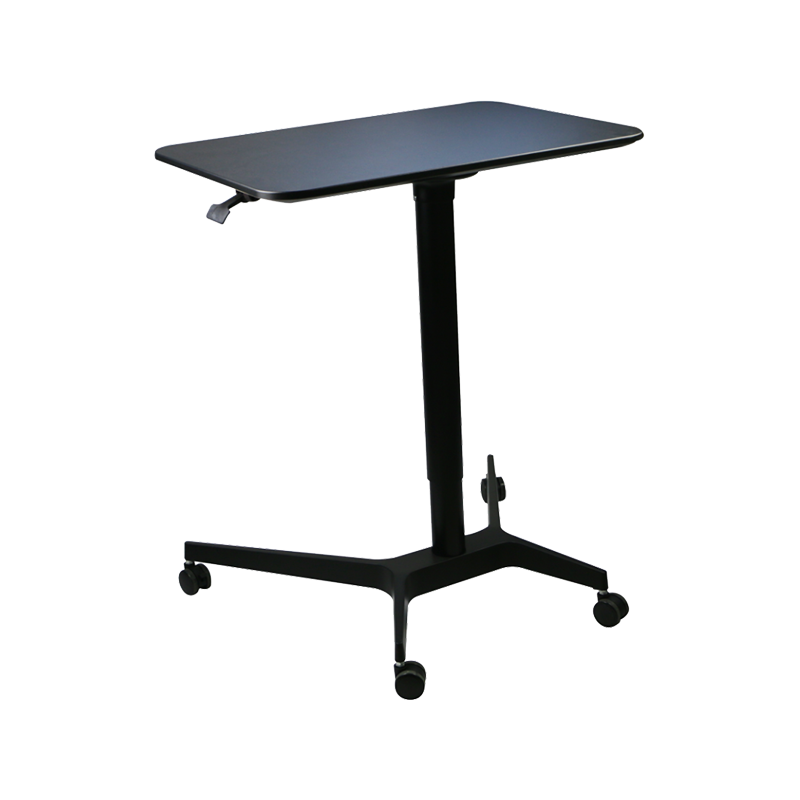
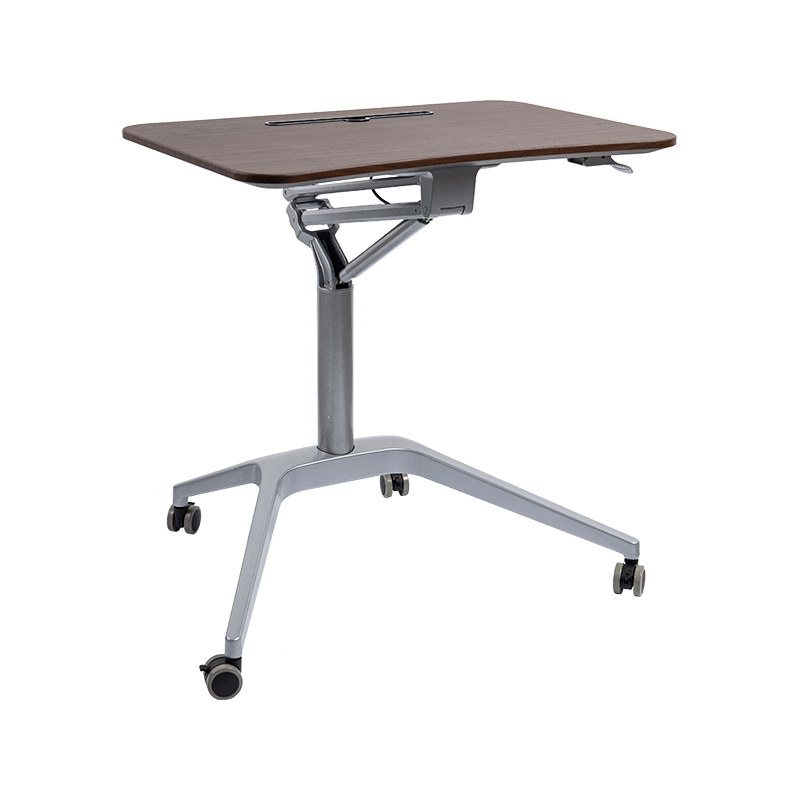
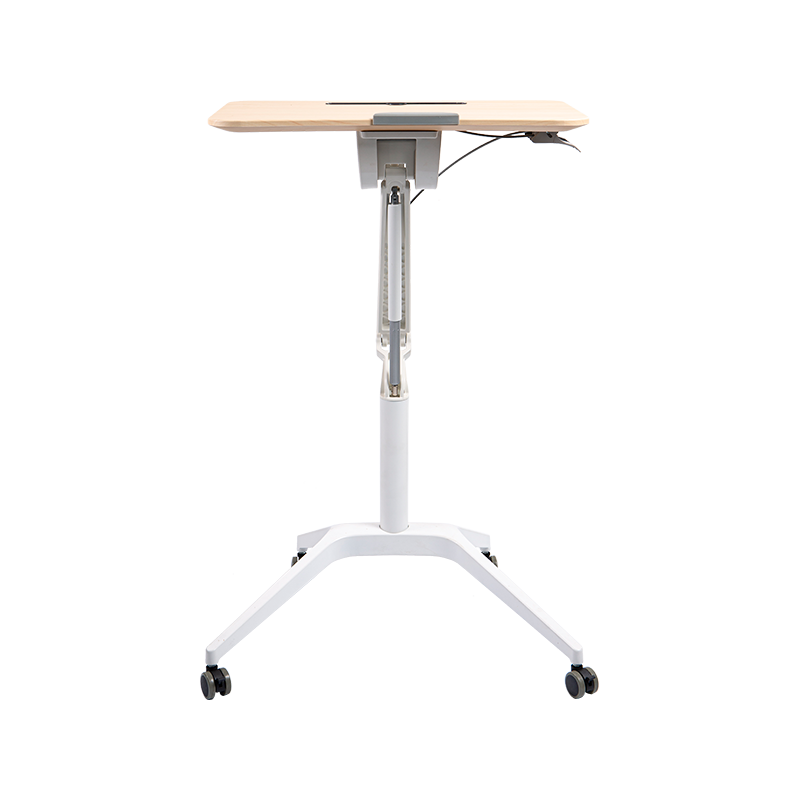
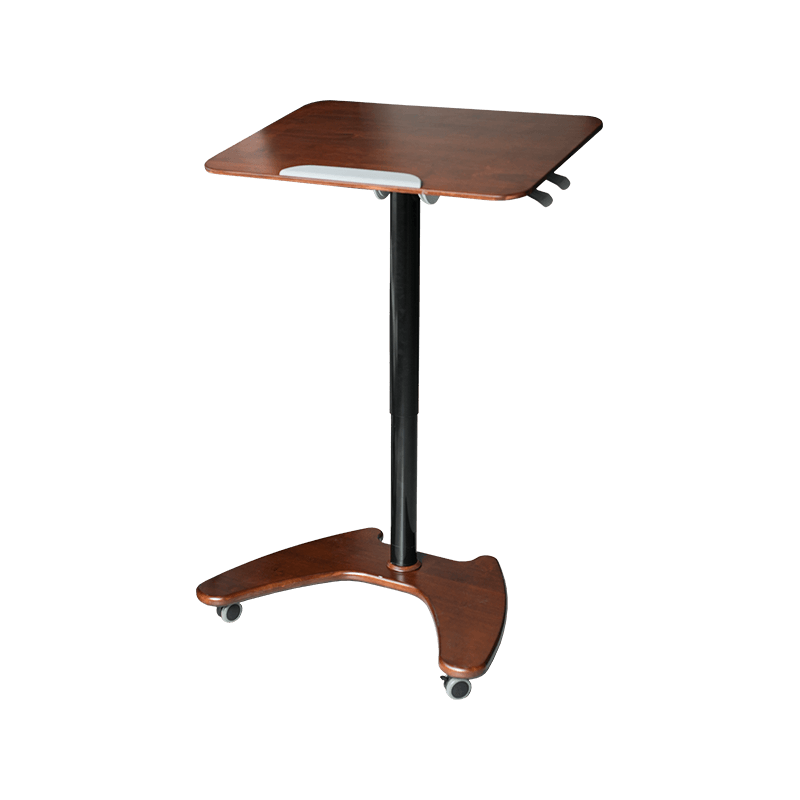
TH10 (Three-Claw Leg) Pneumatic Height-Adjustable Desk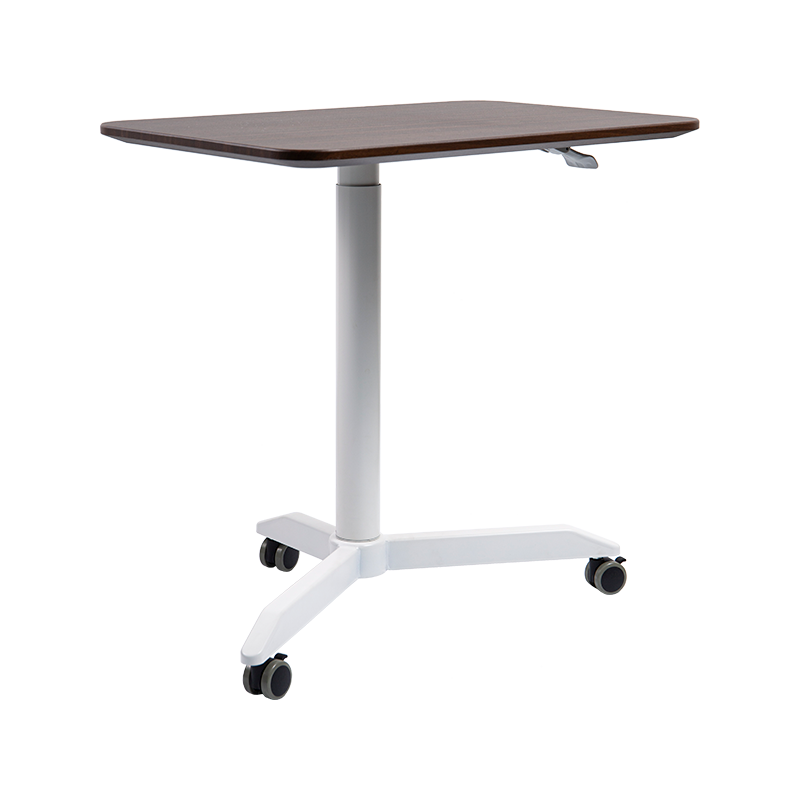
Product Overview
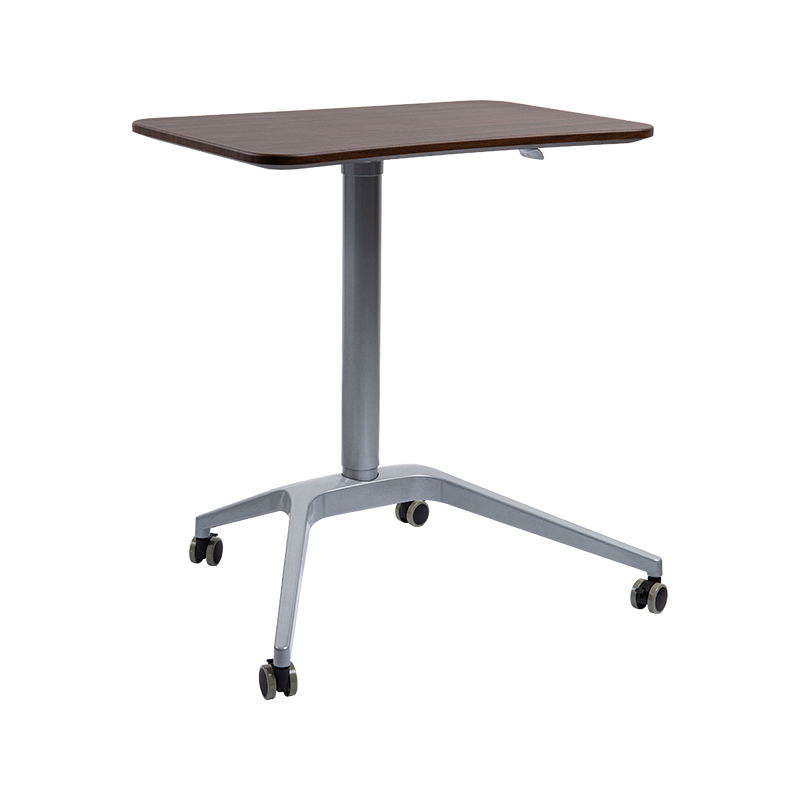
The TH10 Three-Claw Leg Pneumatic Height-Adjustable Desk is a compact height-adjustable table with a column tripod base. Its defining feature is the gas spring lifting system, which enables smooth movement between the lower and upper height positions. The height range of 720 mm to 1100 mm is well suited for many common seated and standing tasks, giving users the ability to change posture during the day and adapt the working surface to different operations.
The desk uses a 25 mm MDF tabletop with PVC vacuum forming. This construction offers a clean appearance, practical durability, and consistent surface quality. The desktop is available in Walnut, White, and Maple finishes, allowing it to match different office styles or functional environments. The frame combines aluminum and iron, balancing lightness, strength, and structural stability. The surface is finished with powder coating in White or Silver, improving corrosion resistance and giving the product a neat, professional appearance.
The three-claw base is especially useful in compact environments. Compared with a traditional four-leg table, the tripod-style base can be easier to move, position, and rotate within limited spaces. It also gives the product a distinctive appearance and supports effective stability when properly used. The desk includes three caster wheels: two with locks and one without a lock. This arrangement allows users to move the desk easily and then secure it during work.
The product is designed for people who need a portable, height-adjustable surface without complicated electronics. It is useful in offices, reception areas, studios, laboratories, training rooms, healthcare-related support spaces, technical service areas, education settings, showrooms, and compact home offices. It is particularly well suited to environments where workstations need to be rearranged often or where different users share the same work surface.
Core Specifications
Item |
Specification |
Practical Value |
Product Type |
Pneumatic Height-Adjustable Desk |
Supports sit-stand work without electricity |
Lifting Range |
720 mm to 1100 mm |
Suitable for seated and standing tasks |
Tabletop Dimensions |
715 mm × 495 mm × 25 mm |
Compact surface for office, technical, or mobile work |
Tabletop Material |
25 mm MDF with PVC vacuum forming |
Stable board structure with a clean, practical finish |
Frame Material |
Aluminum and iron |
Balances strength, durability, and manageable weight |
Surface Color |
White or Silver |
Matches modern office and professional environments |
Surface Treatment |
Powder coating |
Improves wear resistance and corrosion protection |
Caster Wheels |
Two locking casters and one non-locking caster |
Allows mobility while maintaining stable placement |
Panel Colors |
Walnut, White, Maple |
Offers visual customization for different interiors |
Working Principle |
Gas spring lifting |
Smooth manual adjustment with low maintenance needs |
Why Pneumatic Height Adjustment Matters
Height-adjustable furniture is often associated with electric standing desks, but electric systems are not always the best solution for every workplace. A pneumatic height-adjustable desk offers a different set of advantages. It eliminates dependence on power outlets, simplifies operation, reduces cable concerns, and allows the desk to be used in locations where electricity may not be convenient or desirable.
The gas spring lifting principle is familiar in many reliable products, including office chairs, monitor arms, industrial access panels, and adjustable work supports. In a desk application, a gas spring can provide smooth lifting assistance so the user can adjust the working height with reduced effort. This makes the product suitable for workplaces that value quick transitions and mechanical simplicity.
The TH10 is particularly useful where a desk must be moved frequently. Electric desks often include motors, controllers, cables, and power supplies. These components may be unnecessary for compact mobile workstations. A pneumatic desk can be positioned in different areas, used immediately, and adjusted without connecting to power. This gives facilities managers, office planners, teachers, technicians, and mobile professionals more freedom when organizing workspaces.
Another benefit is maintenance simplicity. Electric lifting systems depend on synchronized motors, electronic control boards, and sometimes anti-collision sensors. These features are valuable in large desks, but they can be excessive for a small mobile table. A gas spring system reduces the number of electronic failure points and supports straightforward daily use. For many organizations, this simplicity can translate into reduced downtime, easier user training, and improved long-term practicality.
Ergonomic Advantages for Daily Work
The human body is not designed to remain in one position for long periods. Fixed-height desks often force users into static postures, which can contribute to discomfort in the neck, shoulders, back, wrists, and legs. A height-adjustable desk helps users vary posture throughout the day. The TH10 supports this practice by enabling height changes between a seated working level and a standing working level.
Its 720 mm minimum height suits many seated tasks, while the 1100 mm maximum height supports standing work for a wide range of users. Because the adjustment does not depend on electricity, users can change height quickly in any room. This encourages more frequent posture variation, which is one of the key principles of ergonomic workspace design. A desk that is difficult to adjust may remain unused in one position, but a smooth pneumatic adjustment system encourages actual daily use.
The compact tabletop size also supports ergonomic clarity. It provides enough space for essential tools without encouraging clutter. In many work environments, a smaller dedicated surface can help users maintain better organization and reduce unnecessary reaching. For laptop work, writing, inspection, sample review, or compact instrument operation, the desktop area is practical and efficient.
The mobility of the desk also contributes to ergonomic flexibility. Users can bring the work surface closer to where the task happens rather than carrying materials to a fixed desk. In studios, laboratories, workshops, and training rooms, this mobility can reduce repeated bending, awkward carrying, and inefficient movement. The locking casters allow the user to secure the desk after positioning it, combining movement with stable work support.
Compact Tabletop Designed for Practical Work
The tabletop measures 715 mm by 495 mm and is 25 mm thick. These dimensions make the desk compact but not undersized. It is large enough for focused work while small enough to move through office areas, between equipment, or around tight layouts. The 25 mm thickness gives the tabletop a substantial feel and contributes to structural confidence during everyday use.
MDF is a practical material for desktop construction because it offers consistent density and a smooth surface suitable for finishing. The PVC vacuum forming process provides a clean and integrated surface layer. This type of finish helps create a uniform appearance and supports resistance to common surface wear in light to moderate applications. The result is a tabletop suitable for offices, educational spaces, studios, and professional support environments.
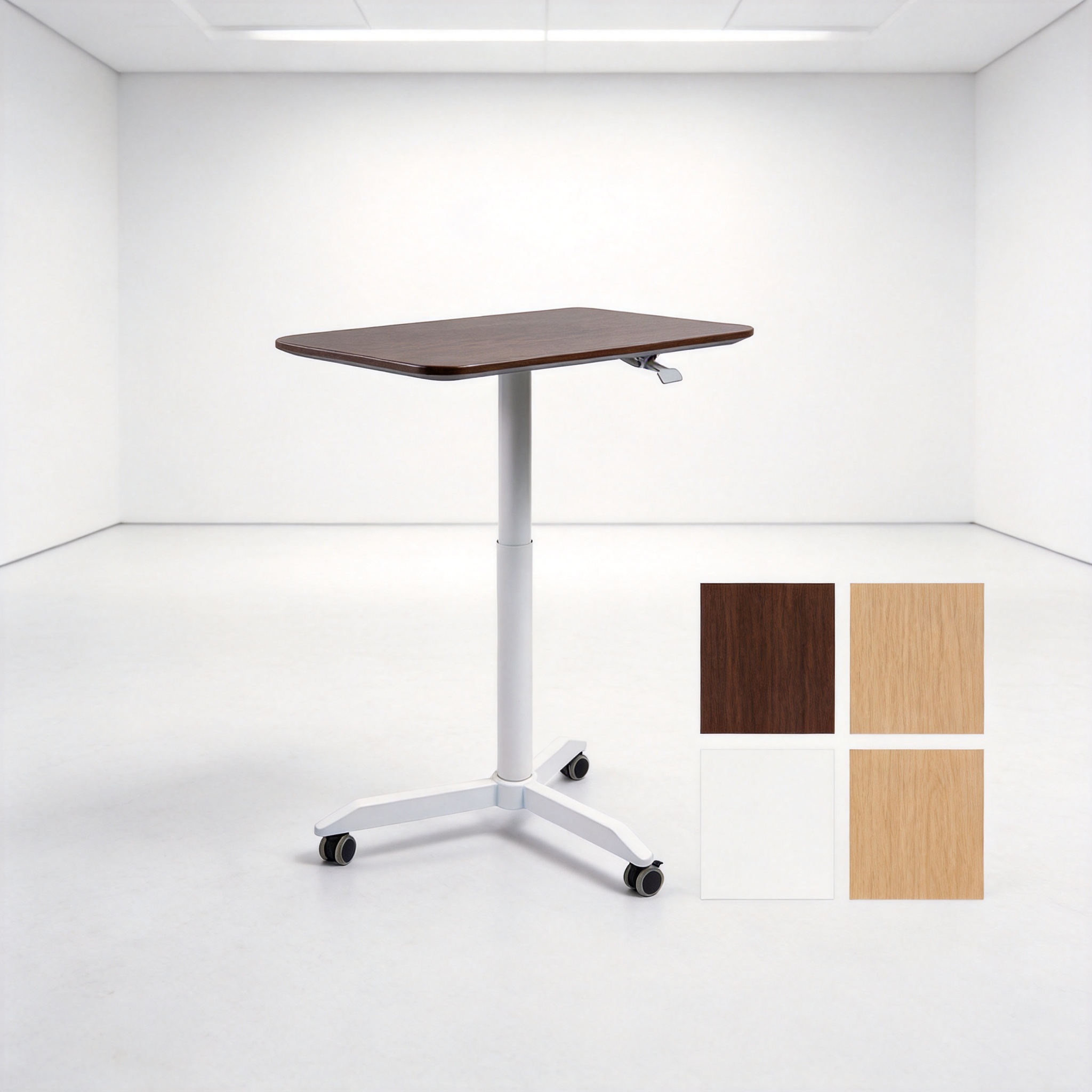
The available panel colors give users visual flexibility. Walnut provides a warmer, more traditional appearance and can coordinate well with executive offices, hospitality spaces, and studio interiors. White gives a clean, modern, minimal look that works well in laboratories, clinics, design offices, and contemporary workspaces. Maple offers a lighter wood tone that feels natural and versatile, suitable for education, home offices, and collaborative environments.
Because the tabletop is compact, the desk can function as a primary small workstation or as a secondary support table. It can hold a laptop beside a main desk, serve as a mobile presentation platform, support inspection equipment, act as a temporary teaching station, or provide an adjustable surface for specialized tasks. This multifunctional character increases the value of the product compared with single-purpose furniture.
Stable Three-Claw Leg Base
The three-claw leg base is one of the defining design elements of the TH10. A tripod-style base offers a balance of mobility, visual lightness, and functional support. Unlike bulky rectangular frames, the three-claw base can fit more easily into compact spaces and can be maneuvered around obstacles. This is especially useful in dynamic environments where furniture layouts change often.
Stability is essential for any height-adjustable table. As the working surface rises, the center of gravity changes, and the base must provide proper support. The TH10 uses a column-style structure connected to the three-claw base to maintain a stable platform throughout its adjustment range. The combination of aluminum and iron supports durability while keeping the product manageable for movement.
The three-caster arrangement enhances the base design. Two locking casters allow users to secure the table during work, while the non-locking caster contributes to smooth movement. This design is practical for users who need both mobility and confidence. Once the desk is moved into position, the locks can be engaged to reduce unwanted movement.
Compared with lightweight portable tables that may wobble, the TH10 offers a stronger and more purposeful construction. Compared with large fixed desks, it offers much greater flexibility. This middle ground is a key competitive advantage: the desk is mobile and compact, but it is still built as a serious work surface rather than a temporary accessory.
Advantages Over Conventional Fixed-Height Desks
A conventional fixed-height desk is simple, but it cannot adapt to different users or tasks. In shared workplaces, one fixed height rarely suits everyone. A tall user and a shorter user may require different working heights for comfort. A task involving writing may require a different surface height than a task involving inspection, assembly, laptop operation, or demonstration. The TH10 solves this limitation by allowing height adjustment across a useful range.
Another advantage is posture variation. Fixed desks typically encourage long periods of sitting. Even when a user has a good chair, staying seated for too long can cause fatigue. A pneumatic sit-stand desk enables the user to alternate between sitting and standing without replacing the entire workstation. This makes the TH10 an efficient way to support healthier work habits.
Fixed desks are also less flexible in space planning. Once installed, they often remain in the same location. The TH10 can be moved, repositioned, and reused in different areas. For growing businesses, training centers, laboratories, and multi-purpose rooms, this flexibility can reduce furniture waste and improve space utilization. A mobile height-adjustable desk can serve several functions across its service life.
In addition, fixed desks often require more floor space. The compact footprint of the TH10 allows it to fit into small offices, corner areas, or support zones. It can be placed beside a larger workstation as an auxiliary surface or used independently in limited spaces. This provides a practical advantage for organizations seeking ergonomic improvements without major renovation.
Advantages Over Electric Standing Desks
Electric standing desks are popular and valuable in many environments, but they are not always necessary. The TH10 offers several advantages over electric desks in specific use cases. First, it does not require electricity. This means it can be used in rooms without convenient outlets, moved freely without cable concerns, and operated even where power access is restricted.
Second, the pneumatic system simplifies the user experience. There is no control panel to learn, no motor noise, no power adapter, and no cable routing. For mobile workstations, this simplicity is a major advantage. Users can focus on the task rather than managing the desk’s electronics. In shared environments, the mechanical adjustment can be easier for new users to understand.
Third, pneumatic systems can reduce maintenance complexity. Electric desks may require motor alignment, controller troubleshooting, cable replacement, or electronic component service. A gas spring lifting system is mechanically straightforward and has fewer electronic failure points. For procurement teams and facility managers, this can be an attractive long-term benefit.
Fourth, the TH10 is more compact than many electric desks. Electric standing desks often have larger frames, dual motors, and wider tabletops. These features are excellent for full office workstations, but they may be excessive for a mobile support desk. The TH10 is designed for focused, flexible tasks where compactness and mobility are central requirements.
Finally, the TH10 offers fast deployment. It can be introduced into an existing workplace without electrical planning, complicated installation, or workstation redesign. This makes it especially suitable for companies that want to add ergonomic capacity quickly and efficiently.
Advantages Over Basic Mobile Tables
Basic mobile tables are convenient, but many lack height adjustability, stable locking, or durable construction. The TH10 improves on basic mobile furniture by integrating a gas spring height adjustment system, a powder-coated metal structure, and a stable tripod base. It is not simply a rolling table; it is an ergonomic adjustable workstation.
Many mobile tables are designed only for temporary use. Their surfaces may be thin, their frames may be light, and their adjustment mechanisms may be limited or absent. The TH10 uses a 25 mm tabletop and an aluminum-iron frame, giving it a more robust character. This makes it suitable for repeated daily use in professional environments.
Height adjustability is a major differentiator. A basic mobile table may be useful for transport or support, but it cannot adapt to seated and standing work. The TH10 can support different users, tasks, and postures. This adds ergonomic value and broadens the range of applications.
The locking caster configuration also improves usability. A mobile table that moves when the user is writing, typing, or handling tools can become frustrating or unsafe. With two locking casters, the TH10 can be positioned and secured more effectively. This combination of movement and stability is important for real-world workplace use.
Materials and Surface Treatment
The TH10 combines aluminum and iron in its structure. This material strategy uses the strengths of both metals. Aluminum offers a favorable strength-to-weight ratio and corrosion resistance, while iron provides rigidity and load-bearing confidence. Together, they create a frame that is durable enough for professional use while remaining suitable for a mobile product.
Powder coating is used as the surface treatment for the metal components. Powder coating is widely valued in furniture and equipment manufacturing because it produces a durable, uniform finish. Compared with many liquid paint processes, powder coating can offer good adhesion, improved resistance to chipping, and a clean appearance. The available White and Silver frame colors suit modern interiors and professional settings.
The tabletop uses MDF with PVC vacuum forming. This construction helps produce a smooth and consistent surface with attractive finish options. The vacuum forming process allows the PVC layer to conform closely to the board, creating a neat edge and surface appearance. For users, this means the desk can provide both visual appeal and practical everyday performance.
The combination of a powder-coated metal frame and PVC-formed tabletop gives the TH10 a balanced identity: durable enough for work environments, refined enough for office interiors, and practical enough for shared-use facilities. This balance is important because many products excel in one area but compromise another. The TH10 aims to combine function, appearance, and mobility.
Manufacturing Strength and Process Control
The product is supported by the manufacturing capabilities of SuZhou Skyhone Intelligent Technology Co., Ltd., a professional enterprise engaged in research and development, production, sales, and service of standing desks and related ergonomic office solutions. Located in Suzhou, within the Yangtze River Delta furniture and intelligent manufacturing ecosystem, the company benefits from regional supply chain advantages, skilled manufacturing resources, and strong industrial collaboration.
Advanced manufacturing begins with product design and engineering. A height-adjustable desk must be more than attractive; it must move smoothly, remain stable, resist wear, and support repeated use. The development process requires attention to lifting force, column alignment, base geometry, caster placement, tabletop durability, surface treatment, and packaging protection. By focusing on standing desk products and related motion solutions, the company can apply specialized knowledge to the TH10 design.
Material selection is another important strength. The use of aluminum and iron must be controlled carefully to ensure that each component meets functional requirements. Metal parts require accurate forming, cutting, machining, welding or fastening preparation, surface cleaning, and finishing. Powder coating quality depends on proper pretreatment, coating thickness control, curing temperature, and inspection. These manufacturing details directly affect the appearance and durability of the final product.
The tabletop also requires controlled production. MDF quality, board thickness, surface preparation, PVC material selection, vacuum forming temperature, pressure, edge finish, and final inspection all influence the desk’s performance and appearance. A well-produced tabletop should feel solid, look consistent, and fit accurately with the frame. In a compact desk, the visual quality of the tabletop is especially noticeable because it is the main surface users interact with.
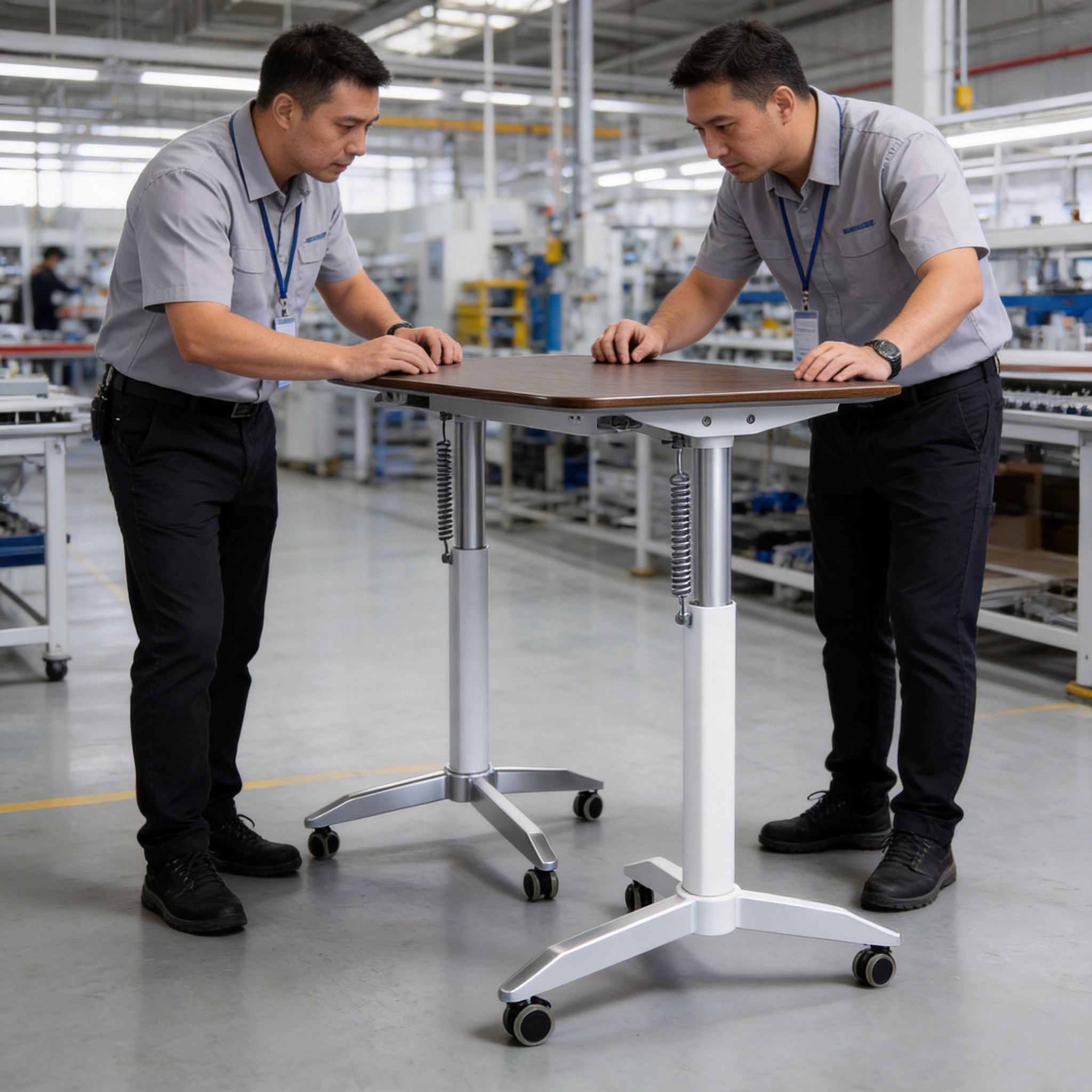
The gas spring lifting system requires reliable component integration. Proper force matching is essential so the desk adjusts smoothly without feeling too heavy or too unstable. The column and gas spring must work together through the full lifting range. Manufacturing teams must verify fit, motion consistency, and assembly quality to ensure that users experience controlled and convenient adjustment.
SuZhou Skyhone Intelligent Technology Co., Ltd. emphasizes healthy, efficient, and intelligent office space solutions. This strategic focus supports continuous improvement in ergonomic furniture design. Rather than treating height-adjustable desks as isolated products, the company approaches them as part of a broader workplace health and productivity system. This perspective can lead to better usability, improved product consistency, and stronger support for customers requiring customized ergonomic solutions.
Quality Assurance and Durability Considerations
Durability in a height-adjustable desk depends on more than one component. The tabletop must resist daily use, the frame must maintain structural integrity, the lifting system must remain smooth, and the casters must operate reliably. The TH10 addresses these requirements through its material combination, surface treatment, and practical mechanical design.
Quality assurance begins with incoming material inspection. Metal parts, MDF boards, PVC surfaces, casters, gas springs, fasteners, and coating materials must meet defined standards before assembly. Consistency at this stage reduces later problems and helps ensure product reliability. For a manufacturer specializing in adjustable desks, these checks are part of building repeatable product performance.
During production, dimensional accuracy is important. If the tabletop holes, frame connection points, column parts, or base components are misaligned, the final desk may not assemble properly or may not feel stable. Controlled manufacturing processes help ensure that components fit correctly and that the height adjustment operates as intended.
Surface quality inspection is also important. Powder coating should be visually consistent, properly cured, and free from major defects. Desktop finishes should be smooth and attractive, with reliable edge treatment. These details influence user satisfaction because they are visible and tactile every day.
Final assembly checks should evaluate height adjustment, caster function, locking performance, frame stability, and overall appearance. The goal is to deliver a product that is ready for professional use and requires minimal effort from the customer. Because the TH10 is designed for mobility and repeated adjustment, these checks are essential to long-term user confidence.
Applications in Offices and Corporate Environments
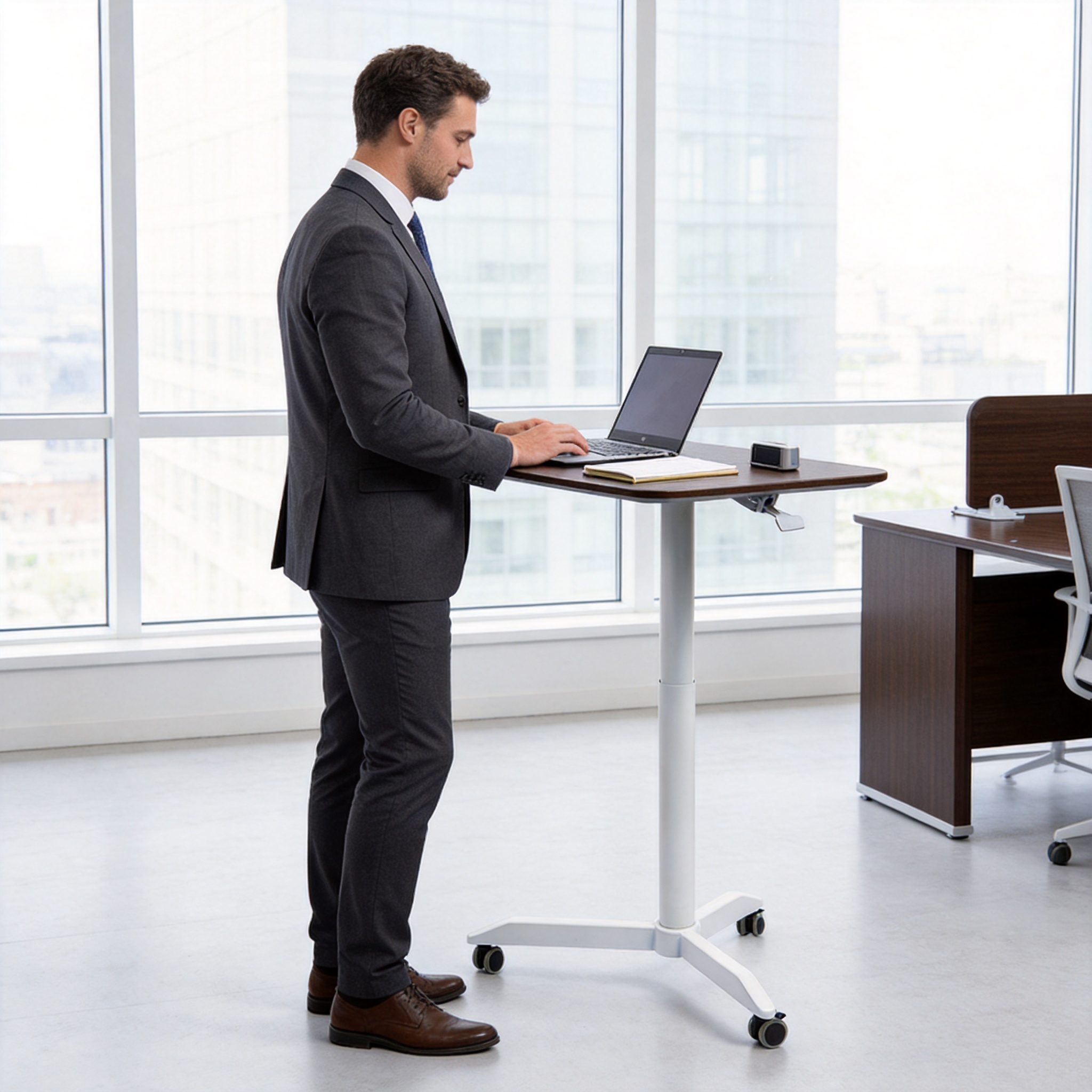
In offices, the TH10 can serve as a personal sit-stand workstation, a mobile laptop desk, a temporary meeting table, or an auxiliary surface beside a larger desk. Its compact size is useful in open-plan offices where space is valuable. Employees can move it between work areas, collaboration zones, and meeting rooms as needed.
For companies introducing ergonomic furniture gradually, the TH10 offers a flexible starting point. Instead of replacing every fixed desk with a full-size electric standing desk, an organization can deploy pneumatic mobile desks where flexibility is most needed. This can support employees who require alternating postures, temporary standing work, or mobile task surfaces.
The desk is also useful for managers, consultants, trainers, and support staff who move between locations during the day. It can hold a laptop for quick documentation, a projector support device, printed materials, or training tools. Because it does not require power for height adjustment, it can be used in different rooms without planning around outlet placement.
In reception and customer service areas, the desk can provide a flexible support station for tablets, documents, or visitor check-in materials. Its clean White or Silver frame and desktop color options allow it to match professional interiors. The ability to lock the casters helps maintain a neat, stable presentation during customer-facing tasks.
Applications in Studios, Workshops, and Creative Spaces
Creative work often requires changes in posture and working height. Designers, artists, photographers, model makers, craft workers, and product developers may shift between sketching, inspecting, assembling, presenting, and digital work. The TH10 provides a compact adjustable surface that can follow these changing needs.
In a studio, the desk can support a laptop during a photo shoot, hold reference materials during drawing, provide a movable surface for samples, or function as a standing review table. The height range makes it suitable for both close seated work and standing review tasks. The caster system allows users to reposition the desk near lighting, equipment, storage, or collaboration areas.
In workshops, the desk can support light technical work, measurement tasks, documentation, or parts organization. Because it is compact, it can be placed near machinery or assembly benches without occupying excessive floor space. The locking casters are important in this environment because the desk must stay secure when tools or materials are being handled.
For creative teams, furniture flexibility can improve workflow. A fixed table may require users to move repeatedly between stations. A mobile adjustable table brings the work surface to the task. This reduces wasted movement and allows the workspace to evolve around the project.
Applications in Laboratories and Technical Settings
Laboratories and technical environments often require adaptable work surfaces. Users may need to review documents, operate compact instruments, inspect samples, record data, or move between benches. The TH10 can provide a secondary adjustable surface that supports these activities without requiring permanent installation.
The White frame and White desktop option are especially suitable for clean, technical spaces. The compact tabletop can hold notebooks, tablets, small instruments, labels, or sample containers. The height adjustment range supports different operators and different tasks, while the mobility allows the desk to be positioned where needed.
Because the height adjustment is pneumatic rather than electric, the desk avoids power cable complications. This can be useful in environments where cable clutter is undesirable or where electrical connections are already occupied by equipment. The low-maintenance mechanical design also supports practical facility management.
In quality control areas, the desk can serve as an inspection support table. Users can adjust the height to achieve a better viewing angle or more comfortable working posture. In technical service departments, it can support tools, manuals, tablets, or diagnostic devices. The combination of mobility and height adjustment makes it useful across many specialized tasks.
Applications in Education and Training
Educational spaces increasingly need flexible furniture. Classrooms, training rooms, laboratories, libraries, and maker spaces may host different activities throughout the day. The TH10 can function as a mobile instructor table, student workstation, demonstration platform, or equipment support surface.
For instructors, the desk can hold a laptop, notes, demonstration materials, or teaching tools. Its height can be adjusted for seated preparation or standing presentation. Because it can be moved easily, teachers can bring materials closer to students or reposition the desk for group activities.
In training rooms, the desk can be used by different participants with different height preferences. A pneumatic adjustment system is easy to understand, making it suitable for shared use. The locking casters help keep the desk stable during writing, typing, or demonstration.
In maker spaces and design classrooms, the desk supports hands-on work. Students may use it for drafting, assembling, reviewing prototypes, or documenting projects. Its compact size means several units can be arranged in different layouts, then moved aside when the room needs to be reconfigured.
Applications in Home Offices
Many home offices are limited in space. A full-size standing desk may not fit in a bedroom, apartment, study corner, or shared living area. The TH10 offers a compact alternative for users who want height adjustability without a large footprint. It can serve as a laptop workstation, writing desk, hobby table, or auxiliary surface.
The available tabletop finishes help the desk blend into home interiors. Walnut provides warmth, Maple offers a natural light tone, and White supports a clean modern look. The White or Silver frame options further improve compatibility with different room styles.
Mobility is a major home office advantage. Users can move the desk from one room to another, position it near natural light, use it beside a sofa or chair, or store it more conveniently when not in use. Because it does not require electricity for lifting, it can be used flexibly throughout the home.
For remote workers, posture variation is important. Many people use dining tables, fixed desks, or improvised work surfaces at home. The TH10 provides a more ergonomic option, allowing users to alternate between sitting and standing. This can improve comfort during long workdays and create a more professional home working experience.
Design Balance: Mobility, Strength, and Simplicity
The value of the TH10 lies in its balance. It is mobile but not flimsy. It is adjustable but not complicated. It is compact but still practical. It is professional in appearance but adaptable to many environments. This balance differentiates it from products that focus too narrowly on one feature.
Some standing desks offer large surfaces but lack mobility. Some mobile tables roll easily but do not adjust in height. Some adjustable tables are inexpensive but may not provide stable construction. Some electric desks provide advanced features but require power and more space. The TH10 sits between these categories, offering a carefully targeted solution for users who need a compact, reliable, pneumatic sit-stand desk.
The three-claw base contributes to this balance by supporting movement and stability. The gas spring lifting mechanism contributes by providing adjustment without electrical dependence. The MDF and PVC tabletop contributes by offering a usable and attractive surface. The aluminum and iron frame contributes by supporting structural strength. The powder coating contributes by improving appearance and durability. Each element has a clear purpose.
This purposeful design makes the desk suitable for procurement decisions where value is measured not only by purchase price but also by usability, flexibility, maintenance needs, and service life. A product that can be used in many settings and adapted to many tasks can offer stronger long-term value than a product limited to one function.
Customization and Visual Integration
Furniture must work visually as well as functionally. The TH10 offers several color combinations that allow customers to match the desk with different interior designs. Frame colors include White and Silver, both of which are widely compatible with modern office furniture, laboratory equipment, training room interiors, and home environments.
The tabletop options of Walnut, White, and Maple provide different moods. Walnut can create a premium and warm impression. White can communicate cleanliness and simplicity. Maple can deliver a bright, natural appearance. These options allow the same product structure to serve different markets and user preferences.
Customization is also important for businesses that want consistent interior identity. SuZhou Skyhone Intelligent Technology Co., Ltd. provides custom ergonomic adjustable office table solutions, and its manufacturing background supports product adaptation for different customer needs. For distributors, project buyers, and office furniture planners, the ability to coordinate colors and specifications can be a meaningful advantage.
Visual integration also supports adoption. Users are more likely to accept ergonomic furniture when it looks appropriate in the workplace. A desk that appears too industrial may not suit an executive office. A desk that appears too delicate may not fit a workshop. The TH10’s clean frame and practical desktop choices help it bridge multiple environments.
Low Maintenance and Operational Efficiency
Maintenance is a hidden cost in workplace furniture. Products that require frequent adjustment, repair, or specialized service can become expensive over time. The TH10 reduces maintenance complexity through its pneumatic lifting design and non-electric operation. Without motors, control boxes, or power cables for lifting, there are fewer electronic components that can fail.
The powder-coated frame is also practical from a maintenance perspective. It is designed to resist common wear and corrosion better than untreated metal surfaces. The tabletop finish is suitable for everyday cleaning and general office use. The caster system is straightforward and easy for users to understand.
Operational efficiency is improved because the desk can be moved and adjusted quickly. In a training room, staff can rearrange furniture before a session. In an office, employees can reposition a workstation for a temporary project. In a laboratory, technicians can bring the desk to the location where documentation is needed. In a studio, creators can shift the desk around equipment. These time-saving movements can improve daily workflow.
For organizations with multiple departments, a mobile adjustable desk can be shared across functions. This reduces the need to purchase separate specialized tables for every temporary requirement. The TH10’s versatility helps increase utilization, which is an important factor in overall furniture investment value.
Purchasing Considerations
When evaluating a pneumatic height-adjustable desk, buyers should consider height range, tabletop size, stability, material quality, mobility, finish options, and supplier capability. The TH10 performs strongly across these categories. Its 720 mm to 1100 mm adjustment range covers common seated and standing work needs. Its compact tabletop supports focused tasks without occupying excessive space. Its aluminum and iron frame provides durability. Its two locking casters support secure placement.
Buyers should also consider whether electric adjustment is necessary. For a large dedicated workstation, an electric desk may be appropriate. For a compact mobile worktable, pneumatic adjustment may be more efficient. The TH10 is ideal when users need quick height changes, room-to-room movement, and simple operation.
Supplier strength is equally important. A reliable product depends on manufacturing consistency and after-sales service. SuZhou Skyhone Intelligent Technology Co., Ltd. is deeply engaged in the research and development, production, sales, and service of standing desks. Its location in Suzhou provides access to the Yangtze River Delta industrial chain, supporting efficient production and product development.
For distributors and project buyers, the product’s combination of compact size, ergonomic function, and aesthetic options makes it suitable for many customer segments. It can be positioned as an office wellness product, a mobile work support product, a training room solution, a laboratory auxiliary table, or a home office upgrade.
Q&A Section
What is the main purpose of the TH10 pneumatic height-adjustable desk?
The main purpose is to provide a compact, mobile, and ergonomic work surface that can be adjusted between seated and standing heights. It is designed for offices, studios, laboratories, workshops, education spaces, and home offices where flexibility and posture variation are important.
What height range does the desk support?
The desk supports a lifting range from 720 mm to 1100 mm. This range makes it suitable for many seated tasks and standing work activities, depending on user height and task requirements.
Does the desk require electricity?
No. The desk uses a gas spring lifting mechanism, so it does not require electrical power for height adjustment. This makes it easy to move, simple to operate, and convenient in locations without nearby power outlets.
How large is the tabletop?
The tabletop measures 715 mm by 495 mm and has a thickness of 25 mm. It is compact enough for limited spaces while offering enough surface area for laptop work, writing, inspection, tools, documents, or small equipment.
What materials are used in the desk?
The tabletop is made from 25 mm MDF with PVC vacuum forming. The frame combines aluminum and iron, and the metal surface is finished with powder coating. This combination supports durability, appearance, and practical daily use.
Is the desk easy to move?
Yes. The desk includes three caster wheels, including two locking casters and one non-locking caster. This allows users to move the desk easily and then lock it in place during work.
What color options are available?
The frame is available in White and Silver. The desktop panel is available in Walnut, White, and Maple. These options allow the desk to fit different office, professional, and home environments.
How does it compare with an electric standing desk?
Compared with an electric standing desk, the TH10 is simpler, more mobile, does not require power, and has fewer electronic components. It is especially suitable for compact and movable workstations rather than large permanent desks.
Is the desk suitable for professional environments?
Yes. Its aluminum and iron frame, powder-coated finish, stable base, and pneumatic lifting design make it suitable for many professional settings, including offices, laboratories, studios, training rooms, and technical work areas.
Who manufactures the product?
The product is manufactured by SuZhou Skyhone Intelligent Technology Co., Ltd., a company specializing in the research, development, production, sales, and service of standing desks and ergonomic office solutions.
Conclusion
The TH10 Three-Claw Leg Pneumatic Height-Adjustable Desk is a practical response to the modern need for flexible, ergonomic, and space-efficient furniture. It offers a smooth gas spring lifting range from 720 mm to 1100 mm, a compact 715 mm by 495 mm tabletop, a durable aluminum and iron frame, powder-coated surface treatment, attractive panel options, and a mobile caster base with locking capability.
Its advantages are clear. Compared with fixed-height desks, it supports posture variation and multiple users. Compared with electric standing desks, it offers power-free simplicity and easier mobility. Compared with basic mobile tables, it provides true ergonomic height adjustment and stronger construction. These strengths make it suitable for offices, studios, laboratories, workshops, classrooms, training rooms, and home workspaces.
The product also reflects the manufacturing strengths of SuZhou Skyhone Intelligent Technology Co., Ltd. Through focused expertise in standing desks, access to the Yangtze River Delta industrial chain, controlled material selection, powder coating processes, tabletop finishing, gas spring integration, and quality inspection, the company is positioned to deliver reliable ergonomic office table solutions for global users.
For organizations and individuals seeking a compact adjustable worktable that is easy to move, simple to operate, and suitable for many tasks, the TH10 is a strong choice. It represents a practical balance of ergonomics, mobility, durability, and manufacturing quality, making it more than a desk. It is a flexible work platform for healthier and more efficient spaces.
References
International Ergonomics Association. Ergonomic Principles in Workplace Design and Human-Centered Systems.
American National Standards Institute and Human Factors and Ergonomics Society. Human Factors Engineering of Computer Workstations.
Occupational Safety and Health Administration. Computer Workstations: Ergonomics Guidance for Work Surface and Posture.
Panero, Julius, and Martin Zelnik. Human Dimension and Interior Space: A Source Book of Design Reference Standards.
Kroemer, Karl H. E., and Anne D. Kroemer. Office Ergonomics: Ease and Efficiency at Work.
Grandjean, Etienne. Fitting the Task to the Man: An Ergonomic Approach.
Manufacturing Engineering Handbook. Surface Finishing, Powder Coating, and Metal Component Quality Control.
Furniture Industry Research Association. Guidelines for Office Furniture Performance, Stability, and User Safety.
Product: TH10 (Three-Claw Leg) Pneumatic Height-Adjustable Desk


- Contact Info
-
-
 Phone+86-15950656125
 -
 Email
Email -
 AddressRoom 1007-1, South Building, Suyue Plaza, Suzhou Industrial Park, Suzhou City, Jiangsu Province, China
-
- Products
- Follow Us
- Need help? Please contact us
Copyright ©
SuZhou Skyhone Intelligent Technology Co., Ltd.
All Rights Reserved.
Privacy
Custom Ergonomic Adjustable Office Tables Manufacturers

