

 English
 русский
 Español
 عربى

Content
- 1 What Is a Standard Free-Type Gas Spring?
- 2 Operating Principle and Internal Construction
- 3 Key Advantages Over Conventional Support Solutions
- 4 Specification Range
- 5 Application Areas
- 6 Advantages of Precision Manufacturing
- 7 How This Product Compares with Competing Solutions
- 8 Design and Installation Guidance
- 9 Selection Process for Product Engineers
- 10 Service Life, Safety, and Responsible Use
- 11 Why Work with an Integrated Manufacturer?
- 12 Q&A
- 12.1 What is the difference between a free gas spring and a lockable gas spring?
- 12.2 Can a standard free-type gas spring hold a lid open?
- 12.3 Does a gas spring lift the full weight of a lid?
- 12.4 What force range is available?
- 12.5 What stroke lengths are available?
- 12.6 Can stainless steel be used outdoors?
- 12.7 Are gas springs maintenance-free?
- 12.8 Can a free gas spring replace an electric actuator?
- 12.9 Why is hydraulic oil used inside the gas spring?
- 12.10 What should be checked during prototype testing?
- 13 Conclusion
- 14 References
- 15 Product: Standard free-type gas spring
Standard Free-Type Gas Springs: Reliable Motion Support for Industrial and Furniture Applications
2026-10-19
Standard free-type gas springs are among the most practical and widely used motion-support components in modern product design. They are suitable for lids, doors, panels, covers, hatches, storage compartments, equipment enclosures, automotive components, furniture systems, and many other applications where a movable part must be lifted, supported, or lowered in a controlled manner. By combining pressurized nitrogen, hydraulic damping oil, a precision cylinder, a piston, and a sealed rod assembly, a gas spring can provide dependable assistance without requiring an electric motor, complex linkage, or continuous maintenance.
A well-designed free-type gas spring does more than simply push a component upward. It helps reduce the effort required to open a lid or door, supports the moving part during use, cushions the closing movement, and improves the overall perception of quality. Compared with ordinary mechanical springs, free gas springs offer smoother force delivery, cleaner integration, reduced vibration, and a more controlled movement cycle. Compared with lockable gas springs or powered actuators, they provide a simpler and more economical solution when intermediate positioning or automated movement is not required.
The standard free-type gas spring described in this article is designed for applications requiring assisted opening and controlled closing. It provides end-position limits at full extension and full compression, but it does not lock at intermediate points along its stroke. This straightforward operating principle makes it highly dependable and cost-effective for products where the supported component naturally remains open or closed at its end positions.
With a broad range of cylinder and rod dimensions, center distances, stroke lengths, and force ratings, this type of gas spring can be selected for compact household products as well as larger industrial structures. Available cylinder materials include precision seamless steel tubing and stainless steel, allowing designers to balance strength, cost, appearance, and corrosion resistance according to the working environment.
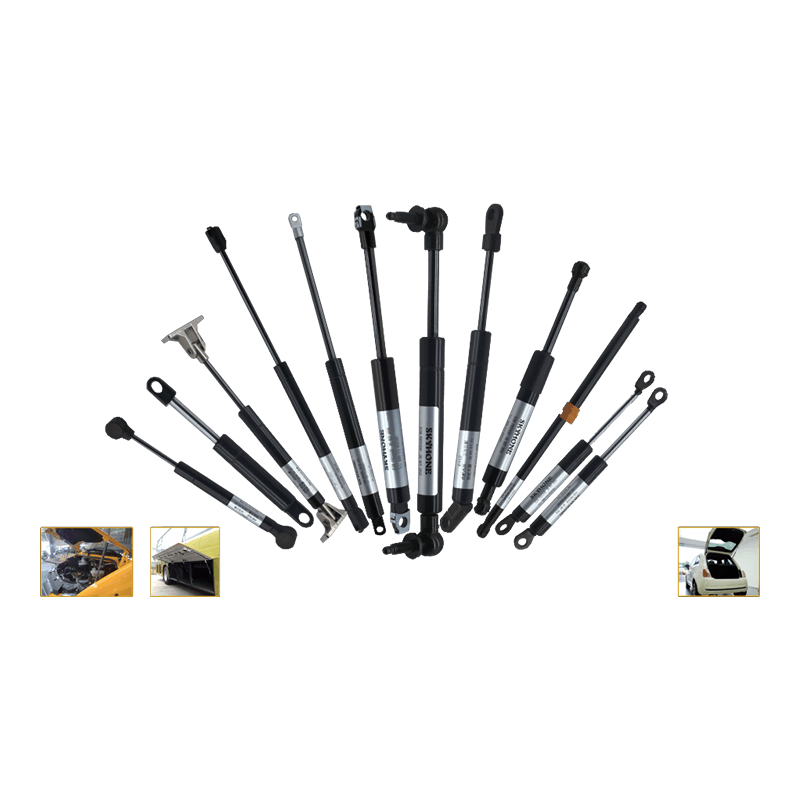
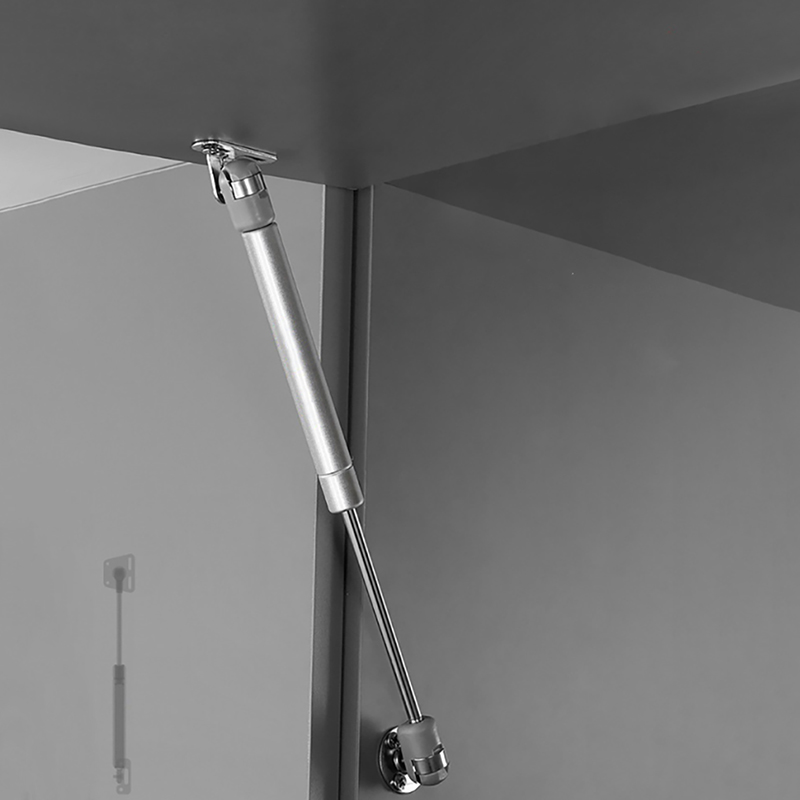
Standard free-type gas spring
What Is a Standard Free-Type Gas Spring?
A standard free-type gas spring is a sealed pneumatic support device that uses compressed nitrogen to create an extension force. The main components normally include a pressure cylinder, piston assembly, piston rod, sealing system, guide components, damping oil, and end fittings. Nitrogen is sealed inside the cylinder at a controlled pressure. When the piston rod is pushed into the cylinder, the gas is compressed further and stores energy. When the external load is released, the gas pressure encourages the rod to extend.
The term “free-type” refers to the spring’s operating behavior. The rod can extend or retract according to the balance between the gas force, the weight of the supported component, friction, and the geometry of the installation. It is not designed to remain mechanically locked at every intermediate position. Instead, it provides assistance throughout the movement and reaches its normal limits at full extension and full compression.
This operating principle is especially appropriate for upward-opening lids, cabinet doors, equipment covers, vehicle hatches, storage boxes, inspection panels, and other components that typically have a defined open position and a defined closed position. When the design is correctly calculated, the gas spring helps the user lift the component with much less effort and then controls its descent as it approaches the closed position.
Unlike an ordinary coil spring, whose force may change substantially according to its compression distance and whose movement may be accompanied by vibration, a gas spring produces a comparatively smooth and predictable force curve. The exact force is influenced by cylinder pressure, piston area, temperature, friction, and the length of the rod inside the cylinder. This makes proper sizing important, but it also enables engineers to achieve a refined movement experience.
Unlike a powered linear actuator, a free gas spring does not require a motor, control system, wiring, switch, or power supply. This reduces installation complexity and eliminates electricity consumption during operation. For many covers and lids, the gas spring is therefore the most efficient way to create assisted movement.
Operating Principle and Internal Construction
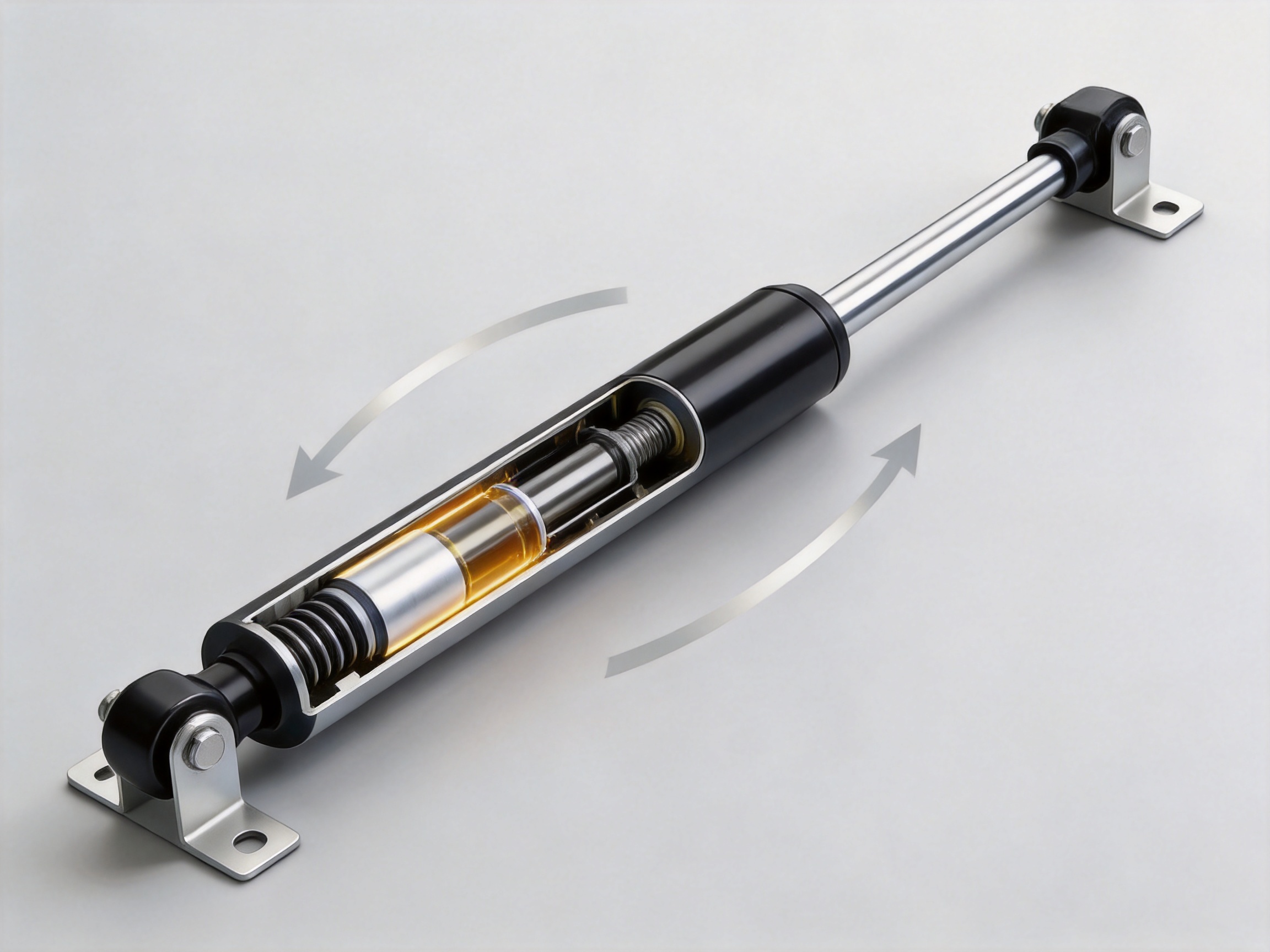
The cylinder contains high-pressure nitrogen and a controlled quantity of hydraulic oil. The nitrogen provides the primary lifting force, while the oil contributes to damping. The piston separates or manages the gas and oil zones inside the cylinder, and calibrated passages allow the oil to move at a controlled rate as the rod travels.
When the rod is compressed, the piston moves inward and the internal gas volume changes. Because the gas is compressed, the pressure rises and creates a force that acts on the piston area. When the rod begins to extend, the stored pneumatic energy assists the movement. The resulting force is transmitted through the rod to the lid, panel, or door connected to the gas spring.
Hydraulic damping is particularly important near the end of travel. Without damping, a supported lid could rise too quickly, strike its upper stop, or create unnecessary vibration. During closing, a free gas spring can help reduce the speed of the moving part as it approaches the closed position. This produces a softer and quieter motion, improving both user comfort and the service life of the surrounding hinges, brackets, and panels.
The sealing system must retain the nitrogen and oil while allowing the rod to move repeatedly. A precision guide and sealing arrangement supports the rod, limits unwanted lateral movement, and helps protect the internal fluid from contamination. The rod surface must be smooth and properly finished because surface quality directly affects seal life, friction, corrosion resistance, and movement consistency.
The cylinder is commonly manufactured from seamless precision steel tubing or stainless steel tubing. Steel provides excellent mechanical strength and is suitable for many general-purpose applications. Stainless steel is advantageous in environments exposed to humidity, cleaning agents, salt, outdoor air, or demanding aesthetic requirements. The correct material should be chosen according to the application environment rather than by size alone.
Key Advantages Over Conventional Support Solutions
Effortless Opening Assistance
The principal benefit of a gas spring is the reduction of manual lifting effort. A heavy lid, door, hatch, or panel can be difficult to raise because the user must overcome its weight and the torque created by its distance from the hinge. A correctly selected gas spring supplies part of the required force, allowing the user to open the component smoothly and with less strain.
This advantage is valuable in furniture, vehicle components, machinery, storage equipment, and public facilities. It can improve accessibility for a wide range of users and make repeated operation less tiring. In commercial or industrial environments, reduced opening effort can also increase productivity and decrease the likelihood of sudden drops or awkward handling.
Controlled and Quiet Closing
Integrated hydraulic damping helps prevent abrupt closing. Rather than allowing a panel to fall freely under gravity, the gas spring moderates the final portion of travel. This reduces impact noise and protects hinges, brackets, locks, handles, and surrounding structures.
Quiet movement is increasingly important in office furniture, residential products, medical equipment, hospitality facilities, and public installations. A smooth closing action gives users the impression that the product is carefully engineered. It also reduces the stress imposed on the assembly during every operating cycle.
Simple Construction and Easy Integration
A free-type gas spring has a relatively compact structure and can be installed using simple mounting points. It does not require a motor, gearbox, control panel, electrical harness, or software. This makes it easier for product designers to integrate into a new product or add to an existing design.
The gas spring can normally be mounted between the moving component and a fixed frame. The mounting geometry, angle, stroke, and force must be calculated carefully, but the overall installation is straightforward. When the design is optimized, the component remains visually discreet and does not occupy excessive internal space.
Low Maintenance Requirements
The sealed construction is designed for long-term operation without routine refilling or lubrication. Because the nitrogen and damping oil remain inside the cylinder, the product does not require the regular servicing associated with some mechanical lifting systems. This is particularly useful when the gas spring is installed inside furniture, equipment housings, or difficult-to-access enclosures.
Low maintenance does not mean that installation conditions are unimportant. The rod should be protected from severe scratches, side loading, welding spatter, and contamination. Correct alignment and appropriate mounting hardware also contribute significantly to service life. With these conditions properly managed, the sealed gas spring offers a convenient and reliable support solution.
Cost-Effective Performance
When intermediate locking is not necessary, a standard free-type gas spring can provide the required performance at a lower level of complexity than a lockable gas spring or electric actuator. It uses fewer control components, consumes no operating electricity, and generally requires less installation space.
This cost advantage is important for high-volume furniture, automotive parts, storage products, cabinets, kiosks, and equipment covers. Manufacturers can select an appropriate force rating and cylinder size without paying for locking or powered functions that the final product does not need.
Flexible Material and Size Options
The available specification range supports both compact and heavy-duty designs. Pipe diameters include 15 millimeters, 18 millimeters, 22 millimeters, and larger 28 millimeter options, while rod diameters range from 6 millimeters to 14 millimeters in the listed configurations. Center distances extend from approximately 150 millimeters to 1,000 millimeters, and strokes range from 40 millimeters to 450 millimeters depending on the cylinder and rod combination.
Force options begin at approximately 20 newtons and extend to 2,000 newtons in the listed range. This allows the same product family to serve small lids, household storage units, and larger panels. It also gives design engineers the flexibility to select a component based on actual torque and balance requirements rather than relying on a one-size-fits-all solution.
Specification Range
The following table summarizes the principal size and force combinations available for the standard free-type gas spring range. Center distance refers to the approximate overall length between mounting centers in the specified configuration. Actual product selection should also consider end fittings, installation angle, operating temperature, load distribution, and the number of springs used in the application.
| Pipe Diameter and Rod Diameter | Center Distance | Stroke | Pressure Force |
|---|---|---|---|
| 15 mm / 6 mm | 150–300 mm | 40–110 mm | 20–300 N |
| 18 mm / 8 mm | 150–600 mm | 40–250 mm | 30–500 N |
| 22 mm / 10 mm | 200–400 mm | 60–160 mm | 50–1,000 N |
| 22 mm / 10 mm | 400–500 mm | 160–200 mm | 50–1,000 N |
| 22 mm / 10 mm | 500–600 mm | 200–250 mm | 50–1,000 N |
| 22 mm / 10 mm | 600–700 mm | 250–300 mm | 50–1,000 N |
| 22 mm / 10 mm | 700–800 mm | 300–340 mm | 50–1,000 N |
| 22 mm / 10 mm | 900 mm | 400 mm | 50–1,000 N |
| 22 mm / 12 mm | 500–1,000 mm | 200–450 mm | 500–1,500 N |
| 28 mm / 14 mm | 500–1,000 mm | 200–450 mm | 500–2,000 N |
The specification table demonstrates that the product family can accommodate multiple design scales. Smaller 15/6 and 18/8 configurations are suitable for compact applications where space and weight are limited. The 22/10 series provides a broad middle range for furniture, covers, cabinets, and equipment panels. The 22/12 and 28/14 options are appropriate when greater force and structural capacity are required.
Force should not be selected solely by comparing the weight of the supported component with the force printed on the gas spring. The correct calculation must account for hinge location, center of gravity, mounting points, opening angle, friction, the number of springs, and the desired manual operating effort. A gas spring installed close to the hinge has a different leverage effect from one installed farther away. Professional selection therefore considers the complete movement geometry.
Application Areas
Furniture and Ergonomic Office Products
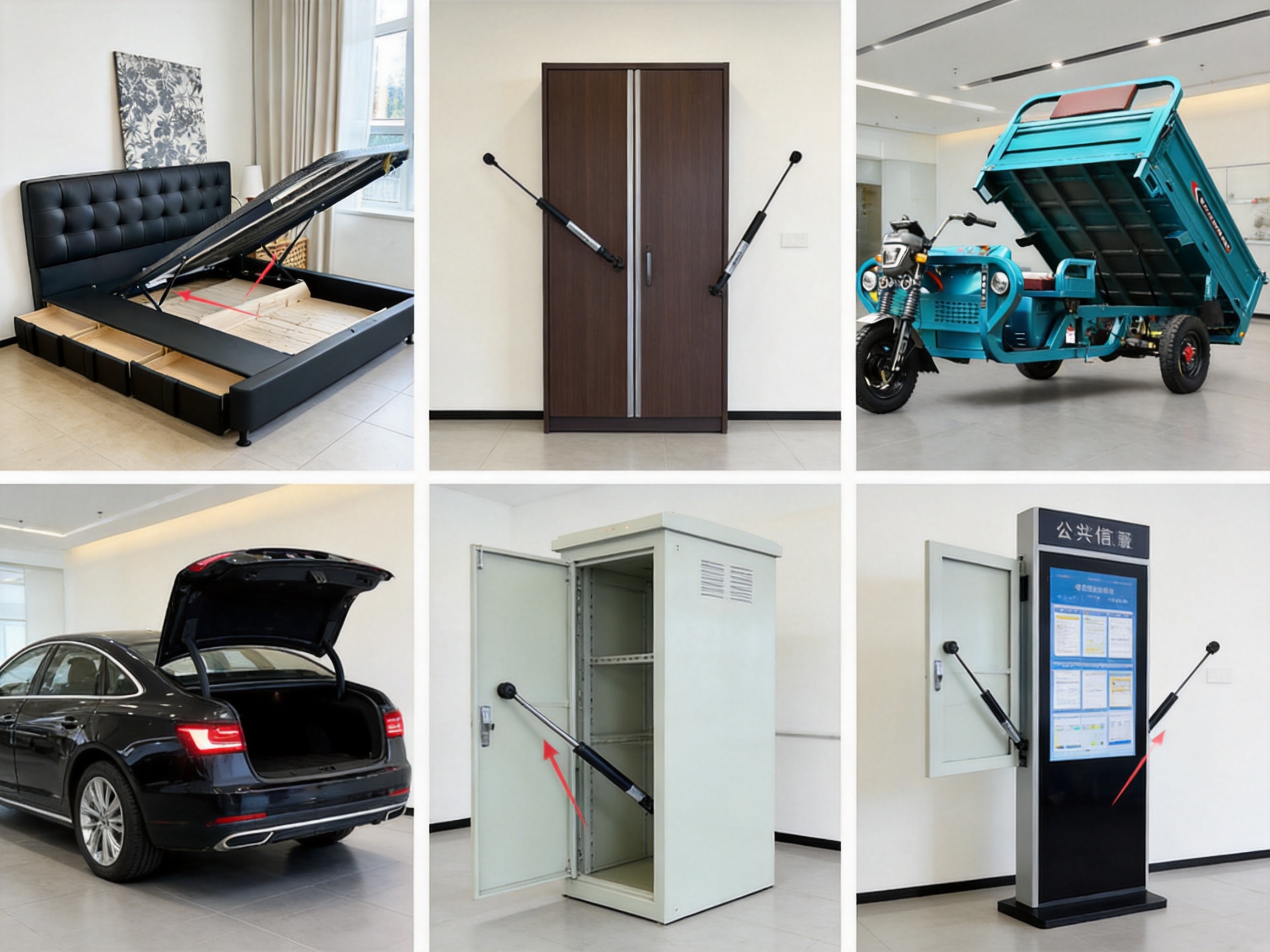
Gas springs are useful in storage cabinets, flip-top desks, office consoles, modular furniture, seating systems, and adjustable furniture components. They can help users lift work surfaces, access storage compartments, or open concealed panels with less effort. The quiet and controlled movement is well suited to offices, libraries, hotels, and residential interiors where excessive noise is undesirable.
In furniture design, appearance is also important. A compact gas spring can often be positioned inside the structure, leaving the exterior clean and uncluttered. Steel and stainless steel options allow manufacturers to coordinate the component with the intended durability and visual requirements of the furniture.
Automotive Tailgates and Hoods
Vehicle tailgates, trunks, engine hoods, and service panels often require assisted opening because the panel may be large, heavy, or positioned above the user. Gas springs reduce lifting effort and help retain the panel in the raised position. They also moderate the closing movement, reducing the risk of a sudden drop.
Automotive applications demand careful consideration of temperature, vibration, corrosion, cycle frequency, and installation geometry. Stainless steel or appropriately protected steel components may be selected depending on the environment. The mounting brackets and body structure must be strong enough to transfer the gas spring force without deformation.
Equipment Enclosures and Industrial Machinery
Industrial equipment frequently includes access doors, inspection covers, electrical cabinet panels, and maintenance hatches. These components may be made from heavy sheet metal and may need to remain open while an operator performs inspection or service work. A gas spring can support the door and reduce the risk of accidental closure.
Because the free-type design does not require electrical control, it is particularly useful for simple mechanical access panels. It can operate even when the machine is powered down, and it does not introduce additional wiring or control-system dependencies. Designers should nevertheless assess heat, dust, chemical exposure, and the possibility of side loading before selecting the final configuration.
Bus Shelter Advertising Kiosks and Public Installations
Advertising kiosks, information displays, service cabinets, and public infrastructure often include large panels that require periodic access. A gas spring can assist maintenance personnel when opening these panels and can help prevent the panel from falling unexpectedly. The smooth movement also reduces noise in public spaces.
Outdoor applications require special attention to corrosion protection, sealing, temperature variation, and vandalism resistance. Stainless steel cylinders may be advantageous in wet or coastal environments. The mounting arrangement should protect the gas spring from impact while still allowing inspection or replacement when necessary.
Storage Boxes and Upward-Opening Lids
Storage benches, toolboxes, instrument cases, bed compartments, and recreational equipment often use upward-opening lids. These lids may be awkward to lift because their hinges are located at the rear and their center of gravity moves significantly during opening. A gas spring provides assistance through the opening arc and helps control the final closing movement.
For household and consumer products, the reduced impact and quiet operation can significantly improve user satisfaction. It also protects the lid and box structure from repeated slamming. The gas spring should be selected so that the lid is not forced open too aggressively and can still be closed comfortably by hand.
Advantages of Precision Manufacturing
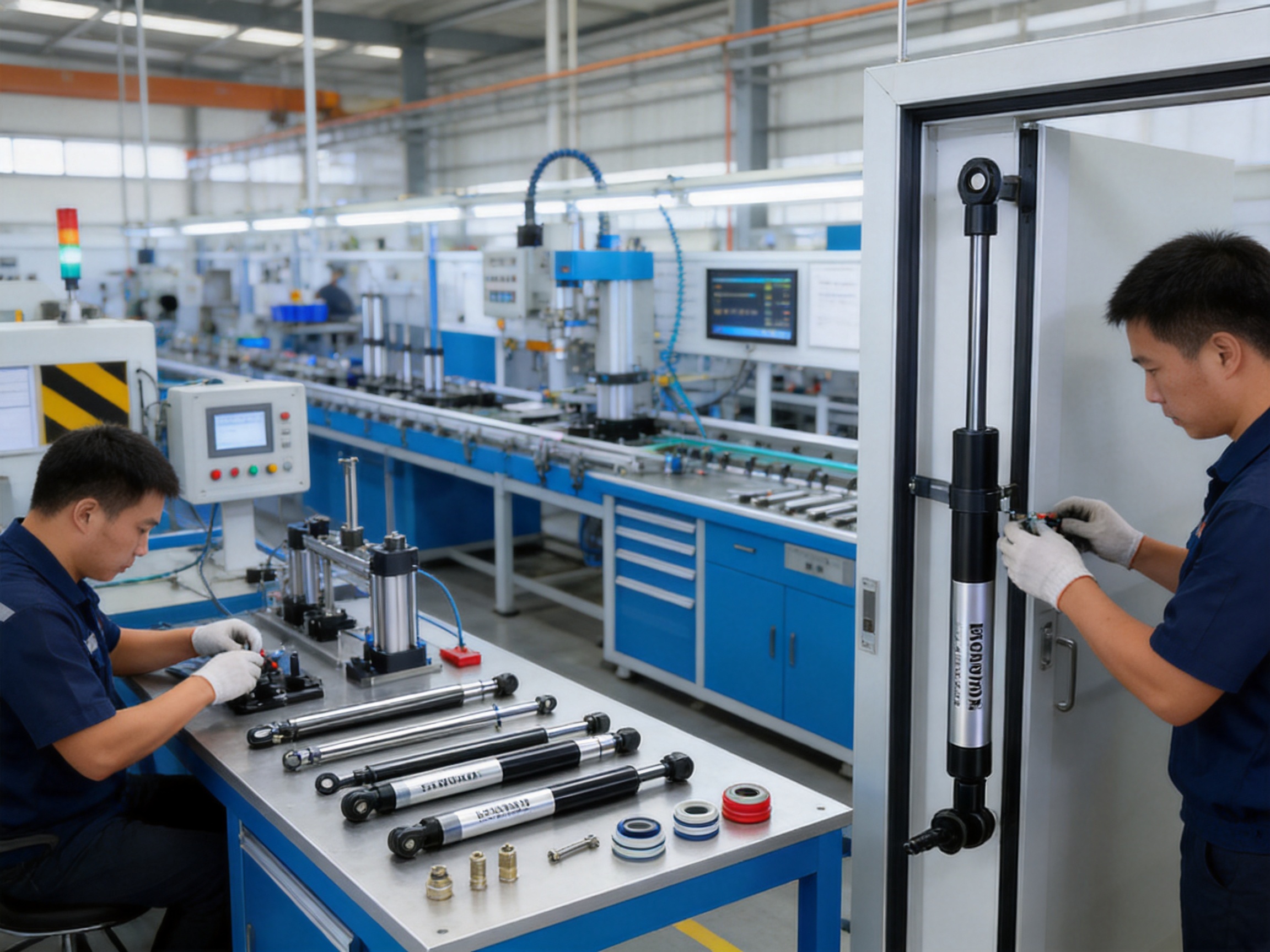
The performance of a gas spring depends on more than nitrogen pressure. Dimensional accuracy, surface finish, seal quality, oil volume, assembly cleanliness, and force consistency all affect the final result. A manufacturer with an integrated research, development, production, sales, and service capability can manage these factors more effectively than a supplier focused only on final assembly.
SuZhou Skyhone Intelligent Technology Co., Ltd. is positioned in Suzhou, within the Yangtze River Delta furniture and manufacturing region. This location provides access to a broad industrial supply chain, engineering resources, metal-processing capabilities, component suppliers, and intelligent manufacturing support. Such an industrial environment is valuable for developing gas springs intended for furniture, office products, equipment, and related applications.
The company’s experience in standing desks and office-space solutions also supports a practical understanding of ergonomic movement, structural integration, product appearance, and repeated daily use. Although gas springs and electric linear actuators serve different functions, they may be used within related furniture and equipment designs. This broader product perspective helps the manufacturer consider how a gas spring will work as part of the complete product rather than as an isolated component.
Material Preparation and Tube Processing
Manufacturing begins with the careful selection and preparation of cylinder and rod materials. Precision steel tubing must provide consistent internal dimensions and sufficient strength to withstand the pressure and repeated mechanical loading of the gas spring. Stainless steel tubing may be chosen where corrosion resistance or appearance is especially important.
Tube cutting and end preparation must be controlled so that the finished cylinder achieves the required length and connection geometry. Burrs, particles, and surface irregularities can damage seals or interfere with piston movement, so cleaning and preparation are important stages in the process. A controlled manufacturing environment helps reduce the chance of contamination entering the sealed assembly.
The piston rod requires accurate sizing and a suitable surface finish. The rod moves through the guide and seal during every operating cycle, meaning even small surface defects can influence friction and wear. Proper finishing supports smooth movement, limits seal damage, and improves resistance to environmental exposure.
Precision Assembly
During assembly, the piston, rod, guide, seals, cylinder, oil, and end fittings must be combined in the correct sequence. Seal orientation, piston fit, oil quantity, and internal cleanliness are all critical. A gas spring that appears externally correct may still perform inconsistently if internal assembly controls are inadequate.
Precision assembly also includes the installation of mounting components and the verification of overall length. Threaded, ball-joint, eyelet, or other end-fitting styles may be selected according to the customer’s installation design. Consistent assembly torque helps ensure that fittings remain secure during repeated operation.
Controlled Nitrogen Charging
Nitrogen charging is one of the most important manufacturing stages because the internal pressure determines the spring’s approximate extension force. The charging process must be managed carefully to achieve the requested force range while protecting the cylinder and seals.
Because gas pressure can be affected by temperature, manufacturers should evaluate force under defined test conditions. A reliable production process records the relevant parameters and compares finished products against the required specification. This helps reduce variation between batches and supports predictable product selection for customers.
Damping and Movement Verification
The damping performance depends on the interaction between the piston, oil, internal passages, seals, and gas pressure. The manufacturer can evaluate the movement behavior by checking extension, compression, end-of-stroke cushioning, and general smoothness. These inspections are especially important for applications where noise, impact, or user comfort is a primary concern.
Quality verification may include dimensional checks, visual inspection, force testing, leakage evaluation, and repeated-cycle testing according to the product requirement. The exact test plan should correspond to the application, expected service life, and customer quality agreement. A professional manufacturing process uses documented inspection procedures rather than relying only on visual confirmation.
Intelligent Manufacturing and Traceability
Intelligent manufacturing can improve production consistency by connecting equipment, process instructions, inspection records, and production planning. Digital work instructions reduce ambiguity on the assembly line, while recorded process data can help identify variation and support corrective action.
Traceability is also valuable for customized products. When a customer orders a particular cylinder diameter, stroke, center distance, and force, production records can associate those parameters with the relevant batch and inspection results. This makes later communication, replenishment, and technical support more efficient.
How This Product Compares with Competing Solutions
Compared with Ordinary Mechanical Springs
Mechanical springs are useful in many applications, but they may require additional guides, linkages, stops, or damping devices to provide the same controlled movement as a gas spring. They can also produce more noticeable vibration or noise when the moving component reaches an end position.
A free gas spring integrates the force-generating and damping functions within a sealed component. This reduces the number of separate parts and can simplify product assembly. It also offers a cleaner appearance and a more refined movement profile when properly sized.
Compared with Lockable Gas Springs
Lockable gas springs are appropriate when a panel or seat must remain fixed at an intermediate position. However, their additional locking mechanism may increase cost, size, weight, and operating complexity. If the application only requires fully open and fully closed positions, a standard free-type gas spring is often the more economical and reliable choice.
The free-type design also offers a simpler user experience. There is no release lever or locking control to operate. The user opens or closes the component directly, while the gas spring supplies assistance and damping throughout the movement.
Compared with Electric Linear Actuators
Electric linear actuators provide powered movement and may support programmable positioning, remote control, synchronized operation, or automatic adjustment. These functions are necessary in height-adjustable desks, medical equipment, and automated machinery. However, they also require motors, controls, wiring, power supplies, and additional protection against electrical or mechanical faults.
For a passive lid, door, or hatch, those functions may be unnecessary. A free gas spring can deliver the required assistance at a much lower system complexity. It continues to function without mains power and can often be installed in a narrower space than a complete powered actuator system.
Compared with Friction Hinges
Friction hinges create resistance at the hinge and can help hold a panel in a range of positions. They may be suitable for lightweight covers, but they can experience wear and may provide less lifting assistance for heavier components. The operating torque can also change as the hinge ages or as the friction surfaces become contaminated.
A gas spring supports the moving component through a dedicated force element and can be specified for the required load. It is particularly effective when the lid is large, heavy, or frequently operated.
Design and Installation Guidance
Correct installation is essential for achieving the expected performance. The gas spring should be mounted so that its movement follows the natural path of the supported component. Excessive side loading, twisting, or misalignment can increase friction and place unnecessary stress on the rod, seals, brackets, and hinges.
Designers should determine the closed and open positions, available mounting space, desired stroke, center distance, and required force before final selection. The installation angle changes the effective lifting contribution, so a gas spring rated at a particular force does not automatically provide that same force at the lid edge.
Two gas springs may be used when the supported component is wide, heavy, or subject to uneven loading. Using two springs can improve balance and reduce twisting, but the force must be distributed carefully. The mounting points should be symmetrical where possible, and the structure should be strong enough to withstand the combined forces.
The piston rod should generally be protected from direct impact, sharp objects, welding debris, paint overspray, and aggressive chemicals. Damage to the rod surface can reduce seal life and cause leakage. Where possible, the gas spring should be installed in a position that limits water accumulation and avoids unnecessary exposure to contaminants.
The gas spring should not be used as a structural stop unless the product has specifically been designed for that purpose. The supported lid or panel should have suitable mechanical stops that define the final open and closed positions. This prevents the gas spring from receiving loads beyond its intended stroke or from being forced into an abnormal position.
Mounting hardware should be tightened correctly, but the rod should not be clamped or constrained in a way that prevents free axial movement. Ball joints and similar fittings should be aligned with the direction of travel. If the component is installed at an angle, designers should verify that the joint can accommodate the full operating arc.
Selection Process for Product Engineers
Step One: Define the Moving Component
Record the weight, dimensions, center of gravity, hinge location, opening angle, and intended operating frequency of the lid, door, or panel. Consider whether the user should be able to open it with one hand and whether the component must remain open without additional support.
Step Two: Determine the Geometry
Identify possible mounting points on the fixed frame and moving component. Measure the center distance in the closed and open positions. Confirm that the proposed stroke is sufficient for the required travel while leaving appropriate clearance at both ends.
Step Three: Estimate the Required Force
Use the component weight and lever geometry to estimate the assistance required. Include a reasonable allowance for friction, manufacturing tolerances, temperature effects, and the desired manual operating force. Avoid selecting excessive force merely to guarantee opening, because an oversized gas spring may make closing difficult or place unnecessary stress on the structure.
Step Four: Select the Cylinder and Rod Size
Choose the pipe and rod diameter based on the required force, available space, structural loads, and expected service conditions. Smaller configurations may be suitable for compact products, while larger 22/12 and 28/14 configurations can provide higher force for larger panels and industrial equipment.
Step Five: Confirm the Material and Environment
Evaluate humidity, salt, cleaning chemicals, temperature, dust, outdoor exposure, and appearance requirements. Precision steel is suitable for many standard applications, while stainless steel can provide additional corrosion resistance in demanding environments.
Step Six: Test a Sample Assembly
Before finalizing mass production, install sample gas springs on a representative prototype. Check opening effort, closing speed, end-position behavior, noise, mounting stress, and clearance throughout the full movement. Prototype testing can reveal problems that are not visible in a static calculation.
Service Life, Safety, and Responsible Use
A gas spring is a pressurized component and should not be opened, punctured, heated excessively, or modified after manufacture. The internal nitrogen pressure is controlled during production, and unauthorized disassembly can create a safety hazard. If the gas spring shows leakage, serious corrosion, bent rod damage, or abnormal movement, it should be replaced rather than repaired by unqualified personnel.
Service life depends on the number of cycles, load, temperature, installation alignment, rod protection, and environmental conditions. A gas spring used in a clean indoor cabinet may experience very different conditions from one installed on an outdoor vehicle or industrial hatch. Product evaluation should therefore reflect the actual operating environment.
Correctly selected gas springs can help improve safety by reducing uncontrolled drops. However, they should not be considered the only safety device for a panel that could injure a person if it falls. Heavy lids and doors may require secondary supports, mechanical stops, latches, or maintenance locks, particularly when people work beneath the open component.
At the end of the product’s service life, disposal should follow applicable local requirements. Steel and stainless steel components may be recoverable through appropriate metal recycling channels, while seals and oil should be handled responsibly.
Why Work with an Integrated Manufacturer?
Working with an integrated manufacturer offers advantages beyond purchasing a standard catalog component. Product developers may need assistance with force selection, stroke adjustment, center-distance changes, fitting choices, material selection, packaging, and production scheduling. A supplier that combines technical development, manufacturing, sales, and service can coordinate these requirements more efficiently.
SuZhou Skyhone Intelligent Technology Co., Ltd. operates as a professional manufacturing enterprise engaged in research and development, production, sales, and service. Its location in Suzhou provides access to the mature industrial resources of the Yangtze River Delta, while its focus on standing desks and intelligent office-space solutions supports experience with ergonomic products and mechanical integration.
The company can support customers seeking gas springs for furniture, office products, equipment enclosures, vehicle components, kiosks, and other applications. The available range of dimensions and forces provides a starting point for standard orders, while application-specific discussions can help determine whether a customized length, force, material, or fitting configuration is appropriate.
Manufacturing strength is especially important when gas springs are installed in products that will be produced in large quantities. Consistency between batches helps manufacturers maintain the same opening effort, closing behavior, and user experience across the finished product line. Coordinated technical communication also helps reduce design changes late in the production process.
Q&A
What is the difference between a free gas spring and a lockable gas spring?
A free gas spring supports and controls movement but does not lock at intermediate positions. It normally reaches its intended limits at full extension and full compression. A lockable gas spring includes an additional locking function that can hold the rod at a selected intermediate position. The free type is simpler and more economical when intermediate locking is unnecessary.
Can a standard free-type gas spring hold a lid open?
Yes, when it is correctly selected and installed. The gas force, mounting geometry, lid weight, hinge position, and center of gravity must be balanced so that the spring supports the lid in the open position. Mechanical stops should still be provided to define the final open position and prevent overextension.
Does a gas spring lift the full weight of a lid?
Not necessarily. The gas spring provides a force that works through the installation geometry. Its effective contribution at the lid edge depends on the distance from the hinge and the angle of the spring. Engineers should calculate the required torque rather than comparing the gas spring force directly with the total lid weight.
What force range is available?
The listed configurations cover approximately 20 to 2,000 newtons. Smaller 15/6 and 18/8 sizes cover lower force requirements, while larger 22/12 and 28/14 configurations support higher loads. The correct choice depends on the complete application rather than force alone.
What stroke lengths are available?
The listed stroke range extends from approximately 40 millimeters to 450 millimeters. The available stroke depends on the pipe and rod diameter and the overall center distance. The selected stroke must match the actual movement required by the lid, door, or panel.
Can stainless steel be used outdoors?
Stainless steel is generally more suitable than ordinary steel for humid or outdoor environments, but the complete assembly must still be evaluated. End fittings, brackets, fasteners, coatings, temperature, salt exposure, and water drainage can all influence corrosion performance.
Are gas springs maintenance-free?
The sealed design is intended to operate without routine refilling or lubrication. However, the installation should be inspected periodically for corrosion, rod damage, loose fittings, leakage, or abnormal movement. Damaged gas springs should be replaced rather than opened or repaired improperly.
Can a free gas spring replace an electric actuator?
It can replace an electric actuator when the application only needs passive lifting assistance and controlled closing. It cannot replace an electric actuator when powered movement, automatic positioning, remote control, synchronization, or programmable adjustment is required.
Why is hydraulic oil used inside the gas spring?
The oil provides damping as the piston moves through the cylinder. This helps control extension and compression speed, particularly near the end of travel, reducing impact and noise. The nitrogen supplies the primary pneumatic force, while the oil contributes to movement control.
What should be checked during prototype testing?
Prototype testing should include opening effort, closing effort, travel speed, end-position cushioning, noise, mounting stress, clearance, alignment, and performance at the intended operating temperature. Repeated cycling can also help identify early problems with brackets, seals, or structural strength.
Conclusion
The standard free-type gas spring is a simple but highly effective solution for assisted lifting and controlled movement. Its combination of pressurized nitrogen, hydraulic damping, precision construction, and sealed operation allows it to improve the usability and durability of lids, doors, hatches, panels, and enclosures without the complexity of powered equipment.
Its principal advantages include reduced manual effort, quiet closing, compact installation, low maintenance, broad size availability, and strong cost performance. Compared with lockable gas springs, it avoids unnecessary complexity when intermediate positioning is not required. Compared with electric linear actuators, it provides a passive and power-free solution for products that do not need automated movement.
The range of pipe diameters, rod diameters, center distances, strokes, force ratings, and material options supports applications from compact household furniture to larger industrial and vehicle components. Careful calculation and prototype testing remain essential because gas spring performance depends on installation geometry as well as the nominal force rating.
With research and development, production, sales, and service capabilities, SuZhou Skyhone Intelligent Technology Co., Ltd. is positioned to support customers seeking reliable gas spring solutions for furniture, office products, equipment, automotive components, and public installations. Its Suzhou manufacturing base and connection with the Yangtze River Delta industrial ecosystem provide a practical foundation for coordinated product development, precision manufacturing, and application support.
For designers and manufacturers seeking a dependable alternative to complicated lifting mechanisms, the standard free-type gas spring offers a balanced combination of performance, simplicity, and value. When correctly specified and responsibly installed, it can provide smooth assistance and controlled movement over a long period of everyday use.
References
1. General engineering principles for pneumatic gas springs, sealed pressure components, and controlled mechanical motion.
2. Product specification data for standard free-type gas springs, including pipe diameter, rod diameter, center distance, stroke, and force ranges.
3. Manufacturing and quality-control principles for precision steel tubing, stainless steel components, sealing systems, and nitrogen-charged assemblies.
4. General guidelines for mechanical load calculation, hinge torque, mounting geometry, and gas spring selection.
5. Industrial design practices for furniture hardware, equipment enclosures, vehicle panels, storage lids, and public access cabinets.
6. General safety considerations for pressurized mechanical components, installation alignment, maintenance inspection, and end-of-life handling.
Product: Standard free-type gas spring


- Contact Info
-
-
 Phone+86-15950656125
-
 Email
-
 AddressRoom 1007-1, South Building, Suyue Plaza, Suzhou Industrial Park, Suzhou City, Jiangsu Province, China
-
- Products
- Follow Us
- Need help? Please contact us
Copyright ©
SuZhou Skyhone Intelligent Technology Co., Ltd.
All Rights Reserved.
Privacy
Custom Ergonomic Adjustable Office Tables Manufacturers

