

 English
 русский
 Español
 عربى

Content
- 1 What Is a Standard Free-Type Gas Spring?
- 2 Operating Principle and Main Components
- 3 Key Advantages Compared with Basic Support Alternatives
- 4 Specification Range
- 5 Application Areas
- 6 Manufacturing Strengths and Quality-Oriented Production
- 7 Material and Configuration Considerations
- 8 How to Select the Correct Gas Spring
- 9 Installation and Operating Recommendations
- 10 Why a Standard Design Can Outperform More Complex Alternatives
- 11 Quality, Testing, and Long-Term Reliability
- 12 Value for Furniture and Equipment Manufacturers
- 13 Q&A
- 13.1 What is a free-type gas spring?
- 13.2 How is it different from a lockable gas spring?
- 13.3 Can a free gas spring hold a lid open?
- 13.4 How do I choose the correct force?
- 13.5 What does center distance mean?
- 13.6 What is the purpose of hydraulic oil?
- 13.7 Are gas springs maintenance-free?
- 13.8 Can these gas springs be used outdoors?
- 13.9 Can a gas spring be installed at any angle?
- 13.10 What happens if the gas spring is too strong?
- 13.11 What happens if the gas spring is too weak?
- 13.12 Can two gas springs be used on one lid?
- 13.13 What materials are available for the cylinder?
- 13.14 What industries can use this product?
- 13.15 Why work with a manufacturer rather than purchase an unverified standard part?
- 14 Conclusion
- 15 References
- 16 Product: Standard free-type gas spring
Standard Free-Type Gas Springs: Reliable Lift Assistance for Furniture, Vehicles, and Equipment
2026-10-15
Standard free-type gas springs are among the most practical and widely used support components for products that require controlled lifting, opening, holding, and closing. Also called free gas springs, standard gas struts, or simple gas springs, they use compressed nitrogen and hydraulic damping oil to help users move lids, doors, panels, covers, and other hinged structures with less effort. Their uncomplicated design, broad size range, maintenance-free construction, and competitive cost make them suitable for many industries, from office furniture and household products to automotive equipment, public facilities, and industrial enclosures.
A well-designed gas spring does more than simply push an object upward. It balances the weight of the supported component, improves operating comfort, reduces impact during closing, protects hinges and surrounding structures, and contributes to a more refined user experience. The standard free-type design is particularly valuable when an application requires assistance throughout a defined movement but does not need locking at intermediate positions. It extends when the supported component must be raised and compresses when the component is closed, with end-of-stroke damping helping to prevent abrupt movement.
SuZhou Skyhone Intelligent Technology Co., Ltd. supplies standard free-type gas springs as part of its broader product portfolio for adjustable height desks, electric linear actuators, and gas springs. With a manufacturing focus connected to intelligent office and furniture applications, the company also supports the customization requirements of global customers. Its product approach combines practical engineering, a wide specification range, controlled production, and application-oriented service.
What Is a Standard Free-Type Gas Spring?
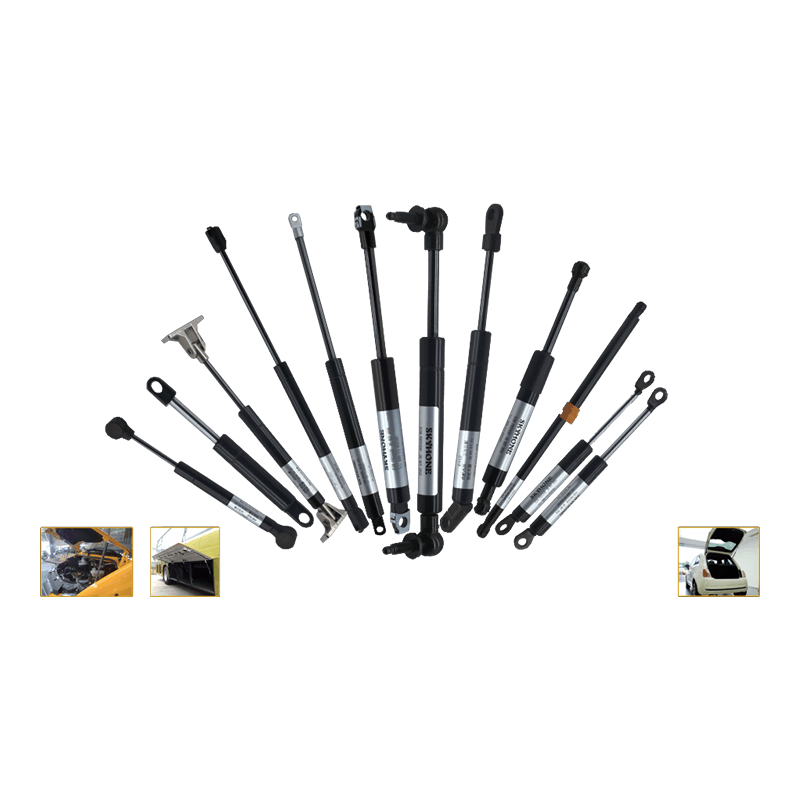
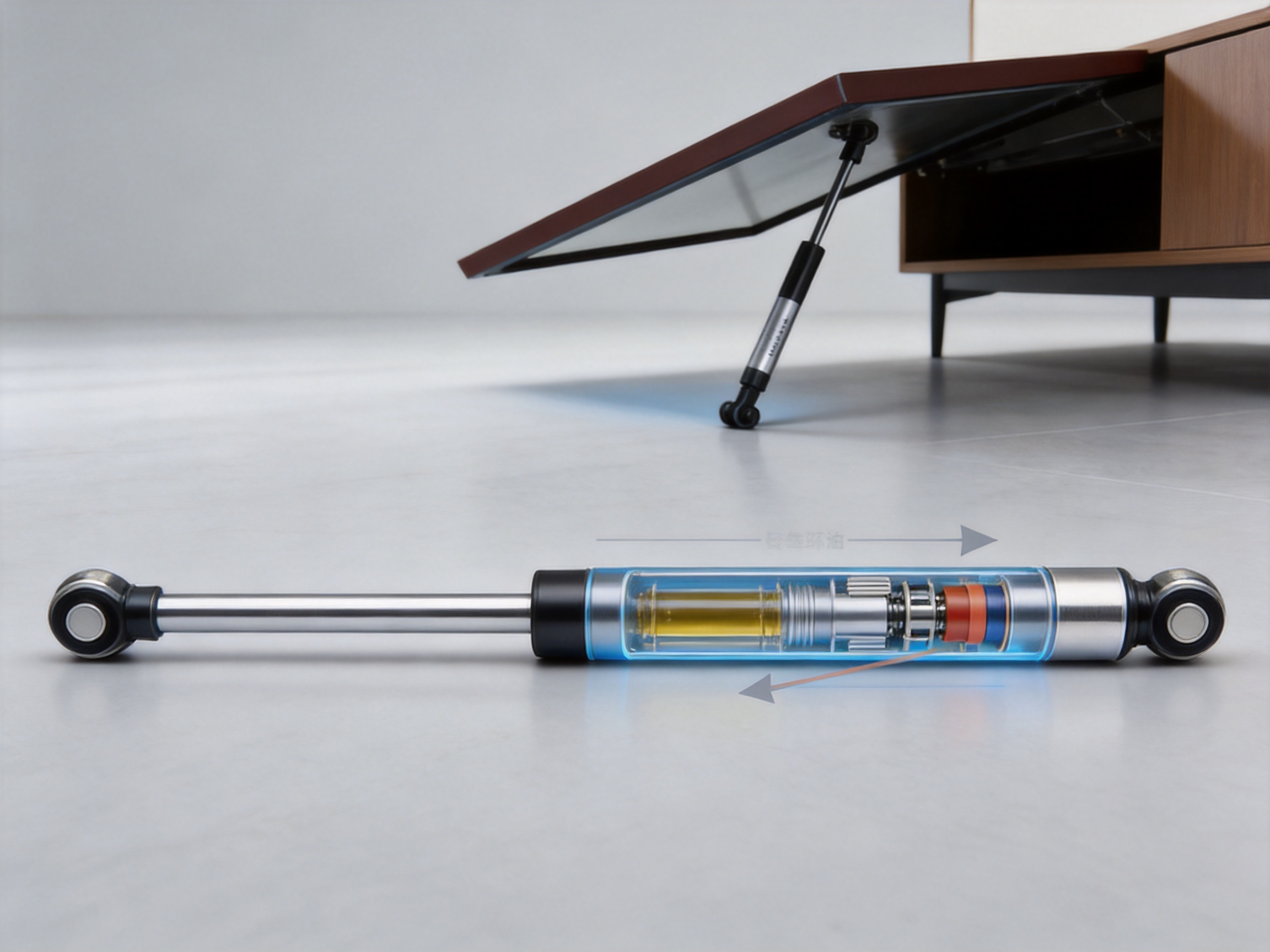
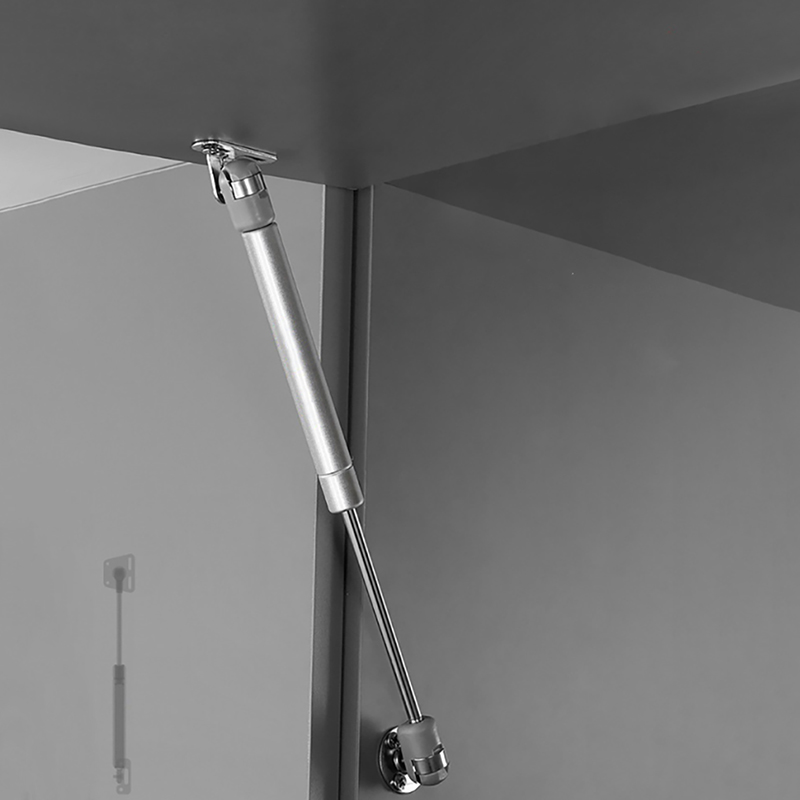
A standard free-type gas spring is a sealed mechanical support device consisting primarily of a pressure tube, piston, piston rod, sealing system, guide assembly, hydraulic oil, and pressurized nitrogen. The gas is contained inside the cylinder at high pressure. When the piston rod is pushed into the cylinder, the gas is compressed and stores energy. When the external force is released, the compressed gas creates an extension force that assists the opening or lifting motion.
The term “free-type” refers to the operating behavior of the spring. Unlike a lockable gas spring, it does not include a release mechanism that allows the user to secure the rod at any selected position. It normally reaches two functional end positions: fully extended and fully compressed. This simple operating principle is ideal for applications where the supported part should move freely between its two limits and where intermediate locking is unnecessary.
Hydraulic oil inside the cylinder provides damping. As the piston moves, the oil passes through controlled internal passages. This slows the final part of the movement and helps reduce noise, vibration, and impact. Depending on the design and installation direction, the gas spring can provide a smoother opening action, a cushioned closing action, or both. Proper mounting geometry is essential because the actual user force depends on the gas spring force, hinge position, lever arm, lid weight, and angle of movement.
Because the gas spring is factory-sealed, the user does not need to add lubricant, recharge nitrogen, or perform routine internal maintenance. A correctly selected and installed unit can provide repeated support over a long operating life. External protection, appropriate materials, and correct installation are especially important where the spring is exposed to moisture, dust, temperature changes, road conditions, or cleaning chemicals.
Standard free-type gas spring
Operating Principle and Main Components
Pressurized Nitrogen
Nitrogen is used as the working gas because it is stable and suitable for controlled pressurization. The gas creates the spring force that helps raise the supported load. As the rod enters the cylinder, the available internal volume changes and the nitrogen becomes more compressed. This produces a progressive force behavior rather than the constant force of a simple mechanical coil spring.
The force rating of a gas spring is generally expressed in newtons. The specified force is an important selection parameter, but it should not be treated as the only factor. A spring that appears strong enough based on the object weight may still perform poorly if the mounting points create an unfavorable leverage ratio. Conversely, a correctly positioned gas spring may provide smooth assistance with a lower nominal force.
Hydraulic Damping Oil
The damping oil controls piston movement near the end of travel. Without damping, a gas spring could extend or compress too quickly, causing the lid or panel to move abruptly. The hydraulic system helps produce a quieter and more controlled result. This is particularly useful for office furniture, vehicle hoods, storage lids, equipment covers, and public installations where repeated impact could cause wear or create an unpleasant user experience.
Pressure Tube and Piston Rod
The pressure tube contains the gas, oil, piston, and sealing elements. It must maintain dimensional stability and resist deformation under internal pressure. The piston rod transfers the extension force to the supported component. It must have a smooth surface and suitable corrosion resistance because it moves through the seal during every operating cycle.
For different environments and design requirements, cylinder options may include seamless precision steel tubing and stainless steel. Precision steel tubing is an efficient choice for many indoor furniture and general equipment applications. Stainless steel is better suited to applications where corrosion resistance is a stronger priority, such as humid environments, certain transportation equipment, or installations that require a more durable external surface.
Seals and Guide Assembly
Seals retain the pressurized gas and hydraulic oil while preventing contaminants from entering the cylinder. The guide assembly supports the piston rod and helps maintain alignment as it moves. The quality of these components directly affects service life, smoothness, leakage resistance, and consistency between individual units.
Key Advantages Compared with Basic Support Alternatives
Effortless Opening and Lifting
The primary benefit of a gas spring is reduced operating effort. A heavy lid, hatch, or panel can become much easier to lift when the extension force is correctly matched to the load. Users do not need to support the entire weight throughout the movement, which improves convenience and may also reduce the risk of strain or accidental dropping.
Compared with an unassisted hinge, a standard gas spring provides active support throughout the opening process. Compared with a basic metal prop rod, it offers a cleaner appearance and a more controlled motion. Compared with a simple coil spring, it integrates stored gas energy with hydraulic damping and a compact sealed cylinder.
Controlled Closing
Uncontrolled lids and doors can close with excessive speed, producing noise, damaging hinges, or trapping fingers. The internal damping system of a free-type gas spring helps reduce the velocity near the end of travel. This creates a more comfortable closing action and reduces mechanical shock transferred to the surrounding structure.
Maintenance-Free Construction
A fully sealed gas spring does not require periodic internal servicing. There is no need for the end user to replenish gas or oil. The sealed construction also allows the component to be integrated into finished products without adding a complex maintenance schedule. Routine external inspection remains advisable, especially in safety-critical or heavily used equipment, but normal operation does not require disassembly.
Compact Integration
Gas springs deliver substantial assistance from a relatively compact package. They can be installed along the sides of lids, under work surfaces, inside furniture frames, or within equipment housings. Their cylindrical form is easy to accommodate in many product designs, and different end fittings can be used to connect the spring to hinges, brackets, or ball studs.
Cost-Effective Performance
The standard free-type design avoids the additional mechanism required for locking or position control. This helps reduce product complexity and makes it an economical option for applications with simple extension and compression requirements. Manufacturers can provide dependable support without adding electronic controls, motors, or complicated mechanical linkages.
Wide Application Range
The available specification range allows the same basic technology to be adapted for small furniture lids, medium-sized equipment doors, vehicle hoods, and larger access panels. The listed product range includes tube and rod combinations from 15-6 millimeters through 28-14 millimeters, center distances from 150 to 1,000 millimeters, strokes from 40 to 450 millimeters, and force ratings from 20 to 2,000 newtons, depending on the configuration.
Specification Range
The following table summarizes the available standard combinations. These values are reference ranges for selection and should be confirmed against the actual application, mounting geometry, operating temperature, required cycle life, end fittings, and material requirements.
| Pipe Diameter and Rod Diameter | Center Distance | Stroke | Pressure Force |
|---|---|---|---|
| 15 mm - 6 mm | 150-300 mm | 40-110 mm | 20-300 N |
| 18 mm - 8 mm | 150-600 mm | 40-250 mm | 30-500 N |
| 22 mm - 10 mm | 200-400 mm | 60-160 mm | 50-1,000 N |
| 22 mm - 10 mm | 400-500 mm | 160-200 mm | 50-1,000 N |
| 22 mm - 10 mm | 500-600 mm | 200-250 mm | 50-1,000 N |
| 22 mm - 10 mm | 600-700 mm | 250-300 mm | 50-1,000 N |
| 22 mm - 10 mm | 700-800 mm | 300-340 mm | 50-1,000 N |
| 22 mm - 10 mm | 900 mm | 400 mm | 50-1,000 N |
| 22 mm - 12 mm | 500-1,000 mm | 200-450 mm | 500-1,500 N |
| 28 mm - 14 mm | 500-1,000 mm | 200-450 mm | 500-2,000 N |
“Center distance” normally refers to the distance between the attachment centers when the gas spring is in its designated reference condition. “Stroke” identifies the available rod travel between the compressed and extended positions. “Pressure force” identifies the approximate extension force range. In a final product design, these values must be considered together rather than selected independently.
Application Areas
Adjustable Furniture and Office Products
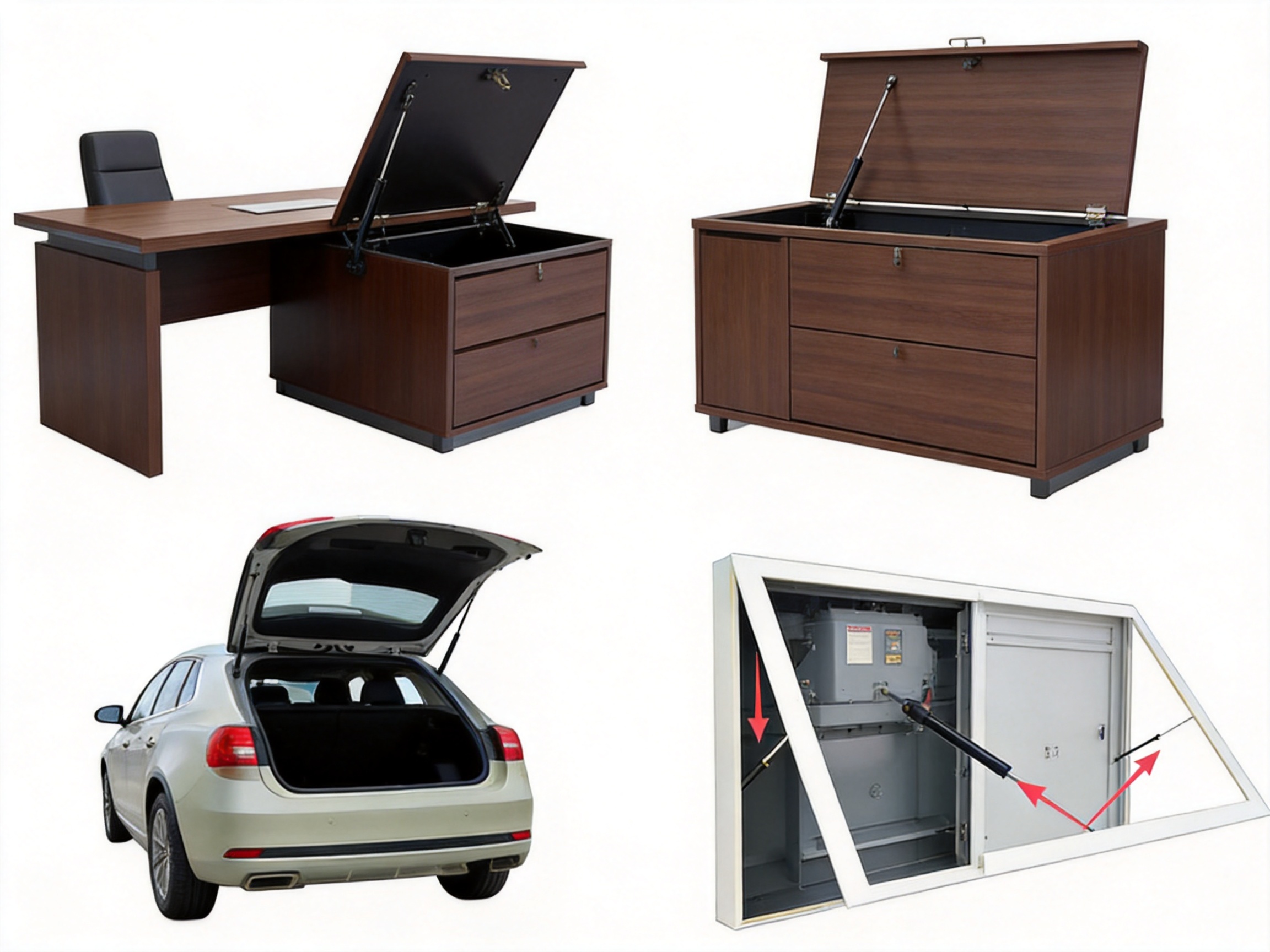
Gas springs are useful in furniture designs that include lifting lids, storage compartments, flip-top work surfaces, monitor platforms, and access panels. They help users open components smoothly while keeping the furniture visually clean. In office environments, controlled movement is valuable because products may be used frequently and often in shared spaces where noise should be minimized.
Although a standard free-type gas spring does not replace an electric height-adjustment system, it can complement adjustable desk designs by assisting smaller hinged sections or accessory modules. For example, it can support a cable-management cover, a lifting storage compartment, or a foldable extension panel. Its compact size allows it to be integrated without significantly changing the external appearance of the desk.
Automotive Hoods and Tailgates
Vehicle hoods, trunks, and tailgates are common applications for gas springs. The spring helps raise the panel and supports it in the fully open position. Stainless steel or suitable protective finishes may be selected when exposure to moisture, road salt, temperature variation, and dirt is a concern. Automotive applications require careful attention to force stability, mounting geometry, temperature behavior, and safety margins.
The controlled movement provided by hydraulic damping can make a vehicle panel feel more refined and reduce the likelihood of a sudden stop at the end of travel. Correct matching is essential: excessive force may make closing difficult, while insufficient force may prevent the panel from remaining open.
Home Furnishings
Storage beds, lift-top tables, cabinets, recliner mechanisms, kitchen units, and other furnishings can benefit from assisted movement. A gas spring is especially useful when the panel is too heavy or awkward to lift manually but does not require position locking. The product can be installed inside a frame to preserve a neat appearance while making the furniture more accessible.
Equipment Enclosures
Industrial machines, electrical cabinets, generator covers, inspection hatches, and protective enclosures often use gas springs to support access doors. The spring reduces the force needed for service access and helps keep the door from dropping unexpectedly. The correct material and surface protection should be selected according to the equipment environment.
Bus Shelter Advertising Kiosks and Public Installations
Advertising kiosks and public information units may include hinged panels that must be opened for poster replacement, cleaning, or maintenance. A gas spring can make these tasks faster and more manageable. Since public installations may experience frequent use and outdoor exposure, product selection should consider corrosion resistance, vandalism risk, temperature variation, and the need for robust attachment points.
Manufacturing Strengths and Quality-Oriented Production
SuZhou Skyhone Intelligent Technology Co., Ltd. is based in Suzhou, Jiangsu Province, a region known for its developed manufacturing infrastructure and extensive furniture industry supply chain. This location provides access to supporting industries, processing resources, engineering talent, and logistics networks. These advantages are relevant to customers seeking coordinated production for standing desks, office products, actuators, and gas spring components.
The company describes itself as a professional manufacturing enterprise involved in research and development, production, sales, and service. This integrated structure is important for gas spring projects because performance depends on the relationship between product design, manufacturing tolerances, force selection, attachment design, and the final application. A supplier that understands the complete product environment can provide more useful technical support than a source focused only on selling standardized cylinders.
Engineering and Application Development
Gas spring selection should begin with application analysis rather than a simple comparison of nominal force. Product engineers need to consider the component weight, center of gravity, hinge axis, opening angle, desired opening effort, available installation space, compressed length, extended length, cycle frequency, and environmental conditions. Skyhone’s broader experience with furniture systems and intelligent office products supports an application-oriented approach to these requirements.
Where a standard specification is suitable, the customer can benefit from an efficient and economical product. Where a project needs different dimensions, attachment points, force values, or material choices, technical communication can help identify an appropriate configuration. Customization should be managed carefully because even small changes in length, force, or mounting position may affect the user experience.
Precision-Oriented Component Production
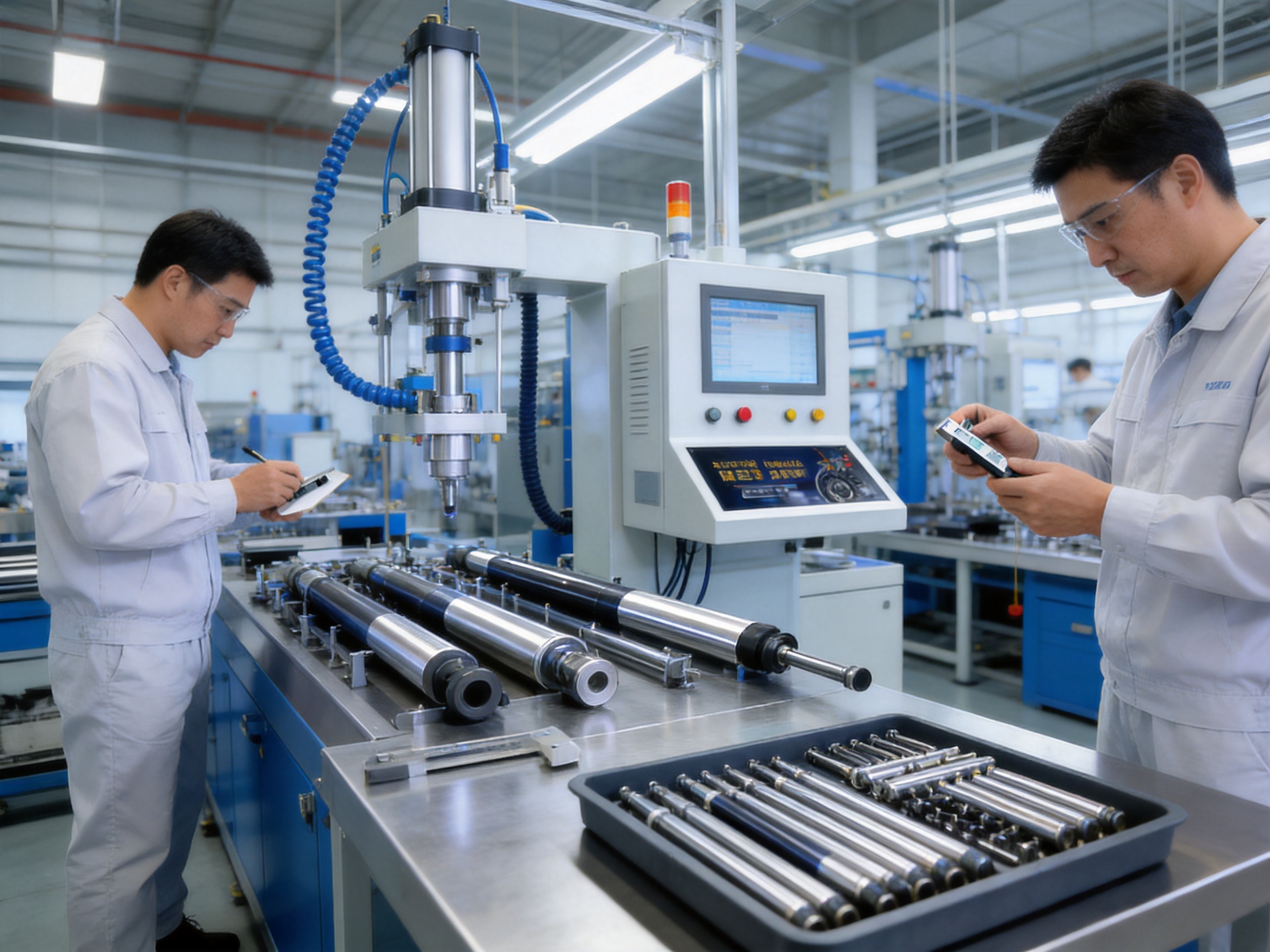
A gas spring requires coordinated control of tube dimensions, piston rod surface quality, seal installation, internal assembly, and gas charging. Consistency in these areas helps reduce variation in extension force and movement behavior. Precision steel tubing provides a stable base for cylinder assembly, while a properly finished piston rod supports reliable seal contact during repeated operation.
Manufacturing quality is also influenced by cleanliness and assembly discipline. Dust, metal particles, or improper sealing during production can affect leakage resistance and damping performance. A controlled production environment, appropriate inspection procedures, and traceable process management are therefore important parts of a dependable gas spring supply system.
Intelligent Manufacturing Direction
The company’s focus on intelligent manufacturing reflects the growing need for repeatable production, efficient coordination, and data-informed quality control. Intelligent manufacturing does not simply mean using automated equipment. It also involves organizing production information, reducing avoidable variation, improving process visibility, and coordinating engineering, purchasing, assembly, inspection, and delivery.
For international customers, a structured production process can provide practical advantages. These include clearer specification confirmation, better batch consistency, more predictable lead-time coordination, and easier communication about design changes. Such capabilities are particularly valuable when gas springs are supplied as part of a larger furniture or equipment project.
Integrated Service Capability
Product performance is affected by installation and application design, so service should continue beyond the shipment of the component. An effective supplier helps customers clarify dimensions, forces, attachment requirements, packaging expectations, and application conditions. This reduces the likelihood of selecting a spring that is technically within a general range but unsuitable for the actual product.
Skyhone combines product supply with research and development, sales, and service functions. This can support a more direct communication path between customers and production teams. For manufacturers, such coordination may simplify new-product development, sample confirmation, repeat orders, and adjustments to production specifications.
Material and Configuration Considerations
Precision Steel Tubing
Seamless precision steel tubing is a practical solution for many standard gas spring applications. It offers a strong and stable cylinder structure while supporting efficient manufacturing. It is suitable for indoor furniture, office equipment, general machinery, and other environments where ordinary protective treatment is adequate.
Stainless Steel Construction
Stainless steel can provide improved resistance to moisture and corrosion. It may be preferred for vehicle-related applications, humid locations, outdoor equipment, public facilities, or products that require a particular appearance. Material selection should consider not only the cylinder but also the piston rod, end fittings, brackets, and surrounding components. A corrosion-resistant cylinder alone may not provide complete system protection if other exposed parts are unsuitable for the environment.
End Fittings and Mounting Hardware
End fittings connect the gas spring to the product structure. Ball sockets, eyelets, clevises, threaded ends, and other connection styles may be used depending on the design. The mounting hardware must tolerate the applied load and should permit the gas spring to follow the natural arc of the hinged component.
Side loading should be minimized. A gas spring is intended primarily to work along its axis. Misalignment, bending, or lateral force can increase friction, accelerate seal wear, and shorten service life. Brackets should be rigid enough to prevent movement that changes the installation angle during operation.
How to Select the Correct Gas Spring
Measure the Application
Begin by recording the weight of the moving component and identifying its center of gravity. Measure the hinge location, available mounting points, required open angle, and the space available for the compressed and extended spring. The center distance and stroke must allow the spring to complete the required movement without bottoming out or reaching an unsuitable angle.
Estimate the Required Force
The required gas force depends on more than the weight of the lid or door. The distance between the center of gravity and the hinge, the distance between the gas spring mounting point and the hinge, and the angle of the spring all affect the torque balance. In many cases, two gas springs are used to distribute the load and improve stability.
A spring that is too weak may fail to support the component or may require excessive manual effort. A spring that is too strong may cause difficult closing, excessive stress on the hinge, or an unsafe opening action. Testing a prototype is recommended before finalizing a production specification.
Choose the Stroke and Length
The stroke must be sufficient to achieve the desired opening angle, but excess stroke may create an unnecessary package length. The fully compressed length should fit inside the product without interference. The extended length should support the intended open position without forcing the hinge beyond its designed range.
Consider the Environment
Indoor office furniture normally has less demanding environmental exposure than an automotive tailgate or outdoor kiosk. Temperature range, humidity, salt, dust, cleaning chemicals, ultraviolet exposure, and frequency of use should all be considered. These factors influence the preferred cylinder material, surface finish, seal selection, and inspection requirements.
Confirm Whether Locking Is Needed
The standard free-type gas spring is appropriate when the product needs assistance between the closed and open positions but does not require intermediate locking. If the user must lock a lid at a selected height or prevent movement in a specific position, a lockable gas spring or another mechanism may be more suitable. Choosing the simplest mechanism that satisfies the application can improve cost, reliability, and ease of use.
Installation and Operating Recommendations
Gas springs should be installed according to the specified orientation and mounting instructions. In many designs, the cylinder is positioned so that the hydraulic oil can provide effective damping near the closing end of travel. The exact orientation depends on the product design and the desired movement characteristics, so the supplier’s technical guidance should be followed.
Attachment points should be aligned before the spring is connected. Do not force the spring into position or use it to correct a structural misalignment. The mounting brackets should be parallel and securely fastened. If ball sockets or clips are used, verify that they are fully engaged before operating the product.
After installation, move the supported component slowly through its complete range. Check for interference, abnormal noise, side loading, uneven movement, and excessive force at either end. Confirm that the spring does not contact sharp edges or become pinched by nearby parts.
Users should not drill into, heat, cut, crush, or disassemble a pressurized gas spring. The internal gas and oil are contained under pressure, and the unit should be replaced if it shows leakage, severe corrosion, bent rod damage, or abnormal loss of force. External cleaning should be performed with materials compatible with the protective finish and seal area.
Why a Standard Design Can Outperform More Complex Alternatives
More features do not always produce a better solution. Locking gas springs, motorized mechanisms, and complex linkages can be valuable when their functions are required, but they also introduce additional components, adjustment points, cost, and potential failure modes. A standard free-type gas spring is often the better choice when the application only needs assisted opening and controlled closing.
Its advantage is functional efficiency. The component performs the necessary task with a sealed pneumatic system, a straightforward installation method, and no electrical power. This makes it suitable for products where reliability, simplicity, and low maintenance are more important than programmable movement or intermediate positioning.
Compared with low-cost support components that lack consistent damping or dimensional control, a properly manufactured gas spring can provide a more stable user experience. Consistent force, smooth rod movement, secure seals, and suitable end fittings all contribute to the perceived quality of the finished product.
Quality, Testing, and Long-Term Reliability
Reliability begins with correct design, but it also depends on manufacturing and inspection. Important quality considerations include dimensional accuracy, extension force, compressed and extended length, leakage resistance, damping behavior, rod surface condition, end-fitting security, and visual finish.
Prototype testing should reproduce the intended operating conditions as closely as possible. The test should consider the actual load, hinge geometry, opening and closing speed, temperature, installation orientation, and cycle frequency. A gas spring that performs well in a simple hand test may require further evaluation when installed in a complete product.
Batch consistency is also important. If several gas springs are installed on the same product or across a production line, excessive force variation can create uneven operation. A controlled manufacturing process helps reduce differences between units and supports more predictable assembly.
For professional buyers, supplier evaluation should include more than unit price. Production capability, material options, engineering responsiveness, sample support, packaging, delivery coordination, and after-sales communication can influence the total cost of ownership. A reliable supplier helps prevent redesign, installation problems, and field complaints.
Value for Furniture and Equipment Manufacturers
For manufacturers, standard free-type gas springs can improve product usability without requiring a major redesign. A supported lid may become easier to operate, an access panel may become safer for service personnel, and a vehicle or enclosure may gain a more polished opening and closing action. These benefits can strengthen product differentiation in markets where users notice convenience and build quality immediately.
The broad range of available dimensions and forces also supports product families. A manufacturer may use related gas spring designs across several models while adjusting the stroke, center distance, or force rating to match each product. This can simplify purchasing and technical documentation while preserving application-specific performance.
Skyhone’s combination of gas spring products with adjustable desk and electric actuator expertise can be useful for customers developing complete ergonomic furniture systems. A project may require electric height adjustment for the main desk frame, gas spring support for a hinged work surface, and coordinated structural components for cable management or storage. A supplier familiar with related mechanisms can help simplify technical coordination.
Q&A
What is a free-type gas spring?
A free-type gas spring is a sealed pneumatic support component that uses pressurized nitrogen to create extension force and hydraulic oil to provide damping. It normally operates between fully compressed and fully extended positions and does not lock at intermediate points.
How is it different from a lockable gas spring?
A standard free-type gas spring provides lifting assistance and controlled movement but does not include a mechanism for holding the rod at a selected intermediate position. A lockable gas spring includes an additional locking function that can secure the rod according to the product design.
Can a free gas spring hold a lid open?
Yes. When correctly selected and installed, it can help raise a lid and support it in the fully open position. The ability to hold the lid open depends on the spring force, mounting geometry, lid weight, hinge design, and opening angle.
How do I choose the correct force?
Consider the moving component’s weight, center of gravity, hinge position, mounting points, opening angle, and desired operating effort. The nominal newton rating should be evaluated together with the installation geometry. Prototype testing is recommended for final confirmation.
What does center distance mean?
Center distance generally describes the distance between the centers of the two attachment points in a specified spring position. It is used with the stroke to determine whether the gas spring will fit and move correctly in the application.
What is the purpose of hydraulic oil?
Hydraulic oil provides damping by controlling the speed of piston movement. It helps reduce sudden extension or compression and supports a quieter, softer movement near the end of travel.
Are gas springs maintenance-free?
The sealed internal design is intended to operate without adding gas or oil. However, the external component and mounting hardware should be inspected periodically for corrosion, leakage, bending, loose fasteners, or other signs of damage.
Can these gas springs be used outdoors?
They may be suitable for outdoor or exposed applications when the selected materials, finishes, seals, and fittings are appropriate for the environment. Stainless steel may be preferred where moisture or corrosion is a major concern. The complete application should be reviewed before selection.
Can a gas spring be installed at any angle?
Installation angle affects damping, force behavior, and mechanical loading. The spring should be installed in the orientation recommended for the application. It must also be aligned with the movement to minimize side loading.
What happens if the gas spring is too strong?
A spring that is too strong may make closing difficult, cause the lid to open too quickly, overload brackets or hinges, and create an uncomfortable or unsafe operating experience. Correct force selection is essential.
What happens if the gas spring is too weak?
A weak spring may not provide sufficient lifting assistance or may fail to keep the component open. The user may need to apply excessive force, and the unsupported component could close unexpectedly.
Can two gas springs be used on one lid?
Yes. Two gas springs are often used to distribute the load and improve balance, especially on wide or heavy panels. Both units should have compatible specifications and be installed symmetrically where possible.
What materials are available for the cylinder?
The stated product options include seamless precision steel tubing and stainless steel. The appropriate choice depends on application environment, corrosion requirements, appearance, cost, and the materials used for the other exposed components.
What industries can use this product?
Typical applications include automotive hoods and tailgates, office furniture, home furnishings, equipment enclosures, industrial access panels, bus shelter advertising kiosks, and other hinged structures requiring assisted movement.
Why work with a manufacturer rather than purchase an unverified standard part?
A manufacturer can help match the force, dimensions, materials, fittings, and installation conditions to the application. This reduces the risk of selecting a part that fits physically but does not provide the desired operating performance.
Conclusion
The standard free-type gas spring is a simple but highly effective solution for assisted lifting, controlled opening, and cushioned closing. Its sealed nitrogen-and-oil construction provides dependable support without electrical power or complicated maintenance. With no intermediate locking mechanism, it remains economical and easy to integrate into products that only require fully open and fully closed operating limits.
Its advantages include reduced user effort, smoother movement, lower closing impact, compact installation, broad specification availability, and strong cost-effectiveness. The product can serve applications ranging from adjustable furniture accessories and household storage units to automotive panels, industrial enclosures, and public information kiosks.
Product performance depends on correct selection, accurate mounting, suitable material choice, and consistent manufacturing. SuZhou Skyhone Intelligent Technology Co., Ltd. combines gas spring supply with research and development, production, sales, and service capabilities. Based in Suzhou and connected to the region’s developed furniture manufacturing ecosystem, the company is positioned to support standard products as well as application-specific requirements.
For buyers and product developers, the best results come from treating the gas spring as part of the complete mechanical system. Weight, geometry, stroke, center distance, force, environment, fittings, and user expectations must all be considered together. When these factors are properly matched, a standard free-type gas spring can provide a durable, quiet, and professional operating experience across a wide variety of products.
References
1. General principles of pneumatic gas spring construction, including pressurized nitrogen, piston movement, hydraulic damping, and sealed-cylinder operation.
2. Mechanical design practice for hinged lids, doors, hatches, access panels, and assisted opening systems.
3. Product specification data for standard free-type gas springs, including tube diameter, rod diameter, center distance, stroke, and pressure-force ranges.
4. Practical guidelines for gas spring mounting geometry, force selection, alignment, end fittings, and application testing.
5. Materials and corrosion-resistance considerations for precision steel tubing and stainless steel components used in furniture, automotive, industrial, and outdoor applications.
6. Manufacturing quality principles for sealed pneumatic components, including dimensional control, assembly cleanliness, leakage prevention, surface inspection, and batch consistency.
7. Application information supplied for standard free-type gas springs by SuZhou Skyhone Intelligent Technology Co., Ltd.
Product: Standard free-type gas spring


- Contact Info
-
-
 Phone+86-15950656125
-
 Email
-
 AddressRoom 1007-1, South Building, Suyue Plaza, Suzhou Industrial Park, Suzhou City, Jiangsu Province, China
-
- Products
- Follow Us
- Need help? Please contact us
Copyright ©
SuZhou Skyhone Intelligent Technology Co., Ltd.
All Rights Reserved.
Privacy
Custom Ergonomic Adjustable Office Tables Manufacturers

