

 English
  русский
  Español
  عربى
عربى 
Content
- 1 Product Overview
- 2 Key Technical Specifications
- 3 Why Pneumatic Height Adjustment Matters
- 4 Advantages Over Common Competitor Designs
- 5 Ergonomic Value for Daily Work
- 6 Mobility and Spatial Flexibility
- 7 Material and Surface Treatment
- 8 Manufacturing Strength Behind the Product
- 9 Quality Control and Reliability
- 10 Customization and Application Flexibility
- 11 Office Use: Supporting Healthier Work Habits
- 12 Laboratory and Technical Environments
- 13 Studio, Creative, and Educational Use
- 14 Design Balance: Compact but Capable
- 15 Sustainability and Maintenance Considerations
- 16 Buyer Considerations
- 17 Q&A Section
- 17.1 What is the main advantage of the TH-14 Double-Leg Pneumatic Height-Adjustable Desk?
- 17.2 What is the height adjustment range?
- 17.3 How large is the tabletop?
- 17.4 Does the desk require electricity?
- 17.5 How does the gas spring mechanism compare with an electric motor?
- 17.6 Why is the dual-leg design important?
- 17.7 Can the desk be moved easily?
- 17.8 What material is used for the frame?
- 17.9 What surface treatment is applied?
- 17.10 Where can the TH-14 be used?
- 17.11 Is it suitable for shared workspaces?
- 17.12 What makes the manufacturer competitive?
- 18 Conclusion
- 19 References
Double-Leg Pneumatic Height-Adjustable Desk for Flexible Workspaces
2026-05-18
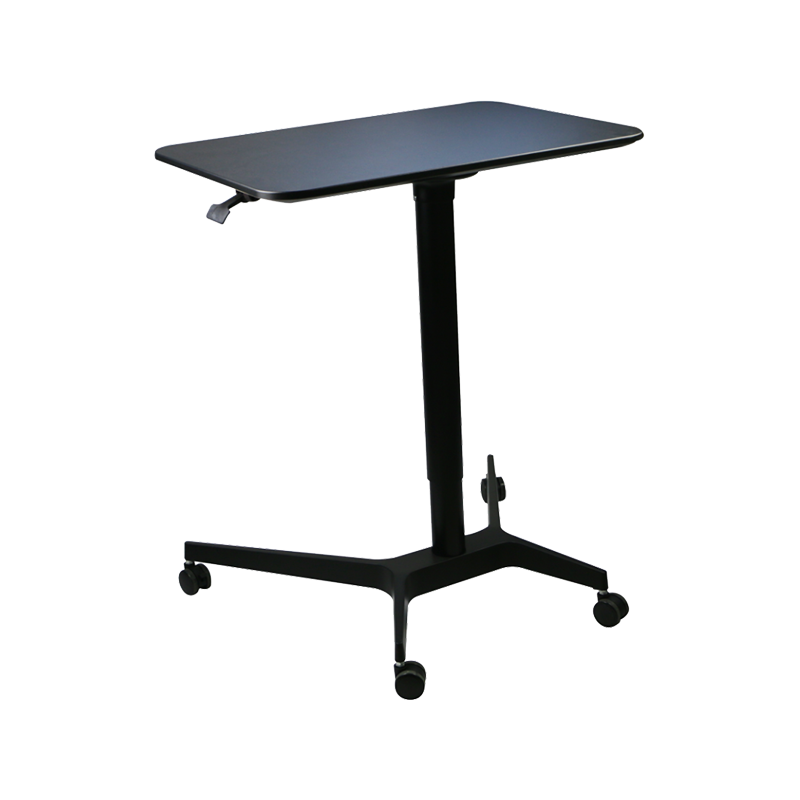
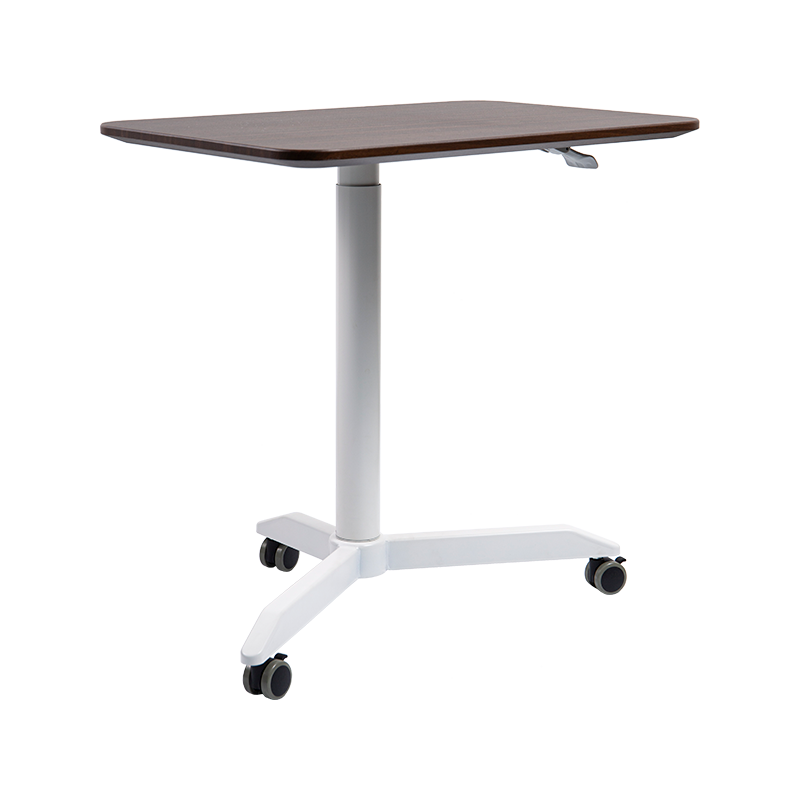
Modern workspaces are no longer defined by fixed seating, static layouts, or one-size-fits-all furniture. Offices, laboratories, studios, education rooms, training centers, and home work areas increasingly require equipment that can adapt quickly to different users, tasks, and spatial arrangements. The TH-14 Double-Leg Pneumatic Height-Adjustable Desk is designed for this environment. It combines stepless gas spring height adjustment, a stable dual-leg metal frame, a compact tabletop, a black powder-coated surface, and mobile caster support to create a practical desk solution for sit-stand working and flexible movement.
Unlike electric height-adjustable desks that depend on motors, controllers, cables, and power access, this pneumatic desk uses a gas spring lifting mechanism. The result is a simpler, cleaner, and more mobile structure. Users can adjust the desk height manually without connecting to electricity, making the desk especially useful in spaces where power outlets are limited, where frequent relocation is required, or where a low-maintenance solution is preferred.
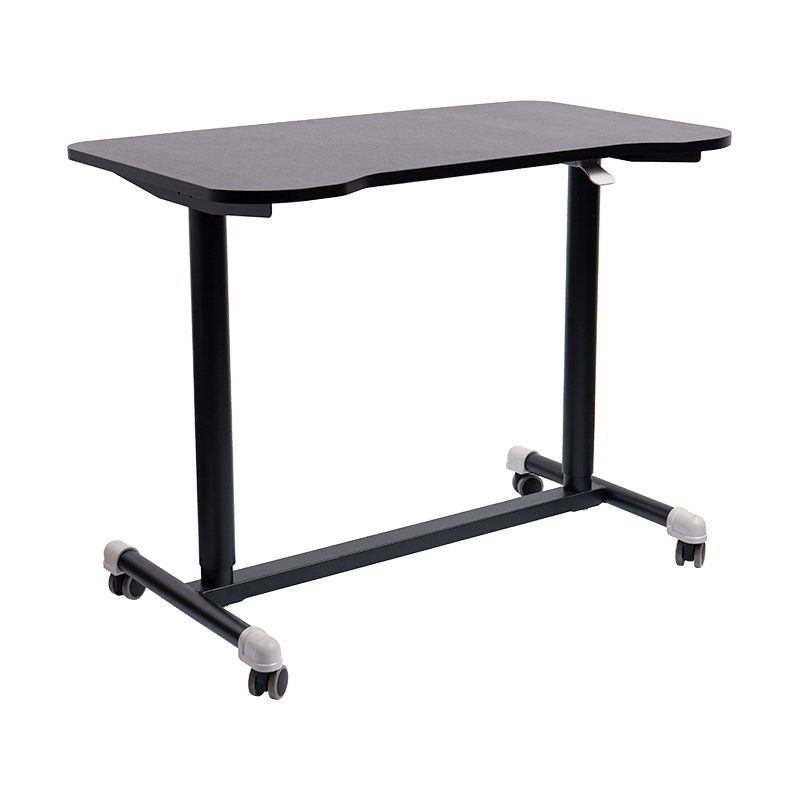
The TH-14 offers a lifting range from 760 mm to 1100 mm, supporting seated and standing postures for a wide range of common working scenarios. Its 980 mm by 560 mm tabletop provides enough room for a laptop, monitor, keyboard, documents, tools, or instruments, while maintaining a compact footprint suitable for offices, laboratories, classrooms, studios, and home study rooms. The product is built with an iron structure, finished in black powder coating, and equipped with four casters, including two locking wheels and two non-locking wheels. These features combine mobility with stability, allowing the desk to be repositioned when needed and secured during use.
SuZhou Skyhone Intelligent Technology Co., Ltd. develops and manufactures standing desk and ergonomic workstation solutions with a focus on practical engineering, stable performance, and efficient production. Located in Suzhou, within the Yangtze River Delta furniture and manufacturing ecosystem, the company benefits from strong supply chain resources, skilled production capabilities, and a mature industrial environment. This background supports consistent product quality, customization capability, and reliable service for global buyers seeking ergonomic adjustable office tables and related components.
Product Overview
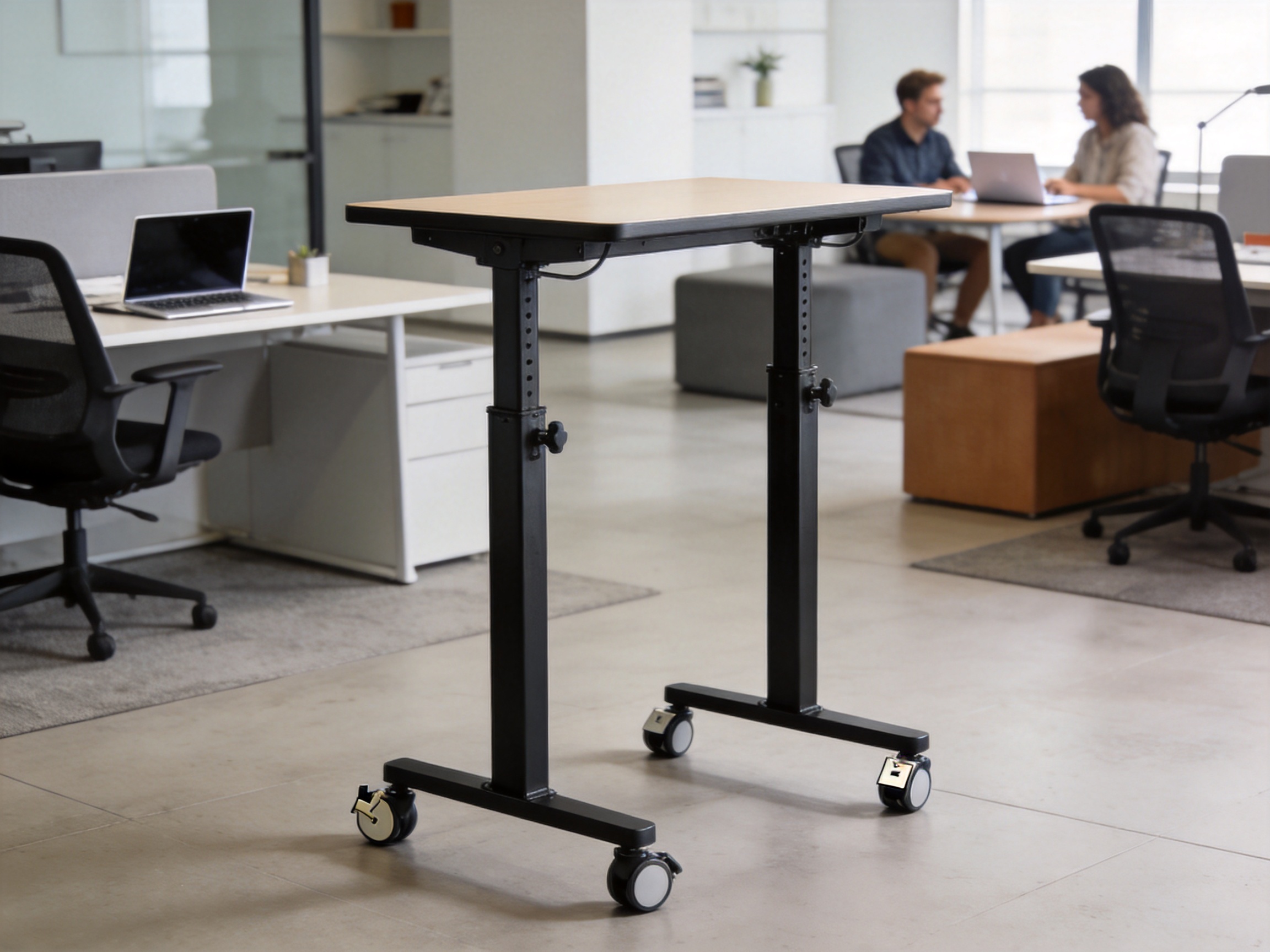
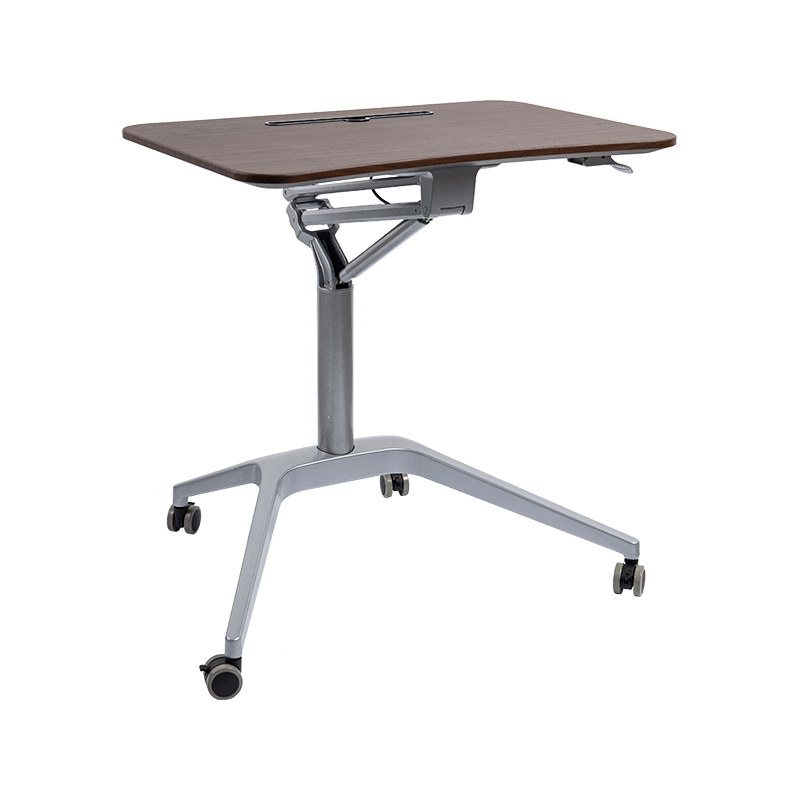
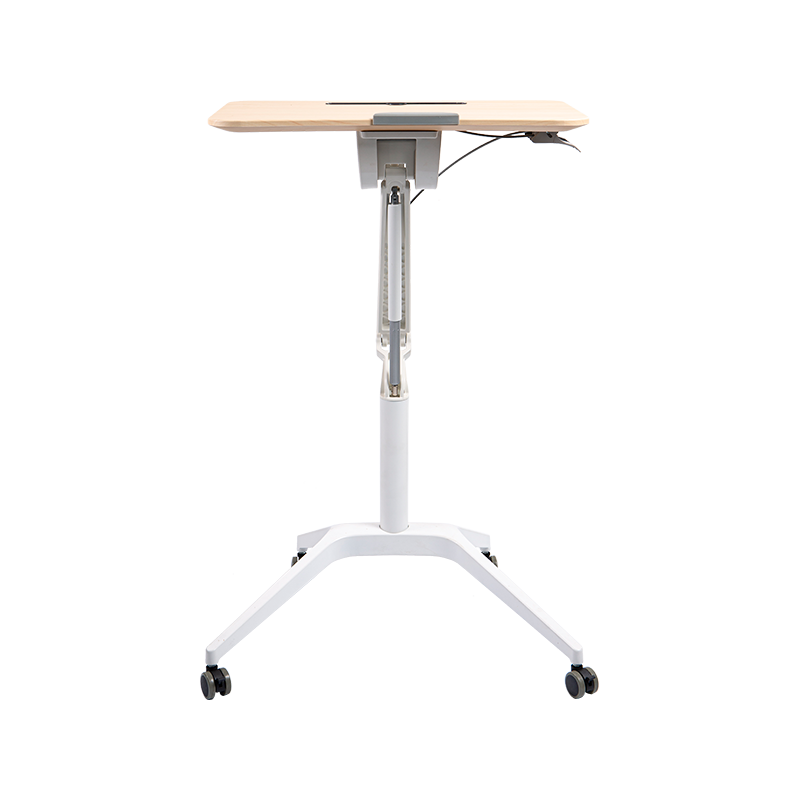
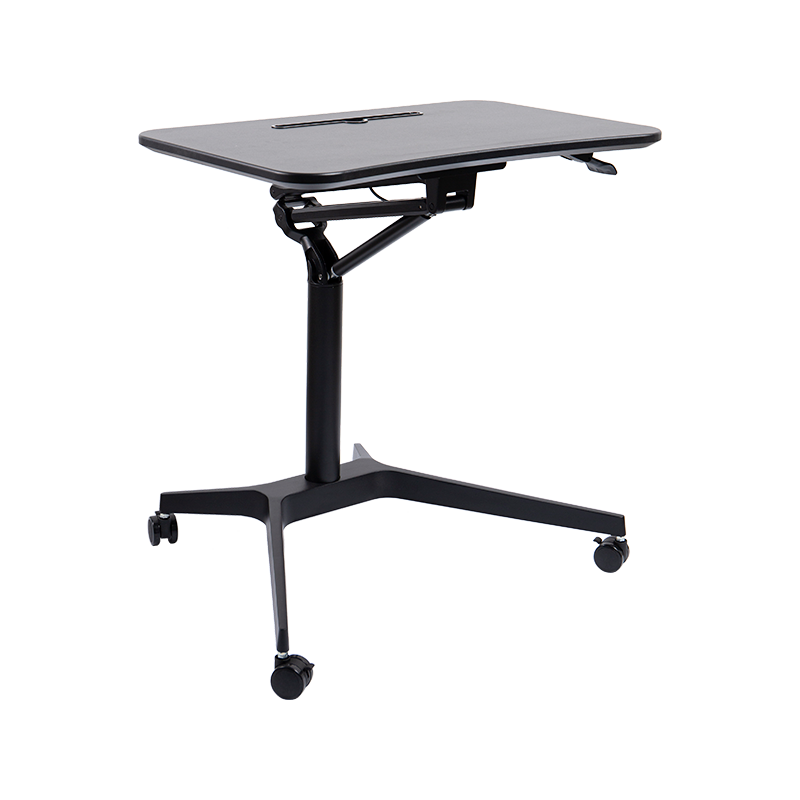
The TH-14 Double-Leg Pneumatic Height-Adjustable Desk is a height-adjustable table designed around three core user needs: ergonomic posture adjustment, easy mobility, and dependable structural support. It is suitable for people who want to alternate between sitting and standing without using an electric lifting system. The pneumatic lifting principle provides smooth manual adjustment, while the dual-leg frame improves overall balance compared with many single-column mobile desks.
The desk’s height range of 760 mm to 1100 mm covers many common seated and standing working positions. At the lower end, the desk can be used as a standard workstation surface for typing, writing, reading, or equipment placement. At the upper end, it can serve as a standing desk for focused work, presentations, collaborative discussions, or short-term operational tasks. Because the adjustment is stepless, users are not limited to preset height increments. They can set the desk at the position that best matches their body height, chair height, task type, and preferred working posture.
The tabletop size, 980 mm by 560 mm, reflects a balance between usable surface area and space efficiency. It is large enough to support typical office equipment, but compact enough for environments where mobility and floor space are important. This makes the desk practical not only as a personal workstation, but also as a shared mobile desk, training desk, demonstration table, laboratory auxiliary bench, studio table, or temporary project station.
The main structure uses iron material, selected for its strength, durability, and suitability for load-bearing office furniture. The black powder-coated finish creates a clean, professional appearance while improving resistance to wear and corrosion. Powder coating is also valued in industrial production because it produces a uniform finish and supports consistent surface quality across batches.
The base is fitted with four swivel casters. Two casters include locking mechanisms, allowing users to secure the desk after moving it into position. This combination is important because a mobile desk must move smoothly when needed, but also remain stable during use. The caster design supports both requirements, making the desk adaptable to dynamic spaces.
Key Technical Specifications
Product Model |
TH-14 Double-Leg Pneumatic Height-Adjustable Desk |
Product Category |
Pneumatic Height-Adjustable Table |
Lifting Range |
760 mm to 1100 mm |
Tabletop Size |
980 mm by 560 mm |
Main Material |
Iron |
Surface Color |
Black |
Surface Treatment |
Powder Coating |
Caster Configuration |
Two casters with locks and two casters without locks |
Working Principle |
Gas Spring Lifting |
Typical Applications |
Office workstations, laboratory benches, studio tables, home study areas, training rooms, and flexible collaborative spaces |
Why Pneumatic Height Adjustment Matters
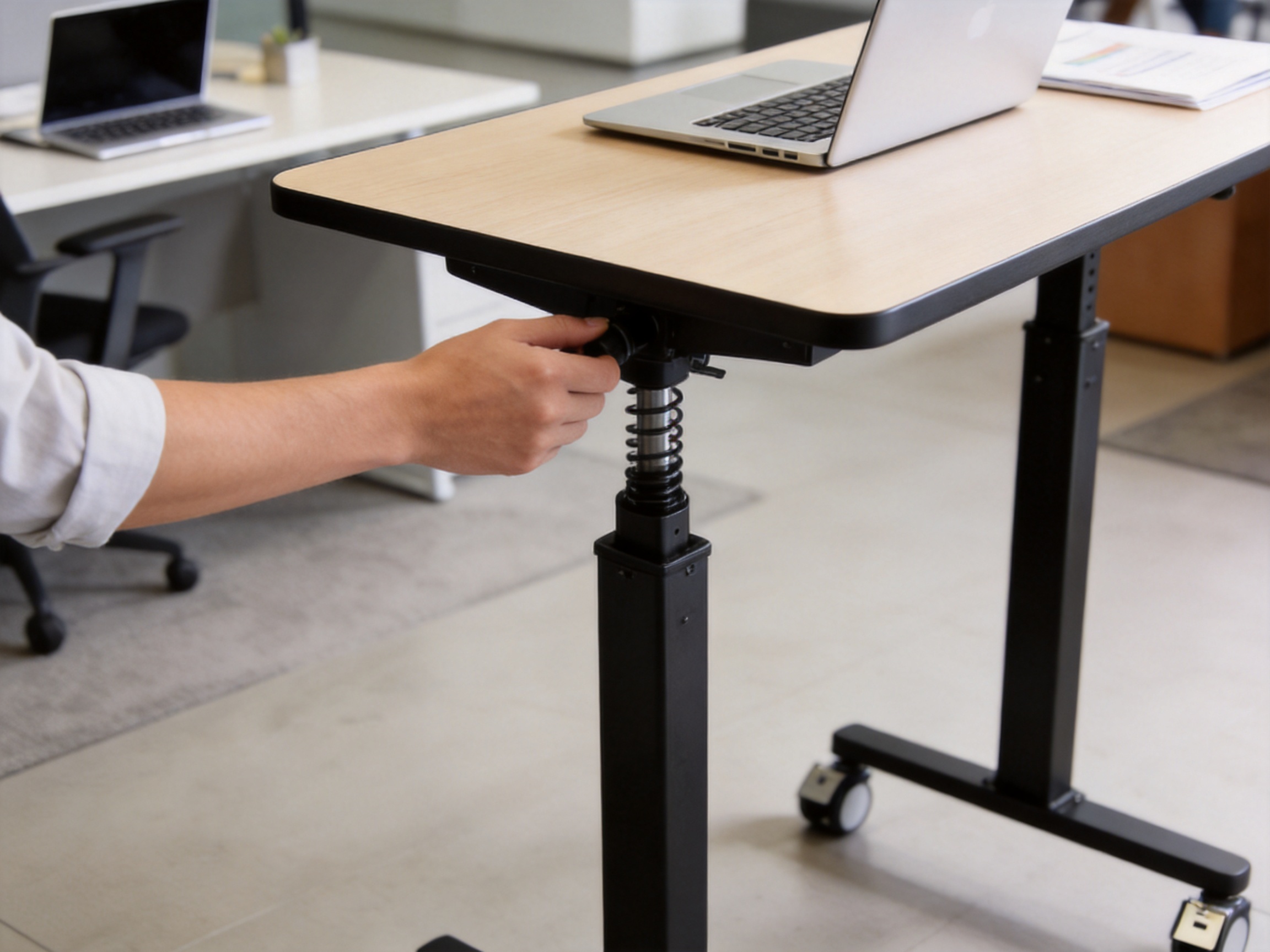
Height-adjustable desks are often associated with electric motors, but pneumatic adjustment provides a strong alternative for many workplaces. A gas spring mechanism uses stored pressure to assist lifting and lowering. This allows users to change desk height through manual operation with less effort than a purely mechanical lifting system. The movement is smooth, direct, and intuitive.
One of the main advantages of pneumatic adjustment is independence from electrical power. The TH-14 does not require a power outlet, control box, cable routing, or electronic keypad. This simplifies installation and eliminates concerns related to power access, electrical component maintenance, and cable clutter. In mobile workspaces, this is particularly valuable because users can move the desk freely without considering cord length or plug location.
Another advantage is operational simplicity. Electric desks can offer programmable height memory and heavy-load capacity, but they also introduce more parts that may require maintenance over time. Motors, control units, wiring, adapters, switches, and sensors can increase complexity. A pneumatic desk keeps the core lifting system simpler. For users who need reliable height adjustment without advanced electronic features, the gas spring system offers a practical and efficient solution.
The stepless adjustment of the TH-14 also improves user comfort. Some desks adjust only through fixed holes or limited locking positions, forcing users to choose the closest available height rather than the ideal height. With a gas spring mechanism, the user can stop at a preferred position within the full range. This supports more personalized ergonomic settings, whether the task involves typing, drawing, measuring, assembling, reading, presenting, or using laboratory tools.
The pneumatic system is also beneficial in environments where noise control matters. Motorized desks generate operational sound when raising or lowering, which may be noticeable in shared offices, libraries, classrooms, and clinical support areas. A gas spring system typically operates quietly, helping maintain a calm working environment.
Advantages Over Common Competitor Designs
The market for height-adjustable desks includes electric standing desks, hand-crank desks, single-column mobile desks, fixed-height tables, and lightweight portable workstations. The TH-14 occupies a practical position among these options by combining mobility, pneumatic adjustment, a dual-leg structure, and a durable metal frame. These characteristics give it several advantages over competing designs.
Compared with Fixed-Height Desks
Traditional fixed-height desks are simple and familiar, but they cannot adapt to different users or changing tasks. In shared workplaces, one fixed height may be too high for some users and too low for others. Over time, poor desk height can contribute to uncomfortable wrist, shoulder, neck, and back positions. The TH-14 solves this limitation by offering a 760 mm to 1100 mm adjustment range. Users can change height according to posture, body size, and task requirements.
Fixed desks also reduce spatial flexibility. Once placed, they are often difficult to move, especially if they are large or not equipped with casters. The TH-14, by contrast, is designed for mobility. Its four casters make relocation simple, while the locking wheels provide stability when the desk is in use. This makes it more suitable for modern layouts where teams may reconfigure rooms for meetings, training, individual work, or collaborative sessions.
Compared with Electric Height-Adjustable Desks
Electric desks are popular for their convenience, but they are not always the best choice for every environment. They require power and include electrical components that can add cost, weight, and maintenance complexity. The TH-14 provides height adjustment without electricity. This makes it useful in mobile work areas, temporary setups, classrooms, workshops, and spaces where clean cable management is important.
Another advantage is deployment speed. An electric desk may require assembly of motors, wiring, control boxes, and power adapters. The pneumatic TH-14 has a more straightforward operating principle, reducing setup complexity. For organizations purchasing multiple units, simpler deployment can save time and reduce operational inconvenience.
Electric desks can also be less convenient when frequently moved. Cables must be unplugged, secured, and reconnected. If connected to monitors, chargers, or docking stations, movement becomes more complicated. The TH-14’s non-electric lifting system supports free relocation without dependence on nearby outlets, offering a cleaner solution for flexible workspaces.
Compared with Hand-Crank Desks
Hand-crank desks are another non-electric option, but they require repeated turning to raise or lower the surface. This can discourage frequent posture changes because adjustment takes time and effort. A pneumatic lifting system is faster and more intuitive. The user can adjust height smoothly through manual control without rotating a crank many times.
In environments where multiple users share the desk, quick adjustment is especially important. A shared desk may need to change height several times per day. The TH-14’s gas spring mechanism makes this process more convenient than a hand-crank system, supporting more consistent ergonomic use.
Compared with Single-Column Mobile Desks
Many mobile height-adjustable desks use a single central column. While single-column designs can be compact, they may be more vulnerable to wobble, especially when the tabletop is wide or loaded unevenly. The TH-14 uses a double-leg design that improves support across the width of the work surface. This enhances balance and gives users greater confidence when typing, writing, or placing equipment on the desk.
The 980 mm tabletop width benefits from the dual-leg support because the structure distributes forces more evenly. For users who require a stable surface for documents, devices, tools, or small instruments, this design is more suitable than many narrow or lightweight single-post alternatives.
Compared with Lightweight Portable Tables
Portable tables can be easy to move, but they often compromise stability, durability, and adjustability. The TH-14 uses an iron frame and powder-coated surface, supporting stronger structural performance. It is mobile, but it is not simply a lightweight temporary table. It is designed as a practical workstation that can be moved and adjusted while still providing a stable user experience.
This combination makes the product attractive for buyers who want mobility without sacrificing durability. The desk can support everyday professional use in offices, laboratories, studios, and home workspaces, while maintaining the flexibility needed for changing layouts.
Ergonomic Value for Daily Work
Ergonomics is not only about furniture shape; it is about helping the user maintain healthier and more efficient working positions throughout the day. A height-adjustable desk supports ergonomic behavior by allowing posture variation. Instead of remaining seated for long periods, users can alternate between sitting and standing. This can help reduce static strain and encourage movement.
The TH-14’s height range supports many common work postures. At seated height, it can be adjusted to align the tabletop with the user’s elbow level, helping the wrists remain in a more neutral position while typing or writing. At standing height, it allows the user to continue working without bending excessively over the tabletop. The ability to fine-tune height is important because even small differences can affect comfort.
In office environments, the desk can serve as a compact sit-stand workstation. A laptop user can raise the surface for standing work during calls or focused tasks, then lower it for seated work. In a shared office, the same desk can be used by employees of different heights. In a meeting room, it can become a standing collaboration table. In training or education settings, it can support instructors, presenters, or students who need a flexible work surface.
In laboratories, adjustable height can improve task alignment. Different procedures may require different working heights depending on whether the user is observing, writing, handling instruments, or organizing samples. While the TH-14 should be selected according to the specific load and environmental requirements of each laboratory, its mobile and adjustable structure makes it useful as an auxiliary bench or support table.
In creative studios, standing and seated positions often change throughout the day. Designers, photographers, artists, and technicians may need a work surface for laptops, tools, sketches, or small devices. A mobile pneumatic desk can be moved near equipment, windows, backdrops, or collaborative zones, helping the workspace adapt to the project rather than forcing the project to adapt to fixed furniture.
Mobility and Spatial Flexibility
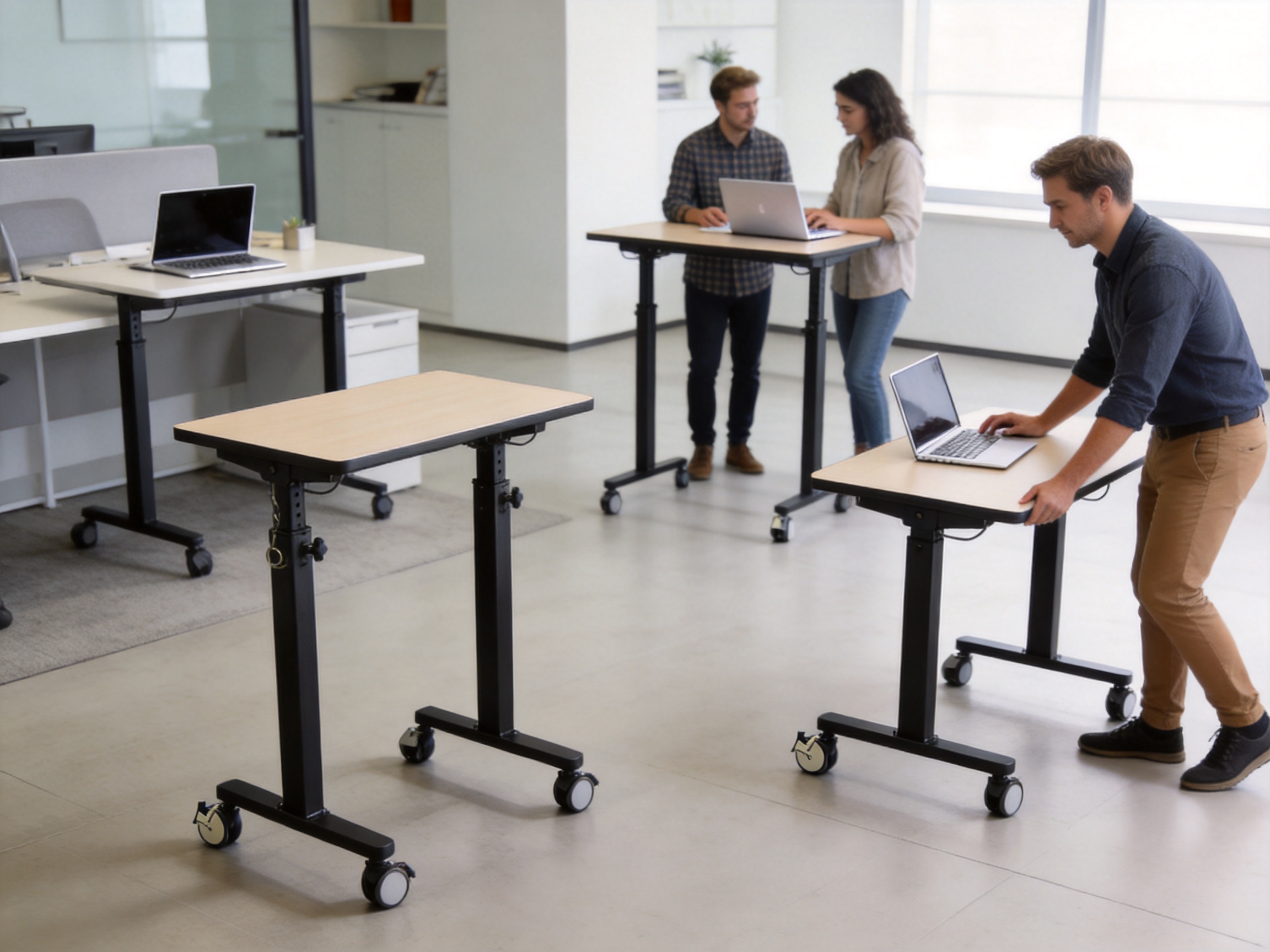
One of the strongest features of the TH-14 is mobility. Flexible workspaces depend on furniture that can move easily and safely. The desk’s four casters allow it to be repositioned across different areas, while two locking casters help secure it after placement. This is especially valuable in spaces that serve multiple functions throughout the day.
For example, a training room may be used for lectures in the morning, group exercises in the afternoon, and equipment demonstrations later in the day. Fixed desks can limit layout changes, but mobile desks allow fast reconfiguration. The TH-14 can be moved to form rows, clusters, individual workstations, or presentation stations.
In offices using agile work methods, teams may frequently reorganize around projects. A mobile height-adjustable desk can serve as a temporary workstation, a standing meeting surface, or a support table for shared equipment. Because it does not require power for height adjustment, it can be placed wherever it is most useful.
Home users also benefit from mobility. Not every home has a dedicated office room. A compact mobile desk can be moved between a bedroom, living room, study corner, or quiet area depending on the time of day. When not in use, it can be repositioned to save space. The locking casters help keep it steady during work sessions.
The caster configuration reflects practical design thinking. If all wheels were unlocked, the desk might shift during use. If all wheels were fixed, movement would be less convenient. By combining two locking and two non-locking casters, the desk balances maneuverability and stability.
Material and Surface Treatment
The TH-14 uses iron as the main frame material. Iron is widely used in furniture structures because it offers strength, rigidity, and manufacturability. A height-adjustable mobile desk must resist forces from lifting, lowering, movement, and everyday work activities. The metal frame helps provide the necessary support.
Surface treatment is equally important. The black powder coating is not only an aesthetic choice; it contributes to durability. Powder coating creates a uniform protective layer over the metal surface. Compared with some liquid paint processes, powder coating can offer strong adhesion, good coverage, and resistance to chipping, wear, and corrosion when properly applied and cured.
The black finish also suits a broad range of interiors. It can match modern offices, technical environments, laboratories, studios, and home workspaces. A neutral professional color helps the desk integrate with different design schemes while maintaining a clean visual appearance.
From a manufacturing perspective, powder coating supports consistent batch production. Proper surface preparation, coating thickness control, curing temperature, and inspection help ensure that each desk frame meets appearance and durability expectations. This is part of the broader manufacturing strength behind the product.
Manufacturing Strength Behind the Product
SuZhou Skyhone Intelligent Technology Co., Ltd. is positioned as a professional manufacturing enterprise focusing on research and development, production, sales, and service of standing desks and ergonomic office solutions. The company’s location in Suzhou provides access to the advanced industrial base of the Yangtze River Delta, a region known for manufacturing capacity, supply chain integration, skilled labor, and logistical advantages.
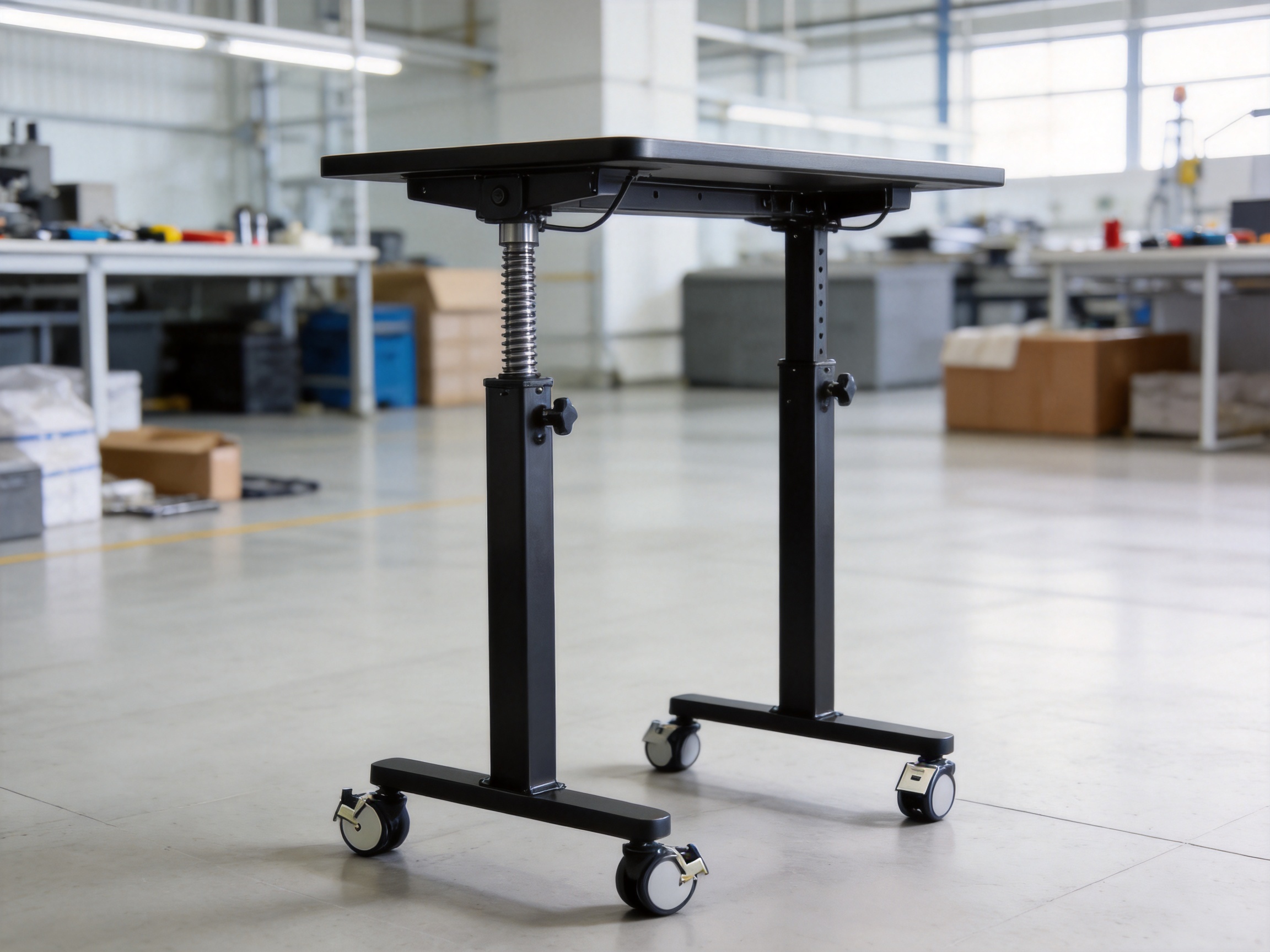
For a product such as the TH-14, manufacturing strength is reflected in multiple stages: design engineering, material selection, metal processing, welding or joining, surface treatment, component assembly, quality inspection, packaging, and after-sales support. Each stage affects the final user experience. A height-adjustable desk must move smoothly, remain stable, look consistent, and perform reliably over repeated use.
Advanced manufacturing begins with product design. The desk must balance tabletop size, lifting range, frame geometry, caster position, and gas spring performance. If the frame is too light, stability may suffer. If the lifting system is poorly matched, adjustment may feel uneven. If caster placement is not properly considered, movement and balance may be affected. A professional manufacturer evaluates these factors during product development to create a practical and repeatable design.
Material sourcing is another strength. A reliable manufacturer works with qualified suppliers for metal tubes, gas springs, casters, tabletop materials, coating materials, fasteners, and packaging. Consistent component quality is essential because even a small variation in a lifting mechanism, caster lock, or frame part can affect assembly and performance.
Metal fabrication requires precision. Cutting, forming, punching, bending, and joining must be controlled to maintain dimensional accuracy. For a dual-leg adjustable desk, alignment is especially important because both sides need to support smooth movement and stable positioning. Accurate fabrication helps reduce wobble, assembly difficulty, and uneven loading.
Surface treatment requires process discipline. Before powder coating, metal surfaces typically need cleaning and preparation to remove contaminants and improve coating adhesion. Powder application must be even, and curing conditions must be controlled. A well-managed coating line supports consistent color, texture, and protective performance.
Assembly processes are equally important. The gas spring lifting system, frame components, caster base, and tabletop connection must be assembled according to standardized procedures. Good manufacturing practice includes torque control for fasteners, functional testing of lifting movement, inspection of caster locking performance, and appearance checks before packaging.
The company’s broader experience in adjustable height desks, electric linear actuators, and gas springs supports product development. Knowledge of lifting mechanisms helps the manufacturer understand how different systems perform under real use conditions. This expertise benefits pneumatic products because gas spring selection and integration are central to user satisfaction.
Quality Control and Reliability
For buyers, a desk is not only a product specification; it is an investment in daily usability. Quality control determines whether the product performs consistently after delivery. A professional manufacturer must evaluate both visible and functional quality.
Visible quality includes surface finish, color consistency, weld appearance, tabletop condition, and general fit. A black powder-coated desk should present a uniform appearance without obvious coating defects. Edges, joints, and contact points should be finished properly so the product feels professional in office and commercial environments.
Functional quality includes height adjustment, stability, caster operation, locking performance, and assembly fit. The gas spring must allow smooth lifting and lowering within the specified range. The desk should not feel unstable during ordinary use. Casters should roll smoothly and lock effectively. Components should align properly so assembly is efficient and final structure is secure.
Reliability also depends on packaging. Mobile height-adjustable desks include structural parts, tabletop components, casters, hardware, and lifting mechanisms that must be protected during transportation. Strong packaging reduces the risk of scratches, dents, coating damage, and missing parts. For international buyers, packaging design is especially important because products may pass through multiple handling stages.
SuZhou Skyhone Intelligent Technology Co., Ltd. supports global users with manufacturing and service capabilities. This means the company is not only producing furniture, but also responding to the requirements of business customers, distributors, project buyers, and custom clients. Professional communication, technical support, and product consistency are important strengths in competitive export markets.
Customization and Application Flexibility
Many buyers need more than a standard product. They may require different tabletop finishes, packaging methods, order quantities, logo arrangements, component adjustments, or project-specific solutions. As a manufacturer of ergonomic adjustable office tables, SuZhou Skyhone Intelligent Technology Co., Ltd. is positioned to provide custom ergonomic adjustable office table solutions according to market needs.
The TH-14 platform is well suited to customization because it has a clear structural concept: gas spring lifting, dual-leg support, compact tabletop, metal frame, and caster mobility. Within this concept, buyers may explore adjustments depending on feasibility, production requirements, and target application. For example, tabletop materials or colors may be adapted to match office interiors. Packaging can be developed for retail, distribution, or project delivery. Surface finish requirements can be discussed for specific environments.
Customization capability is a key advantage over suppliers that only provide off-the-shelf products. In competitive furniture markets, distributors and project contractors often need products that match local preferences. A manufacturer with engineering and production control can respond more effectively than a simple trading company.
Application flexibility is equally important. The TH-14 is not limited to a single use. It can function as an office sit-stand desk, a mobile laptop table, a laboratory support bench, a studio work surface, a training room desk, a temporary project station, or a home study table. This broad application range improves product value for buyers because the same model can serve multiple customer groups.
Office Use: Supporting Healthier Work Habits
In office environments, the TH-14 supports a more active work style. Employees often spend many hours at desks, and static posture can contribute to discomfort. A sit-stand desk encourages movement by making posture changes easier. Users can sit for detailed work, stand during calls, raise the desk for quick reviews, or lower it for writing tasks.
The compact tabletop is well suited for laptop-based workstations, small monitors, documents, and accessories. It can fit into private offices, open-plan areas, meeting rooms, and hot-desking zones. Because the desk is mobile, it can serve as a shared resource rather than being assigned permanently to one location.
For companies redesigning offices around flexibility, mobile height-adjustable desks provide a practical way to create adaptable work points. A team may move desks together for collaboration and then separate them for individual work. The TH-14’s locking casters help ensure that once the layout is arranged, the desks remain in place.
Laboratory and Technical Environments
Laboratories and technical rooms often require surfaces that can adapt to different tasks. While specialized laboratory furniture may be required for chemical resistance, heavy equipment, or sterile procedures, mobile adjustable desks can be useful as auxiliary workstations. The TH-14 can support documentation, laptop operation, sample organization, small instruments, or observation tasks where its specifications are appropriate.
Height adjustment is particularly useful in technical environments because users may alternate between seated analysis and standing operation. A fixed-height table may not align well with different instruments or user preferences. The pneumatic lifting system allows quick adaptation without power access, which can be helpful in rooms where electrical outlets are already dedicated to equipment.
The black powder-coated metal frame provides a professional appearance suitable for technical spaces. Mobility allows the desk to be repositioned near work areas, storage, or equipment stations as workflows change.
Studio, Creative, and Educational Use
Creative work often changes between digital tasks, hands-on preparation, review, and collaboration. The TH-14 can serve as a flexible support surface for designers, photographers, video editors, artists, and makers. Its height adjustment allows users to stand while reviewing layouts, sit while editing, or move the desk near other equipment.
In educational settings, the desk can support instructors, students, and training facilitators. A teacher may use it as a mobile presentation station. A training room may use several units for flexible group exercises. A student may use it as an adjustable study desk. Because the desk does not need electrical power for lifting, it can be used in rooms with limited outlet access.
For home study, the TH-14 offers a practical solution for users who want ergonomic adjustment without installing a large electric desk. Its compact size makes it suitable for apartments, bedrooms, or multipurpose rooms. The casters allow users to move it aside when space is needed.
Design Balance: Compact but Capable
A successful mobile height-adjustable desk must balance several competing requirements. It should be compact, but not too small to be useful. It should be mobile, but not unstable. It should be adjustable, but not complicated. It should be durable, but not excessively heavy. The TH-14 is designed around this balance.
The 980 mm by 560 mm tabletop provides practical workspace without occupying the footprint of a large executive desk. The 760 mm to 1100 mm height range supports common sit-stand use. The dual-leg structure improves stability compared with many single-column mobile desks. The gas spring mechanism avoids electrical dependence. The iron frame and powder-coated finish support durability and a professional appearance.
This design balance is one of the product’s main competitive advantages. It does not attempt to be the most complex desk on the market. Instead, it focuses on reliable everyday functionality for users who value mobility, simple adjustment, and stable support.
Sustainability and Maintenance Considerations
Furniture sustainability is influenced by durability, repairability, material efficiency, and energy use. A pneumatic desk has an inherent energy advantage during operation because it does not consume electricity for height adjustment. While the gas spring is a manufactured component, daily use does not require power, reducing dependence on electrical systems.
The simple mechanism can also reduce maintenance complexity. Without motors, cables, control boxes, and electronic keypads, there are fewer electrical components that may fail. For facilities managers, schools, and shared workspaces, simpler maintenance can be a meaningful benefit.
The powder-coated metal frame supports long service life when used in appropriate indoor environments. A durable desk that remains functional for years can reduce replacement frequency, which is an important aspect of responsible furniture selection.
Routine maintenance is straightforward. Users should keep the surface clean, avoid overloading beyond the intended use, ensure the casters remain free of debris, check fasteners periodically, and operate the gas spring mechanism according to instructions. These simple practices help preserve stability and performance.
Buyer Considerations
When selecting a height-adjustable desk, buyers should consider the user group, work tasks, required mobility, available space, power access, desired maintenance level, and budget. The TH-14 is especially suitable when mobility and non-electric adjustment are priorities.
For organizations with multiple shared spaces, the desk can reduce the need for fixed furniture. For individual users, it provides a compact way to adopt sit-stand working. For distributors, it offers a product that can appeal to office, education, home, studio, and light technical markets.
Buyers comparing products should look beyond basic height range and tabletop size. Frame stability, caster quality, lifting smoothness, surface treatment, manufacturer capability, customization support, and after-sales service all influence long-term value. The TH-14 is supported by a manufacturer with experience in standing desk systems and ergonomic office furniture, which strengthens confidence in product consistency and supply capability.
Q&A Section
What is the main advantage of the TH-14 Double-Leg Pneumatic Height-Adjustable Desk?
The main advantage is its combination of stepless pneumatic height adjustment, dual-leg stability, mobility, and non-electric operation. Users can switch between seated and standing positions without needing a power outlet, while the caster base allows the desk to be moved and locked in place.
What is the height adjustment range?
The desk adjusts from 760 mm to 1100 mm. This range supports common seated and standing work postures for many office, study, studio, and light technical applications.
How large is the tabletop?
The tabletop measures 980 mm by 560 mm. It provides a compact yet practical surface for laptops, documents, keyboards, small monitors, tools, or other work materials.
Does the desk require electricity?
No. The TH-14 uses a gas spring lifting mechanism and does not require electricity for height adjustment. This makes it easier to move, simpler to install, and suitable for spaces where power access is limited.
How does the gas spring mechanism compare with an electric motor?
A gas spring system is simpler, quieter, and independent of power. It does not provide electronic memory settings like some electric desks, but it offers smooth manual height adjustment with fewer electrical components and lower cable management requirements.
Why is the dual-leg design important?
The dual-leg design improves support across the tabletop width. Compared with many single-column mobile desks, it can provide better balance and a more stable working experience, especially during typing, writing, or equipment placement.
Can the desk be moved easily?
Yes. The desk includes four casters. Two casters have locking mechanisms, allowing users to move the desk when needed and secure it during work.
What material is used for the frame?
The main structure uses iron, which provides strength and load-bearing support for everyday workstation use.
What surface treatment is applied?
The frame is finished with black powder coating. This creates a uniform appearance and helps improve resistance to wear and corrosion in appropriate indoor environments.
Where can the TH-14 be used?
It can be used in office workstations, home study rooms, laboratories, studios, classrooms, training rooms, meeting spaces, and other flexible work areas where adjustable height and mobility are useful.
Yes. Its stepless adjustment and mobile design make it suitable for shared spaces where different users may need different working heights throughout the day.
What makes the manufacturer competitive?
SuZhou Skyhone Intelligent Technology Co., Ltd. focuses on standing desks and ergonomic office solutions, combining research and development, manufacturing, sales, and service. Its location in the Yangtze River Delta supports supply chain strength, production efficiency, and customization capability.
Conclusion
The TH-14 Double-Leg Pneumatic Height-Adjustable Desk is a practical solution for modern work environments that demand flexibility, ergonomic support, mobility, and simple operation. Its 760 mm to 1100 mm stepless height range helps users alternate between sitting and standing. Its 980 mm by 560 mm tabletop offers a compact but useful work surface. Its iron frame, black powder coating, and dual-leg structure support durability and stability. Its caster base allows easy relocation, while locking wheels help secure the desk during use.
Compared with fixed desks, it offers ergonomic adaptability. Compared with electric desks, it eliminates power dependence and reduces electrical complexity. Compared with hand-crank desks, it provides quicker adjustment. Compared with many single-column mobile desks, it offers stronger support through its double-leg structure. These advantages make it a strong choice for offices, laboratories, studios, education spaces, and home work areas.
Behind the product is the manufacturing capability of SuZhou Skyhone Intelligent Technology Co., Ltd., a professional enterprise engaged in standing desk research, development, production, sales, and service. With access to the industrial strengths of Suzhou and the Yangtze River Delta, the company can support product quality, customization, supply reliability, and global customer needs.
For buyers seeking an ergonomic adjustable office table that is mobile, durable, power-free, and easy to use, the TH-14 represents a balanced and competitive solution. It reflects the direction of modern furniture: adaptable, efficient, user-centered, and ready for changing workspaces.
References
International Ergonomics Association. Ergonomics Principles and Human-Centered Design Guidelines.
American National Standards Institute and Human Factors and Ergonomics Society. Human Factors Engineering of Computer Workstations.
Occupational Safety and Health Administration. Computer Workstations eTool and Office Ergonomics Guidance.
European Agency for Safety and Health at Work. Workplace Ergonomics and Musculoskeletal Health Publications.
Powder Coating Institute. Powder Coating Process, Performance, and Surface Finishing References.
General Industry Studies on Sit-Stand Workstations, Posture Variation, and Office Furniture Design.


- Contact Info
-
-
 Phone+86-15950656125
 -
 Email
Email -
 AddressRoom 1007-1, South Building, Suyue Plaza, Suzhou Industrial Park, Suzhou City, Jiangsu Province, China
-
- Products
- Follow Us
- Need help? Please contact us
Copyright ©
SuZhou Skyhone Intelligent Technology Co., Ltd.
All Rights Reserved.
Privacy
Custom Ergonomic Adjustable Office Tables Manufacturers

