

 English
 русский
 Español
 عربى

Content
- 1 1. Product Overview
- 2 2. Ergonomic Flexibility for Seated and Standing Work
- 3 3. The Advantages of Gas Spring Adjustment
- 4 4. Dual-Leg Construction for Everyday Stability
- 5 5. Compact Desktop Dimensions for Efficient Space Use
- 6 6. Powder-Coated Iron Surface
- 7 7. Advantages Over Conventional Fixed Tables
- 8 8. Advantages Over Electric Height-Adjustable Desks
- 9 9. Suitable Application Environments
- 10 10. Manufacturing Strengths of SuZhou Skyhone Intelligent Technology Co., Ltd.
- 11 11. Quality Considerations for Buyers
- 12 12. Maintenance Recommendations
- 13 13. Procurement Benefits for Commercial Customers
- 14 14. Customization and Project Suitability
- 15 15. Comparative Value of the SK-14 Design
- 16 16. Frequently Asked Questions
- 16.1 Q1: What type of desk is the SK-14?
- 16.2 Q2: What is the height range?
- 16.3 Q3: Does the desk require electricity?
- 16.4 Q4: Is the height adjustment stepless?
- 16.5 Q5: What are the desktop dimensions?
- 16.6 Q6: What material is used for the frame?
- 16.7 Q7: How many casters does the desk have?
- 16.8 Q8: Can the desk be moved easily?
- 16.9 Q9: Where can the SK-14 be used?
- 16.10 Q10: What are the main advantages over an electric desk?
- 16.11 Q11: What are the main advantages over a fixed table?
- 16.12 Q12: Who manufactures the product?
- 16.13 Q13: What manufacturing strengths support the product?
- 16.14 Q14: How should the desk be maintained?
- 17 17. Conclusion
- 18 References
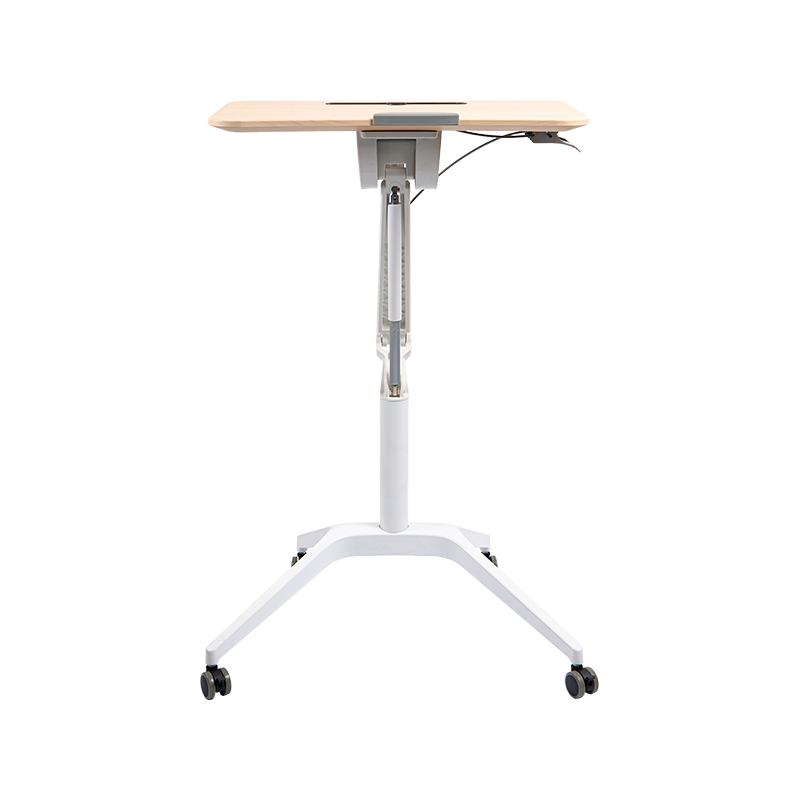
- 19 Product: SK-14 Double-Leg Pneumatic Height-Adjustable Desk
Why a Double-Leg Pneumatic Desk Is a Practical Choice for Flexible Workspaces
2026-09-19
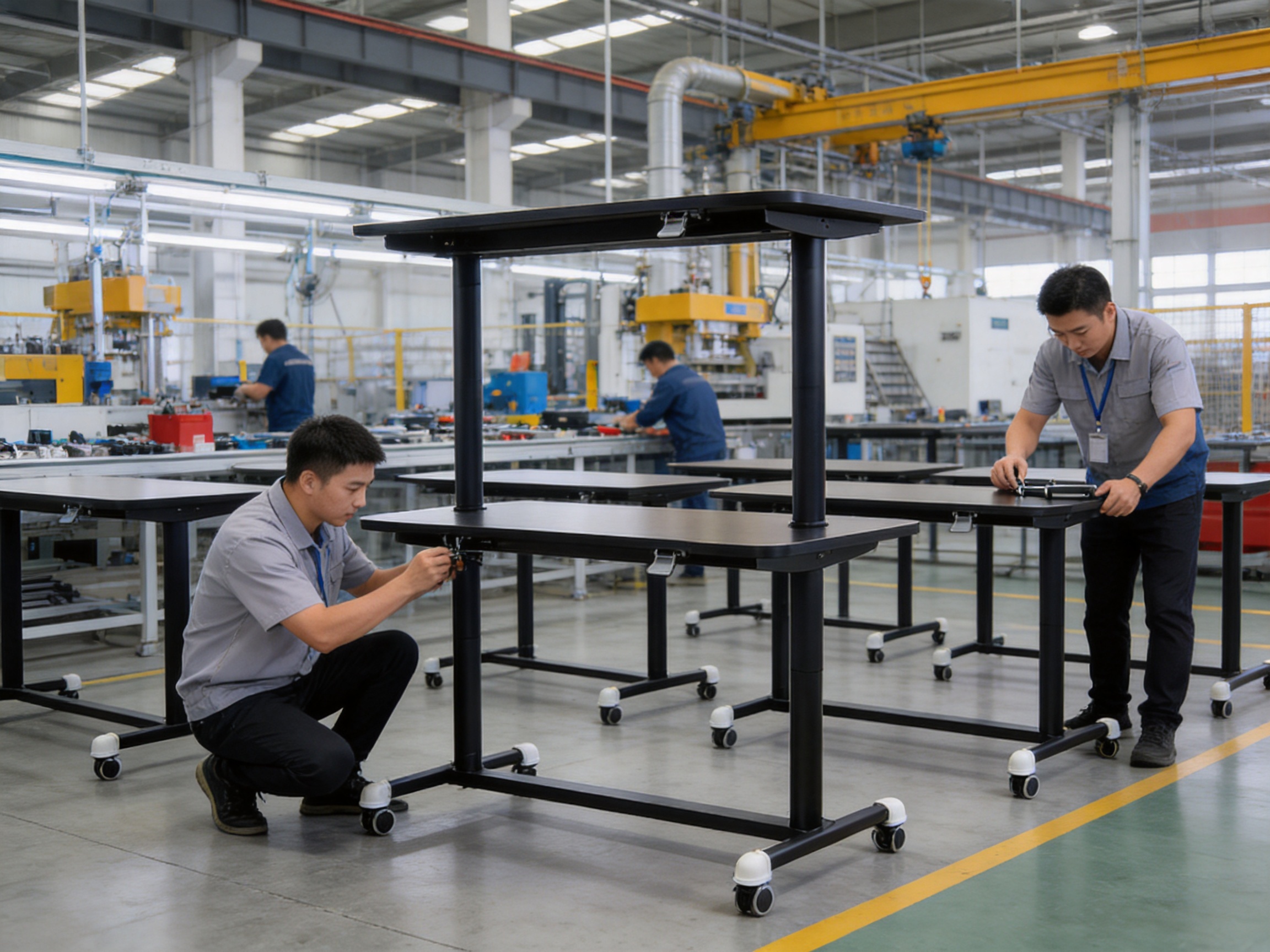
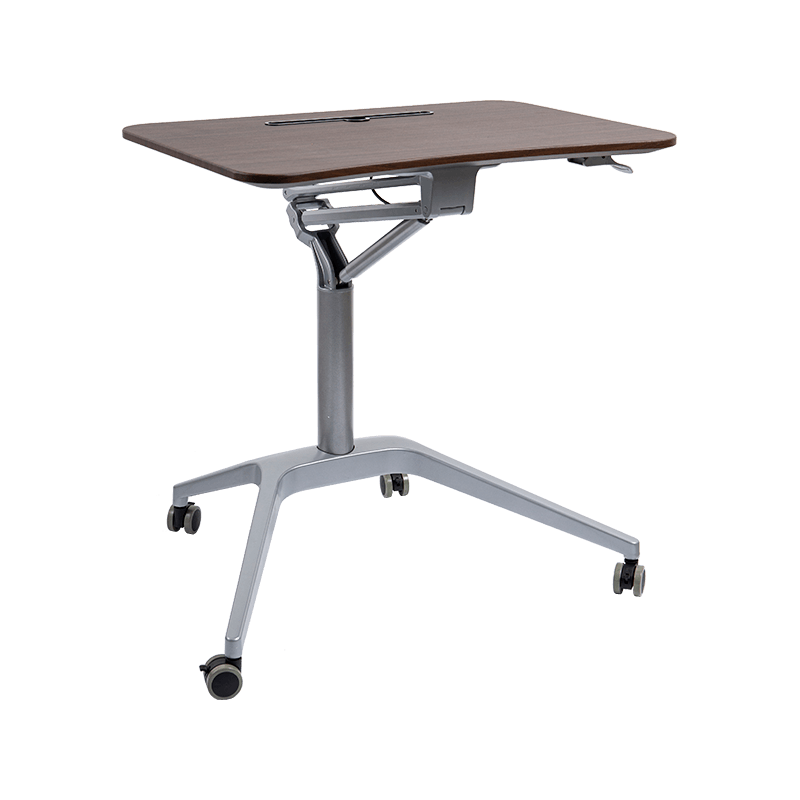
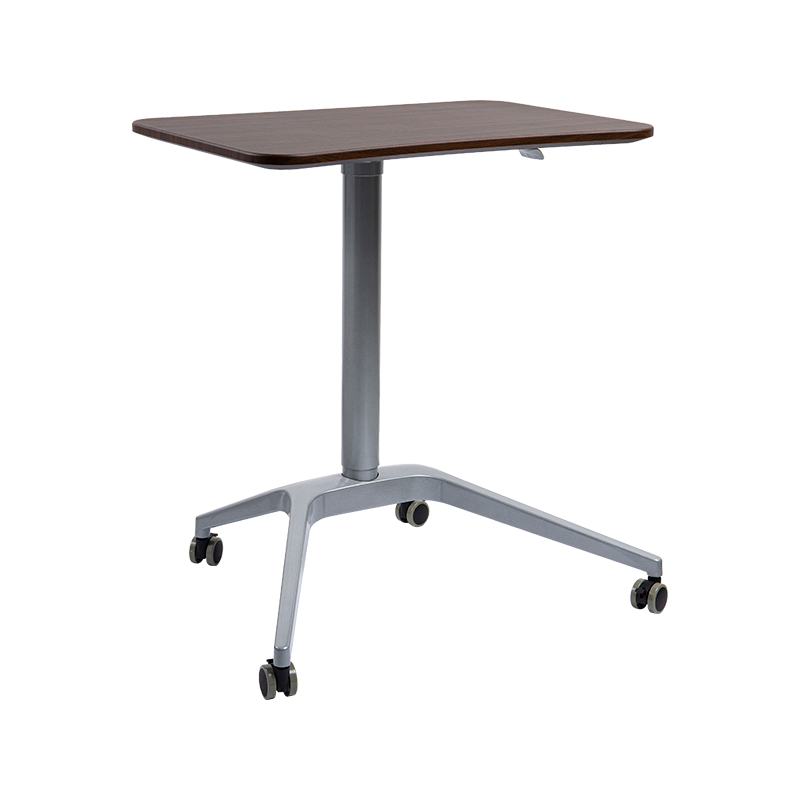
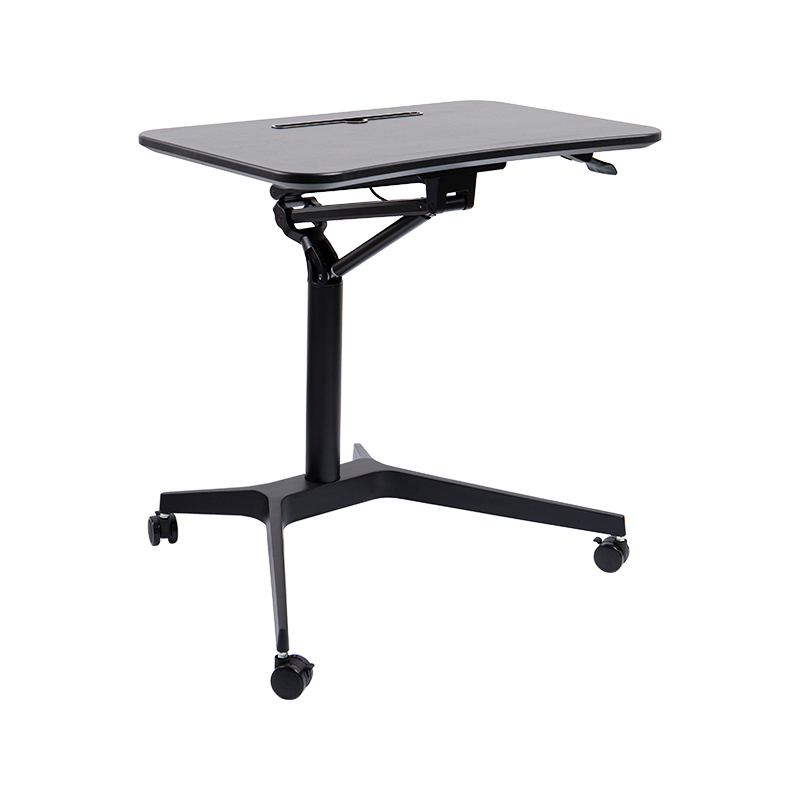
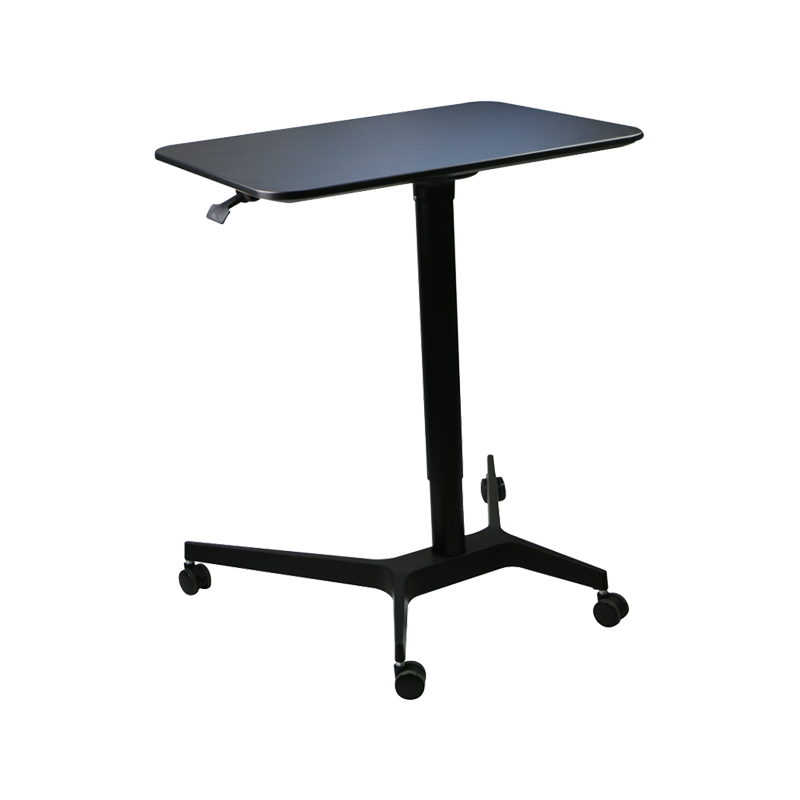
Modern workspaces increasingly need furniture that can adapt to changing tasks, body positions, room layouts, and user preferences. A fixed-height desk may be adequate for a single-purpose workstation, but it cannot easily support alternating between sitting and standing, temporary project arrangements, shared use, or frequent space reorganization. The SK-14 Double-Leg Pneumatic Height-Adjustable Desk addresses these requirements through a compact metal structure, manual gas spring lifting, a practical height range, and mobile casters.
Designed as a pneumatic height-adjustable table, the SK-14 combines the simplicity of a non-electric mechanism with the stability of a dual-leg frame. It is suitable for offices, laboratories, studios, home study areas, and other environments where users need a dependable work surface that can be repositioned and adjusted without relying on electrical power.
Its design is particularly relevant for customers seeking an ergonomic office table that is easy to operate, straightforward to maintain, and flexible enough for multiple applications. With a lifting range of 760 mm to 1100 mm, a 980 mm by 560 mm desktop, four swivel casters, and a black powder-coated iron frame, the product offers a balanced combination of mobility, durability, and functional adaptability.
1. Product Overview
The SK-14 is built around a dual-leg pneumatic lifting structure. Its working principle is based on a gas spring, allowing the user to raise or lower the desktop through manual operation. Unlike an electric standing desk, it does not require a motor, control panel, power cable, or electrical outlet. This makes the product suitable for environments where electrical access is limited or where a clean, cable-free appearance is preferred.
The product specifications are summarized below.
| Specification | Product Detail |
|---|---|
| Product name | SK-14 Double-Leg Pneumatic Height-Adjustable Desk |
| Product category | Pneumatic Height-Adjustable Table |
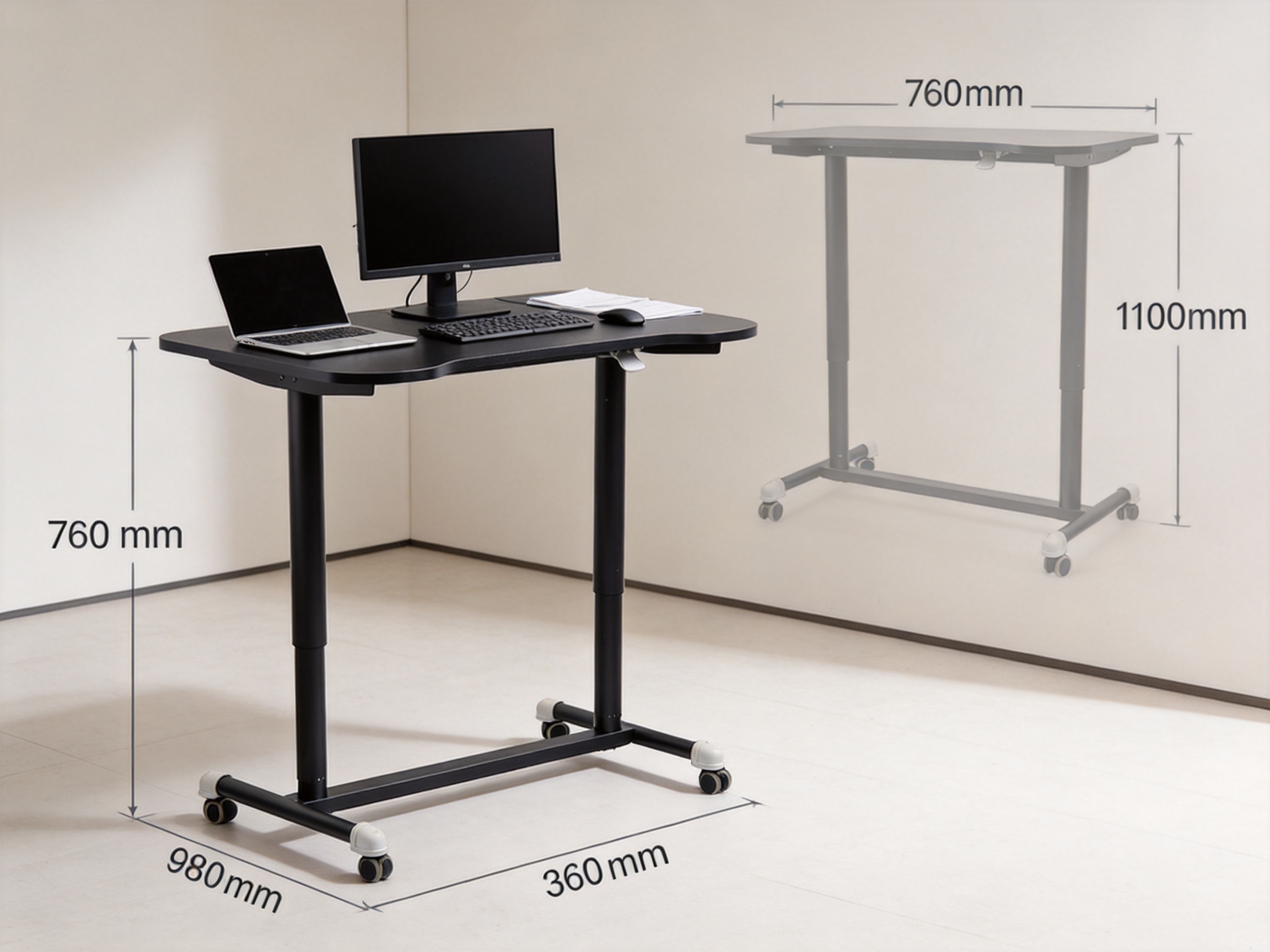
| Lifting range | 760 mm to 1100 mm |
| Desktop size | 980 mm by 560 mm |
| Main material | Iron |
| Surface color | Black |
| Surface treatment | Powder coating |
| Casters | Two locking casters and two non-locking casters |
| Lifting method | Gas spring lifting |
This specification profile positions the SK-14 between a conventional fixed table and a larger electrically powered sit-stand workstation. It provides an adjustable working height while keeping the construction compact and mechanically uncomplicated.
2. Ergonomic Flexibility for Seated and Standing Work
One of the principal advantages of a height-adjustable desk is the ability to change working posture. Remaining in one position for an extended period can contribute to discomfort, reduced movement, and fatigue. By allowing a user to alternate between seated and standing positions, an adjustable desk can support a more dynamic working routine.
The SK-14 provides a height range from 760 mm to 1100 mm. The lower end is appropriate for seated desk work in many common office and study arrangements, while the upper end provides additional clearance for standing tasks, short-duration presentations, equipment handling, and collaborative activities. Users can select a working position according to their body height, chair dimensions, task requirements, and preferred posture.
Because the adjustment is stepless, the user is not restricted to a limited number of preset levels. A specific intermediate height can be selected to suit a particular activity. For example, a user may choose one height for keyboard and mouse work, another for reading documents, and a higher position for reviewing drawings or demonstrating equipment.
The product is not intended to prescribe one universal ergonomic position. Instead, it provides a practical adjustment range that allows each user to establish a more suitable relationship between the desktop, chair, monitor, keyboard, and working materials. This adaptability is especially valuable in shared offices, training rooms, laboratories, and home work areas used by more than one person.
Supporting Dynamic Work Habits
Height adjustment can also encourage users to vary their posture during the working day. A user may begin a task while seated, raise the desk for a standing review, lower it for concentrated computer work, and move the entire unit to another location when the task is complete. This type of flexibility supports changing work patterns without requiring several dedicated tables.
The SK-14 is therefore more than a simple height-adjustable frame. It is a compact workstation platform that can adapt to different activities and room configurations. Its pneumatic operation makes the adjustment process independent of software, buttons, or electrical controls, keeping the interaction direct and easy to understand.
3. The Advantages of Gas Spring Adjustment
The gas spring is the central functional component of the SK-14. A gas spring uses stored pressure to assist movement, helping the user raise or lower the desk manually. When properly integrated into a dual-leg structure, this approach can provide smooth and controlled height adjustment without the need for a powered motor.
A pneumatic desk has several notable advantages compared with an electrically powered alternative. The first is energy independence. The SK-14 does not need a power supply during operation. This eliminates the need for a power cord running from the desk to a wall outlet and makes placement more flexible.
The second advantage is mechanical simplicity. An electric desk generally includes motors, control electronics, cables, a handset, and sometimes a control box. A gas spring desk uses a more straightforward manual mechanism. Fewer electrical components can simplify daily operation and reduce the number of powered parts that require attention.
The third advantage is a clean visual appearance. Without a motor cable or control panel, the desk maintains a minimal and uncluttered profile. This can be beneficial in studios, reception areas, laboratories, and offices where appearance and floor organization are important.
The fourth advantage is suitability for occasional or shared adjustment. Not every user needs to adjust a workstation repeatedly throughout the day. In environments where the desk is changed several times during a work session or repositioned between projects, manual pneumatic adjustment can be entirely practical.
Manual Operation Without Electrical Dependence
The SK-14 is suitable for facilities where access to electrical outlets is restricted, where cable management is difficult, or where a powered desk is unnecessary. It can also be useful for temporary workstations, pop-up office arrangements, mobile project areas, and spaces where furniture is frequently moved.
A non-electric design may also be advantageous in settings where the user wants immediate manual control. Instead of waiting for a motor to move the desktop, the user can operate the gas spring mechanism directly. This supports a straightforward user experience and avoids dependence on electronic controls.
As with any manually adjustable product, users should operate the desk according to the supplied instructions and respect the intended load and adjustment procedures. Proper use helps preserve smooth operation and protects the lifting components over time.
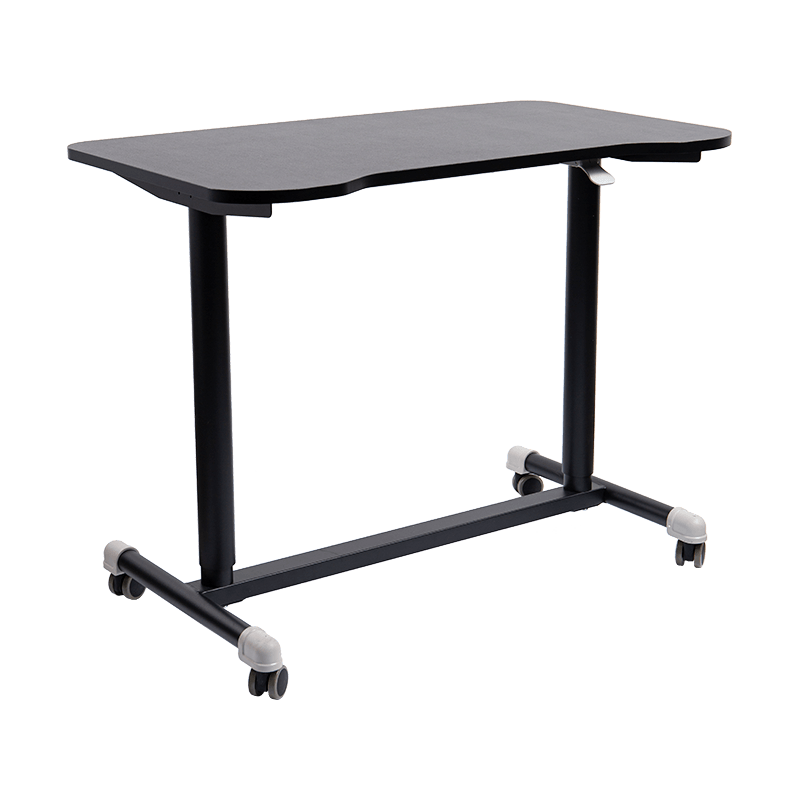
SK-14 Double-Leg Pneumatic Height-Adjustable Desk
4. Dual-Leg Construction for Everyday Stability
The SK-14 uses two lifting legs rather than a single central support. A dual-leg arrangement helps distribute the desktop load across a wider base and provides a stable structural foundation for routine office, study, laboratory, or studio tasks.
Two legs can also contribute to a more balanced appearance and reduce dependence on a single support point. When a user places a monitor, laptop, documents, tools, or other work materials on the desktop, the dual-leg configuration helps organize the supporting structure across the width of the table.
The iron frame provides a firm metal foundation. Iron is widely used in work furniture because it offers structural strength and can be formed into frames, supports, brackets, and base components suitable for repeated use. In the SK-14, the metal construction is paired with a powder-coated finish to create a practical surface for commercial and residential environments.
Balancing Mobility and Stability
Mobility and stability are often treated as competing requirements. A desk that is easy to move must also remain secure when users are working. The SK-14 addresses this balance with four swivel casters, including two locking casters and two non-locking casters.
When the casters are unlocked, the desk can be repositioned across the floor. This is useful when reorganizing a room, moving the desk closer to equipment, changing the direction of a workstation, or clearing space for cleaning and maintenance. Swivel movement helps the desk turn more easily than a fixed-wheel arrangement.
When the locking casters are engaged, the desk can remain in a selected position during normal work. The locking function helps reduce unintended movement and provides additional confidence when the user is typing, writing, reviewing materials, or conducting a practical task at the desk.
The caster configuration is especially useful for multifunctional rooms. A laboratory may need a table to move between preparation and testing areas. A studio may require the work surface to be repositioned around equipment. A home office may need to share floor space with other activities. In each case, mobility allows the workspace to respond to the room instead of remaining permanently fixed.
5. Compact Desktop Dimensions for Efficient Space Use
The desktop measures 980 mm by 560 mm. This size provides a practical working surface while remaining compact enough for rooms where floor area is limited. It can accommodate common office essentials such as a laptop or monitor, keyboard, mouse, documents, and small accessories, depending on the chosen setup.
A compact desktop is particularly valuable in urban apartments, small offices, laboratory aisles, training rooms, and shared workspaces. Instead of occupying the area required by a large executive desk, the SK-14 can be placed in a corner, beside equipment, or within a flexible workstation layout.
The proportions also support mobility. A smaller desktop generally makes it easier to navigate through doorways and around furniture than an oversized work surface. This complements the four-caster base and allows the table to be used as a mobile work platform rather than a permanently installed station.
Customers can select the SK-14 when they need a focused personal work area rather than a large conference or storage surface. The design is suitable for tasks that require a computer, writing materials, small tools, laboratory accessories, or creative equipment without demanding an expansive tabletop.
In a home study, the desk can provide a dedicated workstation without overwhelming the room. In a shared office, it can function as a flexible hot-desk unit. In a laboratory, it can serve as a movable bench for selected procedures or documentation tasks. In a studio, it can support sketching, editing, product preparation, or equipment operation.
Its compact format also makes inventory planning easier for commercial buyers. More units can potentially be arranged within a given room than large fixed desks, while the mobile base allows the layout to be changed as user needs develop.
6. Powder-Coated Iron Surface
The SK-14 uses an iron structure with a black powder-coated surface. Powder coating is a dry finishing process in which coating material is applied to a prepared metal surface and cured to form a consistent protective layer. Compared with an untreated metal surface, a finished surface offers improved resistance to everyday wear and helps maintain a more uniform appearance.
The black finish provides a professional and versatile visual style. It can coordinate with common office furniture, laboratory equipment, studio fixtures, and home interiors. The neutral color also helps conceal minor marks associated with ordinary handling while presenting a clean, modern appearance.
Surface treatment is important for work furniture because the frame may be exposed to frequent contact, movement, cleaning, and changes in the surrounding environment. A properly applied powder coating supports the long-term usability of the metal structure and contributes to easier routine care.
Users should still follow appropriate cleaning practices. Soft cloths and suitable mild cleaning solutions are generally preferable to abrasive materials or harsh chemicals that could damage the coating. Keeping the frame dry and inspecting areas around joints and casters can also support continued product performance.
7. Advantages Over Conventional Fixed Tables
Compared with a fixed-height table, the SK-14 provides a significantly broader range of use. A fixed table is normally designed around one sitting height or one task. If a user needs a standing position, the table may require an additional riser, replacement, or separate workstation.
The SK-14 integrates adjustment into the table itself. This means that the user can change the work height without adding a separate platform or purchasing another desk. The integrated solution keeps the workstation more coherent and avoids some of the space and visual issues associated with desktop risers.
Mobility is another distinction. Conventional fixed tables may be difficult to move because they lack casters or require lifting. The SK-14 can be repositioned by releasing the caster locks and guiding the unit to a new location. This creates greater flexibility for room reconfiguration, cleaning, collaborative work, and temporary projects.
The dual-leg iron frame also offers a more purpose-built solution than placing an adjustable desktop support on an ordinary table. The lifting structure, base, and casters are designed as one workstation system, allowing the product to function as a complete mobile adjustable table.
8. Advantages Over Electric Height-Adjustable Desks
Electric desks remain useful for users who require frequent powered adjustment, memory presets, or automated movement. However, not every application needs those functions. The SK-14 offers a different value proposition based on manual pneumatic operation.
The absence of electrical components means there is no motor noise during powered movement, no handset to install, and no power cable to manage. It can be placed in areas where outlets are inconvenient or where the customer wants to reduce cable clutter.
The gas spring mechanism also supports a direct and uncomplicated user experience. Users adjust the desk through a manual action rather than navigating electronic controls. This can be suitable for facilities that prioritize simple operation and easy training.
From a maintenance perspective, a pneumatic desk avoids several categories of electrical components that may require diagnosis in a powered model. The product still requires sensible care, inspection, and correct use, but its mechanical design is less dependent on electronic systems.
For procurement teams, the choice between pneumatic and electric adjustment should be based on application. If a desk must move repeatedly at the touch of a button throughout the day, an electric system may be appropriate. If the priority is mobility, energy independence, compact construction, and manual simplicity, the SK-14 can offer a compelling alternative.
9. Suitable Application Environments
Office Workstations
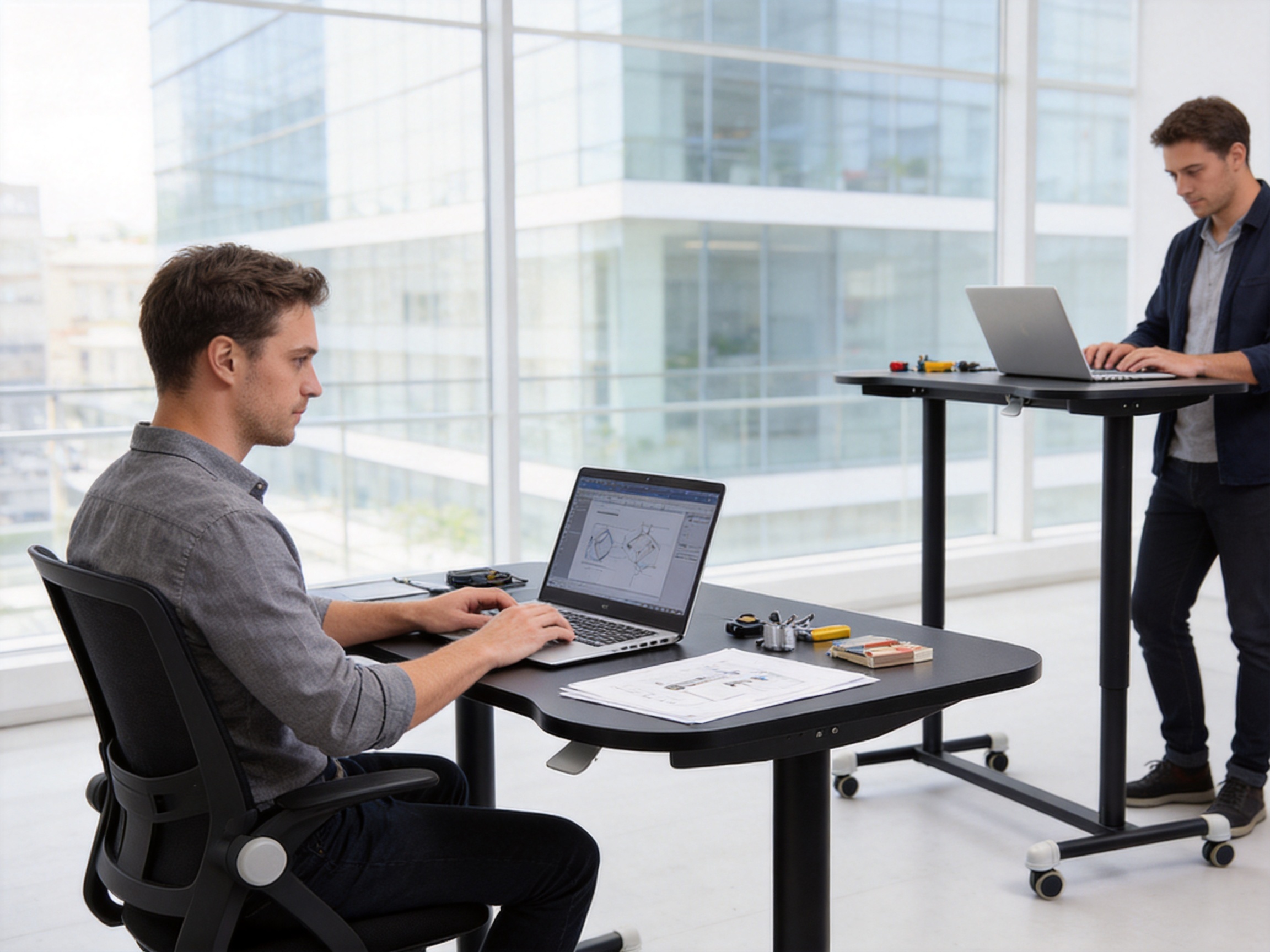
In an office, the SK-14 can support employees who want to alternate between sitting and standing. Its compact size is suitable for individual work areas, shared offices, temporary project zones, and flexible seating plans.
The locking casters allow the desk to remain in position during computer work, while the unlocked casters make it easier to reorganize the office. The black finish can also integrate with a wide range of office interiors and equipment.
Laboratories and Technical Work Areas
Laboratories often require flexible surfaces that can be moved around equipment or adjusted for different procedures. The SK-14 can serve as a mobile support table for documentation, instrument operation, preparation tasks, or short-duration standing work.
Because the desk does not require electrical power for height adjustment, it can be positioned according to workflow rather than outlet location. However, customers should evaluate the specific laboratory environment, including chemical exposure, cleaning requirements, load demands, and safety procedures, before selecting any furniture.
Studios and Creative Workspaces
Studios may combine computers, tools, samples, drawings, cameras, lighting accessories, and other equipment. A compact adjustable table can help users establish a suitable working height for editing, crafting, reviewing, or demonstrating materials.
The mobile base allows the desk to be moved as a project develops. This can be useful in product design studios, content production areas, photography workspaces, and maker environments where the layout is frequently changed.
Home Study Areas
For home users, the SK-14 provides a flexible workstation without requiring a large dedicated office. It can be used for remote work, online learning, writing, reading, and computer-based activities.
The manual gas spring mechanism avoids the need to reserve a nearby electrical outlet for the lifting system. When the desk is not being used, it can be moved to create additional room for household activities, provided the floor and surrounding layout allow safe movement.
10. Manufacturing Strengths of SuZhou Skyhone Intelligent Technology Co., Ltd.
The product is manufactured by SuZhou Skyhone Intelligent Technology Co., Ltd., a professional enterprise engaged in the research and development, production, sales, and service of standing desks. This complete business scope is important because a height-adjustable table requires coordination between product design, structural engineering, component selection, assembly, quality control, and customer support.
The company is based in Suzhou, an important industrial and furniture manufacturing area in the Yangtze River Delta. The region provides access to an extensive industrial chain and a strong manufacturing ecosystem. This location supports efficient cooperation among material suppliers, metal-processing resources, finishing providers, component manufacturers, logistics partners, and related technical services.
The company also emphasizes intelligent manufacturing advantages. In the context of adjustable furniture, intelligent manufacturing can support more organized production planning, better process coordination, and improved consistency between product specifications and finished units. It can help connect product development with production execution, making it easier to manage standard models and respond to customer requirements.
Research and Development Capability
Research and development is essential for pneumatic height-adjustable furniture because the performance of the final product depends on the relationship between the gas spring, lifting structure, frame geometry, tabletop dimensions, and caster base.
A product such as the SK-14 requires attention to practical engineering questions. The lifting mechanism must be integrated into the dual-leg frame. The desktop must remain usable throughout the specified range. The base must provide a stable foundation while retaining mobility. The casters must support repositioning and locking. The surface treatment must be compatible with the metal structure and intended environment.
By maintaining research and development alongside production and service, the company can approach the desk as a complete product system rather than as a collection of unrelated parts. This integrated approach is valuable for customers seeking a repeatable product for business, institutional, or residential use.
Production and Process Coordination
Manufacturing a metal adjustable table involves multiple stages, including material preparation, component forming, welding or structural joining, surface treatment, mechanism installation, caster assembly, final inspection, and packaging. Effective coordination among these stages helps maintain dimensional consistency and product reliability.
The company’s presence in the Suzhou manufacturing region provides access to supporting industrial capabilities. Combined with an intelligent manufacturing orientation, this creates a foundation for organizing production around defined specifications and repeatable procedures.
For the SK-14, process coordination is particularly important because the height-adjustment mechanism and dual-leg structure must work together. Assembly accuracy can influence smooth movement, balance, and the user’s overall experience. The frame finish must also be protected during handling, assembly, and packaging.
Surface Finishing and Product Appearance
The black powder-coated finish is not only an aesthetic choice. It forms part of the product’s practical identity by giving the iron frame a consistent appearance and an additional protective surface. Manufacturing control over surface preparation, coating application, and curing helps support a uniform finished product.
A well-coordinated finishing process contributes to customer confidence because the desk is often placed in visible environments. Offices, studios, and home workspaces benefit from furniture that looks organized and professional as well as functional.
Sales and Service Support
The company’s business scope includes sales and service, which is important for customers purchasing adjustable furniture for multiple locations or ongoing projects. Product selection, application consultation, order coordination, installation guidance, and after-sales communication can all influence the success of a furniture program.
For business customers, service capability is especially relevant when the product is used in offices, laboratories, schools, studios, or other environments with specific layout requirements. A supplier that understands the product from research and production through delivery and service can provide more coherent support than a seller focused only on transactional supply.
11. Quality Considerations for Buyers
When evaluating a pneumatic height-adjustable desk, customers should consider more than the appearance of the frame. The gas spring, lifting range, structural alignment, caster configuration, surface finish, and intended application should all be reviewed.
The specified lifting range of the SK-14 is 760 mm to 1100 mm. Buyers should compare this range with the expected user population, chair dimensions, working posture, and task requirements. A desk is most effective when its adjustment range matches the real needs of the people using it.
Buyers should also review the floor conditions where the desk will be used. Casters work best on surfaces that allow smooth movement. Uneven floors, thick thresholds, loose mats, or cluttered walkways may affect mobility. The locking casters should be engaged whenever the desk is intended to remain stationary.
The desktop dimensions should be compared with the equipment to be placed on it. A 980 mm by 560 mm surface is suitable for many focused workstation arrangements, but customers should confirm that monitors, input devices, documents, tools, or other materials can be positioned comfortably.
Finally, buyers should establish a suitable inspection and care routine. Regularly checking the casters, visible fasteners, lifting mechanism, and frame condition can help identify issues before they affect normal use.
12. Maintenance Recommendations
The SK-14 is designed with a straightforward mechanical structure, but regular care remains important. Users should keep the lifting area free from obstructions and avoid placing objects where they could interfere with the movement of the legs or gas spring components.
Casters should be checked periodically for accumulated dust, hair, fibers, or other debris. Such materials can affect rolling performance. The locking function should also be tested to confirm that the desk can be secured when required.
The powder-coated frame can normally be cleaned with a soft cloth and a mild cleaning solution. Abrasive pads, aggressive solvents, and sharp tools should be avoided because they may damage the finish. Spills should be removed promptly, particularly in environments where the desk is exposed to laboratory materials, liquids, or food.
Users should not force the desk beyond its specified adjustment range. Height changes should be made in a controlled manner, with attention to nearby objects and equipment. Following the operating instructions helps preserve the smooth action of the gas spring and reduces unnecessary stress on the frame.
13. Procurement Benefits for Commercial Customers
For commercial customers, the SK-14 offers several procurement advantages. Its compact dimensions simplify space planning, while the mobile base allows one room to support multiple activities. The non-electric mechanism also reduces dependence on power outlets and may simplify cable management throughout a facility.
A pneumatic desk can be particularly practical when an organization needs adjustable workstations but does not require electronic memory functions. It provides essential height flexibility without adding powered controls to every unit.
The product can also be considered for phased workspace upgrades. An organization may introduce adjustable tables into selected departments, meeting areas, laboratories, or home-working programs without replacing every existing desk at once. The SK-14 can function as a targeted solution for users or activities that benefit most from mobility and posture variation.
Because the company handles research and development, production, sales, and service, commercial buyers can communicate with a supplier that understands the entire product lifecycle. This supports clearer discussions about specifications, applications, packaging, delivery, and after-sales requirements.
14. Customization and Project Suitability
The standard SK-14 specification includes a black powder-coated iron frame, a 980 mm by 560 mm desktop, a 760 mm to 1100 mm lifting range, and a four-caster base. These features make the product suitable as a ready configuration for many applications.
For project buyers, the product may also serve as a reference point when discussing application-specific requirements with the manufacturer. Customers may need to review factors such as workspace layout, order volume, packaging, branding, surface preferences, or deployment environment.
Any customization should be evaluated carefully because changes to the desktop, load, frame, caster arrangement, or adjustment range may influence the performance of the pneumatic system. The manufacturer’s research and production capabilities can help determine whether a requested modification is technically appropriate.
The company’s position within the Suzhou industrial ecosystem and its focus on intelligent manufacturing provide a useful foundation for supporting organized product development and project coordination. For international buyers, this can be relevant when sourcing adjustable furniture in a repeatable and scalable manner.
15. Comparative Value of the SK-14 Design
The strongest value of the SK-14 comes from the combination of features rather than from any single component. A gas spring alone would not provide a complete workstation. A metal frame alone would not provide height flexibility. Casters alone would not provide ergonomic adaptation. The product combines these elements into one mobile, manually adjustable table.
Compared with a fixed table, it offers adjustable height and mobility. Compared with a large electric standing desk, it offers a simpler, non-powered design. Compared with a desktop riser, it provides a complete integrated frame and base. Compared with a heavy fixed workstation, it can be repositioned when the room or workflow changes.
This balance makes the SK-14 appropriate for customers who value practical flexibility without unnecessary complexity. It is not designed around advanced electronic features; instead, it focuses on fundamental functions that many users need every day: a stable work surface, an adjustable height, a movable base, and a durable metal structure.
16. Frequently Asked Questions
Q1: What type of desk is the SK-14?
The SK-14 is a dual-leg pneumatic height-adjustable desk. It uses a gas spring lifting mechanism for manual, stepless height adjustment.
Q2: What is the height range?
The lifting range is 760 mm to 1100 mm. Users can select a suitable position within this range for seated or standing work, subject to their individual setup and application requirements.
Q3: Does the desk require electricity?
No. The SK-14 uses gas spring lifting and does not require an electrical motor, power cable, or outlet for height adjustment.
Q4: Is the height adjustment stepless?
Yes. The pneumatic mechanism is designed for stepless adjustment, allowing users to select an intermediate height rather than being limited to fixed preset positions.
Q5: What are the desktop dimensions?
The desktop measures 980 mm by 560 mm. It provides a compact work surface for common office, study, laboratory, and studio tasks.
Q6: What material is used for the frame?
The main structure is made of iron and finished with black powder coating.
Q7: How many casters does the desk have?
The desk has four swivel casters. Two include locking mechanisms, and two are without locks.
Q8: Can the desk be moved easily?
When the caster locks are released, the desk can be repositioned across a suitable floor. The casters should be locked when the desk is placed in its working position.
Q9: Where can the SK-14 be used?
It is suitable for office workstations, laboratories, studios, home study areas, shared workspaces, and other environments requiring a compact mobile adjustable table.
Q10: What are the main advantages over an electric desk?
The SK-14 does not require electricity, has no power cable for height adjustment, and uses a simpler manual gas spring mechanism. It is a practical option when users do not need powered movement or electronic memory controls.
Q11: What are the main advantages over a fixed table?
It provides a height range for seated and standing work and can be repositioned using its caster base. A fixed table normally offers neither integrated height adjustment nor the same level of mobility.
Q12: Who manufactures the product?
The product is manufactured by SuZhou Skyhone Intelligent Technology Co., Ltd., a Suzhou-based enterprise engaged in the research and development, production, sales, and service of standing desks.
Q13: What manufacturing strengths support the product?
The company benefits from its location in Suzhou’s Yangtze River Delta furniture and industrial manufacturing region, its access to a complete industrial chain, and its focus on intelligent manufacturing. Its integrated involvement in research, production, sales, and service supports coordinated product development and customer support.
Q14: How should the desk be maintained?
Users should keep the lifting mechanism and caster areas clean, avoid overloading or forcing the adjustment range, inspect the casters and visible structural components periodically, and clean the powder-coated surface with suitable non-abrasive materials.
17. Conclusion
The SK-14 Double-Leg Pneumatic Height-Adjustable Desk is designed for users who need a flexible work surface without the complexity of an electric lifting system. Its 760 mm to 1100 mm height range supports seated and standing tasks, while the gas spring provides stepless manual adjustment without electrical power.
The dual-leg iron structure contributes to a stable foundation, and the black powder-coated finish provides a consistent professional appearance. Four swivel casters, including two locking casters, allow the desk to move when flexibility is needed and remain secured when work begins. The 980 mm by 560 mm desktop offers a focused work area suitable for offices, laboratories, studios, home study rooms, and shared environments.
Compared with fixed tables, the SK-14 offers greater ergonomic and layout flexibility. Compared with electric desks, it provides a simpler, cable-free, non-powered alternative. Its value lies in combining adjustability, mobility, compact dimensions, and mechanical simplicity in one practical product.
The manufacturing background of SuZhou Skyhone Intelligent Technology Co., Ltd. further supports the product’s market position. Through research and development, production, sales, and service, the company approaches standing desk manufacturing as a complete product and customer-support process. Its Suzhou location, access to the Yangtze River Delta industrial chain, and intelligent manufacturing orientation provide a strong foundation for serving domestic and international customers seeking adjustable office tables.
For buyers looking for an ergonomic office table that can adapt to different postures, room layouts, and working conditions, the SK-14 presents a balanced and practical solution. It is especially well suited to customers who value manual simplicity, mobility, compact design, and dependable metal construction.
References
1. Product specification sheet for the SK-14 Double-Leg Pneumatic Height-Adjustable Desk.
2. Manufacturer-provided product information for pneumatic height-adjustable tables.
3. General principles of ergonomic workstation arrangement and posture variation.
4. General technical information on gas spring mechanisms used in adjustable furniture.
5. General manufacturing references concerning powder-coated metal furniture surfaces.
6. Company information supplied by SuZhou Skyhone Intelligent Technology Co., Ltd. regarding research and development, production, sales, service, and intelligent manufacturing.
Product: SK-14 Double-Leg Pneumatic Height-Adjustable Desk


- Contact Info
-
-
 Phone+86-15950656125
-
 Email
-
 AddressRoom 1007-1, South Building, Suyue Plaza, Suzhou Industrial Park, Suzhou City, Jiangsu Province, China
-
- Products
- Follow Us
- Need help? Please contact us
Copyright ©
SuZhou Skyhone Intelligent Technology Co., Ltd.
All Rights Reserved.
Privacy
Custom Ergonomic Adjustable Office Tables Manufacturers

