

 English
  русский
  Español
  عربى
عربى 
Content
- 1 Product Overview
- 2 Core Technical Specifications
- 3 Why Pneumatic Height Adjustment Matters
- 4 Ergonomic Advantages for Active Work
- 5 Competitive Advantages Over Ordinary Mobile Desks
- 6 Application Scenarios
- 7 Design Details That Improve Daily Use
- 8 Manufacturing Strength Behind the Product
- 9 How the TH01-3 Supports Procurement Goals
- 10 Customization and Configuration Possibilities
- 11 Comparison With Electric Height-Adjustable Desks
- 12 Comparison With Fixed-Height Carts and Tables
- 13 Workplace Health and Productivity Value
- 14 Durability Through Materials and Finishing
- 15 Space Efficiency and Interior Integration
- 16 Buying Considerations
- 17 Practical Use Guidelines
- 18 Q&A Section
- 18.1 Q1: What is the main purpose of the TH01-3 pneumatic height-adjustable desk?
- 18.2 Q2: What is the height adjustment range?
- 18.3 Q3: Does the desk require electricity?
- 18.4 Q4: What is the tabletop made of?
- 18.5 Q5: What are the available tabletop colors?
- 18.6 Q6: What materials are used for the frame?
- 18.7 Q7: What frame colors are available?
- 18.8 Q8: How mobile is the desk?
- 18.9 Q9: How does it compare with an electric height-adjustable desk?
- 18.10 Q10: What makes the flat-legged design special?
- 18.11 Q11: Is it suitable for classrooms or training rooms?
- 18.12 Q12: Is it suitable for heavy industrial use?
- 18.13 Q13: Why is the manufacturer’s location important?
- 18.14 Q14: Can the product support custom project requirements?
- 19 Company Manufacturing and Service Advantage
- 20 Conclusion
- 21 References
- 22 Product: TH01-3 iPad (Flat-Legged) Pneumatic Height-Adjustable Desk
Flat-Legged Pneumatic Height-Adjustable Mobile Desk for Agile Workspaces
2026-07-19
The modern workplace is no longer defined by a fixed chair, a fixed monitor, and a fixed desk. Offices, classrooms, laboratories, training rooms, demonstration areas, and light-duty production spaces all increasingly require furniture that can move, adapt, and support a healthier working rhythm. The TH01-3 iPad Pneumatic Height-Adjustable Desk with a flat-legged structure is designed for exactly this kind of environment. It combines mobile workstation flexibility, gas spring height adjustment, a durable tabletop, and a stable aluminum-iron frame in a compact form that is easy to reposition and practical for daily use.
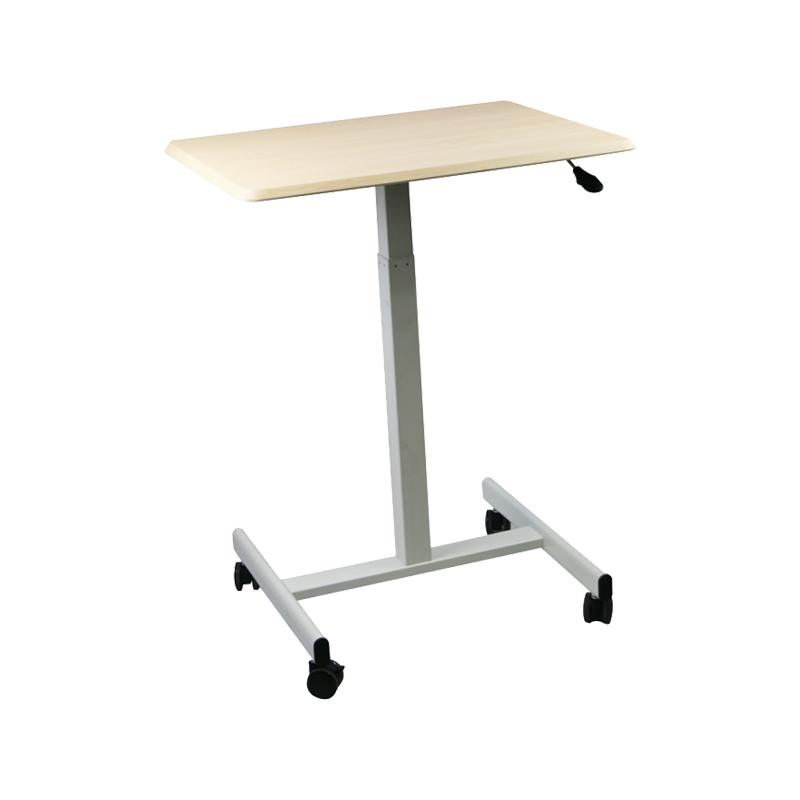
This product belongs to the category of pneumatic height-adjustable tables and is especially suitable for users who need a simple, cable-free, manually controlled height-adjustment solution. With a lifting range of 750mm to 1060mm, it supports both seated and standing working postures. Its tabletop measures 715mm by 475mm by 25mm, providing a useful working surface for tablets, laptops, documents, testing devices, teaching materials, product samples, or compact assembly tools. The tabletop is made from 25mm MDF with a PVC vacuum-formed surface, while the supporting structure uses aluminum and iron with powder-coated finishing options in white, silver, and black.
For organizations comparing mobile desks, rolling lecterns, sit-stand carts, and compact workstation tables, the TH01-3 offers a balanced combination of ergonomic adjustment, mobility, durability, and clean visual design. Its triangular support structure, flat-legged form, defined leg angle, and direct structural transition give the product a more linear and stable appearance than many ordinary mobile desks. Two lockable casters and two non-locking casters allow easy movement while still enabling secure positioning during use.
Behind the product is SuZhou Skyhone Intelligent Technology Co., Ltd., a manufacturing enterprise focused on the research and development, production, sales, and service of standing desks and intelligent office-space solutions. Located in Suzhou, within the Yangtze River Delta furniture and manufacturing ecosystem, the company benefits from regional industrial-chain support, material availability, precision processing resources, and intelligent manufacturing advantages. This background supports the consistent development of products that are practical, ergonomic, and suitable for global users seeking healthier and more efficient workspaces.
TH01-3 iPad (Flat-Legged) Pneumatic Height-Adjustable Desk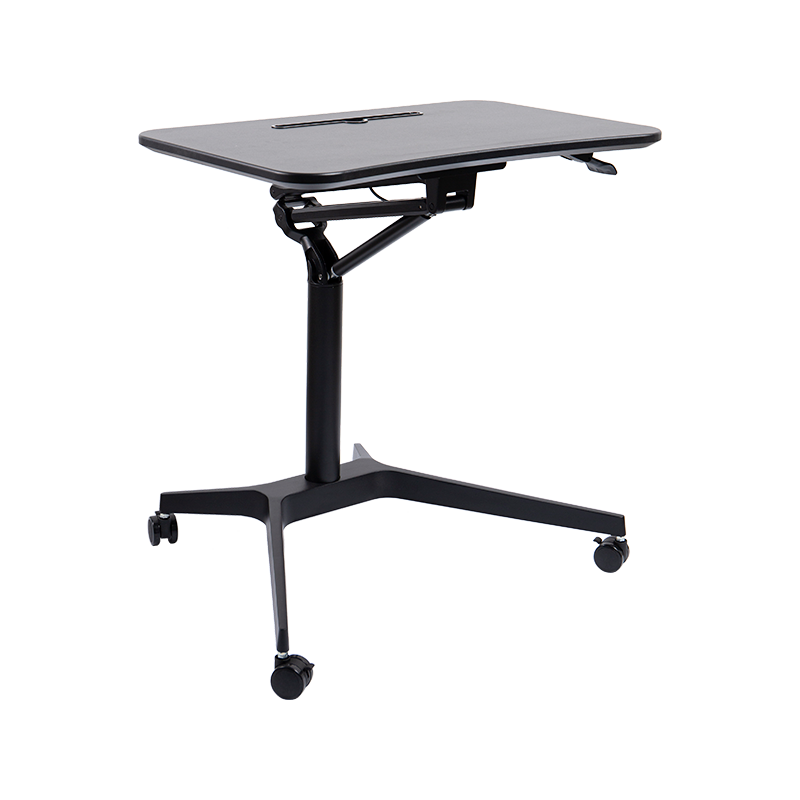
Product Overview
The TH01-3 iPad Pneumatic Height-Adjustable Desk is a compact mobile workstation designed around one key principle: rapid adaptation. Instead of forcing the user to remain in a single seated posture or requiring electrical power for lifting, the desk uses a gas spring lifting mechanism. This allows the user to adjust the height smoothly and manually, making the product suitable for places where simplicity, quiet operation, and flexible deployment are important.
The height range of 750mm to 1060mm allows the desk to serve different users and different tasks. At the lower end of the range, it can function as a seated workstation, a side table, a mobile document table, or a testing station. At the higher end, it can be used as a standing desk, teaching platform, product demonstration cart, or temporary work surface in environments where users need to move frequently. The desk therefore supports active working habits by encouraging transitions between sitting, standing, and moving.
The tabletop size of 715mm by 475mm is intentionally compact. It is large enough for common work materials but not so large that the desk becomes difficult to move through offices, classrooms, showrooms, or production aisles. The 25mm thickness gives the tabletop a substantial feel, while the MDF core and PVC vacuum-formed surface provide a smooth, practical, and easy-to-maintain finish. Available tabletop colors include white, maple, walnut, and black, giving buyers options for different interior styles.
The frame is made from aluminum and iron. This material combination provides a good balance between strength, rigidity, and manageable product weight. The powder-coated surface improves resistance to everyday wear and supports a clean, modern look. The frame can be supplied in white, silver, or black, allowing the desk to coordinate with different furniture systems, technology devices, and workspace environments.
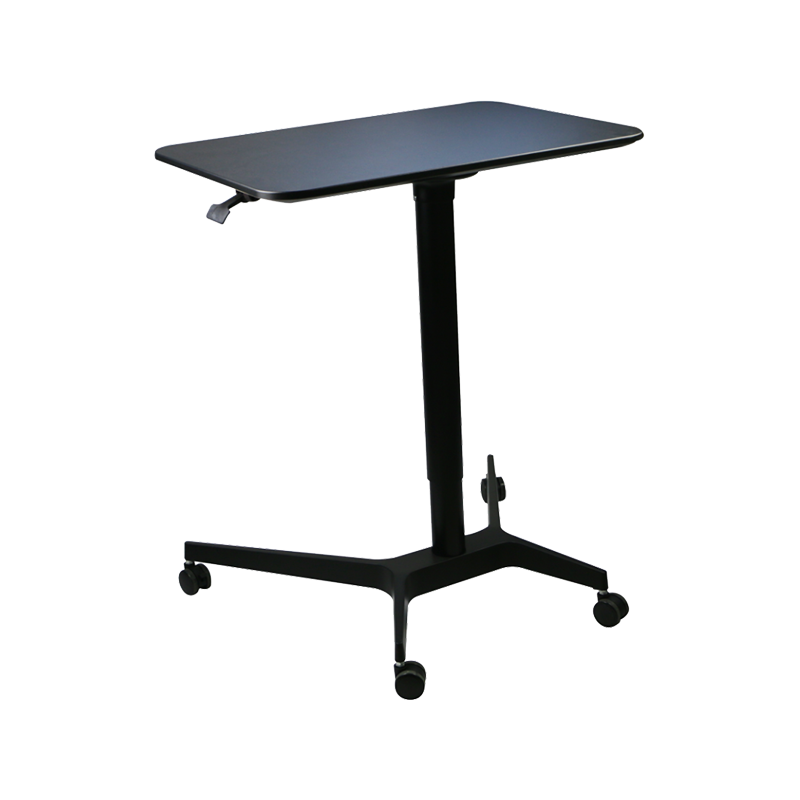
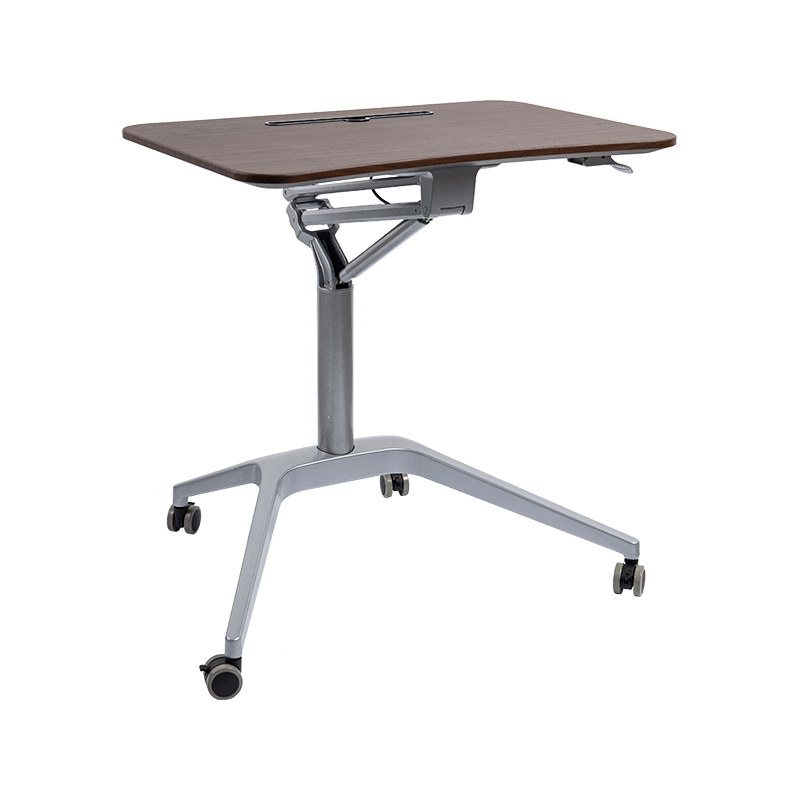
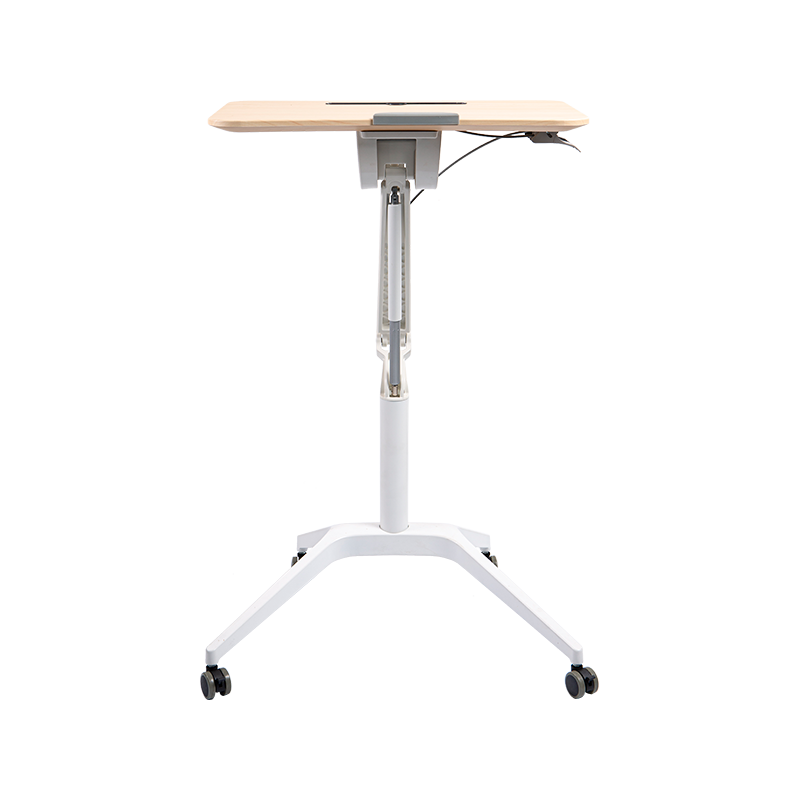
The flat-legged design is an important visual and structural feature. The triangular support layout creates a clear load path, while the slightly larger outward angle of the legs helps improve the sense of stability. The lines at the center connection are more distinct, and the transition between structural components is direct. Compared with many generic rolling tables, this gives the TH01-3 a more engineered appearance and a stronger design identity.
Core Technical Specifications
Item |
Specification |
Practical Value |
Product Type |
Pneumatic Height-Adjustable Table |
Supports manual sit-stand adjustment without electrical power. |
Lifting Range |
750mm to 1060mm |
Suitable for seated work, standing work, presentations, and mobile tasks. |
Tabletop Dimensions |
715mm x 475mm x 25mm |
Compact surface for tablets, laptops, documents, and light-duty tools. |
Tabletop Material |
25mm MDF plus PVC vacuum forming |
Provides a smooth surface with improved wear and impact resistance. |
Frame Material |
Aluminum plus iron |
Combines strength, rigidity, and practical mobility. |
Surface Treatment |
Powder coating in white, silver, or black |
Enhances durability and appearance for professional environments. |
Casters |
2 lockable casters plus 2 non-locking casters |
Allows easy movement and stable positioning during use. |
Panel Colors |
White, maple, walnut, black |
Supports visual matching with office, education, or commercial interiors. |
Foot Design |
Triangular support with flat-legged linear structure |
Improves visual stability, structural clarity, and design differentiation. |
Working Principle |
Gas spring lifting |
Enables smooth, power-free, and convenient height adjustment. |
Why Pneumatic Height Adjustment Matters
Height-adjustable furniture has become an important part of ergonomic workplace planning. However, not every height-adjustable desk needs an electric motor. In many practical environments, a pneumatic system can be the better choice because it is simple, responsive, quiet, and free from dependence on cables or power outlets. The TH01-3 uses gas spring lifting to provide height adjustment without requiring electrical wiring or motorized components.
A gas spring works by using compressed gas to support controlled movement. When the user activates the adjustment mechanism, the gas spring assists the lifting or lowering movement. This makes the adjustment smoother than purely mechanical friction-based systems and easier than lifting a table manually without assistance. Because the process is power-free, the desk can be moved from room to room without considering socket locations, cable management, or electrical safety restrictions.
Compared with many electric mobile desks, the pneumatic approach offers several advantages. It reduces the number of electrical components, which can simplify maintenance. It removes the need for control panels, motors, power cords, and adapters, which can be valuable in education, testing, healthcare support areas, exhibition spaces, and temporary work zones. It also makes the desk more flexible in shared environments where users may need to quickly adjust height without learning a digital control system.
Compared with fixed-height mobile tables, the TH01-3 provides a more ergonomic experience. A fixed-height table may be comfortable for one person but awkward for another. It may work for seated use but not for standing use, or it may be suitable for demonstration work but uncomfortable for typing. The 750mm to 1060mm range allows the same desk to support multiple users, multiple tasks, and multiple working postures.
In everyday work, small changes in height can make a noticeable difference. When the surface is too low, users may bend the neck and upper back. When it is too high, shoulders may rise and wrists may become uncomfortable. A height-adjustable desk allows the working surface to be positioned more appropriately for the task, helping users maintain a more natural posture. This is especially valuable for tablet-based work, product demonstrations, training sessions, and inspection tasks where the user may frequently look down at the surface.
Ergonomic Advantages for Active Work
The TH01-3 is not merely a table with wheels; it is an ergonomic tool designed to support movement. In many workplaces, employees shift between writing, checking a tablet, presenting information, reviewing samples, and interacting with other people. A mobile height-adjustable desk allows the work surface to follow the task instead of forcing the task to fit a static furniture layout.
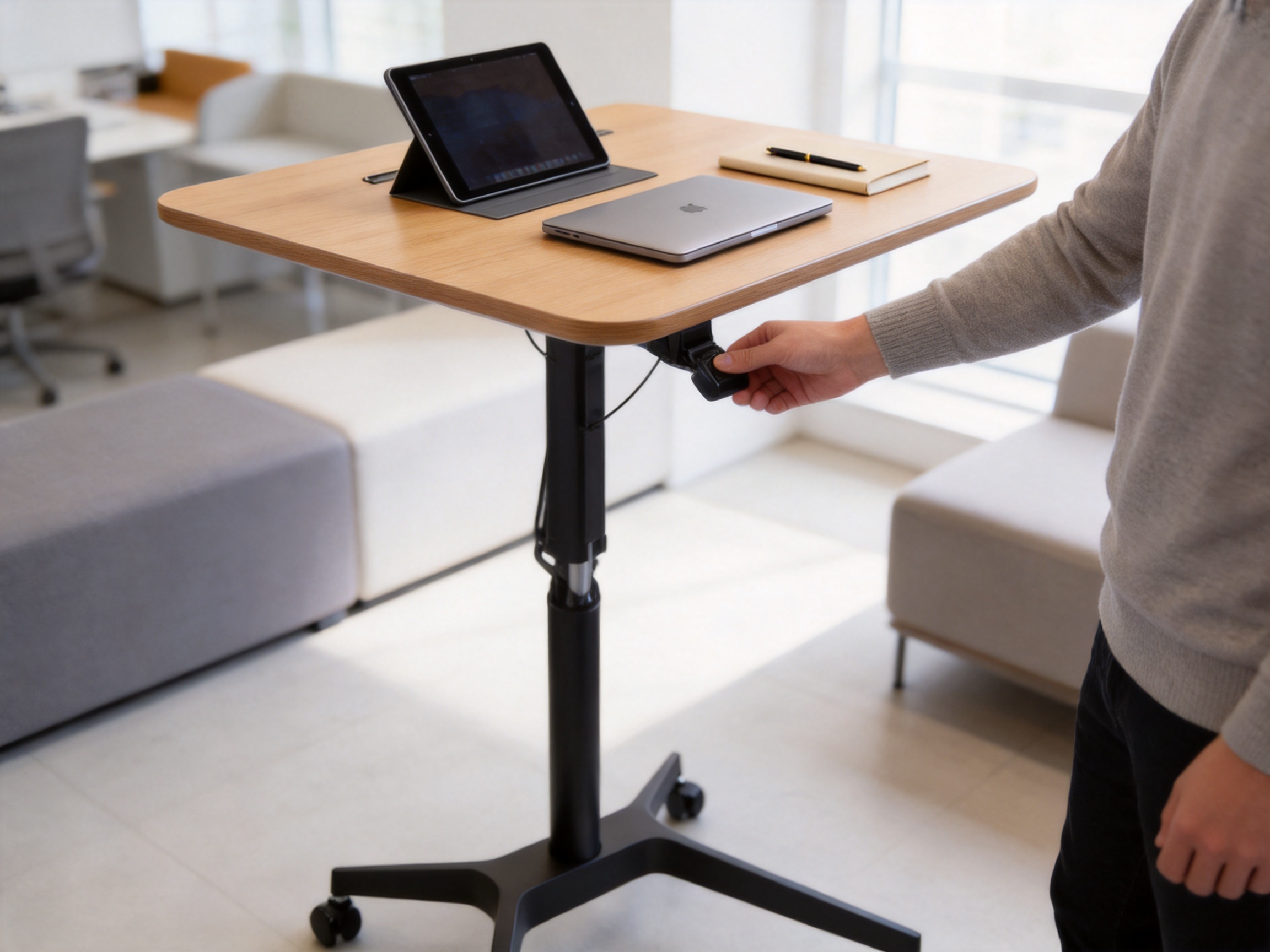
The 750mm low position supports seated work. Users can place a tablet, laptop, keyboard, or documents on the tabletop and work in a conventional seated posture. The compact surface helps keep essential items within reach, reducing unnecessary stretching. For environments such as training rooms or temporary offices, this can create a quick workstation without installing a full desk system.
The 1060mm high position supports standing work. Standing can be useful during presentations, quick meetings, device testing, customer demonstrations, teaching activities, and short-duration administrative tasks. A standing surface can also encourage users to remain more alert and mobile. In shared spaces, the desk can be adjusted quickly for different users and purposes.
The range between 750mm and 1060mm provides transitional flexibility. Many tasks do not fit neatly into seated or standing categories. A user may need a slightly elevated surface when reading technical drawings, checking devices, or presenting to a small group. Another user may prefer a mid-height position for sorting materials or reviewing samples. The pneumatic lift allows these intermediate positions to be reached easily.
Because the product is mobile, ergonomic advantage also comes from placement. Users can move the desk closer to where work is happening. Instead of walking repeatedly between a fixed table and a testing area, the desk can serve as a mobile support platform. Instead of carrying presentation materials around a classroom, the instructor can move the desk to the most useful location. Instead of placing a tablet on an unsuitable surface, users can create a more controlled working height.
Ergonomics also depends on psychological comfort and workflow efficiency. A desk that can be adjusted, moved, and locked in place gives users greater control over their environment. This sense of control can be valuable in fast-changing workplaces where tasks and teams change frequently. The TH01-3 supports this flexibility in a straightforward way.
Competitive Advantages Over Ordinary Mobile Desks
Many mobile desks on the market share a similar basic concept: a tabletop, a support column, and casters. However, the real difference lies in stability, adjustment quality, material selection, surface finishing, and manufacturing consistency. The TH01-3 is designed to compete not only as a mobile table but as a more refined pneumatic height-adjustable workstation.
Advantage 1: Power-Free Height Adjustment
Compared with electric desks, the pneumatic system allows flexible placement without power access. This is especially valuable in spaces where cables create trip risks or where power outlets are limited. For training rooms, exhibition halls, school classrooms, shared offices, and product demonstration areas, a power-free adjustable desk is easier to deploy and reposition.
Compared with manually bolted or knob-adjusted tables, the gas spring system is faster and more convenient. Users do not need tools, repeated loosening and tightening, or complicated adjustment steps. A smoother adjustment experience encourages users to actually use the sit-stand function instead of leaving the desk at one height.
Advantage 2: Compact but Functional Tabletop
The 715mm by 475mm tabletop is a practical size for modern mobile work. It is not excessively large, so it does not reduce mobility or occupy unnecessary floor space. At the same time, it is large enough for an iPad or tablet, compact laptop, documents, small tools, test instruments, or teaching materials. This balance makes the desk suitable for high-density environments where space efficiency matters.
Some competitor products use thinner boards or simple laminated surfaces that may feel less solid over time. The TH01-3 uses a 25mm MDF tabletop with PVC vacuum forming. The thickness contributes to a more substantial work surface, while the formed PVC surface helps improve daily resistance to wear and impact. For mobile furniture, where the table may be moved, touched, and used frequently by different people, surface durability is a practical advantage.
Advantage 3: Stronger Visual and Structural Identity
The flat-legged triangular support design gives the TH01-3 a more distinctive appearance than many generic rolling tables. The outward angle of the legs creates a visual impression of stability, while the defined center connection and direct structural transition communicate engineering clarity. This matters because workplace furniture is also part of the interior environment. A mobile desk used in a showroom, classroom, reception area, or demonstration space should look professional as well as function well.
The triangular support structure also helps distinguish the product from competitors that rely on simple straight bases or narrow supports. A well-designed foot structure can improve user confidence when moving or adjusting the desk. Even when a product is compact, it should not feel fragile or temporary. The TH01-3 is designed to look and feel like purposeful equipment.
Advantage 4: Material Combination of Aluminum and Iron
The combination of aluminum and iron allows the frame to balance strength and practicality. Iron contributes rigidity and load-bearing capability, while aluminum can support a lighter and cleaner structural solution in selected components. This combination is suitable for mobile workstation products because users expect the desk to be stable enough for daily work but still easy to reposition.
Some low-cost mobile tables use materials that may reduce stability or long-term durability. The TH01-3 takes a more industrially grounded approach with metal construction and powder-coated finishing. This makes the product suitable not only for office use but also for education, testing, assembly, and demonstration scenarios where furniture may experience frequent movement.
Advantage 5: Practical Mobility With Locking Casters
Mobility is only useful when it can be controlled. The TH01-3 uses two lockable casters and two non-locking casters. This configuration allows users to roll the desk easily when needed and then lock it for more stable use. In many applications, such as product demonstration or tablet operation, the ability to secure the desk position is important for comfort and safety.
Competitor products may include casters but not provide sufficient locking stability, or they may be difficult to move smoothly across common flooring. A good mobile workstation should transition between motion and stationary use without frustration. The caster arrangement of the TH01-3 supports this everyday usability.
Application Scenarios
The TH01-3 is suited to environments requiring frequent height or position changes. Its compact size, pneumatic lifting, and casters make it useful across many industries and space types.
Electronic Device Testing
In electronic device testing, technicians often need to move between devices, inspection points, and computer systems. A mobile height-adjustable desk can hold a tablet, testing instrument, checklist, or small component tray. The desk can be moved to the device under inspection, adjusted to a comfortable working height, and locked in place. This can reduce unnecessary walking and improve task organization.
Product Demonstration
For showrooms, exhibitions, and sales presentations, the desk can serve as a compact platform for displaying a product, tablet interface, catalog, or sample. The height can be raised for standing interaction and lowered for seated discussion. The visual cleanliness of the frame and tabletop color options help it fit into professional display environments.
Light Assembly Stations
Light assembly work often benefits from adjustable surface height because different tasks require different hand positions. While the TH01-3 is not intended as a heavy industrial workbench, it is useful for compact tools, instruction sheets, tablets, and small components. Its mobility helps support flexible production lines, temporary workstations, and training areas.
Creative Workspaces
Design teams, media teams, and creative studios often rearrange their spaces for brainstorming, review sessions, and hands-on work. A mobile adjustable desk provides a flexible surface for sketches, tablets, mood boards, laptops, or samples. The pneumatic lift allows the desk to support seated review, standing discussion, or quick collaborative sessions.
Educational Training
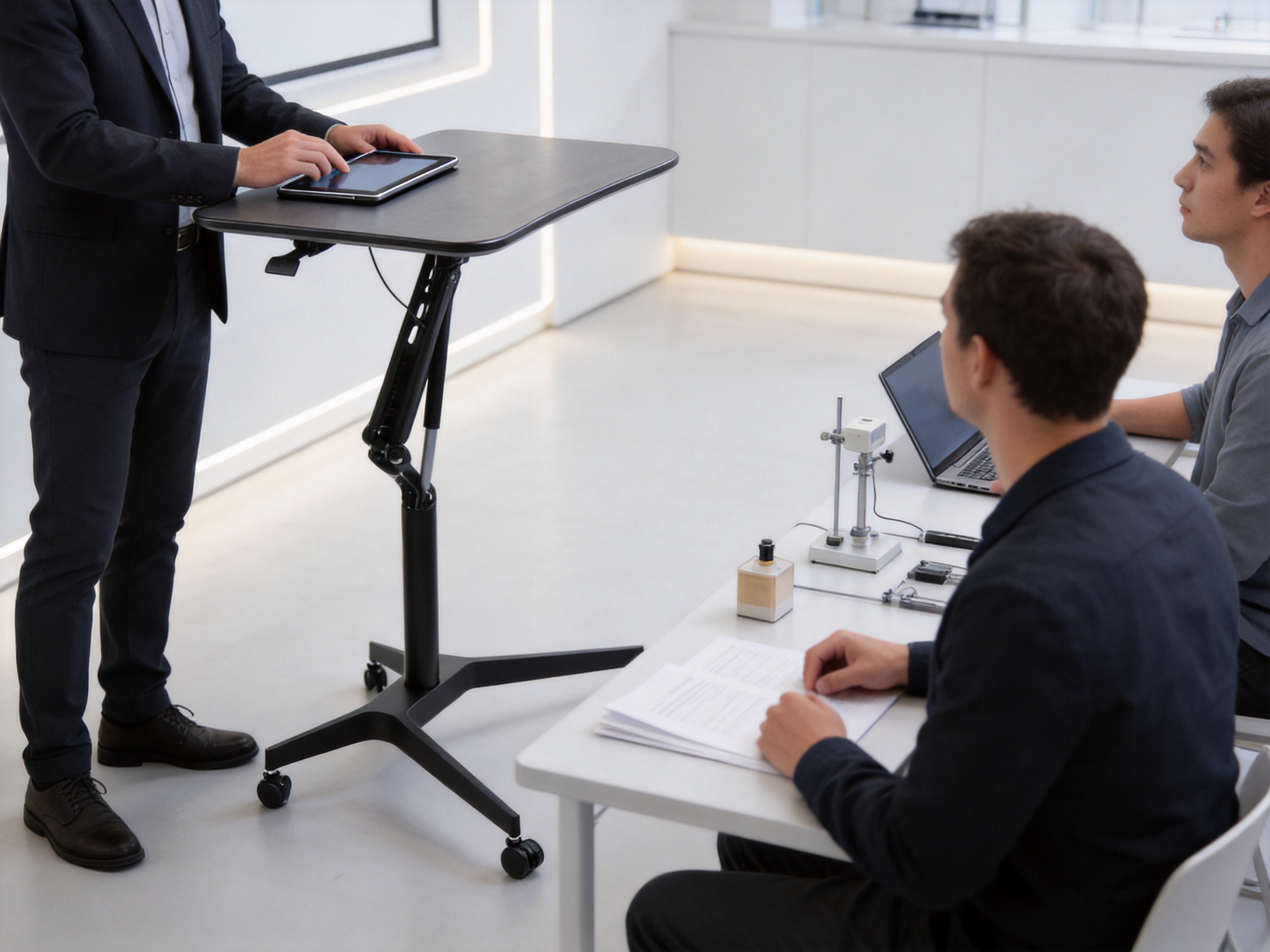
In classrooms, laboratories, and training rooms, instructors often need to move around the room while keeping materials close. The TH01-3 can function as a mobile teaching station, tablet stand, document platform, or demonstration table. The lockable casters help keep the desk stable when the instructor is presenting or operating a device.
Healthcare Support and Administrative Areas
Although the product is not presented as a medical device, its mobility and height adjustment can be useful in healthcare-adjacent administrative settings, reception support, staff training areas, and equipment documentation zones. A power-free design can be easier to manage in shared spaces where simple movement and quick repositioning are preferred.
Design Details That Improve Daily Use
Good furniture design is often noticed through small details. The TH01-3 combines several features that make it practical in daily use.
The tabletop thickness of 25mm gives users a sense of solidity. Thin panels can feel temporary, especially when supporting devices or when users rest their hands on the surface. A thicker tabletop also provides a more premium visual proportion, matching the metal frame more convincingly.
The PVC vacuum-formed surface supports easy maintenance. In busy environments, surfaces must resist common wear from hands, devices, papers, sample products, and repeated cleaning. A smooth formed surface can help reduce exposed edges and improve the tabletop’s resistance to everyday use conditions.
The powder-coated frame finish supports durability and appearance. Powder coating is widely used for metal furniture because it can provide an even, attractive, and protective surface. The availability of white, silver, and black allows the product to fit different purchasing standards, interior design schemes, and product families.
The color options for the tabletop make the desk adaptable. White can create a clean and modern look. Maple can soften the workspace with a lighter wood tone. Walnut can provide a warmer and more premium appearance. Black can coordinate with technology equipment and contemporary interiors. This variety gives buyers flexibility without changing the core product structure.
The caster configuration supports movement and stability. In mobile furniture, users often need to move the product frequently but also expect it to stay still during work. Two locking casters offer a practical balance between easy rolling and secure placement. This is especially important when the desk is used for typing, touch-screen operation, or product demonstration.
The triangular support design is more than an appearance feature. It organizes the base visually and structurally. The outward leg angle creates a stable stance, while the more direct transition at the center connection helps the product look purposeful. For buyers choosing furniture for visible environments, this design can be a meaningful advantage over plain utilitarian carts.
Manufacturing Strength Behind the Product
SuZhou Skyhone Intelligent Technology Co., Ltd. is deeply engaged in the research and development, production, sales, and service of standing desks. This specialization matters because height-adjustable furniture requires more than simple fabrication. It requires understanding of ergonomics, lifting systems, stability, material behavior, surface finishing, assembly quality, and user experience.
The company is based in Suzhou, a city located within the industrially advanced Yangtze River Delta region. This location supports access to a mature furniture supply chain, metalworking resources, surface-treatment capabilities, packaging suppliers, and logistics networks. For global buyers, a manufacturer supported by a complete industrial chain can often provide stronger consistency, better customization coordination, and more reliable production planning.
Advanced manufacturing strength begins with product development. For a pneumatic height-adjustable desk, engineers must consider the lifting range, gas spring specification, tabletop size, base geometry, caster selection, and structural balance. The desk must be easy to adjust but not unstable. It must be mobile but not flimsy. It must be compact but still useful. These trade-offs require experience in standing desk design.
Material selection is another important manufacturing step. The tabletop uses MDF with PVC vacuum forming, while the frame uses aluminum and iron. Each material must be selected to match the intended performance. MDF provides a flat and stable panel substrate. PVC vacuum forming provides a finished surface that wraps and protects the tabletop. Aluminum and iron provide structural support where strength and shape are needed.
Metal processing is essential for the frame and base. Cutting, forming, welding or fastening preparation, hole positioning, and dimensional control all affect final assembly. If the frame components are not accurately made, the desk may be difficult to assemble or may not stand correctly. A professional manufacturing enterprise must control tolerances and ensure repeated production quality.
Powder coating adds both protection and visual quality. Before coating, metal surfaces typically require preparation to support adhesion and finish consistency. A quality powder-coated surface should be even, clean, and suitable for the product’s intended use. Color consistency is especially important when customers order multiple units for the same office, classroom, or project installation.
The tabletop manufacturing process also affects the user experience. PVC vacuum forming requires control of heat, pressure, material fit, and edge quality. A properly formed tabletop should appear smooth, with clean edges and a durable surface. Because users interact with the tabletop directly, surface quality is one of the most visible indicators of product value.
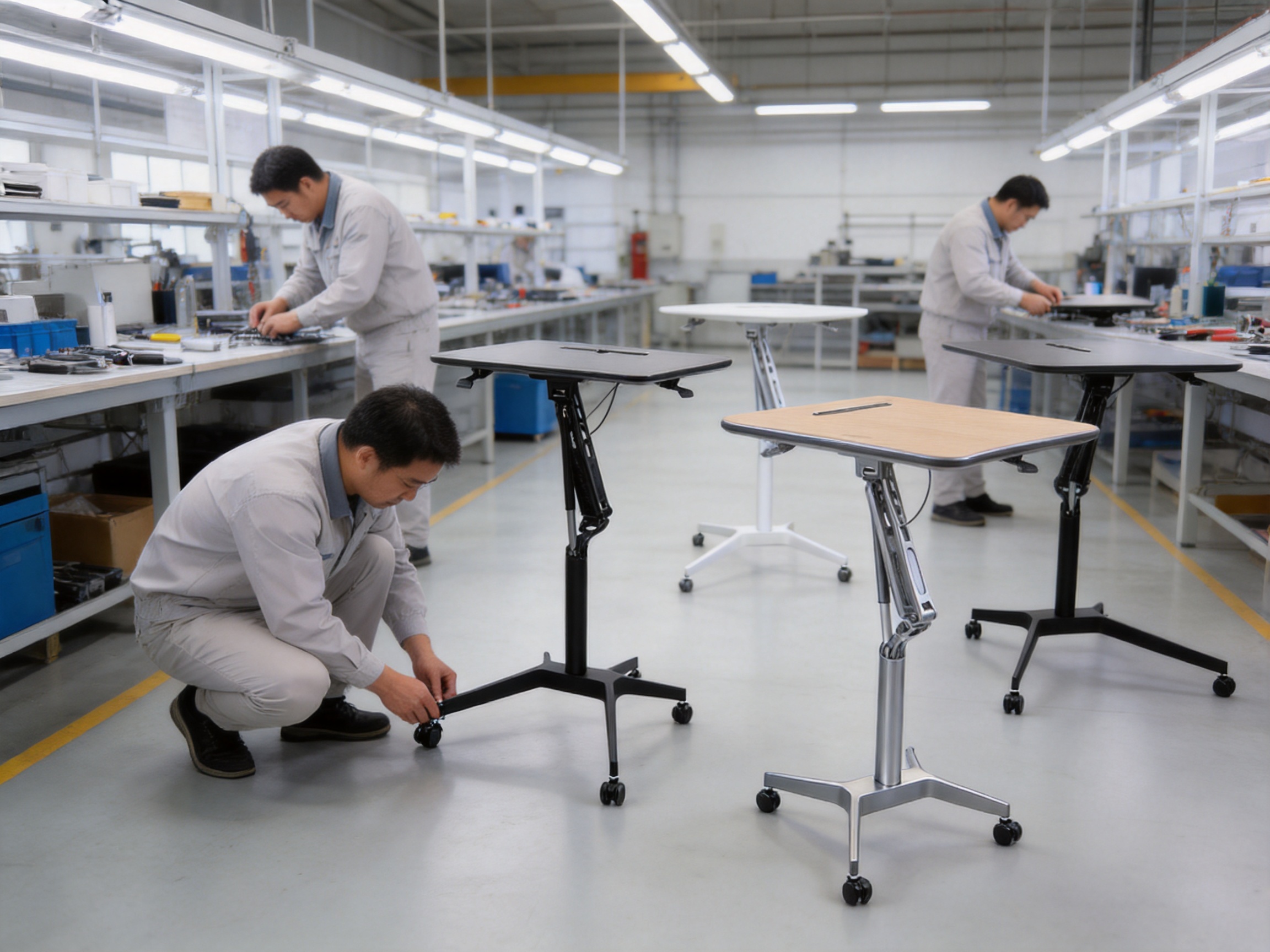
Assembly quality is equally important. The gas spring, frame, tabletop, legs, and casters must be integrated correctly. The lifting mechanism must operate smoothly. The desk should roll properly, lock securely, and feel stable across its height range. Manufacturing strength is visible not only in individual parts but in how those parts work together as a finished product.
Quality inspection should address appearance, dimensions, function, and packaging readiness. A height-adjustable mobile desk must be checked for lifting performance, surface condition, caster operation, frame finish, and assembly accuracy. When products are shipped to global buyers, packaging must protect the tabletop, frame, and moving components from damage during transportation.
The company’s commitment to healthy, efficient, and intelligent office-space solutions supports long-term product development. As workspaces continue to evolve, demand for flexible furniture will grow. Products such as the TH01-3 show how manufacturing experience in standing desks can be applied to compact, mobile, and task-specific workstation solutions.
How the TH01-3 Supports Procurement Goals
Business buyers often evaluate furniture according to several practical criteria: usability, durability, appearance, flexibility, maintenance, price-performance balance, supplier reliability, and customization options. The TH01-3 addresses these criteria through a focused design and a manufacturer with standing desk expertise.
Usability is supported by the simple pneumatic adjustment system. Users do not need to understand complicated controls. They can adjust the height as needed and move the desk where it is required. This makes training and deployment easier, especially when the desks are shared by many people.
Durability is supported by the 25mm MDF tabletop, PVC vacuum-formed surface, aluminum-iron frame, and powder-coated finish. These choices are suitable for frequent office, education, demonstration, and light-duty use. For buyers, durability reduces replacement pressure and improves long-term value.
Appearance is supported by the flat-legged triangular structure and multiple color choices. The desk can be selected to match bright modern offices, technology-focused spaces, neutral training rooms, or warm wood-tone interiors. This helps organizations maintain visual consistency without sacrificing function.
Flexibility is one of the product’s strongest procurement advantages. A single desk can serve many departments and tasks. It can be used in a classroom one day, a demonstration room the next, and a temporary workstation after that. This versatility can reduce the need to purchase multiple single-purpose furniture items.
Maintenance is simplified by the power-free lifting system. Without electric motors, control boxes, and power cables, there are fewer electrical elements to manage. This does not eliminate the need for proper use and inspection, but it can make the product easier to operate in shared spaces.
Supplier reliability is supported by the company’s focus on standing desks and its location in a mature manufacturing region. For buyers seeking custom ergonomic adjustable office table solutions, working with a specialized manufacturer can help align product details, packaging, colors, and project needs.
Customization and Configuration Possibilities
The TH01-3 already includes several configurable visual options. The frame surface can be finished in white, silver, or black powder coating. The tabletop panel can be supplied in white, maple, walnut, or black. These options enable buyers to match the desk to different environments and brand-neutral interior schemes.
For offices with a bright, minimal design, a white tabletop and white frame can create a clean, contemporary appearance. For technology labs or product testing areas, a black or silver frame may coordinate well with equipment. For training rooms or educational spaces, maple or walnut tabletop colors can provide a warmer and more comfortable visual effect.
Customization is also important for project-based purchasing. Different markets may require different packaging approaches, instructions, labeling, or color combinations. A manufacturer experienced in standing desk production can support these discussions more effectively than a general furniture trader. The result is a product that better fits buyer needs while maintaining the core engineering structure.
Because the desk is compact, it can be deployed in series across multiple rooms or departments. A buyer might choose the same frame color for all units while varying tabletop colors by department. Alternatively, a school or training center might select one consistent combination for easy management. The product’s design supports both standardization and visual adaptation.
Comparison With Electric Height-Adjustable Desks
Electric height-adjustable desks are excellent for many full-size office workstations, especially where users need programmable height presets, larger work surfaces, or frequent monitor-and-keyboard setups. However, the TH01-3 serves a different purpose. It is not intended to replace every electric desk; instead, it fills a need for mobile, compact, power-free adjustment.
In environments where desks remain fixed in one location, electric systems can be highly effective. But in spaces where furniture must move frequently, power cables can become inconvenient. A pneumatic desk avoids this limitation. Users can move it across a room or between rooms without unplugging, managing cords, or searching for outlets.
Electric desks also typically include motors, control boxes, keypads, and wiring. These components add functionality but also increase system complexity. For a compact mobile desk, simplicity can be more valuable. The gas spring lifting principle provides enough adjustment function for the intended application while keeping the product easy to use.
Electric desks often have larger frames and tabletops, which are useful for full workstations but less convenient in tight spaces. The TH01-3’s compact dimensions make it easier to maneuver, store, and deploy in multipurpose rooms. It is particularly useful where the work surface is needed temporarily or where users interact while standing.
For procurement teams, the choice is not necessarily pneumatic versus electric in all cases. A well-planned workplace may use electric standing desks for permanent workstations and pneumatic mobile desks for agile support tasks. The TH01-3 complements broader ergonomic furniture strategies by adding flexible mobile capability.
Comparison With Fixed-Height Carts and Tables
Fixed-height carts and tables are common because they are simple and often inexpensive. However, they have significant limitations. A fixed height cannot suit all users or all tasks. It may force a tall user to bend forward or a shorter user to raise the shoulders. It may be acceptable for moving objects but less comfortable for typing, presenting, or operating touch screens.
The TH01-3 improves on fixed-height solutions by allowing height adjustment from 750mm to 1060mm. This makes the desk more inclusive for different users and more adaptable for different work modes. In shared environments, this is especially important because a desk may be used by many people throughout the day.
Fixed-height carts may also look purely utilitarian. The TH01-3’s triangular flat-legged design, color options, and powder-coated metal frame make it suitable for professional spaces where appearance matters. It can support demonstrations, customer-facing interactions, and teaching activities without looking like a temporary utility cart.
From a value perspective, an adjustable mobile desk can replace several fixed-height items. Instead of buying separate seated tables, standing podiums, and mobile carts, an organization may use the TH01-3 for multiple purposes. This can improve space efficiency and furniture utilization.
Workplace Health and Productivity Value
The growing interest in sit-stand work is connected to a broader understanding of movement and posture. While no desk alone can guarantee health outcomes, furniture that supports posture variation can contribute to better daily work habits. The TH01-3 gives users a practical way to alternate between seated and standing tasks without requiring a permanent sit-stand workstation.
Posture variation can reduce the discomfort that comes from remaining in one position for too long. In many workplaces, users naturally perform different tasks throughout the day. A height-adjustable mobile desk helps match the working surface to the task, whether that task involves reading, writing, presenting, testing, or operating a tablet.
Productivity can also improve when tools and information are positioned where work happens. A mobile desk can bring documents, devices, and materials closer to the point of use. In training rooms, this helps instructors remain engaged with participants. In testing areas, it helps technicians keep reference materials nearby. In creative spaces, it supports quick collaboration.
Because the TH01-3 is easy to move and adjust, it can reduce friction in daily workflow. Users are more likely to use adjustable features when they are simple and immediate. A gas spring system supports this behavior by making adjustment quick and intuitive.
Durability Through Materials and Finishing
Durability in a mobile desk depends on multiple elements working together. The tabletop must resist routine contact. The frame must maintain stability. The lifting mechanism must continue to operate smoothly. The casters must roll and lock reliably. The surface finish must withstand normal handling and movement.
The MDF tabletop provides a stable base for the PVC vacuum-formed finish. MDF is commonly used in furniture because it offers a smooth and consistent panel structure. When paired with vacuum-formed PVC, it can provide a practical surface for office, education, and demonstration environments. The 25mm thickness improves the tabletop’s feeling of strength.
The aluminum-iron frame supports the product’s structure. Metal framing is important for a height-adjustable mobile desk because it experiences forces during movement, adjustment, and daily use. A powder-coated finish helps protect the metal surface while providing color and a professional appearance.
The casters are important wear components. A desk that moves frequently must roll smoothly and remain stable when locked. The combination of two lockable and two non-locking casters provides a practical arrangement for users who need mobility without sacrificing stationary use.
Durability also depends on manufacturing consistency. Accurate component dimensions, secure assembly points, proper coating preparation, and careful packaging all contribute to the finished product’s long-term performance. This is where the company’s manufacturing focus and regional industrial support become valuable.
Space Efficiency and Interior Integration
Many workplaces are under pressure to do more with less space. Large fixed desks are not always practical in training rooms, shared offices, laboratories, or multipurpose areas. The TH01-3’s compact footprint helps organizations create usable work surfaces without permanently occupying large areas.
When not in use, the desk can be moved aside or repositioned for the next activity. This is valuable in rooms that change function during the day. A training room may become a meeting room. A demonstration area may become a testing area. A classroom may shift from lecture mode to group activity. Mobile adjustable furniture supports these transitions.
The clean color options help the desk integrate with different interiors. White and silver finishes can work well in modern office and laboratory environments. Black can provide contrast and coordinate with electronics. Wood-tone tabletops such as maple and walnut can soften the appearance of learning or customer-facing spaces.
Interior integration is not only about color. The product’s linear flat-legged design makes it appear intentional rather than improvised. This helps maintain a professional impression even when the desk is used in visible areas such as showrooms, conference spaces, or reception support zones.
Buying Considerations
When evaluating the TH01-3 for a project, buyers should consider the intended use, user height range, required mobility, surface color, frame color, and quantity. The lifting range of 750mm to 1060mm is suitable for many seated and standing tasks, but each organization should match the range to its specific ergonomic needs.
The tabletop size of 715mm by 475mm is ideal for compact tasks. Buyers needing a large dual-monitor workstation may require a different desk type. However, for tablets, laptops, documents, demonstrations, and light tools, the size is practical and efficient.
Buyers should also consider flooring conditions. Casters perform differently on hard floors, carpets, thresholds, and uneven surfaces. The product is best used in appropriate indoor environments where mobile furniture can move safely and be locked during use.
Color selection can be based on the environment. White panels may support clean office aesthetics, maple or walnut may match educational or hospitality settings, and black may suit technology or industrial design spaces. Frame color should be selected to coordinate with the tabletop and surrounding furniture.
For bulk procurement, communication with the manufacturer can help clarify packaging, delivery, after-sales support, and customization requirements. Because the company specializes in standing desks and ergonomic adjustable office table solutions, it is positioned to support buyers seeking consistent product supply and project coordination.
Practical Use Guidelines
To get the best performance from the TH01-3, users should adjust the desk height according to the task. For typing or tablet operation, the surface should allow the shoulders to remain relaxed and the wrists to stay in a comfortable position. For presentation or demonstration, the surface can be raised to improve visibility and interaction.
When moving the desk, users should unlock the lockable casters first and guide the desk carefully. After placing it in the desired location, the lockable casters should be engaged to improve stability. Users should avoid moving the desk aggressively or using it on unsuitable uneven surfaces.
The tabletop should be kept clean according to normal furniture-care practices. Sharp impacts, excessive loads, or harsh cleaning materials should be avoided. Although the PVC vacuum-formed surface improves everyday resistance, proper use helps preserve appearance and performance.
The gas spring lifting mechanism should be used as intended. Users should not force the desk beyond its lifting range. If the desk is used in a shared environment, simple user instructions can help ensure safe and consistent operation.
Q&A Section
Q1: What is the main purpose of the TH01-3 pneumatic height-adjustable desk?
The main purpose is to provide a compact, mobile, and height-adjustable workstation for environments where users need to switch between seated and standing work or move the work surface frequently. It is suitable for tablet operation, product demonstrations, training, light assembly support, device testing, and creative workspaces.
Q2: What is the height adjustment range?
The desk adjusts from 750mm to 1060mm. This range supports seated work, standing interaction, and intermediate task heights for different users and applications.
Q3: Does the desk require electricity?
No. The desk uses a gas spring lifting mechanism, so height adjustment is manual and power-free. This makes the product easy to move and use in spaces where power outlets are limited or where cables would be inconvenient.
Q4: What is the tabletop made of?
The tabletop is made of 25mm MDF with a PVC vacuum-formed surface. This combination provides a solid working surface with improved resistance to everyday wear and impact.
Q5: What are the available tabletop colors?
The tabletop is available in white, maple, walnut, and black. These options allow the desk to match a variety of office, education, showroom, and training-room interiors.
Q6: What materials are used for the frame?
The frame is made from aluminum and iron. This material combination supports rigidity, durability, and practical mobility for daily use.
Q7: What frame colors are available?
The frame is available with powder coating in white, silver, or black. Powder coating improves the appearance and durability of the metal surface.
Q8: How mobile is the desk?
The desk is equipped with four casters: two with locks and two without locks. This allows the desk to be moved easily and then secured in position during use.
Q9: How does it compare with an electric height-adjustable desk?
An electric desk is often suitable for large permanent workstations, while the TH01-3 is designed for compact, mobile, power-free flexibility. It does not require cables, motors, or control boxes, making it easier to move and deploy in shared or temporary spaces.
Q10: What makes the flat-legged design special?
The flat-legged design uses a triangular support structure with a slightly larger outward leg angle, distinct center connection lines, and direct structural transitions. This provides a more linear, stable, and professional appearance than many ordinary mobile tables.
Q11: Is it suitable for classrooms or training rooms?
Yes. The desk can serve as a mobile teaching station, tablet platform, document table, or demonstration surface. The height adjustment and casters make it useful in rooms that need flexible layouts.
Q12: Is it suitable for heavy industrial use?
The desk is best understood as a compact mobile workstation for office, education, demonstration, electronic testing, creative, and light assembly support. For heavy industrial loads, buyers should evaluate specialized industrial workbenches.
Q13: Why is the manufacturer’s location important?
The manufacturer is located in Suzhou, within the Yangtze River Delta industrial region. This area provides strong supply-chain resources, manufacturing support, and logistics advantages, helping the company produce ergonomic adjustable furniture with consistency.
Q14: Can the product support custom project requirements?
The product already offers frame and tabletop color options. For project-based purchasing, buyers can discuss requirements such as color combinations, packaging, and supply arrangements with the manufacturer.
Company Manufacturing and Service Advantage
SuZhou Skyhone Intelligent Technology Co., Ltd. provides more than a single product; it provides the manufacturing foundation behind ergonomic adjustable office table solutions. As a professional enterprise engaged in standing desks, the company understands how lifting mechanisms, frame stability, materials, and user experience interact.
This expertise is important for global buyers because height-adjustable products require consistent engineering. A poorly designed adjustable desk may wobble, lift unevenly, feel unstable, or fail to meet user expectations. A specialized manufacturer can reduce these risks through product development, controlled production, and practical quality checks.
The company’s location in Suzhou Industrial Park also supports business communication and supply-chain efficiency. The Yangtze River Delta is known for its advanced manufacturing ecosystem, and this environment helps support material sourcing, component processing, finishing, and shipment preparation. For buyers seeking dependable supply, this regional advantage can be significant.
The company’s product direction is aligned with global workplace trends. More organizations are looking for furniture that supports health, movement, flexibility, and efficient space use. The TH01-3 reflects these trends by providing a compact pneumatic solution that can be used in many environments without electrical installation.
Conclusion
The TH01-3 iPad Pneumatic Height-Adjustable Desk with a flat-legged structure is a practical answer to the changing demands of modern workspaces. It combines a 750mm to 1060mm lifting range, gas spring power-free adjustment, a 715mm by 475mm compact tabletop, 25mm MDF with PVC vacuum forming, aluminum-iron construction, powder-coated finishing, and mobile casters with locking capability.
Its greatest strength is versatility. It can support seated work, standing work, product presentation, tablet operation, light assembly support, education, training, electronic testing, and creative collaboration. Unlike fixed-height carts, it adapts to users and tasks. Unlike electric desks, it remains simple, mobile, and independent of power access. Unlike generic mobile tables, it offers a more refined triangular flat-legged structure and stronger visual identity.
The product is also strengthened by the manufacturing background of SuZhou Skyhone Intelligent Technology Co., Ltd. With specialization in standing desks and access to the industrial resources of Suzhou and the Yangtze River Delta, the company is well positioned to deliver ergonomic adjustable office table solutions for global customers.
For organizations seeking a compact, durable, mobile, and power-free adjustable workstation, the TH01-3 offers a strong balance of design, function, and manufacturing value. It is not just a movable table; it is a flexible work platform designed for the active, changing, and human-centered spaces of today.
References
Bridger, R. S. Introduction to Human Factors and Ergonomics. CRC Press.
Kroemer, K. H. E., and Grandjean, E. Fitting the Task to the Human: A Textbook of Occupational Ergonomics. Taylor & Francis.
Pheasant, S., and Haslegrave, C. M. Bodyspace: Anthropometry, Ergonomics and the Design of Work. CRC Press.
Sanders, M. S., and McCormick, E. J. Human Factors in Engineering and Design. McGraw-Hill.
Panero, J., and Zelnik, M. Human Dimension and Interior Space. Watson-Guptill.
International Ergonomics Association. General Principles of Ergonomics and Human-Centered Design.
Manufacturing Engineering Handbook. Desk and Metal Furniture Processing Principles.
Powder Coating Institute. Fundamentals of Powder Coating for Metal Products.
Product: TH01-3 iPad (Flat-Legged) Pneumatic Height-Adjustable Desk


- Contact Info
-
-
 Phone+86-15950656125
 -
 Email
Email -
 AddressRoom 1007-1, South Building, Suyue Plaza, Suzhou Industrial Park, Suzhou City, Jiangsu Province, China
-
- Products
- Follow Us
- Need help? Please contact us
Copyright ©
SuZhou Skyhone Intelligent Technology Co., Ltd.
All Rights Reserved.
Privacy
Custom Ergonomic Adjustable Office Tables Manufacturers

