

 English
  русский
  Español
  عربى
عربى 
Content
- 1 Product Overview and Design Purpose
- 2 Key Specifications
- 3 Gas Spring Lifting: A Practical Alternative to Electric Adjustment
- 4 Ergonomic Benefits for Sitting and Standing Work
- 5 Dual-Leg Stability Compared with Single-Column Mobile Tables
- 6 Compact Desktop with Practical Workspace Dimensions
- 7 Mobility Through Lockable Caster Design
- 8 Durable Iron Frame and Powder-Coated Surface
- 9 Manufacturing Strengths Behind the Product
- 10 Advantages Over Conventional Fixed Desks
- 11 Advantages Over Electric Height-Adjustable Desks
- 12 Advantages Over Lightweight Portable Laptop Tables
- 13 Application Scenarios
- 14 User Experience and Daily Operation
- 15 Why the Product Matches Modern Workspace Trends
- 16 Company Manufacturing and Service Advantages
- 17 Customization and Procurement Considerations
- 18 Safety and Practical Use Guidelines
- 19 Q&A Section
- 19.1 What is the main function of this pneumatic height-adjustable desk?
- 19.2 How large is the desktop?
- 19.3 Does the desk need to be connected to power?
- 19.4 What makes it different from an electric standing desk?
- 19.5 Is the desk stable?
- 19.6 What are the casters used for?
- 19.7 Where can this desk be used?
- 19.8 What is the surface treatment?
- 19.9 Why is a dual-leg design useful?
- 19.10 Who manufactures the product?
- 20 Conclusion
- 21 References
- 22 Product: TH-14 Double-Leg Pneumatic Height-Adjustable Desk
Double-Leg Pneumatic Height-Adjustable Desk for Flexible Workspaces
2026-06-23
Modern work environments are changing quickly. Offices, laboratories, studios, training rooms, and home work areas no longer rely only on fixed furniture that forces users to remain in one posture throughout the day. A practical workstation must now support movement, space efficiency, ergonomic adjustment, and fast layout changes. The double-leg pneumatic height-adjustable desk is designed for exactly this kind of flexible environment, combining manual gas spring lifting, a stable metal structure, a compact desktop, and mobile casters into one adaptable workstation.
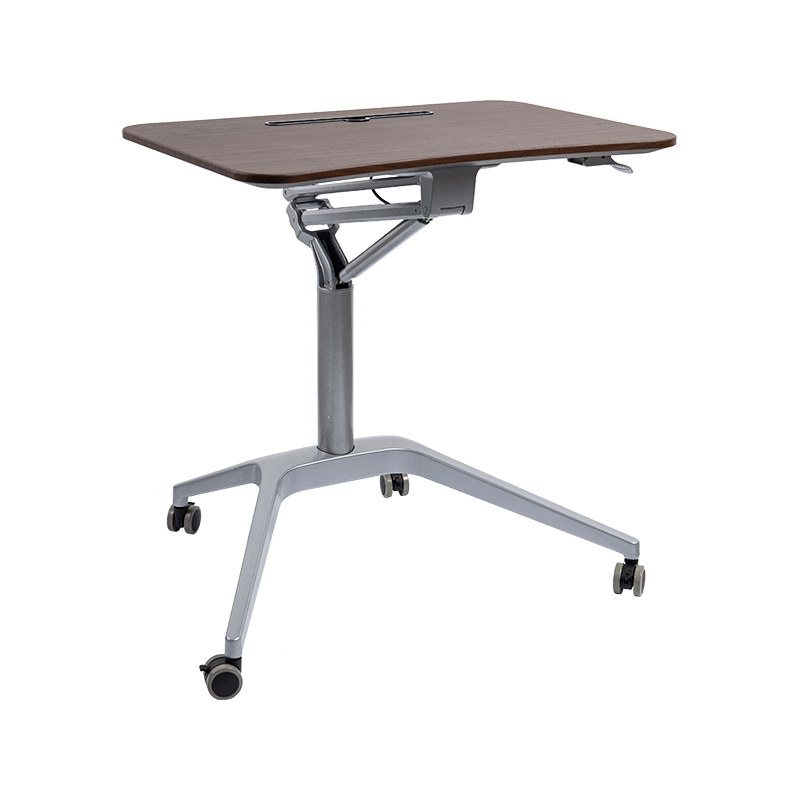
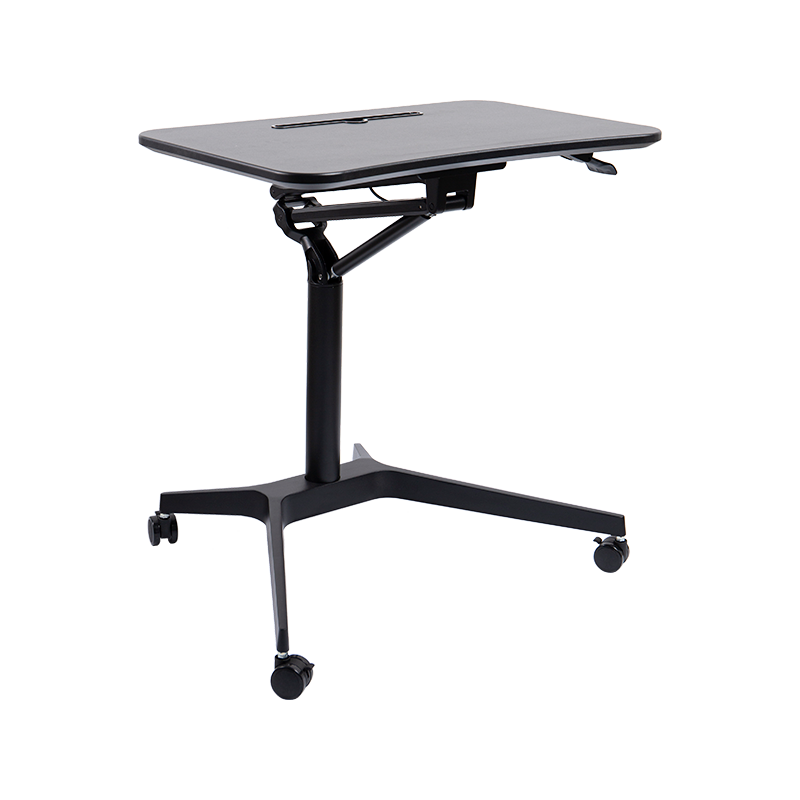
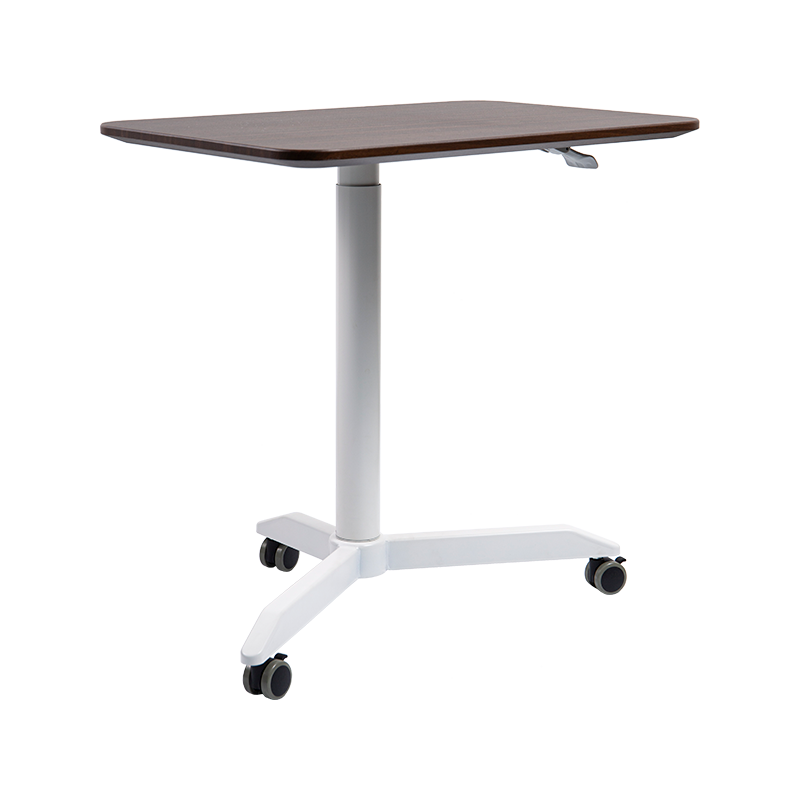
This article focuses on the TH-14 double-leg pneumatic height-adjustable desk, a product built around a gas spring lifting system and a dual-leg frame. With a lifting range from 760 mm to 1100 mm, it supports both seated and standing work. Its 980 mm by 560 mm tabletop provides a useful surface for laptops, monitors, instruments, documents, writing materials, or light professional equipment. The iron frame, black powder-coated finish, and four swivel casters make it suitable for workspaces where strength, mobility, and durability are required.
Compared with many conventional desks, this pneumatic height-adjustable desk provides more freedom. Compared with many electric standing desks, it offers a simpler operating principle, does not require power, and reduces concerns related to wiring, control boxes, motors, or electrical maintenance. Compared with small portable tables, it offers a more stable dual-leg support structure and a more professional appearance. Its value lies in balancing adjustability, mobility, durability, and ease of use.
SuZhou Skyhone Intelligent Technology Co., Ltd. manufactures standing desk solutions with a focus on healthy, efficient, and intelligent office space applications. Based in Suzhou, an important manufacturing region in the Yangtze River Delta, the company benefits from industrial chain support, technical resources, material processing capability, and production coordination advantages. These strengths help the company provide height-adjustable desk products for offices, education, laboratories, studios, commercial workspaces, and home environments.
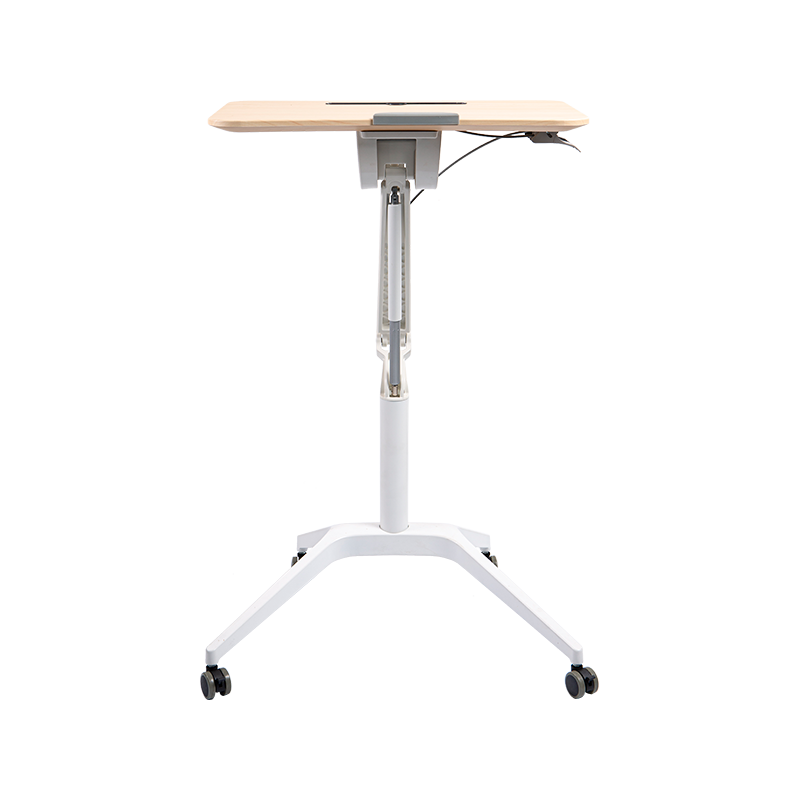
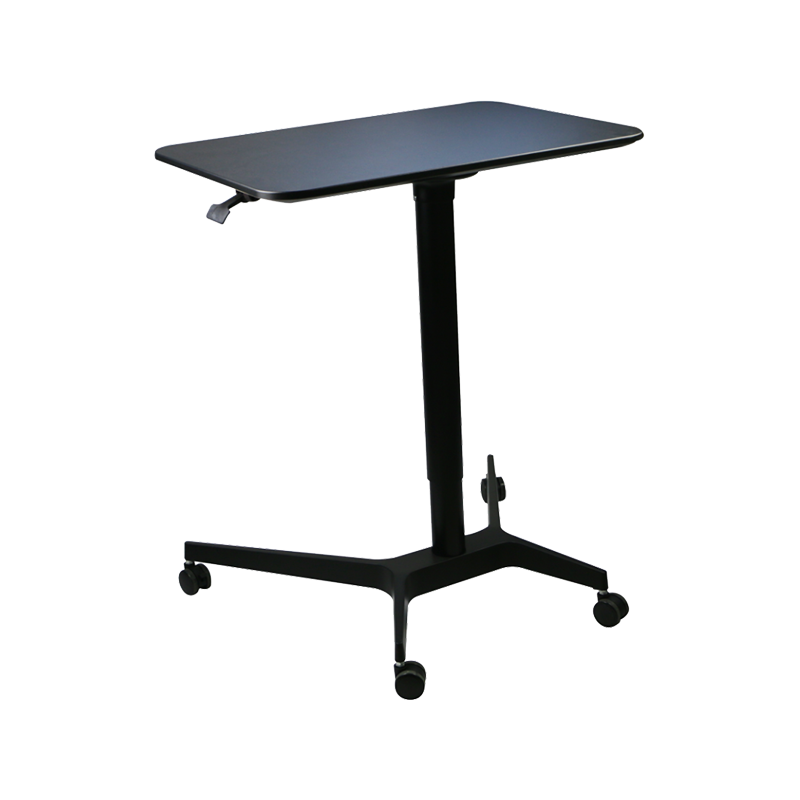
TH-14 Double-Leg Pneumatic Height-Adjustable Desk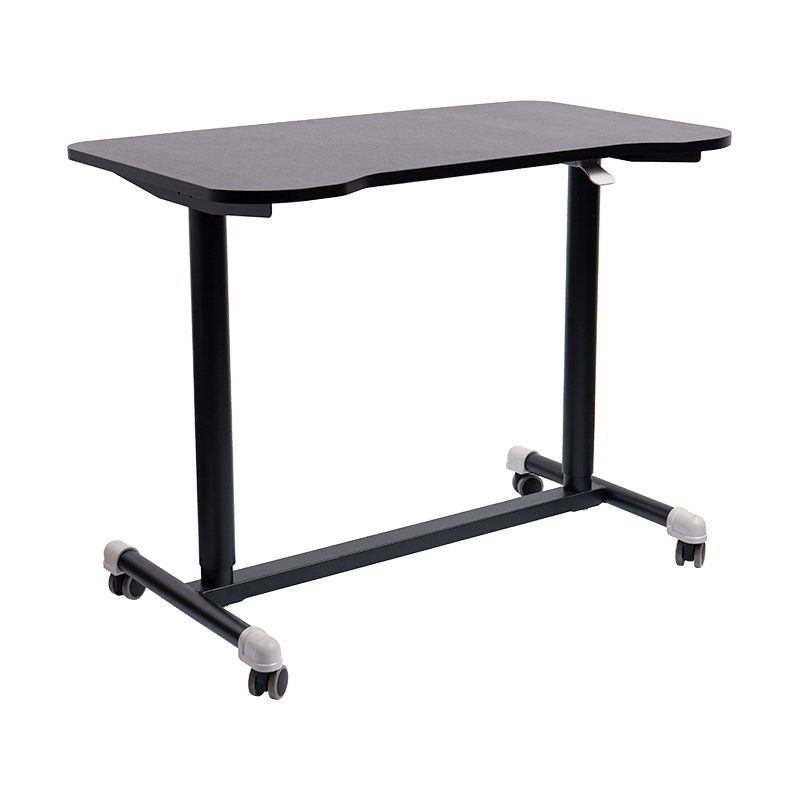
Product Overview and Design Purpose
The TH-14 double-leg pneumatic height-adjustable desk is a manually operated height-adjustable workstation. Its primary lifting mechanism is based on gas spring technology. The user can adjust the desktop height smoothly within the range of 760 mm to 1100 mm, allowing the desk to serve different postures and different users without requiring electricity. This makes the product especially useful in areas where power outlets are limited, cable management is inconvenient, or furniture needs to be moved frequently.
The desk uses a double-leg structure rather than a single-column support. This design gives the workstation a stable foundation and helps distribute weight more evenly. The dual-leg frame is important for users who need a dependable desk for daily work, meetings, equipment placement, or temporary workstation deployment. While compact in size, the desk is not designed as a fragile occasional table. It is built as a practical work surface for repeated use.
The tabletop size of 980 mm by 560 mm is suitable for many applications. It is large enough for a laptop and notebook, a compact monitor setup, laboratory documents, teaching materials, studio tools, or control devices. At the same time, it remains compact enough to fit into smaller spaces, narrow office aisles, shared working areas, or home study corners. This balance between working area and space economy is one of the main advantages of the product.
The desk frame is made from iron and finished with black powder coating. Iron provides structural strength and reliable support, while powder coating forms a durable surface layer that helps resist wear, scratches, corrosion, and everyday handling marks. The black finish also gives the product a clean and professional appearance, allowing it to fit into office, industrial, laboratory, educational, and home interiors.
The base is equipped with four swivel casters. Two casters include locking mechanisms, while two are non-locking. This caster arrangement allows the desk to be moved when needed and secured in place during work. For organizations that often reconfigure rooms, move equipment, or create temporary work zones, mobility is a major advantage. The desk can be relocated without heavy lifting, and once positioned, the locking casters help maintain stability.
Key Specifications
Product Type |
Double-Leg Pneumatic Height-Adjustable Desk |
Category |
Pneumatic Height-Adjustable Table |
Lifting Range |
760 mm to 1100 mm |
Tabletop Size |
980 mm by 560 mm |
Main Material |
Iron |
Surface Color |
Black |
Surface Treatment |
Powder Coating |
Caster Configuration |
Two casters with locks and two casters without locks |
Working Principle |
Gas Spring Lifting |
Typical Applications |
Offices, laboratories, studios, home studies, training rooms, and mobile workstations |
Gas Spring Lifting: A Practical Alternative to Electric Adjustment
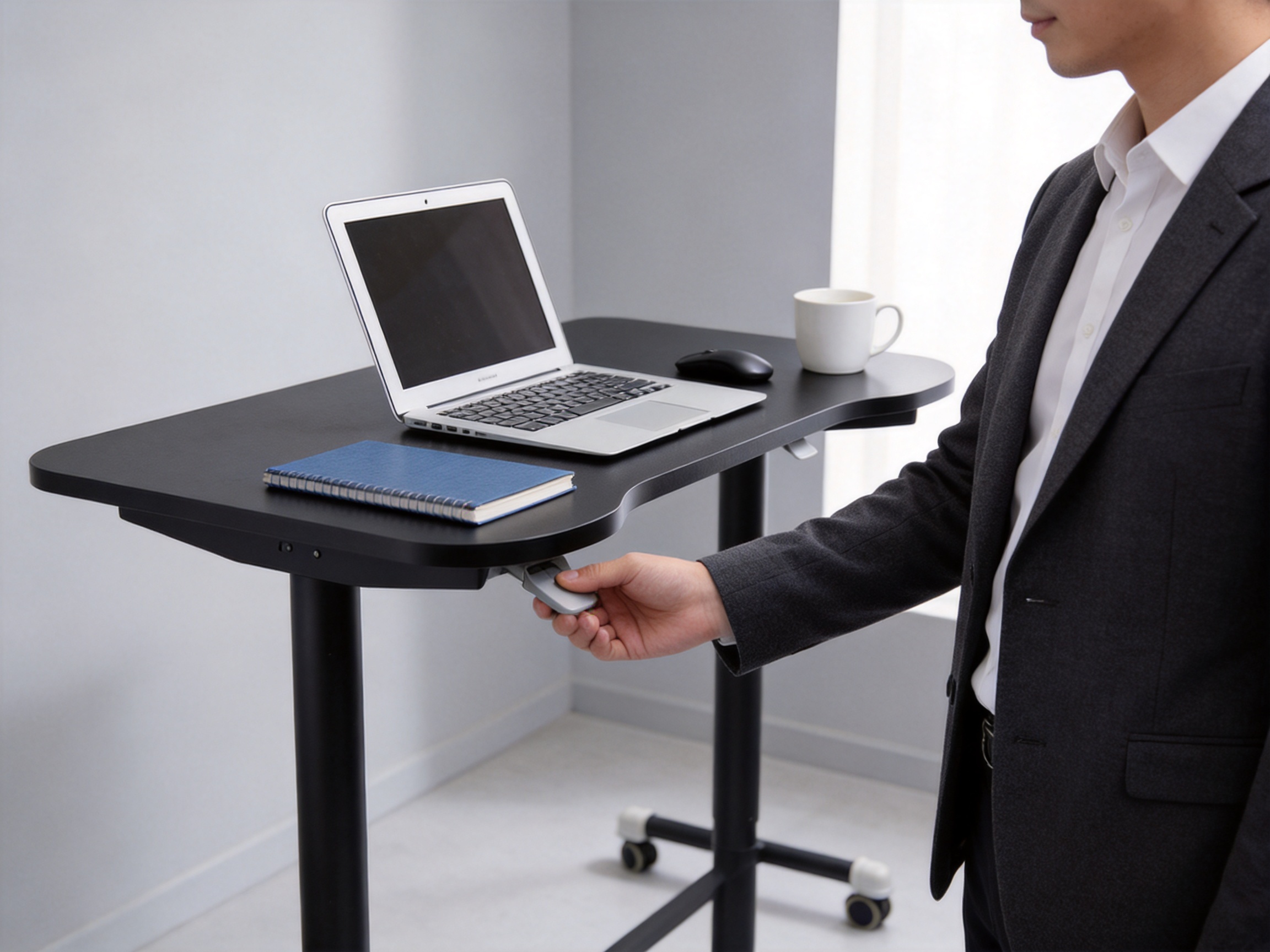
The most important feature of this desk is its gas spring lifting mechanism. Gas spring systems use compressed gas and internal mechanical components to assist movement. In the context of a height-adjustable desk, the gas spring helps raise or lower the desktop through manual operation. The user can adjust the height smoothly without pressing an electric control button or connecting the desk to a power supply.
This feature gives the product several advantages over many electric desks. First, it eliminates dependence on electricity. In offices and laboratories, power outlets are often already occupied by computers, testing equipment, chargers, lighting, or instruments. A non-electric desk can be placed anywhere without considering power cable routing. This is especially valuable for temporary workstations, training spaces, exhibition areas, and rooms that change layout frequently.
Second, a gas spring desk avoids the complexity of electric motors, control panels, wiring harnesses, and power adapters. Electric height-adjustable desks are useful in many situations, but their additional components can increase cost, weight, maintenance requirements, and potential failure points. A pneumatic desk keeps the adjustment principle straightforward. For users who want a reliable, low-maintenance workstation, this simplicity is a strong advantage.
Third, the adjustment is stepless. Instead of limiting the user to fixed height positions, the gas spring mechanism allows a continuous height range from 760 mm to 1100 mm. This makes it easier to find a comfortable position for typing, writing, reading, equipment operation, or standing discussion. Different users can adjust the desk according to body height, task type, and posture preference.
Fourth, gas spring lifting is quiet and convenient. In shared offices, classrooms, medical support spaces, or laboratories, excessive mechanical noise can be distracting. A manually operated pneumatic system avoids the sound of electric motors and provides smooth movement when properly designed and assembled. This supports a more comfortable working environment.
Fifth, because no motor is required, the desk is well suited for mobile applications. A movable electric desk may still need to be plugged in after relocation, and cables may create trip hazards. A pneumatic desk on casters can be rolled into position and used immediately. This is particularly useful when multiple departments share equipment, when meeting rooms are converted into temporary offices, or when educational spaces require flexible setups.
Ergonomic Benefits for Sitting and Standing Work
Ergonomics is one of the main reasons height-adjustable desks are increasingly used. A fixed-height desk may be suitable for one person but uncomfortable for another. It may support seated work but fail to support standing work. It may force the shoulders, neck, wrists, or back into positions that cause fatigue over time. A height-adjustable desk helps solve these problems by allowing the work surface to match the user and the task.
The lifting range of 760 mm to 1100 mm gives the TH-14 desk the flexibility to support seated and standing postures. At lower settings, it can serve as a seated desk for laptop work, writing, reading, or office tasks. At higher settings, it can support standing work, presentations, equipment control, or short collaborative discussions. This range allows users to alternate between positions rather than remaining seated for long periods.
Alternating between sitting and standing can help encourage movement during the workday. The purpose is not to stand all day, but to make posture changes easier. A worker may sit while concentrating on detailed document review, stand while answering messages, lower the desk for writing, then raise it again for a short meeting. This dynamic work style is more natural than remaining fixed in one position.
In laboratory or technical settings, adjustable height can also improve task comfort. Users may need to operate instruments, inspect samples, record data, or use laptops beside equipment. A fixed bench may not always align with the task. A mobile adjustable desk can be positioned near equipment and raised or lowered to a convenient working height.
In studios, design rooms, and teaching environments, a height-adjustable desk supports different work modes. It can serve as a laptop cart, a presentation station, a drawing support table, or a temporary demonstration surface. Because the height adjustment is manual and does not require power, the desk can be adapted quickly for each activity.
Dual-Leg Stability Compared with Single-Column Mobile Tables
Many mobile height-adjustable tables use a single-column structure. While single-column designs can be compact, they may have limitations in lateral stability, especially when the desktop is relatively wide or when equipment is placed unevenly. The double-leg structure of the TH-14 desk gives it an advantage in stability and user confidence.
A dual-leg frame distributes the desktop load across two vertical supports. This helps reduce wobble and improves balance during height adjustment and daily use. When a user places a laptop, monitor, documents, or tools on the desktop, the structure provides a more secure working feel than many lightweight single-pillar alternatives.
Stability is particularly important for standing work. At greater heights, any desk can become more sensitive to movement. A double-leg layout helps maintain steadiness across the height range. This is useful in office environments where users type, write, lean lightly on the surface, or move items across the tabletop.
The dual-leg design also provides a more professional visual appearance. Instead of looking like a temporary stand, the desk resembles a compact workstation. This makes it suitable for client-facing offices, conference rooms, training centers, and modern workspace layouts where furniture must look organized as well as function effectively.
Compared with low-cost mobile tables that rely mainly on thin tubing and minimal support, the iron frame of the TH-14 offers a more robust structural foundation. Its construction is intended for repeated use, not occasional light duty only. This gives it an advantage for buyers looking for long-term practicality rather than a short-term accessory.
Compact Desktop with Practical Workspace Dimensions
The desktop measures 980 mm in width and 560 mm in depth. These dimensions are carefully balanced. The desk is wide enough to support common work materials but compact enough to remain mobile and space-efficient. In many modern offices, every square meter matters. A large executive desk is not always necessary or practical, especially in shared spaces, hot-desking areas, training rooms, or temporary project zones.
A 980 mm width can accommodate a laptop, mouse, notebook, phone, and documents. It can also support a compact monitor and keyboard setup when used as a focused workstation. The 560 mm depth gives enough room for comfortable hand placement and work materials without making the desk difficult to move through doorways or around furniture.
For home study areas, the compact size is especially valuable. Many users need a desk that can fit into a bedroom, living room corner, balcony workspace, or multipurpose room. A full-size office desk may be too large, while a small laptop stand may not offer enough stability or surface area. This product fills the gap between those extremes.
For laboratories and studios, the desktop can serve as a support surface for instruments, tablets, control devices, tools, documents, or sample records. Because the desk is mobile, it can follow the workflow rather than forcing the user to move repeatedly between fixed locations.
The rectangular work surface also makes the desk easy to integrate into different room layouts. It can be positioned against a wall, beside a larger desk, near a workbench, at the end of a conference table, or in the center of a temporary work area. Its size supports flexibility without creating clutter.
Mobility Through Lockable Caster Design
Mobility is one of the defining characteristics of this desk. The base uses four swivel casters, with two locking and two non-locking wheels. This configuration allows the user to move the desk across work areas and then lock it in place when stability is needed. The result is a workstation that can adapt to changing space requirements.
In offices, mobile desks are useful for agile teams, project rooms, and flexible seating arrangements. A worker can reposition the desk for focused work, move it near colleagues for collaboration, or roll it into a meeting area for presentations. When the task is complete, the desk can be moved aside to free space.
In education and training environments, mobility supports fast classroom reconfiguration. Instructors can use the desk as a teaching station, demonstration surface, laptop cart, or movable podium. Because the height is adjustable, the same desk can suit different instructors and teaching styles.
In laboratories, workshops, and technical rooms, mobile work surfaces can improve efficiency. A desk can be moved close to instruments, machines, storage cabinets, or inspection areas. Users can place records, tools, or control devices at a comfortable height and then relocate the desk as tasks change.
The locking casters are important because mobility alone is not enough. A workstation must remain steady during use. Two lockable casters allow users to secure the desk after positioning. This reduces unwanted movement while typing, writing, operating devices, or handling materials.
Compared with fixed desks, the mobile caster design offers a major advantage in space management. Fixed furniture locks the room into one layout. A mobile height-adjustable desk helps users adapt the room to current needs. This makes it suitable for organizations that value multipurpose spaces and efficient utilization.
Durable Iron Frame and Powder-Coated Surface
The product’s main structure is made from iron. This material choice reflects a focus on load-bearing capability, frame strength, and long-term use. Iron is widely used in office furniture and mechanical support structures because it provides dependable rigidity and can be shaped, welded, and finished effectively in manufacturing.
A stable metal frame is especially important in a height-adjustable product. Because the desk moves through a height range, the structure must remain aligned and stable during adjustment. The frame must support the desktop, the lifting mechanism, and the items placed on the work surface. Proper manufacturing and assembly help ensure that movement remains smooth and the desk feels secure.
The black powder-coated finish adds both functional and aesthetic value. Powder coating is a dry finishing process in which powder is applied to metal and then cured to form a protective layer. Compared with some traditional liquid paint processes, powder coating can provide improved coating uniformity, surface durability, and resistance to everyday wear.
For office and industrial furniture, surface treatment matters. Desks may be moved, touched, cleaned, and exposed to different environments. A strong powder-coated surface helps resist scratches, corrosion, and minor impact marks. The black color also hides small signs of use better than many lighter finishes and gives the desk a modern, understated appearance.
The surface finish supports a broad range of applications. In offices, the black frame pairs well with modern interiors. In laboratories and studios, it provides a clean technical appearance. In home spaces, it can blend with other furniture without drawing excessive attention.
Manufacturing Strengths Behind the Product
The performance of a height-adjustable desk depends not only on its concept but also on manufacturing quality. Gas spring alignment, frame welding, surface finishing, caster installation, packaging, and quality control all influence the user experience. SuZhou Skyhone Intelligent Technology Co., Ltd. focuses on the research and development, production, sales, and service of standing desk solutions, giving it the manufacturing background required for products such as the TH-14.
The company is located in Suzhou, within the Yangtze River Delta region, an area known for its strong industrial ecosystem. This regional advantage supports efficient sourcing of materials, metal components, surface treatment services, packaging materials, mechanical parts, and manufacturing equipment. A complete industrial chain helps manufacturers control production schedules, maintain consistent quality, and respond to customized requirements.
Advanced manufacturing begins with product design. For a pneumatic height-adjustable desk, engineers must consider lifting force, user operation, structural balance, desktop dimensions, frame geometry, caster placement, and safety during height adjustment. The product must be easy to move yet stable during work. It must be compact yet strong enough for practical applications. These requirements demand coordinated design rather than simple assembly.
Metal processing is another important stage. The iron frame must be cut, formed, welded, and finished with precision. Inconsistent tube dimensions, poor welding alignment, or uneven frame assembly can lead to instability or rough movement. A professional manufacturing enterprise uses controlled processes to improve repeatability and reduce variation between units.
Surface treatment is also critical. Powder coating requires appropriate pretreatment, powder application, curing temperature control, and inspection. A poor coating process may result in uneven color, weak adhesion, bubbling, or premature corrosion. A well-managed coating process produces a uniform surface layer that supports durability and appearance.
Assembly quality directly affects user satisfaction. The gas spring mechanism must be installed correctly so that height adjustment feels smooth and controlled. The desktop must be securely attached. Casters must rotate properly and locking mechanisms must function reliably. Each of these details contributes to the final product experience.
Quality control strengthens competitiveness. Inspection can include dimensional checks, surface finish review, stability assessment, caster function testing, lifting operation checks, and packaging verification. By controlling these steps, the company can provide products that meet practical performance expectations in real workplaces.
Advantages Over Conventional Fixed Desks
Fixed desks remain common, but they have limitations. They usually provide only one working height, which may not fit all users or tasks. They are difficult to move, often occupy permanent floor space, and rarely support dynamic work styles. The double-leg pneumatic height-adjustable desk offers a more flexible alternative.
The first advantage is adjustability. A fixed desk forces users to adapt their posture to the furniture. A height-adjustable desk allows the furniture to adapt to the user. This is especially important in shared spaces where different people use the same workstation. Instead of purchasing multiple desk heights or accepting discomfort, organizations can use adjustable desks to serve a wider range of users.
The second advantage is sit-stand capability. Fixed desks are usually optimized for seated work. Standing work requires a separate standing table or riser. The TH-14 desk can move between seated and standing heights, making it more versatile. Users can change posture throughout the day without changing furniture.
The third advantage is mobility. Traditional desks are often heavy and stationary. Moving them requires planning, labor, and sometimes disassembly. A caster-equipped adjustable desk can be repositioned easily by one person. This is valuable for modern workspaces that change frequently.
The fourth advantage is space efficiency. The compact tabletop provides useful workspace without dominating a room. In small offices and homes, this matters. A fixed desk may become a permanent obstacle, while a mobile desk can be moved aside when not needed.
The fifth advantage is functional versatility. The same desk can serve as an office workstation, mobile meeting table, laboratory support desk, teaching station, studio surface, or home study desk. A conventional fixed desk is usually less adaptable.
Advantages Over Electric Height-Adjustable Desks
Electric standing desks are popular, and they offer benefits such as push-button adjustment and programmable height settings. However, they are not always the best solution for every environment. The TH-14 pneumatic desk provides several advantages in situations where simplicity, mobility, and independence from power are priorities.
The first advantage is no power requirement. Electric desks need outlets, power cords, and safe cable routing. In flexible spaces, this can be inconvenient. A pneumatic desk can be placed anywhere and used immediately. This makes it particularly useful for mobile workstations, classrooms, laboratories, temporary offices, and rooms with limited electrical access.
The second advantage is reduced electrical complexity. Electric desks include motors, controllers, cables, switches, and sometimes sensors. These components may increase maintenance needs and replacement costs. A gas spring desk uses a simpler mechanical lifting principle, reducing dependence on electrical parts.
The third advantage is easier mobility. An electric desk on wheels may still be limited by power cord placement. A pneumatic desk avoids this limitation. Users can roll the desk to a new area without unplugging, reconnecting, or managing cables.
The fourth advantage is quiet manual adjustment. Electric motors create noise during lifting and lowering. While many are relatively quiet, a gas spring mechanism can be even less disruptive when operated properly. This is useful in shared offices, study spaces, and classrooms.
The fifth advantage is potential maintenance simplicity. With fewer electronic components, there are fewer electrical failure points. For organizations managing many workstations, simplified maintenance can be an important long-term benefit.
This does not mean pneumatic desks replace electric desks in every situation. Some users prefer powered adjustment for heavy setups or frequent height changes. However, for compact, mobile, power-free, and practical workstations, the pneumatic design offers clear competitive value.
Advantages Over Lightweight Portable Laptop Tables
Portable laptop tables and small rolling stands are often inexpensive and easy to move, but many of them lack the stability, durability, and professional functionality required for daily work. The TH-14 desk occupies a stronger position between a lightweight portable stand and a full-size adjustable workstation.
The double-leg structure provides better support than many single-pole laptop carts. This is important when users need a stable surface for typing, writing, equipment operation, or long work sessions. A shaky table can reduce productivity and create frustration.
The iron frame is also more suitable for repeated use. Lightweight tables may rely on thin materials that can bend, loosen, or wear quickly. A properly manufactured metal frame supports longer service life and better overall reliability.
The larger desktop is another advantage. Some portable laptop tables only support a laptop and little else. The 980 mm by 560 mm desktop provides enough space for multiple work items, making the desk more practical for real office and professional tasks.
The powder-coated surface also provides a more durable and refined finish than many low-cost alternatives. In professional environments, appearance matters. Furniture should support a clean, organized impression, especially in client-facing areas, laboratories, training centers, and modern offices.
The combination of mobility and stability makes the desk suitable for users who need a movable workstation but do not want to compromise on usability. It is not simply a cart; it is a compact adjustable desk designed for flexible daily work.
Application Scenarios
Office Workstations
In office environments, the desk can serve as a personal workstation, shared hot desk, mobile laptop station, or auxiliary work surface. Employees can adjust the height for sitting or standing tasks, supporting a more active working style. The compact size makes it suitable for open offices, private rooms, and collaborative areas.
For project teams, the desk can be moved between work zones. It can support a laptop during a meeting, act as a temporary standing desk during focused work, or provide an extra surface during group discussions. The lockable casters help secure the desk once positioned.
Laboratories and Technical Spaces
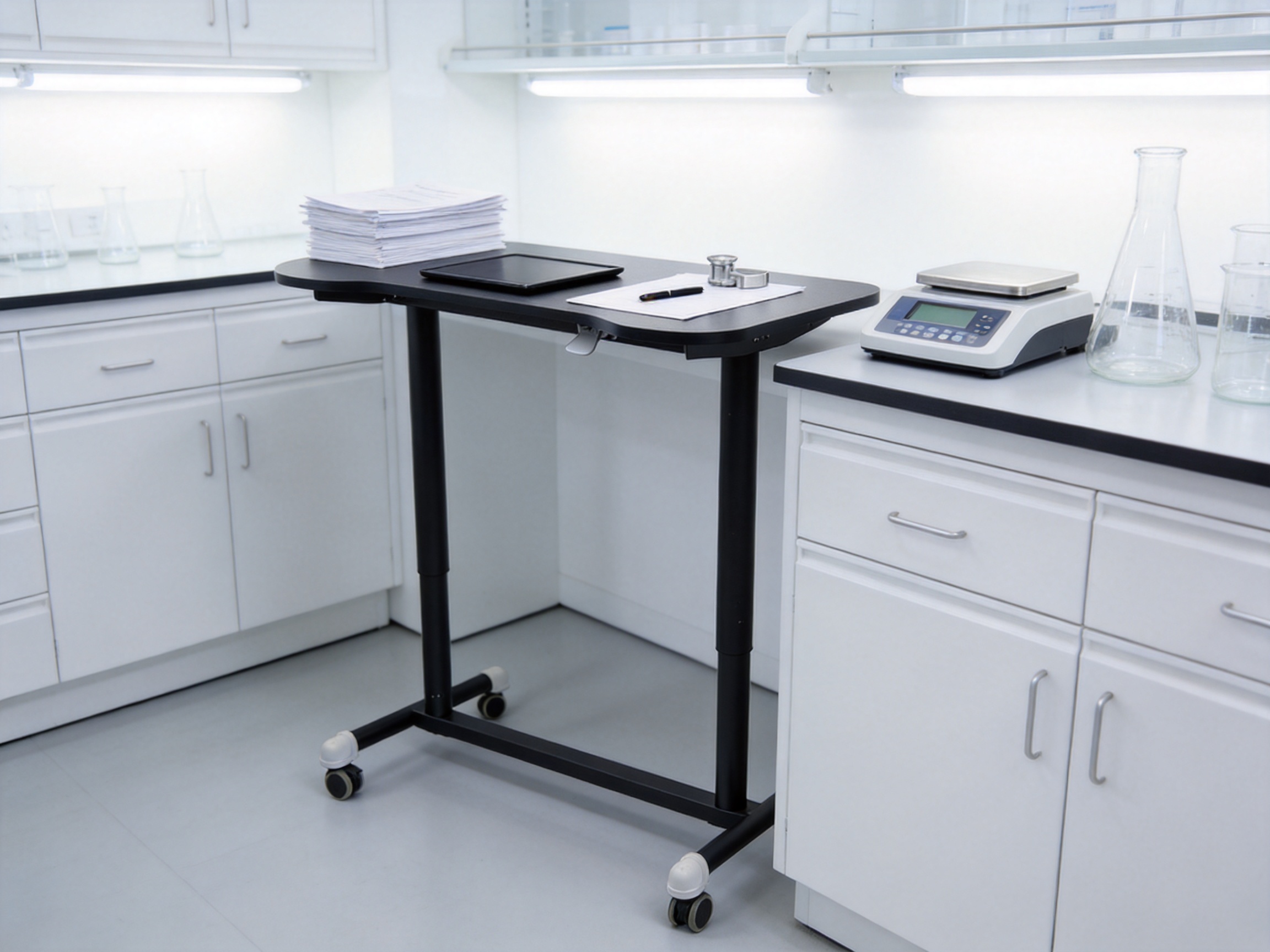
In laboratories, work often changes from one area to another. A mobile height-adjustable desk can support documentation, sample records, instruments, tablets, or computer operation near testing equipment. Because it does not require power for height adjustment, it can be used in areas where electrical outlets must be reserved for specialized equipment.
The metal frame and powder-coated finish are suitable for technical spaces that require practical durability. While the desk should always be used within appropriate environmental and load conditions, its design is well matched to general laboratory support tasks.
Studios and Creative Workrooms
Creative professionals often shift between drawing, digital work, review, discussion, and material handling. A mobile adjustable desk can act as a flexible station that supports these different modes. It can be raised for standing review, lowered for seated laptop work, or moved beside other equipment.
The black finish fits well into many studio interiors. Its compact footprint keeps the space open and adaptable, which is important in creative rooms where layouts may change according to projects.
Home Study Areas
Many home users need ergonomic furniture but do not have space for a large office desk. The compact tabletop and mobile base make this desk a strong option for apartments, bedrooms, study corners, and multipurpose rooms. It can be used during work hours and moved aside afterward.
The non-electric gas spring lifting mechanism is also convenient at home. Users do not need to arrange another power connection just for the desk. This reduces cable clutter and makes placement easier.
Education and Training Rooms
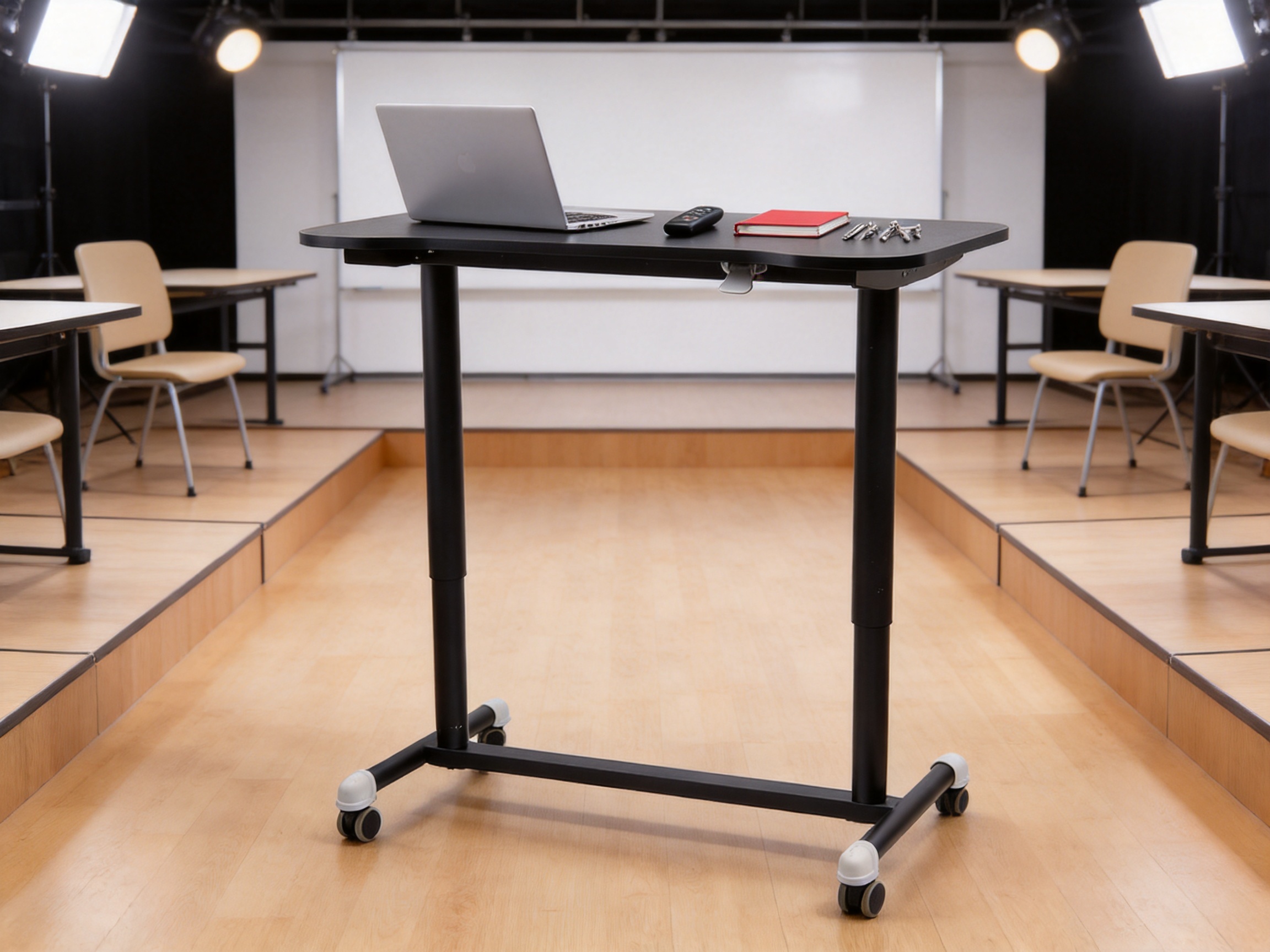
Training rooms require furniture that can adapt quickly. The desk can serve as a trainer’s station, mobile computer desk, demonstration table, or temporary support surface. Its height adjustability helps different instructors work comfortably, while the casters support fast room reconfiguration.
Because the desk can be locked in place, it can remain stable during presentations or teaching activities. When the session ends, the desk can be moved to storage or repositioned for the next layout.
User Experience and Daily Operation
The daily experience of using this desk is defined by simplicity. The user adjusts the height manually through the gas spring lifting system. There is no need to learn complex controls, connect to electricity, or manage preset functions. This direct operation makes the desk accessible to a wide range of users.
To use the desk effectively, users should first position it on a suitable floor surface. After moving it into place, they should lock the lockable casters to reduce movement. Then the height can be adjusted according to the task. For seated work, the desktop should generally allow the user’s arms to rest comfortably while typing or writing. For standing work, the surface should support relaxed shoulders and comfortable wrist alignment.
The stepless adjustment range allows fine tuning. Users do not need to accept a height that is almost correct. They can make small changes until the desk feels comfortable. This is an important ergonomic benefit because small height differences can affect posture over long periods.
During movement, users should ensure that objects on the desktop are stable. While the desk is designed for mobility, it is always good practice to move it carefully, especially when laptops, monitors, instruments, or liquids are present. Locking the casters after relocation helps maintain a secure work setup.
Maintenance is straightforward. The powder-coated surface can be kept clean with appropriate wiping methods. Casters should be checked periodically to ensure smooth rolling and reliable locking. The lifting mechanism should be operated within intended conditions and not overloaded. These simple practices help maintain performance over time.
Why the Product Matches Modern Workspace Trends
Several workplace trends make this type of desk especially relevant. The first is the move toward flexible offices. Companies increasingly use spaces for multiple purposes rather than assigning every area a fixed function. Furniture must support this flexibility. A mobile height-adjustable desk can shift from workstation to meeting support to presentation table as needed.
The second trend is ergonomic awareness. Employers and individuals are more aware that comfort affects productivity and well-being. Height-adjustable furniture allows users to work in positions that better suit their bodies and tasks. The TH-14 desk supports this trend by making sit-stand adjustment accessible without electric complexity.
The third trend is hybrid work. Many people now divide work between company offices and home spaces. Home workstations must be compact, adaptable, and easy to integrate into existing rooms. A mobile pneumatic desk is useful because it can create a professional work surface without permanently occupying a large area.
The fourth trend is equipment mobility. In laboratories, schools, studios, and offices, work tools are often moved to where they are needed. A mobile desk supports equipment and documentation close to the task, improving workflow efficiency.
The fifth trend is simplified maintenance. Organizations managing many furniture assets often prefer products that are dependable and easy to service. A non-electric adjustable desk reduces reliance on motors and electronic components, making it attractive for certain procurement strategies.
Company Manufacturing and Service Advantages
SuZhou Skyhone Intelligent Technology Co., Ltd. is positioned as a professional manufacturing enterprise engaged in standing desk research and development, production, sales, and service. This integrated capability is important because high-quality adjustable furniture requires coordination across design, manufacturing, quality control, and customer support.
The company’s location in Suzhou provides access to the strong industrial base of the Yangtze River Delta. This region is known for manufacturing resources, skilled labor, supplier networks, logistics infrastructure, and engineering support. These advantages help the company manage production efficiently and develop products that meet changing market needs.
Research and development capability allows the company to refine product structures, improve usability, and respond to customer requirements. For height-adjustable desks, this may involve optimizing lifting mechanisms, improving frame stability, selecting suitable materials, and enhancing surface treatments. Continuous development helps products remain competitive in a market where users expect both functionality and durability.
Production strength is reflected in material processing, metal fabrication, powder coating, assembly, and inspection. A manufacturer that controls these stages can better maintain consistency. This is important for business buyers, distributors, and project customers who require reliable supply and repeatable product quality.
Sales and service capability also matter. Height-adjustable desks are used in many different environments, and customers may have questions about product selection, customization, packaging, logistics, or after-sales support. A company with a complete service structure can provide more confidence to buyers.
The company’s focus on healthy, efficient, and intelligent office space solutions aligns well with the increasing demand for ergonomic workstations. The TH-14 desk reflects this direction by offering a practical product that encourages posture variation, space flexibility, and easy daily operation.
Customization and Procurement Considerations
For business buyers, selecting a height-adjustable desk involves more than checking dimensions. Procurement teams should consider work environment, user needs, space constraints, mobility requirements, maintenance expectations, and long-term value. The TH-14 desk is especially appropriate when the buyer needs a compact, mobile, manually adjustable workstation.
Potential customization discussions may involve desktop materials, packaging, surface finish requirements, order quantity, labeling, or application-specific details. Since SuZhou Skyhone Intelligent Technology Co., Ltd. provides standing desk manufacturing and related services, buyers can communicate project needs and evaluate suitable solutions.
For office projects, buyers should assess how many mobile desks are needed, where they will be stored, and how they will support shared work. For laboratories, buyers should consider floor conditions, required working heights, and the types of tools or documents placed on the desk. For home office distribution, compact packaging and easy assembly may be important.
Long-term value should include durability, ease of movement, user comfort, and maintenance simplicity. A lower-cost desk that lacks stability or wears quickly may not be economical over time. A well-built pneumatic height-adjustable desk can provide better value by supporting daily use across multiple scenarios.
Safety and Practical Use Guidelines
Like any adjustable furniture, this desk should be used correctly. Users should avoid overloading the desktop beyond intended practical use. Heavy equipment should be placed carefully and evenly. When adjusting height, users should keep hands and objects clear of moving parts. The desk should be placed on a stable floor surface, and the locking casters should be engaged during work.
When moving the desk, users should push it slowly and avoid sudden impacts. Thresholds, uneven flooring, cables, and obstacles should be handled carefully. If valuable devices are placed on the tabletop, it may be safer to remove them before moving the desk over long distances.
The gas spring mechanism should be operated according to product instructions. Users should not attempt unauthorized disassembly or modification of the lifting system. If adjustment performance changes, the product should be inspected by qualified personnel or handled according to manufacturer guidance.
Routine inspection helps preserve performance. Users can check caster locks, frame fasteners, desktop connection points, and the surface condition. Regular care is simple but can extend the service life of the desk.
Q&A Section
What is the main function of this pneumatic height-adjustable desk?
The main function is stepless height adjustment between 760 mm and 1100 mm through a gas spring lifting mechanism. This allows the desk to support both seated and standing work without requiring electricity.
How large is the desktop?
The tabletop measures 980 mm by 560 mm. This size offers enough space for common work items such as a laptop, notebook, documents, mouse, compact monitor, tools, or control devices while remaining suitable for limited spaces.
Does the desk need to be connected to power?
No. The desk uses gas spring lifting and does not require electrical power for height adjustment. This makes it easy to place and move in different environments without cable management concerns.
What makes it different from an electric standing desk?
Compared with electric standing desks, this pneumatic desk is simpler, does not require power, avoids motors and electrical controls, and is easier to move freely. It is especially suitable for flexible spaces, mobile workstations, and users who prefer low-maintenance mechanical adjustment.
Is the desk stable?
Yes. The desk uses a double-leg structure and an iron frame, which provide better support than many lightweight single-column mobile tables. The lockable casters also help keep the desk in place during use.
What are the casters used for?
The four swivel casters allow the desk to be moved easily. Two casters include locks, allowing users to secure the desk after positioning it.
Where can this desk be used?
It can be used in offices, laboratories, studios, home study areas, education rooms, training spaces, and other flexible work environments.
What is the surface treatment?
The metal frame uses black powder coating. This finish provides a clean appearance and helps improve resistance to wear and corrosion.
Why is a dual-leg design useful?
A dual-leg design distributes support across two vertical structures, improving stability and reducing wobble compared with many single-column mobile tables. This is particularly helpful when the desk is used at standing height.
Who manufactures the product?
The product is manufactured by SuZhou Skyhone Intelligent Technology Co., Ltd., a professional enterprise engaged in standing desk research, development, production, sales, and service.
Conclusion
The double-leg pneumatic height-adjustable desk is a practical solution for modern flexible workspaces. Its gas spring lifting system provides smooth, stepless height adjustment from 760 mm to 1100 mm without requiring electricity. Its 980 mm by 560 mm tabletop offers a useful work surface while preserving compact mobility. Its iron frame, black powder-coated finish, and lockable caster configuration support durability, stability, and easy repositioning.
The product stands out against conventional fixed desks by offering ergonomic adjustability and mobility. It stands out against many electric desks by avoiding power dependence and reducing electrical complexity. It stands out against lightweight laptop carts by providing a stronger dual-leg frame, a larger practical surface, and a more professional structure.
For offices, laboratories, studios, educational spaces, and home work areas, the desk supports dynamic work, efficient space use, and user comfort. Behind the product, SuZhou Skyhone Intelligent Technology Co., Ltd. contributes manufacturing capability, regional industrial advantages, and a focus on healthy and efficient office solutions. The result is a height-adjustable workstation that meets the needs of users who require flexibility, reliability, and practical design.
References
Bridger, R. S. Introduction to Human Factors and Ergonomics. CRC Press.
Kroemer, K. H. E., and Grandjean, E. Fitting the Task to the Human: A Textbook of Occupational Ergonomics. Taylor & Francis.
Pheasant, S., and Haslegrave, C. M. Bodyspace: Anthropometry, Ergonomics and the Design of Work. CRC Press.
Sanders, M. S., and McCormick, E. J. Human Factors in Engineering and Design. McGraw-Hill.
Hedge, A. Ergonomic Workplace Design for Health, Wellness, and Productivity. CRC Press.
Powder Coating Institute. Powder Coating: The Complete Finisher’s Handbook.
International Organization for Standardization. Ergonomic Principles in the Design of Work Systems.
Product: TH-14 Double-Leg Pneumatic Height-Adjustable Desk


- Contact Info
-
-
 Phone+86-15950656125
 -
 Email
Email -
 AddressRoom 1007-1, South Building, Suyue Plaza, Suzhou Industrial Park, Suzhou City, Jiangsu Province, China
-
- Products
- Follow Us
- Need help? Please contact us
Copyright ©
SuZhou Skyhone Intelligent Technology Co., Ltd.
All Rights Reserved.
Privacy
Custom Ergonomic Adjustable Office Tables Manufacturers

