

 English
  русский
  Español
  عربى
عربى 
Content
- 1 Product Overview
- 2 Technical Specifications
- 3 Why Pneumatic Height Adjustment Matters
- 4 Competitive Advantages of the TH10 Desk
- 5 Ergonomic Value in Daily Work
- 6 Gas Spring Lifting: Simple, Efficient, and Reliable
- 7 Tripod Base Design and Stability
- 8 Tabletop Construction and Surface Performance
- 9 Manufacturing Strengths Behind the Product
- 10 Advanced Production Processes
- 11 Advantages Over Electric Adjustable Desks
- 12 Advantages Over Fixed-Height Tables
- 13 Advantages Over Crank-Adjustable Tables
- 14 Applications in Professional Environments
- 15 Design for Space-Constrained Workplaces
- 16 Durability and Long-Term Value
- 17 Customization and Supply Capability
- 18 Quality Control as a Competitive Strength
- 19 User Experience and Practical Operation
- 20 Aesthetic Integration
- 21 Sustainability Considerations
- 22 Procurement Considerations for Buyers
- 23 Q&A Section
- 23.1 What is the main purpose of the TH10 pneumatic height-adjustable desk?
- 23.2 What height range does the desk provide?
- 23.3 Does the TH10 require electricity?
- 23.4 What are the tabletop dimensions?
- 23.5 What materials are used in the desk?
- 23.6 What color options are available?
- 23.7 Is the desk easy to move?
- 23.8 How does the TH10 compare with electric standing desks?
- 23.9 How does it compare with fixed-height tables?
- 23.10 Who manufactures the TH10?
- 23.11 Why is the manufacturer’s location important?
- 24 Conclusion
- 25 References
- 26 Product: TH10 (Three-Claw Leg) Pneumatic Height-Adjustable Desk
Compact Pneumatic Height-Adjustable Desk for Flexible Sit-Stand Workspaces
2026-05-30
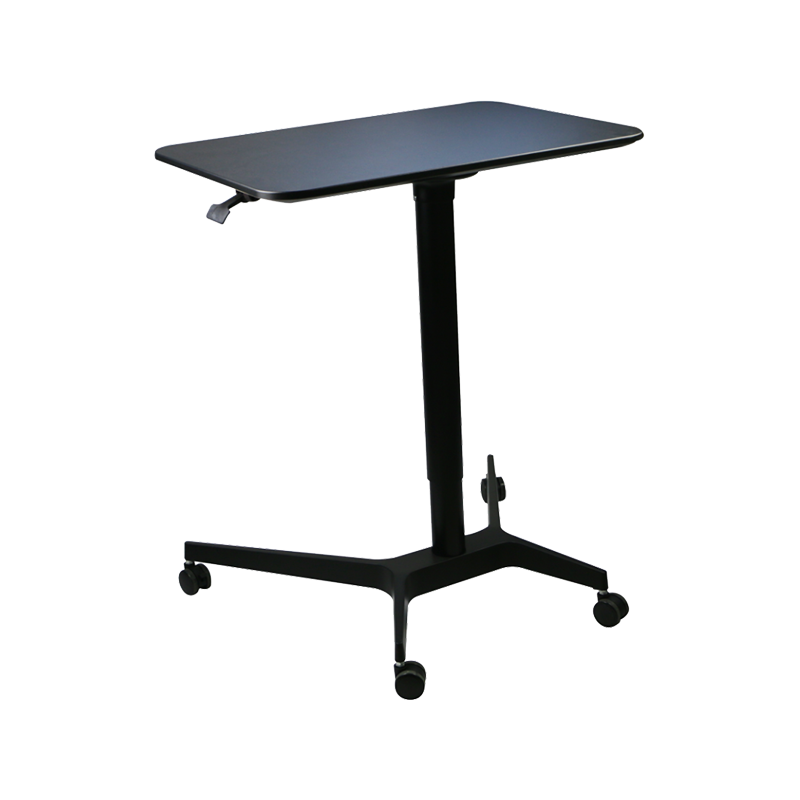
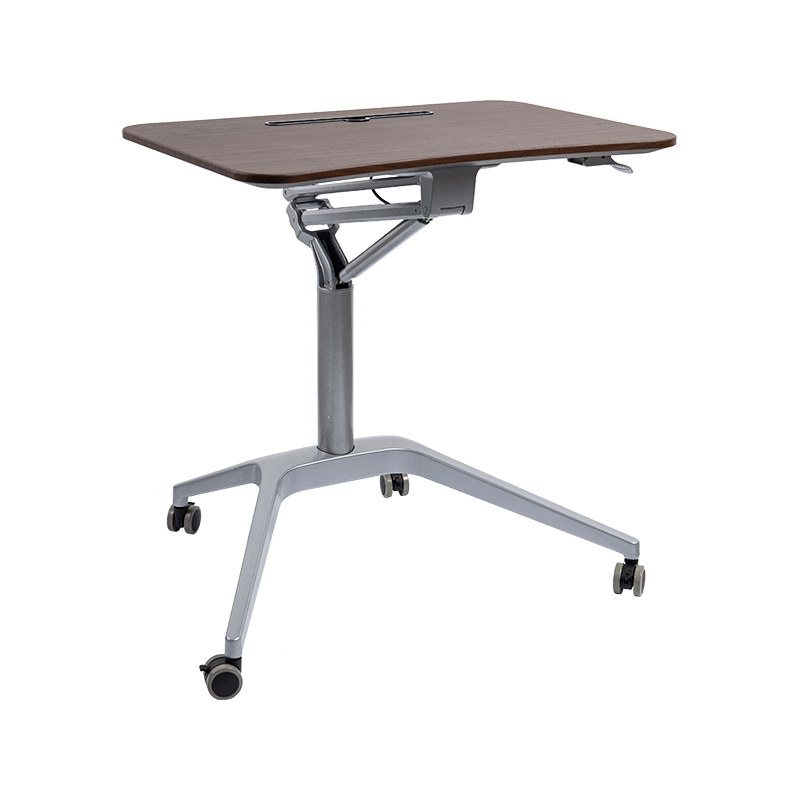
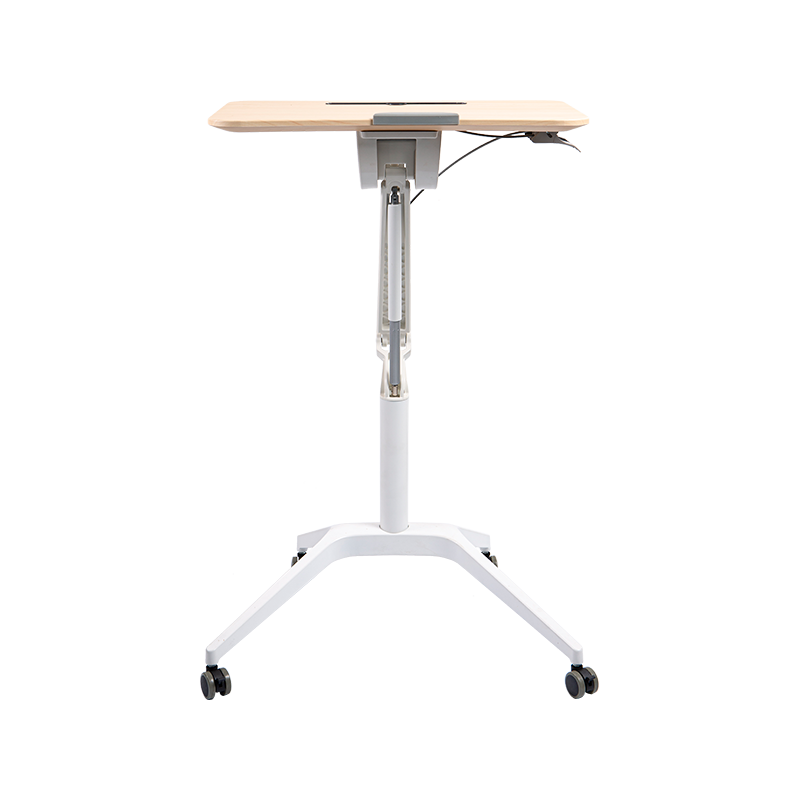
Modern workplaces increasingly require furniture that can adapt to different tasks, users, and spatial constraints without sacrificing stability, usability, or long-term durability. The TH10 Three-Claw Leg Pneumatic Height-Adjustable Desk is designed for exactly this type of environment. It combines a compact tabletop, a smooth gas spring lifting system, a stable tripod-style base, and mobile casters to create a practical sit-stand worktable for offices, studios, workshops, laboratories, training rooms, and personal work areas.
Unlike large electric standing desks that require power access, cable management, and more installation space, this pneumatic height-adjustable desk provides manual height control through a gas spring mechanism. Users can move the desktop between 720 mm and 1100 mm, making it suitable for seated work, standing tasks, short meetings, drafting, inspection work, device support, or flexible workstation arrangements. Its 715 mm × 495 mm tabletop is large enough for daily working tools while remaining compact enough for environments where space efficiency matters.
Manufactured by SuZhou Skyhone Intelligent Technology Co., Ltd., the TH10 reflects a product development philosophy centered on ergonomic improvement, reliable mechanical design, and efficient manufacturing. The company is located in Suzhou, within the highly developed Yangtze River Delta industrial region, and benefits from an integrated supply chain for metal processing, furniture components, surface treatment, and intelligent manufacturing. This allows the company to support consistent quality, customization, and dependable production capacity for global buyers.
TH10 (Three-Claw Leg) Pneumatic Height-Adjustable Desk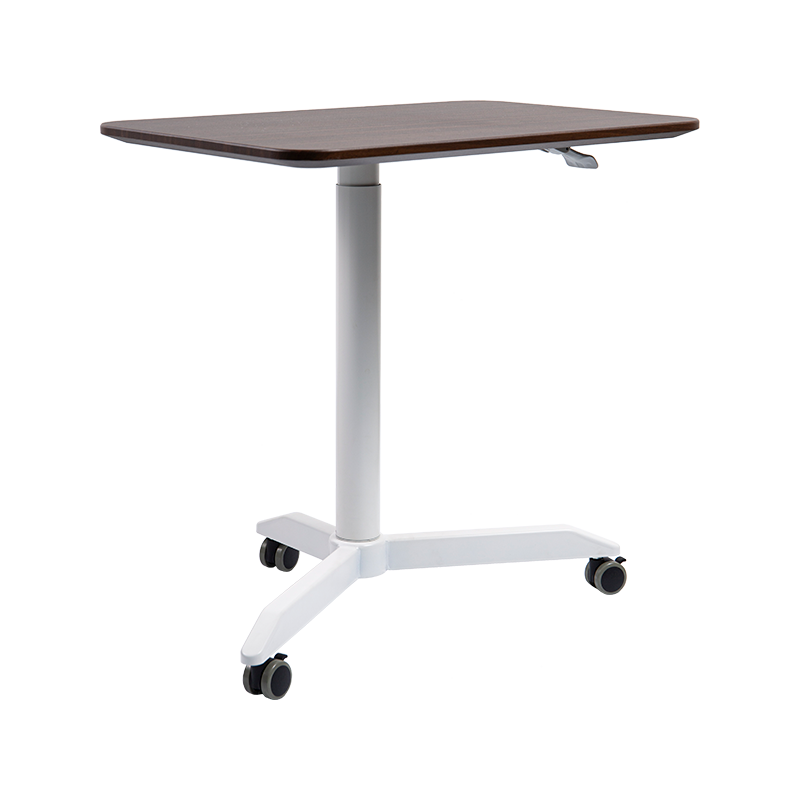
Product Overview
The TH10 Three-Claw Leg Pneumatic Height-Adjustable Desk is a compact worktable using gas spring lifting technology. Its core function is to allow smooth and convenient height adjustment without electric motors. The user can raise or lower the work surface according to task requirements, posture needs, or personal comfort preferences. This design provides the benefits of height-adjustable furniture while reducing dependence on power outlets and electronic controls.
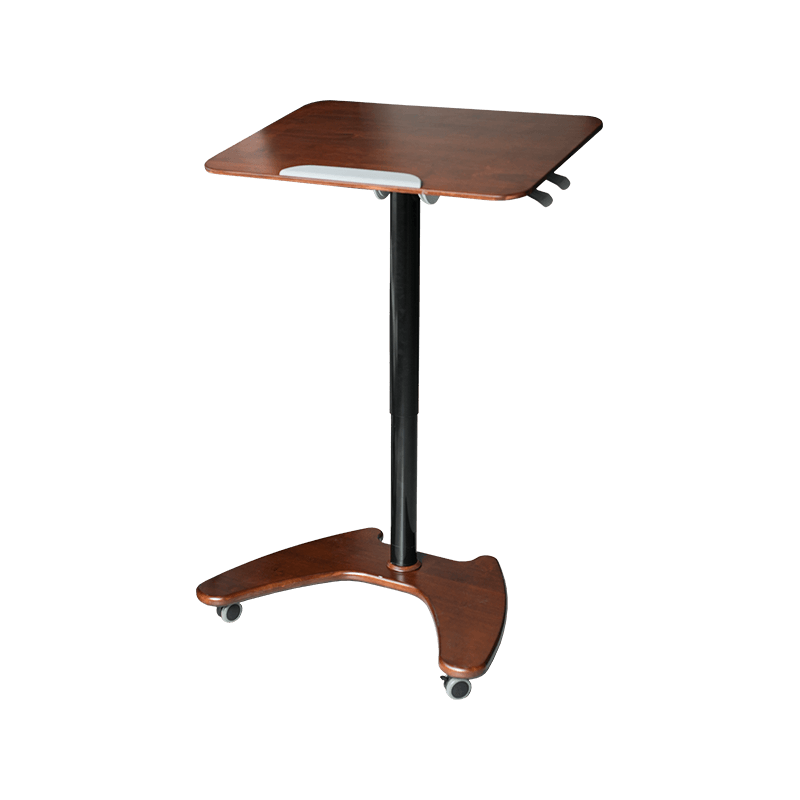
The desk is built with an aluminum and iron frame, providing a balance between strength, durability, and manageable weight. The surface is powder coated, with white and silver options available, helping the structure resist corrosion and maintain a clean, modern appearance. The tabletop is made of 25 mm MDF with PVC vacuum forming, giving it a solid feel and a practical surface for office, technical, or creative work. Available tabletop finishes include walnut, white, and maple, allowing the desk to blend into different interior styles.
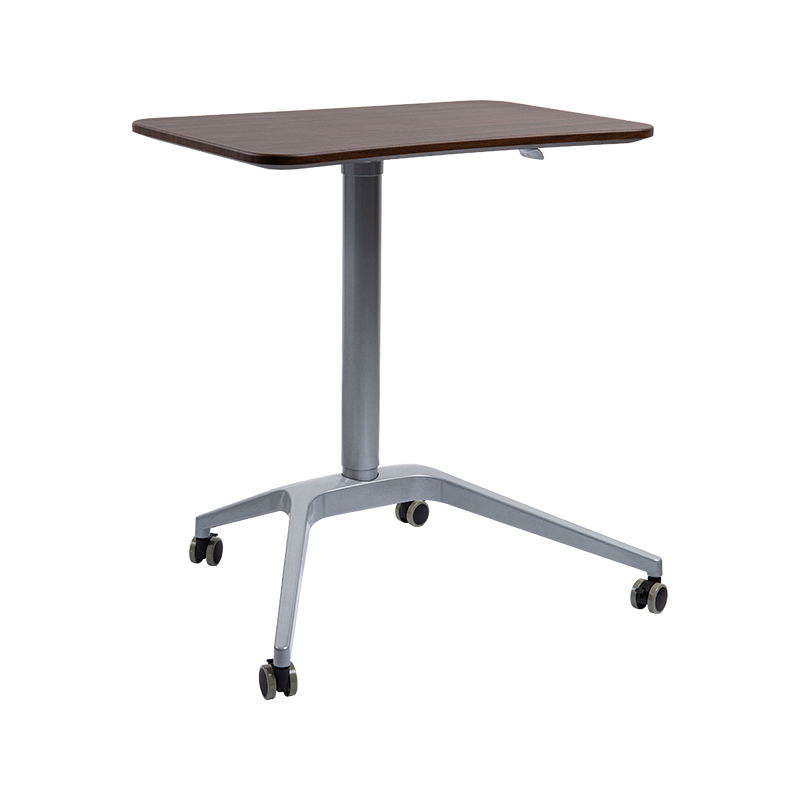
The base uses a three-claw or tripod-style structure. This design helps distribute load evenly while keeping the footprint efficient. The unit includes three casters: two with locks and one without a lock. This configuration allows the desk to be moved easily and then secured in place when needed. For workspaces that change frequently, such as laboratories, shared offices, classrooms, or project studios, this mobility is a significant advantage.
Technical Specifications
Item |
Specification |
Product model |
TH10 Three-Claw Leg Pneumatic Height-Adjustable Desk |
Product category |
Pneumatic Height-Adjustable Table |
Lifting range |
720 mm to 1100 mm |
Tabletop dimensions |
715 mm × 495 mm × 25 mm |
Tabletop material |
25 mm MDF with PVC vacuum forming |
Frame material |
Aluminum and iron |
Surface treatment |
Powder coating |
Frame color options |
White and silver |
Panel color options |
Walnut, white, and maple |
Caster configuration |
Two locking casters and one non-locking caster |
Working principle |
Gas spring lifting |
Why Pneumatic Height Adjustment Matters
Height-adjustable furniture has become an important part of ergonomic office planning because it helps users change posture throughout the day. Remaining seated for long periods may contribute to discomfort, fatigue, and reduced focus. A sit-stand workstation allows users to alternate between seated and standing positions, helping improve comfort and encouraging movement. The TH10 supports this need with a 720 mm to 1100 mm lifting range, making it practical for different body heights and work modes.
The pneumatic lifting system offers several advantages over traditional fixed-height tables. First, it provides adjustment without electricity. This makes the desk useful in locations where power outlets are limited or where cable clutter should be avoided. Second, gas spring lifting is simple and intuitive. Users do not need to operate complicated control panels or programmable systems. Third, the mechanism is well suited to compact mobile furniture because it supports smooth movement without heavy electronic components.
Compared with many low-cost manual desks, the TH10 is easier to adjust because the gas spring assists movement. A purely mechanical screw or crank system may require more effort and time. In contrast, pneumatic lifting can make the transition between heights faster and more user-friendly. For work settings where several users may share the same desk, this convenience is especially valuable.
Competitive Advantages of the TH10 Desk
Compact Size Without Losing Practicality
One of the most important advantages of the TH10 is its compact desktop size. Measuring 715 mm × 495 mm, the tabletop provides sufficient space for a laptop, writing materials, instruments, or small equipment while remaining easy to position in tight areas. This makes it more flexible than larger standing desks that may dominate a room or require permanent placement.
For offices with limited square footage, the TH10 can function as a mobile workstation, auxiliary table, presentation surface, or temporary standing desk. In studios and workshops, it can serve as a movable task table. In laboratories, it can hold instruments or samples at a comfortable working height. Its size allows it to be used where a full-size electric desk would be excessive.
Power-Free Operation
Many adjustable desks on the market rely on electric motors. Electric models can be effective for full-size office desks, but they also introduce additional requirements, including power access, control modules, wiring, and motor maintenance. The TH10 avoids these limitations. Its gas spring lifting mechanism requires no electricity, which makes it ideal for flexible spaces, mobile work areas, and environments where simple operation is preferred.
This power-free design can also reduce installation complexity. Users do not need to route power cables or worry about electrical compatibility in different regions. For procurement teams purchasing furniture for international projects, a pneumatic desk can simplify deployment because it does not depend on plug standards or voltage requirements.
Mobility With Secure Placement
The caster arrangement is another practical advantage. The desk includes two locking casters and one non-locking caster. This allows users to move the table quickly and then stabilize it when the working position is selected. In shared workspaces, furniture is often moved to support meetings, training, equipment layout changes, or project-based collaboration. The TH10 is built for this reality.
Some competitors provide mobility but fail to deliver sufficient locking stability. Others are stable but difficult to move. The TH10 balances both needs. The tripod base and locking caster configuration help the desk remain functional in dynamic environments where flexibility and reliability are both required.
Durable Material Combination
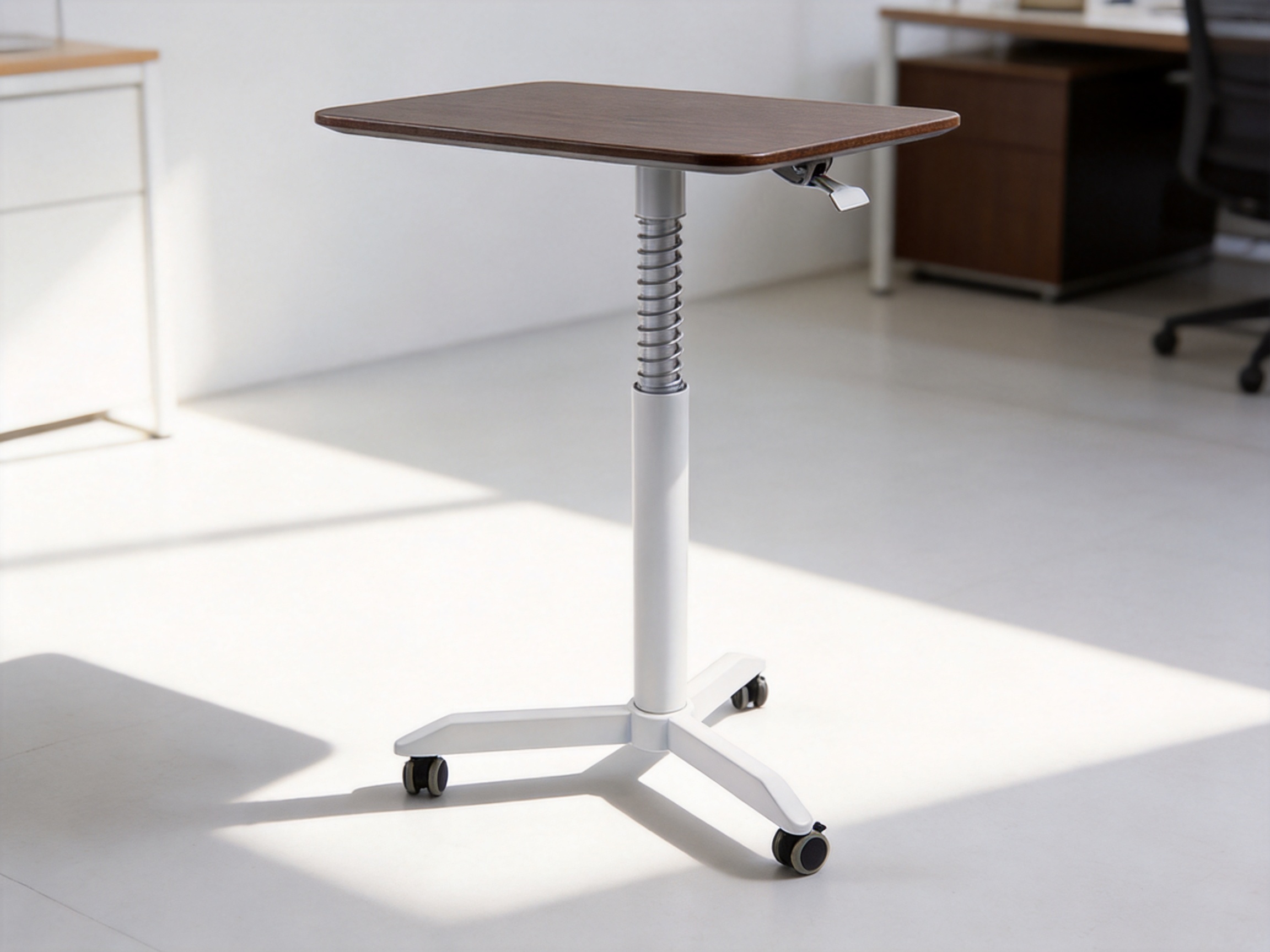
The use of aluminum and iron gives the desk a strong structural foundation. Aluminum contributes corrosion resistance and reduced weight, while iron adds strength and stability. Together, these materials help the frame resist everyday wear in office and professional environments. The powder-coated finish further improves durability by creating a protective layer over the metal surface.
Compared with desks made from thinner or lower-grade materials, the TH10 is designed for longer service life. Its combination of metal structure, reinforced tabletop thickness, and controlled surface treatment supports repeated movement, height adjustment, and daily use.
Multiple Finish Options
The TH10 offers frame colors in white and silver, along with tabletop options in walnut, white, and maple. These choices allow buyers to match different workplace aesthetics. White and silver frames fit clean, modern interiors, while walnut and maple panels provide warmer visual options. This flexibility helps the product serve corporate offices, education facilities, healthcare-related spaces, home offices, and creative environments.
In competitive markets, visual adaptability matters. A height-adjustable table is not only a mechanical product; it is also part of the interior environment. The TH10 addresses both functional and design expectations.
Ergonomic Value in Daily Work
The TH10 is designed to support healthier work habits by making posture changes easier. When a desk is fixed at one height, users must adapt their bodies to the furniture. Over time, this can cause awkward shoulder angles, wrist strain, neck tension, or lower back fatigue. A height-adjustable desk reverses this relationship: the furniture adapts to the user.
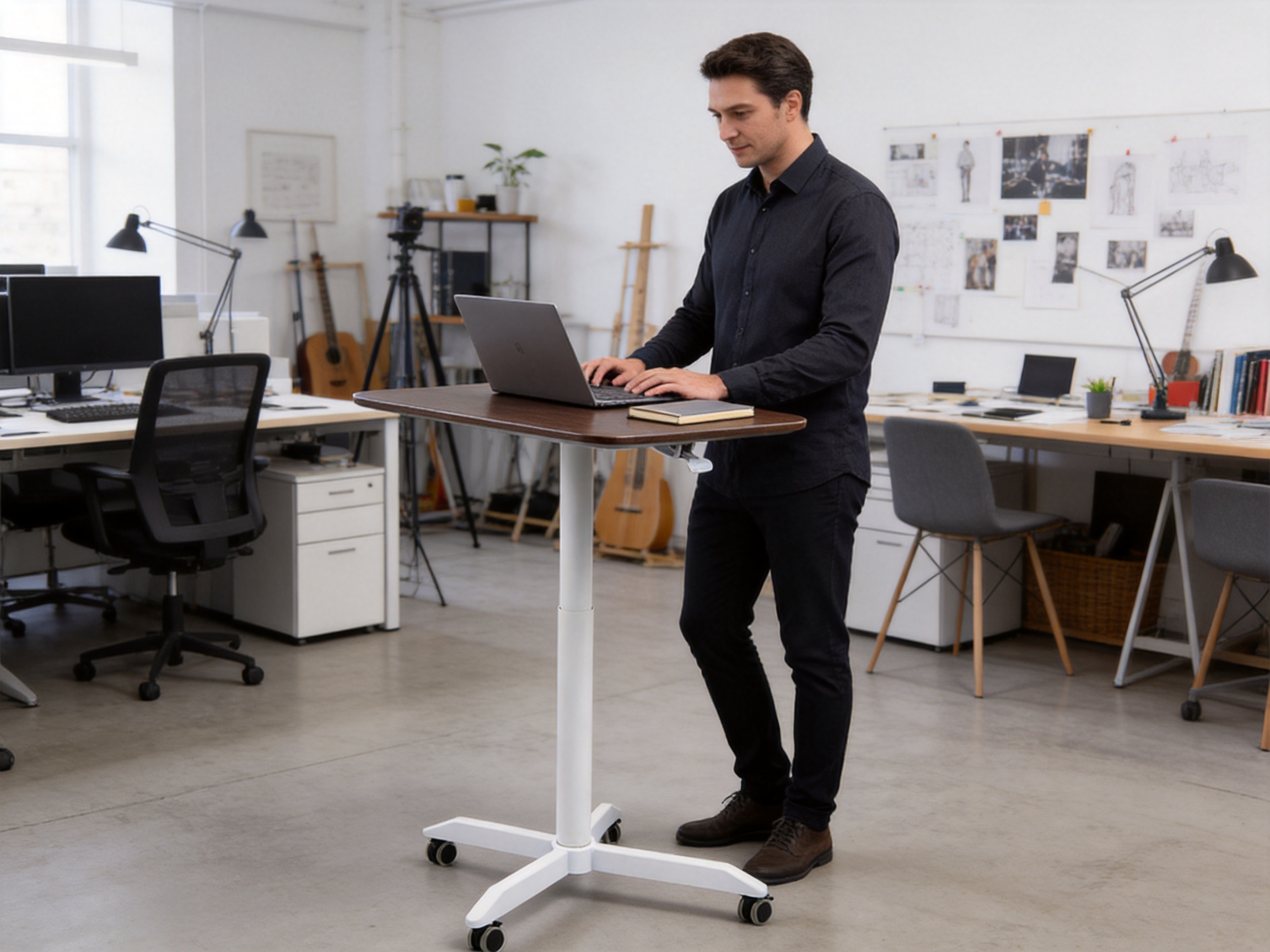
The 720 mm lower height supports seated work for many users, while the 1100 mm upper height makes standing work possible. This range can accommodate different activities such as typing, reading, drawing, inspection, light assembly, and consultation. Because adjustment is simple, users are more likely to change positions throughout the day instead of remaining in one posture.
In offices, the desk can be used as a compact sit-stand workstation. In workshops, it can support work at a comfortable standing height. In medical or laboratory settings, it can help staff position tools or documents at a height that reduces bending. In classrooms or training centers, it can be moved and adjusted for instructors, demonstrations, or temporary stations.
Gas Spring Lifting: Simple, Efficient, and Reliable
The gas spring is the key technology behind the TH10 lifting function. A gas spring stores energy in compressed gas, creating a controlled lifting force that assists height adjustment. This technology is widely used in furniture, automotive components, medical equipment, and industrial applications because it provides smooth motion and dependable support.
For a height-adjustable desk, the gas spring offers an excellent balance between convenience and simplicity. It reduces the effort required to raise the desktop and allows controlled lowering. Since it has fewer electronic parts than an electric system, it also reduces the risk of motor failure, control panel malfunction, or cable damage. This makes the TH10 especially suitable for users who prefer low-maintenance furniture.
Another benefit is quiet operation. Electric desks may create motor noise, especially in quiet office environments. A pneumatic desk generally adjusts with minimal sound, making it suitable for shared work areas, libraries, studios, consultation rooms, and meeting spaces. The user can change the height without disrupting others.
Tripod Base Design and Stability
The three-claw leg design is a defining feature of the TH10. A tripod-style base provides stable support by distributing contact points around the central lifting column. This structure is common in mobile support equipment because it balances stability and movement efficiency. The three-leg layout can also reduce the chance of rocking on slightly uneven surfaces compared with certain narrow two-foot designs.
The base shape is particularly useful for compact desks because it keeps the footprint manageable while still supporting the vertical lifting column. For a mobile height-adjustable table, the relationship between center of gravity, caster position, and tabletop size is essential. The TH10 is engineered to provide practical stability while preserving easy movement.
In comparison with many lightweight mobile tables, the TH10 offers a more professional structure. Its aluminum and iron materials add strength, and the powder-coated surface helps protect the base from scratches and corrosion. For buyers evaluating long-term value, this structural quality is a meaningful advantage.
Tabletop Construction and Surface Performance
The tabletop uses 25 mm MDF with PVC vacuum forming. MDF provides a stable and smooth board structure, while PVC vacuum forming creates a continuous surface layer that supports everyday use and appearance consistency. The 25 mm thickness gives the desktop a substantial feel and improves user confidence during tasks such as writing, laptop work, or light equipment handling.
PVC vacuum forming also helps create clean edges and a finished appearance. Compared with thin panels or simple laminated boards, a molded PVC surface can provide improved visual uniformity and practical resistance to normal office wear. The walnut, white, and maple finishes allow the desktop to suit different environments, from minimalist workstations to warmer natural-style interiors.
The compact tabletop is particularly valuable for task-focused applications. Instead of acting as a large permanent desk, the TH10 functions as a movable work surface that can be placed exactly where needed. This makes it useful for supervisors, technicians, designers, educators, and professionals who frequently shift between locations or tasks.
Manufacturing Strengths Behind the Product
SuZhou Skyhone Intelligent Technology Co., Ltd. is a professional manufacturing enterprise focused on standing desks and adjustable office solutions. The company integrates research and development, production, sales, and service, allowing product feedback and technical improvement to be connected throughout the manufacturing process. This integrated approach is important for height-adjustable furniture because product quality depends on mechanical precision, material consistency, surface finishing, assembly control, and user experience.
Located in Suzhou, the company benefits from the mature industrial ecosystem of the Yangtze River Delta. This region is known for advanced manufacturing capability, strong logistics, skilled labor, and a complete supply chain for metal components, furniture panels, gas springs, actuators, surface coatings, packaging, and export services. These advantages support stable production, faster sourcing, and better quality control compared with manufacturers operating in less integrated industrial locations.
The company’s manufacturing philosophy is based on healthy, efficient, and intelligent workspace solutions. For the TH10, this is reflected in its ergonomic height range, mobile structure, durable frame, and low-maintenance pneumatic mechanism. Rather than designing a desk that only looks modern, the company focuses on usability, manufacturing consistency, and long-term product performance.
Advanced Production Processes
Material Selection and Incoming Inspection
Quality begins with material selection. For a product such as the TH10, the aluminum and iron components must meet requirements for strength, dimensional accuracy, surface compatibility, and durability. The tabletop material must also satisfy thickness, flatness, bonding, and surface appearance standards. A professional manufacturing process includes incoming inspections to reduce defects before production begins.
By controlling materials at the start of production, the company can improve product consistency. This is especially important for adjustable furniture because small dimensional deviations can affect lifting smoothness, assembly alignment, or stability.
Metal Processing and Structural Forming
The frame components require accurate cutting, forming, drilling, and joining. Precision in metal processing ensures that the column, base, caster connections, and support parts align correctly. If tolerances are poorly controlled, the desk may wobble, adjust unevenly, or become difficult to assemble. Advanced manufacturing processes help prevent these issues.
In comparison with low-cost furniture suppliers that may rely on inconsistent component processing, a focused adjustable desk manufacturer can achieve better repeatability. This leads to products that are easier to assemble, smoother to operate, and more reliable in daily use.
Powder Coating and Surface Treatment
The TH10 frame uses powder coating, a surface treatment known for durability, corrosion resistance, and environmental advantages compared with certain traditional liquid coatings. Powder coating creates an even protective layer over the metal surface and improves resistance to scratches and wear from normal use.
For mobile furniture, surface treatment is especially important because the product may be moved frequently and exposed to contact with walls, equipment, or other furniture. A well-executed powder-coated finish helps the desk maintain a professional appearance over time.
Tabletop Processing and PVC Vacuum Forming
The tabletop production process involves MDF preparation, surface finishing, and PVC vacuum forming. Vacuum forming allows the PVC layer to conform to the board surface and edges, creating a finished desktop with consistent appearance. Proper temperature, pressure, adhesive application, and forming time are essential for surface quality.
A professional production process reduces problems such as bubbling, edge separation, uneven texture, or surface defects. For buyers, this means improved product appearance and reduced after-sales issues.
Assembly and Functional Testing
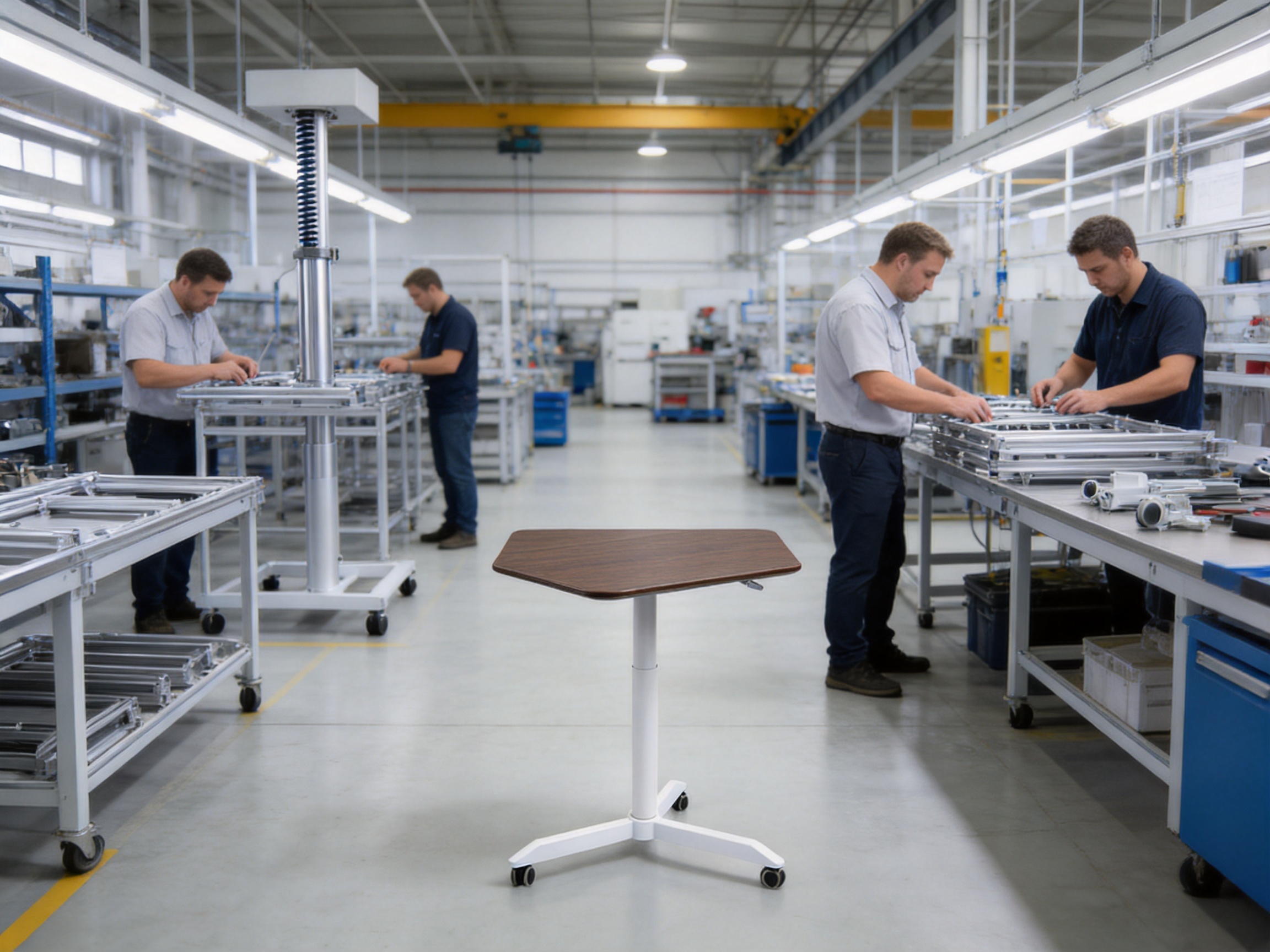
After components are produced, the desk must be assembled and tested. Functional checks may include lifting smoothness, height range verification, caster movement, caster locking performance, tabletop alignment, frame stability, and finish inspection. These steps ensure the product meets practical user expectations, not just dimensional specifications.
The gas spring lifting mechanism must be tested for smooth movement and suitable resistance. A desk that rises too quickly, lowers too abruptly, or feels unstable would not provide a satisfying user experience. Careful assembly and testing help ensure dependable performance.
Advantages Over Electric Adjustable Desks
Electric adjustable desks are popular, especially for full-sized office workstations. However, they are not always the best solution for compact, mobile, or power-free environments. The TH10 offers several advantages in these scenarios.
First, it is easier to relocate because there are no power cords. A mobile electric desk may still require unplugging, moving cables, and finding a new outlet. The TH10 can be moved immediately and used wherever it is needed. This is useful in classrooms, laboratories, meeting rooms, and multipurpose spaces.
Second, the pneumatic system reduces electronic maintenance risks. Electric desks depend on motors, controllers, switches, sensors, and cables. If any of these parts fail, the desk may stop working. The TH10 uses a simpler lifting principle, reducing the number of components that can fail.
Third, the TH10 can be more practical for temporary or shared workstations. Not every adjustable surface needs memory presets, digital displays, or heavy lifting capacity. Many users simply need a reliable worktable that can move between sitting and standing heights. For that purpose, pneumatic adjustment is efficient and cost-effective.
Advantages Over Fixed-Height Tables
Compared with fixed-height tables, the TH10 provides much greater adaptability. A fixed table may be suitable for one user or one task, but it cannot easily support different postures or activities. The TH10’s adjustable range allows it to serve multiple roles throughout the day.
For example, a user may set it low for seated laptop work, raise it for standing review, move it across the room for a quick meeting, and then use it as a support table for a technical task. This flexibility improves furniture utilization. Instead of purchasing several tables for different purposes, an organization can use adjustable mobile desks to support changing needs.
The ergonomic advantage is also significant. Fixed-height tables often require users to bend, reach, or work with uncomfortable arm positions. Height adjustment allows better alignment between the work surface and the user’s body, improving comfort and task efficiency.
Advantages Over Crank-Adjustable Tables
Crank-adjustable tables provide manual height adjustment, but they can be slower and less convenient than pneumatic systems. Users must turn a handle repeatedly, which may discourage frequent height changes. If the adjustment process is inconvenient, the ergonomic benefit is reduced because users are less likely to alternate posture.
The TH10’s gas spring lifting system is designed for quicker adjustment. This makes it more suitable for shared environments where multiple users may need to change height frequently. It also provides a cleaner design without a visible crank handle, improving appearance and reducing the chance of handle interference in compact spaces.
Applications in Professional Environments
Office Workstations
In personal offices and shared workplaces, the TH10 can function as a compact sit-stand workstation. It is suitable for laptop work, document review, video calls, and temporary task support. Because it can be moved easily, it is also useful as an auxiliary desk for collaborative work or flexible office layouts.
Studios and Creative Spaces
Designers, artists, and creative professionals often need to switch between seated planning and standing review. The TH10 provides a convenient work surface for sketching, material inspection, tablet use, or project coordination. Its mobility allows it to be positioned near equipment, display boards, or workbenches.
Workshops and Technical Areas
In workshops, technicians may need a height-adjustable surface for tools, parts, inspection documents, or assembly tasks. The TH10 can be moved to the required location and adjusted to a comfortable height. Its metal frame and powder-coated finish support practical use in demanding environments.
Laboratories
Laboratory work often requires flexible positioning of documents, instruments, or samples. A compact adjustable table can improve workflow by placing items at the correct height and location. The TH10’s caster design allows it to move between stations, while locking casters help secure it during use.
Education and Training
Teachers, trainers, and presenters can use the TH10 as a mobile lectern, demonstration table, or equipment support surface. The height adjustment allows it to be adapted for different presenters and classroom activities. Its compact size makes storage and rearrangement easier.
Healthcare and Consultation Settings
In consultation rooms or healthcare-related administrative spaces, a mobile adjustable table can support laptops, tablets, documents, or small instruments. The quiet, power-free lifting mechanism is suitable for environments where simplicity and low noise are important.
Design for Space-Constrained Workplaces
Many modern workspaces are becoming smaller, more flexible, and more multifunctional. A single room may serve as an office, meeting space, training area, and project room at different times. Large fixed furniture can limit this flexibility. The TH10 responds to this trend by providing a compact, mobile, and adjustable work surface.
The tabletop size is intentionally efficient. It provides enough area for practical work without occupying unnecessary floor space. The tripod base supports stability while preserving maneuverability. The casters allow the desk to be moved to a corner, repositioned for a meeting, or brought directly to a work area.
This space-saving value is especially important for small companies, home offices, co-working spaces, schools, laboratories, and service environments. The TH10 helps maximize the usefulness of available space.
Durability and Long-Term Value
A height-adjustable desk must do more than function on the first day. It must continue to adjust smoothly, remain stable, and maintain appearance after repeated use. The TH10 is designed with long-term value in mind. Its aluminum and iron structure provides strength. Its powder-coated surface improves resistance to corrosion and wear. Its MDF and PVC tabletop offers a practical and attractive work surface. Its gas spring mechanism reduces complexity while supporting reliable height adjustment.
For buyers comparing products, long-term value should be evaluated by considering maintenance, usability, product lifespan, and after-sales reliability. A cheaper table that becomes unstable, difficult to adjust, or visually worn after short use may cost more over time. The TH10 is positioned as a practical, durable product for users who need both flexibility and reliability.
Customization and Supply Capability
SuZhou Skyhone Intelligent Technology Co., Ltd. provides adjustable office table solutions and supports custom ergonomic adjustable office table requirements. Customization may include color selection, finish preferences, packaging requirements, component configuration, or project-based supply needs. For distributors, contractors, and institutional buyers, this capability is valuable because different markets and applications may require different product presentations.
The company’s location in Suzhou supports efficient production coordination and logistics. Being close to a complete industrial chain helps reduce supply uncertainty and supports consistent sourcing of parts and materials. This is a meaningful advantage for international buyers who need dependable lead times and stable product quality.
Quality Control as a Competitive Strength
Quality control is essential in adjustable furniture because users interact with the mechanism every day. A small defect in the lifting system, caster connection, or tabletop installation can affect the entire experience. A professional manufacturer must therefore control quality at multiple stages, including raw material inspection, component processing, surface treatment, assembly, functional testing, packaging, and shipment inspection.
The TH10 benefits from this systematic approach. The metal frame must be accurately formed. The gas spring must operate smoothly. The casters must roll and lock effectively. The tabletop must remain stable and visually consistent. The powder coating must be even and durable. Each of these details contributes to the final product experience.
Compared with suppliers who focus mainly on low price, SuZhou Skyhone Intelligent Technology Co., Ltd. emphasizes integrated manufacturing and service capability. This allows the company to deliver not only products, but also dependable support for buyers who require consistent batches, responsive communication, and product development cooperation.
User Experience and Practical Operation
The TH10 is designed to be straightforward. Users can adjust the desk height manually with the assistance of the gas spring. The movement is smooth and does not require complex controls. Once the desired height is reached, the desk provides a comfortable work surface for the task. When the user needs to move it, the casters allow easy relocation. When it needs to stay in place, the locking casters help secure the position.
This simplicity is one of the product’s strongest benefits. In shared environments, furniture must be easy for anyone to understand. A table that requires training, power setup, or careful handling may not be used properly. The TH10 offers intuitive operation, making it suitable for many user groups.
Aesthetic Integration
The TH10 has a clean and modern appearance. White and silver frame options support contemporary interior design, while walnut, white, and maple desktops provide flexibility for different visual themes. The compact form avoids visual heaviness, making the desk appropriate for offices, studios, clinics, classrooms, and home workspaces.
Furniture appearance can influence how a workspace feels. A clean and coordinated adjustable table can support a professional image while encouraging healthier work habits. The TH10 is designed to combine ergonomic function with a practical, visually adaptable style.
Sustainability Considerations
While the TH10 is primarily valued for its function and durability, its power-free operation also supports sustainability-minded workspace planning. Because it does not require electricity for daily adjustment, it avoids energy use associated with motorized lifting. Its simpler mechanism may also reduce electronic waste compared with motorized products that include control boards and electrical components.
Durability is another aspect of sustainability. Products that last longer reduce replacement frequency and material waste. The TH10’s metal frame, powder-coated finish, and practical surface construction contribute to extended service life when used properly.
Procurement Considerations for Buyers
When evaluating a pneumatic height-adjustable desk, buyers should consider height range, stability, adjustment smoothness, tabletop size, surface durability, caster quality, manufacturer capability, and after-sales support. The TH10 performs well across these key criteria. Its 720 mm to 1100 mm range supports seated and standing use. Its tripod base and locking casters support mobility and positioning. Its gas spring lifting system provides power-free operation. Its material combination supports durability.
Buyers should also consider whether the manufacturer has experience in adjustable furniture. SuZhou Skyhone Intelligent Technology Co., Ltd. is deeply engaged in the research, development, production, sales, and service of standing desks, which helps ensure a stronger understanding of ergonomic product requirements and market expectations.
Q&A Section
What is the main purpose of the TH10 pneumatic height-adjustable desk?
The main purpose is to provide a compact, mobile, and height-adjustable work surface that supports both seated and standing tasks. It is suitable for offices, studios, workshops, laboratories, classrooms, and other flexible work environments.
What height range does the desk provide?
The desk adjusts from 720 mm to 1100 mm, allowing users to choose a suitable height for sitting, standing, or task-specific work.
Does the TH10 require electricity?
No. The desk uses a gas spring lifting mechanism, so it does not require electric power, motors, control panels, or power cables.
What are the tabletop dimensions?
The tabletop measures 715 mm × 495 mm and has a thickness of 25 mm. This size provides a practical compact work surface while saving space.
What materials are used in the desk?
The tabletop is made from 25 mm MDF with PVC vacuum forming. The frame uses aluminum and iron, and the surface is treated with powder coating.
What color options are available?
The frame is available in white and silver. The tabletop is available in walnut, white, and maple finishes.
Is the desk easy to move?
Yes. The desk includes three casters, with two locking casters and one non-locking caster. This allows easy movement and stable placement when the locks are engaged.
How does the TH10 compare with electric standing desks?
The TH10 is more suitable for compact and mobile applications because it does not require power access or cable management. It also has fewer electronic components, which can reduce maintenance complexity.
How does it compare with fixed-height tables?
Unlike fixed-height tables, the TH10 can be adjusted to different working heights. This improves ergonomic flexibility and allows the same desk to support multiple users and tasks.
Who manufactures the TH10?
The TH10 is manufactured by SuZhou Skyhone Intelligent Technology Co., Ltd., a professional enterprise focused on the research, development, production, sales, and service of standing desks and adjustable office furniture solutions.
Why is the manufacturer’s location important?
The company is located in Suzhou, within the Yangtze River Delta industrial region. This area has a mature supply chain, advanced manufacturing resources, and strong logistics support, which help improve production efficiency and product consistency.
Conclusion
The TH10 Three-Claw Leg Pneumatic Height-Adjustable Desk is a practical solution for modern flexible workspaces. It combines ergonomic height adjustment, power-free pneumatic operation, compact dimensions, durable materials, mobile casters, and a stable tripod-style base. These features make it suitable for a wide range of professional and personal environments.
Its advantages over many competing products are clear. Compared with electric desks, it is simpler, more mobile, and independent of power supply. Compared with fixed-height tables, it provides far greater ergonomic adaptability. Compared with crank-adjustable tables, it offers faster and easier adjustment. Compared with lightweight mobile tables, it provides a stronger material structure and more professional design.
Behind the product is the manufacturing strength of SuZhou Skyhone Intelligent Technology Co., Ltd. The company’s focus on standing desk solutions, its integrated production and service model, and its location in the advanced manufacturing ecosystem of Suzhou support consistent product quality and supply reliability. For buyers seeking an ergonomic adjustable office table that is compact, durable, and easy to use, the TH10 offers a well-balanced choice.
References
Bridger, R. S. Introduction to Human Factors and Ergonomics. CRC Press.
Kroemer, K. H. E., and Grandjean, E. Fitting the Task to the Human: A Textbook of Occupational Ergonomics. Taylor & Francis.
Pheasant, S., and Haslegrave, C. M. Bodyspace: Anthropometry, Ergonomics and the Design of Work. CRC Press.
Chaffin, D. B., Andersson, G. B. J., and Martin, B. J. Occupational Biomechanics. Wiley.
Dul, J., and Weerdmeester, B. Ergonomics for Beginners: A Quick Reference Guide. CRC Press.
International Organization for Standardization. Ergonomic Requirements for Office Work with Visual Display Terminals.
Human Factors and Ergonomics Society. Human Factors Guidelines for Workplace Design.
Product: TH10 (Three-Claw Leg) Pneumatic Height-Adjustable Desk


- Contact Info
-
-
 Phone+86-15950656125
 -
 Email
Email -
 AddressRoom 1007-1, South Building, Suyue Plaza, Suzhou Industrial Park, Suzhou City, Jiangsu Province, China
-
- Products
- Follow Us
- Need help? Please contact us
Copyright ©
SuZhou Skyhone Intelligent Technology Co., Ltd.
All Rights Reserved.
Privacy
Custom Ergonomic Adjustable Office Tables Manufacturers

