

 English
  русский
  Español
  عربى
عربى 
Content
- 1 Product Overview
- 2 Key Technical Specifications
- 3 Ergonomic Value of Pneumatic Height Adjustment
- 4 Center-Mounted Structure and Stability
- 5 Gas Spring Lifting System
- 6 Tabletop Design and Material Advantages
- 7 Iron Frame and Powder-Coated Surface
- 8 Mobility and Locking Caster System
- 9 Advantages Over Competing Products
- 10 Manufacturing Strength and Production Philosophy
- 11 Material Selection and Quality Control
- 12 Powder Coating and Surface Processing
- 13 PVC Vacuum Forming and Desktop Finish
- 14 Applications in Office Environments
- 15 Applications in Home Offices
- 16 Applications in Training Rooms and Education
- 17 Applications in Laboratories, Studios, and Professional Spaces
- 18 Operational Simplicity and User Experience
- 19 Why Compact Adjustable Furniture Matters
- 20 Customization and Market Adaptability
- 21 Maintenance and Long-Term Use
- 22 Purchasing Considerations
- 23 Frequently Asked Questions
- 23.1 What type of desk is the TH03?
- 23.2 What is the height adjustment range?
- 23.3 Does the desk need to be plugged into a power outlet?
- 23.4 What is the tabletop made of?
- 23.5 What colors are available?
- 23.6 Is the desk easy to move?
- 23.7 How does it compare with an electric standing desk?
- 23.8 How does it compare with a fixed desk?
- 23.9 Where can the desk be used?
- 23.10 Why is the center-mounted design important?
- 24 Conclusion
- 25 References
- 26 Product: TH03 Center-Mounted Pneumatic Height-Adjustable Desk
Center-Mounted Pneumatic Height-Adjustable Desk for Flexible Workspaces
2026-06-01
Modern work environments require more than a fixed surface and a chair. Offices, home workstations, training rooms, laboratories, clinics, studios, and shared spaces increasingly demand furniture that can adapt quickly to different users, different tasks, and different working postures. The TH03 Center-Mounted Pneumatic Height-Adjustable Desk is designed for this new generation of flexible working. With a gas spring lifting system, a compact tabletop, a durable iron frame, lockable cast wheels, and a practical height range from 745mm to 1060mm, it provides a mobile, ergonomic, and easy-to-use solution for sit-stand activities.
This article presents a detailed product-focused overview of the TH03 pneumatic height-adjustable desk, including its structure, functions, materials, ergonomic value, competitive advantages, manufacturing quality, and application scenarios. It also explains why a center-mounted pneumatic desk can be a practical alternative to traditional fixed desks and some electric standing desk solutions, especially in environments where mobility, simplicity, compactness, and low-maintenance performance are important.
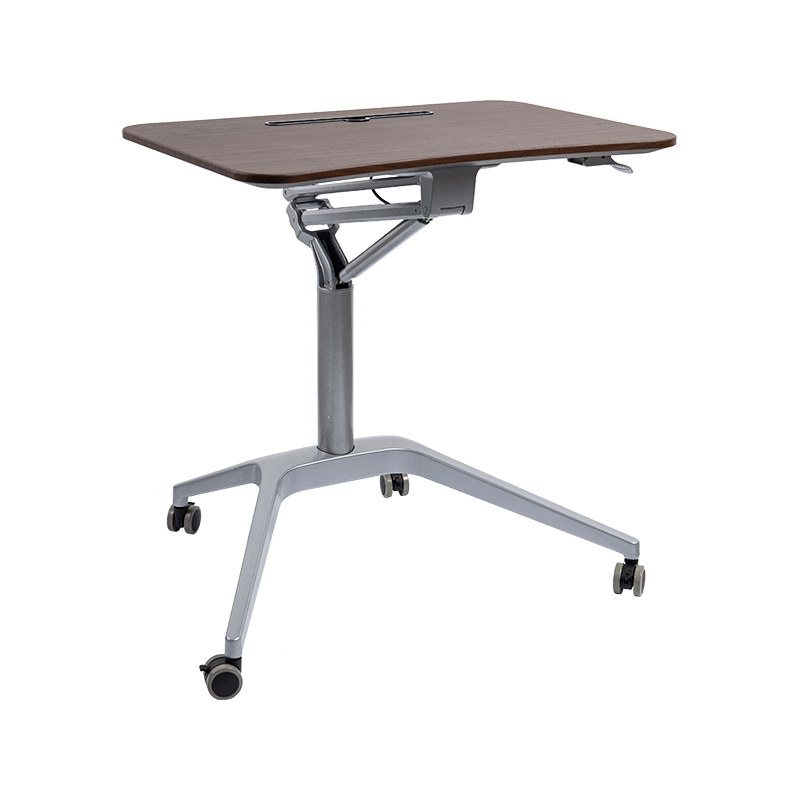
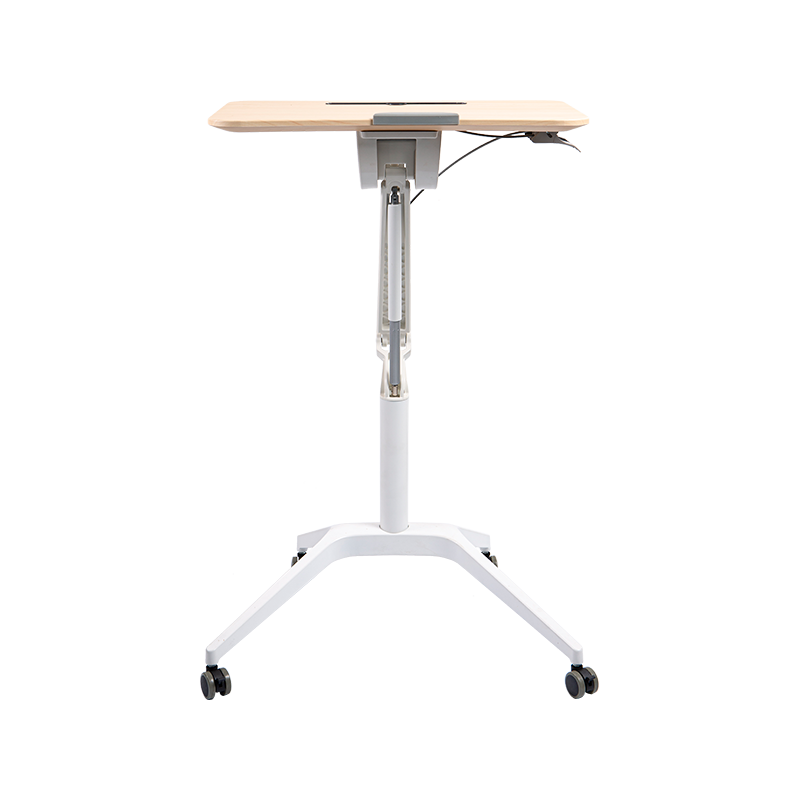
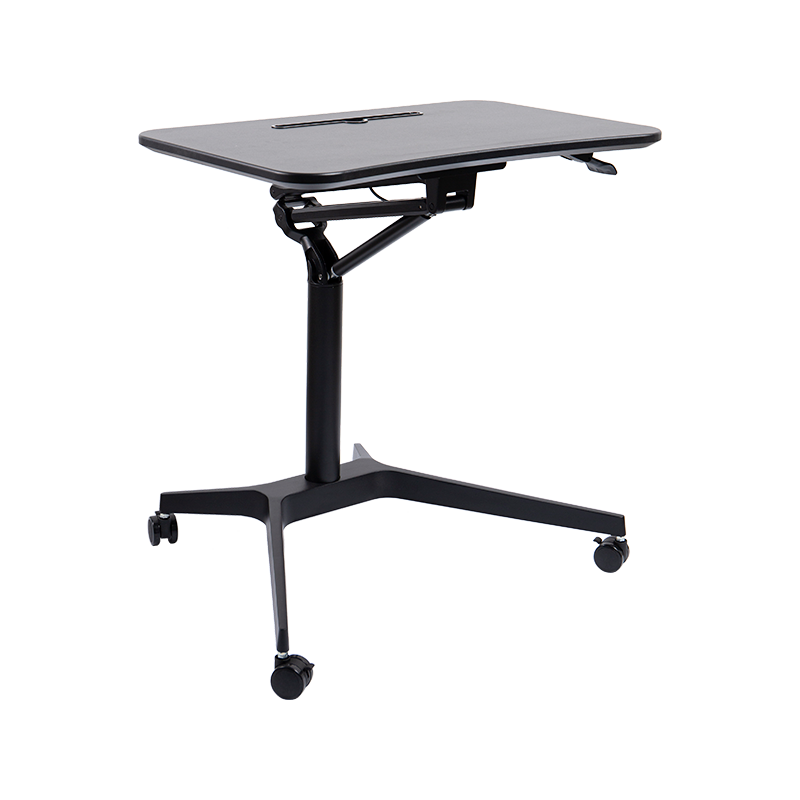
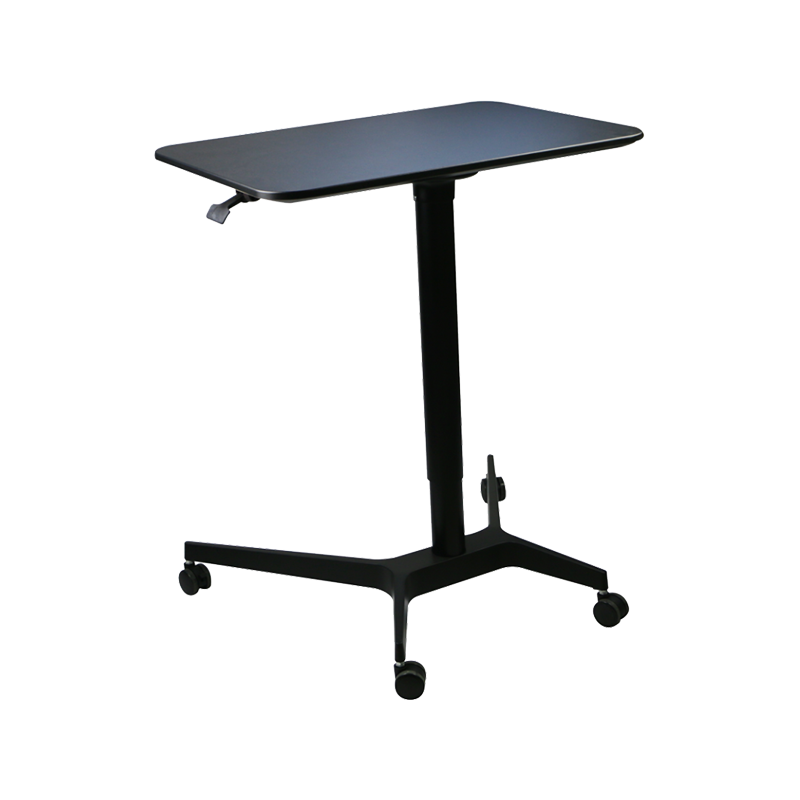
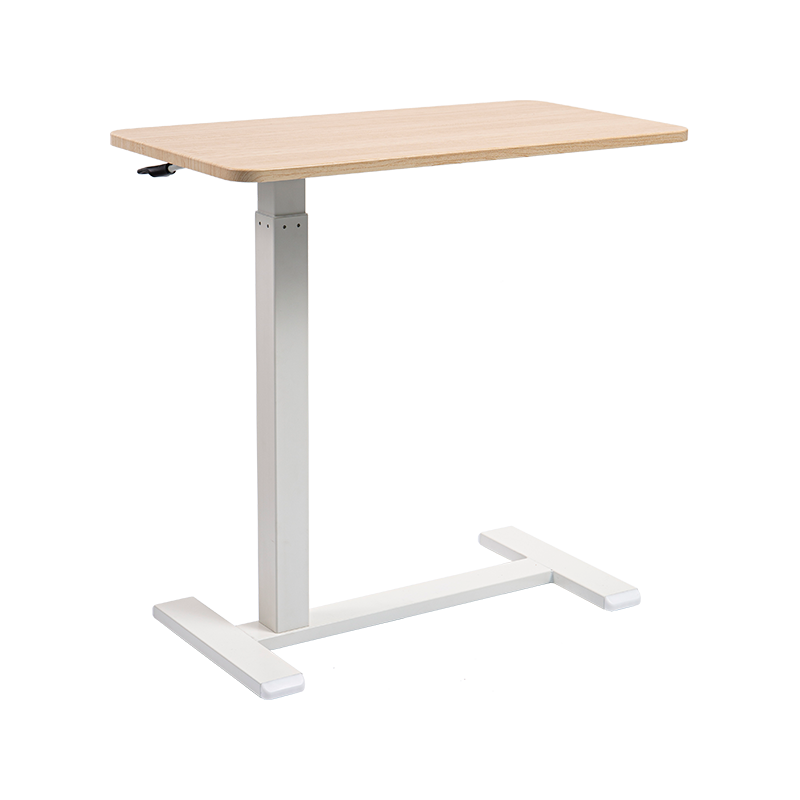
TH03 Center-Mounted Pneumatic Height-Adjustable Desk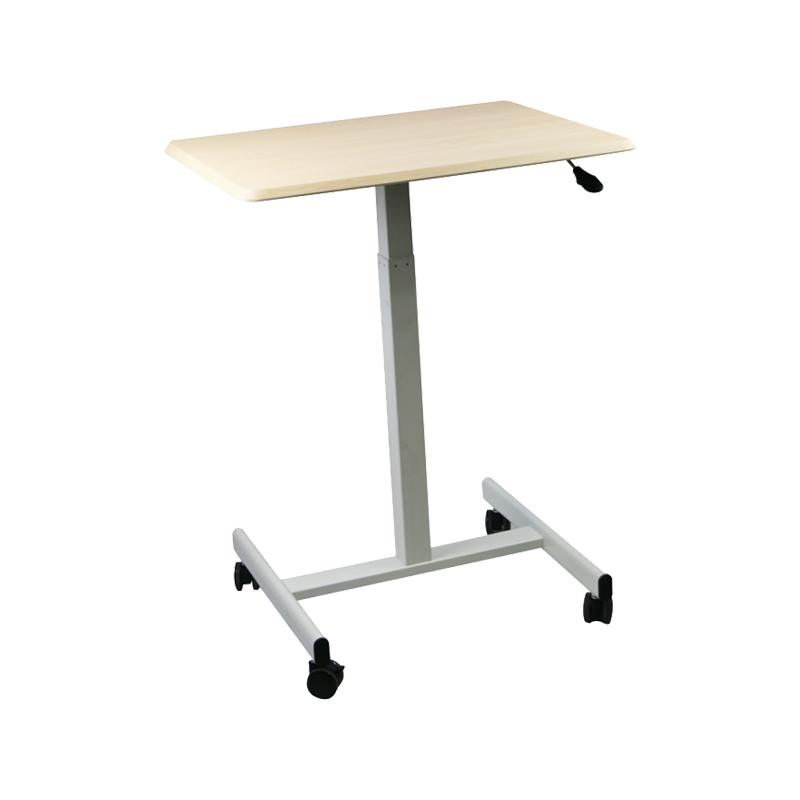
Product Overview
The TH03 is a center-mounted pneumatic height-adjustable table designed around a gas spring lifting principle. Unlike electric height-adjustable desks that rely on motors, control boxes, and power cables, the TH03 uses pneumatic lifting assistance to raise and lower the desktop smoothly. This makes the desk suitable for locations where electrical access may be limited, where cable management must be minimized, or where users need a simple mechanical adjustment method.
The desk has a lifting range of 745mm to 1060mm. This range supports seated work, elevated seated work, and standing work for many users. The tabletop measures 650mm by 480mm with a thickness of 15mm, making it compact enough for mobile use while still providing space for a laptop, documents, writing materials, small instruments, or presentation equipment. The tabletop is made from 15mm MDF with a PVC vacuum-formed surface, combining a stable core with a practical, easy-to-clean finish.
The main frame is made of iron and is finished with powder coating. This combination provides structural strength and surface protection, helping the desk resist wear in busy environments. The base includes four cast wheels, two with locking mechanisms and two without locks. This configuration allows the desk to be moved conveniently and then secured in position when in use. Panel color options include White, Maple, Walnut, and Black, allowing the product to match different workplace interiors.
As a compact mobile adjustable desk, the TH03 fits into a wide range of spaces. It can serve as a personal sit-stand workstation, a temporary training table, a mobile computer desk, a bedside work table, a laboratory support surface, a presentation table, or a flexible surface in a collaborative office. Its greatest value lies in combining ergonomic adjustability, simple operation, mobility, and durable construction in one product.
Key Technical Specifications
Item |
Specification |
Practical Value |
Product Type |
Center-mounted pneumatic height-adjustable desk |
Provides compact sit-stand functionality with simple mechanical adjustment |
Lifting Range |
745mm to 1060mm |
Supports seated, semi-standing, and standing work postures |
Tabletop Size |
650mm x 480mm x 15mm |
Offers a practical surface for laptops, documents, and daily tools |
Tabletop Material |
15mm MDF with PVC vacuum forming |
Balances stability, surface durability, and visual appeal |
Frame Material |
Iron |
Provides strong structural support for frequent daily use |
Surface Treatment |
Powder coating |
Improves resistance to scratches, corrosion, and wear |
Mobility |
Four cast wheels, two with locks and two without locks |
Allows easy relocation and stable positioning during work |
Panel Colors |
White, Maple, Walnut, Black |
Supports matching with different office and interior styles |
Working Principle |
Gas spring lifting |
Enables smooth height adjustment without electrical power |
Ergonomic Value of Pneumatic Height Adjustment
Ergonomics is one of the strongest reasons to choose a height-adjustable desk. Static postures, whether seated or standing, can create fatigue over time. A flexible workstation allows users to change their posture throughout the day, improving comfort and helping them maintain better body alignment. The TH03 is designed to make these posture changes simple and accessible.
The lifting range from 745mm to 1060mm makes the desk suitable for many daily activities. At the lower end of the range, it can be used as a seated workstation. At intermediate heights, it can support tasks such as reviewing documents, using a laptop from a stool, or working in a semi-standing posture. At the upper end, it can function as a standing desk for short or extended periods, depending on the user’s height and working preference.
A major advantage of pneumatic adjustment is its immediacy. Users do not need to search for a power outlet, press electronic controls, or wait for a motorized system. The gas spring mechanism assists the lifting motion, making adjustment efficient and intuitive. For shared environments, this simplicity is especially valuable because different users can quickly adjust the desk without needing training or instructions.
The compact tabletop also supports ergonomic behavior. A smaller surface encourages users to keep essential tools close and reduce clutter. When used with a laptop stand, external keyboard, or compact monitor setup, the TH03 can help create a more organized mobile workstation. For users who move between rooms or need temporary work zones, this combination of height adjustability and compact mobility can be more useful than a large fixed sit-stand desk.
Center-Mounted Structure and Stability
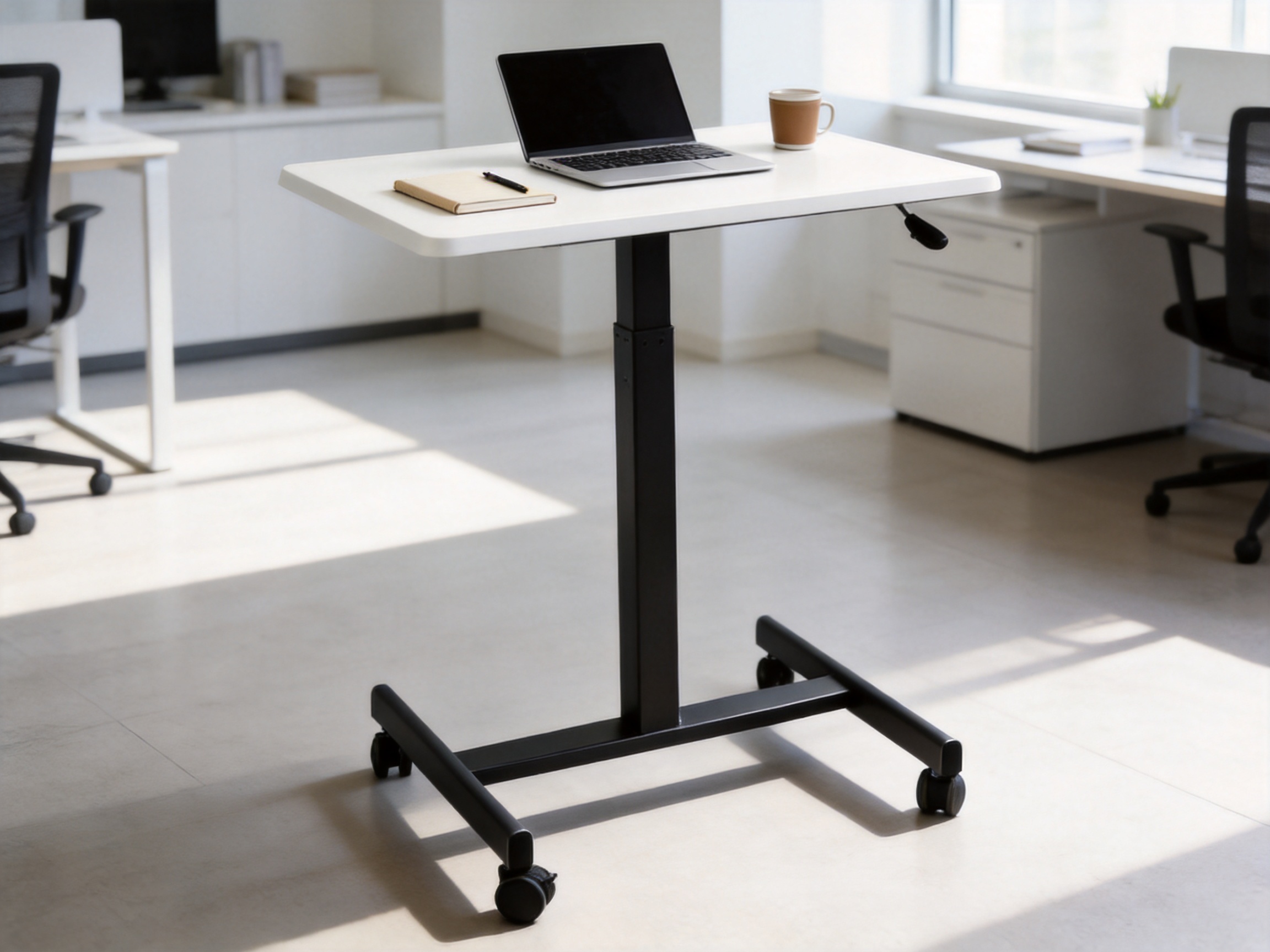
The center-mounted design is an important feature of the TH03. In a height-adjustable desk, the relationship between the lifting column, the tabletop, and the base determines the product’s stability and operating feel. A center-mounted pneumatic column helps distribute the load around a central lifting point, creating a balanced structure for a compact tabletop.
For mobile desks, stability is especially important. A desk that moves easily must also remain secure when a user types, writes, reads, or places equipment on the surface. The TH03 addresses this requirement through its iron frame, powder-coated structure, and caster arrangement. Two lockable wheels allow the user to secure the desk after positioning it. This makes the desk suitable for environments where layouts change frequently but work surfaces still need to feel reliable.
Compared with some lightweight mobile tables, the TH03 offers a stronger and more purpose-built height-adjustment structure. Some basic mobile tables provide wheels but no true ergonomic adjustment. Others may provide height adjustment through manual knobs or telescopic tubes, but such systems can be slower and less convenient. The pneumatic gas spring design allows smoother adjustment while the center-mounted column keeps the form compact and balanced.
The desk’s stability is also supported by its tabletop dimensions. A 650mm by 480mm surface is large enough for everyday tasks but not so wide that it creates excessive leverage on the center column. This proportion helps the desk remain practical and stable during normal use. The result is a mobile adjustable table that feels appropriate for professional environments rather than temporary or lightweight household use only.
Gas Spring Lifting System
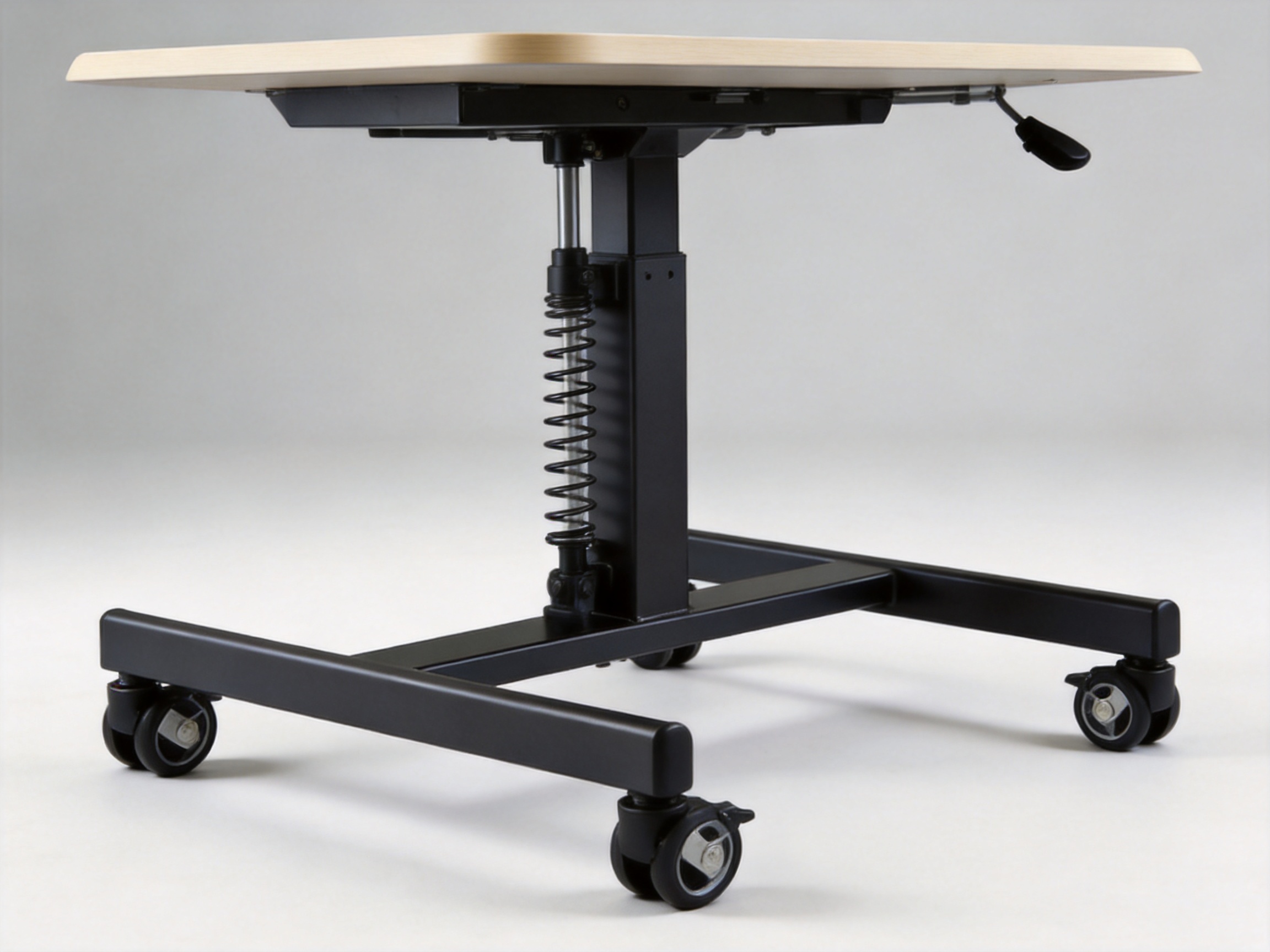
The working principle of the TH03 is gas spring lifting. A gas spring is a mechanical component that uses compressed gas to provide controlled force. In height-adjustable furniture, gas springs are valued because they can assist lifting, reduce user effort, and create a smooth adjustment experience without electrical energy. This is a key distinction between pneumatic desks and electric standing desks.
Electric desks have clear advantages for large desktop systems, heavy equipment, programmable height memory, and multi-leg structures. However, electric systems also include motors, cables, power supplies, control panels, and electronic components. In certain environments, these components add cost, complexity, maintenance considerations, and installation requirements. The TH03 takes a different approach by using a pneumatic mechanism that is easier to deploy and less dependent on the surrounding infrastructure.
For mobile applications, a gas spring system is often highly practical. A mobile desk should be able to move freely from one room to another. If the desk requires constant access to power, mobility becomes less convenient. The TH03 can be rolled to a new location and adjusted immediately without plugging in a cable. This makes it suitable for training spaces, laboratories, medical support rooms, shared offices, and flexible home work areas.
The gas spring also contributes to quiet operation. Motorized systems can produce mechanical sound during movement, while manual screw systems may require more physical effort. Pneumatic lifting is generally smooth and quiet, which is helpful in offices, classrooms, studios, libraries, and other spaces where disturbance should be minimized.
Another advantage of the gas spring system is operational simplicity. Many users prefer products that work reliably with minimal instruction. The TH03 supports this expectation. Its mechanical adjustment principle makes it easy for different users to understand and operate, which is important in shared workspaces where furniture may be used by many people throughout the day.
Tabletop Design and Material Advantages
The tabletop of the TH03 measures 650mm by 480mm with a thickness of 15mm. It is made from MDF and finished with PVC vacuum forming. This material combination is common in practical office furniture because it balances cost control, appearance, surface performance, and shape consistency.
MDF, or medium-density fiberboard, provides a stable and uniform core. It is less prone to irregular grain behavior than some natural wood materials and can be processed accurately for furniture components. For a compact mobile desktop, MDF provides a suitable balance between strength and weight. It offers enough rigidity for daily office tasks while keeping the product manageable for movement and adjustment.
The PVC vacuum-formed surface adds a finished layer that can improve resistance to daily wear and make cleaning easier. In busy environments, desktops are exposed to keyboards, laptops, notebooks, pens, cups, instruments, and repeated hand contact. A practical surface finish helps maintain appearance and usability over time. The vacuum-forming process can also create a clean and consistent surface effect, supporting a more refined look than unfinished board materials.
The available panel colors are White, Maple, Walnut, and Black. These options cover a broad range of interior styles. White is suitable for clean, modern, clinical, or minimalist spaces. Maple creates a warmer and lighter wood-tone appearance. Walnut supports a more traditional or executive aesthetic. Black provides a professional, technical, or contemporary look. By offering these choices, the product can be integrated into offices, home workspaces, educational areas, and specialized professional settings.
The compact tabletop size is also an advantage in space-limited environments. Not every user needs a large standing desk. In many cases, a smaller surface is more efficient because it can be placed beside a main desk, moved between rooms, or stored when not required. The TH03 can function as a flexible workstation instead of replacing every fixed desk. This makes it useful for organizations that want to introduce ergonomic options without redesigning entire rooms.
Iron Frame and Powder-Coated Surface
The frame material of the TH03 is iron, selected for strength, rigidity, and durability. In height-adjustable furniture, the frame carries the load of the tabletop and user equipment while also supporting movement. A weak frame can create wobble, noise, deformation, or shortened service life. The use of iron gives the TH03 a robust foundation for daily adjustment and mobile use.
Powder coating is applied as the surface treatment. Powder coating is widely used for metal furniture because it forms a durable protective layer. Compared with some liquid coating methods, powder coating can offer strong adhesion, a uniform finish, and improved resistance to chipping, scratching, and corrosion when properly processed. For furniture that may be moved often, this surface protection is especially important.
The combination of iron and powder coating helps the desk maintain its appearance and structural integrity in different environments. Offices require furniture that can withstand repeated contact and cleaning. Training rooms may involve frequent layout changes. Laboratories and studios may expose furniture to tools or equipment. Home offices may need products that remain attractive while supporting daily use. The TH03 is engineered for this type of practical durability.
From a competitive perspective, this construction gives the desk an advantage over lightweight plastic or thin-gauge metal alternatives. While very low-cost mobile tables may be adequate for occasional use, they often compromise rigidity and long-term stability. The TH03 is positioned as a professional adjustable table that emphasizes reliability, not merely portability.
Mobility and Locking Caster System
Mobility is one of the defining features of the TH03. The desk is equipped with four cast wheels, including two with locks and two without locks. This design allows users to move the desk easily and then secure it for stable use. In flexible work environments, mobility can be just as important as height adjustment.
A mobile adjustable desk can support changing work patterns throughout the day. For example, a user may move the desk next to a conference table for a presentation, roll it into a quiet corner for focused laptop work, bring it beside a larger workstation as an auxiliary surface, or reposition it in a training room to support group activities. In clinical or laboratory settings, a mobile desk can provide a temporary surface for documentation, equipment, or data entry.
The two locking wheels provide a simple way to stabilize the desk after relocation. This is especially useful when typing, writing, or placing devices on the tabletop. The two non-locking wheels support easy movement and directional flexibility. Together, the caster arrangement creates a balance between mobility and stability.
Compared with fixed standing desks, the TH03 offers greater layout flexibility. A fixed desk may be ideal for an assigned workstation, but it cannot easily serve multiple rooms or tasks. Compared with simple rolling carts, the TH03 offers better ergonomic height adjustment and a more desk-like working surface. This combination helps it serve as a bridge between a mobile cart and a full standing desk.
Advantages Over Competing Products
The TH03 stands out from competing products because it combines several practical features in one compact design: pneumatic lifting, center-mounted structure, iron frame, powder-coated finish, lockable mobility, and multiple tabletop colors. Many competing products offer only some of these benefits.
Compared with traditional fixed desks, the most obvious advantage is height flexibility. Fixed desks force users to adapt their posture to one surface height. The TH03 allows the surface to adapt to the user and task. This can improve comfort during laptop work, writing, reading, equipment operation, and short standing sessions.
Compared with large electric standing desks, the TH03 offers superior mobility and independence from power. Electric desks are excellent for permanent workstations, but they are often heavy, less mobile, and dependent on power access. The TH03 can be moved quickly and used anywhere within a workspace. It also avoids electronic complexity, making it attractive for users who prefer a simpler mechanical product.
Compared with low-cost manual adjustable tables, the TH03 provides smoother operation through gas spring assistance. Manual systems that rely on knobs or pins can require more time and effort to adjust. Users may avoid adjusting them frequently because the process is inconvenient. Pneumatic adjustment encourages more frequent posture changes because the adjustment process is easier.
Compared with ordinary rolling carts, the TH03 provides a more ergonomic and professional workstation experience. A rolling cart may hold equipment, but it is not always designed for comfortable typing, writing, or long-term interaction. The TH03 is specifically designed as a height-adjustable desk, making it more suitable for user-centered work.
Compared with wide mobile workstations, the TH03 offers a compact footprint. This is valuable in small offices, classrooms, apartments, and shared workspaces where floor space is limited. A smaller footprint also improves maneuverability. Users can move the desk through narrow areas more easily and position it close to other furniture.
Another competitive advantage is visual adaptability. With White, Maple, Walnut, and Black tabletop options, the desk can match modern, warm, classic, or technical interiors. Some competitors offer only one color or a limited finish selection, which can restrict their suitability for design-conscious spaces.
Manufacturing Strength and Production Philosophy
SuZhou Skyhone Intelligent Technology Co., Ltd. is a manufacturing enterprise focused on the research and development, production, sales, and service of standing desks and related ergonomic office solutions. Located in Suzhou, within the economically developed Yangtze River Delta region, the company benefits from a strong furniture supply chain, advanced manufacturing resources, and access to skilled industrial talent. These regional advantages support efficient production, component sourcing, process control, and product development.
The company’s manufacturing philosophy emphasizes practical engineering, stable quality, ergonomic function, and scalable production. For a product such as the TH03, these priorities are essential. A pneumatic height-adjustable desk must operate smoothly, remain stable across its lifting range, and maintain durability under repeated adjustment and movement. Achieving this requires more than assembly; it requires careful control of materials, structure, surface treatment, and component integration.
Advanced manufacturing strength begins with product design. The TH03 is not merely a tabletop attached to a lifting column. Its dimensions, gas spring mechanism, central support, frame geometry, caster system, and tabletop material must work together. The lifting range must be practical, the surface size must match the support structure, and the base must provide mobility without sacrificing stability. This integration reflects engineering experience in adjustable height desks and related motion systems.
The company’s engagement with adjustable desks, electric linear actuators, and gas spring products also supports cross-category knowledge. Electric lifting systems require precision motion control, load management, and structural coordination. Gas spring products require understanding of force balance, smooth travel, and mechanical reliability. Adjustable height desks require ergonomic design, safety, assembly efficiency, and long-term usability. Experience across these categories helps strengthen the design and manufacturing quality of pneumatic products like the TH03.
Material Selection and Quality Control
Quality begins with material selection. For the TH03, the main frame uses iron to support strength and durability. The tabletop uses 15mm MDF with PVC vacuum forming for a practical and attractive surface. The caster system includes two lockable wheels to support secure positioning. Each of these material choices affects the user experience and long-term performance.
In professional manufacturing, incoming materials are typically checked for dimensional consistency, surface condition, mechanical properties, and compatibility with production processes. Metal components must be suitable for forming, welding, coating, and assembly. Board materials must be consistent in thickness and surface quality. Gas spring components must provide the required lifting support and smooth movement. Casters must roll reliably and lock securely.
For a height-adjustable desk, quality control must also focus on the relationship between components. A strong frame is not enough if the lifting mechanism is inconsistent. A good tabletop is not enough if the base is unstable. A smooth gas spring is not enough if the casters do not lock properly. The TH03 depends on coordinated performance, and this requires systematic inspection during production.
Dimensional control is particularly important for the center-mounted structure. The lifting column must align properly with the tabletop and base. Misalignment can affect stability, movement feel, and product appearance. Powder-coated surfaces must also be controlled to avoid uneven coating, exposed metal, or defects that could reduce durability. Consistent assembly procedures help ensure that each desk performs as intended.
Powder Coating and Surface Processing
The powder-coated frame is one of the product’s key durability features. Surface processing is not simply decorative; it protects the iron structure from environmental exposure, friction, handling, and daily use. A well-managed powder coating process includes surface preparation, powder application, curing, and inspection.
Surface preparation may include cleaning and pretreatment steps that help the coating adhere properly. Powder application requires even coverage across the metal surfaces, including corners and edges. Curing must be controlled so the powder forms a durable, consistent finish. After coating, components should be inspected for appearance, adhesion, coverage, and defects.
This manufacturing discipline gives the TH03 an advantage in real-world use. Mobile furniture is frequently touched, rolled, repositioned, and occasionally bumped against other objects. A weak surface finish can quickly show scratches, chips, or corrosion. Powder coating improves the desk’s ability to maintain a professional appearance even when used in active environments.
For buyers, surface quality is also a sign of manufacturing maturity. A clean, consistent finish reflects attention to detail and process control. When combined with structural strength and smooth height adjustment, it contributes to a product that feels reliable and professionally made.
PVC Vacuum Forming and Desktop Finish
The tabletop uses PVC vacuum forming over a 15mm MDF core. Vacuum forming is a process in which a surface film is shaped and bonded over a substrate, creating a finished surface that can include different colors and textures. For office furniture, this process allows consistent appearance and practical surface performance.
The advantage of PVC vacuum forming is that it can provide a clean and integrated look. Edges and surfaces can be finished in a way that supports visual continuity, depending on the design. The surface is also suitable for daily office use because it can be wiped and maintained with relative ease. For users, this means the desk can remain presentable even after repeated handling.
The availability of four panel colors supports customization and market flexibility. White can be used in modern offices and clean environments. Maple can soften the appearance of technical or educational spaces. Walnut can coordinate with traditional furniture. Black can match electronic equipment and contemporary interiors. This range helps distributors, project buyers, and end users select a finish that fits the intended application.
By combining standardized manufacturing with color options, the product can support both efficiency and personalization. This is important for manufacturers serving global markets, where interior preferences and project requirements vary widely.
Applications in Office Environments
In office environments, the TH03 can serve multiple roles. It can function as an individual sit-stand workstation for users who do not need a large desk. It can also be used as a shared adjustable station in open offices, allowing employees to step away from fixed desks and work in a standing posture for part of the day.
The desk is useful in meeting rooms and collaborative spaces. During presentations, it can hold a laptop, projector controller, notes, or demonstration materials. Its height can be adjusted for the presenter’s comfort, and the casters allow the desk to be positioned where needed. After the meeting, it can be moved aside or used in another room.
In hot-desking or shared office models, compact mobile furniture is especially valuable. Not every user requires a permanent assigned desk, but many users still need a comfortable work surface. The TH03 can support flexible scheduling and changing layouts without requiring electrical installation at every location.
For managers and facility planners, the product offers a cost-effective way to introduce ergonomic flexibility. Instead of replacing all traditional desks with large electric standing desks, an organization can deploy mobile pneumatic desks in targeted areas. This allows employees to access height-adjustable work surfaces when needed while preserving the existing office layout.
Applications in Home Offices
Home offices often face space limitations. Many people work from apartments, shared rooms, bedrooms, or multipurpose living areas. A full-size standing desk may be too large or too permanent for these spaces. The TH03 offers a compact alternative that can be moved and adjusted according to daily needs.
For remote workers, the desk can support laptop work, video meetings, reading, writing, or light creative tasks. When not in use, it can be rolled to the side. The color options make it easier to match home interiors, whether the user prefers a clean white surface, a warm wood tone, a dark professional look, or a classic walnut finish.
The gas spring system is also beneficial at home because it avoids power cable clutter. Users can place the desk near a sofa, bed, window, or existing table without needing to connect it to an outlet for height adjustment. This flexibility supports changing routines throughout the day.
For households with multiple users, the height-adjustable feature is especially useful. Different family members may use the same surface for work, study, reading, or hobbies. Pneumatic adjustment makes it easier to change the height quickly for each person.
Applications in Training Rooms and Education
Training rooms and educational spaces often require furniture that can be rearranged quickly. The TH03 is well suited for these environments because it combines mobility with height adjustment. Trainers can use it as a mobile lectern, equipment stand, laptop station, or demonstration surface.
In classrooms, the desk can support teachers who move between teaching zones. It can hold teaching materials, digital devices, or classroom tools. Because the desk can be adjusted in height, it can accommodate different instructors and different teaching activities.
For workshops and seminar rooms, mobile desks can help create flexible layouts. Participants may need temporary surfaces for group work, registration, equipment setup, or demonstrations. The TH03 can be deployed quickly and then moved away after the session.
The lockable casters are important in educational settings because furniture may be moved frequently but must remain stable during use. The durable iron frame and powder-coated finish also support repeated handling in high-traffic spaces.
Applications in Laboratories, Studios, and Professional Spaces
Laboratories, studios, and professional work areas often require adaptable surfaces. In a laboratory, a mobile adjustable desk can hold documentation, laptops, instruments, or temporary materials. In a creative studio, it can support sketching, digital work, photography equipment, or project review. In technical environments, it can function as a movable support station for devices or inspection tasks.
The compact footprint of the TH03 is valuable in these spaces because equipment and workflow patterns may change frequently. A large fixed desk can obstruct movement, while a small mobile adjustable desk can be placed exactly where it is needed. The height range supports different tasks, from seated data entry to standing review.
The powder-coated iron frame helps the product withstand active professional use. The PVC vacuum-formed tabletop provides a practical surface for everyday tasks. The locking wheels help keep the desk steady when users are working with tools, documents, or devices.
In creative studios, the appearance of furniture also matters. The choice of panel colors allows the desk to blend into visual environments, whether the space is bright and minimal, warm and natural, dark and technical, or classic and professional.
Operational Simplicity and User Experience
A successful ergonomic product must be easy to use. If adjustment is complicated, users may stop adjusting it and lose the ergonomic benefit. The TH03 is designed for straightforward operation. Its gas spring lifting mechanism provides smooth adjustment without electronic controls or complex setup.
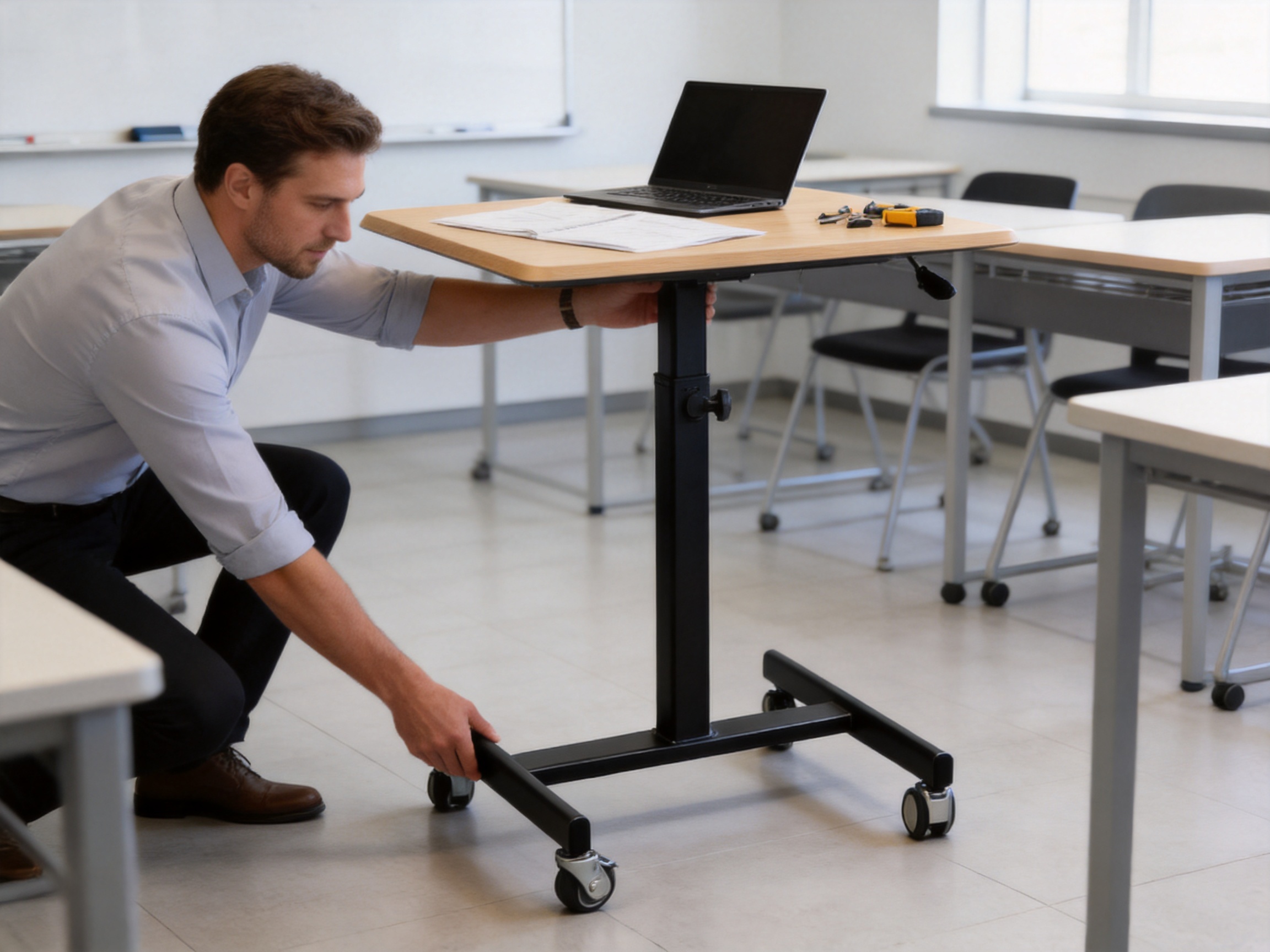
For shared environments, this simplicity improves adoption. A user can approach the desk, adjust it to a comfortable height, lock the casters if needed, and begin working. There is no need to understand memory presets, control panels, cables, or software. This makes the product accessible to a wide range of users, including employees, students, instructors, visitors, and home users.
Simple operation also reduces maintenance concerns. Electric desks may require troubleshooting of motors, control boxes, power adapters, or switches. Pneumatic desks avoid many of these issues. While any mechanical product should be used properly and inspected periodically, the TH03’s mechanical design supports reliable daily use with fewer electronic failure points.
The user experience is also shaped by the desk’s proportions. The tabletop is large enough for essential work tools but small enough to feel agile. The caster system makes movement intuitive. The height range supports posture variation. The finish options make the product visually acceptable in different spaces. Together, these features create a practical and comfortable daily-use product.
Why Compact Adjustable Furniture Matters
The future of work is not limited to large dedicated workstations. Many organizations now use hybrid offices, flexible seating, shared rooms, and multipurpose zones. Home users also need furniture that can adapt to limited space. Compact adjustable furniture responds to these trends by providing function without requiring a large footprint.
The TH03 demonstrates how a small desk can deliver meaningful ergonomic value. It does not try to replace every desk in every situation. Instead, it provides a flexible work surface where mobility, simplicity, and height adjustment are priorities. This makes it especially valuable as a supplementary ergonomic tool.
In an office, it can be used by different departments throughout the day. In a home, it can move between rooms. In a training room, it can support presentations and activities. In a laboratory, it can provide a temporary documentation surface. In a studio, it can serve as a movable creative station. This versatility increases the product’s practical return on investment.
Compact adjustable furniture also supports healthier behavior. When height adjustment is available nearby, users are more likely to alternate between sitting and standing. When a desk is mobile, it can be positioned closer to natural light, collaborative areas, or equipment. When it is easy to use, users can focus on their work rather than the furniture.
Customization and Market Adaptability
The TH03 is designed with adaptability in mind. The available panel colors allow the product to suit different market preferences. For distributors and project buyers, this variety can help address customer needs across multiple sectors. For end users, it provides the freedom to choose a desk that fits the visual character of the workspace.
Customization is also supported by the company’s broader manufacturing capabilities. A manufacturer engaged in adjustable desks, electric linear actuators, and gas spring solutions can better understand the requirements of different projects. Customers may need specific finishes, packaging, configuration support, or product recommendations based on use cases. Strong manufacturing and service capabilities help meet these needs more effectively.
For global buyers, reliable supply and consistent quality are essential. The TH03’s design uses practical materials and proven production methods, supporting stable manufacturing. The company’s location in Suzhou and its access to the Yangtze River Delta industrial ecosystem further support supply chain efficiency, production coordination, and export-oriented service.
Maintenance and Long-Term Use
The TH03 is designed for practical long-term use, but proper care can help preserve its appearance and function. Users should keep the tabletop clean with suitable non-abrasive methods. Heavy impacts, excessive loads, and improper use should be avoided. The wheels should be checked periodically to ensure smooth rolling and reliable locking. The lifting mechanism should be operated according to normal use expectations.
Because the desk uses a gas spring lifting principle, it does not require electric power for height adjustment. This reduces cable-related wear and eliminates some common electrical maintenance concerns. The powder-coated frame can be wiped clean and should be protected from harsh chemicals or severe surface damage. The PVC vacuum-formed tabletop should be kept away from excessive heat or sharp cutting tools unless protective mats are used.
In commercial environments, regular inspection programs can extend furniture service life. Facility teams can check caster locks, frame fasteners, surface condition, and lifting performance. These basic steps help ensure the desk remains safe, stable, and pleasant to use.
Purchasing Considerations
When evaluating a pneumatic height-adjustable desk such as the TH03, buyers should consider the intended environment, user needs, desktop size requirements, mobility expectations, and interior style. The desk is especially suitable for users who want a compact, mobile, power-free height-adjustable solution. It is not intended to replace large multi-monitor executive workstations, but it is highly effective for laptop work, writing, presentations, temporary work zones, and shared ergonomic access.
Buyers should also consider the value of manufacturing reliability. A height-adjustable desk is a moving product, and moving products require careful engineering. The gas spring, frame, tabletop, and wheels must all perform together. Choosing a manufacturer with experience in adjustable desk systems and related motion technologies can reduce quality risks and improve long-term satisfaction.
The TH03 offers a strong balance of function and simplicity. Its height range supports ergonomic variation. Its gas spring system avoids electrical dependence. Its iron frame and powder coating support durability. Its casters support mobility. Its tabletop finish options support design flexibility. These combined advantages make it a practical choice for many professional and personal work environments.
Frequently Asked Questions
What type of desk is the TH03?
The TH03 is a center-mounted pneumatic height-adjustable desk. It uses a gas spring lifting mechanism to support smooth height adjustment without requiring electric power.
What is the height adjustment range?
The desk adjusts from 745mm to 1060mm. This range supports seated work, elevated seated work, and standing work for many users and tasks.
Does the desk need to be plugged into a power outlet?
No. The TH03 uses gas spring lifting rather than an electric motor. This allows it to be adjusted without power cables, making it convenient for mobile and flexible work environments.
What is the tabletop made of?
The tabletop is made from 15mm MDF with a PVC vacuum-formed surface. This provides a stable core, a practical finish, and multiple color options.
What colors are available?
The tabletop is available in White, Maple, Walnut, and Black. These choices allow the desk to match different office, home, educational, and professional interiors.
Is the desk easy to move?
Yes. The TH03 includes four cast wheels. Two wheels have locking mechanisms, allowing the desk to be moved easily and then secured in place during use.
How does it compare with an electric standing desk?
An electric standing desk is often suitable for large permanent workstations and heavy equipment setups. The TH03 is more compact, mobile, power-free, and mechanically simple, making it better suited for flexible spaces, shared environments, and temporary work zones.
How does it compare with a fixed desk?
A fixed desk provides only one working height. The TH03 allows users to adjust the surface height, supporting posture changes and improved ergonomic flexibility.
Where can the desk be used?
It can be used in home offices, corporate offices, training rooms, classrooms, laboratories, studios, meeting rooms, and other spaces that require a compact adjustable work surface.
Why is the center-mounted design important?
The center-mounted structure helps keep the desk compact and balanced. It supports stable height adjustment and makes the product suitable for mobile use with a relatively small footprint.
Conclusion
The TH03 Center-Mounted Pneumatic Height-Adjustable Desk is a practical response to the changing needs of modern workspaces. It combines ergonomic height adjustment, gas spring lifting, mobile casters, lockable stability, durable iron construction, powder-coated surface protection, and a compact MDF tabletop with PVC vacuum forming. Its height range of 745mm to 1060mm supports a variety of seated and standing tasks, while its 650mm by 480mm tabletop provides an efficient surface for laptops, documents, tools, and daily work essentials.
Its advantages over competing products are clear. Compared with fixed desks, it provides ergonomic flexibility. Compared with large electric standing desks, it offers mobility and independence from power. Compared with manual adjustable tables, it provides smoother pneumatic operation. Compared with ordinary rolling carts, it delivers a more professional workstation experience. These strengths make it suitable for offices, homes, training rooms, laboratories, creative studios, and shared work environments.
Behind the product is a manufacturing foundation built on experience in adjustable height desks, gas spring systems, and motion-related furniture solutions. With strong regional industrial support, practical engineering capability, material control, powder coating processes, PVC vacuum forming, and quality-focused production, the company is positioned to provide reliable ergonomic furniture for global users.
For buyers seeking a compact, mobile, durable, and easy-to-use height-adjustable desk, the TH03 offers a balanced and efficient solution. It reflects a simple but powerful idea: a workspace should adapt to the user, not force the user to adapt to the furniture.
References
Bridger, R. S. Introduction to Human Factors and Ergonomics. CRC Press.
Kroemer, K. H. E., and Grandjean, E. Fitting the Task to the Human: A Textbook of Occupational Ergonomics. Taylor & Francis.
Pheasant, S., and Haslegrave, C. M. Bodyspace: Anthropometry, Ergonomics and the Design of Work. CRC Press.
Helander, M. A Guide to Human Factors and Ergonomics. CRC Press.
Dul, J., and Weerdmeester, B. Ergonomics for Beginners: A Quick Reference Guide. CRC Press.
Manufacturing Engineering and Technology. Kalpakjian, S., and Schmid, S. Pearson.
Powder Coating: The Complete Finisher’s Handbook. Powder Coating Institute.
Product: TH03 Center-Mounted Pneumatic Height-Adjustable Desk


- Contact Info
-
-
 Phone+86-15950656125
 -
 Email
Email -
 AddressRoom 1007-1, South Building, Suyue Plaza, Suzhou Industrial Park, Suzhou City, Jiangsu Province, China
-
- Products
- Follow Us
- Need help? Please contact us
Copyright ©
SuZhou Skyhone Intelligent Technology Co., Ltd.
All Rights Reserved.
Privacy
Custom Ergonomic Adjustable Office Tables Manufacturers

