

 English
 русский
 Español
 عربى

Content
- 1 Introduction
- 2 Product Overview
- 3 How the Pneumatic Height-Adjustment System Works
- 4 Compact Desktop Design for Flexible Work
- 5 Tripod Base Stability and Mobility
- 6 Ergonomic Benefits of Adjustable Work Height
- 7 Manufacturing Strengths and Product Development Capabilities
- 8 Why the SK10 Can Be a Strong Alternative for Commercial Buyers
- 9 Applications Across Multiple Industries
- 10 Installation, Operation, and Routine Care
- 11 Customization and Project Procurement
- 12 Frequently Asked Questions
- 12.1 What is the height range of the SK10 desk?
- 12.2 Does the SK10 require electricity?
- 12.3 What are the tabletop dimensions?
- 12.4 What material is used for the tabletop?
- 12.5 What materials are used for the frame?
- 12.6 How does the caster system work?
- 12.7 Is the desk suitable for a small office?
- 12.8 Can the desk be used for standing work?
- 12.9 What types of work can the desk support?
- 12.10 What makes the SK10 different from an electric standing desk?
- 12.11 What maintenance does the desk require?
- 12.12 Can customers request color or project support?
- 13 Conclusion
- 14 References
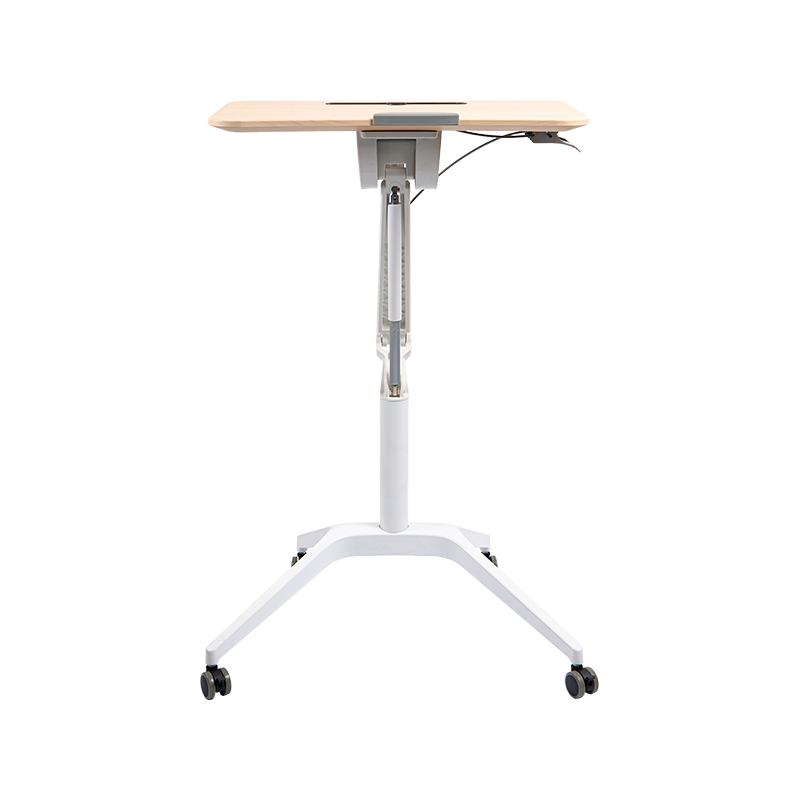
- 15 Product: SK10 (Three-Claw Leg) Pneumatic Height-Adjustable Desk
SK10 Three-Claw Leg Pneumatic Height-Adjustable Desk: A Compact, Mobile, and Flexible Workstation Solution
2026-10-17
Introduction
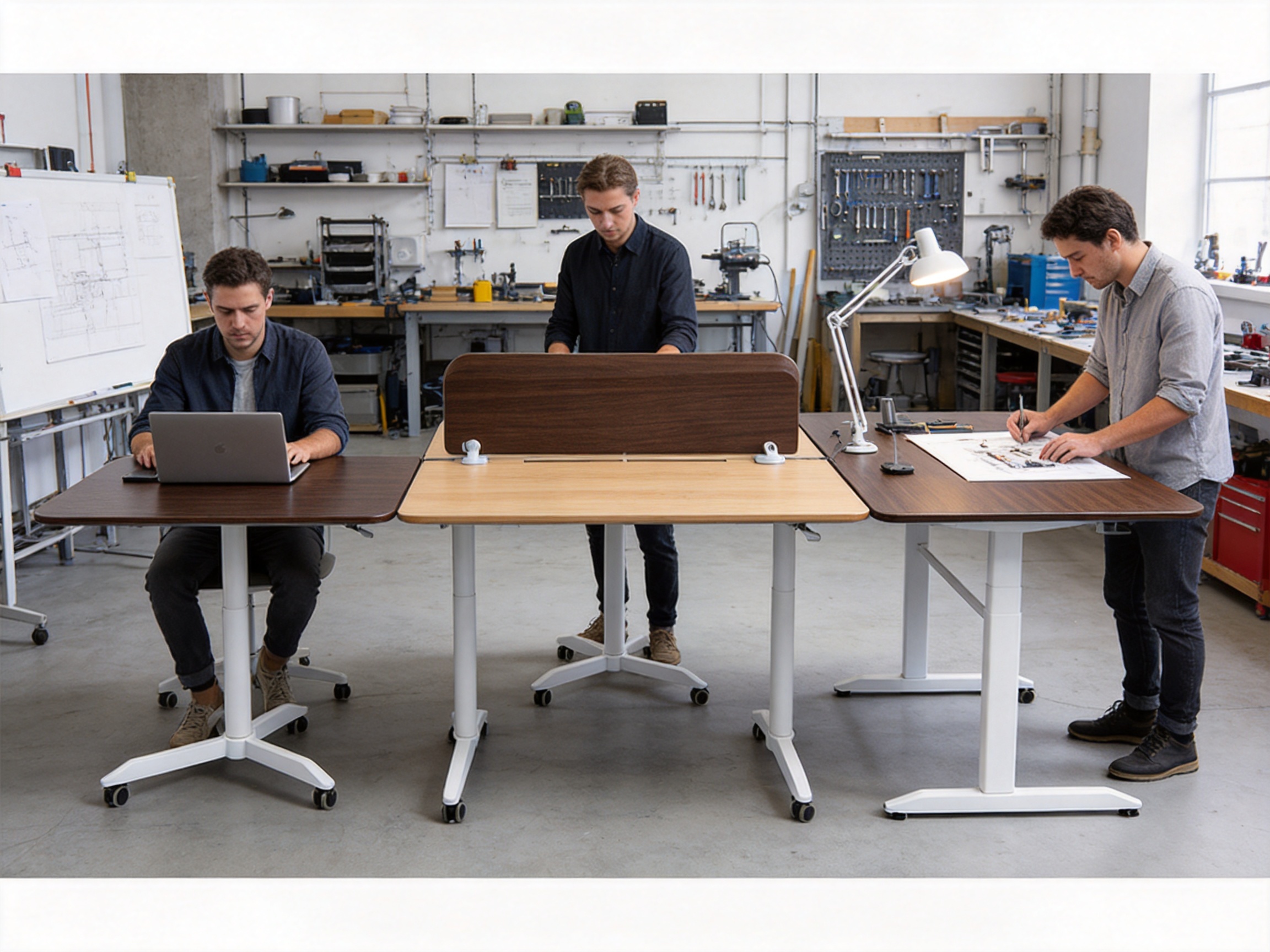
Modern workspaces are becoming more flexible, compact, and user-focused. Offices, laboratories, studios, workshops, educational facilities, and home work areas increasingly need furniture that can adapt to different users and tasks. A fixed-height desk may be suitable for one activity, but it can become uncomfortable or inefficient when users need to alternate between sitting and standing, reposition equipment, or work in rooms with limited space.
The SK10 Three-Claw Leg Pneumatic Height-Adjustable Desk is designed to address these needs through a compact tabletop, a stable tripod-style base, and a gas spring lifting system. Its height can be adjusted manually from 720 mm to 1100 mm, allowing users to work in a seated or standing position without electrical power. The combination of aluminum and iron provides a practical balance between structural strength and manageable weight, while the caster arrangement supports both mobility and stability.
Unlike many electrically powered standing desks, the SK10 does not require a motor, control panel, power cable, or nearby electrical outlet. This makes it useful in environments where mobility, simple operation, and low maintenance are more important than a large working surface or programmable electronic functions. Its compact dimensions also make it suitable for space-constrained areas where a conventional full-size height-adjustable desk may be impractical.
Manufactured by SuZhou Skyhone Intelligent Technology Co., Ltd., the desk reflects the company’s focus on standing desks, ergonomic office furniture, research and development, production, sales, and service. Based in Suzhou, Jiangsu Province, the company benefits from the manufacturing and supply-chain resources of the Yangtze River Delta furniture industry. This regional foundation supports product development, material sourcing, production coordination, and the delivery of adaptable office solutions to global customers.
Product Overview
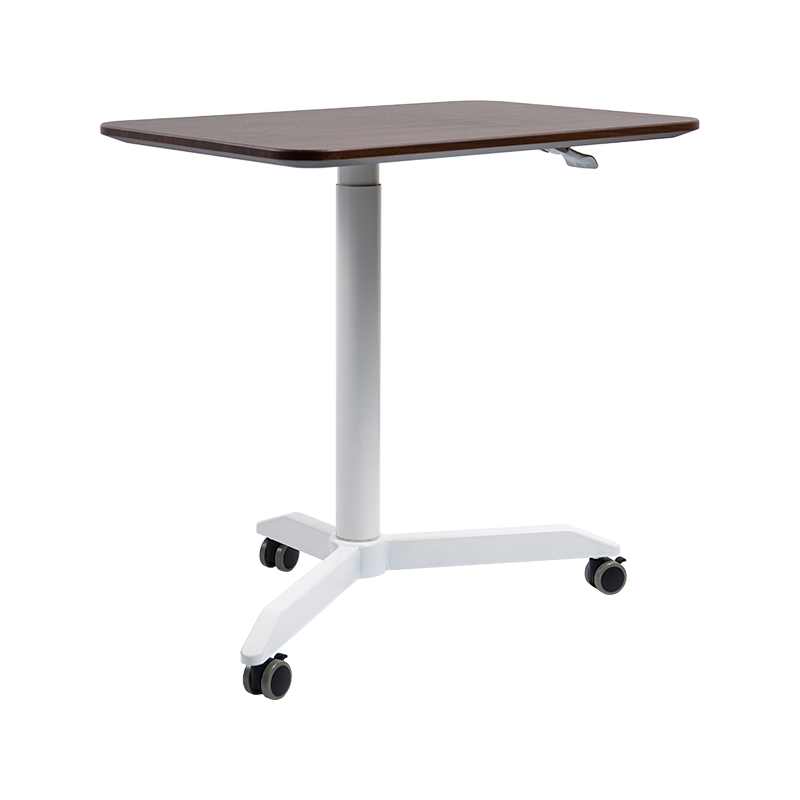
The SK10 is a pneumatic height-adjustable table with a three-claw, or tripod-style, base. It is intended for users who need a compact work surface that can be repositioned and adjusted manually. The table’s lifting range extends from 720 mm to 1100 mm, providing a useful vertical adjustment range for sitting, standing, drafting, equipment handling, and other light-to-medium-duty applications.
The desktop measures 715 mm by 495 mm and has a thickness of 25 mm. This footprint provides enough room for a laptop, documents, small tools, laboratory materials, drafting equipment, or other everyday work items while avoiding the bulk of a large office desk. The desktop is manufactured from 25 mm MDF with a PVC vacuum-formed surface. Available panel colors include Walnut, White, and Maple, giving customers options for matching different interior styles.
The supporting frame uses aluminum and iron components. Aluminum contributes to a clean appearance and helps control overall weight, while iron supplies rigidity in structural areas that require additional strength. The frame is finished by powder coating and is available in White or Silver. Powder coating creates a durable surface layer that helps protect the frame against normal wear and contributes to a consistent visual finish.
The mobile base includes three casters: two casters with locks and one caster without a lock. This configuration is designed to combine movement with placement control. Users can release the desk, move it to another position, and then engage the locking casters to reduce unwanted movement during work.
| Specification | Product Detail |
|---|---|
| Product type | Pneumatic height-adjustable desk |
| Model | SK10 Three-Claw Leg Pneumatic Height-Adjustable Desk |
| Height range | 720 mm to 1100 mm |
| Tabletop dimensions | 715 mm × 495 mm |
| Tabletop thickness | 25 mm |
| Tabletop construction | 25 mm MDF with PVC vacuum forming |
| Frame material | Aluminum and iron |
| Frame colors | White and Silver |
| Surface treatment | Powder coating |
| Panel colors | Walnut, White, and Maple |
| Caster configuration | Two locking casters and one non-locking caster |
| Lifting principle | Gas spring lifting |
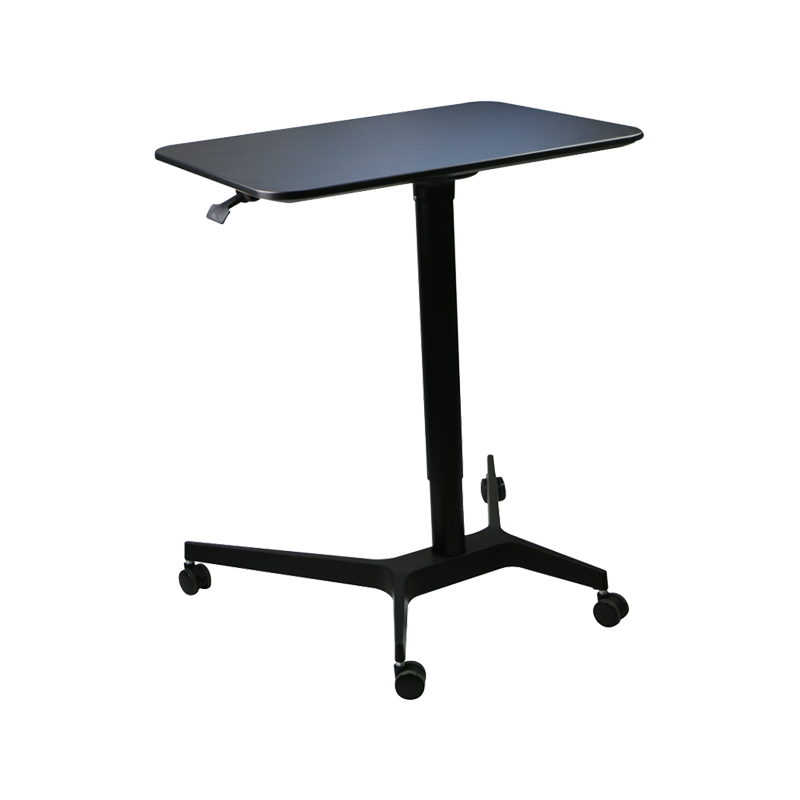
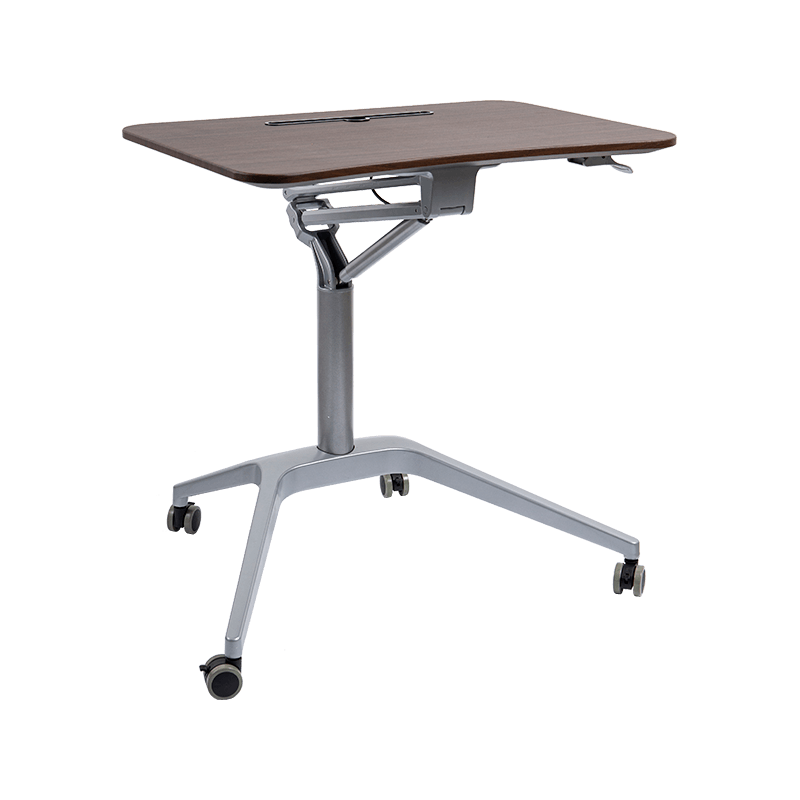
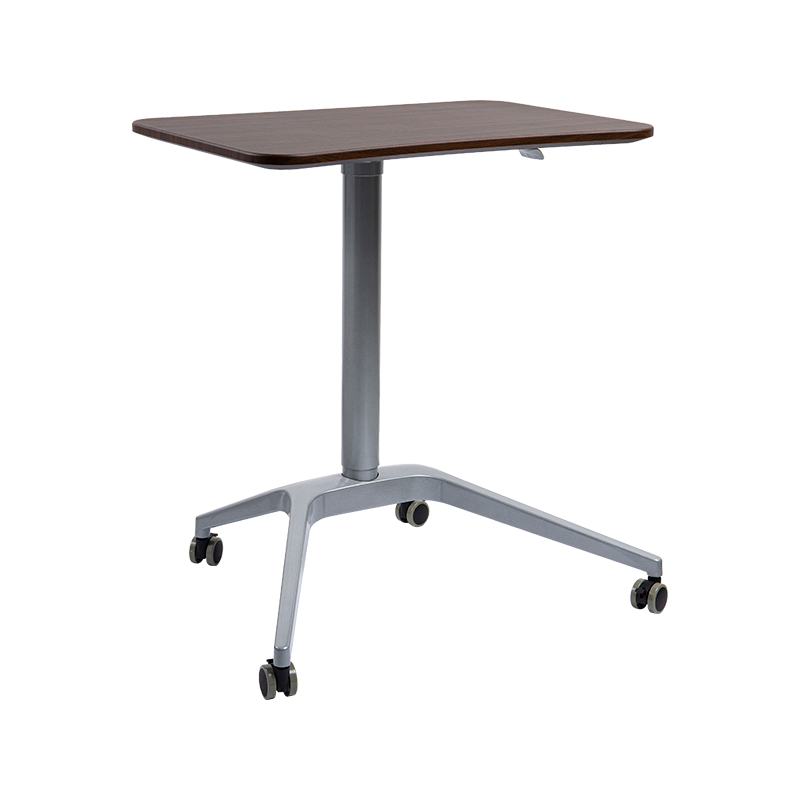
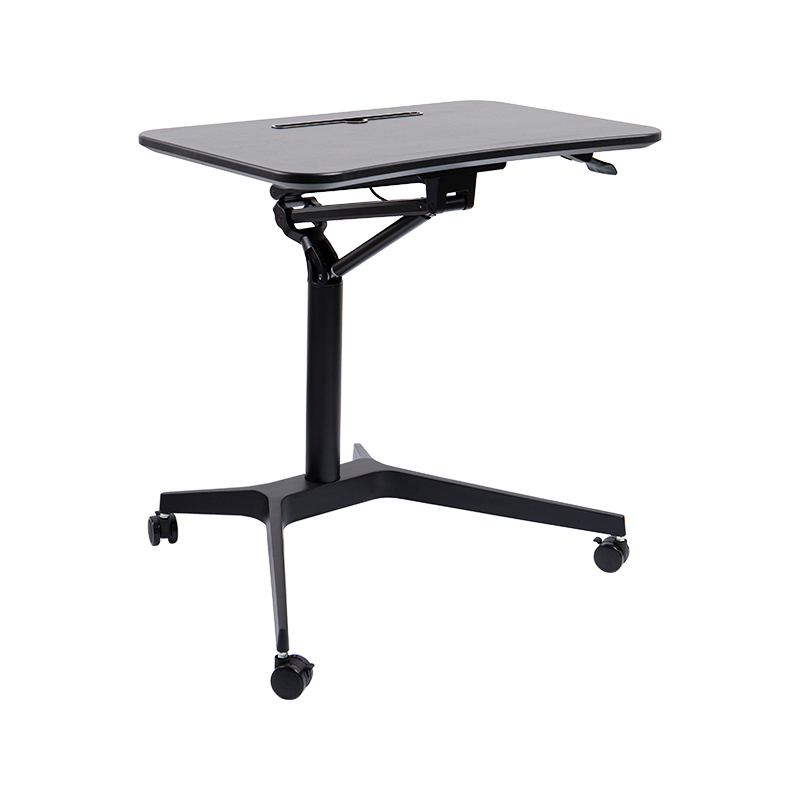
SK10 (Three-Claw Leg) Pneumatic Height-Adjustable Desk
How the Pneumatic Height-Adjustment System Works
The defining feature of the SK10 is its pneumatic height-adjustment mechanism. Instead of relying on an electric motor and lead screw, the desk uses a gas spring to assist vertical movement. A gas spring contains compressed gas within a sealed cylinder. When the adjustment control is activated, the spring assists the user in raising or lowering the work surface.
This operating principle offers a direct and practical alternative to motorized adjustment. The user does not need to connect the desk to a power supply, charge a battery, or operate a digital control panel. The height can be changed manually according to the immediate task. This is especially valuable in workshops, laboratories, training rooms, clinics, studios, or temporary work areas where electrical access may be limited.
The range from 720 mm to 1100 mm covers common seated and standing work positions. At the lower end, the desk can function as a compact seated workstation or support surface. At the upper end, it can provide a standing-height platform for short-duration tasks, demonstrations, drafting, inspection, packaging, and other activities that benefit from a raised work surface.
Gas spring systems also have a simple user experience. The mechanism is intended to make height changes smooth and manageable rather than abrupt. Because the adjustment is manual, users can set the desk at a height that suits their body proportions, chair height, task requirements, or equipment arrangement.
Advantages Over Conventional Fixed-Height Tables
A conventional fixed-height table offers limited flexibility. If its height is not suitable for a particular user, the user must adapt their posture, add accessories, or replace the table. In shared environments, fixed-height furniture can create additional problems because different people may have different ergonomic requirements.
The SK10 addresses this limitation through adjustable positioning. A teacher can raise the desk for a demonstration, a technician can lower it for detail work, and an office user can alternate between seated and standing tasks. The same product can therefore serve multiple users and activities without requiring separate furniture for each purpose.
The adjustable structure may also help organizations use their floor area more efficiently. Rather than installing several specialized tables, a facility can deploy a compact table that supports a broader range of tasks. This is particularly useful in small studios, shared offices, laboratories, and mobile work zones.
Advantages Over Motorized Standing Desks
Electric standing desks are effective for larger work surfaces and frequent automated adjustment, but they also require motors, wiring, control components, power access, and additional electronic parts. These features can increase product complexity and may not be necessary for every application.
The SK10 provides a simpler alternative for users who prioritize portability and manual control. Its pneumatic operation eliminates the need for an electric lifting column and reduces dependence on power infrastructure. It can be placed in areas where cables would create inconvenience or safety concerns, including temporary event spaces, workshops, training areas, and rooms with limited outlets.
A non-electric desk can also be easier to integrate into changing layouts. It can be moved without unplugging a power cord, and it does not require a dedicated cable-management arrangement. This is an important advantage for facilities that frequently reorganize their furniture or use the same space for different functions.
The SK10 is not intended to replace every type of motorized desk. A large executive workstation with memory presets, dual motors, and extensive electronic accessories may require a different solution. However, for compact, manually adjustable applications, the pneumatic design can deliver the essential benefits of height variation while avoiding unnecessary complexity.
Compact Desktop Design for Flexible Work
The 715 mm by 495 mm tabletop is one of the product’s most practical characteristics. It is large enough for focused individual work but compact enough to fit into smaller rooms and narrow circulation areas. This makes the desk suitable for locations where every square meter must be used carefully.
The tabletop can support common work items such as a laptop, keyboard, notebook, documents, light tools, inspection components, and small accessories. Its dimensions also make it suitable as a side workstation, temporary service table, presentation surface, or mobile support station.
A compact desktop can improve operational flexibility. When several workstations are placed in one room, smaller tables can be rearranged more easily than large fixed desks. Users can create individual work zones, collaborative arrangements, demonstration spaces, or temporary equipment stations according to the day’s requirements.
The 25 mm thickness provides a substantial visual and structural profile. The MDF core offers a consistent panel substrate, while the PVC vacuum-formed surface provides a finished exterior. The surface design enables the tabletop to be offered in Walnut, White, and Maple finishes, allowing the desk to fit both professional and residential interiors.
MDF and PVC Vacuum-Formed Surface
Medium-density fiberboard is widely used in furniture production because it provides a relatively uniform panel structure and a smooth surface suitable for decorative finishing. For a compact workstation, MDF can provide an economical and visually consistent foundation for the tabletop.
PVC vacuum forming allows the surface material to follow the panel profile and create a continuous finished appearance. The process can reduce the visual interruption associated with separate surface pieces and supports repeatable production across multiple units. The resulting panel can be coordinated with different environments through the Walnut, White, and Maple color choices.
For manufacturers and purchasing teams, a standardized tabletop construction can simplify product planning. The same basic desk platform can be supplied with different decorative finishes, helping customers select a suitable appearance without changing the fundamental structure of the table.
Tripod Base Stability and Mobility
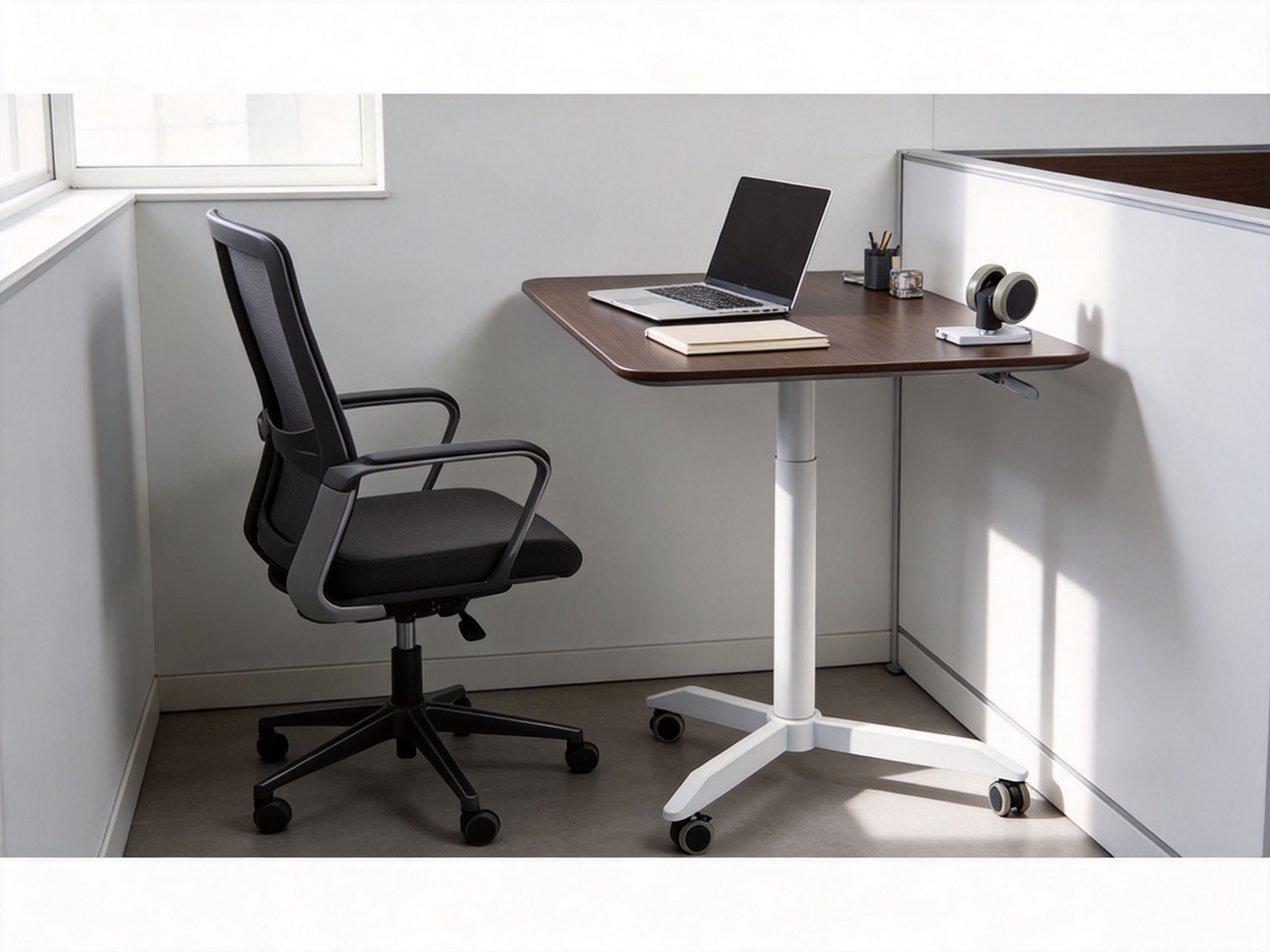
The three-claw base gives the SK10 a distinctive structure. A tripod configuration can provide a stable support footprint while keeping the lower section visually open. This open arrangement can make it easier for users to approach the desk from different directions and can help the table fit into compact layouts.
The base uses a combination of aluminum and iron. These materials can be assigned according to the requirements of different components. Iron is suitable for areas where rigidity and load-bearing support are priorities, while aluminum can contribute to a lighter and cleaner structural appearance. The combination is a practical way to balance performance, appearance, and overall product handling.
Mobility is supported by three casters. Two locking casters allow the user to secure the table after positioning, while the non-locking caster assists movement as part of the rolling base. This arrangement is intended for environments where the desk must be relocated but should remain stable during use.
Mobility in Different Environments
In an office, the desk can be moved between individual work areas, meeting spaces, and shared project zones. In a studio, it can serve as a flexible platform for creative work or equipment support. In a laboratory, it can be repositioned according to workflow requirements, provided the intended load and safety conditions are observed.
In workshops, mobility can help users bring the table closer to a tool, material, or inspection point. In educational settings, the desk can be used by instructors for demonstrations or by students working on practical assignments. In healthcare-related or service environments, a compact mobile workstation can support temporary documentation or equipment placement.
The locking casters are important because mobility alone is not sufficient. A table that rolls easily but cannot be secured may be unsuitable for precision work. The two locking casters help reduce unintended movement when the user is writing, operating equipment, inspecting components, or performing other tasks that require a steady surface.
Ergonomic Benefits of Adjustable Work Height
Ergonomics is not limited to large office desks. Any workstation that is used for extended periods should be considered in relation to user posture, viewing angle, arm position, and task requirements. A fixed table can force users to bend forward, raise their shoulders, or work with their arms at an uncomfortable angle.
The SK10 allows users to adjust the work surface to a more suitable level. The correct height depends on the user, chair, task, equipment, and preferred working position. By offering a range from 720 mm to 1100 mm, the desk gives users more control over their work posture than a fixed-height table.
Alternating between sitting and standing can also provide variation during the working day. The desk does not prescribe one fixed posture; instead, it supports changes according to comfort and task requirements. Users may sit for detailed computer work, raise the desk for reading or review, and select an intermediate height for drafting or light assembly.
In shared environments, height adjustment can reduce the need for each user to compromise. A table that can be adapted by different people is more versatile than one designed around a single average height. This flexibility can be especially useful in training rooms, classrooms, laboratories, and multi-user offices.
Supporting Different Work Activities
The desk can support general office work, drafting, crafting, technical inspection, light assembly, paperwork, device operation, and demonstration tasks. These activities often require different surface heights. For example, detailed drawing may benefit from a lower or intermediate position, while standing review or presentation may benefit from a higher position.
Its compact format makes it appropriate for focused tasks rather than extensive document spreading or large equipment layouts. Users should select the desk according to the intended load, equipment size, and operating conditions. Within its suitable application range, the SK10 provides a convenient way to adjust the working position without changing the entire workstation.
Manufacturing Strengths and Product Development Capabilities
SuZhou Skyhone Intelligent Technology Co., Ltd. is a professional manufacturing enterprise focused on the research and development, production, sales, and service of standing desks. The company’s product direction is centered on healthy, efficient, and intelligent office space solutions.
The company is located in Suzhou, a major industrial and manufacturing area within the Yangtze River Delta. This region has a developed furniture industry and a broad network of supporting suppliers, processing facilities, logistics services, and technical resources. Access to this industrial ecosystem can support coordinated product development and efficient production organization.
The company’s manufacturing strengths are reflected in the SK10’s integrated product design. The desk combines a pneumatic lifting system, mixed-material frame, powder-coated finish, molded tabletop surface, and mobile caster base. Bringing these elements together requires coordination across mechanical design, surface finishing, panel processing, component assembly, and inspection.
Research and Development Orientation
A height-adjustable desk is more than a tabletop with legs. Its performance depends on how the lifting system, frame, base, casters, tabletop, and adjustment interface work together. Product research and development must consider stability, usability, appearance, material selection, and the needs of different application environments.
The SK10 demonstrates a product-development approach that emphasizes practical adaptability. Instead of adding unnecessary electronic functions, the design focuses on pneumatic adjustment, compact dimensions, easy relocation, and straightforward operation. This makes the product relevant to customers looking for a targeted solution rather than a complex workstation platform.
Product development also involves balancing competing requirements. A frame must be strong while remaining manageable. A tabletop must be durable and attractive while remaining cost-effective. A base must roll smoothly while also providing stability. The use of aluminum, iron, MDF, PVC surface material, powder coating, and gas spring technology reflects an effort to allocate materials according to their functional roles.
Material Processing and Surface Finishing
The frame’s powder-coated surface is an important part of the manufacturing process. Powder coating applies a dry coating material to the prepared metal surface, after which the coating is cured to form a continuous finish. This process can provide a consistent appearance and help protect the metal from routine abrasion and environmental exposure.
White and Silver frame options give customers a choice between a bright neutral appearance and a more metallic professional look. These finishes can be used in offices, laboratories, studios, education environments, and other settings where furniture appearance contributes to the overall space.
The tabletop process combines MDF panel production with PVC vacuum forming. This requires accurate panel preparation and controlled surface application to achieve a consistent appearance. The availability of Walnut, White, and Maple finishes supports broader project coordination, especially where furniture must match existing cabinetry, flooring, or interior design themes.
Assembly and Quality Considerations
Integrated furniture products require attention to assembly consistency. The gas spring must be installed correctly, the frame must be aligned, the tabletop must be securely attached, and the casters must be fitted in the intended positions. A coordinated manufacturing process helps ensure that these elements function together as a complete workstation.
For purchasing organizations, consistent assembly is important because it reduces variation between units. It can also simplify installation, inspection, maintenance, and replacement planning. A standardized model with defined dimensions and component specifications is easier to include in office furniture schedules and facility procurement programs.
Although specific testing data is not provided, responsible product evaluation for this type of desk would normally consider height adjustment operation, frame stability, caster performance, surface appearance, component fit, and packaging protection. Customers can confirm application-specific load, testing, and customization requirements with the manufacturer before placing an order.
Why the SK10 Can Be a Strong Alternative for Commercial Buyers
Commercial buyers often need to balance price, usability, durability, maintenance, appearance, and space efficiency. A product may be technically advanced but unsuitable if it is too large, too complex, or difficult to deploy. The SK10 offers a focused combination of features that can be valuable in practical purchasing decisions.
First, the pneumatic lifting system removes the need for electrical infrastructure. This can simplify placement and reduce concerns associated with power cords, motorized controls, and electronic components. For facilities with frequently changing layouts, this flexibility can be more important than programmable height memory.
Second, the compact footprint makes it easier to use the desk in rooms with limited space. Buyers can place the table beside a primary workstation, in a training area, beside laboratory equipment, or in a small office without allocating the floor area required by a full-size executive desk.
Third, the combination of locking and non-locking casters supports both mobility and positioning. This is useful where a workstation must be moved regularly but should not drift during use.
Fourth, the range of desktop and frame colors supports different interior requirements. Walnut, White, and Maple desktop options can create different visual effects, while White and Silver frames provide neutral choices for professional environments.
Finally, the product is based on a relatively straightforward operating principle. A manual gas spring system can be easier for users to understand and may require less technical support than a motorized desk with control electronics. This can make the product attractive for organizations seeking practical, low-complexity furniture.
| Evaluation Factor | SK10 Advantage | Potential Application Value |
|---|---|---|
| Power requirement | Manual gas spring operation without electrical power | Flexible placement and fewer cable-management concerns |
| Height adjustment | 720 mm to 1100 mm | Supports seated, standing, and intermediate work positions |
| Space efficiency | 715 mm × 495 mm desktop | Suitable for compact offices and shared work areas |
| Mobility | Three-caster base with two locking casters | Easy relocation with improved placement control |
| Materials | Aluminum and iron frame with MDF/PVC tabletop | Balances structural support, appearance, and practicality |
| Finish selection | White or Silver frame; Walnut, White, or Maple tabletop | Supports different interior design requirements |
| Maintenance approach | Simple pneumatic mechanism and limited electronics | Potentially straightforward routine care |
Applications Across Multiple Industries
Office and Administrative Work
In offices, the SK10 can function as a compact sit-stand workstation, side table, meeting support table, or shared hot-desking surface. It can be positioned beside a larger desk for occasional standing work or used as an independent station in a small office.
Because it does not need to remain connected to a power outlet, the desk can be moved between departments or reconfigured for temporary projects. The compact top can hold a laptop and basic paperwork without overwhelming the room.
Workshops and Technical Areas
Workshops often require work surfaces that can be moved closer to tools, components, or inspection points. The castered base allows the desk to serve as a mobile support platform, while the pneumatic height adjustment enables users to select a more suitable level for assembly, testing, or documentation.
The desk can also support short-term technical projects where a permanent bench is not necessary. Its compact design helps preserve access routes and leaves more room for larger equipment.
Studios and Creative Spaces
Artists, designers, model makers, and craft users may need different surface heights for sketching, cutting, reviewing, or assembling materials. The SK10 can provide a flexible auxiliary surface that is easier to reposition than a heavy fixed table.
The Walnut, White, and Maple tabletop choices allow the desk to complement different studio styles. The neutral White and Silver frame options can also fit modern creative environments without visually dominating the room.
Laboratories and Educational Facilities
Laboratories, classrooms, and training facilities often serve multiple users and activities. A mobile height-adjustable table can support demonstrations, sample handling, documentation, device placement, or temporary teaching arrangements.
The ability to position the table at different heights may benefit users of different statures. The compact dimensions can also help institutions make better use of crowded teaching or testing rooms.
Home Offices and Space-Constrained Rooms
In a home office, apartment, or multipurpose room, a large electric standing desk may occupy more space than necessary. The SK10 can provide a more focused work surface while still allowing the user to change between sitting and standing positions.
Its mobility can be useful when the same room serves as an office, living area, guest room, or hobby space. The table can be relocated when the work session ends, subject to appropriate handling and floor conditions.
Installation, Operation, and Routine Care
Before use, the desk should be assembled according to the manufacturer’s instructions. The frame, tabletop, gas spring components, adjustment control, and casters should be checked for correct installation. Fasteners should be tightened evenly, and the table should be placed on a suitable floor surface.
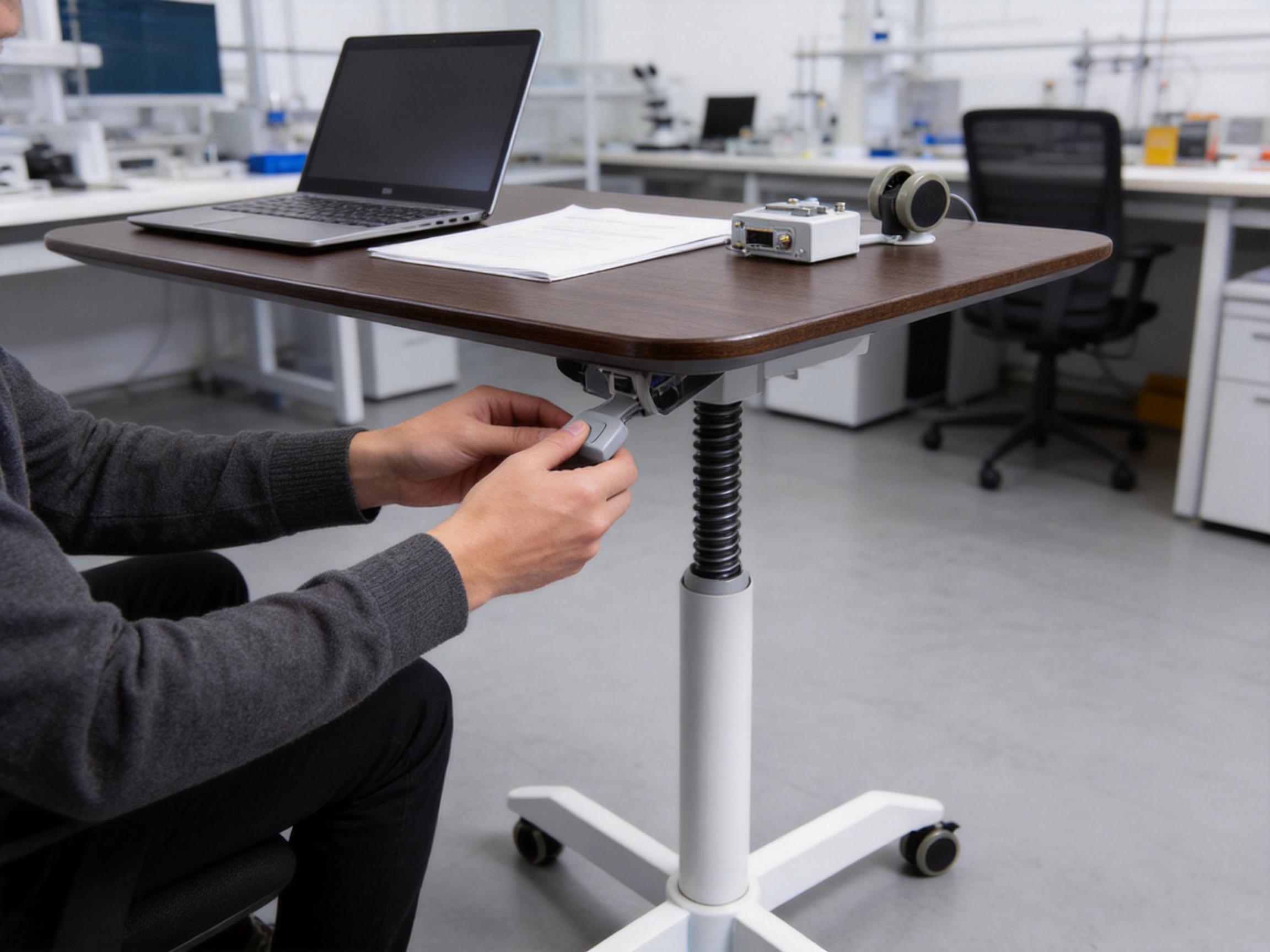
To adjust the height, the user should operate the pneumatic control while applying a controlled upward or downward force to the work surface. The desk should be adjusted gradually rather than forced. Users should keep fingers clear of moving components and should avoid placing unstable objects on the tabletop during adjustment.
After positioning the desk, the locking casters should be engaged when a stationary work surface is required. The table should not be pushed aggressively, dragged sideways, or used on unsuitable surfaces that could affect caster performance or stability.
Routine care generally includes keeping the tabletop clean, checking the caster condition, inspecting visible fasteners, and observing the gas spring mechanism for unusual resistance or movement. Abrasive cleaners should be avoided on finished surfaces. Any damaged structural component or malfunctioning adjustment part should be evaluated by qualified personnel.
The desk should be used within its intended application and load range. Heavy equipment, concentrated loads, or activities involving strong impact may require a different table specification. Commercial customers should discuss their planned use with the manufacturer when special operating conditions apply.
Customization and Project Procurement
Different customers may have different requirements for color, quantity, packaging, branding, documentation, or application. The standard SK10 configuration already offers multiple tabletop and frame colors, which can support many office and institutional projects.
For larger orders, purchasers may also need coordinated delivery schedules, installation instructions, product labeling, or project-specific packaging. A manufacturer with research, production, sales, and service capabilities can help customers discuss these requirements in advance.
When evaluating the product for a project, buyers should consider the number of users, expected daily operating frequency, floor conditions, required mobility, typical tabletop loads, preferred colors, and the relationship between the desk and other furniture. These factors help determine whether the compact pneumatic format is the best match for the application.
SuZhou Skyhone Intelligent Technology Co., Ltd. can be contacted for product consultation, order discussions, and potential customization requirements. The company’s location in Suzhou provides access to the regional manufacturing network and supports its role as a supplier of adjustable office furniture for domestic and international customers.
Frequently Asked Questions
What is the height range of the SK10 desk?
The desk adjusts from 720 mm to 1100 mm. This range supports seated work, standing work, and intermediate positions for activities such as drafting, technical inspection, crafting, and general office use.
Does the SK10 require electricity?
No. The desk uses a gas spring lifting mechanism and is manually adjusted. It does not require a motor, power cord, electrical outlet, or electronic control panel.
What are the tabletop dimensions?
The tabletop measures 715 mm by 495 mm and is 25 mm thick. It is designed as a compact work surface for focused tasks and space-efficient arrangements.
What material is used for the tabletop?
The tabletop is made from 25 mm MDF with a PVC vacuum-formed surface. Available panel colors are Walnut, White, and Maple.
What materials are used for the frame?
The frame combines aluminum and iron. The structure is finished with powder coating and is available in White or Silver.
How does the caster system work?
The base includes two locking casters and one non-locking caster. The table can be moved when the casters are released, and the locking casters can be engaged to help secure the desk in position.
Is the desk suitable for a small office?
Yes. Its 715 mm by 495 mm desktop is compact and can fit into smaller offices, home work areas, studios, laboratories, and shared workspaces. Buyers should confirm the intended equipment and load requirements before selecting it for a specific project.
Can the desk be used for standing work?
Yes. The upper adjustment level reaches 1100 mm, allowing the desk to support standing tasks for many users. The appropriate height depends on the user’s stature, activity, and equipment.
What types of work can the desk support?
The SK10 is suitable for general office work, drafting, crafting, technical tasks, laboratory support, demonstrations, light assembly, documentation, and other activities requiring a compact adjustable surface.
What makes the SK10 different from an electric standing desk?
The SK10 uses manual pneumatic adjustment instead of an electric motor. This reduces dependence on power access and electronic controls and can make the desk easier to reposition in flexible or temporary work environments.
What maintenance does the desk require?
Routine care includes cleaning the tabletop, checking casters, inspecting fasteners, and observing the gas spring mechanism. Users should follow the manufacturer’s instructions and request service if structural or adjustment components show damage or abnormal operation.
Can customers request color or project support?
The standard product is offered with several tabletop and frame color options. Customers with larger or specialized requirements should contact SuZhou Skyhone Intelligent Technology Co., Ltd. to discuss available customization, packaging, production, and service options.
Conclusion
The SK10 Three-Claw Leg Pneumatic Height-Adjustable Desk is a practical solution for users who need compact, mobile, and manually adjustable work furniture. Its 720 mm to 1100 mm lifting range supports varied working positions, while the gas spring mechanism avoids the need for electrical power. The 715 mm by 495 mm desktop provides a focused work surface suitable for offices, workshops, studios, laboratories, classrooms, and home work areas.
The product’s advantages come from the way its features work together. The tripod-style base provides a distinctive support structure, the aluminum and iron frame combines practical materials, the powder-coated finish supports durability and visual consistency, and the caster arrangement allows movement with placement control. The MDF tabletop with PVC vacuum-formed surface adds color and finish options without sacrificing the compact character of the desk.
Compared with fixed-height tables, the SK10 provides greater adaptability. Compared with many electric standing desks, it offers a simpler, non-electric operating model that can be valuable in mobile, shared, and space-constrained environments. It is not intended to replace every larger or electronically programmable workstation, but it provides a focused alternative for customers who prioritize flexibility, straightforward operation, and efficient use of space.
Supported by SuZhou Skyhone Intelligent Technology Co., Ltd.’s focus on standing desk research and development, production, sales, and service, the SK10 reflects a manufacturing approach centered on functional design and adaptable office solutions. Its combination of pneumatic lifting, compact dimensions, mobile support, material coordination, and finish selection makes it a strong candidate for organizations seeking versatile furniture for modern work environments.
References
1. SuZhou Skyhone Intelligent Technology Co., Ltd. Product specification materials for the SK10 Three-Claw Leg Pneumatic Height-Adjustable Desk.
2. SuZhou Skyhone Intelligent Technology Co., Ltd. Company information concerning standing desk research, development, production, sales, and service.
3. General principles of ergonomic workstation design and adjustable working height.
4. General manufacturing principles for powder-coated metal furniture frames.
5. General furniture production principles for MDF panels and PVC vacuum-forming processes.
6. General principles of gas spring mechanisms used in manually adjustable furniture.
Product: SK10 (Three-Claw Leg) Pneumatic Height-Adjustable Desk


- Contact Info
-
-
 Phone+86-15950656125
-
 Email
-
 AddressRoom 1007-1, South Building, Suyue Plaza, Suzhou Industrial Park, Suzhou City, Jiangsu Province, China
-
- Products
- Follow Us
- Need help? Please contact us
Copyright ©
SuZhou Skyhone Intelligent Technology Co., Ltd.
All Rights Reserved.
Privacy
Custom Ergonomic Adjustable Office Tables Manufacturers

