

 English
  русский
  Español
  عربى
عربى 
Content
- 1 1. Product Overview
- 2 2. Ergonomic Flexibility Without Electrical Dependence
- 3 3. Advantages Compared with Conventional Fixed-Height Desks
- 4 4. Advantages Compared with Electric Standing Desks
- 5 5. Gas Spring Lifting Mechanism
- 6 6. Compact Tabletop Design for Efficient Space Use
- 7 7. Materials and Surface Treatment
- 8 8. Concealed Casters and Practical Mobility
- 9 9. Applications in Modern Work Environments
- 10 10. Manufacturing Strengths and Product Development Capabilities
- 11 11. Production Process Considerations
- 12 12. Quality and Consistency for Commercial Buyers
- 13 13. Design Advantages for Distributors and Project Suppliers
- 14 14. Maintenance and Long-Term Use
- 15 15. Safety and User Guidance
- 16 16. Why Choose a Pneumatic Height-Adjustable Design?
- 17 17. How the SK02 Supports Flexible Space Planning
- 18 18. Customer Selection Checklist
- 19 19. Frequently Asked Questions
- 19.1 Q1: What is the height range of the SK02 desk?
- 19.2 Q2: Does the desk require electricity?
- 19.3 Q3: How is the height adjusted?
- 19.4 Q4: What are the tabletop dimensions?
- 19.5 Q5: What is the tabletop made of?
- 19.6 Q6: Which colors are available?
- 19.7 Q7: Can the desk be moved?
- 19.8 Q8: Is the SK02 suitable for a large monitor setup?
- 19.9 Q9: Is the desk suitable for laboratories?
- 19.10 Q10: How should the desk be cleaned?
- 19.11 Q11: What is the main advantage over a fixed desk?
- 19.12 Q12: What is the main advantage over an electric standing desk?
- 19.13 Q13: Who manufactures the SK02?
- 19.14 Q14: Where is the manufacturer located?
- 19.15 Q15: Can the desk be ordered for commercial projects?
- 20 20. Conclusion
- 21 References
- 22 Product: SK02 Eccentric Pneumatic Height-Adjustable Desk
SK02 Eccentric Pneumatic Height-Adjustable Desk: A Flexible Workstation for Modern Offices
2026-08-16
The modern workplace is no longer defined by one fixed desk height, one seating position, or one rigid office layout. Employees increasingly move between focused computer work, short meetings, collaborative tasks, paperwork, and standing activities throughout the day. A workstation that supports these changes can contribute to a more adaptable, space-efficient, and user-centered environment.
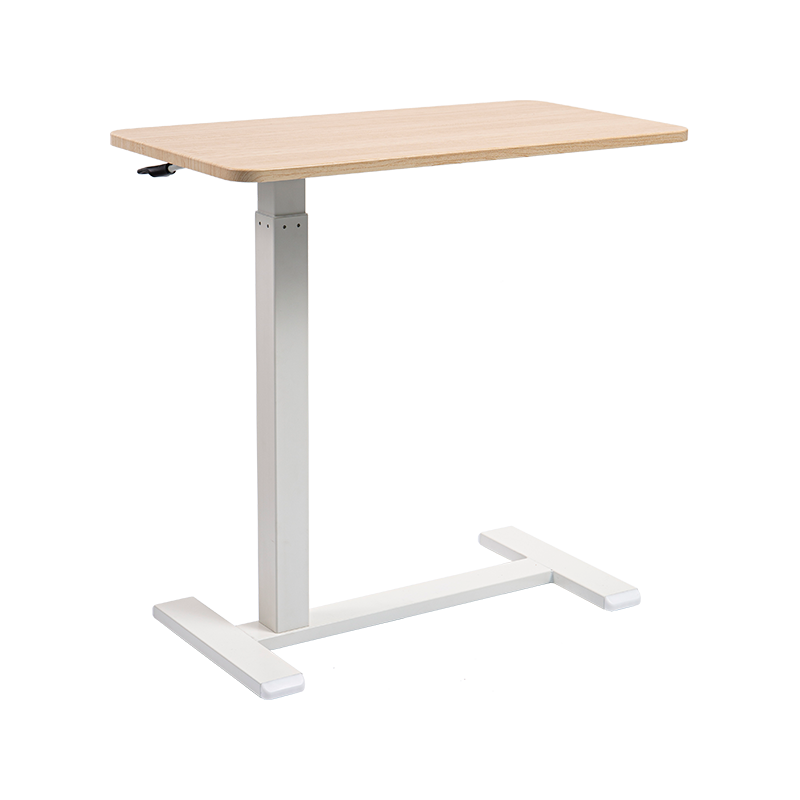
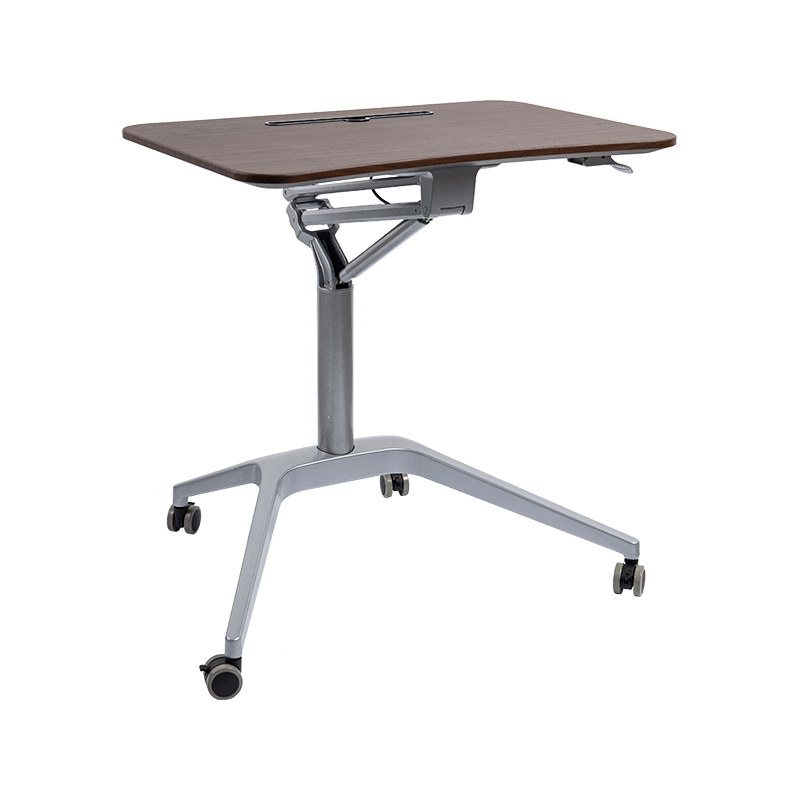
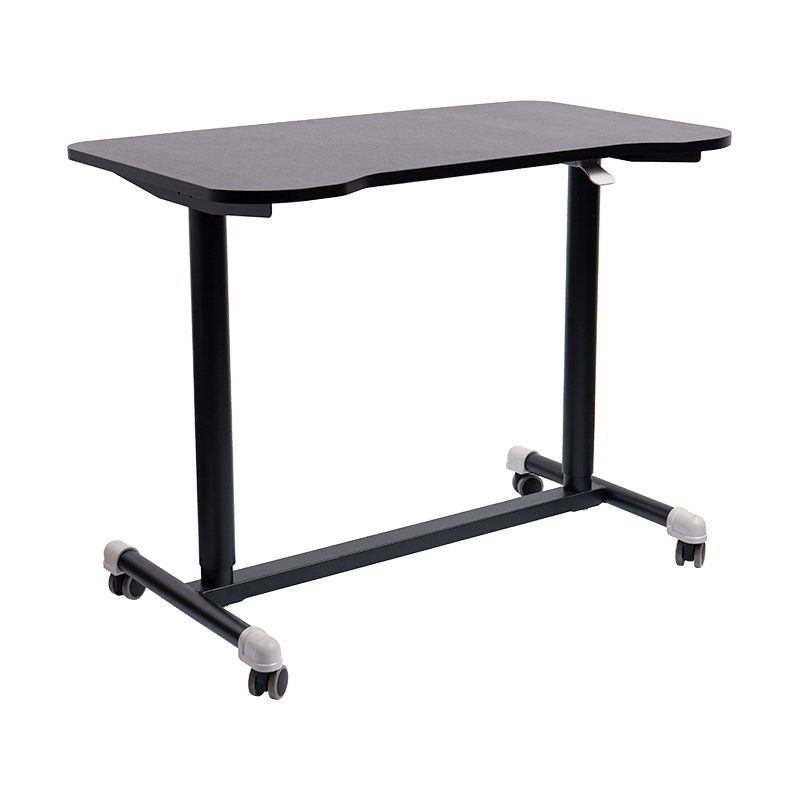
The SK02 Eccentric Pneumatic Height-Adjustable Desk is designed for this purpose. It combines a compact tabletop, an iron frame, concealed casters, and a gas spring lifting mechanism in a manually adjustable workstation. With a height range of 665 mm to 1015 mm, the desk supports seated and standing working positions without relying on an electric motor, control box, or external power supply.
This design makes the SK02 particularly suitable for offices, home workspaces, laboratories, training rooms, and other environments where flexible furniture is needed. Its pneumatic lifting system provides a practical alternative to conventional fixed-height desks and electric standing desks, while its compact dimensions help organizations use available floor space efficiently.
The product is manufactured by SuZhou Skyhone Intelligent Technology Co., Ltd., a professional enterprise focused on the research and development, production, sales, and service of standing desks and related ergonomic workspace solutions. Located in Suzhou, an important manufacturing center in the Yangtze River Delta, the company benefits from access to a mature furniture supply chain and regional intelligent manufacturing capabilities.
1. Product Overview
The SK02 Eccentric Pneumatic Height-Adjustable Desk is a compact workstation with a manually operated gas spring lifting system. The word “pneumatic” refers to the gas spring inside the lifting structure. When the user releases the adjustment mechanism, the compressed gas within the spring assists vertical movement. This allows the work surface to be positioned at different heights with less effort than a conventional fixed mechanical system.
The term “eccentric” describes the desk’s distinctive structural arrangement. Rather than placing every component symmetrically around the center of the tabletop, the design uses an offset configuration that can make the workstation easier to position in compact areas. This type of layout can be useful where floor space is limited or where a desk needs to sit close to other furniture, walls, equipment, or circulation areas.
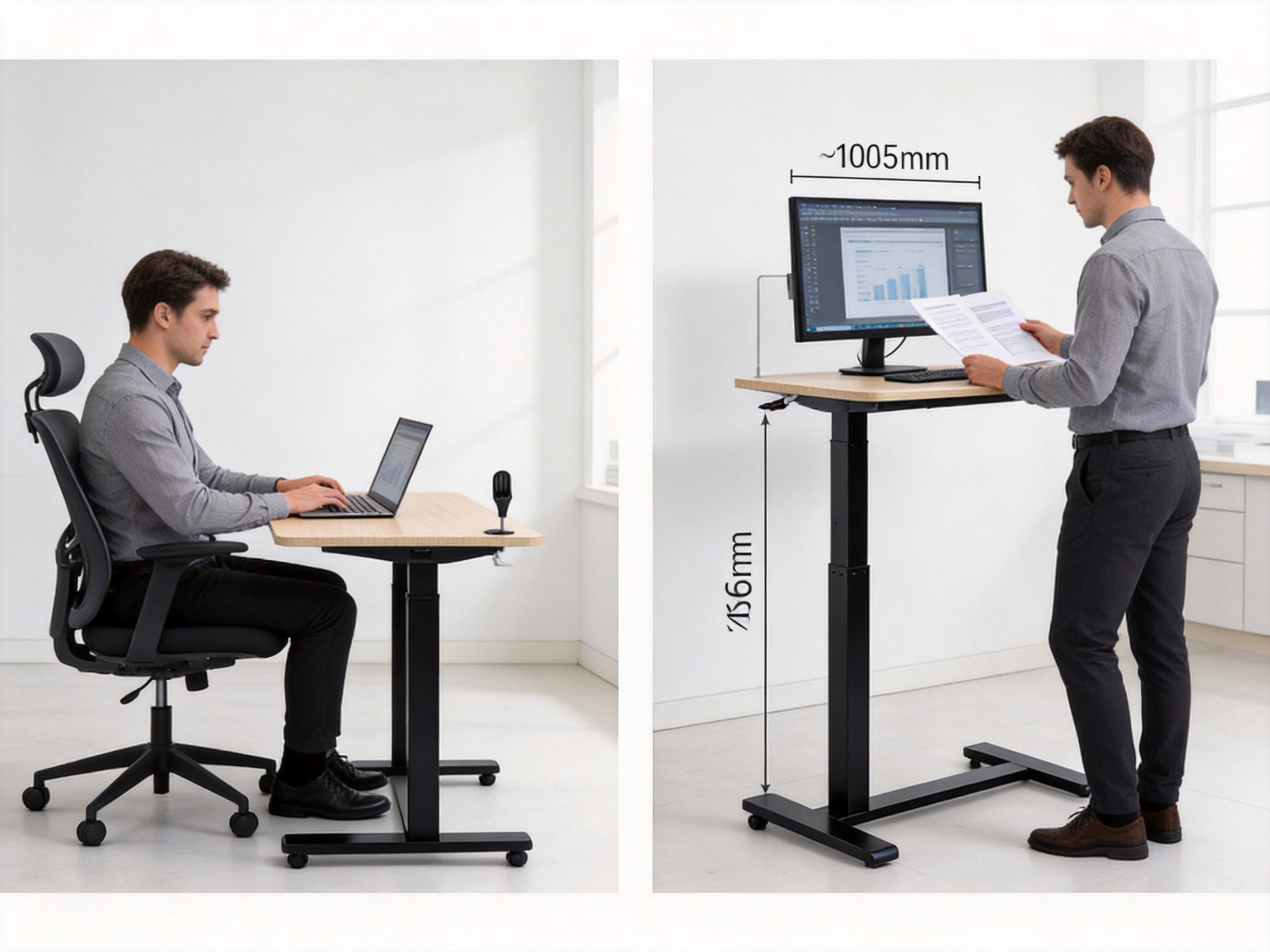
The desk has a lifting range of 665 mm to 1015 mm. The lower position is appropriate for seated work, while the upper position can support standing or elevated task work for many users. The actual ergonomic suitability depends on the user’s height, chair dimensions, footwear, task requirements, and preferred posture. Even so, the range provides meaningful flexibility compared with a fixed-height table.
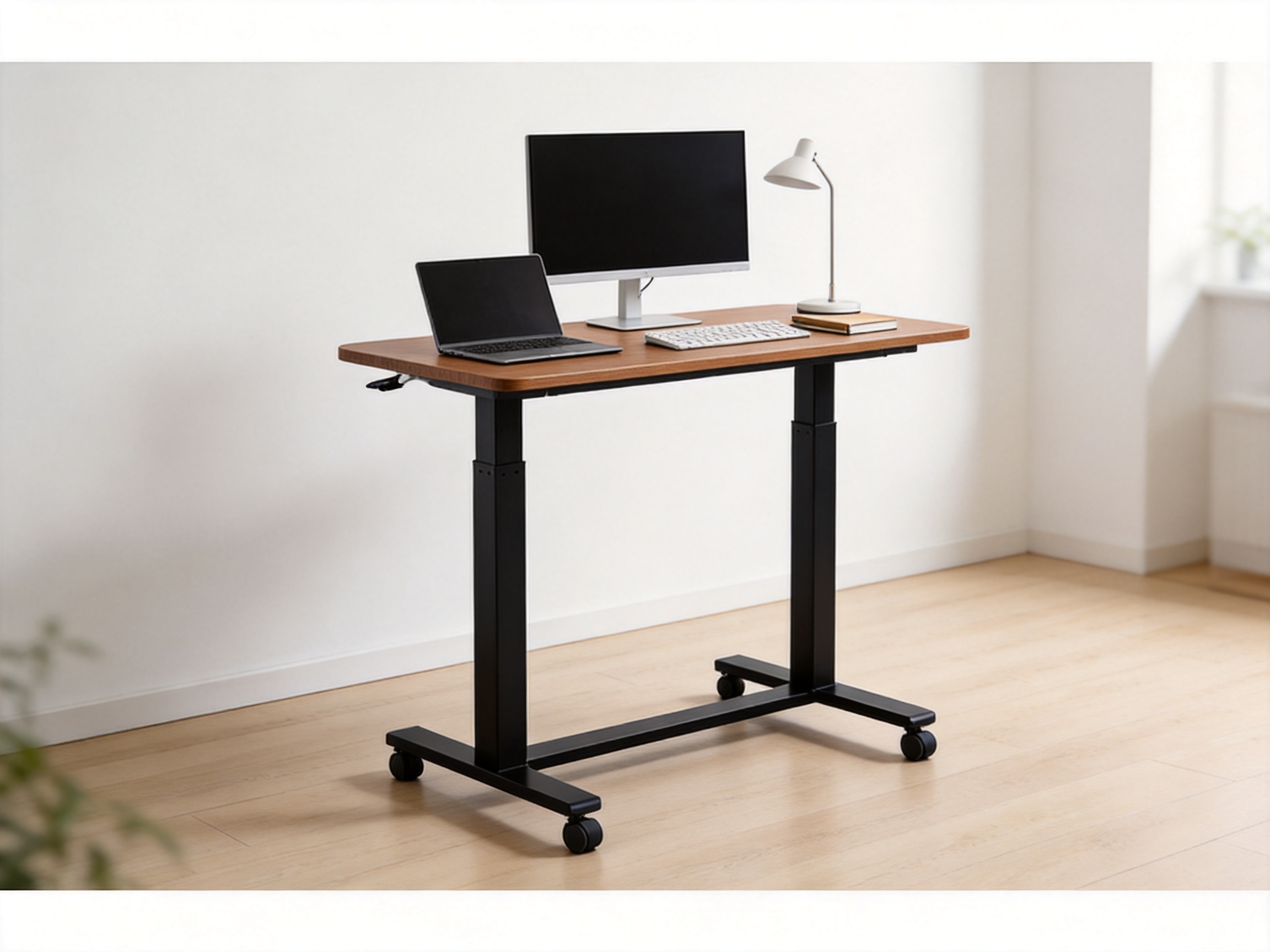
The tabletop measures 680 mm in width, 360 mm in depth, and 15 mm in thickness. This compact work surface is intended for essential equipment and materials rather than large-scale conference or executive use. It can accommodate a laptop, monitor, keyboard, writing materials, documents, or small laboratory and training equipment, depending on the specific application.
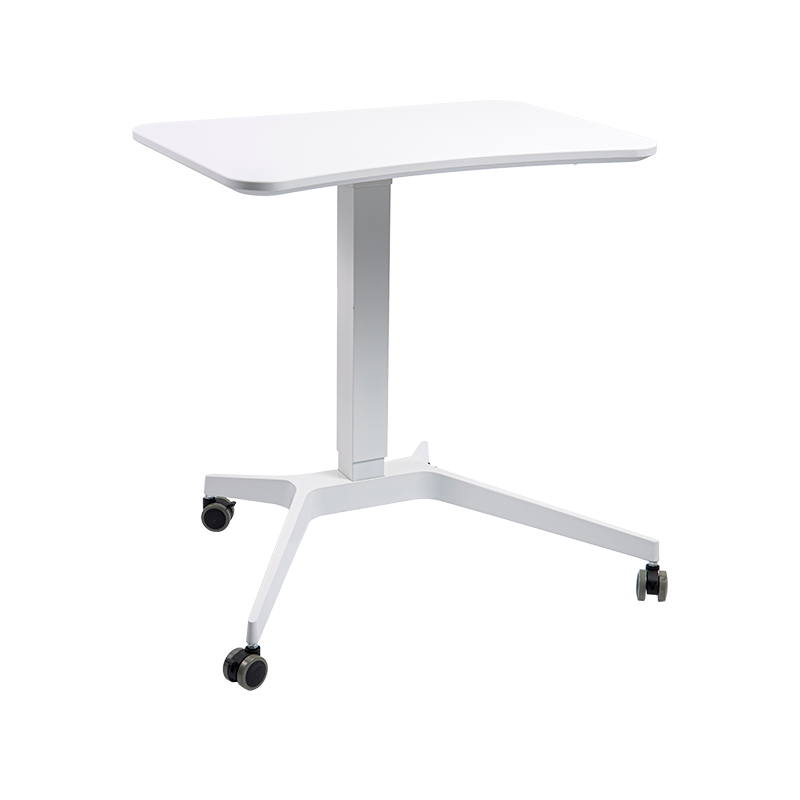
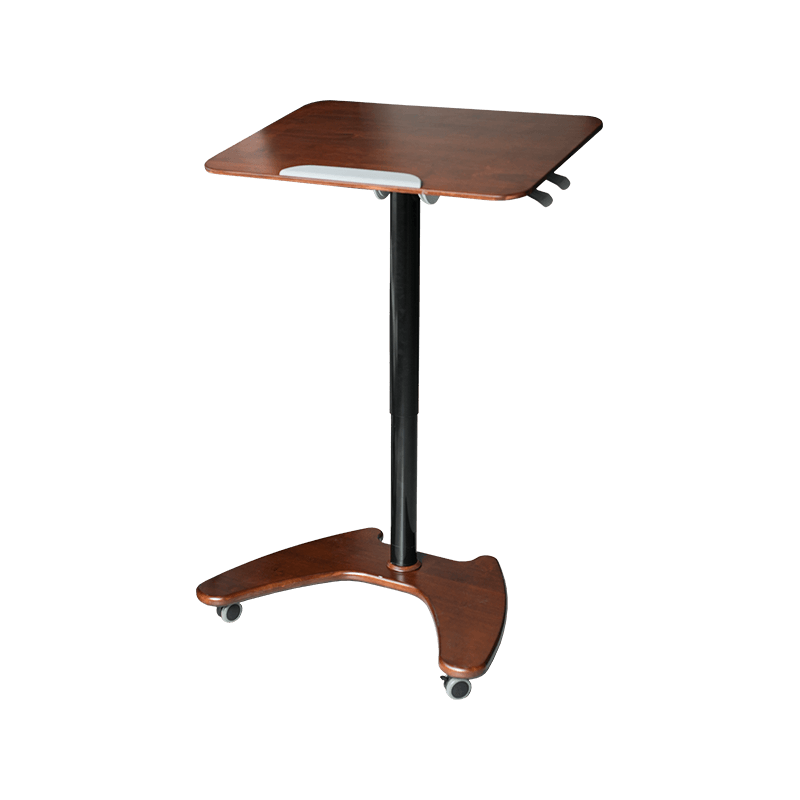
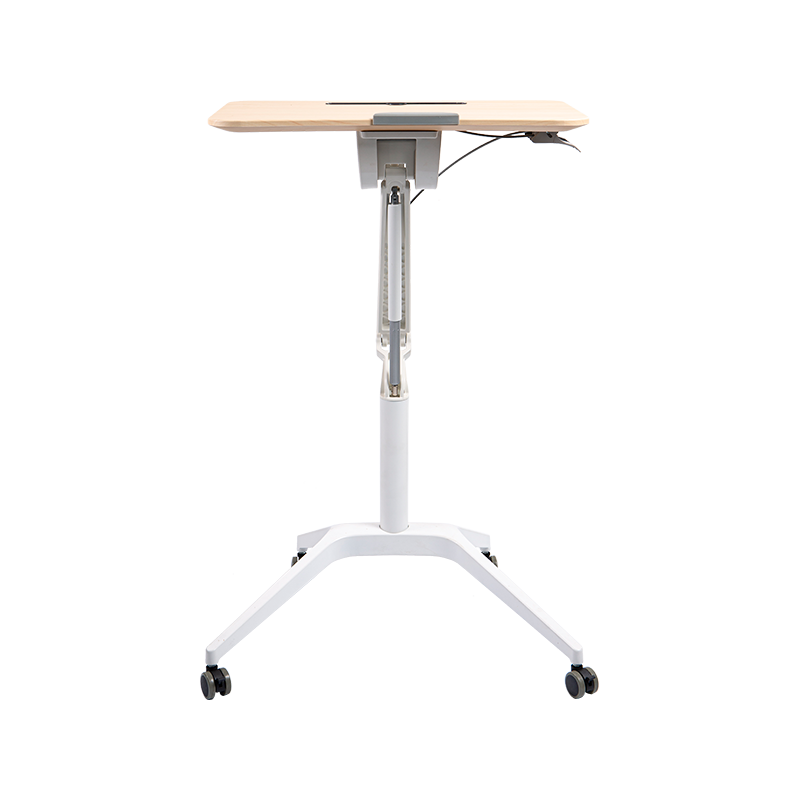
The tabletop is made from 15 mm MDF with a PVC vacuum-formed surface layer. MDF provides a uniform engineered wood substrate, while the PVC layer contributes to the finished appearance and helps create a smooth, easy-to-clean surface. Available panel finishes include white, maple, walnut, and black, allowing the desk to coordinate with different interior styles.
The main frame is constructed from iron and finished with powder coating. The frame surface is available in white or black. Powder coating produces a dry, durable finish through the application and curing of a powder-based coating. In addition to improving the visual appearance of the structure, this finish can help protect the iron frame from everyday abrasion and normal indoor environmental exposure.
For mobility, the desk uses concealed casters. The wheels are positioned within the structure rather than exposed as prominent external components. This supports a cleaner appearance and reduces visual clutter. The casters also make it easier to reposition the desk when cleaning, rearranging a room, or changing the function of a workspace.
Product specification |
SK02 Eccentric Pneumatic Height-Adjustable Desk |
Product category |
Pneumatic height-adjustable table |
Lifting range |
665 mm to 1015 mm |
Tabletop dimensions |
680 mm × 360 mm × 15 mm |
Tabletop construction |
15 mm MDF with PVC vacuum forming |
Main frame material |
Iron |
Frame surface treatment |
Powder coating |
Frame color options |
White and black |
Panel color options |
White, maple, walnut, and black |
Mobility system |
Concealed casters |
Operating principle |
Gas spring lifting |
2. Ergonomic Flexibility Without Electrical Dependence
One of the main advantages of the SK02 is its ability to support multiple working postures without requiring electrical power. Electric height-adjustable desks generally use motors, control panels, cables, power supplies, and sometimes memory controls. These features can be useful, but they also introduce additional components, installation requirements, and potential maintenance considerations.
The SK02 uses a gas spring mechanism instead. The user manually adjusts the desk by releasing the lifting control and guiding the tabletop to the desired level. The gas spring helps balance the movement, reducing the effort required to raise or lower the work surface. This makes the product suitable for locations where access to power outlets is limited or where a cable-free workspace is preferred.
A manually adjustable desk also provides operational simplicity. There is no motor noise during adjustment, no electrical control box beneath the tabletop, and no requirement to route a power cable across the floor. In flexible offices, classrooms, laboratories, or training rooms, these details can improve layout freedom and reduce the number of items that need to be managed during furniture relocation.
Changing posture during the workday may help users avoid remaining in one position for extended periods. A user can work while seated during detailed computer tasks, raise the desk for short standing sessions, and lower it again when seated concentration is preferred. The desk does not force a specific work style; instead, it allows users or facility managers to adapt the workstation to the activity.
The 665 mm lower height is appropriate for many seated work arrangements, although chair height and individual body proportions should always be considered. The 1015 mm upper height provides a useful standing position for a wide range of users and applications. In environments with multiple users, the adjustable range is more practical than a single fixed height because it accommodates different body sizes and task preferences.
3. Advantages Compared with Conventional Fixed-Height Desks
A conventional fixed-height desk can be reliable and economical, but its height is determined at the time of production. If the desk is too low or too high for a particular user, the user must compensate through chair adjustment, posture changes, or accessories. These solutions may not be sufficient for every task or every user.
The SK02 provides a broader range of use because the tabletop can be raised or lowered. This is valuable in shared workspaces where one desk may be used by several people. It is also useful in training rooms and laboratories where the same surface may support seated writing, standing demonstrations, equipment preparation, and short collaborative activities.
The desk’s compact tabletop can also be an advantage over large fixed desks. Not every workspace requires a deep or wide work surface. In high-density offices, small home offices, study areas, and laboratory zones, a compact footprint can leave more room for circulation and additional equipment.
Because the desk includes concealed casters, it can be moved when needed. A fixed desk without casters often requires lifting or dragging, which may damage flooring or require two people. The concealed mobility system is intended to make repositioning more convenient while preserving a clean appearance during normal use.
4. Advantages Compared with Electric Standing Desks
Electric standing desks offer powered adjustment, but they are not the only solution for height flexibility. The SK02 serves users who want the benefits of adjustable positioning without the complexity of a motorized system.
The first advantage is power independence. The desk can be placed in rooms without convenient electrical outlets, including temporary training areas, movable laboratory spaces, collaborative zones, and certain home office arrangements. The absence of a power cable also reduces the risk of cables crossing walkways or becoming visually distracting.
The second advantage is mechanical simplicity. A gas spring lifting system does not require a motor, hand controller, lifting columns, or electronic synchronization components. Fewer electrical parts can simplify product handling and reduce the number of components that facility staff need to inspect or replace over the service life of the desk.
The third advantage is silent manual operation. Electric desks may produce motor noise when moving between positions. The SK02 is adjusted manually with gas spring assistance, making it appropriate for quiet environments such as libraries, private offices, consultation rooms, and teaching spaces where noise should be minimized.
The fourth advantage is layout flexibility. A powered desk typically needs access to a power supply, while the SK02 can be positioned according to the needs of the room rather than the location of electrical sockets. This can be especially helpful when spaces are frequently rearranged.
The most appropriate choice depends on the intended application. Users who require frequent automated height changes, programmable memory positions, or centralized electronic control may prefer an electric system. Users who value compactness, mobility, manual control, and power-free operation may find the SK02 more suitable.
5. Gas Spring Lifting Mechanism
The gas spring is the central operating element of the desk. It contains pressurized gas in a sealed cylinder and uses internal mechanical components to generate controlled assistance during movement. When the user activates the adjustment control, the gas spring supports the vertical travel of the desk frame.
This mechanism is widely used in products where smooth assisted motion is required. In the SK02, the gas spring is integrated into the height-adjustment structure rather than being added as an external accessory. Integration helps maintain a tidy appearance and supports the overall compact design of the workstation.
A gas spring system is particularly useful for manual adjustment because it can offset part of the load created by the tabletop and the user’s equipment. The user still needs to guide the desk and follow the product’s operating instructions, but the spring assistance makes adjustment more practical than lifting the entire load directly.
Correct operation is important. Users should keep hands and objects clear of moving joints, avoid placing excessive loads on the tabletop during adjustment, and make sure the desk is positioned on a level floor. The concealed casters should be used as intended, and the product should not be forced beyond its designed lifting range.
Gas springs are also affected by environmental conditions and usage patterns. Normal indoor operation, appropriate loading, and routine inspection can help maintain consistent performance. As with any height-adjustable furniture, facility managers should include the desk in regular maintenance checks, particularly in high-use commercial environments.
6. Compact Tabletop Design for Efficient Space Use
The SK02 tabletop measures 680 mm by 360 mm, creating a relatively compact workstation footprint. This dimension is useful when the primary task involves a laptop, small display, keyboard, writing materials, or limited equipment. It can also serve as a supplemental workstation beside a larger desk, laboratory bench, or meeting area.
Compact furniture can improve space planning in several ways. More workstations may fit into a fixed room, circulation paths can remain clearer, and unused tabletop area is reduced. For offices with high desk density, a compact adjustable desk can provide posture flexibility without requiring the floor area of a large executive workstation.
In a home office, the desk can be positioned in a bedroom, living area, study corner, or multipurpose room. Its modest size makes it easier to integrate with existing furniture. When not in use, it can be moved to the side of a room or repositioned for another activity.
In training rooms, the compact tabletop gives participants a personal working area while preserving space for chairs, presentation equipment, and movement. In laboratories, the desk may be used for documentation, computer-based monitoring, sample records, or portable equipment, subject to the requirements of the specific laboratory environment.
The 15 mm MDF tabletop balances a slim visual profile with an engineered panel structure. The PVC vacuum-formed layer allows the surface to be finished in several decorative colors and patterns. White and black can support modern or minimal interiors, while maple and walnut can create a warmer furniture appearance.
7. Materials and Surface Treatment
The main structure is made from iron, a material widely used in furniture frames because of its strength, availability, and suitability for forming and welding processes. An iron frame can provide a stable foundation for the tabletop and the lifting mechanism when properly designed and assembled.
The powder-coated finish is available in white and black. Powder coating is applied as a dry powder and then cured to form a continuous surface. Compared with some wet-paint applications, powder coating can produce an even finish and is well suited to high-volume metal furniture production.
For normal indoor use, the coated frame can be cleaned with a soft cloth and a mild cleaning solution. Abrasive cleaners, sharp tools, and prolonged exposure to moisture should be avoided because they may damage the surface finish. If the frame is used in a laboratory or other specialized environment, cleaning and chemical compatibility should be assessed according to the application.
The tabletop’s PVC layer supports easy routine cleaning. The surface should be wiped with a suitable non-abrasive cleaner, and standing moisture should be removed rather than left around edges or joints. Proper care helps preserve the visual quality of the panel and reduces the accumulation of dust and workplace residue.
The combination of a powder-coated iron frame and a PVC-finished MDF tabletop creates a practical balance between appearance, manufacturing efficiency, and everyday usability. Customers can select frame and panel colors according to the interior design, furniture program, or corporate workspace standard.
8. Concealed Casters and Practical Mobility
Mobility is an important feature for flexible furniture. A workstation may need to be moved for cleaning, room reconfiguration, group activities, maintenance, or changes in user allocation. The SK02 uses concealed casters to support this requirement while maintaining a visually streamlined base.
Because the casters are integrated into the structure, they are less visually prominent than conventional exposed wheels. This helps the desk appear more like a stable piece of office furniture rather than a temporary trolley. The concealed arrangement can also reduce the chance that external wheels will interfere with nearby furniture or create unnecessary visual clutter.
The desk should be used on a level floor and moved carefully. Before relocating it, users should remove unstable items from the tabletop and ensure that cables, bags, chairs, and other obstacles are clear. Once the desk is in its working position, it should be placed securely and checked for stability before use.
In open-plan offices, the casters can support rapid changes in workstation arrangement. In training rooms, desks can be shifted between individual and collaborative layouts. In home offices, the desk can be moved closer to a window, storage unit, or power source when required.
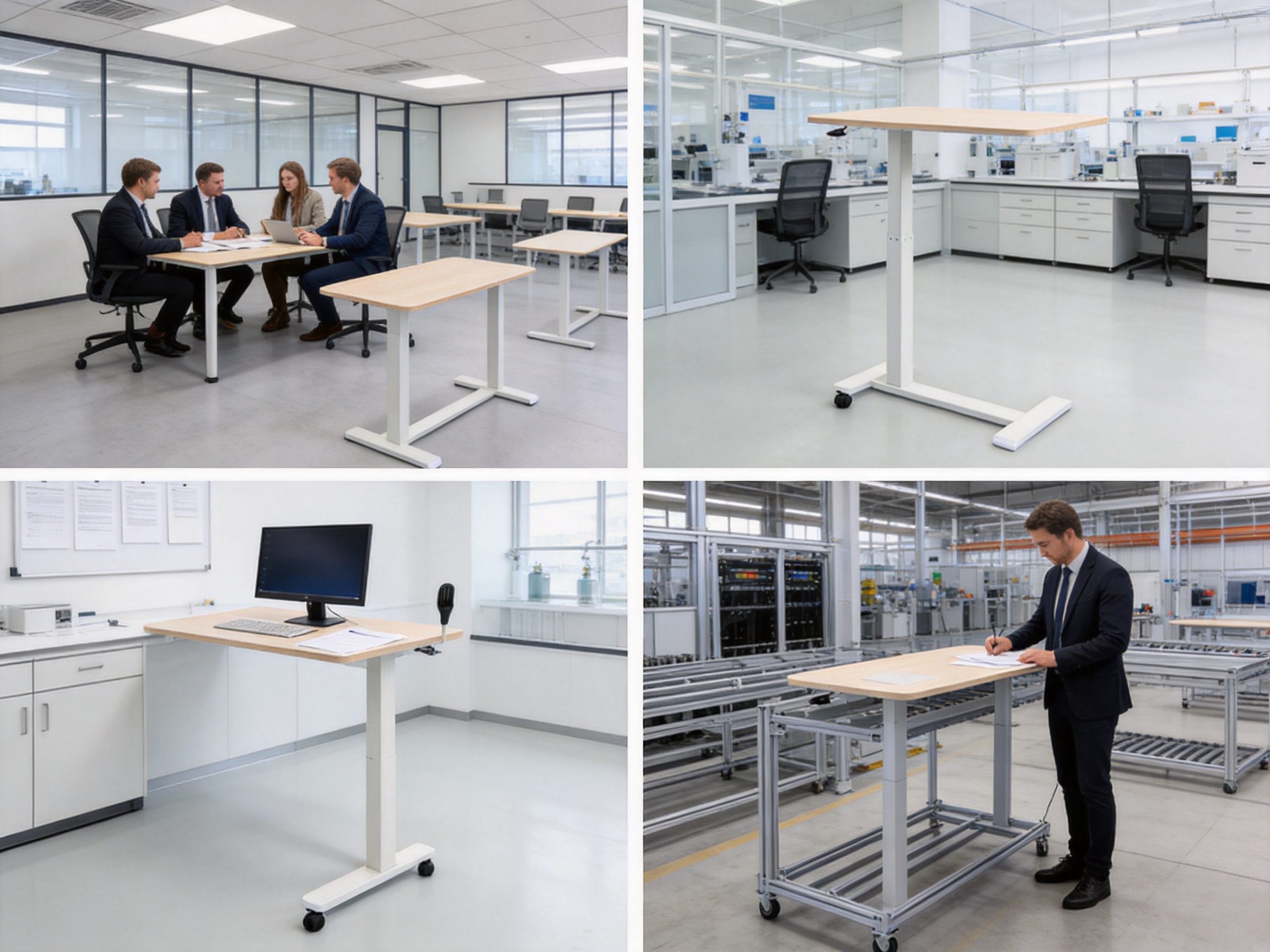
9. Applications in Modern Work Environments
Home Offices
The SK02 is suitable for home offices where space is limited and one workstation may serve several purposes. A user can lower the desk for seated computer work, raise it for standing activities, and move it when the room needs to support another function.
The compact tabletop is useful for apartments, bedrooms, living areas, and shared household spaces. The absence of an electric drive system can simplify installation and reduce cable management requirements. The color options also make it easier to coordinate the desk with residential furniture.
Open-Plan Offices
Open-plan offices often require furniture that can adapt to different employee preferences and changing team structures. An adjustable workstation allows users to change posture and can support more personalized work settings without replacing the entire desk.
The SK02 may also be used as a supplementary workstation, touchdown desk, hot-desk unit, or temporary project station. Its mobility makes it appropriate for offices that regularly reorganize seating arrangements or create short-term collaborative zones.
Collaborative Workspaces
Collaborative spaces benefit from furniture that can be rearranged quickly. The SK02 can support short meetings, standing discussions, laptop work, and project-based activities. Its height range allows teams to choose a seated or standing arrangement according to the task.
Because the desk does not depend on a fixed power connection for height adjustment, it can be positioned according to group interaction rather than outlet location. This can simplify temporary layouts and event-based workspace planning.
Laboratory Workstations
Laboratories may require compact surfaces for computer monitoring, documentation, data entry, instrument support, or administrative work near technical areas. The adjustable height can help users change posture during long periods of observation or recording.
Laboratory customers should confirm that the tabletop material, cleaning method, load requirement, and environmental conditions are appropriate for the specific laboratory. The SK02 is a flexible furniture workstation, and specialized applications should always be evaluated against relevant safety and hygiene requirements.
Training Rooms
Training rooms frequently change between lecture, computer training, group work, testing, and practical instruction. A mobile height-adjustable desk can help instructors and facility managers create different layouts without installing permanent furniture.
The compact dimensions allow multiple units to be arranged while preserving circulation space. The desk can be used for individual learning, demonstration equipment, or standing instruction, depending on the room design and the equipment placed on the tabletop.
10. Manufacturing Strengths and Product Development Capabilities
The performance of a height-adjustable desk depends not only on its visible design but also on the manufacturing systems behind it. The company producing the SK02 describes itself as a professional manufacturing enterprise involved in research and development, production, sales, and service. This integrated structure supports product development from concept through customer use.
Research and development is important for pneumatic furniture because the lifting mechanism, frame geometry, tabletop connection, caster arrangement, and operating controls must function together. A small change in one component can influence stability, lifting feel, appearance, packaging, and assembly. An experienced product development team can evaluate these relationships during design and refinement.
The company is based in Suzhou, within the Yangtze River Delta furniture manufacturing region. This location provides access to a developed industrial ecosystem that may include metal processing, surface treatment, panel production, hardware supply, packaging, logistics, and technical services. Regional supply-chain support can help a manufacturer coordinate components and respond to customer requirements efficiently.
Intelligent manufacturing capabilities can contribute to production consistency. In a furniture product such as the SK02, consistency is important for frame dimensions, mounting points, coating quality, tabletop fit, and gas spring installation. Controlled production processes help reduce variation between units and support more predictable assembly and inspection.
Integrated production also creates opportunities for continuous improvement. Feedback from sales teams, service personnel, installers, and end users can be communicated back to the product development and manufacturing departments. This closed feedback cycle can support improvements in usability, packaging, assembly instructions, finish quality, and product adaptability.
The company’s involvement in sales and service is another strength for international buyers. Commercial customers often require more than a product specification. They may need communication during selection, support with configuration, documentation, shipping coordination, installation guidance, and follow-up service. A manufacturer with a service-oriented structure can help address these stages more effectively.
11. Production Process Considerations
Although the exact internal production sequence may vary by order and configuration, manufacturing a desk like the SK02 generally requires coordination across several stages. The iron frame must be formed, joined, finished, and inspected. The tabletop must be cut or prepared, vacuum formed with PVC, finished, and matched to the frame. The pneumatic lifting components and casters must then be installed and tested as part of the complete unit.
Metal preparation is a foundational stage. The iron components must be produced according to the required dimensions so that the frame remains aligned during assembly. Accurate joints and mounting points help ensure that the tabletop sits correctly and that the lifting system operates without unnecessary friction or misalignment.
Surface treatment is also significant. Powder coating requires appropriate preparation of the metal surface, controlled powder application, and curing. Consistent treatment supports a uniform visual finish across white and black frame options. Inspection may include checking for uneven coverage, visible defects, scratches, or damage caused during handling.
Tabletop production requires attention to both dimensions and surface quality. The MDF panel must be prepared to the specified size and thickness. The PVC vacuum-forming process must create a consistent bond and appearance across the panel. Edges, corners, and mounting areas should be checked because these details influence the user’s perception of quality and the ease of final assembly.
Final assembly brings together the frame, gas spring, adjustment mechanism, tabletop, and concealed casters. Functional testing is important at this stage. The assembled desk should be checked for smooth lifting and lowering, secure connections, appropriate alignment, stable positioning, and correct movement through the specified height range.
Packaging is another important manufacturing consideration. A compact but carefully designed package can help protect the powder-coated frame, tabletop edges, decorative surface, pneumatic components, and caster assembly during transportation. Clear labeling and assembly documentation can also reduce installation time for distributors and end users.
12. Quality and Consistency for Commercial Buyers
Commercial buyers often purchase multiple units rather than a single desk. For these customers, consistency is as important as individual product performance. Desks in the same installation may need matching frame colors, panel finishes, dimensions, adjustment behavior, and visual details.
A manufacturer with coordinated research, production, sales, and service functions is better positioned to manage repeat orders and project requirements. The buyer can communicate specifications through a central organization rather than coordinating several unrelated suppliers.
For a large order, customers may wish to confirm the following details before production: required panel color, frame color, packaging configuration, assembly level, shipping marks, inspection standards, expected delivery schedule, and documentation requirements. These discussions help align the product with the intended project.
Customers should also consider the end-use environment. A desk for a private home office may have different requirements from a desk for a training center, laboratory, or open-plan office. The expected frequency of adjustment, floor condition, cleaning method, equipment load, and relocation frequency should be reviewed during product selection.
13. Design Advantages for Distributors and Project Suppliers
The SK02 offers several characteristics that can be attractive to furniture distributors, office solution providers, and project suppliers. Its manual gas spring operation differentiates it from standard fixed desks while avoiding the electrical components associated with motorized models.
The compact dimensions can support a range of customer segments. Distributors may offer the product for home offices, small businesses, learning environments, and flexible commercial spaces. The multiple panel colors and two frame colors provide a degree of customization without changing the fundamental structure of the desk.
The concealed casters add another selling point. Customers can obtain a workstation that is both mobile and visually clean. This combination can be valuable in modern interiors where furniture is expected to be adaptable but not industrial in appearance.
The product also fits within a broader ergonomic furniture portfolio. A supplier may combine pneumatic desks with electric linear actuator products, gas springs, fixed tables, monitor accessories, or other office furniture components. This allows buyers to choose different adjustment technologies according to room function and budget.
14. Maintenance and Long-Term Use
Routine care for the SK02 is straightforward. The tabletop should be cleaned with a soft cloth and a suitable mild cleaner. Spills should be removed promptly, especially around edges and connection points. Abrasive materials should not be used because they can scratch the PVC surface or reduce its visual quality.
The powder-coated frame should be inspected periodically for scratches, loose parts, or signs of impact. Small surface damage should be addressed according to the manufacturer’s maintenance guidance. Users should avoid dragging the desk across rough floors or striking the frame against walls and other furniture.
The gas spring and adjustment mechanism should be checked if the desk becomes difficult to raise, lower, or hold at the intended position. Users should not disassemble the pressurized gas spring. Any repair or replacement should be handled according to the manufacturer’s instructions and by appropriately qualified personnel.
Concealed casters should remain free of dust, paper, hair, and other debris that could affect movement. The desk should not be overloaded or used as a support for climbing. When the desk is moved, the load should be stabilized and the path should be cleared in advance.
Regular inspection is particularly important in shared offices, schools, laboratories, and training rooms. A simple maintenance schedule can help identify loose fasteners, unusual movement, surface damage, or caster problems before they affect daily use.
15. Safety and User Guidance
Users should read the relevant product instructions before operating the desk. The tabletop should be loaded evenly, and heavy equipment should be positioned securely. Sudden downward pressure, hanging loads, or unsupported items near the edge can affect stability and movement.
Hands, fingers, cables, and other objects should be kept away from moving frame sections during height adjustment. Children should not operate the desk without appropriate supervision. The desk should be placed on a level surface, and users should avoid using it on stairs, steep ramps, or unstable flooring.
The lifting range should not be exceeded. Forcing the desk beyond 665 mm or 1015 mm may damage the mechanism or create an unsafe condition. If unusual noise, resistance, instability, or uneven movement occurs, the desk should be removed from service until it has been inspected.
Customers using the desk in specialized environments should assess the product against their own workplace regulations. Laboratories, educational facilities, and commercial offices may have additional requirements related to fire safety, sanitation, load capacity, accessibility, and furniture stability.
16. Why Choose a Pneumatic Height-Adjustable Design?
A pneumatic desk is a practical middle ground between a fixed desk and a fully motorized standing desk. It offers height flexibility but remains mechanically focused and independent of electrical power. This makes it suitable for users who want adjustment without electronic controls or complex cable management.
The SK02 is especially appropriate when adjustment is needed occasionally rather than continuously. A user may raise the desk at the beginning of a standing task and lower it when returning to seated work. A facility manager may adjust the desk when changing a room layout. In both cases, manual gas spring assistance provides a straightforward solution.
The design can also support sustainability-related purchasing goals by avoiding certain electrical components and reducing dependence on powered operation. However, environmental performance depends on the full product life cycle, including material sourcing, manufacturing, packaging, shipping, maintenance, and end-of-life handling. Buyers should evaluate these factors according to their own procurement standards.
From a user experience perspective, pneumatic adjustment can feel direct and intuitive. The user controls the movement instead of relying on a programmed position. For many shared or temporary workspaces, this simplicity is an advantage rather than a limitation.
17. How the SK02 Supports Flexible Space Planning
Furniture flexibility has become increasingly important as offices adopt hot-desking, hybrid work, project teams, touchdown areas, and multipurpose rooms. A workstation that can move and change height can support more than one configuration during the day.
In a hybrid office, the desk can serve different employees with different body dimensions and preferences. In a project room, it can be used as an individual station during focused work and moved into a group arrangement during collaboration. In a training room, it can be positioned according to the teaching format.
The compact footprint reduces the amount of space committed to each workstation. This allows architects, interior designers, and facility managers to consider more varied layouts. The desk can be placed near a wall, beside a larger workstation, within a temporary activity zone, or in a small personal office.
The color choices also support coordinated interiors. A black frame with a walnut panel may suit a traditional or premium office aesthetic, while a white frame with a white or maple panel may create a brighter appearance. Black and white panels can be used in modern, educational, or technology-oriented spaces.
18. Customer Selection Checklist
Before ordering the SK02, customers should confirm the intended application and the equipment that will be placed on the tabletop. The 680 mm by 360 mm work surface is compact, so users should verify that it provides sufficient room for their monitor, keyboard, laptop, documents, and other accessories.
The desired frame color and panel color should also be selected in advance. Frame colors are white and black, while panel colors are white, maple, walnut, and black. Coordinating these options can help maintain a consistent appearance across a furniture installation.
Customers should review the room’s floor condition and circulation paths. The concealed casters support mobility, but the desk should be used on level indoor flooring and moved with care. The location should provide enough clearance for the tabletop and frame throughout the full lifting range.
For commercial projects, buyers should discuss order quantity, packaging, assembly requirements, inspection procedures, shipping arrangements, and after-sales support with the manufacturer or authorized supplier. These details are important for efficient project delivery.
19. Frequently Asked Questions
Q1: What is the height range of the SK02 desk?
The desk has a lifting range from 665 mm to 1015 mm. This range is intended to support both seated and standing work, although the most comfortable setting depends on the user’s body dimensions and task requirements.
Q2: Does the desk require electricity?
No. The SK02 uses a manual gas spring lifting mechanism and does not require an electric motor, power outlet, control box, or power cable for height adjustment.
Q3: How is the height adjusted?
The user operates the adjustment control and guides the tabletop to the desired height. The gas spring assists the vertical movement. Users should follow the supplied operating instructions and keep hands and objects away from moving components.
Q4: What are the tabletop dimensions?
The tabletop measures 680 mm in width, 360 mm in depth, and 15 mm in thickness.
Q5: What is the tabletop made of?
The tabletop consists of a 15 mm MDF panel with a PVC vacuum-formed surface layer.
Q6: Which colors are available?
The iron frame is available in white and black powder-coated finishes. The panel is available in white, maple, walnut, and black.
Q7: Can the desk be moved?
Yes. The desk is equipped with concealed casters for relocation. It should be moved carefully on a level floor, with unstable items removed and obstacles cleared from the path.
Q8: Is the SK02 suitable for a large monitor setup?
The tabletop is compact, so customers should check the dimensions and weight of their monitor, stand, keyboard, and accessories before purchase. It is best suited to essential equipment and space-efficient workstation applications.
Q9: Is the desk suitable for laboratories?
The desk may be suitable for laboratory documentation, computer monitoring, and other workstation tasks. However, each laboratory should confirm that the tabletop material, cleaning requirements, load needs, and environmental conditions meet its specific standards.
Q10: How should the desk be cleaned?
Use a soft cloth and a mild, non-abrasive cleaning solution. Remove spills promptly and avoid harsh chemicals, abrasive pads, and sharp tools that could damage the PVC tabletop or powder-coated frame.
Q11: What is the main advantage over a fixed desk?
The main advantage is height flexibility. The user can change the work surface between seated and standing positions instead of adapting to one permanent height.
Q12: What is the main advantage over an electric standing desk?
The SK02 provides manual height adjustment without electricity, motors, control boxes, or power cables. This can simplify placement, reduce cable management, and suit locations where powered adjustment is unnecessary.
Q13: Who manufactures the SK02?
The desk is manufactured by SuZhou Skyhone Intelligent Technology Co., Ltd., a company engaged in the research and development, production, sales, and service of standing desks and related workspace solutions.
Q14: Where is the manufacturer located?
The manufacturer is based in Suzhou City, Jiangsu Province, China, within the Yangtze River Delta manufacturing region.
Q15: Can the desk be ordered for commercial projects?
Commercial buyers should contact the manufacturer or supplier to confirm project quantities, colors, packaging, delivery arrangements, inspection requirements, and service support.
20. Conclusion
The SK02 Eccentric Pneumatic Height-Adjustable Desk is a compact and adaptable workstation designed for users who need flexible height positioning without electrical dependence. Its 665 mm to 1015 mm lifting range supports transitions between seated and standing work, while the gas spring mechanism keeps adjustment mechanically simple.
The desk combines an iron powder-coated frame, a 15 mm MDF and PVC vacuum-formed tabletop, concealed casters, and several color options. These features make it appropriate for home offices, open-plan workplaces, collaborative areas, laboratories, and training rooms where space efficiency and mobility are important.
Compared with fixed desks, the SK02 offers greater posture and user flexibility. Compared with electric standing desks, it provides a power-free alternative with fewer electronic components and less cable dependence. Its compact footprint and concealed mobility system further support modern space planning.
The product is backed by a manufacturer with capabilities in research and development, production, sales, and service. Its location in Suzhou provides access to a mature regional furniture supply chain and intelligent manufacturing resources. For distributors, project suppliers, and organizations seeking ergonomic furniture, the SK02 represents a practical solution that combines adjustable functionality, compact design, and manufacturing-oriented reliability.
References
1. SuZhou Skyhone Intelligent Technology Co., Ltd. Product specification information for the SK02 Eccentric Pneumatic Height-Adjustable Desk.
2. SuZhou Skyhone Intelligent Technology Co., Ltd. Company information regarding standing desk research and development, production, sales, and service.
3. General principles of ergonomic workstation design and posture variation in office environments.
4. General technical principles of gas spring mechanisms used in manually adjustable furniture.
5. General manufacturing principles for powder-coated iron furniture frames.
6. General material information concerning MDF panels and PVC vacuum-forming applications.
SK02 Eccentric Pneumatic Height-Adjustable Desk
Product: SK02 Eccentric Pneumatic Height-Adjustable Desk


- Contact Info
-
-
 Phone+86-15950656125
 -
 Email
Email -
 AddressRoom 1007-1, South Building, Suyue Plaza, Suzhou Industrial Park, Suzhou City, Jiangsu Province, China
-
- Products
- Follow Us
- Need help? Please contact us
Copyright ©
SuZhou Skyhone Intelligent Technology Co., Ltd.
All Rights Reserved.
Privacy
Custom Ergonomic Adjustable Office Tables Manufacturers

