

 English
 русский
 Español
 عربى

Content
- 1 Product Overview
- 2 Why Pneumatic Height Adjustment Matters
- 3 Advantages Over Conventional Fixed-Height Desks
- 4 Advantages Over Electric Height-Adjustable Desks
- 5 Structural Design and Material Selection
- 6 Mobility Without Sacrificing Practical Stability
- 7 Ergonomic Benefits for Different Users
- 8 Applications in Offices and Shared Workspaces
- 9 Applications in Education and Training
- 10 Applications in Laboratories and Control Rooms
- 11 Manufacturing Strengths and Production Approach
- 12 Customization and Project Support
- 13 Installation, Operation, and Care
- 14 Comparison with Alternative Desk Types
- 15 Purchasing Considerations for Commercial Buyers
- 16 Frequently Asked Questions
- 16.1 What type of desk is the SK06?
- 16.2 How is the height adjusted?
- 16.3 What is the height range?
- 16.4 Does the desk require electricity?
- 16.5 What are the desktop dimensions?
- 16.6 What is the desktop made from?
- 16.7 What materials are used in the frame?
- 16.8 Can the desk be moved?
- 16.9 Where can the desk be used?
- 16.10 Is the SK06 suitable for shared workspaces?
- 16.11 How does it compare with an electric standing desk?
- 16.12 What should users check before operating the desk?
- 16.13 Can the desktop or frame be customized?
- 17 Conclusion
- 18 References
- 19 Product: SK06 (Fold-Eight Leg Column) Pneumatic Height-Adjustable Desk
SK06 Fold-Eight Leg Column Pneumatic Height-Adjustable Desk: A Flexible Solution for Modern Workspaces
2026-09-09
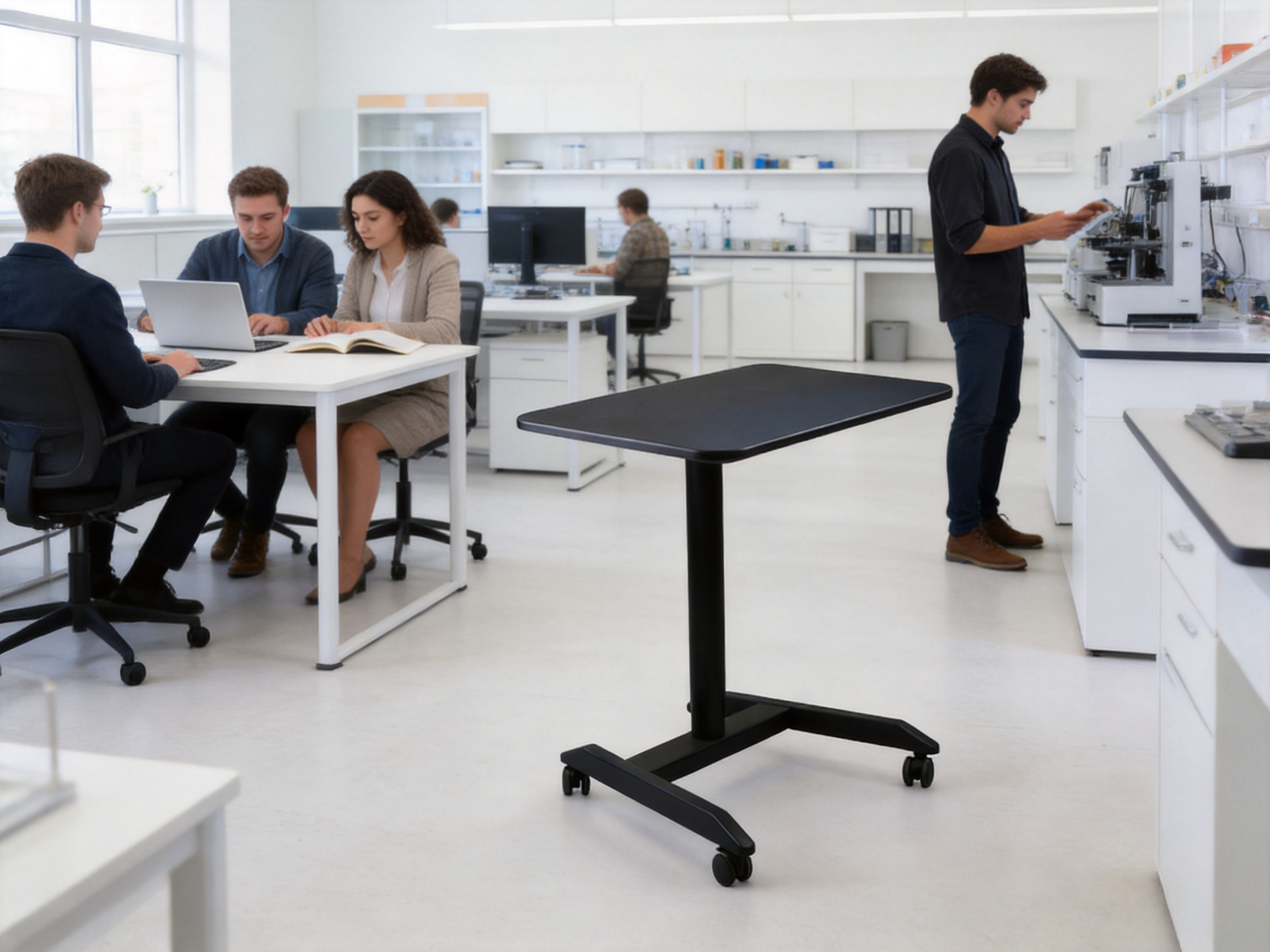
Work environments are changing rapidly. Offices, classrooms, laboratories, home studios, and shared work areas increasingly require furniture that can support different users, tasks, and postures without occupying unnecessary space. A fixed-height desk may be adequate for one person and one activity, but it becomes less practical when a workstation must be moved, shared, or adapted throughout the day. The SK06 Fold-Eight Leg Column Pneumatic Height-Adjustable Desk is designed to address these requirements through a compact desktop, a gas spring lifting mechanism, and a mobile caster-based structure.
With a lifting range of 720mm to 1150mm, the SK06 allows users to alternate between seated and standing working positions. Its pneumatic adjustment system provides a mechanical alternative to electrically powered desk systems, eliminating the need for motors, control panels, power cords, and electrical installation. This makes the desk especially suitable for flexible spaces where mobility, simple operation, and low maintenance are important.
The product combines an aluminum-and-iron frame, powder-coated black surface treatment, a 25mm MDF desktop with PVC vacuum-forming technology, and four casters, including two locking casters. These elements create a workstation that is easy to relocate while still offering a secure working position when the wheels are locked. Available desktop colors include walnut and black, allowing the desk to fit both contemporary office interiors and functional educational or technical environments.
Product Overview
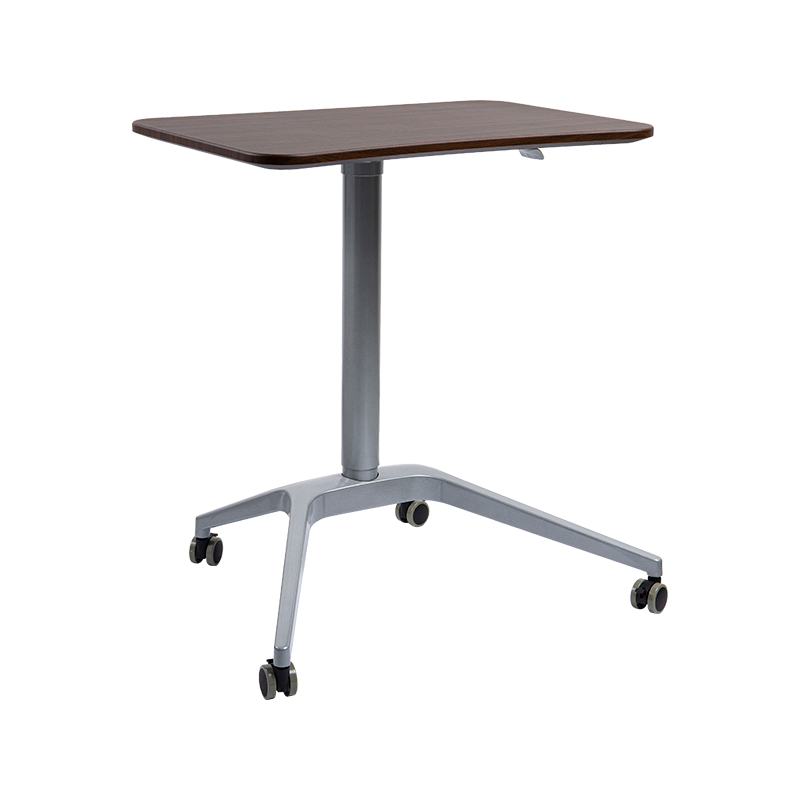
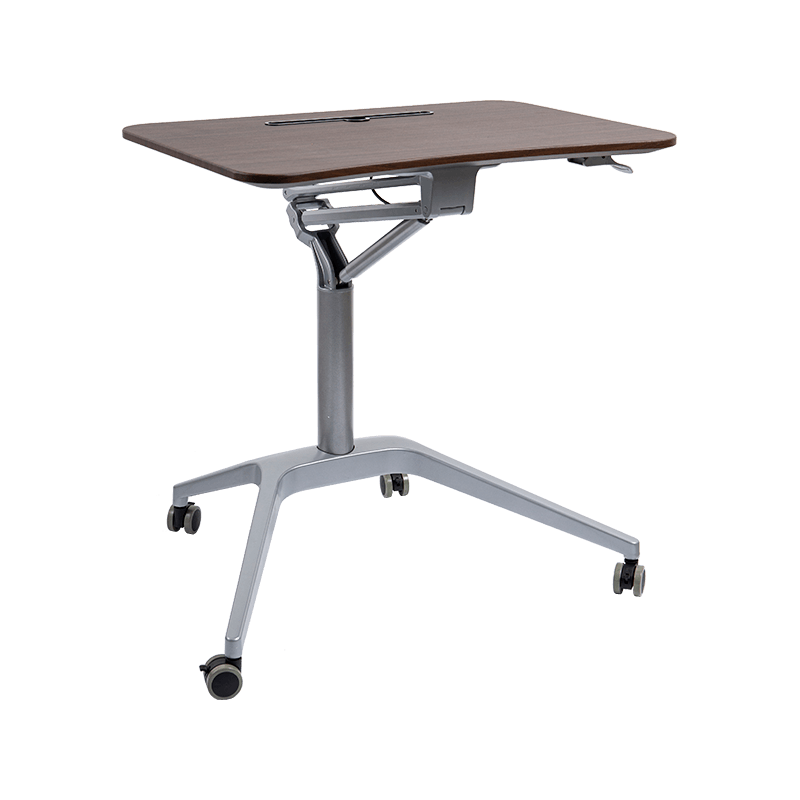
The SK06 is a pneumatic height-adjustable desk configured around a fold-eight leg column structure. Its form is intended to balance stability, portability, and efficient use of floor space. Rather than relying on a large fixed base, the design uses a column-and-leg support arrangement that can be integrated into areas where space is limited or where workstations need to be repositioned frequently.
| Specification | Details |
|---|---|
| Product model | SK06 |
| Product type | Pneumatic height-adjustable desk |
| Lifting range | 720mm to 1150mm |
| Desktop dimensions | 715mm × 495mm × 25mm |
| Desktop construction | 25mm MDF with PVC vacuum forming |
| Main frame material | Aluminum and iron |
| Surface finish | Black powder coating |
| Caster configuration | Two lockable casters and two non-locking casters |
| Desktop color options | Walnut and black |
| Adjustment principle | Gas spring lifting |
The 715mm by 495mm desktop offers a practical surface for a laptop, monitor, documents, laboratory instruments, teaching materials, or other frequently used equipment. The 25mm thickness gives the desktop a substantial appearance and provides a firm platform for daily work. The compact footprint is particularly useful in rooms where several workstations must be arranged efficiently.
The height range begins at 720mm, a level suitable for seated work in many applications, and extends to 1150mm for standing tasks or elevated working activities. The actual ideal working height depends on the user’s height, chair, equipment, and task requirements. By providing a broad adjustment interval, the desk can serve a wider range of users than a fixed-height table.
Why Pneumatic Height Adjustment Matters
The central functional feature of the SK06 is its gas spring lifting mechanism. A gas spring stores energy in a sealed cylinder and assists the user during height adjustment. Instead of using an electric motor, the system relies on mechanical force and controlled movement. This approach allows users to change the working height without connecting the desk to a power source.
For offices, classrooms, studios, and shared facilities, this can simplify installation. There is no need to route electrical cables to every workstation, install additional sockets, or coordinate desk movement with cable management. The desk can be placed in an open room, a temporary work area, or a space where electrical infrastructure is limited.
A pneumatic mechanism can also reduce the number of electrical components exposed to regular handling. Electric desks normally include motors, control boxes, switches, wiring, and power adapters. The SK06 avoids these components in the lifting system, which can be advantageous in environments that prioritize straightforward operation and mechanical simplicity.
The adjustment process is intended to be smooth and convenient. When the release mechanism is activated, the gas spring assists the user in raising or lowering the desktop. The user can select a comfortable position within the 720mm to 1150mm range, allowing the desk to support changes in posture during a working session.
Posture variation is one of the main reasons organizations consider height-adjustable furniture. Remaining in one position for long periods may contribute to discomfort and fatigue. A desk that supports seated and standing work encourages users to change their position according to the task. The SK06 is therefore suited to work environments that value movement, flexibility, and user-centered furniture planning.
Advantages Over Conventional Fixed-Height Desks
A conventional fixed-height desk offers limited adaptability. Once installed, its working level cannot be changed without replacing legs, adding accessories, or using improvised platforms. This can create difficulties when the desk is shared by people of different heights or used for activities requiring different working positions.
The SK06 provides an integrated adjustment range rather than requiring separate desktop risers or foot platforms. Users can set the desk to a comfortable level for typing, reading, writing, inspection, or presentation work. This integrated design also keeps the desktop appearance cleaner than a desk modified with multiple external accessories.
Mobility is another significant difference. Many fixed-height desks are heavy and difficult to move once placed. The SK06 includes four casters, two with locks and two without locks. The casters allow the desk to be relocated for cleaning, room reconfiguration, group activities, or temporary projects. When the desk reaches its intended location, the locking casters help prevent unwanted movement.
The combination of mobility and height adjustment gives the SK06 a broader range of use than a static table. It can function as a personal workstation, a shared desk, a teaching station, a mobile project surface, or a compact equipment table. This versatility can reduce the need to purchase different furniture types for every room or activity.
The compact desktop dimensions also support efficient space planning. A 715mm by 495mm surface is large enough for essential equipment while remaining easier to position than a full-size office desk. In small offices, home workspaces, classrooms, and laboratories, this can help maintain usable walkways and improve layout flexibility.
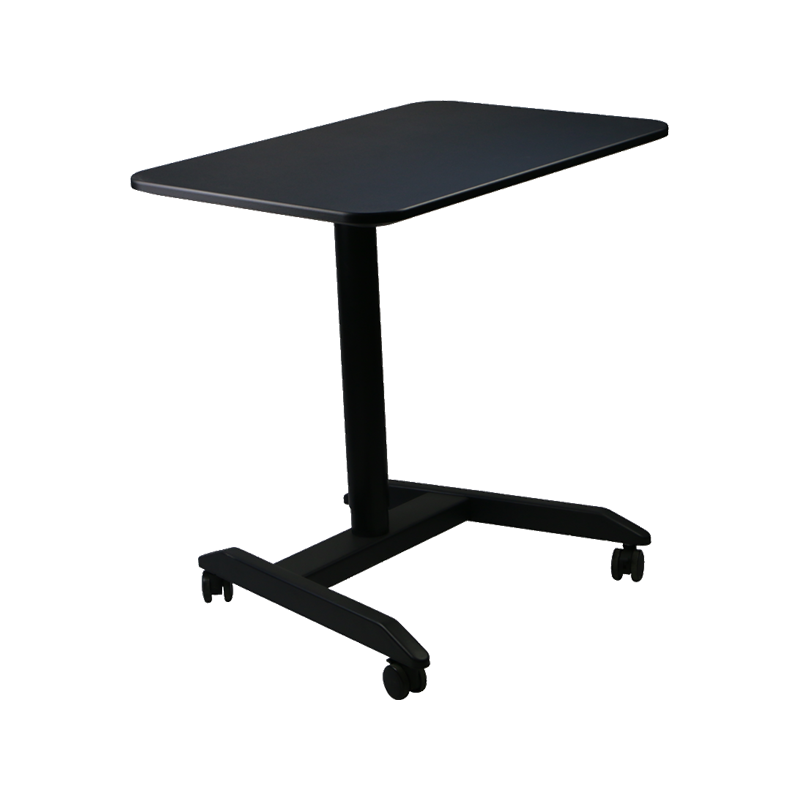
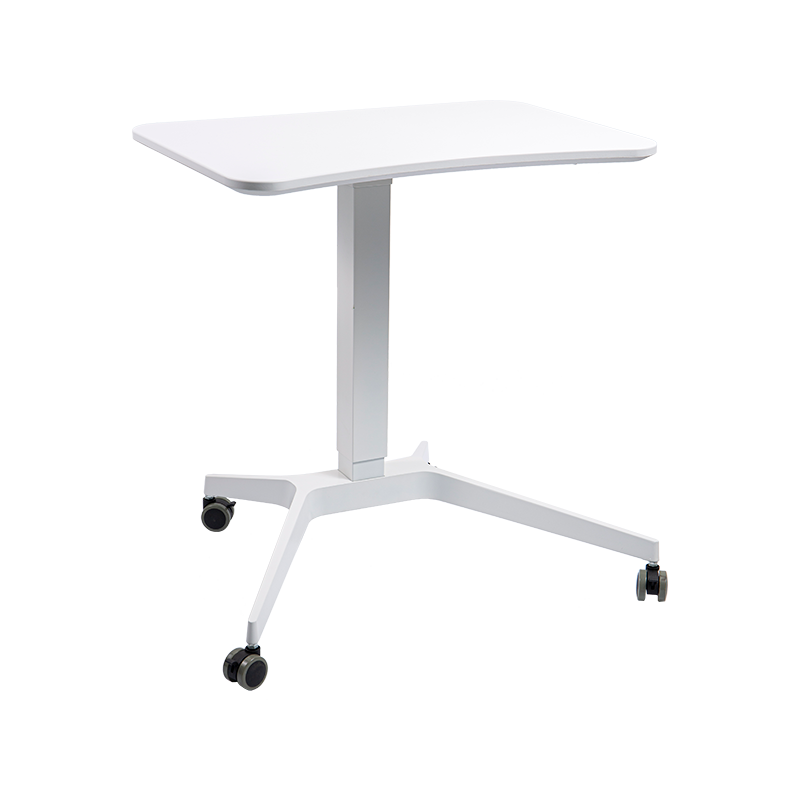
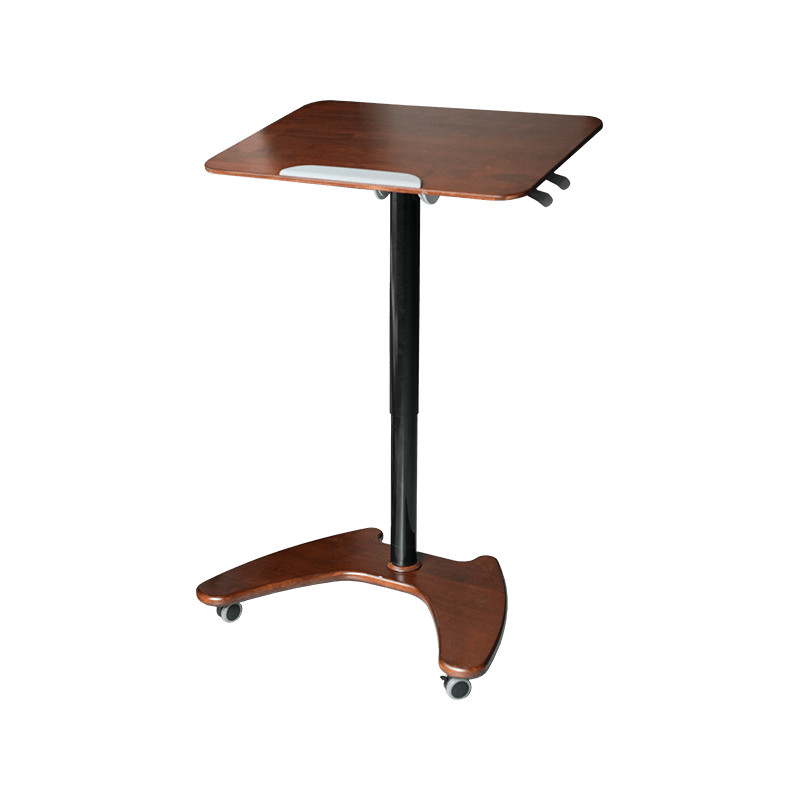
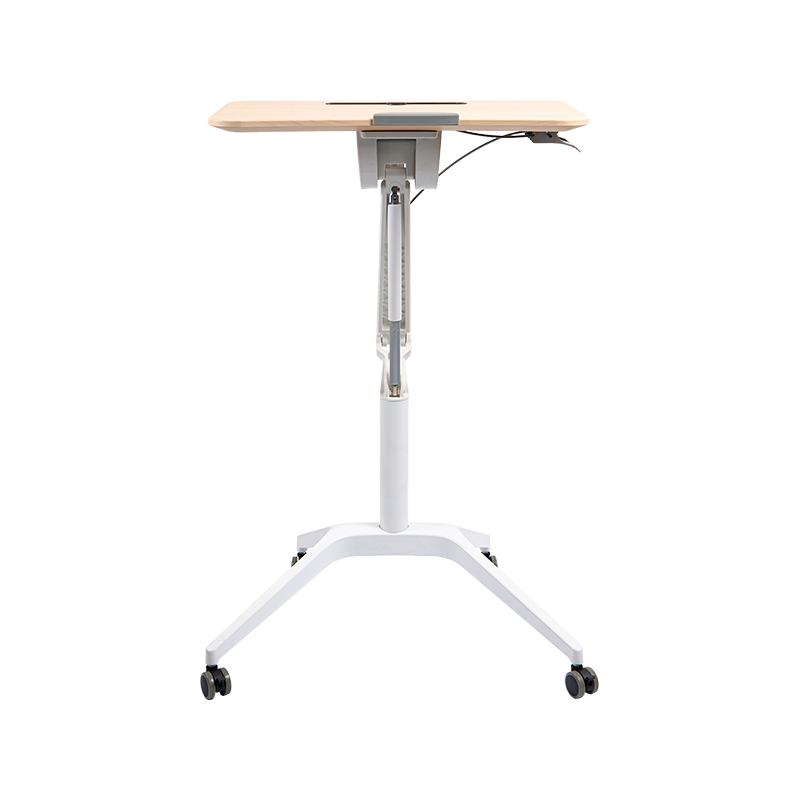
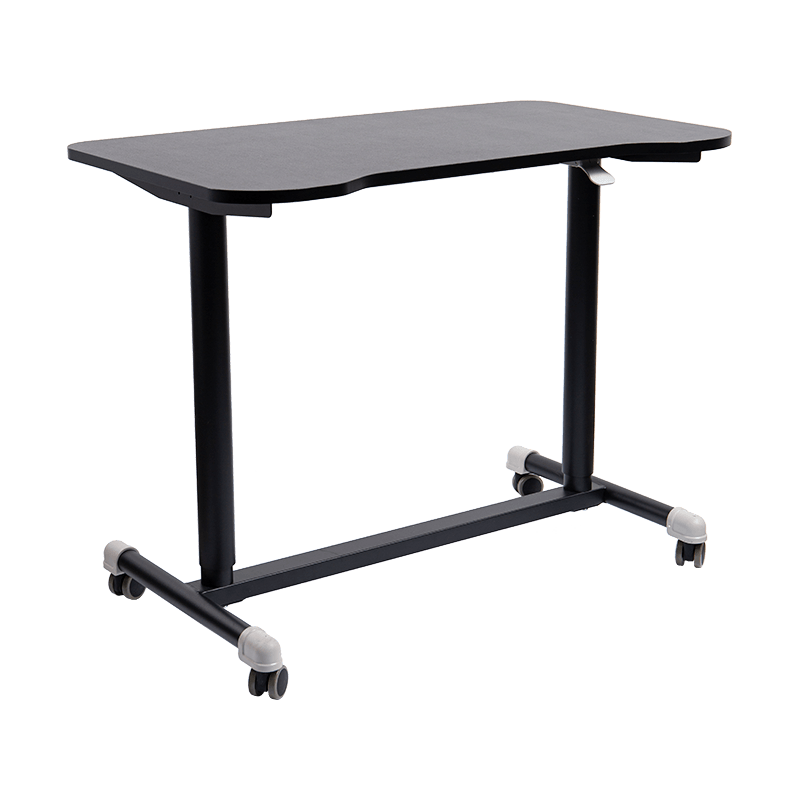
SK06 (Fold-Eight Leg Column) Pneumatic Height-Adjustable Desk
Advantages Over Electric Height-Adjustable Desks
Electric height-adjustable desks are popular, but they are not ideal for every application. Their performance depends on access to electrical power, and their installation often requires attention to cable routing. If a desk must be moved regularly, the power cord can become an inconvenience or create a potential obstruction.
The SK06’s gas spring system operates without a motor or external power supply. This makes the product suitable for locations where outlets are limited, where cables are undesirable, or where furniture must be repositioned often. It may also be useful in temporary spaces that do not justify permanent electrical installation.
Mechanical adjustment can be easier to understand for users who do not need electronic controls. A pneumatic desk does not require a digital display, memory presets, a control keypad, or software-related functions. The design is focused on the essential purpose of height adjustment: changing the working level efficiently and intuitively.
The absence of a motorized lifting assembly may also support a simpler service strategy. Electrical desks contain multiple components that may require inspection or replacement over time. The SK06 concentrates its adjustment function in the gas spring and associated mechanical structure. Correct product handling, appropriate loading, and regular inspection remain important, but the overall operating concept is comparatively straightforward.
Another advantage is flexibility during room planning. A mobile pneumatic desk can be used in settings where desks are moved between zones or stored when not required. It can be repositioned without first disconnecting a power cable. This characteristic is valuable in training rooms, multipurpose classrooms, demonstration areas, and collaborative workspaces.
The product is not intended to replace every electric desk. Electric models may be preferred where programmable height memory, powered lifting under heavy loads, or integrated charging features are required. However, for customers prioritizing mobility, simple operation, power-free adjustment, and compact design, the SK06 provides a practical alternative.
Structural Design and Material Selection
The main frame uses aluminum and iron, combining the characteristics of two widely used engineering materials. Aluminum contributes to a relatively light and manageable structure, while iron provides the strength required in key support areas. This composite approach is appropriate for a mobile desk that must be moved but still remain stable during use.
The fold-eight leg column configuration gives the product a distinctive support arrangement. A well-designed leg structure distributes loads from the desktop toward the base and helps control movement during daily work. The design is especially relevant for a compact mobile workstation because the support system must balance a small footprint with dependable stability.
The frame receives a black powder-coated finish. Powder coating is a dry finishing process in which a coating material is applied to a prepared metal surface and cured to form a durable layer. Compared with an untreated metal surface, a powder-coated frame generally offers improved resistance to ordinary abrasion, surface contamination, and environmental exposure.
The black finish creates a neutral appearance that can coordinate with office furniture, laboratory equipment, classroom interiors, and home furnishings. It also gives the metal structure a consistent visual treatment, helping the desk present a finished appearance in professional environments.
The desktop is made from 25mm MDF with a PVC vacuum-formed surface. MDF provides a uniform engineered-wood substrate, while the PVC surface contributes a protective and decorative outer layer. Vacuum forming allows the surface material to follow the desktop profile closely, supporting a neat finish around the working area.
Two panel colors are offered: walnut and black. Walnut provides a warmer wood-inspired appearance, which may suit offices, reception areas, home studios, and creative environments. Black creates a more minimal and technical appearance, suitable for modern offices, classrooms, laboratories, and control rooms.
Material selection affects not only appearance but also everyday usability. The desktop must accommodate routine contact with computers, writing materials, documents, and personal equipment. The frame must withstand repeated movement and adjustment. The wheels must support relocation and stationary use. By combining engineered board, PVC lamination, aluminum, iron, powder coating, and casters, the SK06 is configured for practical daily operation.
Mobility Without Sacrificing Practical Stability
Mobile furniture is useful only when it can be controlled once placed. The SK06 addresses this requirement with four casters, including two lockable units. The non-locking casters allow the desk to roll when repositioning is required, while the locking casters help hold the desk in place during work.
This configuration supports a simple operating sequence. First, the user releases or moves the desk to the desired position. Next, the user aligns the workstation with the room layout and confirms that the working area is clear. Finally, the lockable casters are engaged before work begins. This process makes the desk appropriate for spaces that alternate between mobile and stationary use.
Casters can also simplify cleaning and maintenance. Staff can move the desk away from walls or neighboring furniture to clean the floor and inspect the base. In classrooms and training rooms, several desks can be rearranged for individual work, group discussion, demonstrations, or presentations.
Mobility is particularly valuable for smaller rooms. Instead of dedicating a large permanent area to one activity, users can move the desk when the room’s function changes. A home office can be converted into a creative area, a classroom can be reconfigured for different lessons, and a laboratory support area can be adjusted for different procedures.
Users should nevertheless operate the casters responsibly. Locking the wheels is recommended before using the desk at its elevated position, placing equipment on the desktop, or performing tasks that involve repeated contact with the surface. The desk should also be moved on suitable flooring and should not be pushed with excessive force or overloaded during relocation.
Ergonomic Benefits for Different Users
Ergonomics is not limited to the shape of an office chair. The relationship between the user, desktop, monitor, keyboard, documents, and floor position also affects comfort. If a work surface is too high, the user may raise the shoulders or bend the wrists. If it is too low, the user may lean forward or round the back. An adjustable desk allows the working height to be matched more closely to the individual.
The SK06’s 720mm to 1150mm range can accommodate a variety of seated and standing tasks. A seated user can lower the desk to coordinate with a chair and keyboard. A standing user can raise the desk to a level that supports more neutral positioning of the arms. The ideal setting should be selected according to the user and the equipment being used.
Changing posture throughout the day can also make work feel more dynamic. Users may sit for focused computer tasks, raise the desk for reading or reviewing materials, and adjust it again for collaborative discussions. This flexibility is useful where work activities vary frequently.
In shared workplaces, height adjustment reduces the compromise required when one workstation serves many people. Each user can make a personal adjustment rather than accepting a single height selected for an average user. In educational settings, the desk can support different age groups or activities. In laboratories and control rooms, it can accommodate observation, documentation, and equipment handling.
Height adjustment should be combined with good ergonomic habits. Users should position screens at a comfortable viewing level, keep frequently used tools within easy reach, avoid excessive loads, and alternate between postures rather than standing continuously. The desk provides an adaptable platform, while the user remains responsible for selecting an appropriate configuration.
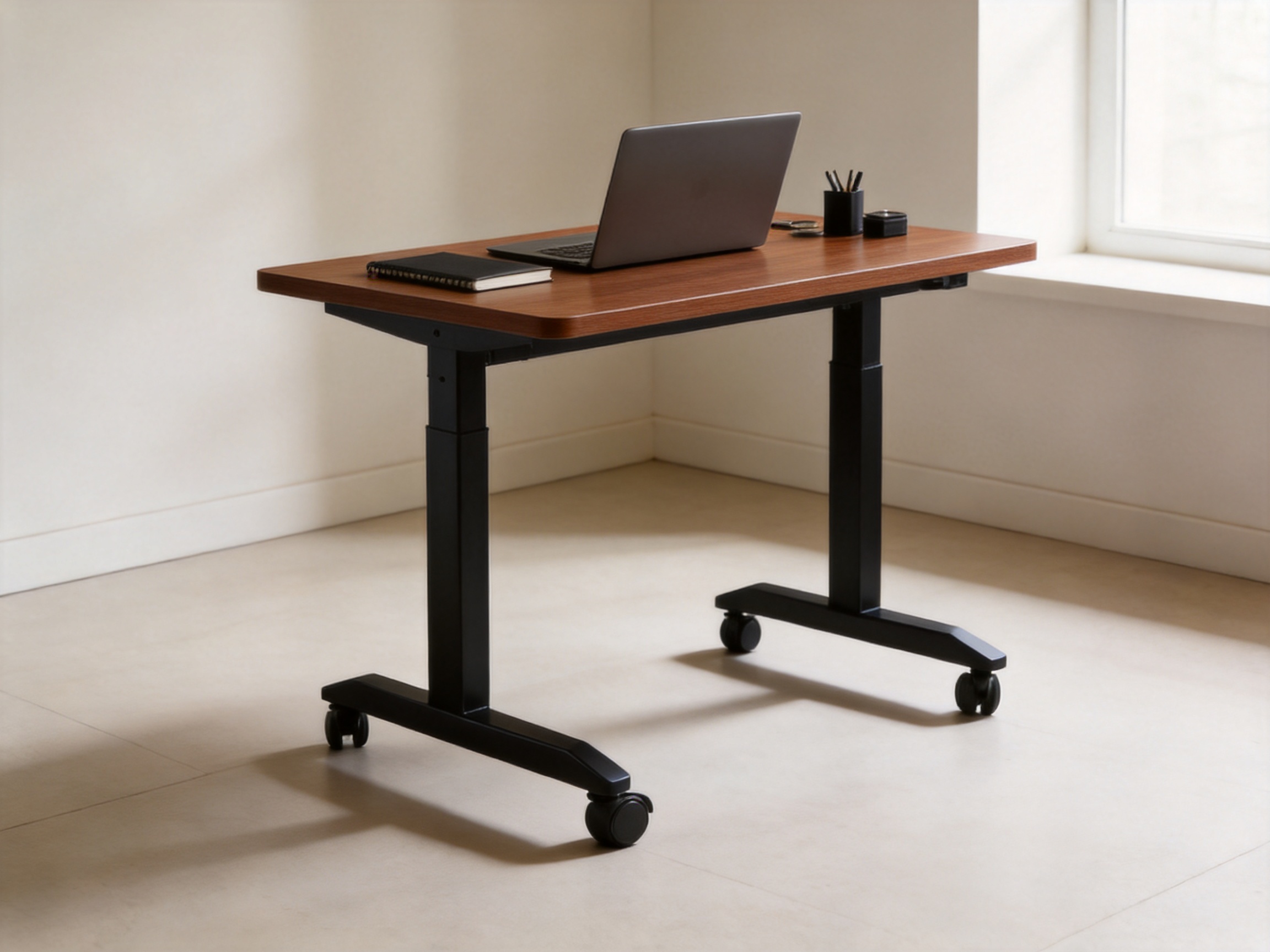
The SK06 can serve as a compact personal workstation in an office. Its modest desktop footprint makes it suitable for laptop work, short-duration administrative tasks, hot-desking areas, and satellite workstations. The caster base allows facilities teams to reorganize the office without lifting a heavy fixed table.
In a shared office, the pneumatic height adjustment supports different users without requiring separate desks for every posture preference. The walnut and black desktop options also allow the desk to coordinate with different interior themes. The black frame provides a consistent foundation even when different desktop colors are selected.
The product can also be used as a meeting-side table or temporary project station. A team may move several desks together for collaborative work and separate them for individual assignments. When floor space is needed for an event, the desks can be moved to the side of the room more easily than fixed furniture.
Home offices can benefit from the same features. A compact desk is easier to place in a bedroom, living room, study, or multipurpose space. The absence of a motor power cord may help maintain a cleaner appearance, particularly where the desk is placed away from a wall outlet.
Applications in Education and Training
Educational environments often need furniture that can support many types of teaching. A classroom may be arranged for individual writing, computer work, group projects, practical demonstrations, or presentations. Mobile height-adjustable desks make these transitions easier.
The SK06 can function as a student workstation, teacher support table, demonstration surface, or equipment stand. The compact desktop helps preserve circulation space, while the casters allow the furniture layout to change according to the lesson plan.
The pneumatic mechanism can also be useful in training rooms where users have different physical characteristics. Rather than providing a single fixed level, the desk can be adjusted for each activity. The simple mechanical operating principle may be advantageous in facilities where staff prefer equipment that does not require electronic instruction or power management.
When used in educational settings, personnel should ensure that caster locks are engaged before writing, typing, or placing equipment on the desk. The desk should also be adjusted by trained users, and children should be supervised when operating the lifting mechanism.
Applications in Laboratories and Control Rooms
Laboratories and control rooms frequently require work surfaces that can support observation, documentation, monitoring, and equipment handling. The user may need to sit during data entry and stand during inspection or communication. A height-adjustable desk can support these changing requirements.
The SK06’s powder-coated frame and PVC-finished desktop offer a practical surface for general-purpose tasks. Its mobile base makes it possible to position the desk near an instrument, monitoring area, or temporary project zone. When the task changes, the desk can be repositioned without dismantling the entire workstation.
In technical environments, the compact surface can be beneficial because it does not unnecessarily obstruct nearby equipment. The desk can hold a laptop, notebook, keyboard, control documents, or small accessories while leaving more floor area available for other systems.
The product should be evaluated against the specific environmental requirements of each laboratory or control room. If a facility requires specialized chemical resistance, cleanroom compliance, grounding, high-load capacity, or other technical certifications, those requirements should be confirmed before purchase. The SK06 is presented as a flexible pneumatic workstation for general applications rather than as a substitute for every specialized technical bench.
Manufacturing Strengths and Production Approach
The manufacturer behind the product specializes in the research and development, production, sales, and service of standing desks. Its location in Suzhou places it within the Yangtze River Delta furniture industry, an area known for an extensive manufacturing supply network and access to multiple furniture-related production capabilities.
This industrial environment can support a coordinated approach to product development. A height-adjustable desk involves multiple parts and processes, including metal fabrication, surface finishing, desktop production, caster integration, pneumatic mechanism assembly, inspection, packaging, and after-sales support. A company operating within a developed furniture manufacturing region can coordinate these activities more efficiently than a supplier focused on only one isolated component.
The SK06 demonstrates the importance of cross-disciplinary manufacturing. Its performance depends on the relationship between the frame, leg structure, gas spring, desktop, casters, and surface finishes. A desk is not simply a tabletop attached to legs; it is a system that must remain functional during adjustment, relocation, and repeated daily use.
The product development process begins with defining the intended use. The compact tabletop, pneumatic adjustment, caster layout, and height range indicate a focus on flexible workspaces. Product engineering must then consider the geometry of the column and legs, the integration of the gas spring, the position of the casters, the thickness of the desktop, and the visual relationship between the frame and panel.
Material preparation is another important stage. Aluminum and iron components must be processed to the required dimensions and prepared for assembly. The MDF desktop must be cut and finished before the PVC surface is applied. The gas spring and caster components must be selected and integrated to match the intended operating range and structure.
Surface treatment contributes to both appearance and durability. The black powder-coated frame requires suitable preparation, controlled coating, and curing. A consistent finish helps protect the metal surface and ensures that products maintain a uniform appearance across production batches.
The desktop surface requires attention to edge quality, lamination consistency, and visual appearance. Vacuum forming is used to shape the PVC material over the MDF substrate. Proper control of this process helps reduce visible defects and supports a clean, continuous surface suitable for office and institutional use.
Assembly is where individual components become a working desk. The frame, column, legs, gas spring, tabletop, and casters must be aligned correctly. The lifting action should be checked through its operating range, and the wheel locks should be inspected for proper engagement. A systematic assembly procedure helps reduce variation between units.
Quality inspection should cover both appearance and function. Visual inspection can identify coating inconsistencies, scratches, edge defects, or surface irregularities. Functional inspection can verify height adjustment, caster movement, locking behavior, structural alignment, and the general stability of the assembled product.
Packaging is also important for a product containing finished metal surfaces and a decorative desktop. Protective materials should reduce the likelihood of impact damage during handling and transportation. Clear assembly instructions and organized components can help customers complete installation efficiently.
The manufacturer’s combined focus on product development, production, sales, and service is valuable for business customers. Buyers often need more than a single shipment. They may require product selection support, color coordination, packaging communication, order follow-up, and after-sales assistance. A supplier with capabilities across these stages can provide a more complete purchasing experience.
Customization and Project Support
Furniture used in commercial projects often needs to fit a specific room, brand environment, or procurement program. The SK06 is offered with walnut and black desktop color options, giving buyers a starting point for interior coordination. The black frame provides a consistent base across both panel selections.
For larger orders, customers may wish to discuss project-specific requirements such as packaging, labeling, quantities, delivery schedules, color coordination, or installation instructions. Any customization should be confirmed with the manufacturer before order placement. The company’s stated focus on custom ergonomic adjustable office tables indicates that it is positioned to discuss customer-specific furniture requirements.
Customization should preserve the functional relationship between the desktop, lifting system, frame, and casters. Changes to desktop size, weight, or material can affect the performance of the pneumatic mechanism and the stability of the structure. Professional review is therefore recommended before making modifications.
For distributors and commercial furniture suppliers, the product can be evaluated as part of a broader adjustable-desk portfolio. Its pneumatic, mobile design complements electric standing desks and fixed-height tables by serving customers who need a different combination of portability, simplicity, and compactness.
Installation, Operation, and Care
Before use, the desk should be assembled according to the supplied instructions. All frame connections, tabletop fasteners, caster fittings, and operating components should be checked. The desk should be placed on a suitable level surface, and the caster locks should be tested before equipment is added.
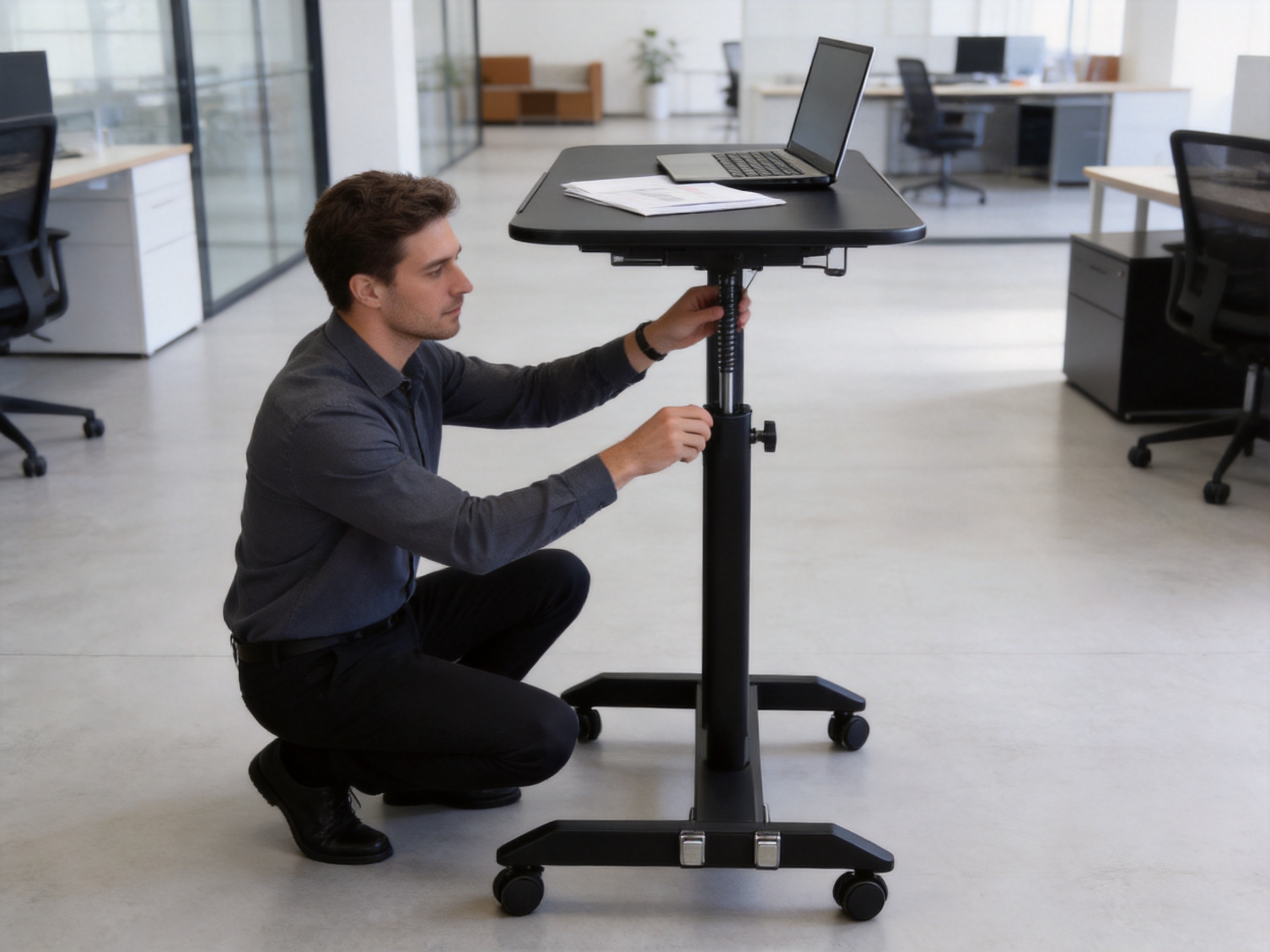
To adjust the height, the user should follow the release and lifting method specified for the product. The desktop should be moved in a controlled manner, with hands and objects kept clear of moving sections. Users should avoid forcing the mechanism or applying uneven pressure to one side of the desktop.
The desk should not be overloaded beyond its intended operating capacity. Heavy equipment should be positioned carefully and distributed as evenly as possible. The product is designed as a compact workstation, so users should distinguish between ordinary office equipment and unusually heavy machinery.
Routine care can include wiping the desktop with a soft, suitable cloth, removing dust from the frame, and checking the casters for debris. The wheel locks should be inspected periodically to confirm that they engage and release correctly. Fasteners may also be checked during scheduled facility maintenance.
Avoid harsh cleaning chemicals unless their compatibility with the MDF, PVC surface, powder-coated frame, and metal components has been confirmed. Standing water should not be left on the desktop or frame. If the desk is used in a demanding environment, the facility should establish a cleaning and inspection procedure suited to that location.
Comparison with Alternative Desk Types
| Desk type | Height adjustment | Mobility | Power requirement | Best suited to |
|---|---|---|---|---|
| Fixed-height desk | None or very limited | Usually limited | None | Stable, dedicated workstations |
| Electric standing desk | Motorized | Usually limited to moderate | Required | Frequent powered adjustment and preset heights |
| Manual crank desk | Hand-crank adjustment | Usually limited | None | Workstations needing mechanical adjustment |
| SK06 pneumatic desk | Gas spring assisted | Four casters, two lockable | Not required for lifting | Mobile, shared, compact, and flexible workspaces |
This comparison shows that the SK06 occupies a specific position in the furniture market. It is more adaptable than a fixed table, less dependent on infrastructure than an electric desk, and potentially more convenient to operate than a hand-crank model. Its strongest competitive qualities are the combination of pneumatic adjustment, a compact desktop, and integrated mobility.
The product may be especially attractive to customers who do not need electronic memory functions but still want a height-adjustable workstation. It can also serve as an additional solution for projects where electric desk wiring would complicate installation or where movable furniture is more valuable than maximum lifting capacity.
Purchasing Considerations for Commercial Buyers
Commercial buyers should first identify how the desk will be used. Important questions include whether the desk will be shared, how often it will be moved, what equipment will be placed on it, whether seated and standing tasks will alternate, and whether the room layout changes frequently.
The available height range should be compared with the expected user group. A desk beginning at 720mm and extending to 1150mm can support many office and institutional applications, but buyers should evaluate the needs of unusually tall users, specialized equipment, or tasks requiring heights outside this range.
Desktop capacity should also be considered. The 715mm by 495mm surface is designed for compact workstation use. It is suitable for essential equipment and personal materials, but buyers requiring multiple large monitors, extensive paperwork, or large instruments may need a larger work surface or a different product category.
Mobility requirements should be discussed with facility managers. Two locking and two non-locking casters support relocation and positioning, but the floor condition, thresholds, ramps, and room layout can influence practical mobility. Buyers should ensure that the intended environment is suitable for a caster-based desk.
Color and visual coordination may be important in offices, schools, healthcare-adjacent areas, studios, and customer-facing locations. Walnut and black desktop choices provide basic flexibility, while project buyers should confirm available quantities, sample consistency, and packaging details for larger orders.
Frequently Asked Questions
What type of desk is the SK06?
The SK06 is a pneumatic height-adjustable desk with a fold-eight leg column structure. It is designed for flexible workspaces that require both height adjustment and mobility.
How is the height adjusted?
The desk uses a gas spring lifting mechanism. This provides assisted mechanical adjustment without requiring an electric motor or power connection for the lifting function.
What is the height range?
The specified lifting range is 720mm to 1150mm. Users can select a suitable working level within this range according to their height, chair, equipment, and task.
Does the desk require electricity?
The pneumatic lifting mechanism does not require electricity to operate. This makes the desk useful in locations where power outlets are limited or where users prefer to avoid desk power cords.
What are the desktop dimensions?
The desktop measures 715mm by 495mm and is 25mm thick. It is intended for compact workstation use, including laptops, documents, monitors, and personal equipment.
What is the desktop made from?
The desktop consists of a 25mm MDF base with a PVC vacuum-formed surface. The available panel colors are walnut and black.
What materials are used in the frame?
The main frame uses aluminum and iron. It is finished with a black powder coating to provide a consistent appearance and a protective surface treatment.
Can the desk be moved?
Yes. The desk includes four casters: two with locking functions and two without locks. The casters allow the desk to be repositioned, while the locking units help secure it during use.
Where can the desk be used?
Potential applications include offices, shared workstations, classrooms, home offices, creative studios, laboratories, and control rooms where a compact and adaptable work surface is needed.
Yes. Its adjustable height allows different users to select a comfortable position, and its casters make it easier to reorganize the room or move the desk between work areas.
How does it compare with an electric standing desk?
The SK06 uses gas spring assistance rather than a motor. It does not require electrical power for height adjustment and offers a simpler, more mobile configuration. Electric desks may be preferable when users require programmable presets or powered lifting for heavier loads.
What should users check before operating the desk?
Users should confirm that the desk is properly assembled, the lifting mechanism operates smoothly, the casters are securely fitted, and the locking casters engage correctly. The desk should be used on a suitable surface and within its intended loading conditions.
Can the desktop or frame be customized?
The product is available with walnut and black desktop options. Customers seeking project-specific modifications should discuss requirements with the manufacturer before ordering, because changes in desktop size, weight, or materials may affect the lifting and stability characteristics.
Conclusion
The SK06 Fold-Eight Leg Column Pneumatic Height-Adjustable Desk is designed for customers seeking a compact, mobile, and mechanically adjustable workstation. Its gas spring lifting system provides a 720mm to 1150mm adjustment range without relying on an electric motor. Its four-caster base supports relocation, while two locking casters help maintain a stable position during use.
The product’s aluminum-and-iron frame, black powder-coated finish, 25mm MDF desktop, PVC vacuum-formed surface, and walnut or black panel options create a practical combination of structure, appearance, and usability. Compared with fixed desks, it offers greater adaptability. Compared with electric height-adjustable desks, it eliminates the need for power during adjustment. Compared with many non-mobile workstations, it is easier to reposition in changing environments.
Its strongest applications include offices, shared workspaces, classrooms, home offices, studios, laboratories, and control rooms. In each of these settings, the value of the desk comes from the relationship between height flexibility, compact dimensions, and mobility. It is not merely an adjustable tabletop; it is a workstation designed to support changing users, tasks, and room arrangements.
The manufacturing approach behind the product also reflects the requirements of modern furniture production. Metal processing, powder coating, MDF and PVC desktop fabrication, pneumatic component integration, caster installation, assembly, inspection, packaging, and customer service must work together to deliver a dependable finished product. The manufacturer’s focus on standing desks and custom ergonomic office furniture provides a foundation for serving both standard orders and project-oriented requirements.
For buyers who need a practical alternative to powered standing desks, the SK06 offers a clear value proposition: assisted pneumatic adjustment, no lifting power cord, compact workspace dimensions, integrated casters, and a professional appearance. These characteristics make it a strong candidate for flexible work environments where efficiency, adaptability, and space optimization are essential.
References
1. Product specification sheet for the SK06 Fold-Eight Leg Column Pneumatic Height-Adjustable Desk.
2. Manufacturer-provided information concerning pneumatic lifting, desktop construction, materials, surface treatment, caster configuration, and application areas.
3. General principles of ergonomic workstation planning and posture variation.
4. General manufacturing principles for powder-coated metal furniture frames.
5. General material and processing principles for MDF substrates, PVC surface lamination, and vacuum forming.
6. General guidance for the selection and use of mobile furniture in offices, classrooms, studios, laboratories, and shared workspaces.
Product: SK06 (Fold-Eight Leg Column) Pneumatic Height-Adjustable Desk


- Contact Info
-
-
 Phone+86-15950656125
-
 Email
-
 AddressRoom 1007-1, South Building, Suyue Plaza, Suzhou Industrial Park, Suzhou City, Jiangsu Province, China
-
- Products
- Follow Us
- Need help? Please contact us
Copyright ©
SuZhou Skyhone Intelligent Technology Co., Ltd.
All Rights Reserved.
Privacy
Custom Ergonomic Adjustable Office Tables Manufacturers

