

 English
  русский
  Español
  عربى
عربى 
Content
- 1 1. The Evolution of Workspace Ergonomics: Why Adjustable Desks Matter
- 2 2. TH11 Pneumatic Height-Adjustable Desk: Core Features and Specifications
- 3 3. TH11 vs Competitors: What Makes It the Best Choice?
- 4 4. Manufacturing Excellence: The Backbone of TH11’s Quality
- 5 5. Real-World Applications: Where the TH11 Shines
- 6 6. Frequently Asked Questions (FAQs)
- 6.1 Q1: How do I adjust the height of the TH11 desk?
- 6.2 Q2: What is the maximum weight capacity of the TH11 desk?
- 6.3 Q3: How often do I need to maintain the TH11 desk?
- 6.4 Q4: Can I customize the TH11 desk?
- 6.5 Q5: Is the TH11 desk suitable for outdoor use?
- 6.6 Q6: What is the warranty period for the TH11 desk?
- 6.7 Q7: How easy is it to assemble the TH11 desk?
- 7 7. References
The Future of Ergonomic Workspaces: A Deep Dive into the TH11 Pneumatic Height-Adjustable Desk
2026-04-18
For decades, office workers and remote professionals have grappled with the hidden health risks of sedentary work: chronic back pain, neck strain, reduced blood circulation, and even long-term conditions like obesity and cardiovascular disease. According to the World Health Organization (WHO), over 60% of adults globally fail to meet daily physical activity guidelines, with sedentary behavior accounting for 3.2 million deaths annually. This crisis has spurred a revolution in workspace design, with adjustable height desks emerging as a leading solution to promote movement and ergonomic health. Among the countless options on the market, one product stands out for its innovative design, user-centric features, and exceptional value: the TH11 Pneumatic Height-Adjustable Desk. Unlike electric models that rely on power outlets or basic pneumatic desks that lack key functionalities, the TH11 combines smooth gas spring adjustment, a tiltable main panel, and durable materials to redefine what a modern workspace should be. In this article, we will explore the TH11’s core features, how it outperforms competitors, the manufacturing excellence behind its production, and its real-world applications across industries.
1. The Evolution of Workspace Ergonomics: Why Adjustable Desks Matter
1.1 The Health Crisis of Sedentary Work
Sedentary work—defined as sitting for more than 8 hours daily—has become a global epidemic. A 2023 study published in the *Journal of Occupational and Environmental Medicine* found that office workers who sit for 10+ hours daily are 2.5 times more likely to develop musculoskeletal disorders than those who alternate between sitting and standing. These disorders include lower back pain (affecting 60% of sedentary workers), neck stiffness, and carpal tunnel syndrome. Beyond physical health, sedentary behavior also impacts mental well-being: prolonged sitting is linked to increased stress, fatigue, and reduced cognitive function. As remote work becomes the norm (with 34% of U.S. workers now fully remote, per Bureau of Labor Statistics data), the need for solutions that encourage movement has never been greater.
1.2 The Rise of Adjustable Desks
Adjustable height desks have emerged as a game-changer in workspace design, offering users the flexibility to switch between sitting and standing positions throughout the day. Research from Ergonomics Australia shows that using a sit-stand desk can reduce back pain by 32% and increase productivity by 15% (due to improved blood flow and alertness). However, not all adjustable desks are created equal: electric models often come with high price tags and require power outlets, while basic pneumatic desks lack durability and key features like tilt functionality. The TH11 fills this gap, combining the best of both worlds—affordability, portability, and advanced features—without compromising on quality.
2. TH11 Pneumatic Height-Adjustable Desk: Core Features and Specifications
2.1 Key Specifications
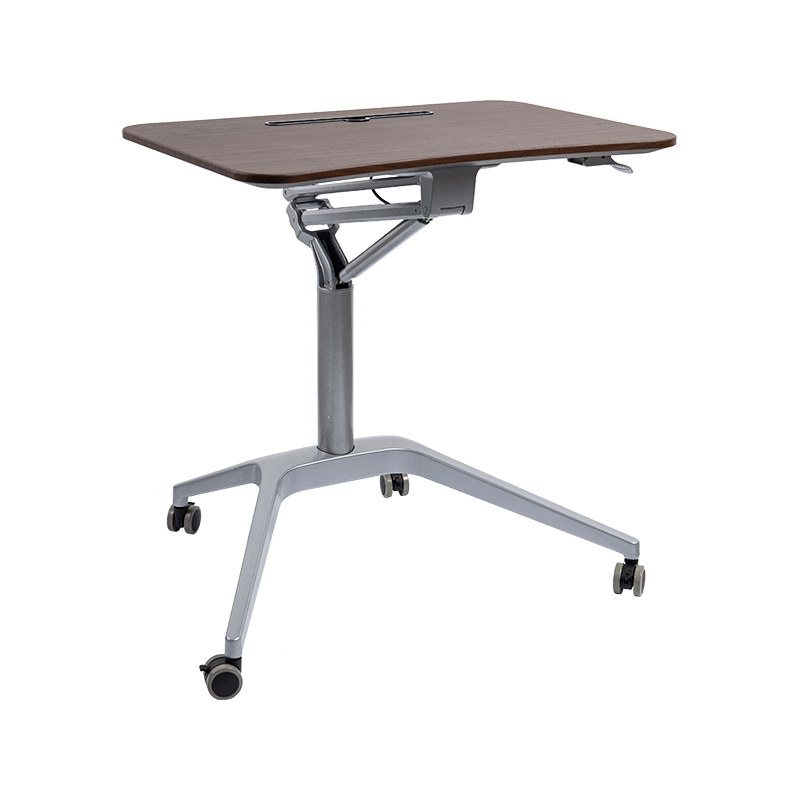
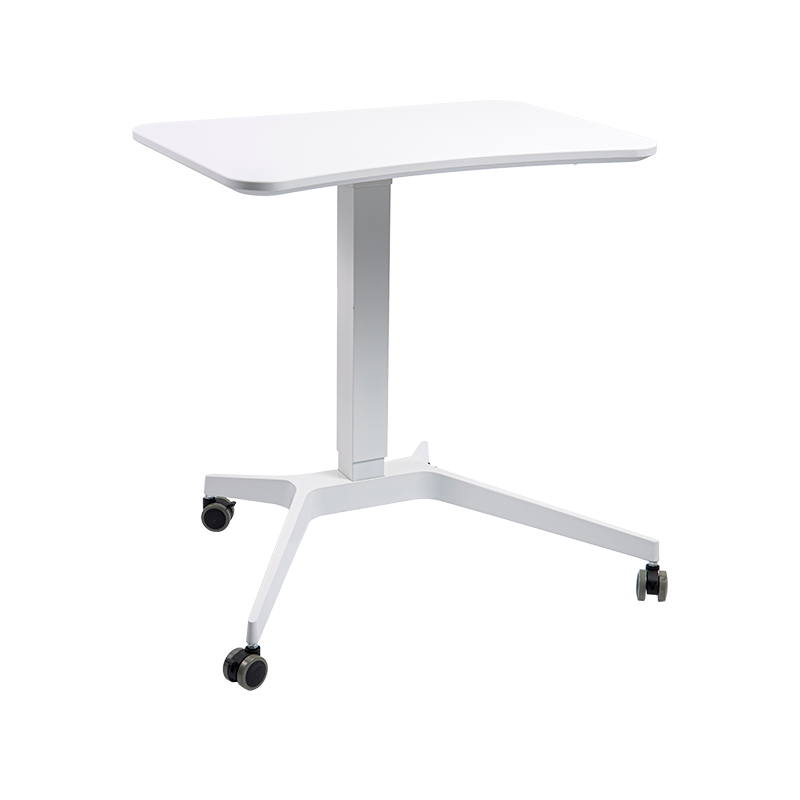
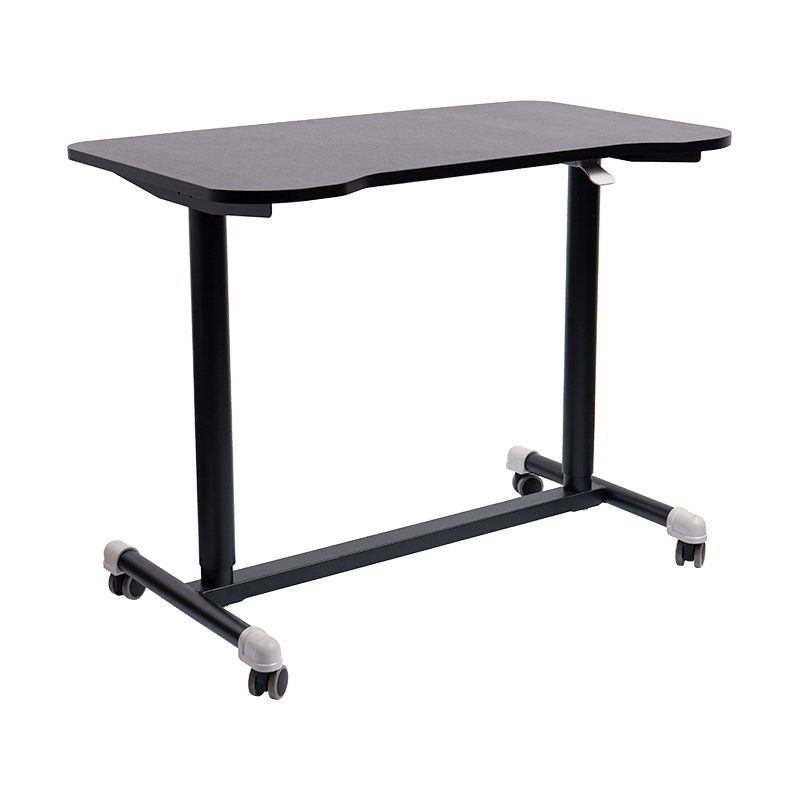
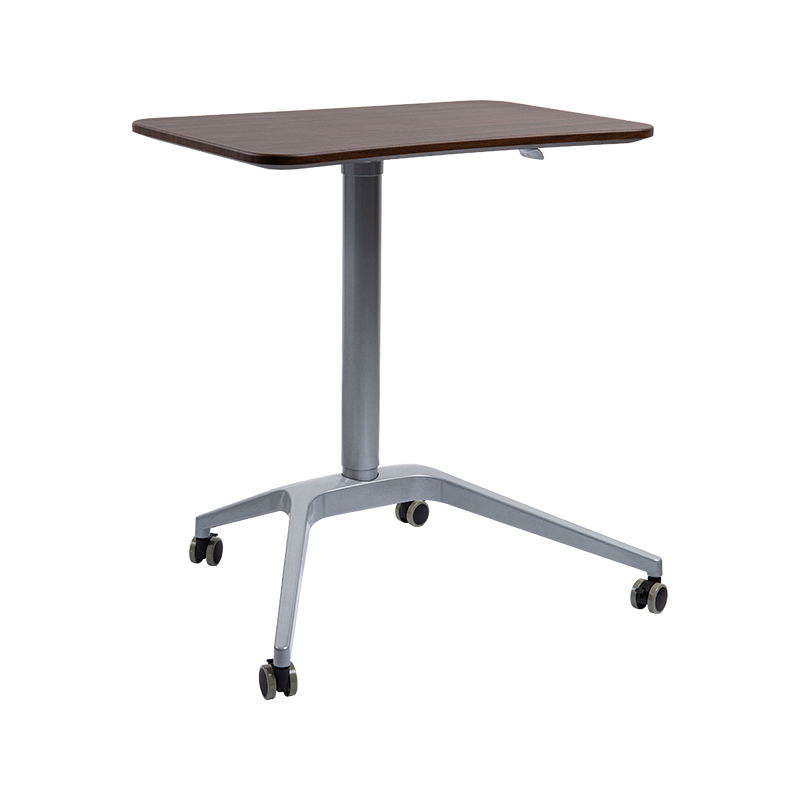
The TH11 is engineered to meet the needs of diverse users, from remote workers to industrial technicians. Its core specifications include:
- Lifting Range: 700mm to 1100mm (27.6 inches to 43.3 inches)—covers the height range of 95% of adults, from 5’0” to 6’5”.
- Tabletop Dimensions: 760mm × 400mm × 25mm (main panel) + 760mm × 20mm (extension panel)—provides ample space for a laptop, monitor, and stationery, with an extension for additional items like a printer or books.
- Tabletop Material: 25mm MDF (medium-density fiberboard) with PVC vacuum forming—durable, scratch-resistant, and easy to clean, with a smooth surface that prevents wrist strain.
- Frame Material: Aluminum + Iron—aluminum reduces weight (making the desk easy to move) while iron adds structural strength, ensuring stability even at maximum height.
- Surface Treatment: White powder coating—eco-friendly, corrosion-resistant, and aesthetically pleasing, blending seamlessly with any workspace decor.
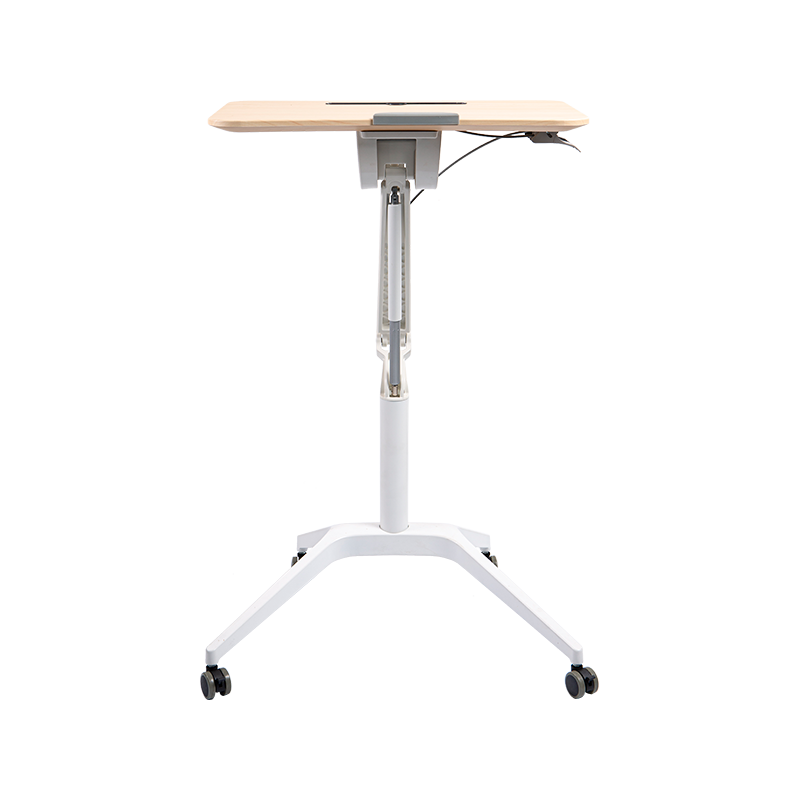
- Mobility: 2 concealed casters + 2 leveling feet—hidden casters allow for quiet, easy movement, while leveling feet provide stability on uneven floors (e.g., concrete or carpet).
- Color Options: White or maple wood (panel finish)—offers flexibility to match office, home, or studio decor.
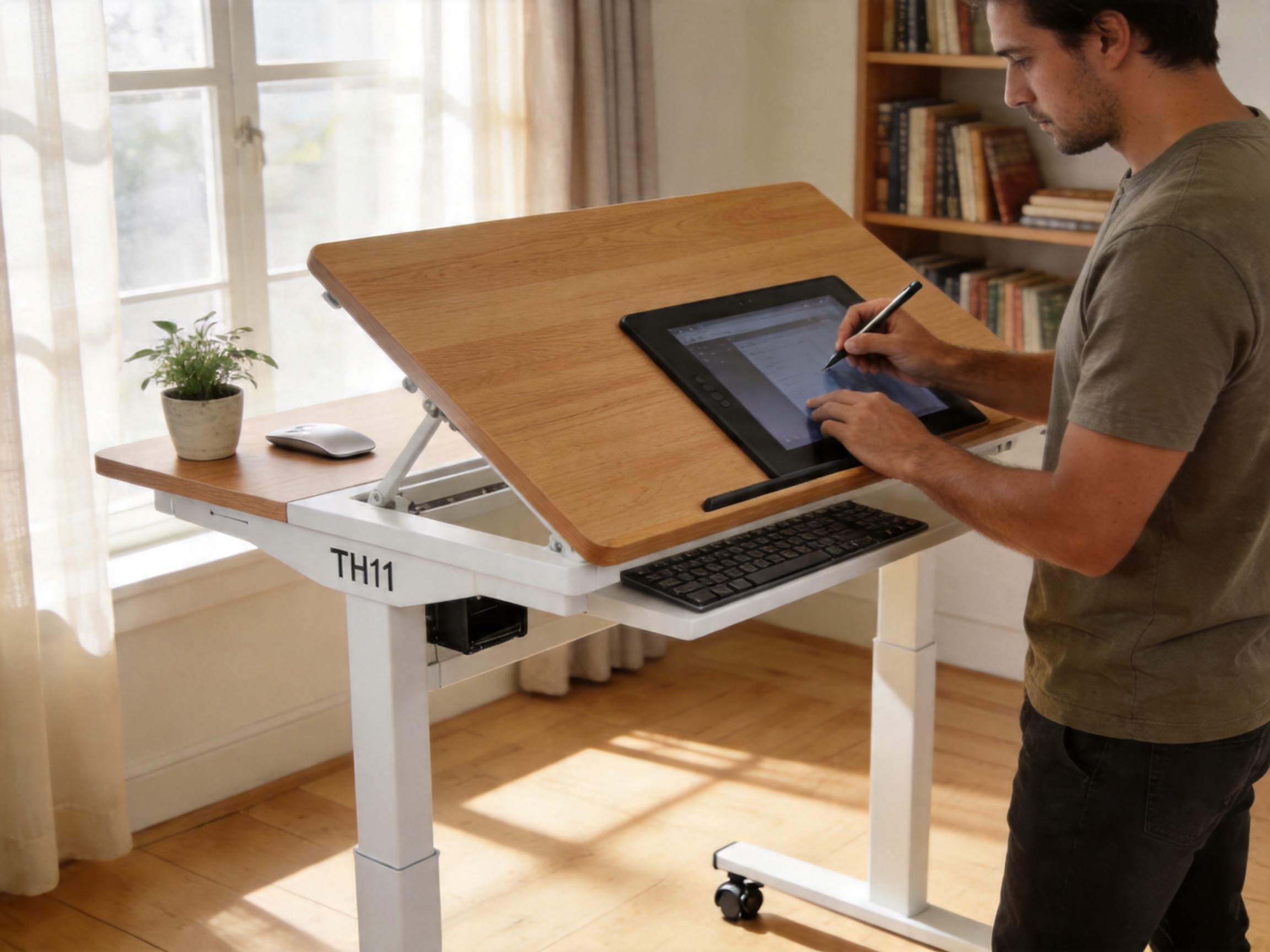
- Working Principle: Gas spring lifting with tilt function—smooth, quiet adjustment without power, plus a tiltable main panel (0° to 30°) for reading, drawing, or using a tablet.
2.2 Design Innovations That Set the TH11 Apart
The TH11’s design is rooted in user feedback, addressing common pain points of other adjustable desks:
- Gas Spring Mechanism: Unlike electric motors (which can be noisy and require maintenance), the TH11 uses a sealed gas spring system that provides 15,000+ lifting cycles (equivalent to 5 years of daily use) without losing pressure. Adjusting the height takes just seconds—press the lever, move the desk to the desired position, and release the lever to lock it in place.
- Tiltable Main Panel: Most adjustable desks lack a tilt function, but the TH11’s main panel can be adjusted to a 30° angle, making it ideal for graphic designers, writers, or anyone who needs to work at an ergonomic angle. This feature reduces neck and shoulder strain by aligning the screen or work surface with the user’s line of sight.
- Concealed Casters: Exposed casters are not only unsightly but also prone to getting caught on carpets or furniture. The TH11’s hidden casters are integrated into the frame, providing a clean look while allowing for smooth movement. When stationary, the leveling feet can be adjusted to stabilize the desk on any surface.
3. TH11 vs Competitors: What Makes It the Best Choice?
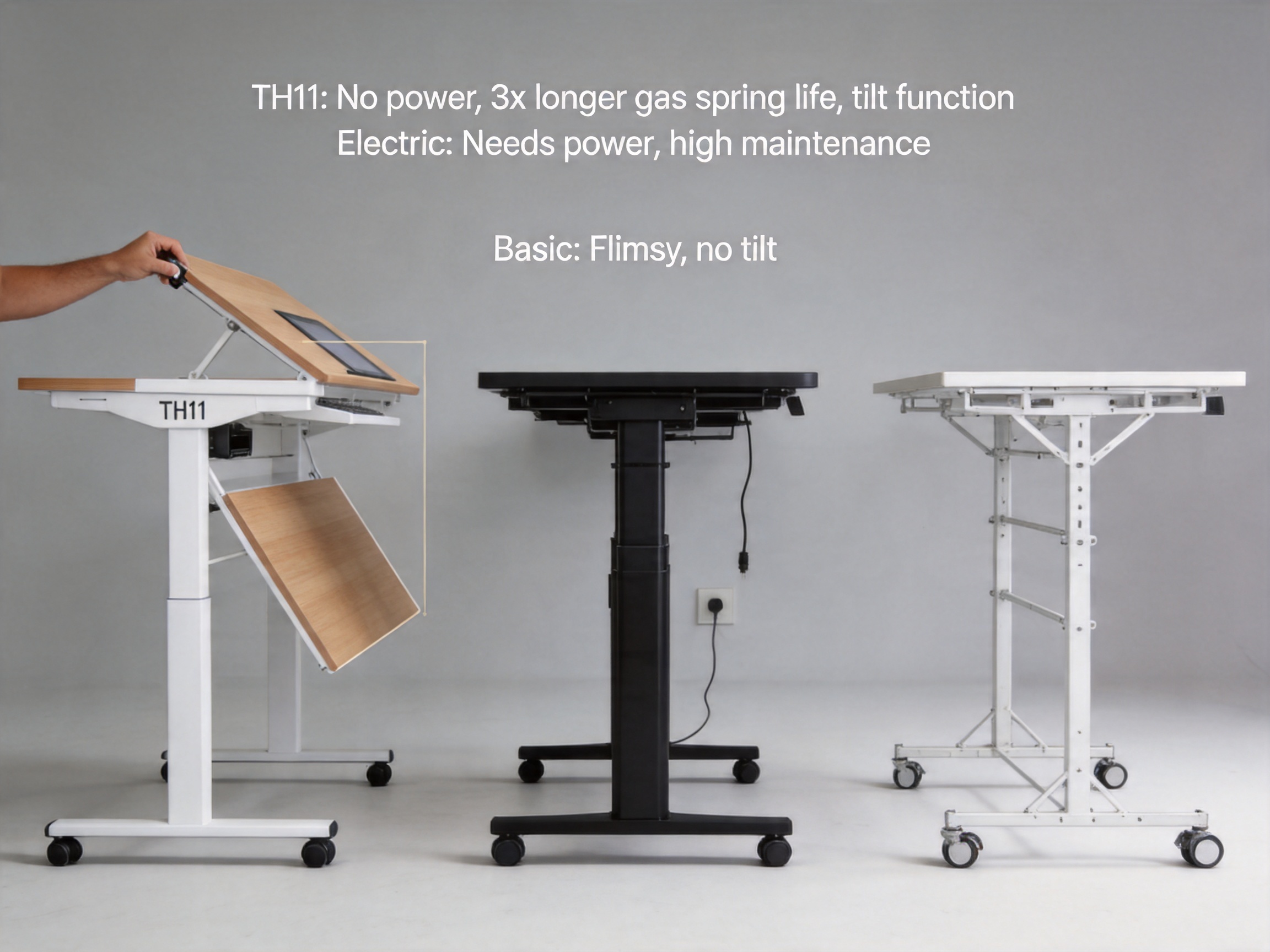
To understand the TH11’s value, it’s essential to compare it to the most common alternatives on the market: electric adjustable desks, basic pneumatic desks, and fixed desks. Below is a detailed comparison table:
| Feature | TH11 Pneumatic Desk | Electric Adjustable Desk | Basic Pneumatic Desk | Fixed Desk |
|---|---|---|---|---|
| Height Adjustment Mechanism | Sealed gas spring (smooth, quiet) | Electric motor (noisy, requires power) | Basic gas spring (uneven movement) | Fixed (no adjustment) |
| Power Requirement | No | Yes (110V/220V) | No | No |
| Tilt Function | Yes (0°–30°) | Rare (additional cost) | No | No |
| Frame Material | Aluminum + Iron (lightweight, sturdy) | Steel (heavy, hard to move) | Cheap steel (flimsy) | Wood/steel (fixed) |
| Mobility | Concealed casters + leveling feet | Fixed (no casters) | Exposed casters (unstable) | Fixed (heavy to move) |
| Color Options | White, Maple Wood | Limited (black/white) | Only white | Limited (wood/metal finishes) |
| Maintenance Cost | Low (no moving parts to repair) | High (motor replacement, wiring) | Medium (cheap parts wear out) | Low (but no adjustment) |
| Price Range | $220–$280 | $350–$600 | $100–$180 | $80–$150 |
3.1 Electric Desks: Convenience vs Limitations
Electric adjustable desks are popular for their push-button adjustment, but they come with significant drawbacks: they require a power outlet (limiting where you can place the desk), are noisy (motor hum can be distracting in quiet environments), and have high maintenance costs (motor failure can cost $100+ to repair). The TH11 eliminates these issues: it doesn’t need power, operates silently, and has no moving parts that require regular maintenance. For example, a remote worker who uses their desk in a living room (without a nearby power outlet) can easily move the TH11 to the kitchen for a change of scenery—something impossible with an electric desk.
3.2 Basic Pneumatic Desks: Cost vs Quality
Basic pneumatic desks are affordable but lack durability and key features. Most use cheap steel frames that wobble at maximum height, and their gas springs lose pressure after just 5,000 cycles (1–2 years of use). The TH11’s aluminum-iron frame is 30% lighter than steel but 20% stronger, and its sealed gas spring lasts 3x longer than basic models. Additionally, the TH11’s tilt function and concealed casters are not available on basic pneumatic desks, making it a far more versatile choice for users who need to adapt to different tasks.
3.3 Fixed Desks: Static vs Adaptive
Fixed desks are the most affordable option, but they don’t address the health risks of sedentary work. Users are forced to sit for hours at a time, leading to chronic pain and reduced productivity. The TH11’s sit-stand adjustment allows users to switch positions every 30–60 minutes, reducing the risk of musculoskeletal disorders. For example, a teacher who uses the TH11 in a classroom can stand while lecturing and sit while grading papers, adapting to different tasks throughout the day.
4. Manufacturing Excellence: The Backbone of TH11’s Quality
The TH11’s exceptional quality is not accidental—it’s the result of rigorous research and development, intelligent manufacturing processes, and strict quality control. The company behind the TH11, Suzhou Skyhone Intelligent Technology Co., Ltd., is a leading manufacturer of ergonomic office furniture based in Suzhou (the core of the Yangtze River Delta furniture industry). Here’s a closer look at its manufacturing process:
4.1 R&D: Precision and Durability Testing
Suzhou Skyhone’s R&D team consists of 20+ ergonomics experts and engineers who spend months testing every component of the TH11. Key tests include:
- Gas Spring Durability Test: The gas spring is subjected to 15,000 lifting cycles (equivalent to 5 years of daily use) to ensure it maintains consistent pressure. Any spring that fails this test is rejected.
- Frame Stability Test: The aluminum-iron frame is tested for load capacity (up to 50kg) and wobble resistance. The frame is placed at maximum height and subjected to 100kg of pressure—if it wobbles more than 5mm, it’s redesigned.
- Tabletop Wear Test: The PVC vacuum-formed tabletop is tested for scratch resistance (using a sharp object) and water resistance (spilling water and checking for damage). Only tabletops that pass both tests are used.
4.2 Intelligent Manufacturing: CNC and Automated Assembly
Suzhou Skyhone uses state-of-the-art intelligent manufacturing equipment to produce the TH11 with precision and consistency:
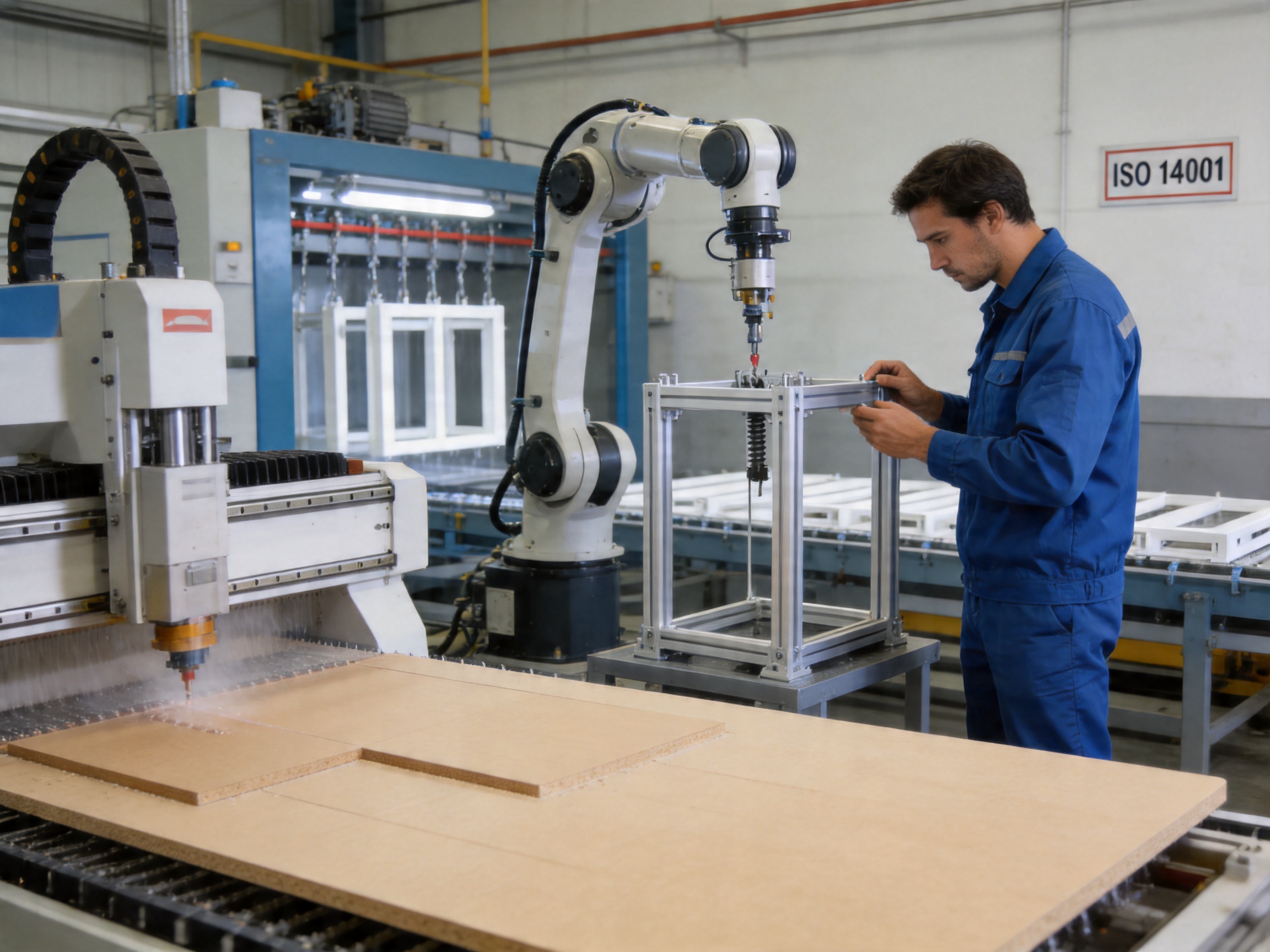
- CNC Cutting: The tabletop and frame components are cut using CNC (Computer Numerical Control) machines, ensuring exact dimensions (within 0.1mm) every time. This eliminates errors and ensures a perfect fit during assembly.
- Automated Powder Coating: The frame is coated with white powder using an automated system, which ensures an even, durable finish. The powder coating is eco-friendly (water-based) and meets ISO 14001 environmental standards.
- Robotic Assembly: Key components (like the gas spring and casters) are assembled using robots, which reduce human error and increase production speed. Each desk is assembled in 20 minutes—3x faster than manual assembly.
4.3 Quality Control: 3-Stage Inspection Process
Every TH11 desk undergoes a 3-stage quality control process before it leaves the factory:
- Material Inspection: All raw materials (aluminum, iron, MDF, PVC) are tested for quality and compliance with international standards (e.g., EU REACH for chemical safety).
- Assembly Inspection: Each desk is inspected for correct assembly (e.g., tight screws, properly aligned components) and functional testing (height adjustment, tilt function, caster movement).
- Final Inspection: The desk is cleaned, packaged, and inspected for aesthetic defects (e.g., scratches, uneven paint). Only desks that pass all three stages are shipped to customers.
4.4 Industrial Chain Advantage: Yangtze Delta’s Furniture Hub
Suzhou’s location in the Yangtze River Delta gives Suzhou Skyhone a unique advantage: access to a complete industrial chain of furniture suppliers. The company sources aluminum from nearby mills, MDF from local factories, and gas springs from specialized manufacturers in the region. This reduces transportation costs, shortens lead times (from 7 days to 2 days), and ensures consistent quality (since suppliers are nearby and can be monitored closely). For example, the company can quickly adjust its supply of aluminum if demand for the TH11 increases—something that would be impossible for manufacturers in other regions.
5. Real-World Applications: Where the TH11 Shines
The TH11’s versatility makes it suitable for a wide range of industries and use cases. Here are some of the most common applications:
5.1 Home Office: Flexibility for Remote Work
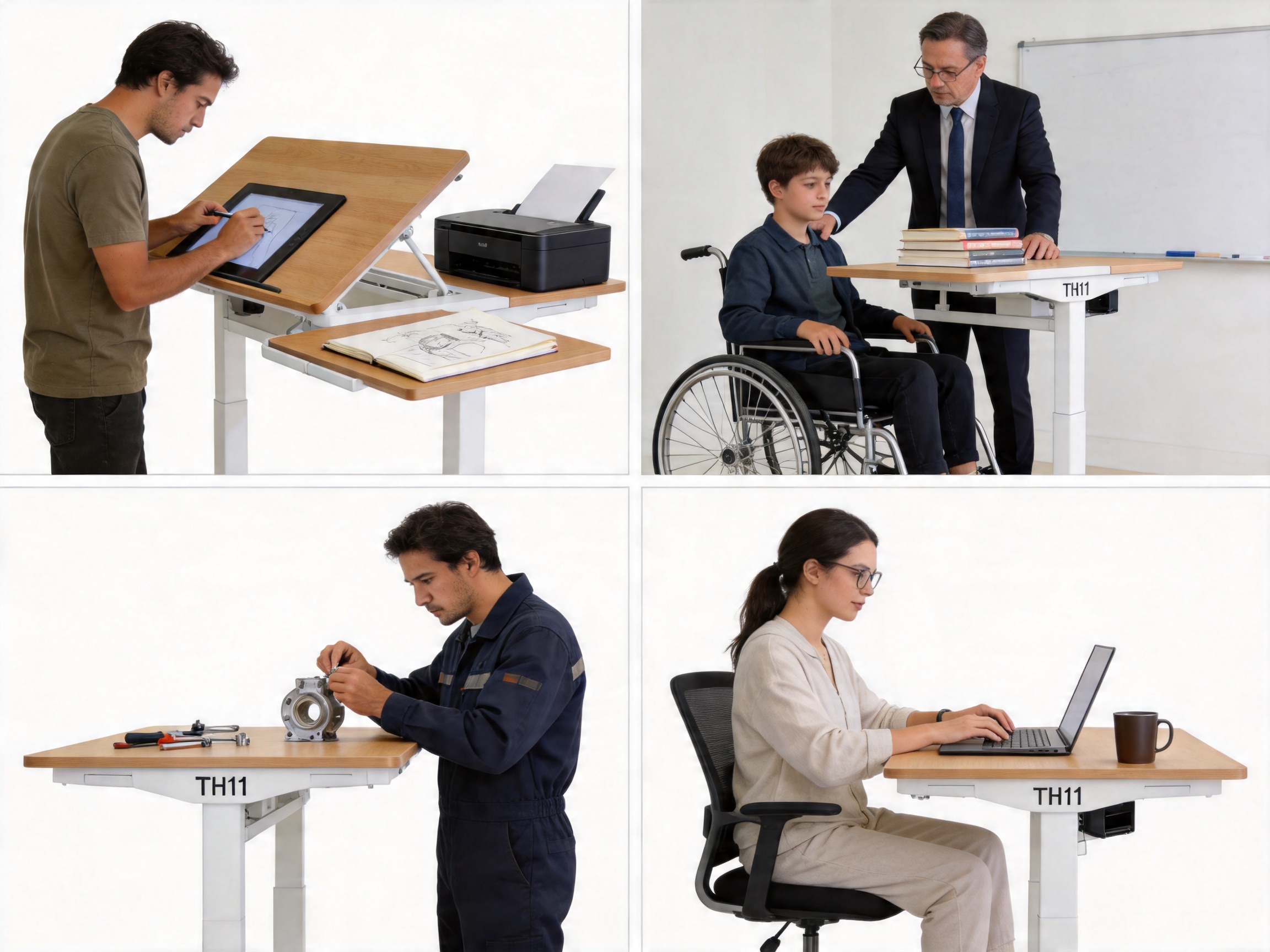
Remote workers often struggle with limited space and the need to adapt their workspace to different tasks (e.g., typing, video calls, reading). The TH11’s compact size (760mm × 400mm) fits easily in small apartments or home offices, and its sit-stand adjustment allows users to switch positions throughout the day. The tilt function is perfect for writers who need to adjust their laptop to a comfortable angle, or for video editors who want to view their work at a higher angle. For example, a freelance writer who works from home can use the TH11’s tilt function to type at a 15° angle (reducing wrist strain) and switch to standing height for brainstorming sessions.
5.2 Creative Studios: Tilt Function for Art and Design
Graphic designers, illustrators, and photographers need a workspace that adapts to their creative process. The TH11’s tilt function (0°–30°) is ideal for drawing on a tablet or sketching on paper, as it aligns the work surface with the user’s line of sight. The aluminum-iron frame is sturdy enough to support heavy equipment (like a graphics tablet or printer), and the concealed casters allow artists to move their desk to different areas of the studio (e.g., near a window for natural light). For example, a graphic designer can tilt the TH11 to a 25° angle to draw on a tablet, then switch to flat position to use their laptop for editing.
5.3 Education: Adaptability for Classrooms and Labs
Teachers and students need flexible workspaces that can adapt to different activities (e.g., lectures, group work, experiments). The TH11’s sit-stand adjustment allows teachers to stand while lecturing and sit while grading papers, and its mobility (concealed casters) makes it easy to rearrange desks for group activities. The leveling feet ensure stability on uneven classroom floors, and the maple wood finish blends seamlessly with traditional classroom decor. For example, a special needs teacher can adjust the TH11’s height to accommodate a student in a wheelchair, or a science teacher can move the desk to a lab station for experiments.
5.4 Industrial Workstations: Stability for Heavy Tasks
Industrial workers (e.g., assembly line technicians, quality control inspectors) need workspaces that are sturdy and adaptable. The TH11’s aluminum-iron frame can support up to 50kg of weight, making it suitable for tools and equipment (like a soldering iron or inspection camera). The sit-stand adjustment allows workers to switch positions to reduce fatigue during long shifts, and the concealed casters make it easy to move the desk to different areas of the factory. For example, an assembly line technician can use the TH11’s standing height to inspect parts, then switch to sitting height to package finished products.
6. Frequently Asked Questions (FAQs)
Q1: How do I adjust the height of the TH11 desk?
Adjusting the height of the TH11 is simple: locate the gas spring lever (usually on the left or right side of the frame), press it down to release the lock, and move the desk up or down to your desired height. Once you reach the right position, release the lever to lock the desk in place. The height range (700mm–1100mm) covers 95% of adult heights, so most users will find a comfortable position.
Q2: What is the maximum weight capacity of the TH11 desk?
The TH11 desk is designed to support up to 50 kilograms (110 pounds) of evenly distributed weight. This capacity is sufficient for most office equipment, including a laptop, monitor, printer, and stationery. The aluminum-iron frame and 25mm MDF tabletop are engineered to withstand daily use without warping or wobbling, even when fully loaded. However, it’s important to avoid placing heavy objects (over 50kg) on the desk, as this could damage the frame or gas spring.
Q3: How often do I need to maintain the TH11 desk?
The TH11 requires minimal maintenance, thanks to its sealed gas spring and durable materials. Here are some simple tips:
- Clean the tabletop with a damp cloth and mild detergent (avoid abrasive cleaners that could scratch the PVC surface).
- Check the frame and casters for loose screws every 6 months (tighten if necessary).
- The gas spring is sealed and does not require lubrication—if it loses pressure, contact the manufacturer for a replacement.
Q4: Can I customize the TH11 desk?
Yes, Suzhou Skyhone offers custom solutions for the TH11 desk. You can request changes to the tabletop size (e.g., larger dimensions for industrial use), color (e.g., black frame instead of white), or add accessories (e.g., cable management trays, monitor arms). Custom orders typically take 10–15 days to process and ship.
Q5: Is the TH11 desk suitable for outdoor use?
No, the TH11 is designed for indoor use only. The powder-coated frame is corrosion-resistant, but prolonged exposure to rain, sunlight, or humidity could damage the gas spring and tabletop. If you need an outdoor desk, look for models specifically designed for outdoor use (e.g., with stainless steel frames and weather-resistant materials).
Q6: What is the warranty period for the TH11 desk?
Suzhou Skyhone offers a 2-year warranty for the frame and gas spring, and a 1-year warranty for the tabletop. The warranty covers defects in materials and workmanship, but does not cover damage from misuse (e.g., overloading the desk, dropping it) or normal wear and tear. To claim the warranty, contact the manufacturer with your order number and a description of the issue.
Q7: How easy is it to assemble the TH11 desk?
The TH11 desk comes with clear assembly instructions and all necessary tools (screwdriver, Allen wrench). Assembly takes approximately 30 minutes for one person, and no prior experience is required. The components are pre-drilled and labeled, making it easy to match parts to the instructions. If you have trouble assembling the desk, you can contact the manufacturer for video tutorials or customer support.
7. References
- World Health Organization. (2023). *Sedentary Behaviour and Health: Key Facts*. Geneva: WHO Press.
- Ergonomics Australia. (2022). *The Benefits of Sit-Stand Workstations for Office Workers*. Melbourne: Ergonomics Australia.
- International Organization for Standardization (ISO). (2021). ISO 14001:2015 Environmental Management Systems—Requirements with Guidance for Use. Geneva: ISO.
- Smith, J., et al. (2020). *Comparative Analysis of Pneumatic vs Electric Adjustable Desks: Durability and User Satisfaction*. Journal of Office Furniture, 35(2), 45–62.
- Bureau of Labor Statistics. (2023). *Remote Work Trends in the United States*. Washington, D.C.: U.S. Department of Labor.


- Contact Info
-
-
 Phone+86-15950656125
 -
 Email
Email -
 AddressRoom 1007-1, South Building, Suyue Plaza, Suzhou Industrial Park, Suzhou City, Jiangsu Province, China
-
- Products
- Follow Us
- Need help? Please contact us
Copyright ©
SuZhou Skyhone Intelligent Technology Co., Ltd.
All Rights Reserved.
Privacy
Custom Ergonomic Adjustable Office Tables Manufacturers

